
Dynamics in the Microbial Transformation of Organic C
Dynamics in the Microbial Transformation of Organic C in Soil Jinshui Wu Institute of Subtropical Agriculture, the Chinese Academy of Sciences
Outlines l Concepts of soil microbial biomass and soil organic C transformations l Methodology for quantifying soil microbial biomass l Case studies on dynamics in the microbial transformations of organic C in soil
Outlines l Concepts of soil microbial biomass and soil organic C transformations l Methodology for quantifying soil microbial biomass l Case studies on dynamics in the microbial transformations of organic C in soil
Biogeochemical functions of the soil microbial community OC (N/P/S) Microbial CO 2/CH 4/Nx. O… HM/Minerals Community 土壤生物
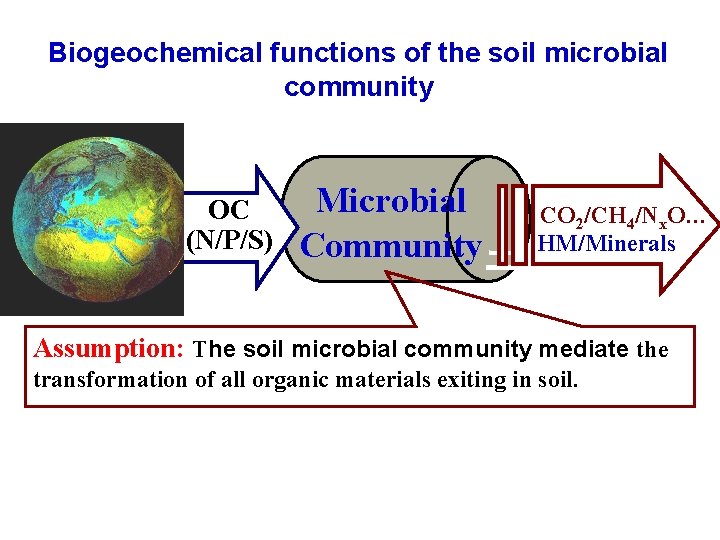
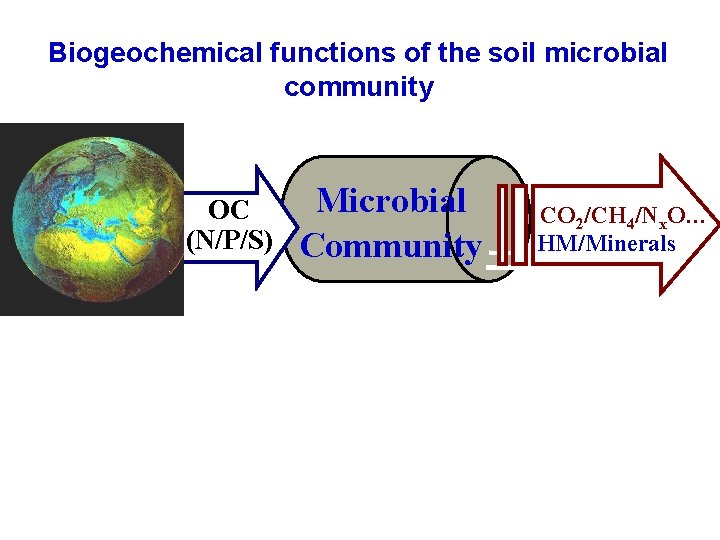
Biogeochemical functions of the soil microbial community OC (N/P/S) Microbial CO 2/CH 4/Nx. O… HM/Minerals Community 土壤生物 Assumption: The soil microbial community mediate the transformation of all organic materials exiting in soil.
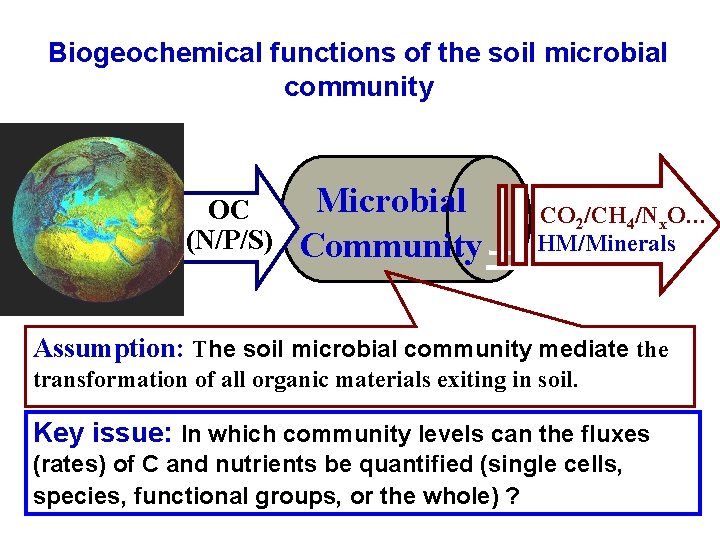
Biogeochemical functions of the soil microbial community OC (N/P/S) Microbial CO 2/CH 4/Nx. O… HM/Minerals Community 土壤生物 Assumption: The soil microbial community mediate the transformation of all organic materials exiting in soil. Key issue: In which community levels can the fluxes (rates) of C and nutrients be quantified (single cells, species, functional groups, or the whole) ?
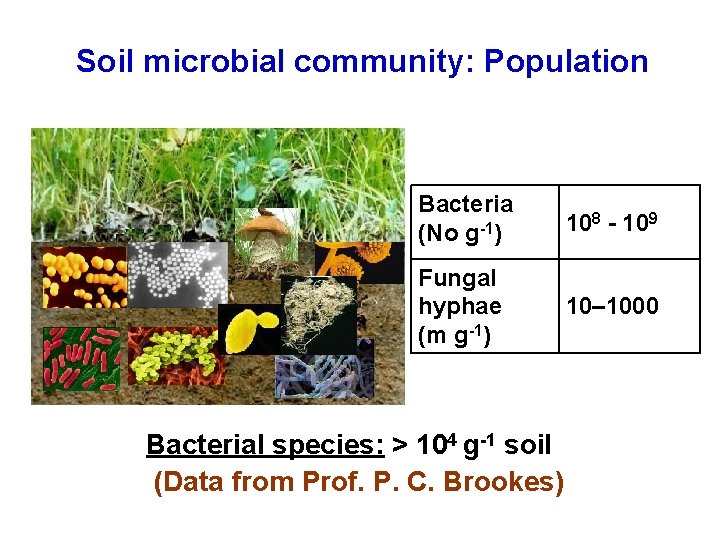
Soil microbial community: Population Bacteria (No g-1) 108 - 109 Fungal hyphae (m g-1) 10– 1000 Bacterial species: > 104 g-1 soil (Data from Prof. P. C. Brookes)
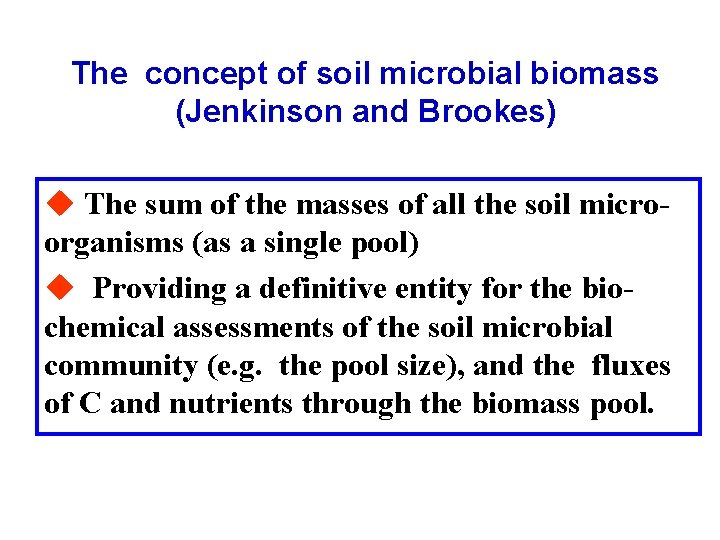
The concept of soil microbial biomass (Jenkinson and Brookes) u The sum of the masses of all the soil microorganisms (as a single pool) u Providing a definitive entity for the biochemical assessments of the soil microbial community (e. g. the pool size), and the fluxes of C and nutrients through the biomass pool.
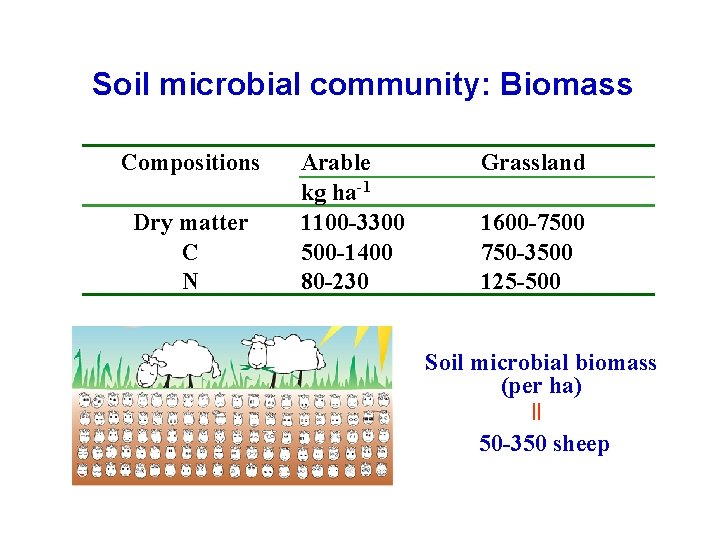
Soil microbial community: Biomass Compositions Dry matter C N Arable kg ha-1 1100 -3300 500 -1400 80 -230 Grassland 1600 -7500 750 -3500 125 -500 Soil microbial biomass (per ha) = 50 -350 sheep
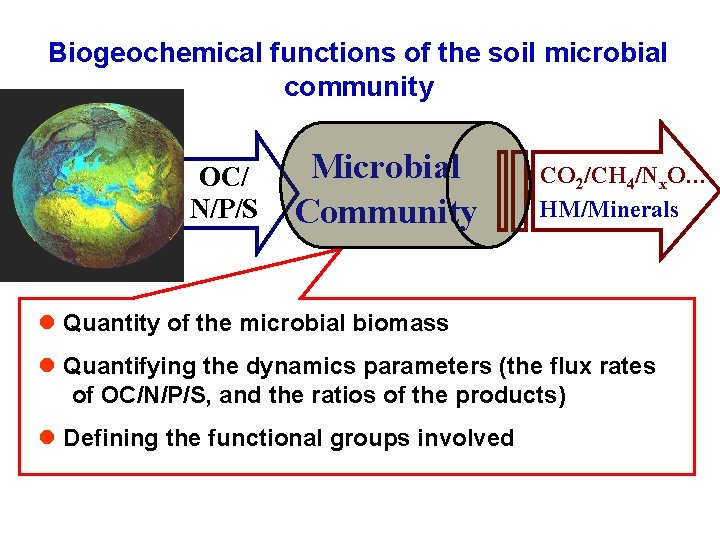
Biogeochemical functions of the soil microbial community OC/ N/P/S Microbial CO 2/CH 4/Nx. O… HM/Minerals Community 土壤生物 l Quantity of the microbial biomass l Quantifying the dynamics parameters (the flux rates of OC/N/P/S, and the ratios of the products) l Defining the functional groups involved
Outlines l Concepts of soil microbial biomass and soil organic C transformations l Methodology for quantifying soil microbial biomass l Case studies on dynamics in the microbial transformations of organic C in soil

The fumigation-extraction method ● Lyses > 95% cells. ● Does not alter the solubility and mineralizing activity of organic materials. Powlson & Jenkinson (1976), SBB
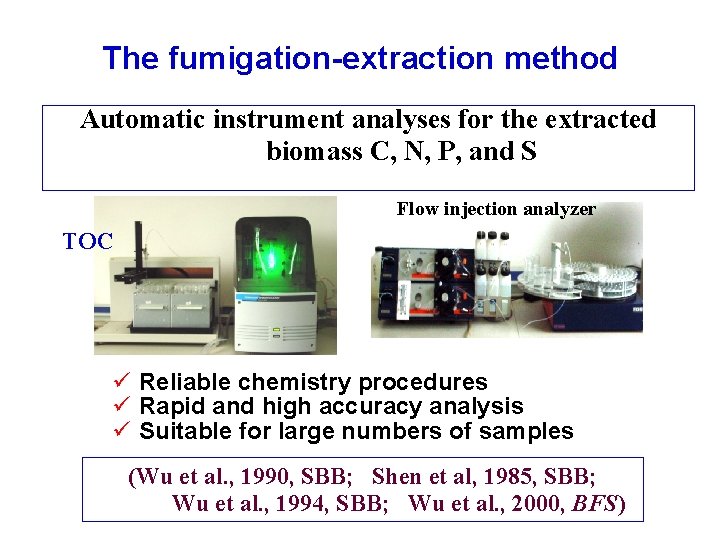
The fumigation-extraction method Automatic instrument analyses for the extracted biomass C, N, P, and S Flow injection analyzer TOC ü Reliable chemistry procedures ü Rapid and high accuracy analysis ü Suitable for large numbers of samples (Wu et al. , 1990, SBB; Shen et al, 1985, SBB; Wu et al. , 1994, SBB; Wu et al. , 2000, BFS)
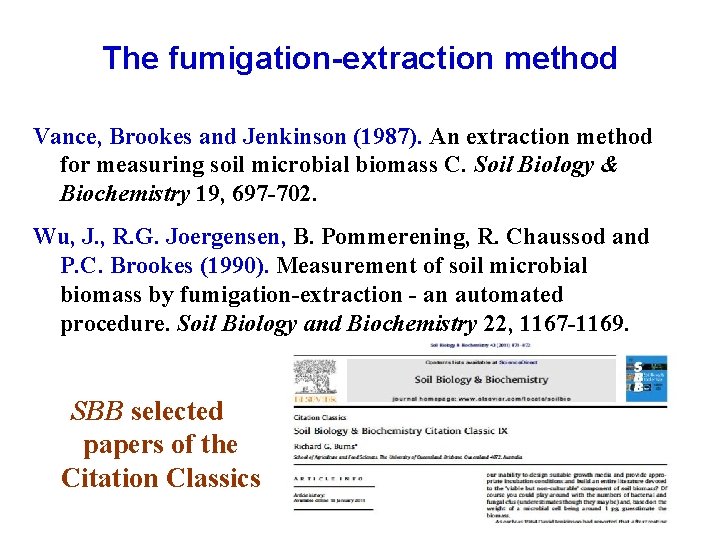
The fumigation-extraction method Vance, Brookes and Jenkinson (1987). An extraction method for measuring soil microbial biomass C. Soil Biology & Biochemistry 19, 697 -702. Wu, J. , R. G. Joergensen, B. Pommerening, R. Chaussod and P. C. Brookes (1990). Measurement of soil microbial biomass by fumigation-extraction - an automated procedure. Soil Biology and Biochemistry 22, 1167 -1169. SBB selected papers of the Citation Classics
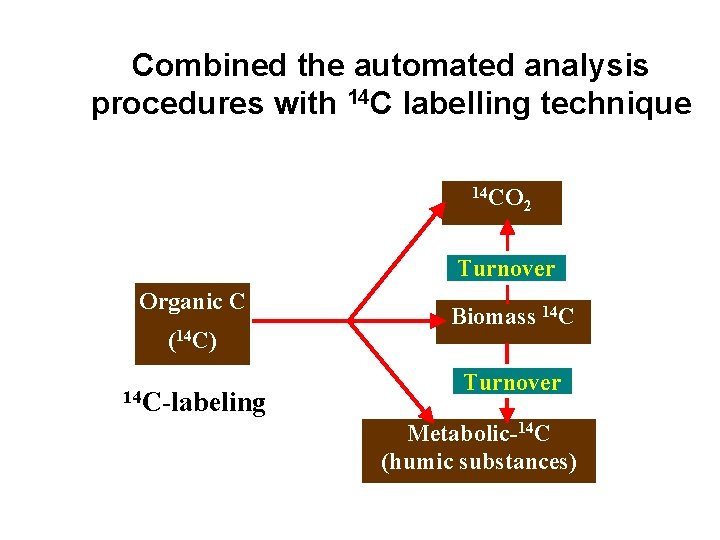
Combined the automated analysis procedures with 14 C labelling technique 14 CO 2 Turnover Organic C (14 C) 14 C-labeling Biomass 14 C Turnover Metabolic-14 C (humic substances)
Outlines l Concepts of soil microbial biomass and soil organic C transformations l Methodology for quantifying soil microbial biomass l Case studies on dynamics in the microbial transformations of organic C in soil
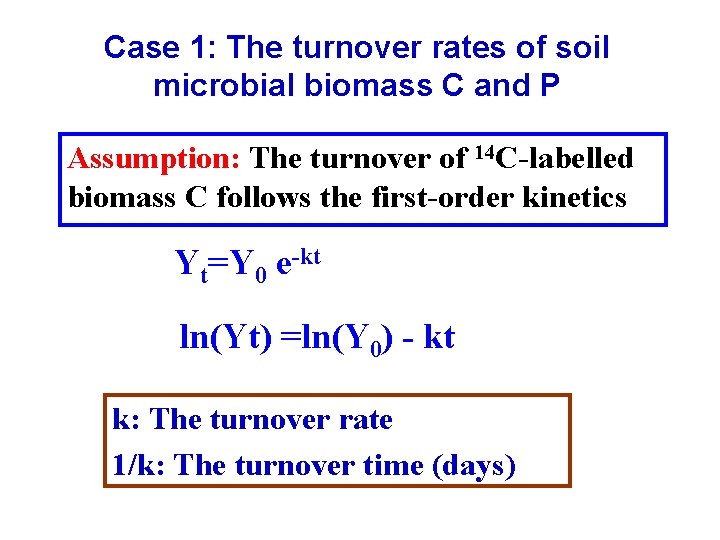
Case 1: The turnover rates of soil microbial biomass C and P Assumption: The turnover of 14 C-labelled biomass C follows the first-order kinetics Yt=Y 0 e-kt ln(Yt) =ln(Y 0) - kt k: The turnover rate 1/k: The turnover time (days)
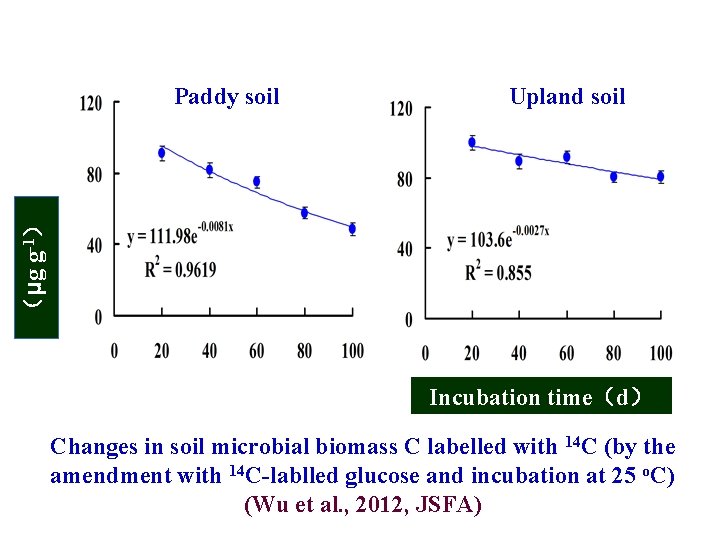
Upland soil (μg g-1) Paddy soil Incubation time(d) Changes in soil microbial biomass C labelled with 14 C (by the amendment with 14 C-lablled glucose and incubation at 25 o. C) (Wu et al. , 2012, JSFA)
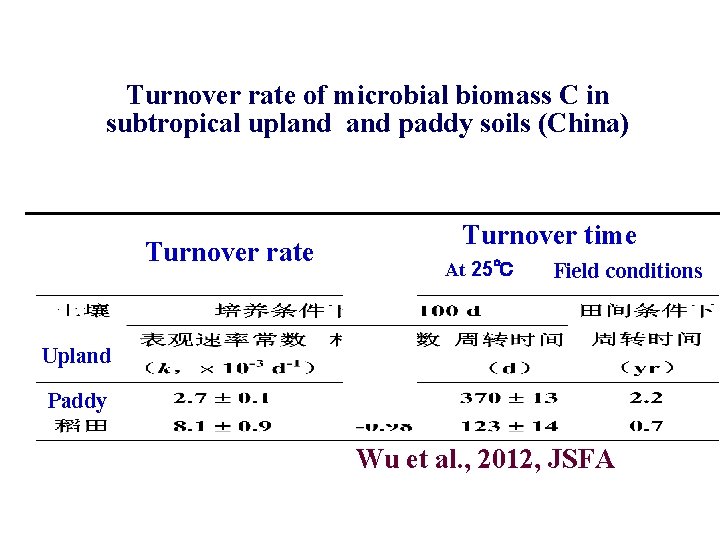
Turnover rate of microbial biomass C in subtropical upland paddy soils (China) Site 1 Turnover rate Turnover time At 25℃ Field conditions Upland Paddy Wu et al. , 2012, JSFA
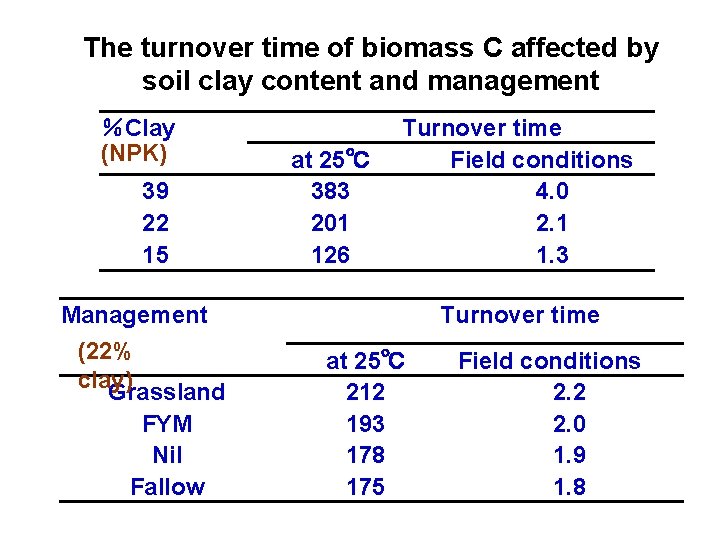
The turnover time of biomass C affected by soil clay content and management %Clay (NPK) 39 22 15 at 25℃ 383 201 126 Turnover time Field conditions 4. 0 2. 1 1. 3 Management (22% clay) Grassland FYM Nil Fallow Turnover time at 25℃ 212 193 178 175 Field conditions 2. 2 2. 0 1. 9 1. 8
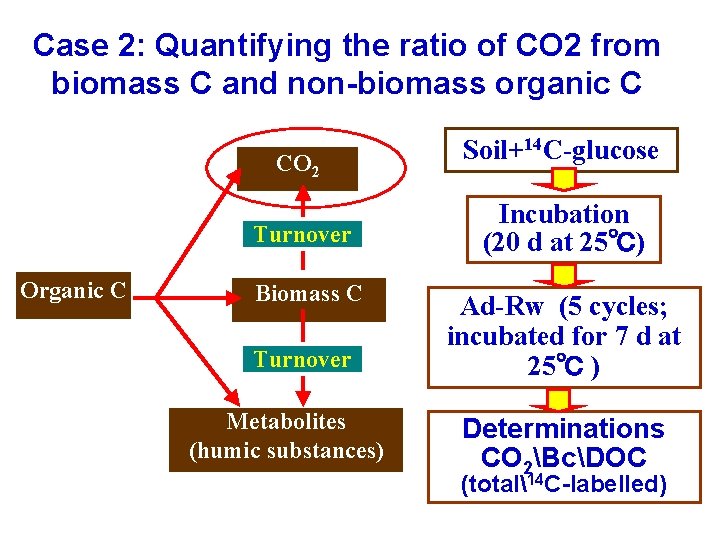
Case 2: Quantifying the ratio of CO 2 from biomass C and non-biomass organic C CO 2 Turnover Organic C Biomass C Turnover Metabolites (humic substances) Soil+14 C-glucose Incubation (20 d at 25℃) Ad-Rw (5 cycles; incubated for 7 d at 25℃ ) Determinations CO 2BcDOC (total14 C-labelled)
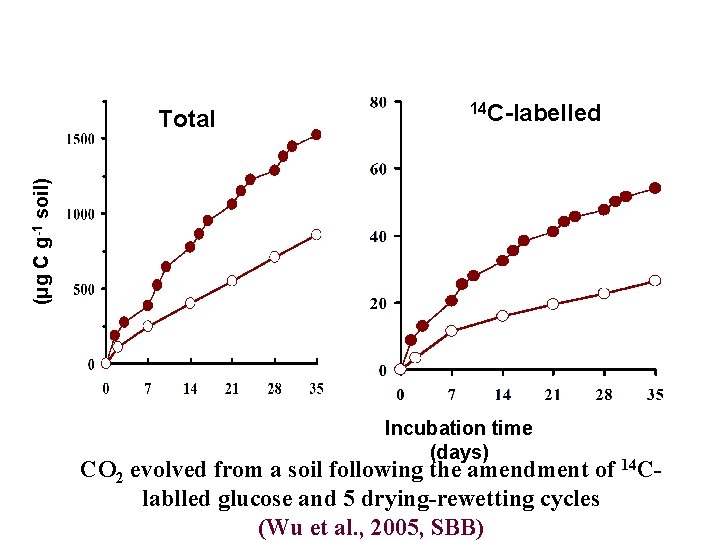
14 C-labelled (μg C g-1 soil) Total Incubation time (days) CO 2 evolved from a soil following the amendment of 14 Clablled glucose and 5 drying-rewetting cycles (Wu et al. , 2005, SBB)
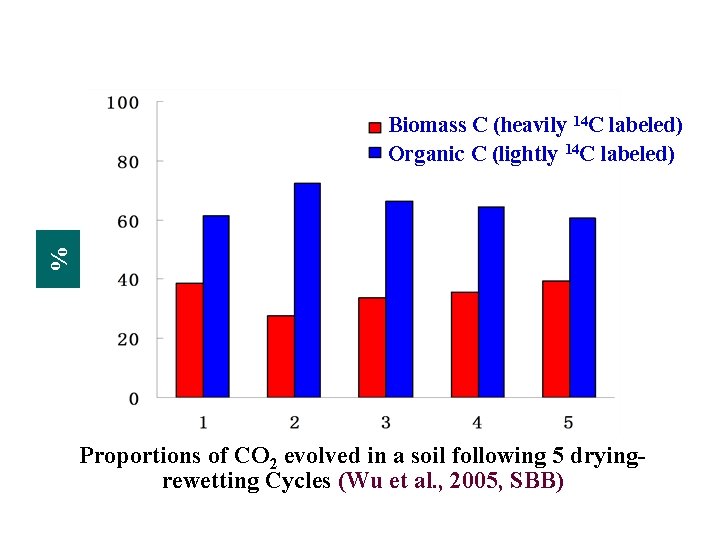
% Biomass C (heavily 14 C labeled) Organic C (lightly 14 C labeled) Proportions of CO 2 evolved in a soil following 5 dryingrewetting Cycles (Wu et al. , 2005, SBB)
Case 3: The mechanisms of “priming effect” Priming effects: Responses of the mineralization of soil organic C following the inputs of fresh organic materials.
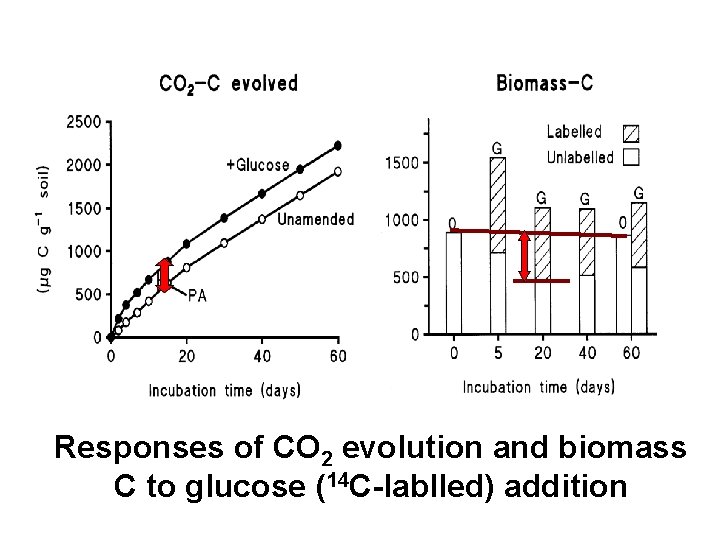
Responses of CO 2 evolution and biomass C to glucose (14 C-lablled) addition
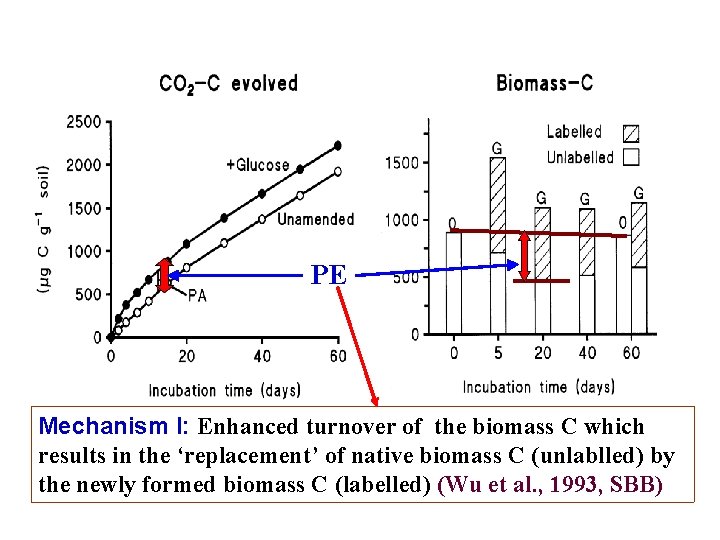
PE Mechanism I: Enhanced turnover of the biomass C which results in the ‘replacement’ of native biomass C (unlablled) by the newly formed biomass C (labelled) (Wu et al. , 1993, SBB)
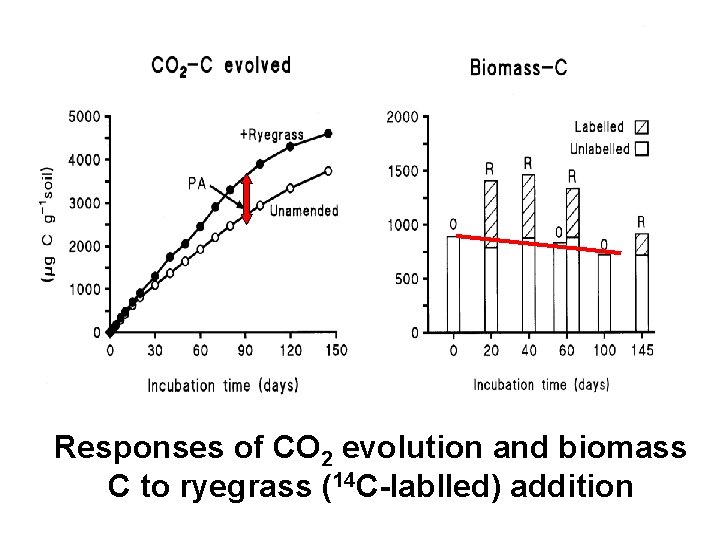
Responses of CO 2 evolution and biomass C to ryegrass (14 C-lablled) addition
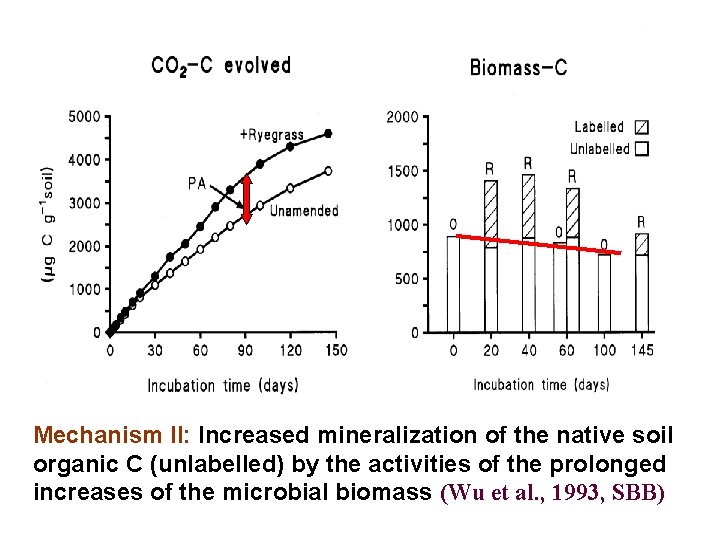
Mechanism II: Increased mineralization of the native soil organic C (unlabelled) by the activities of the prolonged increases of the microbial biomass (Wu et al. , 1993, SBB)
Case 4: Quantifying the assimilation of atmospheric CO 2 by autotrophic microorganisms in soils
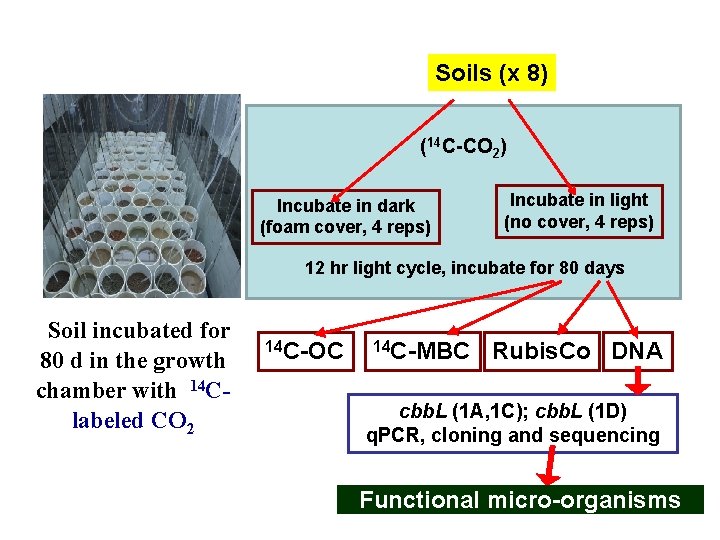
Soils (x 8) (14 C-CO 2) Incubate in dark (foam cover, 4 reps) Incubate in light (no cover, 4 reps) 12 hr light cycle, incubate for 80 days Soil incubated for 80 d in the growth chamber with 14 Clabeled CO 2 14 C-OC 14 C-MBC Rubis. Co DNA cbb. L (1 A, 1 C); cbb. L (1 D) q. PCR, cloning and sequencing Functional micro-organisms
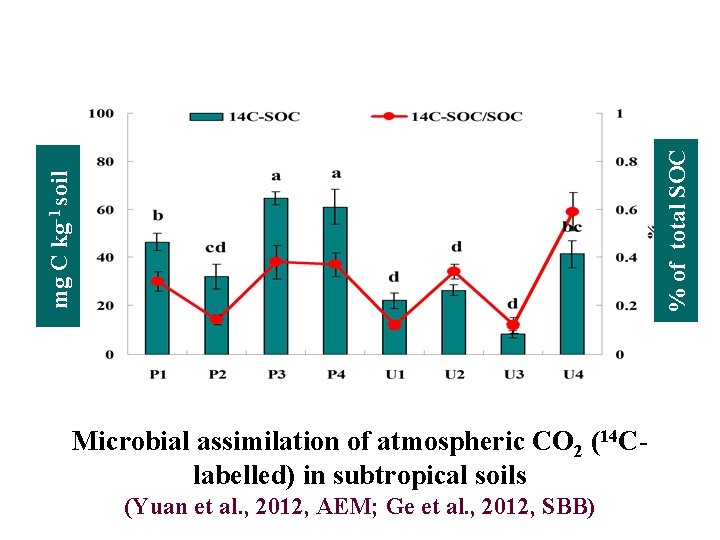
% of total SOC mg C kg-1 soil Microbial assimilation of atmospheric CO 2 (14 Clabelled) in subtropical soils (Yuan et al. , 2012, AEM; Ge et al. , 2012, SBB)
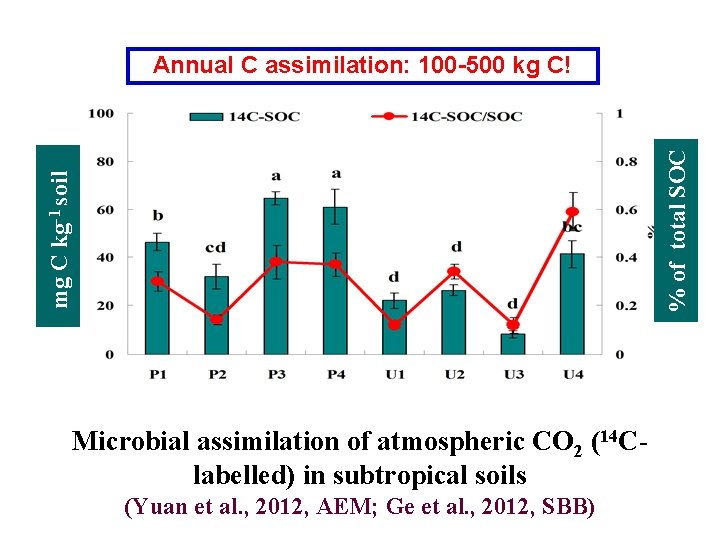
mg C kg-1 soil % of total SOC Annual C assimilation: 100 -500 kg C! Microbial assimilation of atmospheric CO 2 (14 Clabelled) in subtropical soils (Yuan et al. , 2012, AEM; Ge et al. , 2012, SBB)
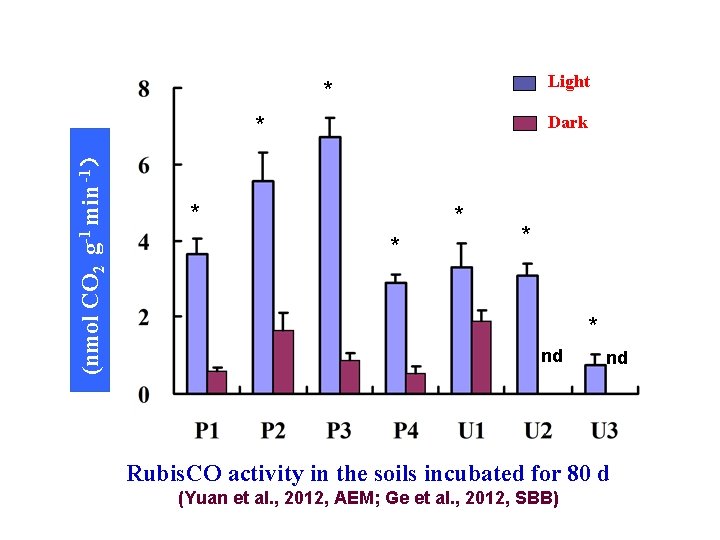
Light * (nmol CO 2 g-1 min -1) * Dark * * * nd nd Rubis. CO activity in the soils incubated for 80 d (Yuan et al. , 2012, AEM; Ge et al. , 2012, SBB)
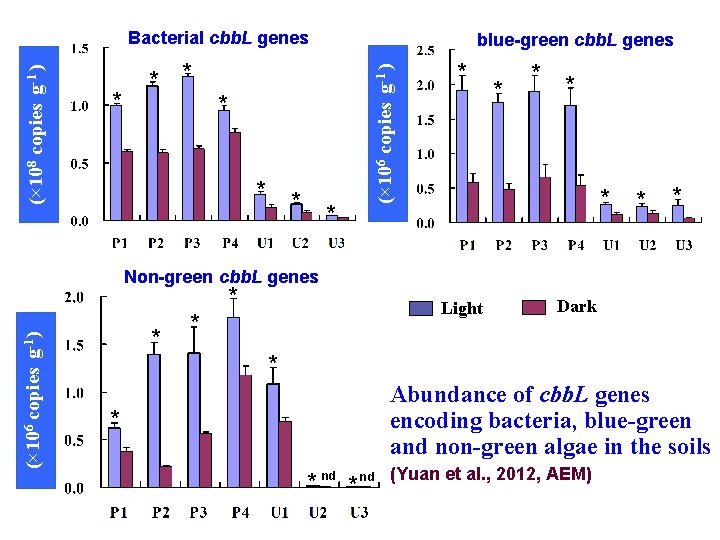
* * blue-green cbb. L genes * * * (× 106 copies g-1 ) (× 108 copies g-1 ) Bacterial cbb. L genes * * * * (× 106 copies g-1) Non-green cbb. L genes * * * Light Dark * Abundance of cbb. L genes encoding bacteria, blue-green and non-green algae in the soils * * nd (Yuan et al. , 2012, AEM)
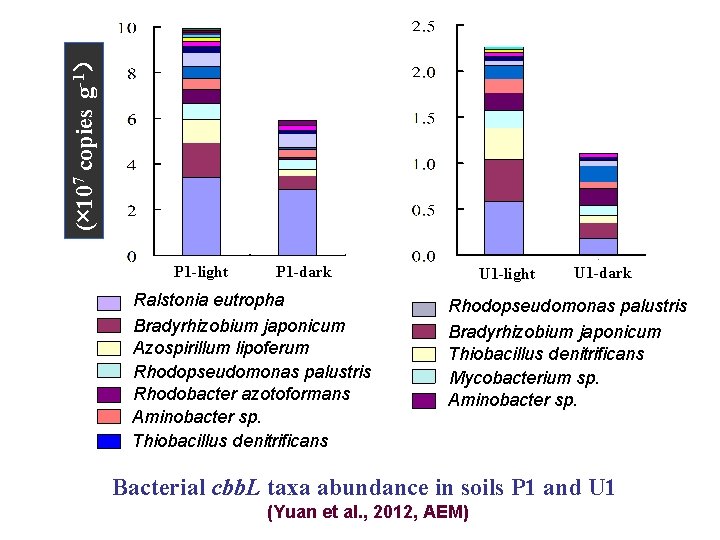
(× 107 copies g-1) P 1 -light P 1 -dark Ralstonia eutropha Bradyrhizobium japonicum Azospirillum lipoferum Rhodopseudomonas palustris Rhodobacter azotoformans Aminobacter sp. Thiobacillus denitrificans U 1 -light U 1 -dark Rhodopseudomonas palustris Bradyrhizobium japonicum Thiobacillus denitrificans Mycobacterium sp. Aminobacter sp. Bacterial cbb. L taxa abundance in soils P 1 and U 1 (Yuan et al. , 2012, AEM)
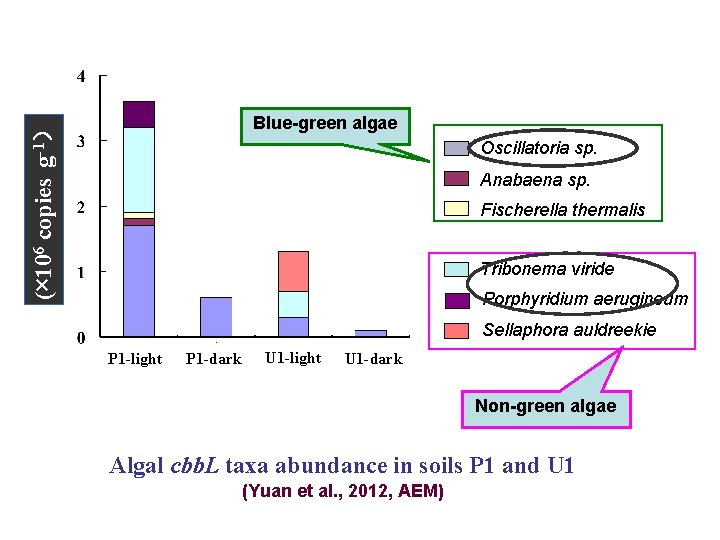
(× 106 copies g-1) Blue-green algae Oscillatoria sp. Anabaena sp. Fischerella thermalis Tribonema viride Porphyridium aerugineum Sellaphora auldreekie P 1 -light P 1 -dark U 1 -light U 1 -dark Non-green algae Algal cbb. L taxa abundance in soils P 1 and U 1 (Yuan et al. , 2012, AEM)

Thank for Your Attention !
- Slides: 37