
Dynamics Dynamics Glossary Slide 3 4 Scalar and
- Slides: 20
Dynamics
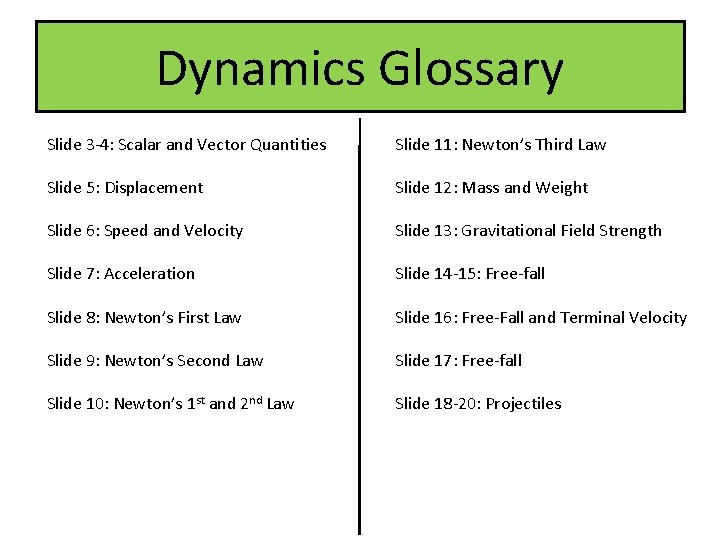
Dynamics Glossary Slide 3 -4: Scalar and Vector Quantities Slide 11: Newton’s Third Law Slide 5: Displacement Slide 12: Mass and Weight Slide 6: Speed and Velocity Slide 13: Gravitational Field Strength Slide 7: Acceleration Slide 14 -15: Free-fall Slide 8: Newton’s First Law Slide 16: Free-Fall and Terminal Velocity Slide 9: Newton’s Second Law Slide 17: Free-fall Slide 10: Newton’s 1 st and 2 nd Law Slide 18 -20: Projectiles
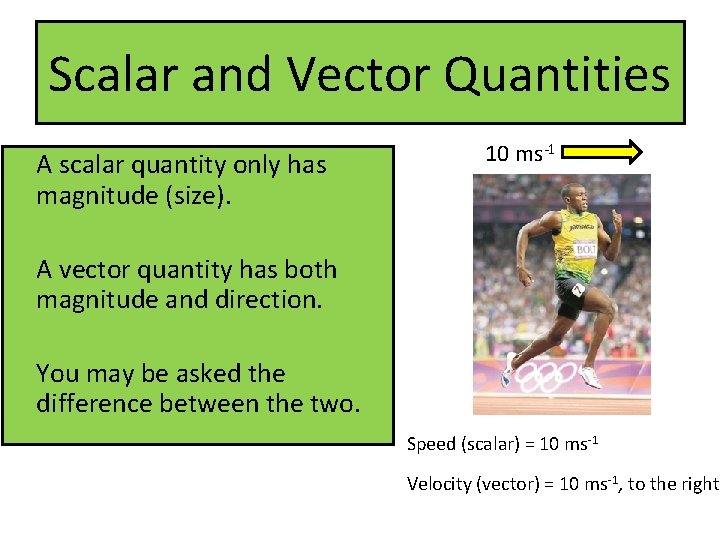
Scalar and Vector Quantities A scalar quantity only has magnitude (size). 10 ms-1 A vector quantity has both magnitude and direction. You may be asked the difference between the two. Speed (scalar) = 10 ms-1 Velocity (vector) = 10 ms-1, to the right
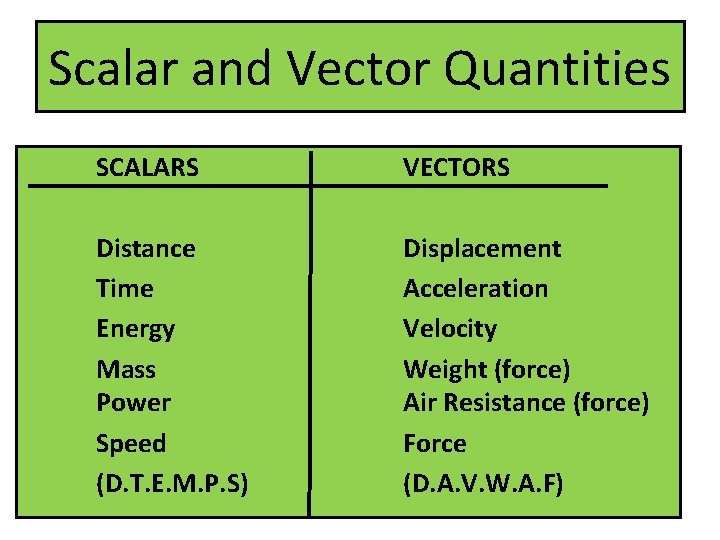
Scalar and Vector Quantities SCALARS VECTORS Distance Time Energy Mass Power Speed (D. T. E. M. P. S) Displacement Acceleration Velocity Weight (force) Air Resistance (force) Force (D. A. V. W. A. F)
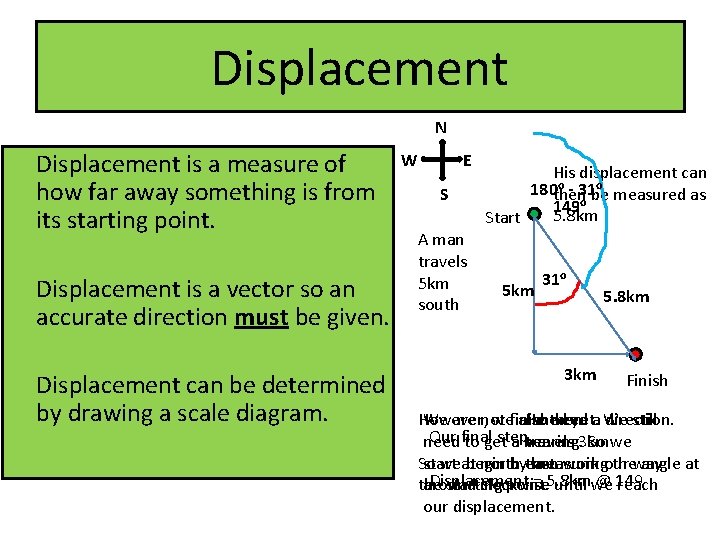
Displacement N Displacement is a measure of how far away something is from its starting point. Displacement is a vector so an accurate direction must be given. Displacement can be determined by drawing a scale diagram. W E S A man travels 5 km south His displacement can o - 31 o 180 then be measured as 149 o 5. 8 km Start 5 km 31 o 3 km 5. 8 km Finish We are not yet. a We still However, wefinished also He then need direction. Our final step, need to get a bearing. So we travels 3 km start north then work our So weat begin byeast measuring theway angle at Displacement = 5. 8 km @ 149 around clockwise until we reach the starting point. our displacement.
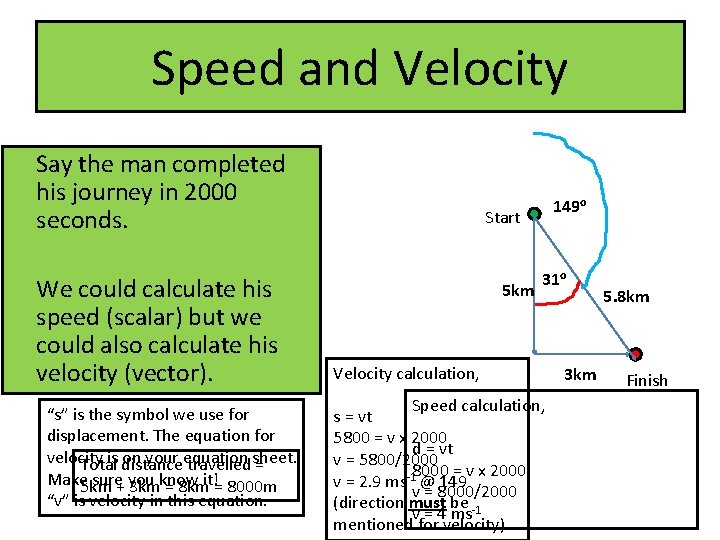
Speed and Velocity Say the man completed his journey in 2000 seconds. We could calculate his speed (scalar) but we could also calculate his velocity (vector). “s” is the symbol we use for displacement. The equation for velocity is distance on your equation Total travelled sheet. = Make 5 km sure+ you 3 kmknow = 8 kmit!= 8000 m “v” is velocity in this equation. 149 o Start 5 km 31 o Velocity calculation, Speed calculation, s = vt 5800 = v x 2000 d = vt v = 5800/2000 8000 = v x 2000 v = 2. 9 ms-1 @ 149 v = 8000/2000 (direction must be -1 v = 4 ms mentioned for velocity) 3 km 5. 8 km Finish
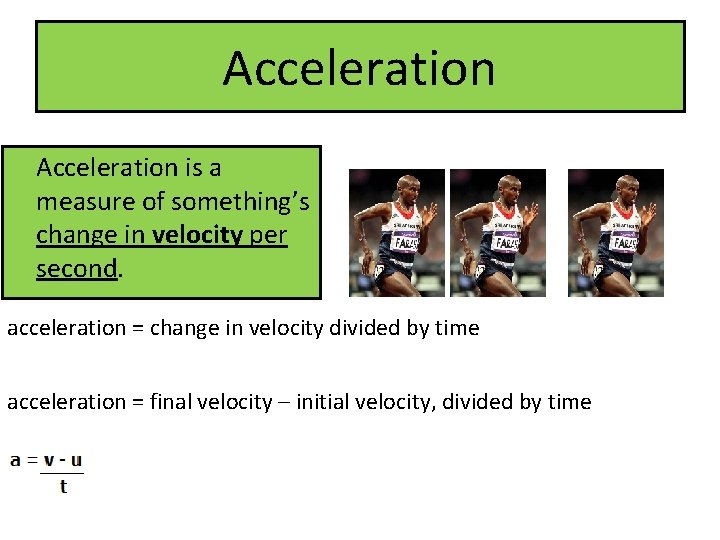
Acceleration is a measure of something’s change in velocity per second. acceleration = change in velocity divided by time acceleration = final velocity – initial velocity, divided by time
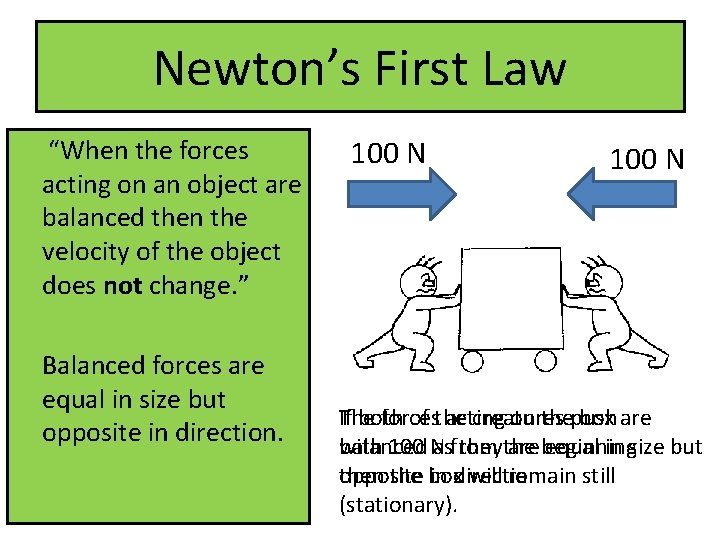
Newton’s First Law “When the forces acting on an object are balanced then the velocity of the object does not change. ” Balanced forces are equal in size but opposite in direction. 100 N The If both forces of the acting creatures on thepush box are balanced with 100 N asfrom they the are beginning equal in size but opposite then the box in direction. will remain still (stationary).
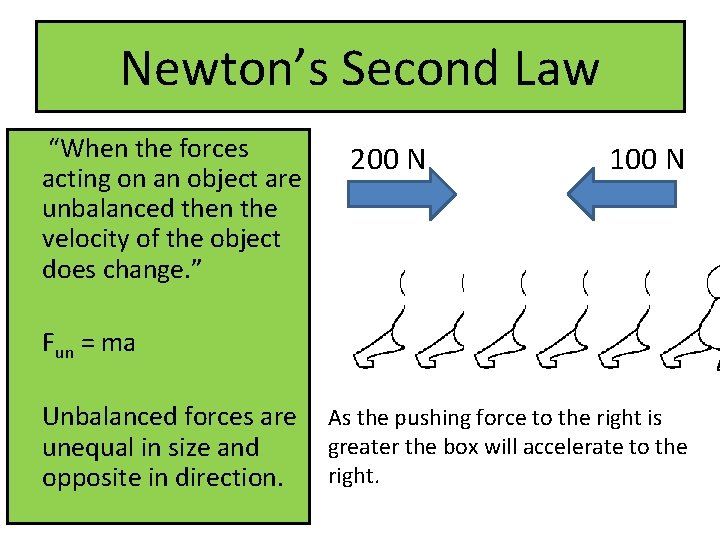
Newton’s Second Law “When the forces acting on an object are unbalanced then the velocity of the object does change. ” 200 N 100 N Fun = ma Unbalanced forces are unequal in size and opposite in direction. As the pushing force to the right is greater the box will accelerate to the right.
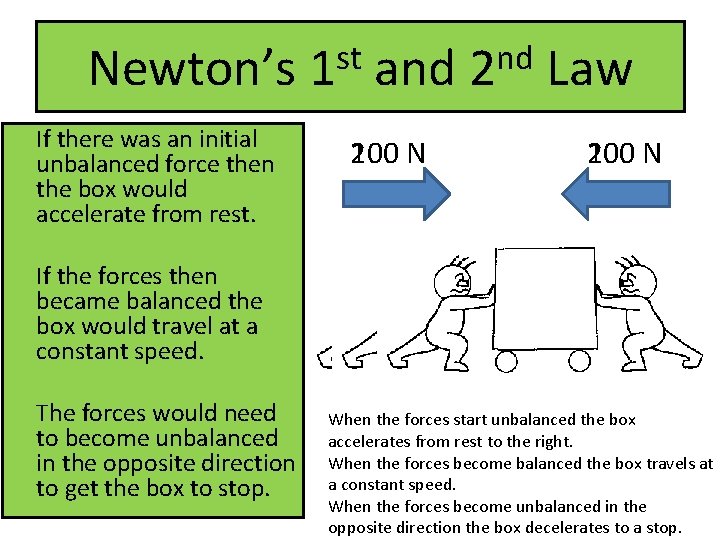
Newton’s If there was an initial unbalanced force then the box would accelerate from rest. st 1 and 200 N 100 nd 2 Law 100 N 200 If the forces then became balanced the box would travel at a constant speed. The forces would need to become unbalanced in the opposite direction to get the box to stop. When the forces start unbalanced the box accelerates from rest to the right. When the forces become balanced the box travels at a constant speed. When the forces become unbalanced in the opposite direction the box decelerates to a stop.
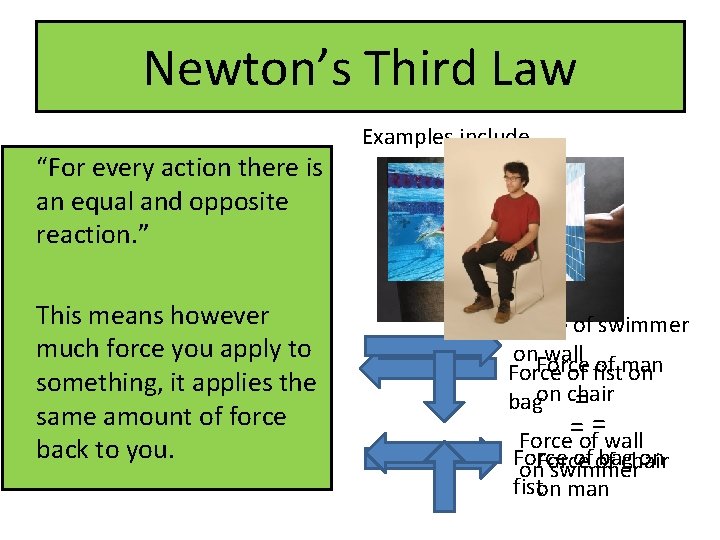
Newton’s Third Law “For every action there is an equal and opposite reaction. ” This means however much force you apply to something, it applies the same amount of force back to you. Examples include, Force of swimmer on. Force wall of man Force of fist on = bagon chair = = Force of wall Force of of bag on chair on. Force swimmer fiston man
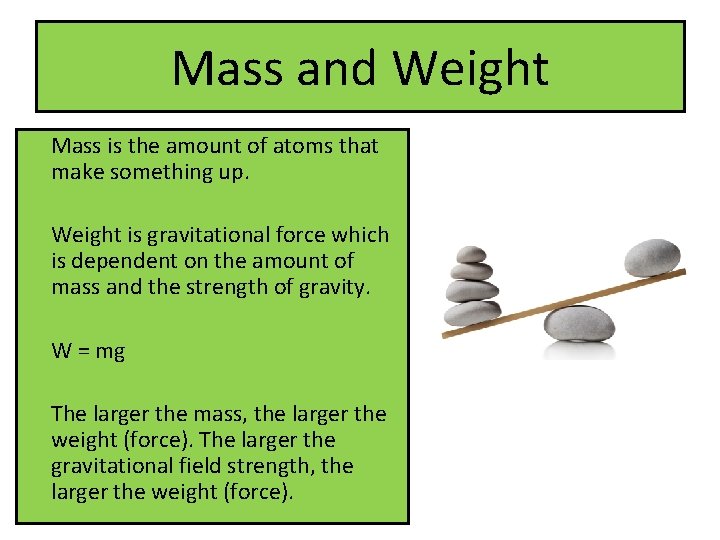
Mass and Weight Mass is the amount of atoms that make something up. Weight is gravitational force which is dependent on the amount of mass and the strength of gravity. W = mg The larger the mass, the larger the weight (force). The larger the gravitational field strength, the larger the weight (force).
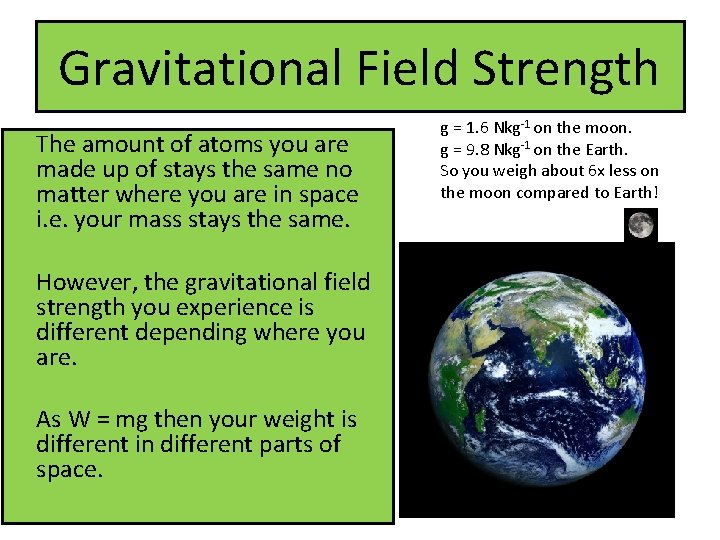
Gravitational Field Strength The amount of atoms you are made up of stays the same no matter where you are in space i. e. your mass stays the same. However, the gravitational field strength you experience is different depending where you are. As W = mg then your weight is different in different parts of space. g = 1. 6 Nkg-1 on the moon. g = 9. 8 Nkg-1 on the Earth. So you weigh about 6 x less on the moon compared to Earth!
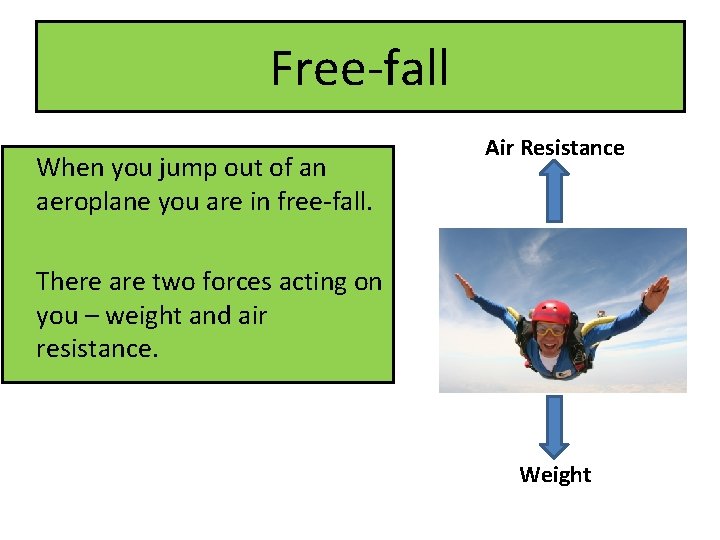
Free-fall When you jump out of an aeroplane you are in free-fall. Air Resistance There are two forces acting on you – weight and air resistance. Weight
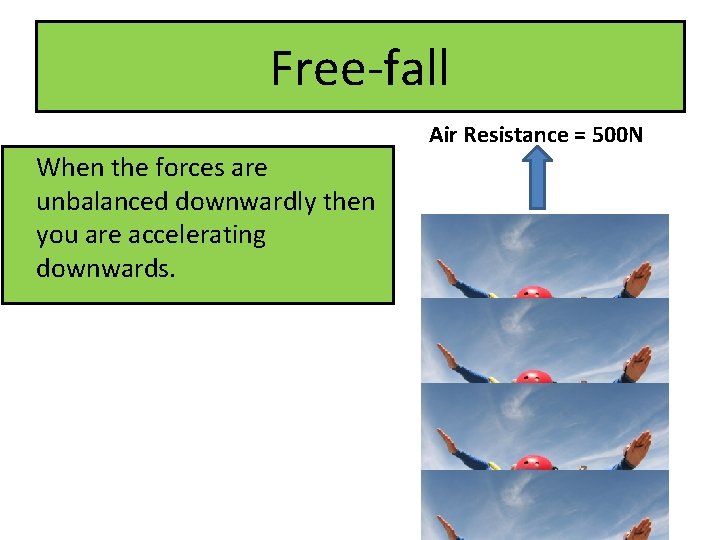
Free-fall Air Resistance = 500 N When the forces are unbalanced downwardly then you are accelerating downwards. Weight = 700 N
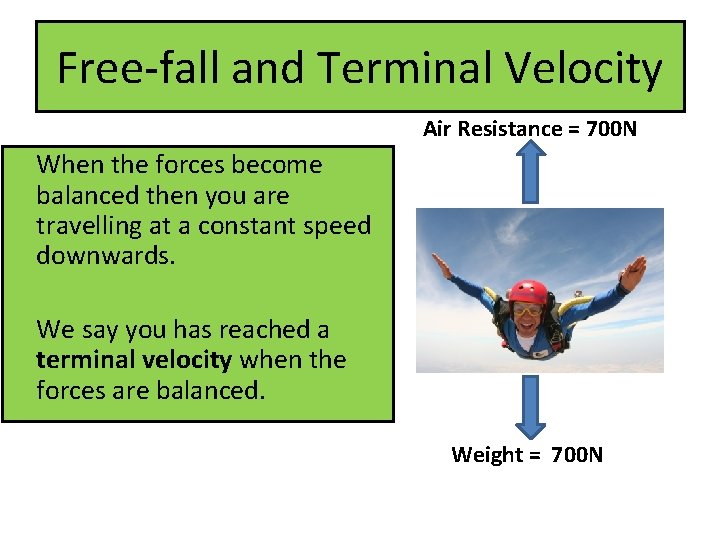
Free-fall and Terminal Velocity Air Resistance = 700 N When the forces become balanced then you are travelling at a constant speed downwards. We say you has reached a terminal velocity when the forces are balanced. Weight = 700 N
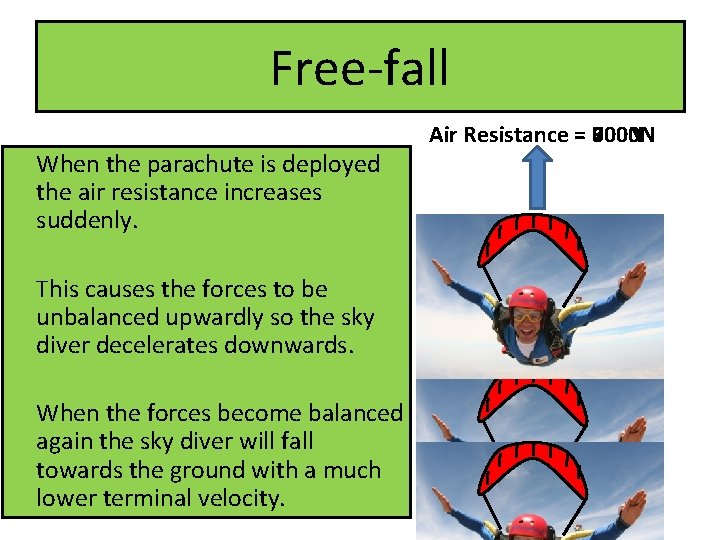
Free-fall When the parachute is deployed the air resistance increases suddenly. Air Resistance = 700 N 6000 N 3000 N 9000 N This causes the forces to be unbalanced upwardly so the sky diver decelerates downwards. When the forces become balanced again the sky diver will fall towards the ground with a much lower terminal velocity. Weight = 700 N
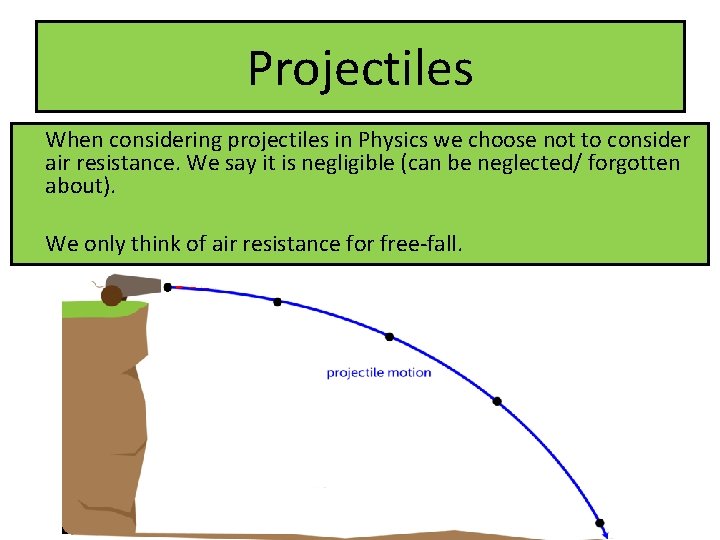
Projectiles When considering projectiles in Physics we choose not to consider air resistance. We say it is negligible (can be neglected/ forgotten about). We only think of air resistance for free-fall.
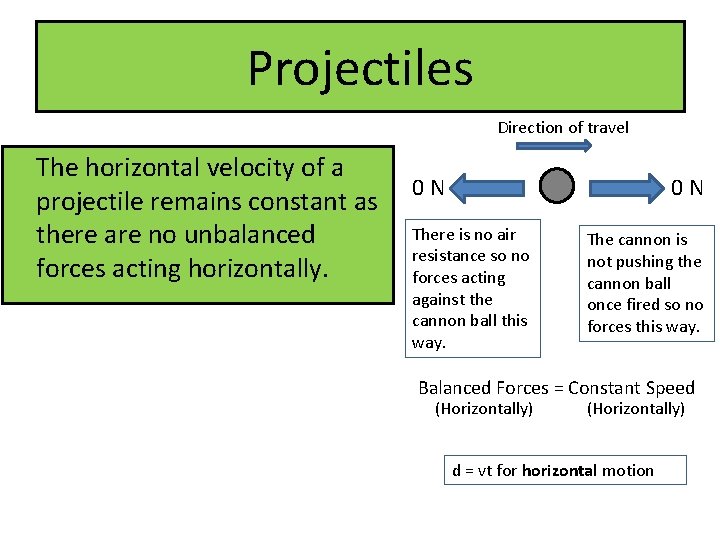
Projectiles Direction of travel The horizontal velocity of a projectile remains constant as there are no unbalanced forces acting horizontally. 0 N 0 N There is no air resistance so no forces acting against the cannon ball this way. The cannon is not pushing the cannon ball once fired so no forces this way. Balanced Forces = Constant Speed (Horizontally) d = vt for horizontal motion
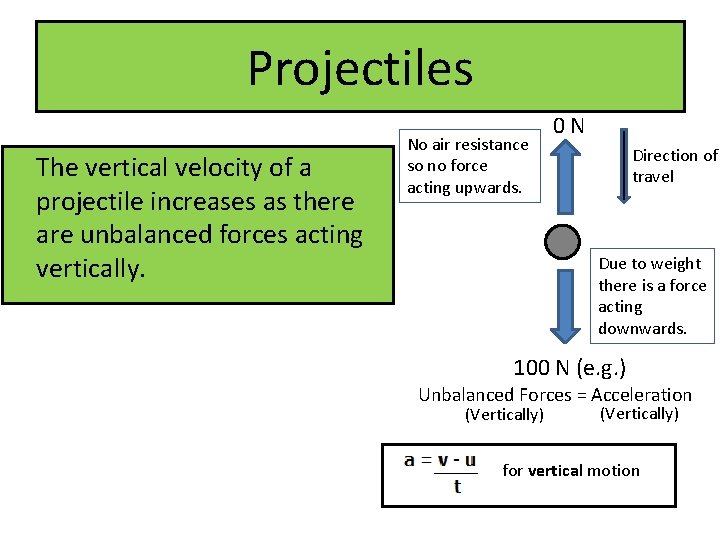
Projectiles The vertical velocity of a projectile increases as there are unbalanced forces acting vertically. No air resistance so no force acting upwards. 0 N Direction of travel Due to weight there is a force acting downwards. 100 N (e. g. ) Unbalanced Forces = Acceleration (Vertically) for vertical motion