
Dynamical Systems Theory Teoria Sistemelor Dinamice Netwon Galilei
- Slides: 31
Dynamical Systems Theory (Teoria Sistemelor Dinamice)
• Netwon (Galilei), Poincare, Landau (‘ 44) • • • Ecological approach (Gibson '66, '79) Ecological psychologists (Turvey et al. '81) Turvey Kluger Kelso ('80)-Motor coordination Thelen & Smith (’ 90 s) for cognition Embodied cognition (Gibson, Agre and Chapman, Hutchins) • Situated action (Gibson → Barwise and Perry '81, '83 Pfeifer and Scheier, Glenberg, Brooks) • Extended mind (Clark '01, '08)
van Gelder & Port (1995) • Dynamical and computational approaches to cognition are fundamentally different • Dynamical approach = Kuhnian revolution • Brain (inner, encapsulated) vs. Brain + + body + environment • Discrete static Rs vs. Mutually + simultaneously influencing changes between brain, body and environment
• Geometrical Rs → To conceptualize how system change! • A plot of states traversed by a system through time = System’s trajectory through state space • Trajectory – Continuous (real time) or discrete (sequence of points) • A dimension = A variable of a system A point = A state Ex - Solar system: Position + Momentum of planets - Mathematical laws relate changes over time → A
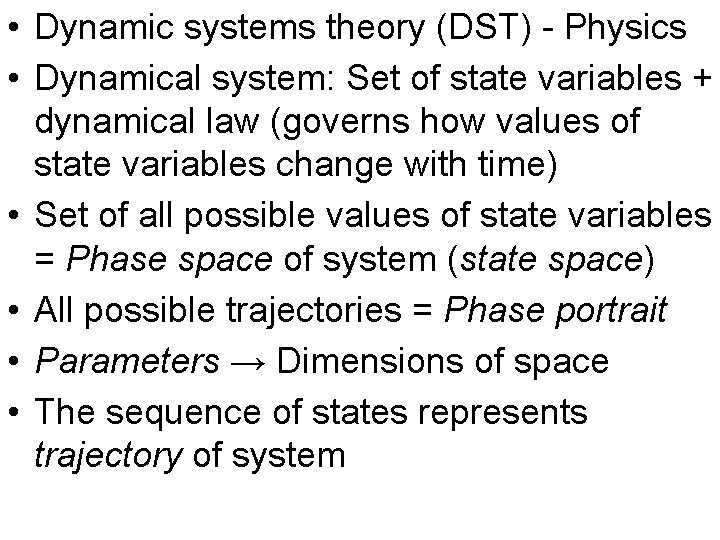
• Dynamic systems theory (DST) - Physics • Dynamical system: Set of state variables + dynamical law (governs how values of state variables change with time) • Set of all possible values of state variables = Phase space of system (state space) • All possible trajectories = Phase portrait • Parameters → Dimensions of space • The sequence of states represents trajectory of system
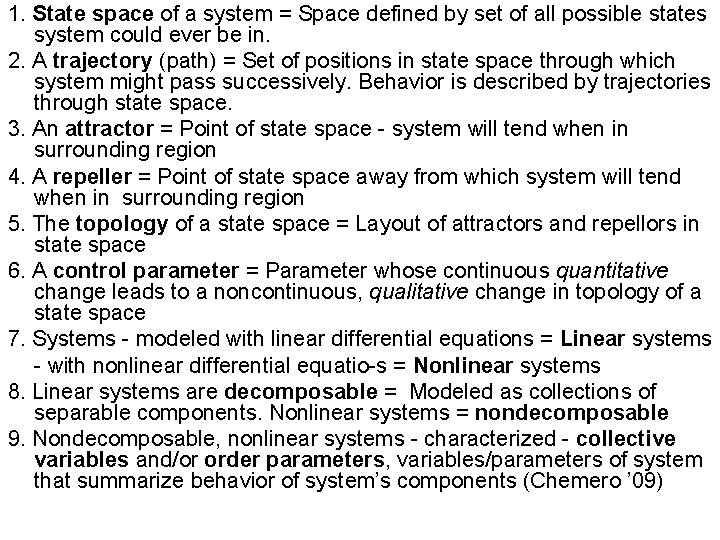
1. State space of a system = Space defined by set of all possible states system could ever be in. 2. A trajectory (path) = Set of positions in state space through which system might pass successively. Behavior is described by trajectories through state space. 3. An attractor = Point of state space - system will tend when in surrounding region 4. A repeller = Point of state space away from which system will tend when in surrounding region 5. The topology of a state space = Layout of attractors and repellors in state space 6. A control parameter = Parameter whose continuous quantitative change leads to a noncontinuous, qualitative change in topology of a state space 7. Systems - modeled with linear differential equations = Linear systems - with nonlinear differential equatio-s = Nonlinear systems 8. Linear systems are decomposable = Modeled as collections of separable components. Nonlinear systems = nondecomposable 9. Nondecomposable, nonlinear systems - characterized - collective variables and/or order parameters, variables/parameters of system that summarize behavior of system’s components (Chemero ’ 09)
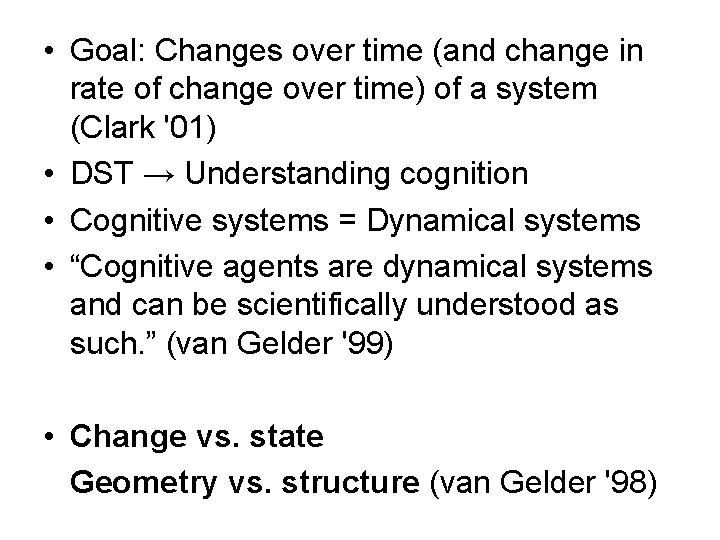
• Goal: Changes over time (and change in rate of change over time) of a system (Clark '01) • DST → Understanding cognition • Cognitive systems = Dynamical systems • “Cognitive agents are dynamical systems and can be scientifically understood as such. ” (van Gelder '99) • Change vs. state Geometry vs. structure (van Gelder '98)
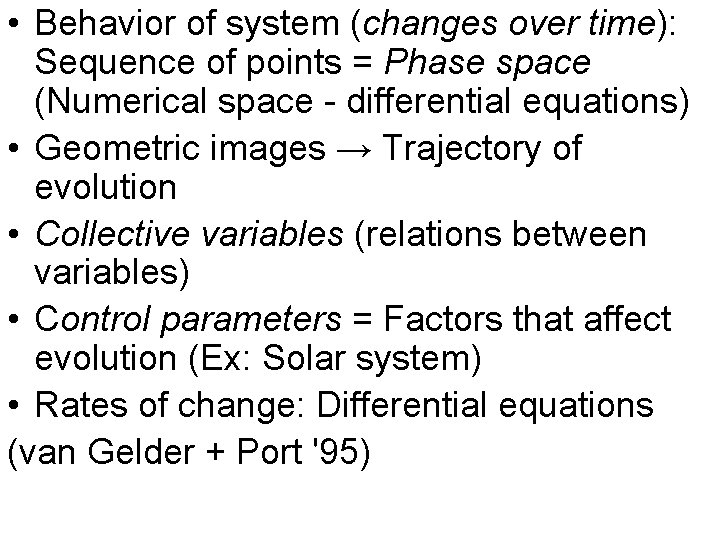
• Behavior of system (changes over time): Sequence of points = Phase space (Numerical space - differential equations) • Geometric images → Trajectory of evolution • Collective variables (relations between variables) • Control parameters = Factors that affect evolution (Ex: Solar system) • Rates of change: Differential equations (van Gelder + Port '95)
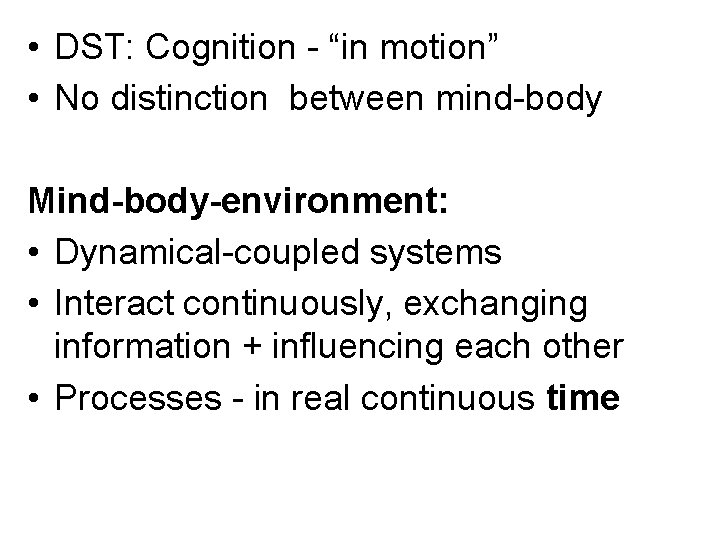
• DST: Cognition - “in motion” • No distinction between mind-body Mind-body-environment: • Dynamical-coupled systems • Interact continuously, exchanging information + influencing each other • Processes - in real continuous time
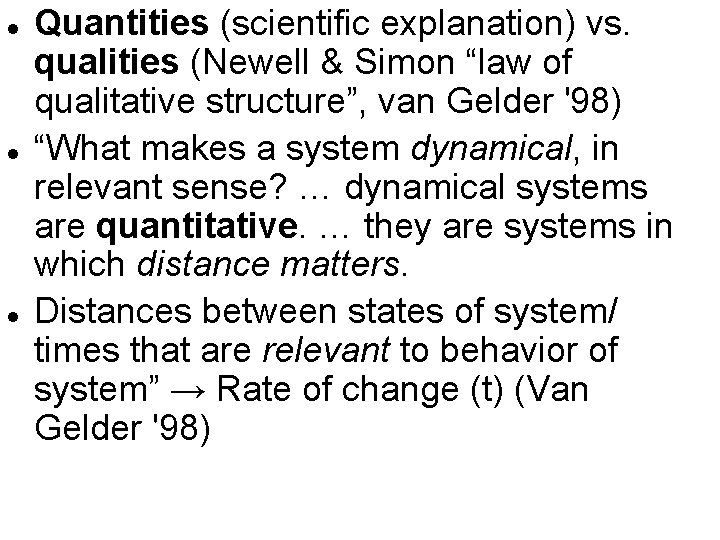
Quantities (scientific explanation) vs. qualities (Newell & Simon “law of qualitative structure”, van Gelder '98) “What makes a system dynamical, in relevant sense? … dynamical systems are quantitative. … they are systems in which distance matters. Distances between states of system/ times that are relevant to behavior of system” → Rate of change (t) (Van Gelder '98)
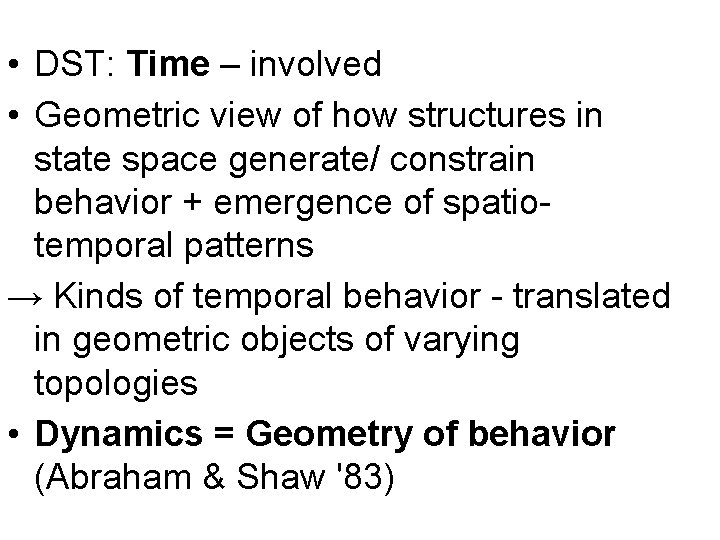
• DST: Time – involved • Geometric view of how structures in state space generate/ constrain behavior + emergence of spatiotemporal patterns → Kinds of temporal behavior - translated in geometric objects of varying topologies • Dynamics = Geometry of behavior (Abraham & Shaw '83)
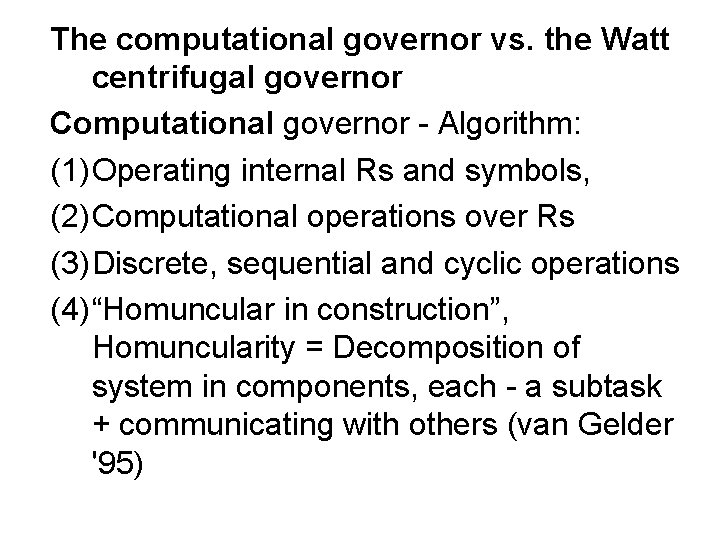
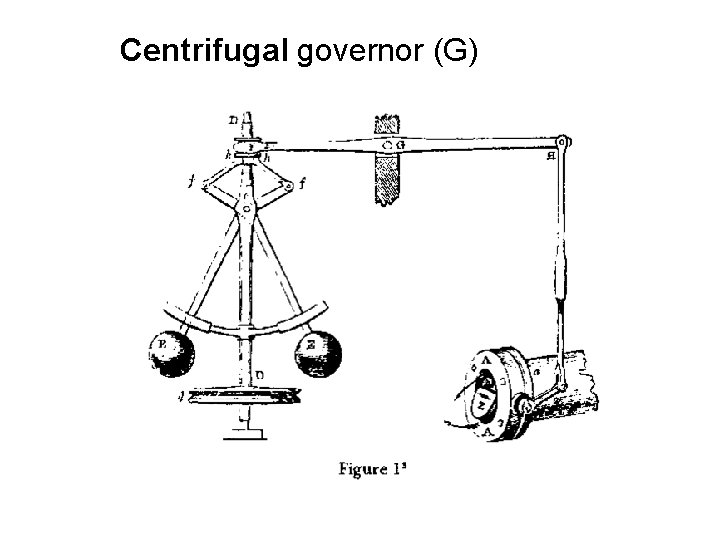
The computational governor vs. the Watt centrifugal governor Computational governor - Algorithm: (1) Operating internal Rs and symbols, (2) Computational operations over Rs (3) Discrete, sequential and cyclic operations (4) “Homuncular in construction”, Homuncularity = Decomposition of system in components, each - a subtask + communicating with others (van Gelder '95)
Centrifugal governor (G)
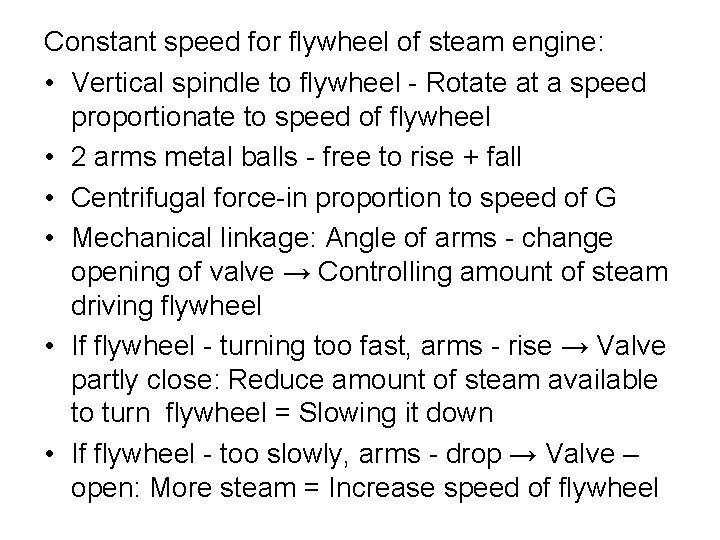
Constant speed for flywheel of steam engine: • Vertical spindle to flywheel - Rotate at a speed proportionate to speed of flywheel • 2 arms metal balls - free to rise + fall • Centrifugal force-in proportion to speed of G • Mechanical linkage: Angle of arms - change opening of valve → Controlling amount of steam driving flywheel • If flywheel - turning too fast, arms - rise → Valve partly close: Reduce amount of steam available to turn flywheel = Slowing it down • If flywheel - too slowly, arms - drop → Valve – open: More steam = Increase speed of flywheel
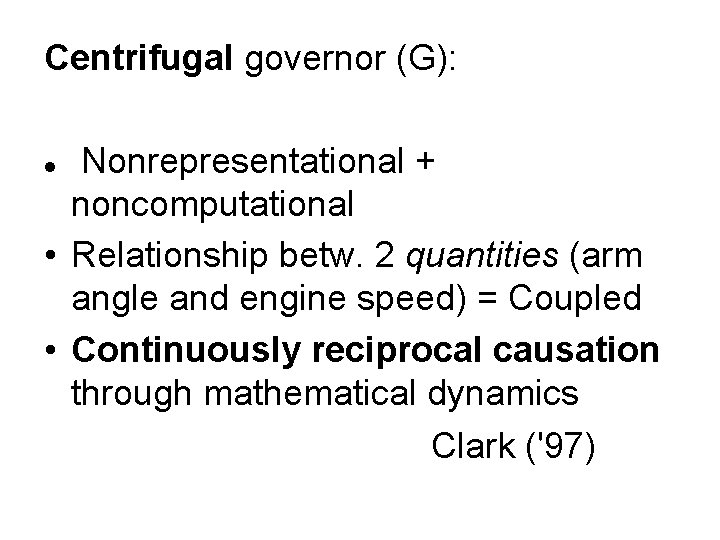
Centrifugal governor (G): Nonrepresentational + noncomputational • Relationship betw. 2 quantities (arm angle and engine speed) = Coupled • Continuously reciprocal causation through mathematical dynamics Clark ('97)
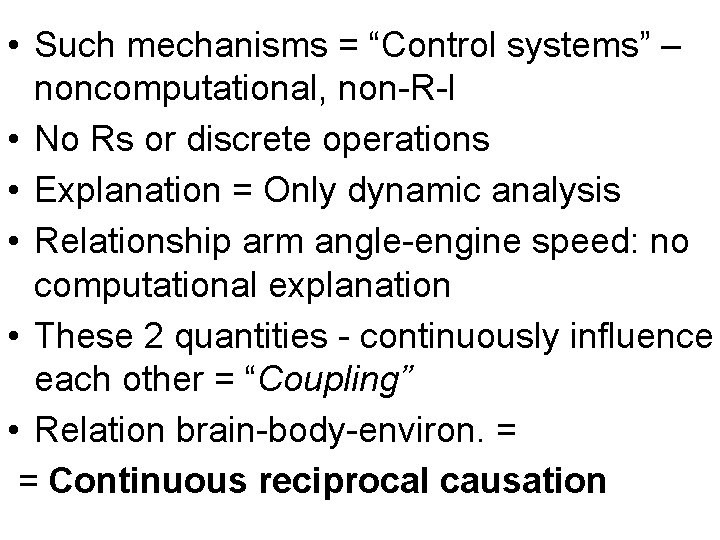
• Such mechanisms = “Control systems” – noncomputational, non-R-l • No Rs or discrete operations • Explanation = Only dynamic analysis • Relationship arm angle-engine speed: no computational explanation • These 2 quantities - continuously influence each other = “Coupling” • Relation brain-body-environ. = = Continuous reciprocal causation
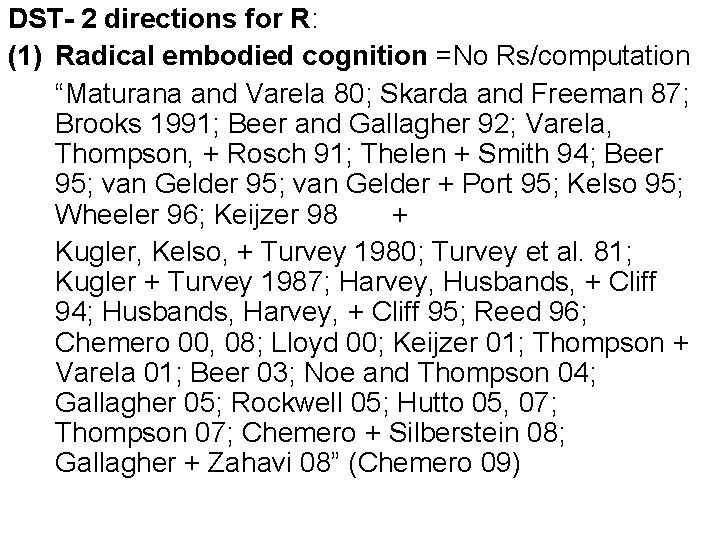
DST- 2 directions for R: (1) Radical embodied cognition =No Rs/computation “Maturana and Varela 80; Skarda and Freeman 87; Brooks 1991; Beer and Gallagher 92; Varela, Thompson, + Rosch 91; Thelen + Smith 94; Beer 95; van Gelder + Port 95; Kelso 95; Wheeler 96; Keijzer 98 + Kugler, Kelso, + Turvey 1980; Turvey et al. 81; Kugler + Turvey 1987; Harvey, Husbands, + Cliff 94; Husbands, Harvey, + Cliff 95; Reed 96; Chemero 00, 08; Lloyd 00; Keijzer 01; Thompson + Varela 01; Beer 03; Noe and Thompson 04; Gallagher 05; Rockwell 05; Hutto 05, 07; Thompson 07; Chemero + Silberstein 08; Gallagher + Zahavi 08” (Chemero 09)
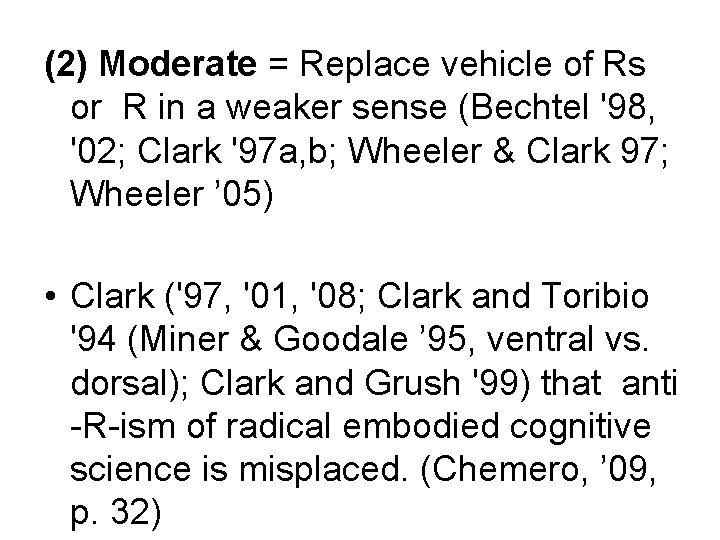
(2) Moderate = Replace vehicle of Rs or R in a weaker sense (Bechtel '98, '02; Clark '97 a, b; Wheeler & Clark 97; Wheeler ’ 05) • Clark ('97, '01, '08; Clark and Toribio '94 (Miner & Goodale ’ 95, ventral vs. dorsal); Clark and Grush '99) that anti -R-ism of radical embodied cognitive science is misplaced. (Chemero, ’ 09, p. 32)
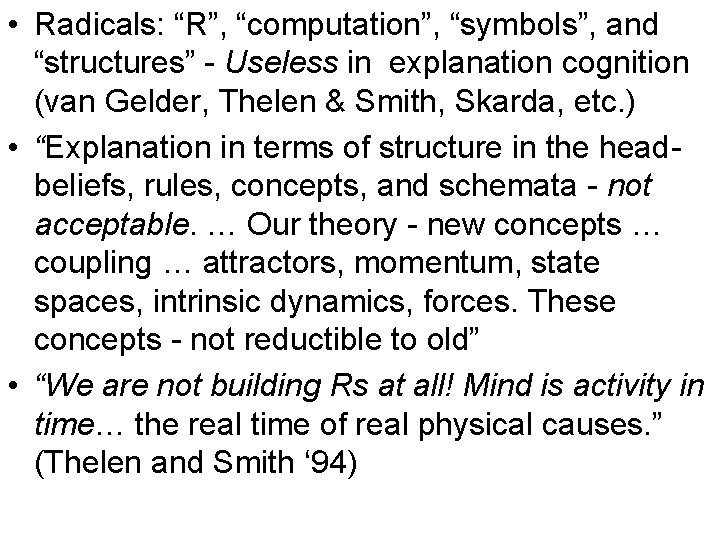
• Radicals: “R”, “computation”, “symbols”, and “structures” - Useless in explanation cognition (van Gelder, Thelen & Smith, Skarda, etc. ) • “Explanation in terms of structure in the headbeliefs, rules, concepts, and schemata - not acceptable. … Our theory - new concepts … coupling … attractors, momentum, state spaces, intrinsic dynamics, forces. These concepts - not reductible to old” • “We are not building Rs at all! Mind is activity in time… the real time of real physical causes. ” (Thelen and Smith ‘ 94)
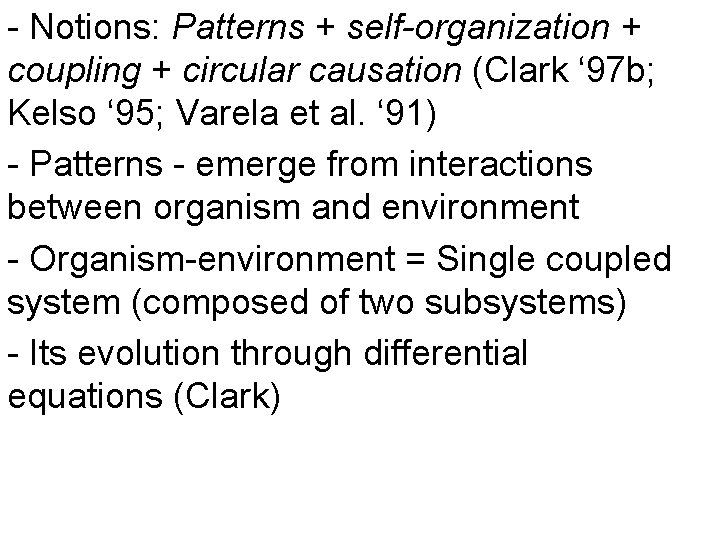
- Notions: Patterns + self-organization + coupling + circular causation (Clark ‘ 97 b; Kelso ‘ 95; Varela et al. ‘ 91) - Patterns - emerge from interactions between organism and environment - Organism-environment = Single coupled system (composed of two subsystems) - Its evolution through differential equations (Clark)
• Bodily actions (child walking – T&S) • Movement of fingers (HKB '87, Kelso) → Extrapolate from sensoriomotor processes to cognition processes! (Implicit-explicit → Hybrid models? ) No decision making/contrafactuals • Replace static, discrete Rs with attractors = Continuous movement • At conceptual level attractors seem static and discrete
• Globus '92, '95; Kelso '95: Reject Rs + computations • Globus: Replaces computation with constraints between elements-levels • “[R]ather than computes, our brain dwells (at least for short times) in metastable states”. (Kelso '95) (See Freeman '87) • Radical embodied cognition: Explores “minimally cognitive behavior” = Categorical perception, locomotion, etc. (Chemero '09)
• Against radicals - Clark and Toribio ('94): certain tasks cannot be accomplished without Rs → “Hungry Rs problems” (decision making, counterfactuals) → Decoupling between R-l system and environment = Off-line cognition (not on-line) • “Cognitive system has to create a certain kind of item, pattern or inner process that stands for a certain state of affairs, in short, a R. ” (Clark)
• TDS - Change: a) Interactions between (ensembles) neurons b) Constitutive relations between Rs → No prediction, but explanation • Dynamics among Rs (Fisher and Bidell '98; van Geert '94)
• Radicals: Cognition = Result of evolution of perception + sensoriomotor control systems [see Barsalou] • Dynamical models - “having” R-s: Attractors, trajectories, bifurcations, and parameter settings → DS store knowledge + Rules defined over numerical states (van Gelder & Port '95)
• DST - discrete state transitions (a) Using discrete states (catastrophe model → Bifurcation) (b) Discreteness: “How a continuous system can undergo changes that look discrete from a distance”
Skarda & Freeman’s model of olfactory bulb • Freeman’s network ('85) (Bechtel) • Rabbit - Pattern neurons - Smelling A, then B then again A • Pattern of activity A 1 ≠ A 2 (even similar) → No Rs ('88, '90) • “Nothing intrinsically R-l about dynamic process until observer intrudes. It is experimenter who infers what observed activity patterns represents to in a subject, in order to explain his results to himself. ” (Werner '88 in Freeman & Skarda '90)
• Nervous system = Dynamical system, constantly in motion • Chaos - System continuously changes state; trajectory appears random but determined by equations • Chaotic systems: Sensitivity to initial conditions = Small differences in initial values → Dissimilar trajectories
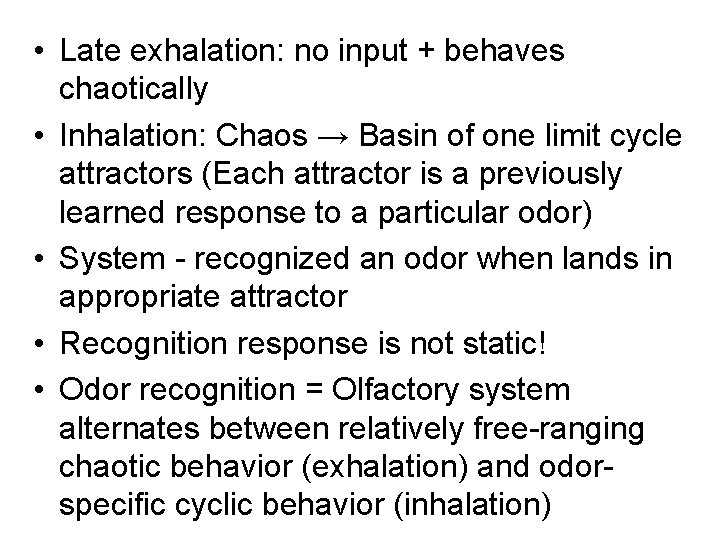
• Late exhalation: no input + behaves chaotically • Inhalation: Chaos → Basin of one limit cycle attractors (Each attractor is a previously learned response to a particular odor) • System - recognized an odor when lands in appropriate attractor • Recognition response is not static! • Odor recognition = Olfactory system alternates between relatively free-ranging chaotic behavior (exhalation) and odorspecific cyclic behavior (inhalation)
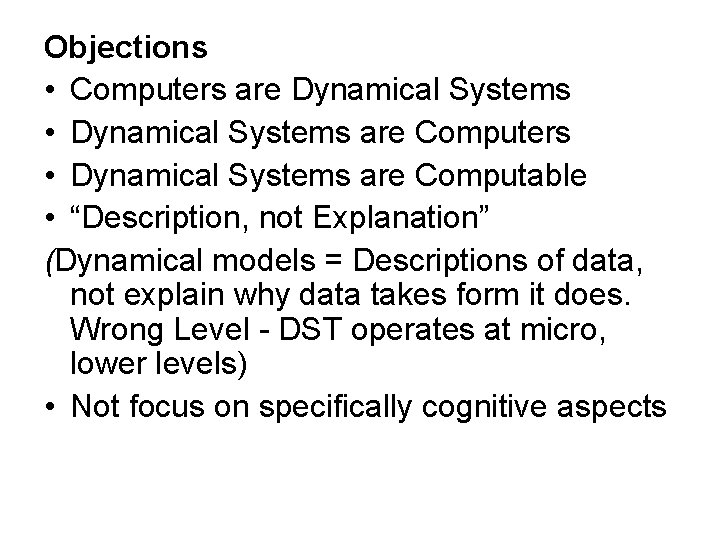
Objections • Computers are Dynamical Systems • Dynamical Systems are Computers • Dynamical Systems are Computable • “Description, not Explanation” (Dynamical models = Descriptions of data, not explain why data takes form it does. Wrong Level - DST operates at micro, lower levels) • Not focus on specifically cognitive aspects
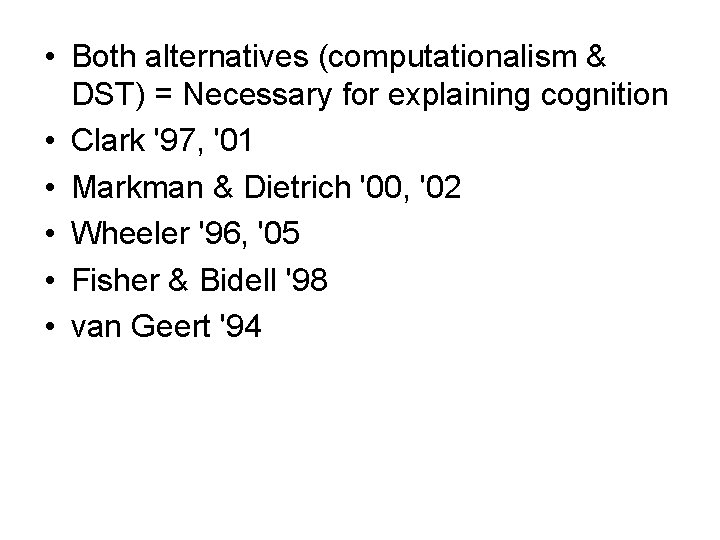
• Both alternatives (computationalism & DST) = Necessary for explaining cognition • Clark '97, '01 • Markman & Dietrich '00, '02 • Wheeler '96, '05 • Fisher & Bidell '98 • van Geert '94