
Dynamic WordImage Interactions in Picture Books Yang Lichung
Dynamic Word/Image Interactions in Picture Books Yang, Lichung Department of English Instruction TMUE 20091019 輔導團註:因版權考量已刪除圖片頁

How can the relationship between words and pictures be described?
picture books as a pedagogical tool How can educators describe their experiences as they share forms of picture books with children?
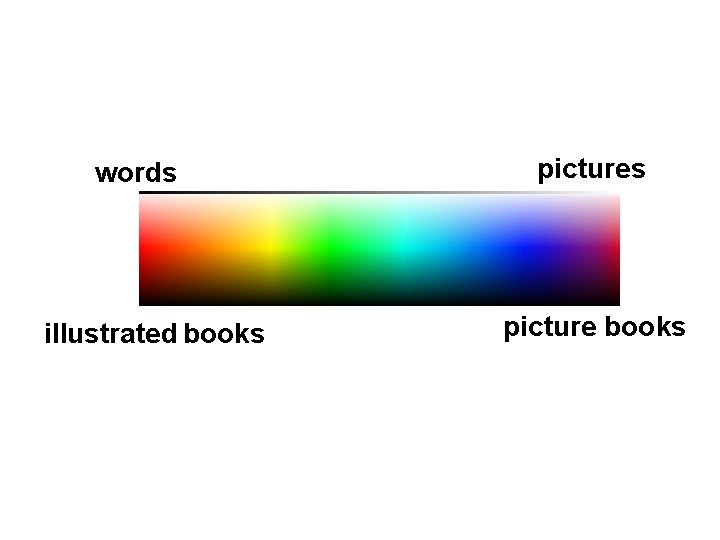
words illustrated books picture books
Nikolajeva and Scott’s categorization (1) • Symmetry: words and pictures come as close as possible • Enhancement: the pictures expand upon the words or vice versa • Complementary: Each provides information • Counterpoint: words and pictures offer the reader “alternative information” • Contradiction: the extreme form of counterpoint,

Symmetry Words and pictures come as close as possible.
Enhancement • Minimal Enhancement – The verbal text carry the narrative, while the visual text enhances it. • Significant Enhancement: Complementary Relationship
Complementary Words and pictures fill each other’s gaps.
Counterpoint • Words and pictures are two mutually dependent narratives. They offer the reader “alternative information. ” • e. g. • Ironic Counterpoint ( Princess Smartypants ) Perspectival Counterpoint (Lily Takes a Walk) Counterpoint in Characterization
Implications for Language Education (1) • How do teachers integrate knowledge of picture books into language education? What will be the benefits? What challenges will be encountered?
Implications for Language Education (2) • Teachers and researchers need to work together to document and understand how children---whether young or old--make their way through the tensions and possibilities conveyed by picture books.
Implications for Language Education (3) • New research needs to be developed that combines the study of older children’s picture book reading with their interest in and knowledge of multilayered texts (websites, video games, advertising).
- Slides: 12