
Dynamic Topology Adaptation of Virtual Networks of Virtual
- Slides: 32
Dynamic Topology Adaptation of Virtual Networks of Virtual Machines Ananth I. Sundararaj Ashish Gupta Peter A. Dinda Prescience Lab Department of Computer Science Northwestern University http: //virtuoso. cs. northwestern. edu
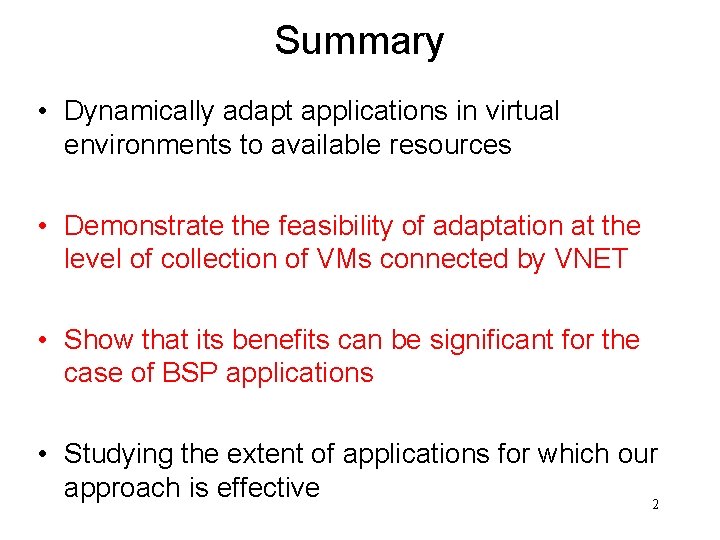
Summary • Dynamically adapt applications in virtual environments to available resources • Demonstrate the feasibility of adaptation at the level of collection of VMs connected by VNET • Show that its benefits can be significant for the case of BSP applications • Studying the extent of applications for which our approach is effective 2
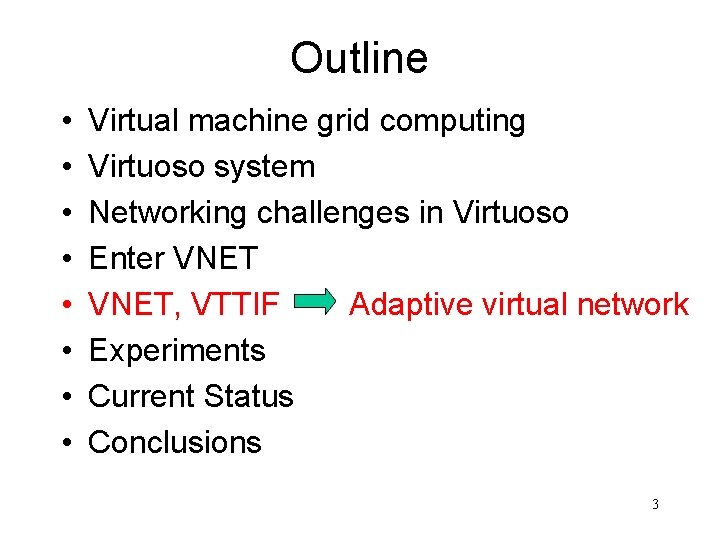
Outline • • Virtual machine grid computing Virtuoso system Networking challenges in Virtuoso Enter VNET, VTTIF Adaptive virtual network Experiments Current Status Conclusions 3
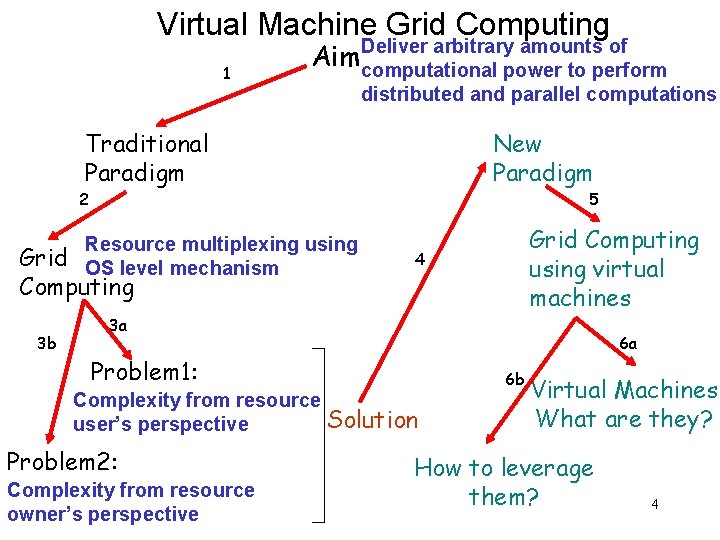
Virtual Machine Grid Computing 1 arbitrary amounts of Aim. Deliver computational power to perform distributed and parallel computations Traditional Paradigm New Paradigm 2 Resource multiplexing using OS level mechanism Grid Computing 3 b 5 Grid Computing using virtual machines 4 3 a 6 a Problem 1: Complexity from resource Solution user’s perspective Problem 2: Complexity from resource owner’s perspective 6 b Virtual Machines What are they? How to leverage them? 4
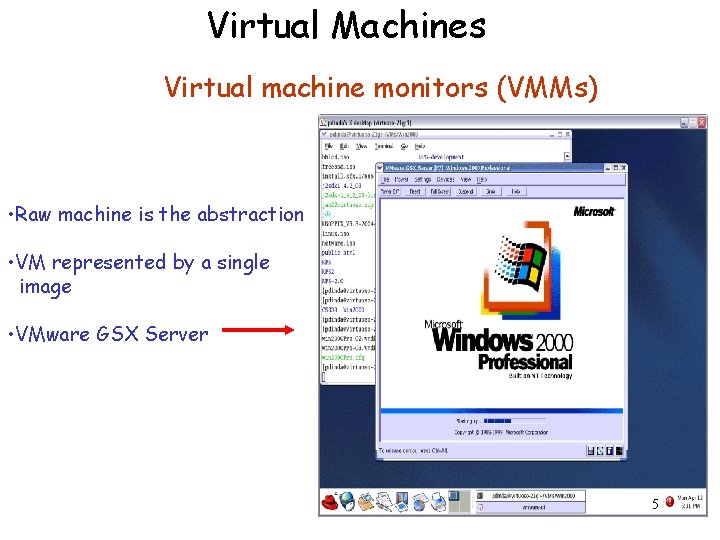
Virtual Machines Virtual machine monitors (VMMs) • Raw machine is the abstraction • VM represented by a single image • VMware GSX Server 5
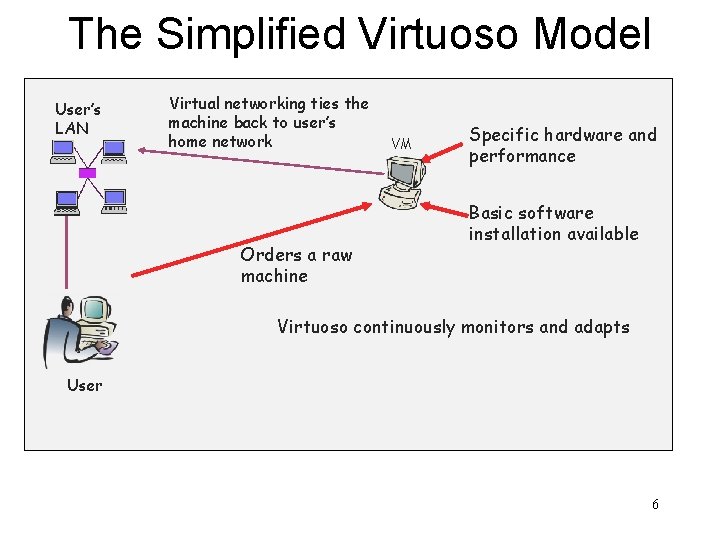
The Simplified Virtuoso Model User’s LAN Virtual networking ties the machine back to user’s home network Orders a raw machine VM Specific hardware and performance Basic software installation available Virtuoso continuously monitors and adapts User 6
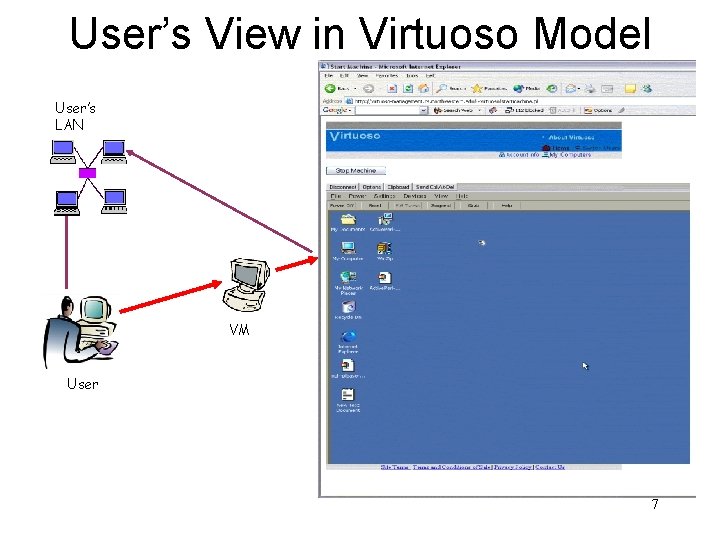
User’s View in Virtuoso Model User’s LAN VM User 7
Outline • • Virtual machine grid computing Virtuoso system Networking challenges in Virtuoso Enter VNET, VTTIF Adaptive virtual network Experiments Current Status Conclusions 8
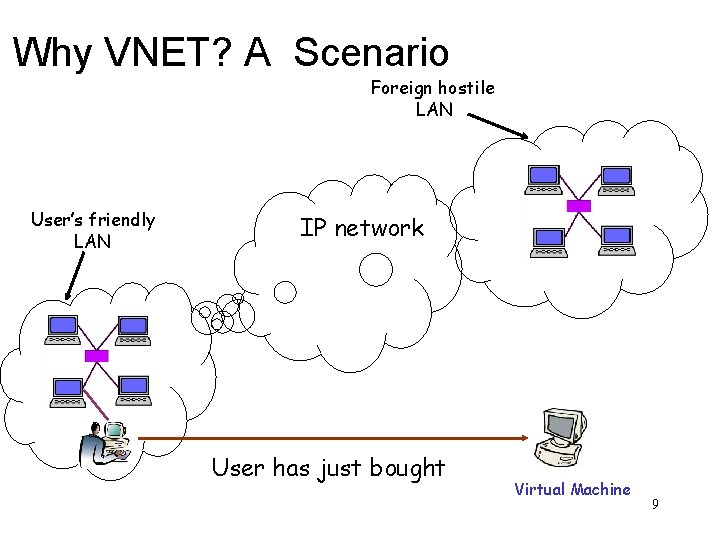
Why VNET? A Scenario Foreign hostile LAN User’s friendly LAN IP network User has just bought Virtual Machine 9
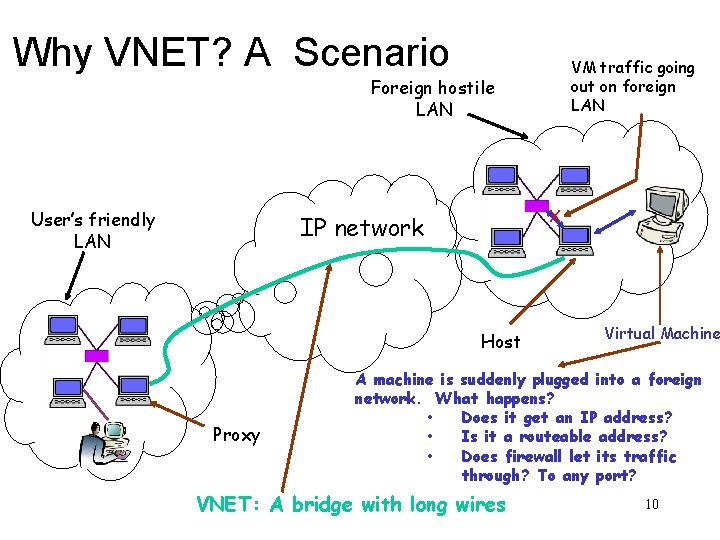
Why VNET? A Scenario VM traffic going out on foreign LAN Foreign hostile LAN User’s friendly LAN X IP network Host Proxy Virtual Machine A machine is suddenly plugged into a foreign network. What happens? • Does it get an IP address? • Is it a routeable address? • Does firewall let its traffic through? To any port? VNET: A bridge with long wires 10
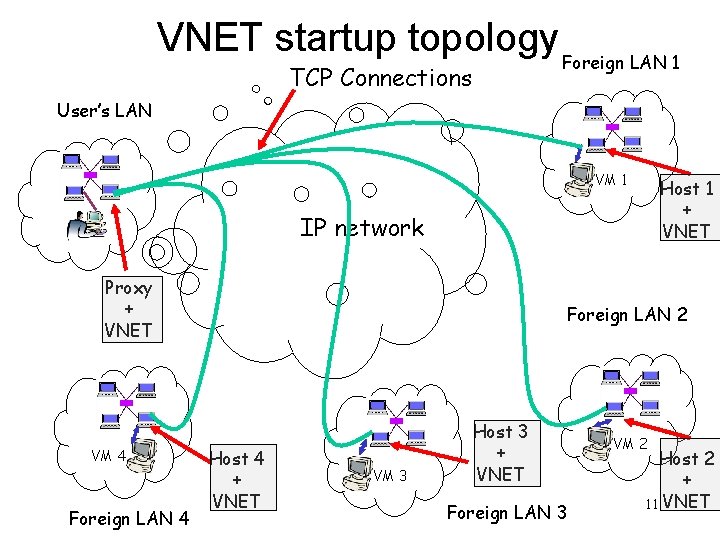
VNET startup topology Foreign LAN 1 TCP Connections User’s LAN VM 1 Host 1 + VNET IP network Proxy + VNET VM 4 Foreign LAN 2 Host 4 + VNET VM 3 Host 3 + VNET Foreign LAN 3 VM 2 Host 2 + 11 VNET
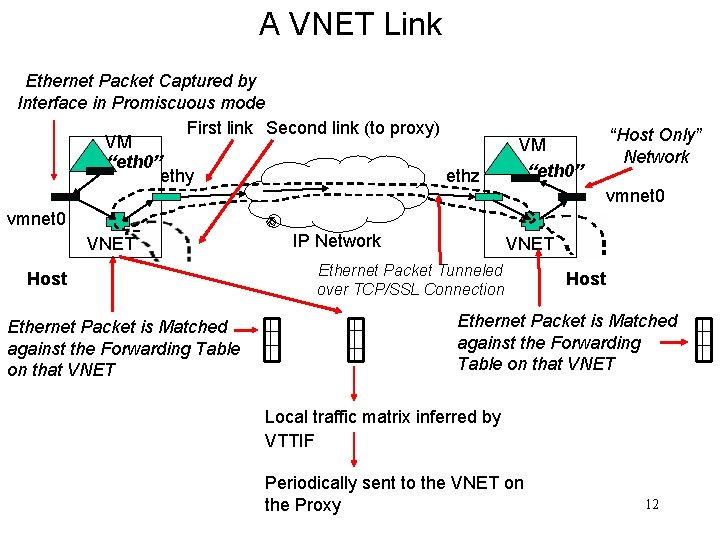
A VNET Link Ethernet Packet Captured by Interface in Promiscuous mode First link Second link (to proxy) VM “eth 0” ethy ethz “Host Only” Network VM “eth 0” vmnet 0 VNET Host Ethernet Packet is Matched against the Forwarding Table on that VNET IP Network VNET Ethernet Packet Tunneled over TCP/SSL Connection Host Ethernet Packet is Matched against the Forwarding Table on that VNET Local traffic matrix inferred by VTTIF Periodically sent to the VNET on the Proxy 12
VTTIF • Topology inference and traffic characterization for applications • Ethernet-level traffic monitoring • VNET daemons collectively aggregate a global traffic matrix for all VMs • Application topology is recovered using normalization and pruning algorithms 13
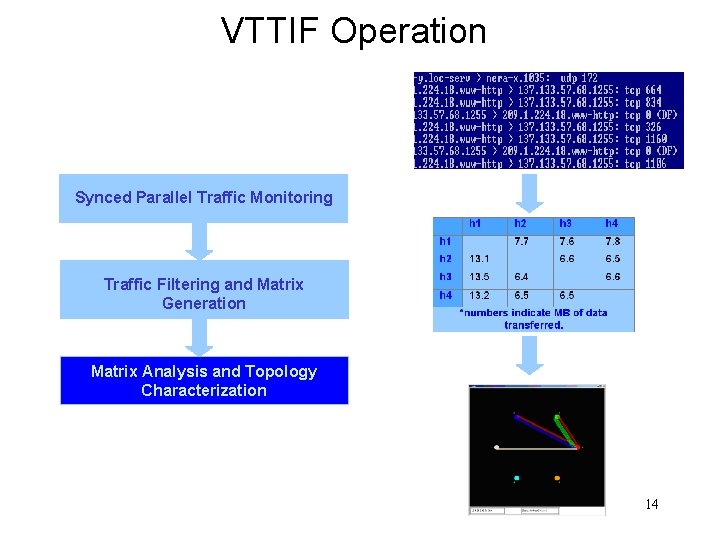
VTTIF Operation Synced Parallel Traffic Monitoring Traffic Filtering and Matrix Generation Matrix Analysis and Topology Characterization 14
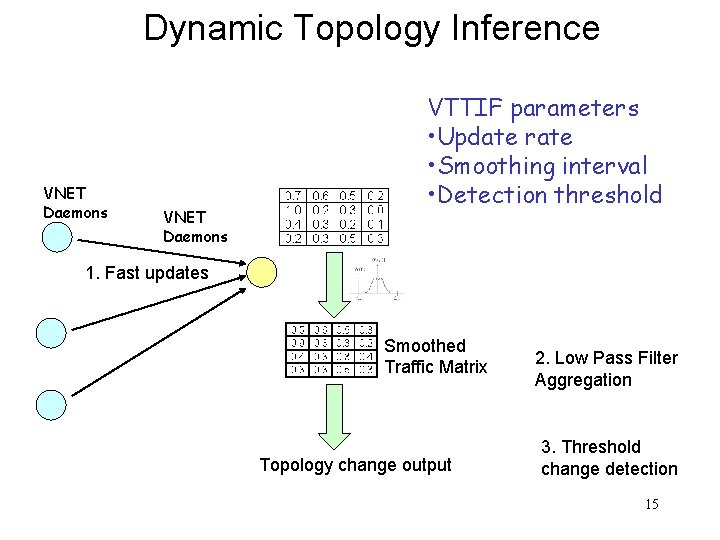
Dynamic Topology Inference VNET Daemons VTTIF parameters • Update rate • Smoothing interval • Detection threshold 1. Fast updates Smoothed Traffic Matrix Topology change output 2. Low Pass Filter Aggregation 3. Threshold change detection 15
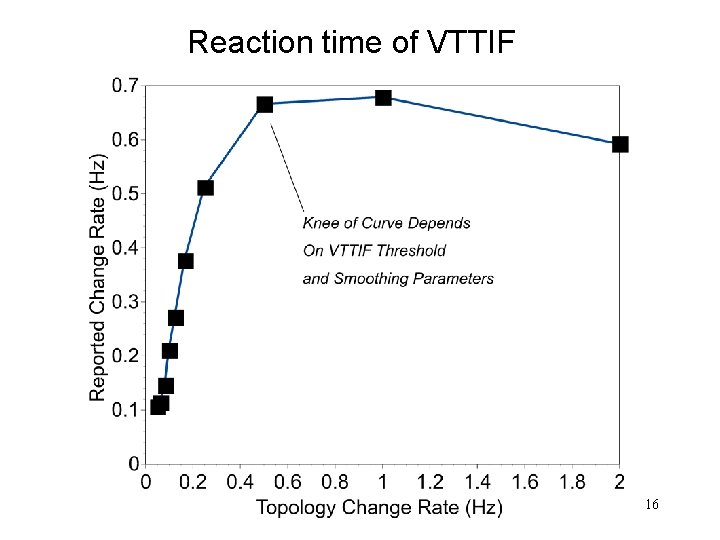
Reaction time of VTTIF 16
Outline • • Virtual machine grid computing Virtuoso system Networking challenges in Virtuoso Enter VNET, VTTIF Adaptive virtual network Experiments Current Status Conclusions 17
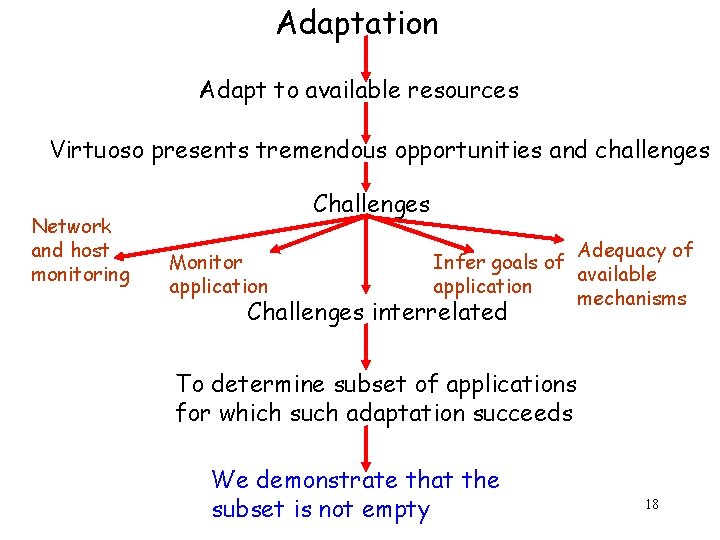
Adaptation Adapt to available resources Virtuoso presents tremendous opportunities and challenges Network and host monitoring Challenges Monitor application Adequacy of Infer goals of available application mechanisms Challenges interrelated To determine subset of applications for which such adaptation succeeds We demonstrate that the subset is not empty 18
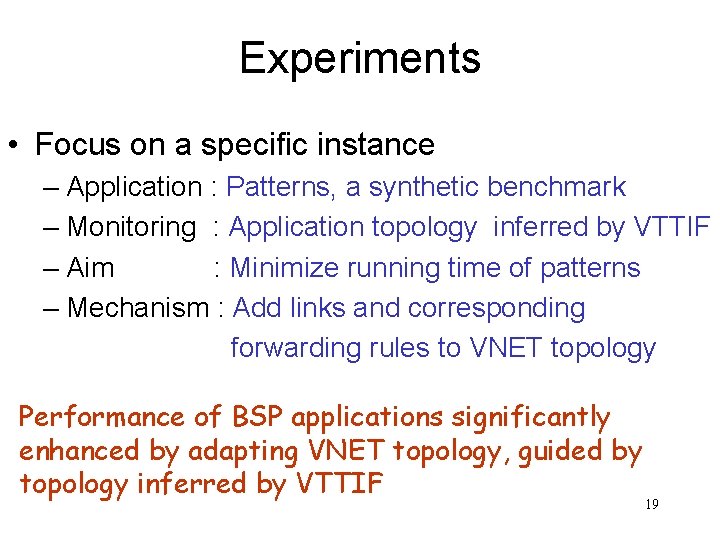
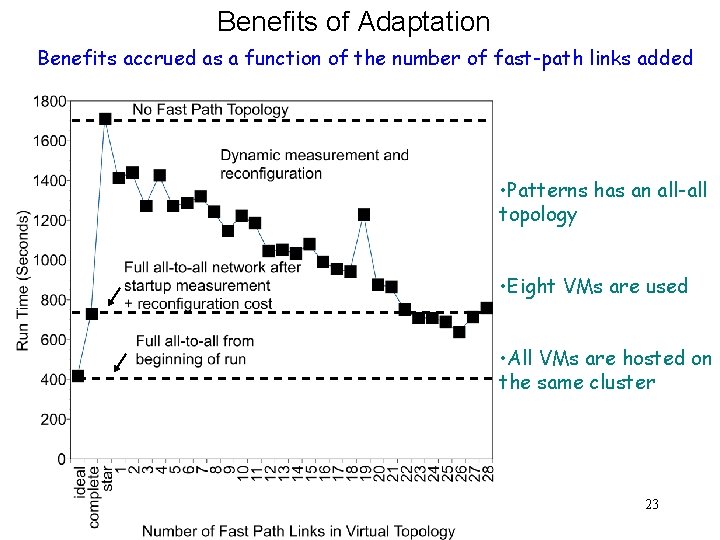
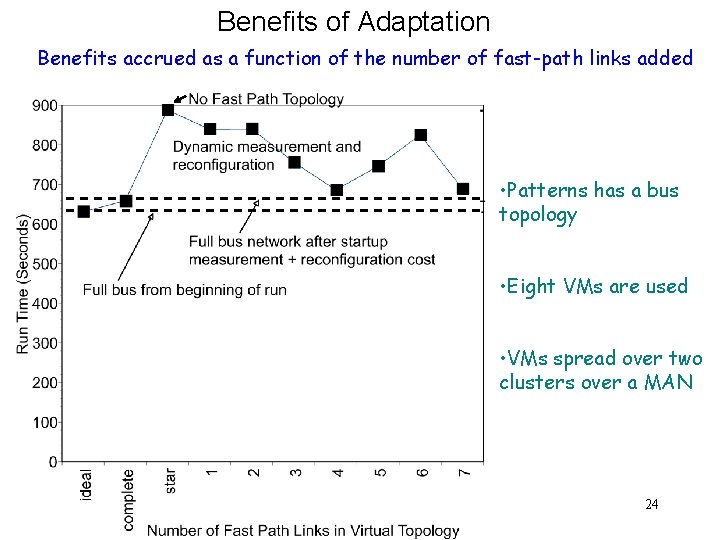
Experiments • Focus on a specific instance – Application : Patterns, a synthetic benchmark – Monitoring : Application topology inferred by VTTIF – Aim : Minimize running time of patterns – Mechanism : Add links and corresponding forwarding rules to VNET topology Performance of BSP applications significantly enhanced by adapting VNET topology, guided by topology inferred by VTTIF 19
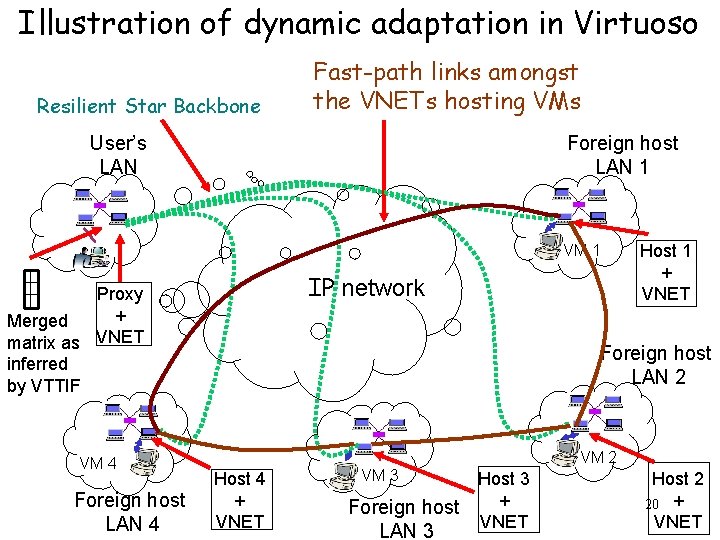
Illustration of dynamic adaptation in Virtuoso Resilient Star Backbone Fast-path links amongst the VNETs hosting VMs User’s LAN Foreign host LAN 1 VM 1 IP network Proxy + Merged matrix as VNET inferred by VTTIF VM 4 Foreign host LAN 4 Host 1 + VNET Foreign host LAN 2 VM 2 Host 4 + VNET VM 3 Foreign host LAN 3 Host 3 + VNET Host 2 20 + VNET
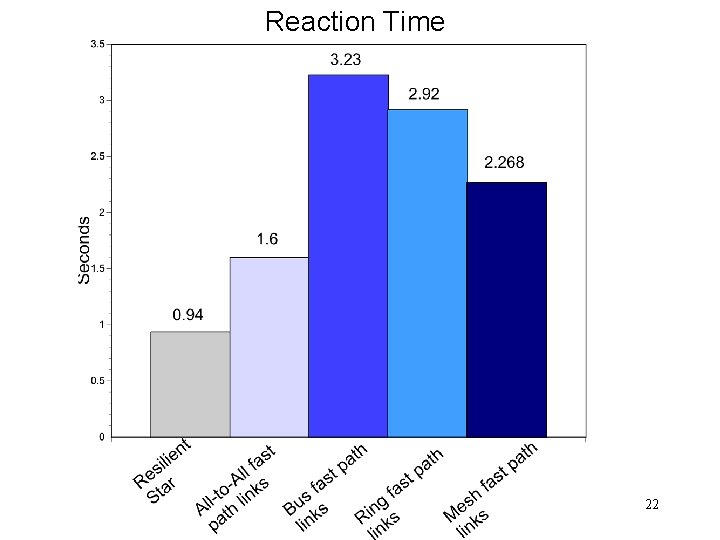
Evaluation • Reaction time of VNET • Benefits of adaptation (performance speedup) – Eight VMs on a single cluster, all-all topology – Eight VMs spread over two clusters over MAN, bus topology – Eight VMs spread over WAN, all-all topology 21
Reaction Time 22
Benefits of Adaptation Benefits accrued as a function of the number of fast-path links added • Patterns has an all-all topology • Eight VMs are used • All VMs are hosted on the same cluster 23
Benefits of Adaptation Benefits accrued as a function of the number of fast-path links added • Patterns has a bus topology • Eight VMs are used • VMs spread over two clusters over a MAN 24
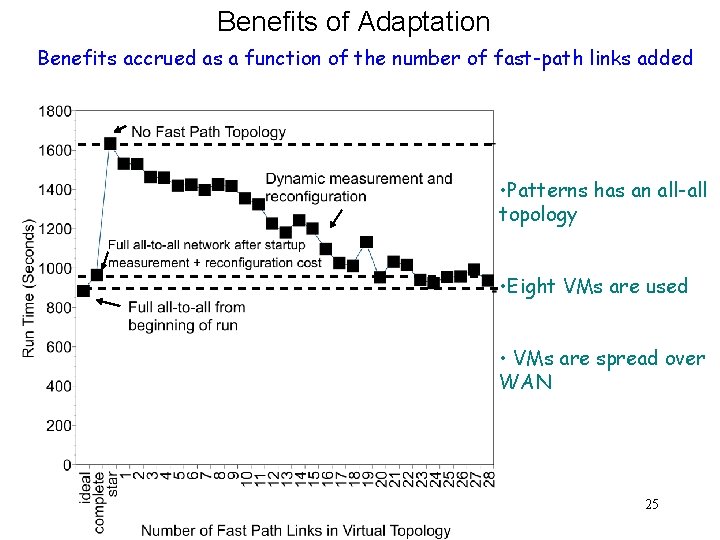
Benefits of Adaptation Benefits accrued as a function of the number of fast-path links added • Patterns has an all-all topology • Eight VMs are used • VMs are spread over WAN 25
Outline • • Virtual machine grid computing Virtuoso system Networking challenges in Virtuoso Enter VNET, VTTIF Adaptive virtual network Experiments Current Status Conclusions 26
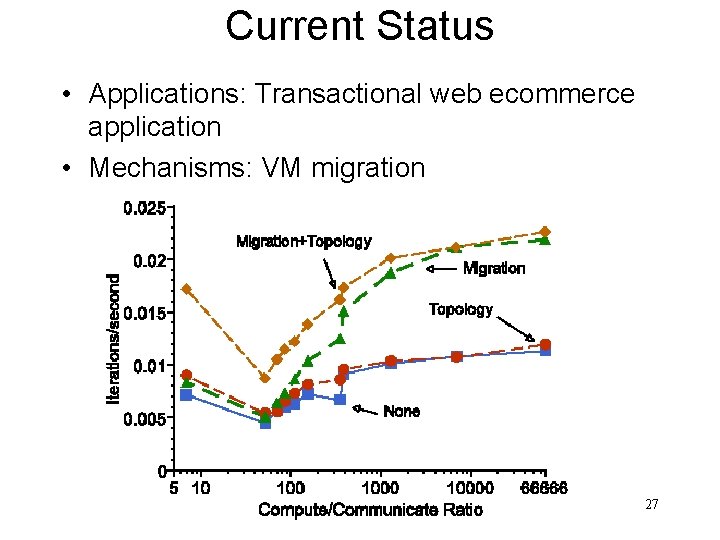
Current Status • Applications: Transactional web ecommerce application • Mechanisms: VM migration 27
Conclusions • Demonstrated the feasibility of adaptation at the level of collection of VMs connected by VNET • Showed that its benefits can be significant for the case of BSP applications • Studying the extent of applications for which our approach is effective • Moving ahead to use other adaptation mechanisms 28
• For More Information – Prescience Lab (Northwestern University) • http: //plab. cs. northwestern. edu – Virtuoso: Resource Management and Prediction for Distributed Computing using Virtual Machines • http: //virtuoso. cs. northwestern. edu • VNET is publicly available from • http: //virtuoso. cs. northwestern. edu 29
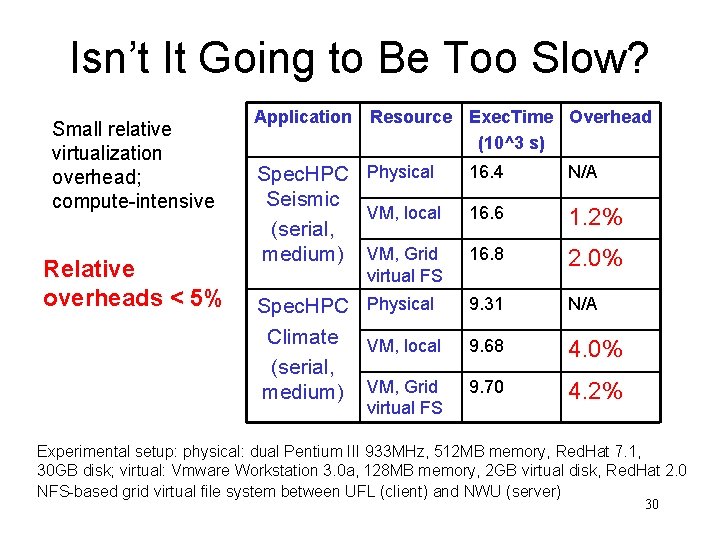
Isn’t It Going to Be Too Slow? Small relative virtualization overhead; compute-intensive Relative overheads < 5% Application Resource Exec. Time Overhead (10^3 s) Spec. HPC Physical Seismic VM, local (serial, medium) VM, Grid 16. 4 N/A 16. 6 1. 2% 16. 8 2. 0% Spec. HPC Physical Climate VM, local (serial, medium) VM, Grid 9. 31 N/A 9. 68 4. 0% 9. 70 4. 2% virtual FS Experimental setup: physical: dual Pentium III 933 MHz, 512 MB memory, Red. Hat 7. 1, 30 GB disk; virtual: Vmware Workstation 3. 0 a, 128 MB memory, 2 GB virtual disk, Red. Hat 2. 0 NFS-based grid virtual file system between UFL (client) and NWU (server) 30
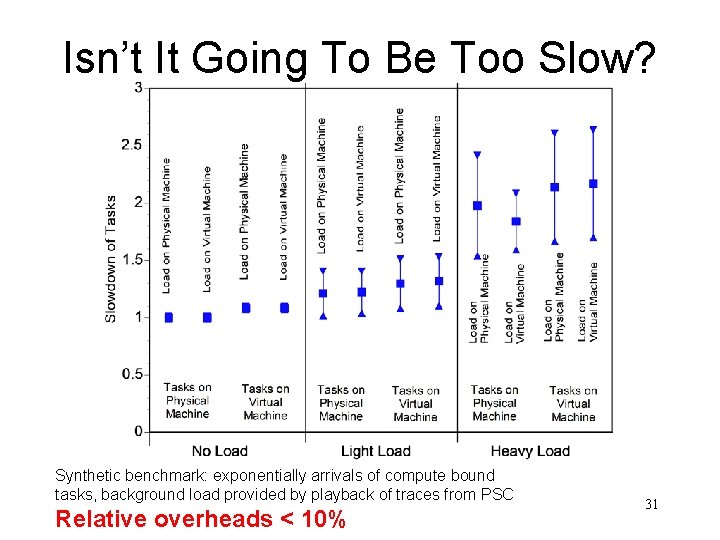
Isn’t It Going To Be Too Slow? Synthetic benchmark: exponentially arrivals of compute bound tasks, background load provided by playback of traces from PSC Relative overheads < 10% 31
Isn’t It Going To Be Too Slow? • Virtualized NICs have very similar bandwidth, slightly higher latencies – J. Sugerman, G. Venkitachalam, B-H Lim, “Virtualizing I/O Devices on VMware Workstation’s Hosted Virtual Machine Monitor”, USENIX 2001 • Disk-intensive workloads (kernel build, web service): 30% slowdown – S. King, G. Dunlap, P. Chen, “OS support for Virtual Machines”, USENIX 2003 However: May not scale with faster NIC or disk 32