
Dynamic Substructuring Methods for Vibration Analysis of Complex
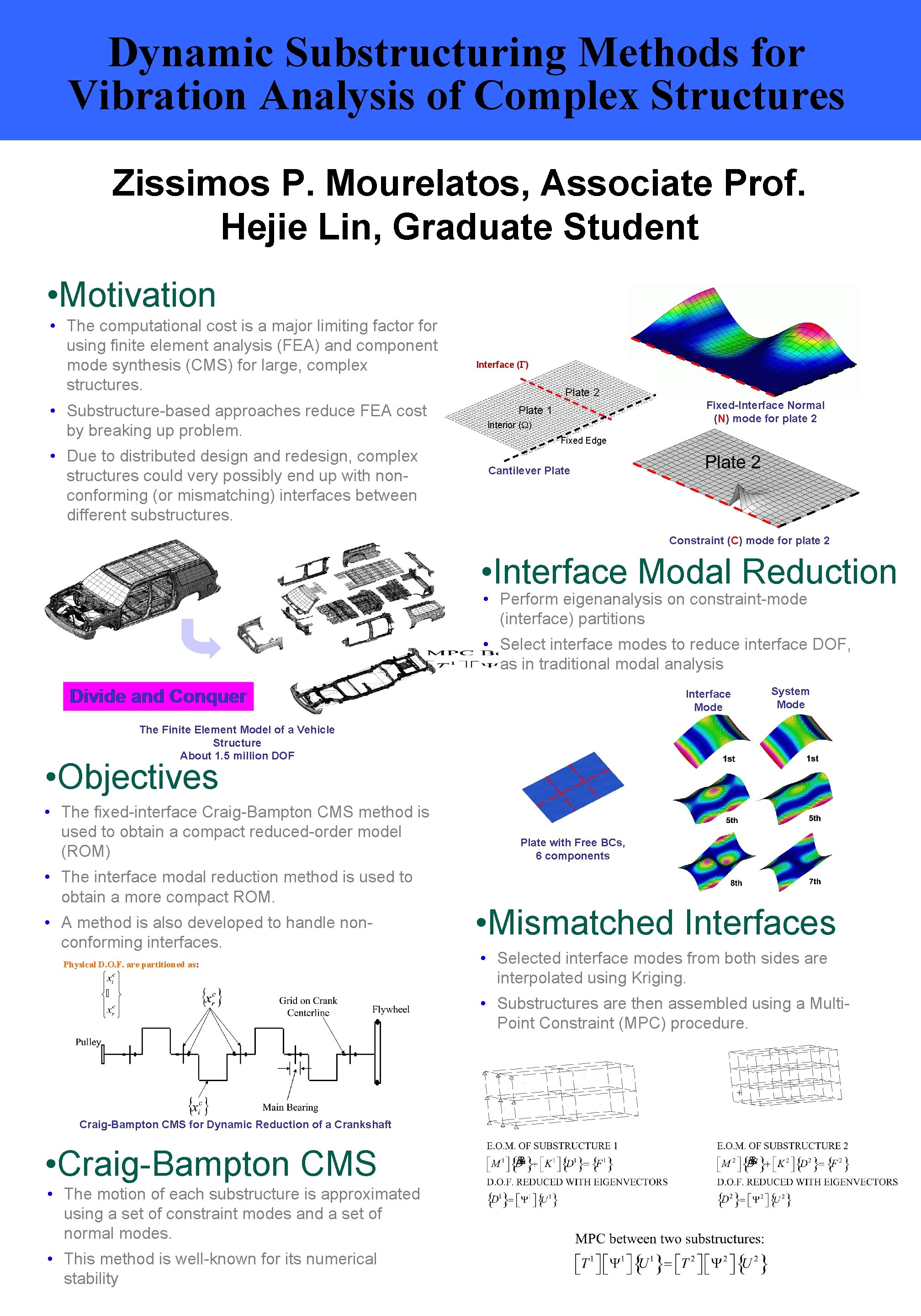
Dynamic Substructuring Methods for Vibration Analysis of Complex Structures Zissimos P. Mourelatos, Associate Prof. Hejie Lin, Graduate Student • Motivation • Substructure-based approaches reduce FEA cost by breaking up problem. • Due to distributed design and redesign, complex structures could very possibly end up with nonconforming (or mismatching) interfaces between different substructures. Interface (G) Skirt Profile • The computational cost is a major limiting factor for using finite element analysis (FEA) and component mode synthesis (CMS) for large, complex structures. Plate 2 Fixed-Interface Normal (N) mode for plate 2 Plate 1 Interior (W) Fixed Edge Cantilever Plate Constraint (C) mode for plate 2 • Interface Modal Reduction • Perform eigenanalysis on constraint-mode (interface) partitions • Select interface modes to reduce interface DOF, as in traditional modal analysis Interface Mode System Mode The Finite Element Model of a Vehicle Structure About 1. 5 million DOF • Objectives • The fixed-interface Craig-Bampton CMS method is used to obtain a compact reduced-order model (ROM) • The interface modal reduction method is used to obtain a more compact ROM. • A method is also developed to handle nonconforming interfaces. Physical D. O. F. are partitioned as: Plate with Free BCs, 6 components • Mismatched Interfaces • Selected interface modes from both sides are interpolated using Kriging. • Substructures are then assembled using a Multi. Point Constraint (MPC) procedure. Craig-Bampton CMS for Dynamic Reduction of a Crankshaft • Craig-Bampton CMS • The motion of each substructure is approximated using a set of constraint modes and a set of normal modes. • This method is well-known for its numerical stability
- Slides: 1