
Dynamic Spectrum Management 1000 M x 1000 M
![Telcordia DSM-ADSL Rate Regions [T 1 E 1. 4/2002 -063] 15 kft Fiber, 10](https://slidetodoc.com/presentation_image/b77435d8e708f31ad70a5e58f1edd456/image-11.jpg "Telcordia DSM-ADSL Rate Regions [T 1 E 1. 4/2002 -063] 15 kft Fiber, 10")
- Slides: 39
Dynamic Spectrum Management (1000 M x 1000 M) IEEE SCV Communications Society October 12, 2005 Speaker: J. Cioffi Stanford University (M. Mohseni, V. Pourahmad, M. Brady) cioffi@stanford. edu Special Thanks to: ASSIA Inc (Wonjong Rhee, I. Almandoz , G. Ginis, P. Silverman) SBC Network Systems Engineering (R. Savoor, S. Sposato) France Telecom (R&D) (H. Mariotte, M. Ouziff, F. Gauthier) British Telecom (K. Foster, J. Cook) Deutche Telekom T-Systems (S. Symalia, E. Berndt, J. Buhl) Alcatel Bell (DSM Research Group) Telcordia (K. Kerpez & D. Waring)
Automated Maintenance (=DSM) • OPS = Majority of DSL effort • Reduce through electronic management of – Provisioning – Maintenance – Qualification – Capacity (rate/range) • Reduce “truck rolls” and improve overall ADSL performance 70+ % – Permits higher speeds further 2 30 - %
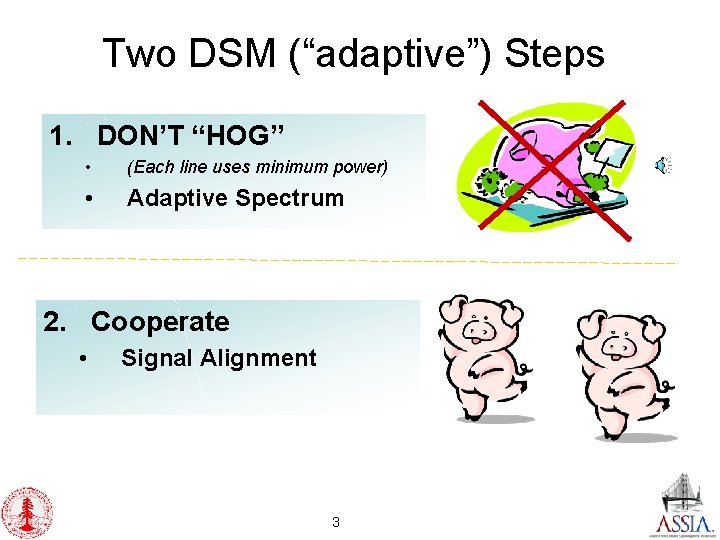
Two DSM (“adaptive”) Steps 1. DON’T “HOG” • (Each line uses minimum power) • Adaptive Spectrum 2. Cooperate • Signal Alignment 3
Outline • Step One (Adaptive Spectra) – Margin/Rate management – Impulse/code management • Step Two (Signal Alignment) 4
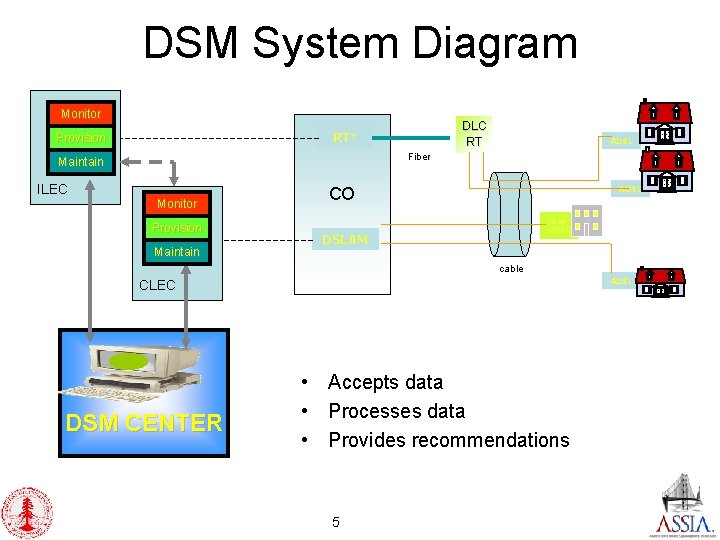
DSM System Diagram Monitor DLC RT RT+ Provision ADSL Fiber Maintain ILEC Monitor Provision Maintain ADSL CO H or VDSL DSLAM cable ADSL CLEC DSM CENTER • Accepts data • Processes data • Provides recommendations 5
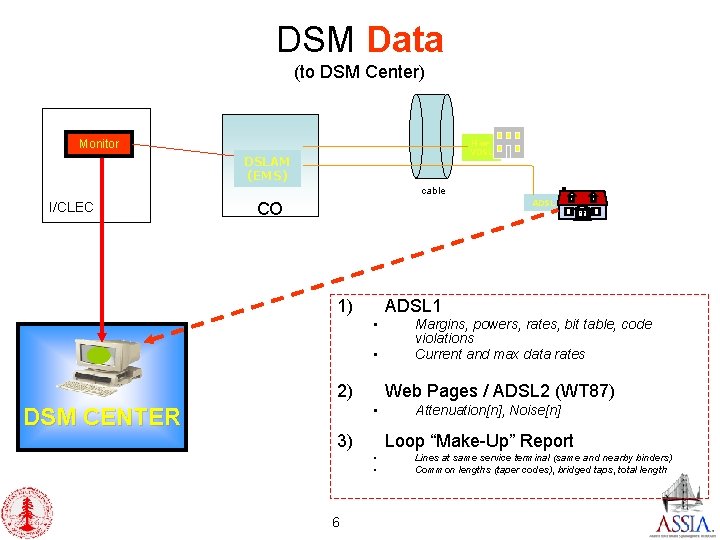
DSM Data (to DSM Center) H or VDSL Monitor DSLAM (EMS) cable I/CLEC ADSL CO 1) ADSL 1 • • 2) DSM CENTER Web Pages / ADSL 2 (WT 87) • 3) Attenuation[n], Noise[n] Loop “Make-Up” Report • • 6 Margins, powers, rates, bit table, code violations Current and max data rates Lines at same service terminal (same and nearby binders) Common lengths (taper codes), bridged taps, total length
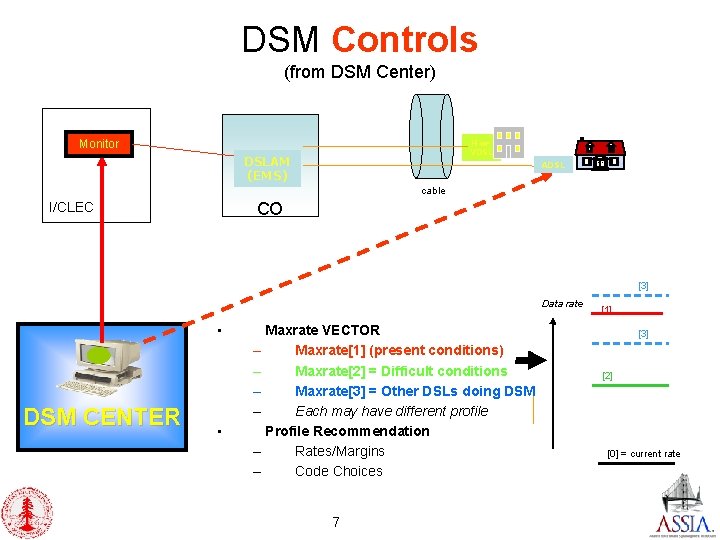
DSM Controls (from DSM Center) H or VDSL Monitor DSLAM (EMS) ADSL cable CO I/CLEC [3] Data rate • DSM CENTER • Maxrate VECTOR – Maxrate[1] (present conditions) – Maxrate[2] = Difficult conditions – Maxrate[3] = Other DSLs doing DSM – Each may have different profile Profile Recommendation – Rates/Margins – Code Choices 7 [1] [3] [2] [0] = current rate
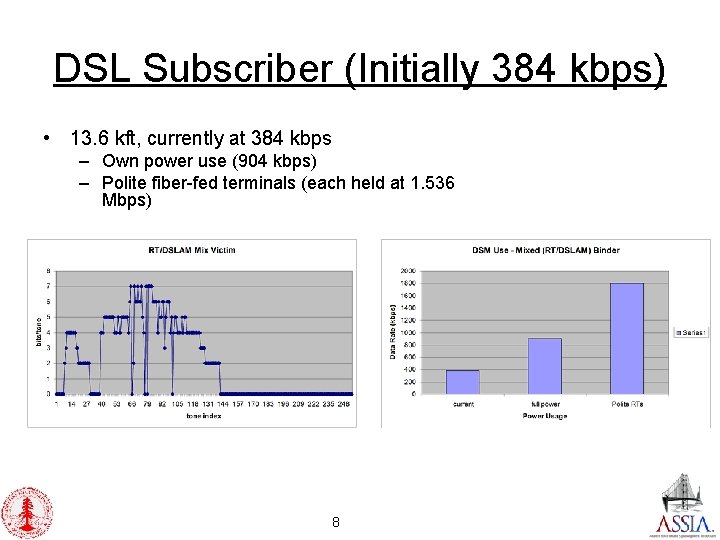
DSL Subscriber (Initially 384 kbps) • 13. 6 kft, currently at 384 kbps – Own power use (904 kbps) – Polite fiber-fed terminals (each held at 1. 536 Mbps) 8
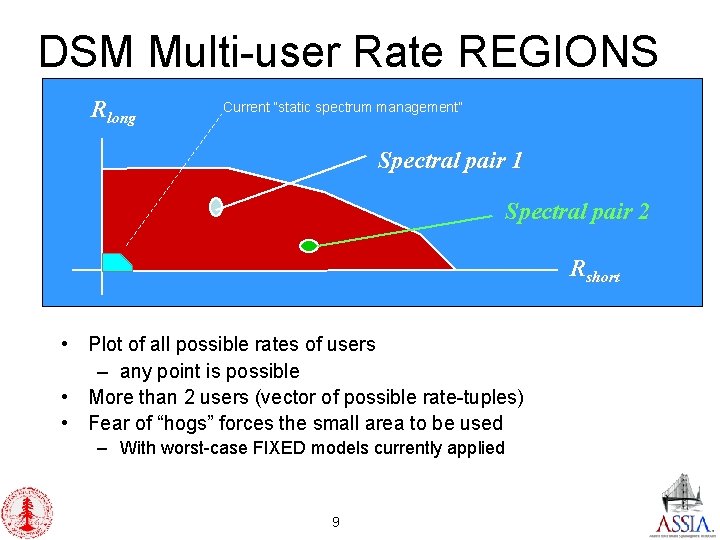
DSM Multi-user Rate REGIONS Rlong Current “static spectrum management” Spectral pair 1 Spectral pair 2 Rshort • Plot of all possible rates of users – any point is possible • More than 2 users (vector of possible rate-tuples) • Fear of “hogs” forces the small area to be used – With worst-case FIXED models currently applied 9
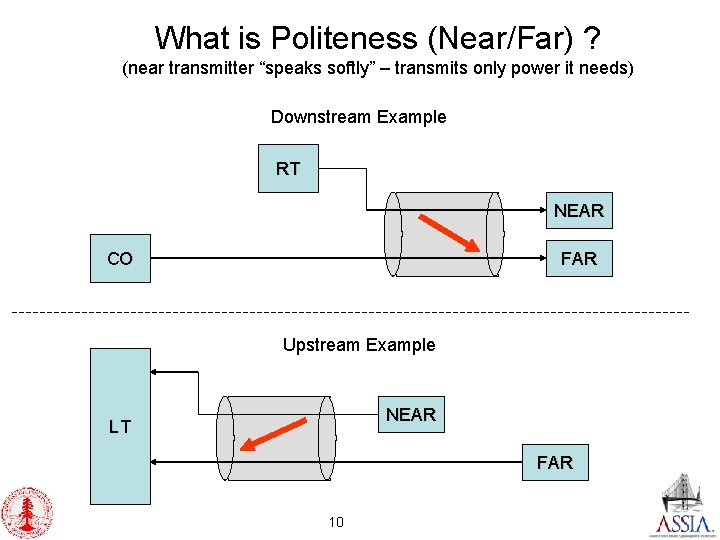
What is Politeness (Near/Far) ? (near transmitter “speaks softly” – transmits only power it needs) Downstream Example RT NEAR CO FAR Upstream Example NEAR LT FAR 10
Telcordia DSM-ADSL Rate Regions [T 1 E 1. 4/2002 -063] 15 kft Fiber, 10 kft A A 5 kft Copper, 15 kft lines 1 & 3 (2 held at 1. 6 Mbps) A A Nominal 300 kbps A lines 1 & 2 (3 removed) – 063 R 1 • Nominal 15 kft data rate without DSM – 300 kbps 11
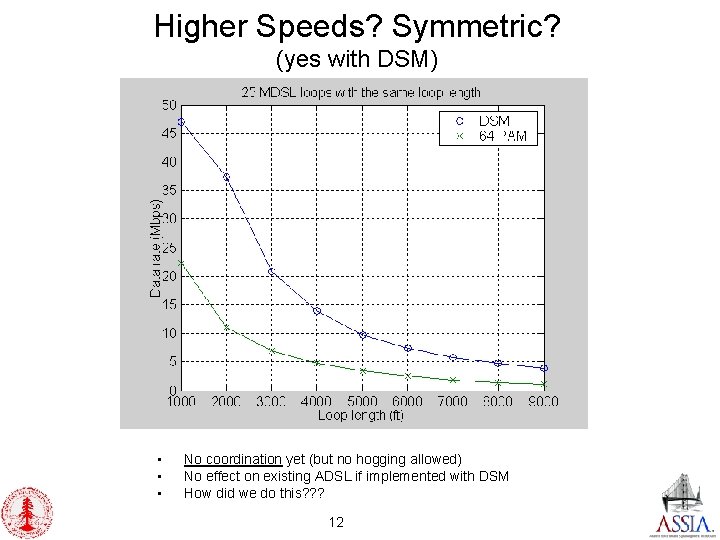
Higher Speeds? Symmetric? (yes with DSM) • • • No coordination yet (but no hogging allowed) No effect on existing ADSL if implemented with DSM How did we do this? ? ? 12
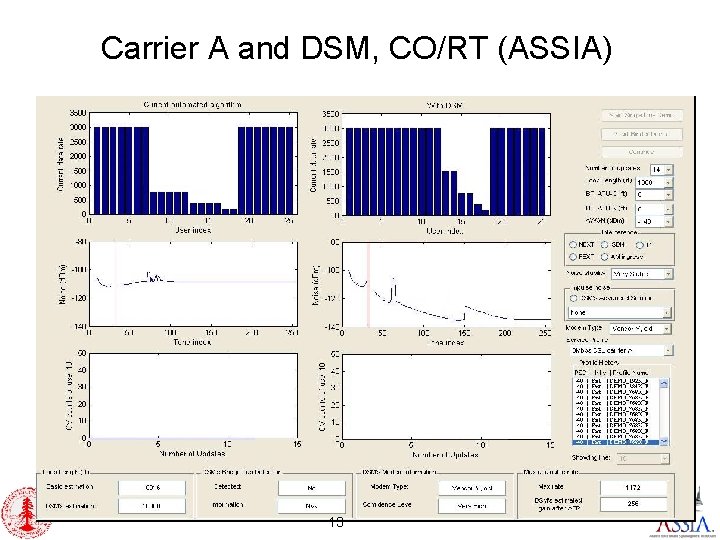
Carrier A and DSM, CO/RT (ASSIA) 13
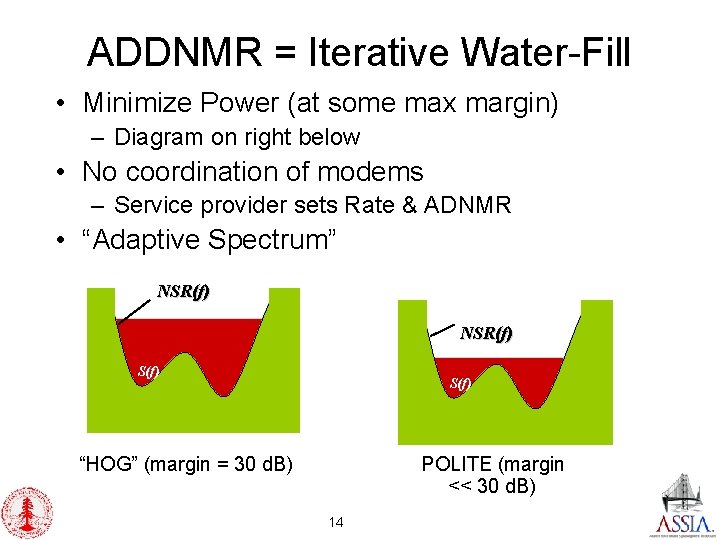
ADDNMR = Iterative Water-Fill • Minimize Power (at some max margin) – Diagram on right below • No coordination of modems – Service provider sets Rate & ADNMR • “Adaptive Spectrum” NSR(f) S(f) “HOG” (margin = 30 d. B) POLITE (margin << 30 d. B) 14
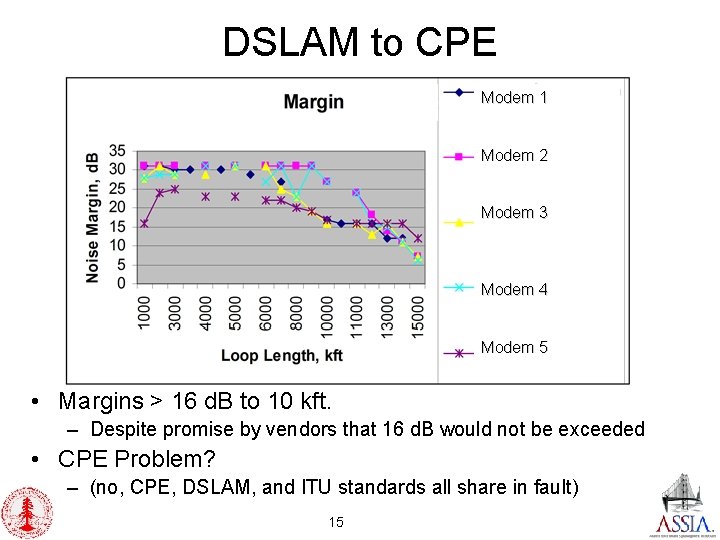
DSLAM to CPE Modem 1 Modem 2 Modem 3 Modem 4 Modem 5 • Margins > 16 d. B to 10 kft. – Despite promise by vendors that 16 d. B would not be exceeded • CPE Problem? – (no, CPE, DSLAM, and ITU standards all share in fault) 15
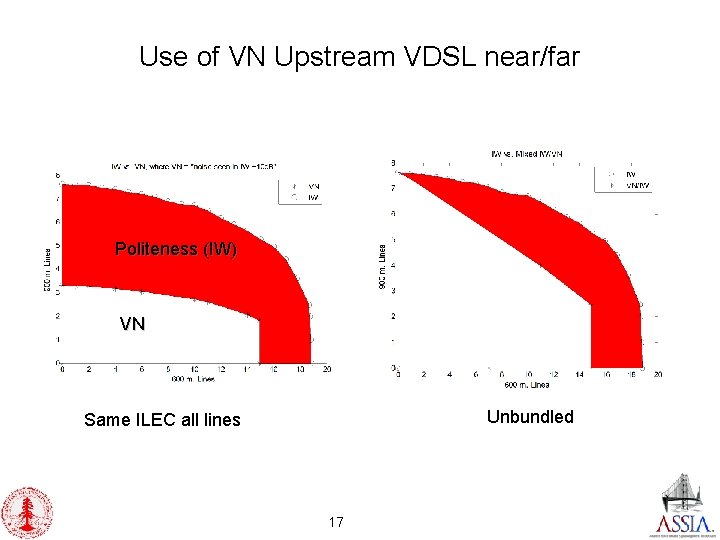
Another Vendor Issue – “Virtual Noise” • Telco sets a worst-case noise – Often wrong or not possible – Undue conservative (opposite of politeness) 16
Use of VN Upstream VDSL near/far Politeness (IW) VN Unbundled Same ILEC all lines 17
Outline • Step One (Adaptive Spectra) – Margin/Rate management – Impulse/code management • Step Two (Signal Alignment) 18
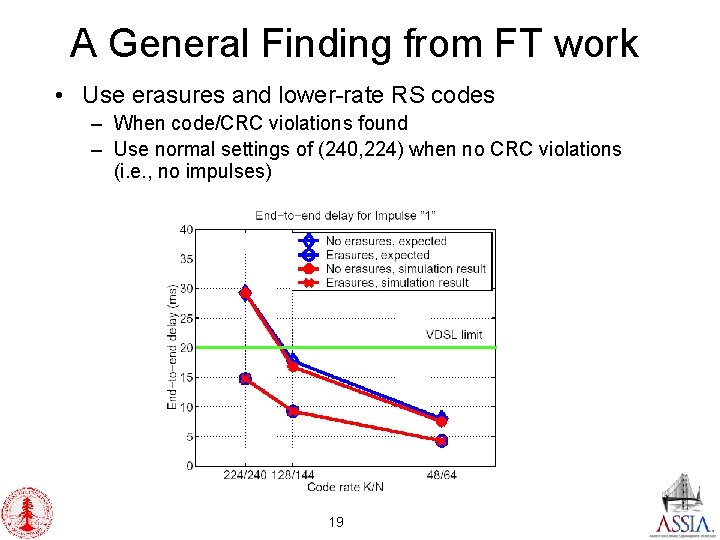
A General Finding from FT work • Use erasures and lower-rate RS codes – When code/CRC violations found – Use normal settings of (240, 224) when no CRC violations (i. e. , no impulses) 19
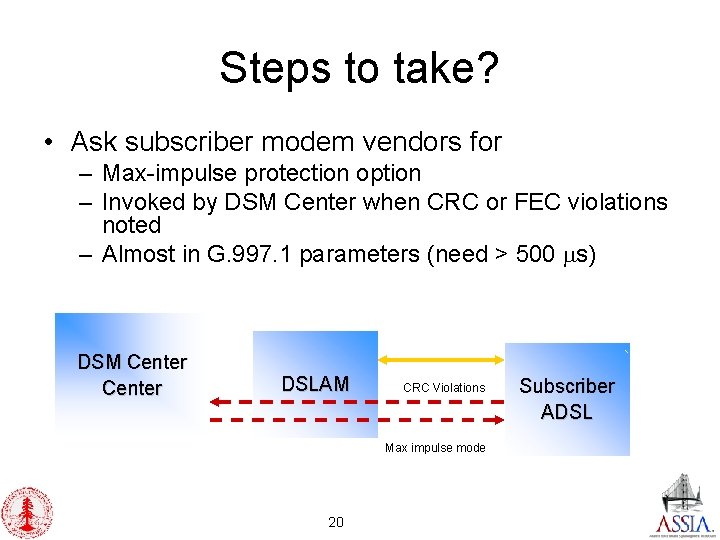
Steps to take? • Ask subscriber modem vendors for – Max-impulse protection option – Invoked by DSM Center when CRC or FEC violations noted – Almost in G. 997. 1 parameters (need > 500 ms) DSM Center DSLAM CRC Violations Max impulse mode 20 Subscriber ADSL
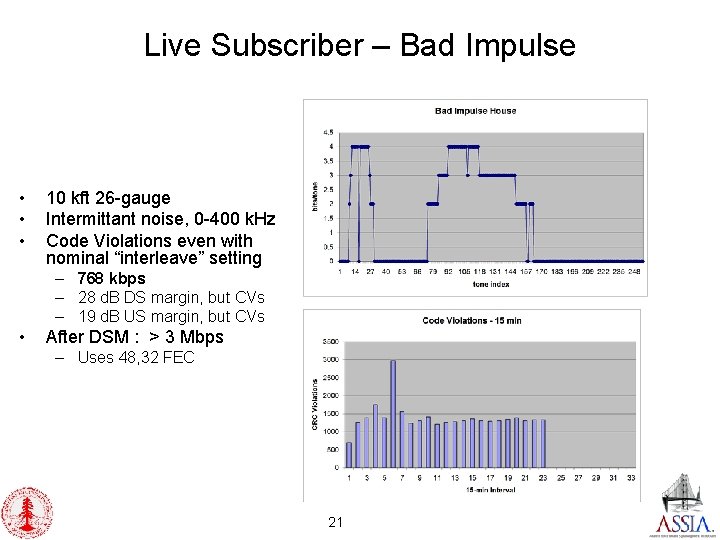
Live Subscriber – Bad Impulse • • • 10 kft 26 -gauge Intermittant noise, 0 -400 k. Hz Code Violations even with nominal “interleave” setting – 768 kbps – 28 d. B DS margin, but CVs – 19 d. B US margin, but CVs • After DSM : > 3 Mbps – Uses 48, 32 FEC 21
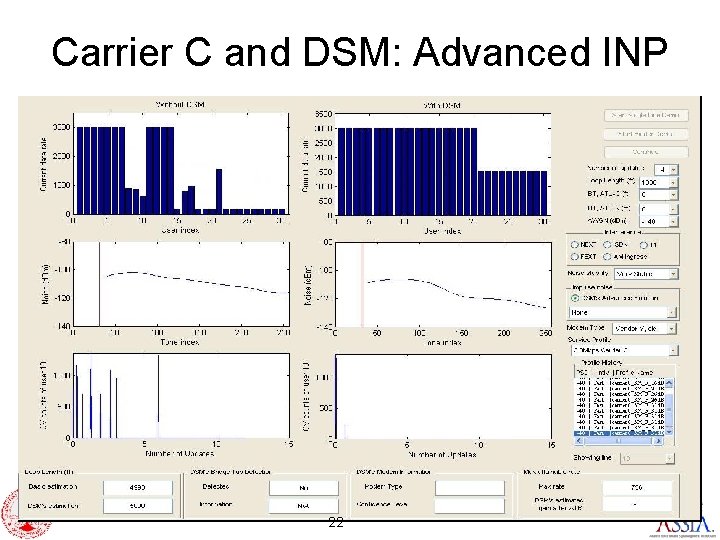
Carrier C and DSM: Advanced INP 22
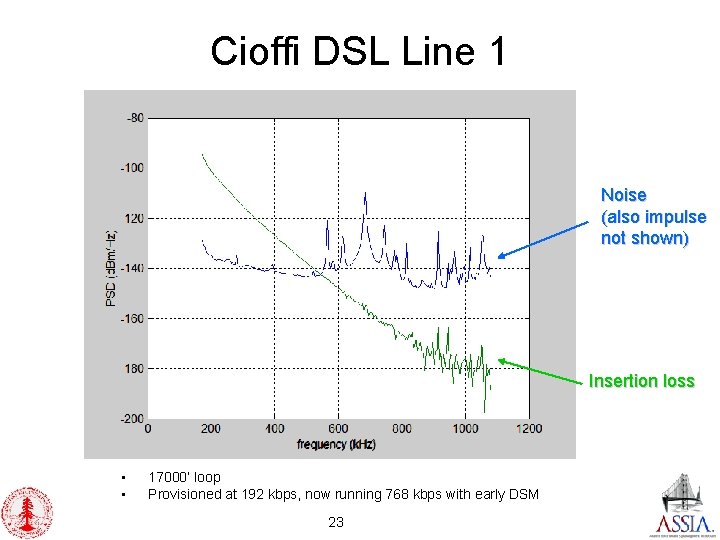
Cioffi DSL Line 1 Noise (also impulse not shown) Insertion loss • • 17000’ loop Provisioned at 192 kbps, now running 768 kbps with early DSM 23
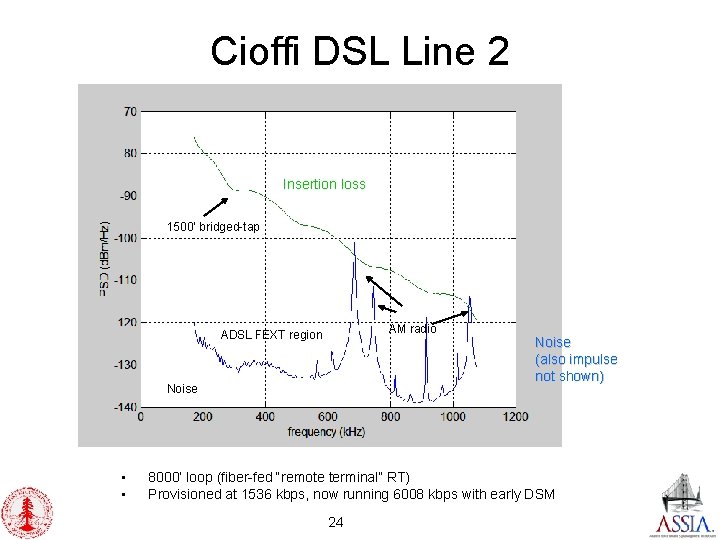
Cioffi DSL Line 2 Insertion loss 1500’ bridged-tap AM radio ADSL FEXT region Noise • • Noise (also impulse not shown) 8000’ loop (fiber-fed “remote terminal” RT) Provisioned at 1536 kbps, now running 6008 kbps with early DSM 24
Outline • Step One (Adaptive Spectra) – Margin/Rate management – Impulse/code management • Step Two (Signal Alignment) 25
Bonding ≠ Vectoring • Bonding – Use N lines to get N x the data rate • Possible to vector also, but bonding does not force use of vectoring – Mux and inverse Mux • Vectoring – – Cogenerate at PHY level signals and/or Coreceive at PHY level signals Can do one-sided without bonding Can do one/two-sided with vectoring 26
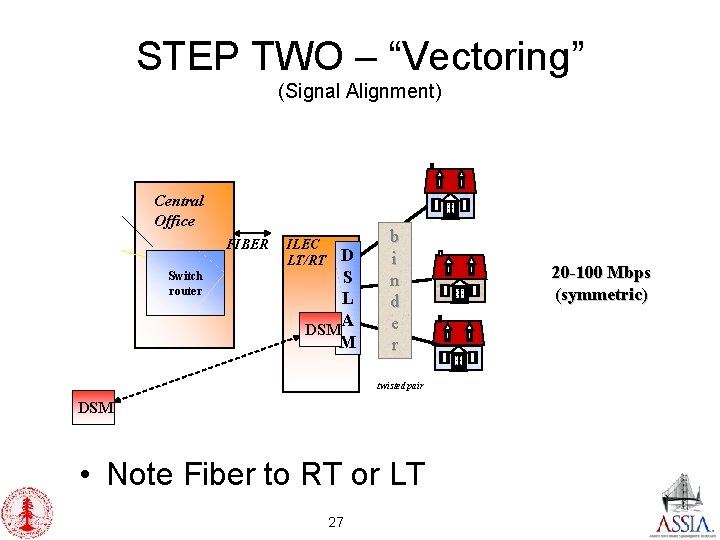
STEP TWO – “Vectoring” (Signal Alignment) Central Office FIBER Switch router ILEC LT/RT D S L A DSM M b i n d e r twisted pair DSM • Note Fiber to RT or LT 27 20 -100 Mbps (symmetric)
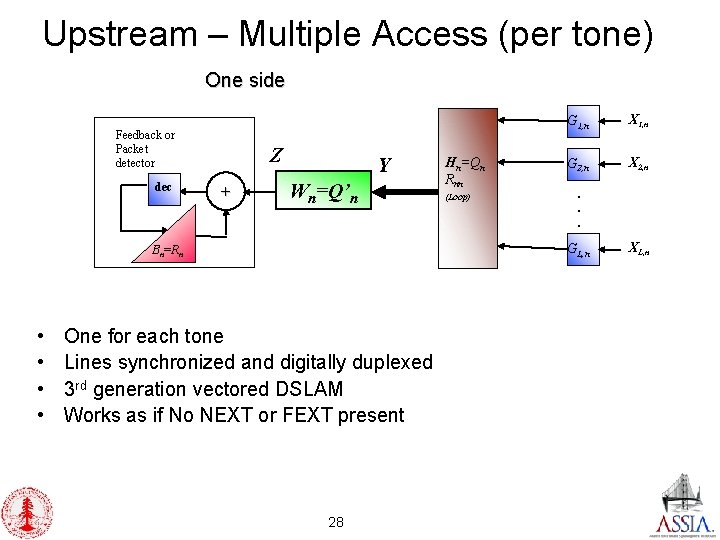
Upstream – Multiple Access (per tone) One side Feedback or Packet detector dec Z + Y Wn=Q’n (Loop) X 1, n G 2, n X 2, n . . . GL, n Bn=Rn • • Hn=Qn Rnn G 1, n One for each tone Lines synchronized and digitally duplexed 3 rd generation vectored DSLAM Works as if No NEXT or FEXT present 28 XL, n
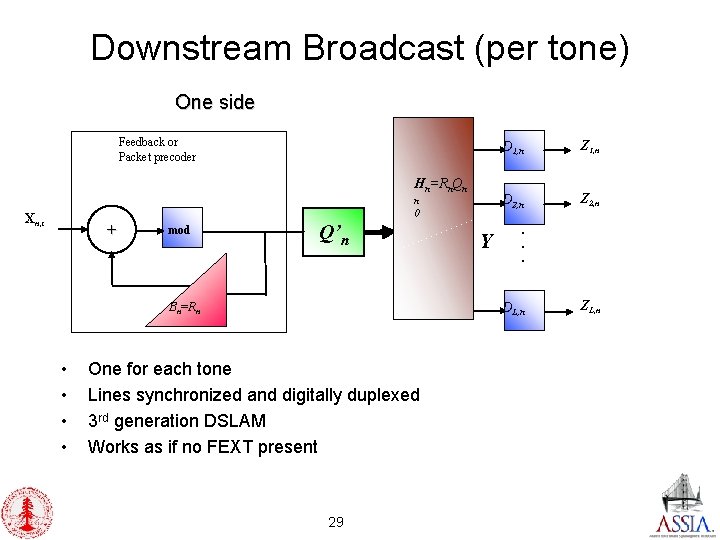
Downstream Broadcast (per tone) One side Feedback or Packet precoder Hn=Rn. Qn n () Xn, i + mod Q’n Z 1, n D 2, n Z 2, n . . . DL, n Bn=Rn • • Y D 1, n One for each tone Lines synchronized and digitally duplexed 3 rd generation DSLAM Works as if no FEXT present 29 ZL, n
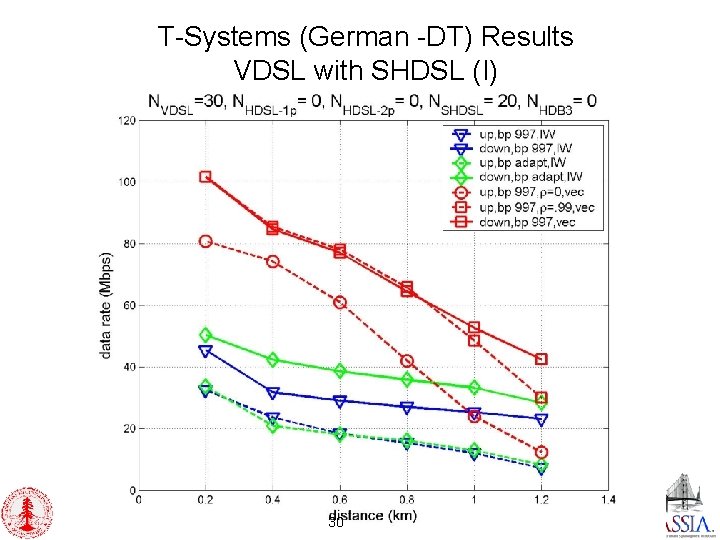
T-Systems (German -DT) Results VDSL with SHDSL (I) 30
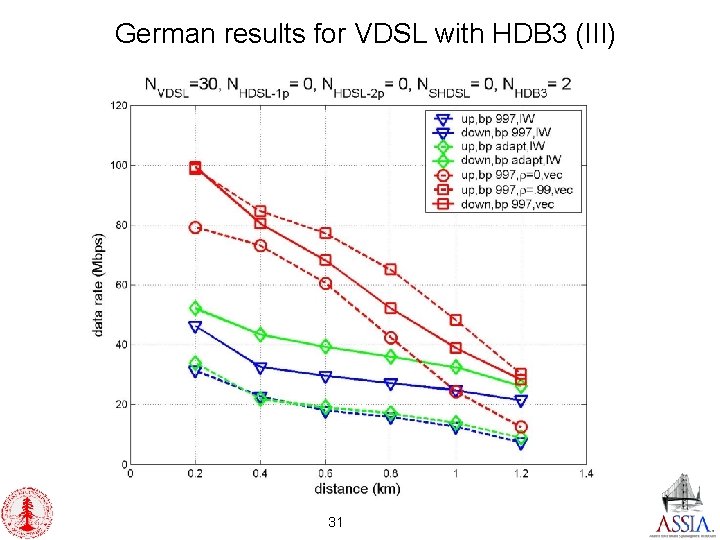
German results for VDSL with HDB 3 (III) 31
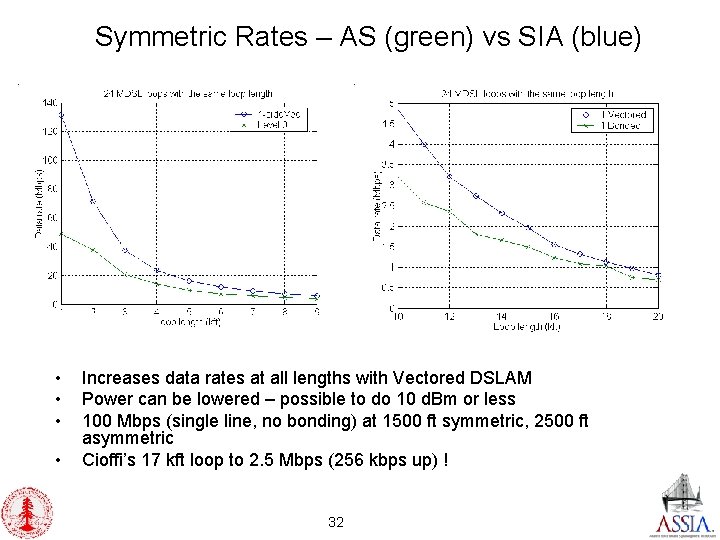
Symmetric Rates – AS (green) vs SIA (blue) • • Increases data rates at all lengths with Vectored DSLAM Power can be lowered – possible to do 10 d. Bm or less 100 Mbps (single line, no bonding) at 1500 ft symmetric, 2500 ft asymmetric Cioffi’s 17 kft loop to 2. 5 Mbps (256 kbps up) ! 32
Ultimate Result of Vectoring • Distribution Area to 100 Mbps single line • 1000 M x 100 Mbps – Getting closer to the goal 33
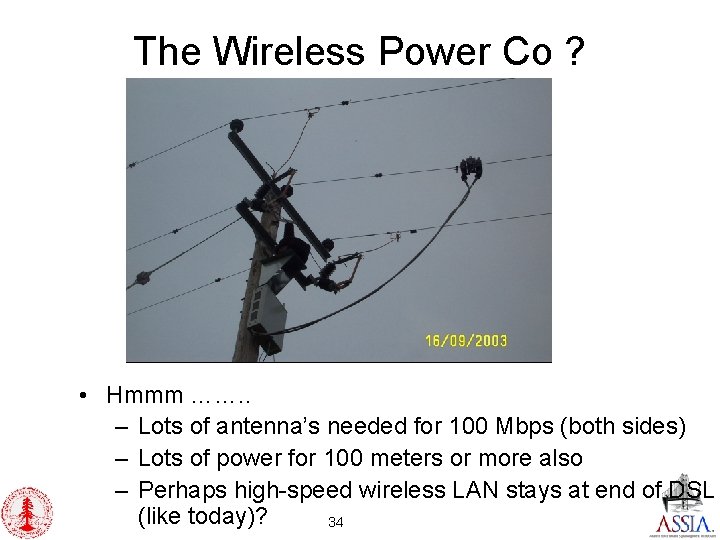
The Wireless Power Co ? • Hmmm ……. . – Lots of antenna’s needed for 100 Mbps (both sides) – Lots of power for 100 meters or more also – Perhaps high-speed wireless LAN stays at end of DSL (like today)? 34
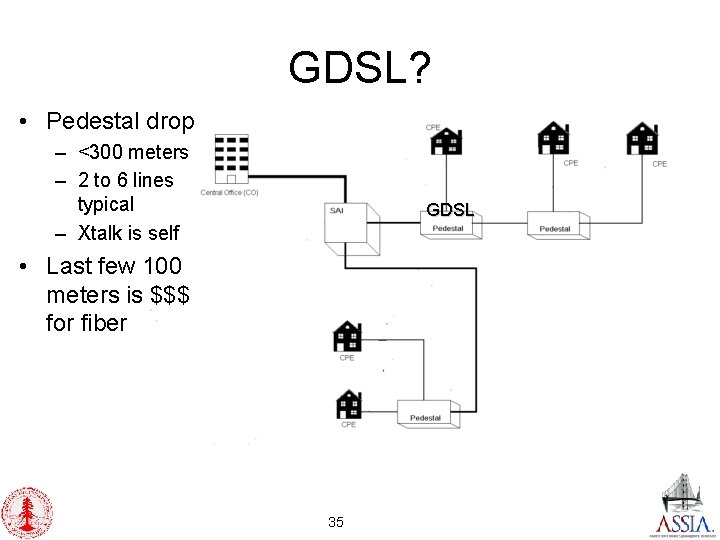
GDSL? • Pedestal drop – <300 meters – 2 to 6 lines typical – Xtalk is self GDSL • Last few 100 meters is $$$ for fiber 35
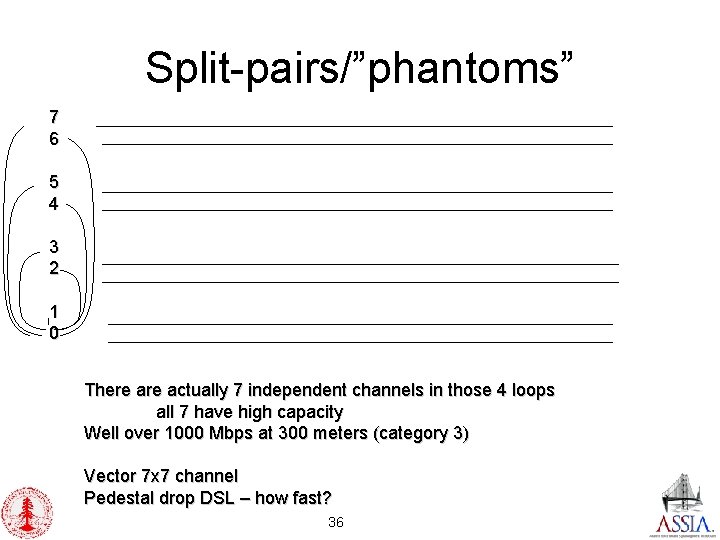
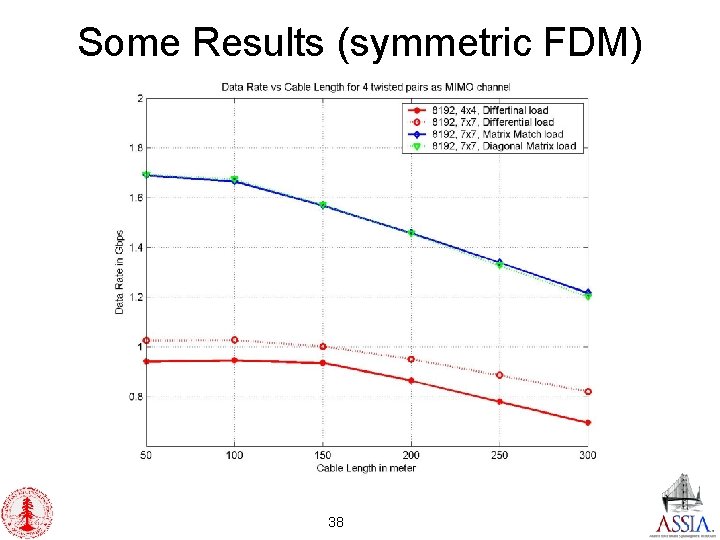
Split-pairs/”phantoms” 7 6 5 4 3 2 1 0 There actually 7 independent channels in those 4 loops all 7 have high capacity Well over 1000 Mbps at 300 meters (category 3) Vector 7 x 7 channel Pedestal drop DSL – how fast? 36
Matrix Matched Load • Resistor across all 7 possibilities 37
Some Results (symmetric FDM) 38
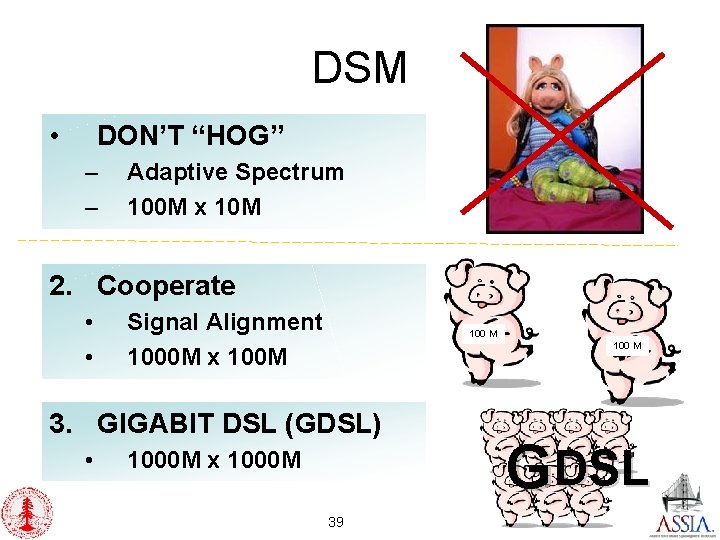
DSM • DON’T “HOG” – – Adaptive Spectrum 100 M x 10 M 2. Cooperate • • Signal Alignment 1000 M x 100 M 100 M 3. GIGABIT DSL (GDSL) • 1000 M x 1000 M 39 GDSL