
Dynamic Singlesource Shortest Paths Camil Demetrescu University of
![A fast implem. (RRL) [Dem. ’ 01] increase(u, v, ) Exercise 7: write decrease(u,](https://slidetodoc.com/presentation_image_h2/5f47312ca569a17d70ba31ef011c24df/image-16.jpg "A fast implem. (RRL) [Dem. ’ 01] increase(u, v, ) Exercise 7: write decrease(u,")



![Further readings Ramalingam & Reps’ approach + RR algorithm: [Ramalingam-Reps’ 96] G. Ramalingam, Thomas](https://slidetodoc.com/presentation_image_h2/5f47312ca569a17d70ba31ef011c24df/image-22.jpg "Further readings Ramalingam & Reps’ approach + RR algorithm: [Ramalingam-Reps’ 96] G. Ramalingam, Thomas")
- Slides: 22
Dynamic Single-source Shortest Paths Camil Demetrescu University of Rome “La Sapienza”
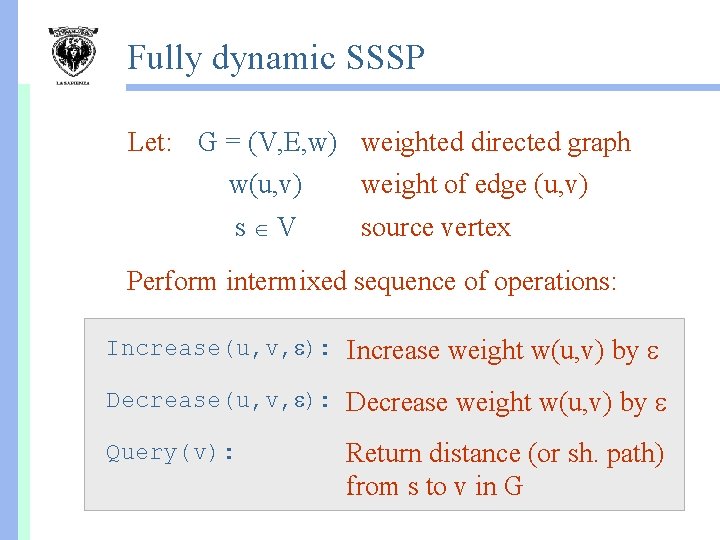
Fully dynamic SSSP Let: G = (V, E, w) weighted directed graph w(u, v) weight of edge (u, v) s V source vertex Perform intermixed sequence of operations: Increase(u, v, ): Increase weight w(u, v) by Decrease(u, v, ): Decrease weight w(u, v) by Query(v): Return distance (or sh. path) from s to v in G
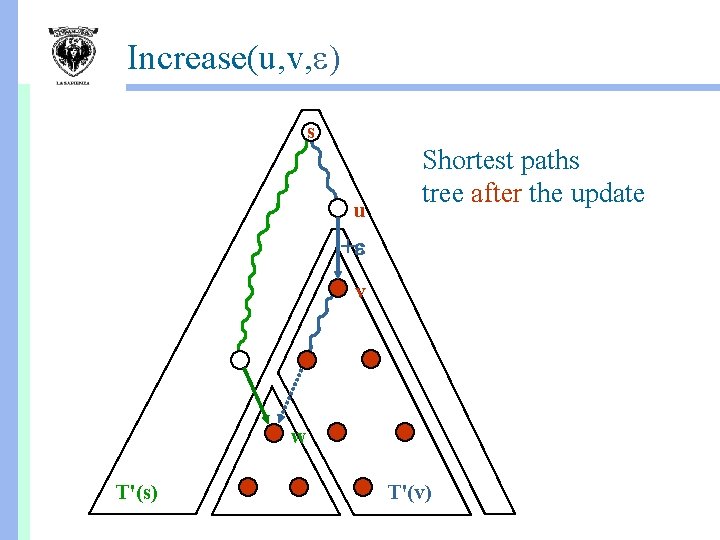
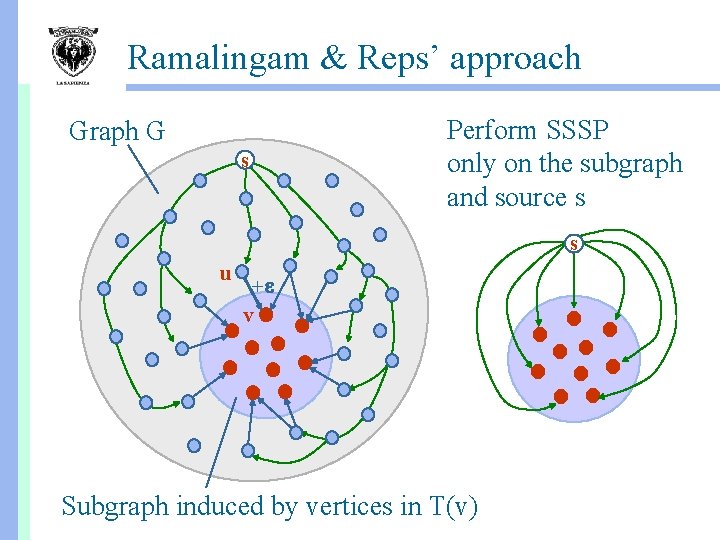
Ramalingam & Reps’ approach Maintain a shortest paths tree throughout the sequence of updates Querying a shortest paths or distance takes optimal time Update operations work only on the portion of tree affected by the update Each update may take as long as a static SSSP computation in the worst case! Very efficient in practice
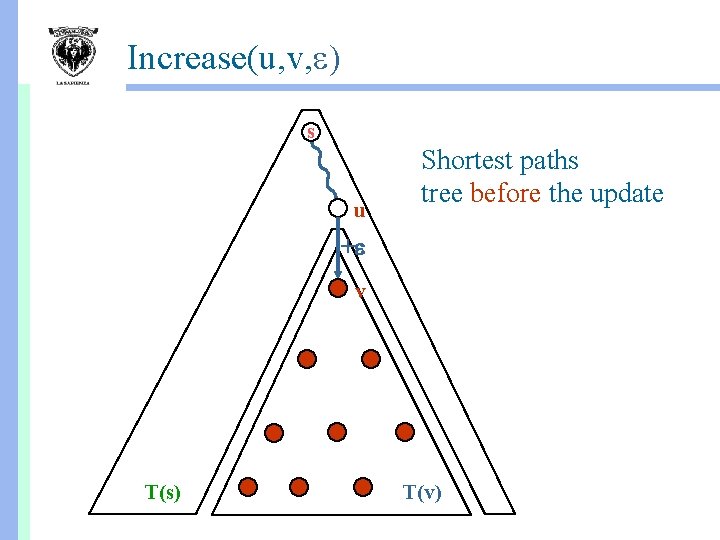
Increase(u, v, ) s u Shortest paths tree before the update +e v T(s) T(v)
Increase(u, v, ) s u Shortest paths tree after the update +e v + w T'(s) T'(v)
Ramalingam & Reps’ approach Graph G s Perform SSSP only on the subgraph and source s s u +e v Subgraph induced by vertices in T(v)
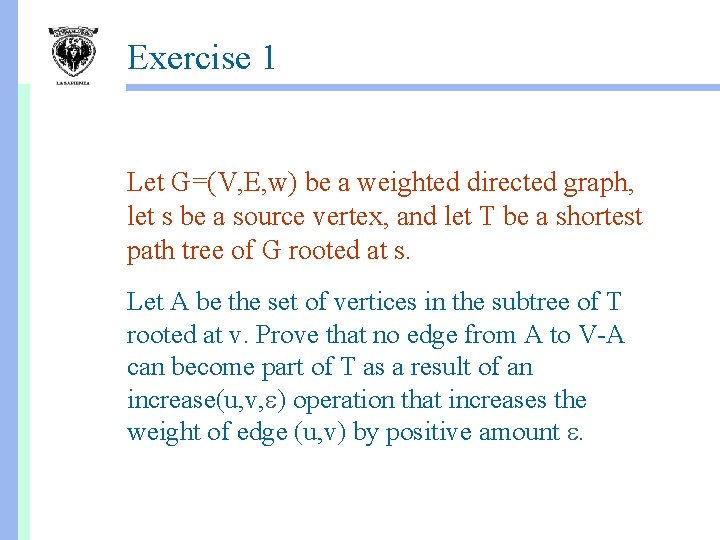
Exercise 1 Let G=(V, E, w) be a weighted directed graph, let s be a source vertex, and let T be a shortest path tree of G rooted at s. Let A be the set of vertices in the subtree of T rooted at v. Prove that no edge from A to V-A can become part of T as a result of an increase(u, v, ) operation that increases the weight of edge (u, v) by positive amount .
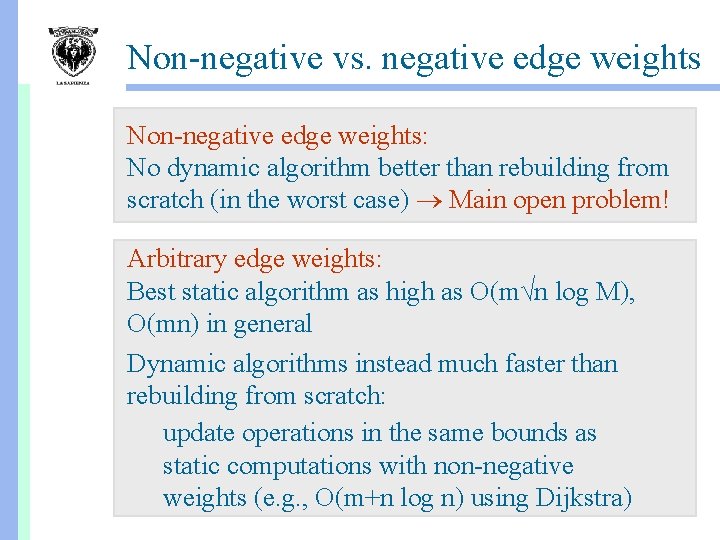
Non-negative vs. negative edge weights Non-negative edge weights: No dynamic algorithm better than rebuilding from scratch (in the worst case) Main open problem! Arbitrary edge weights: Best static algorithm as high as O(m√n log M), O(mn) in general Dynamic algorithms instead much faster than rebuilding from scratch: update operations in the same bounds as static computations with non-negative weights (e. g. , O(m+n log n) using Dijkstra)
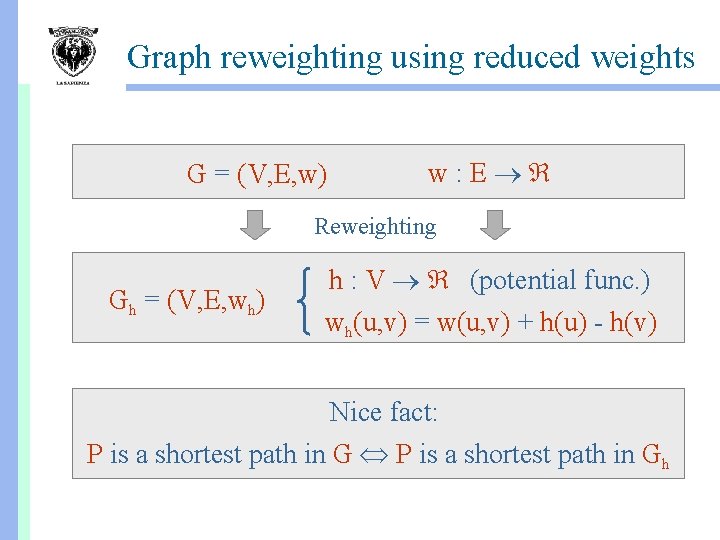
Graph reweighting using reduced weights G = (V, E, w) w: E Reweighting Gh = (V, E, wh) h : V (potential func. ) wh(u, v) = w(u, v) + h(u) - h(v) Nice fact: P is a shortest path in Gh
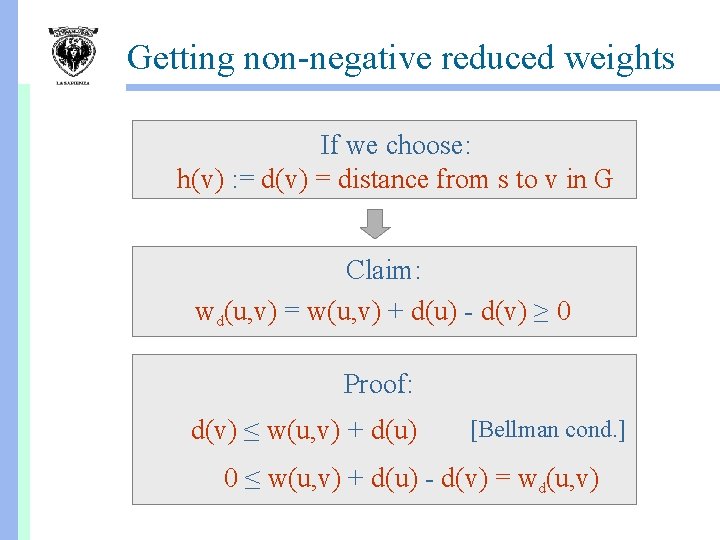
Getting non-negative reduced weights If we choose: h(v) : = d(v) = distance from s to v in G Claim: wd(u, v) = w(u, v) + d(u) - d(v) ≥ 0 Proof: d(v) ≤ w(u, v) + d(u) [Bellman cond. ] 0 ≤ w(u, v) + d(u) - d(v) = wd(u, v)
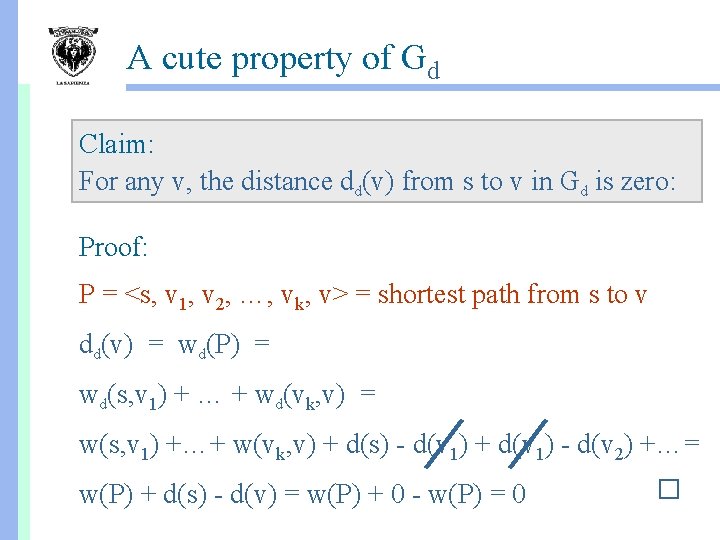
A cute property of Gd Claim: For any v, the distance dd(v) from s to v in Gd is zero: Proof: P = <s, v 1, v 2, …, vk, v> = shortest path from s to v dd(v) = wd(P) = wd(s, v 1) + … + wd(vk, v) = w(s, v 1) +…+ w(vk, v) + d(s) - d(v 1) + d(v 1) - d(v 2) +…= w(P) + d(s) - d(v) = w(P) + 0 - w(P) = 0
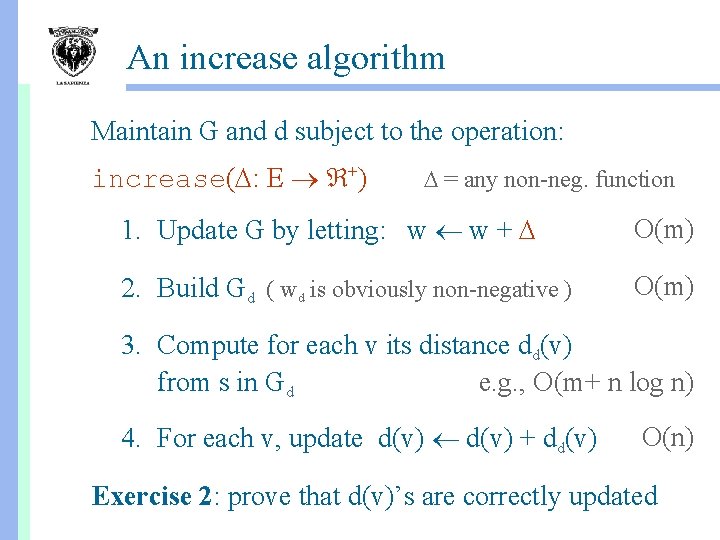
An increase algorithm Maintain G and d subject to the operation: increase( : E +) = any non-neg. function 1. Update G by letting: w w + O(m) 2. Build Gd ( wd is obviously non-negative ) O(m) 3. Compute for each v its distance dd(v) from s in Gd e. g. , O(m+ n log n) 4. For each v, update d(v) + dd(v) O(n) Exercise 2: prove that d(v)’s are correctly updated
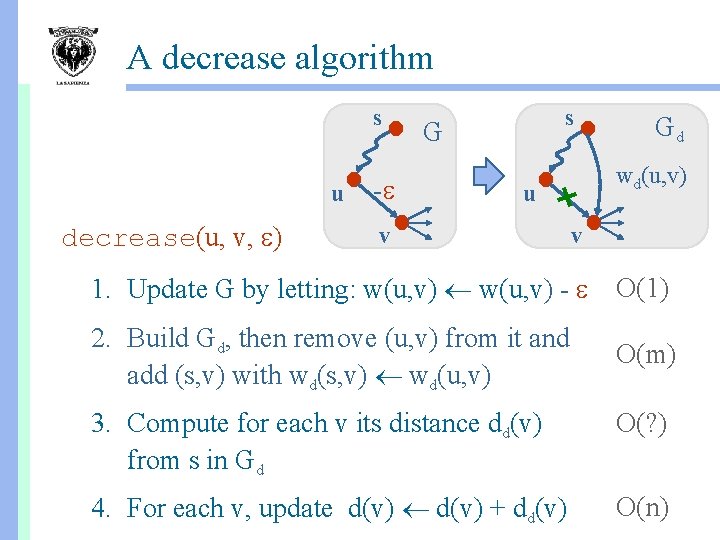
A decrease algorithm s u decrease(u, v, ) - s G wd(u, v) u v Gd v 1. Update G by letting: w(u, v) - O(1) 2. Build Gd, then remove (u, v) from it and add (s, v) with wd(s, v) wd(u, v) O(m) 3. Compute for each v its distance dd(v) from s in Gd O(? ) 4. For each v, update d(v) + dd(v) O(n)
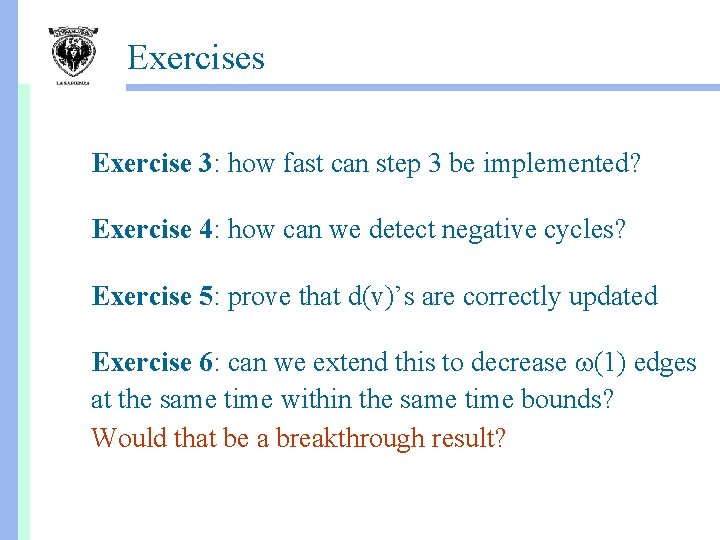
Exercises Exercise 3: how fast can step 3 be implemented? Exercise 4: how can we detect negative cycles? Exercise 5: prove that d(v)’s are correctly updated Exercise 6: can we extend this to decrease (1) edges at the same time within the same time bounds? Would that be a breakthrough result?
Theory and practice In theory, for arbitrary edge weights, we can do much better than rebuilding from scratch O(m·n) O(m+n·log n) In practice, can we get fast codes? Two tricks: • Only work for vertices affected by the update (Ramalingam-Reps’ approach) • Avoid to build Gd explicitly
A fast implem. (RRL) [Dem. ’ 01] increase(u, v, ) Exercise 7: write decrease(u, v, ) w(u, v) + if (u, v) T(v) then return let H be a priority queue add x T(v) to H with priority: p(x) = min(z, x): z T(v) d(z) + w(z, x) - d(x) while (H ≠ ) x extract min priority vertex from H d(x) + p(x) for each (x, y) if d(x) + w(x, y) - d(y) < p(y) then p(y) d(x) + w(x, y) - d(y)
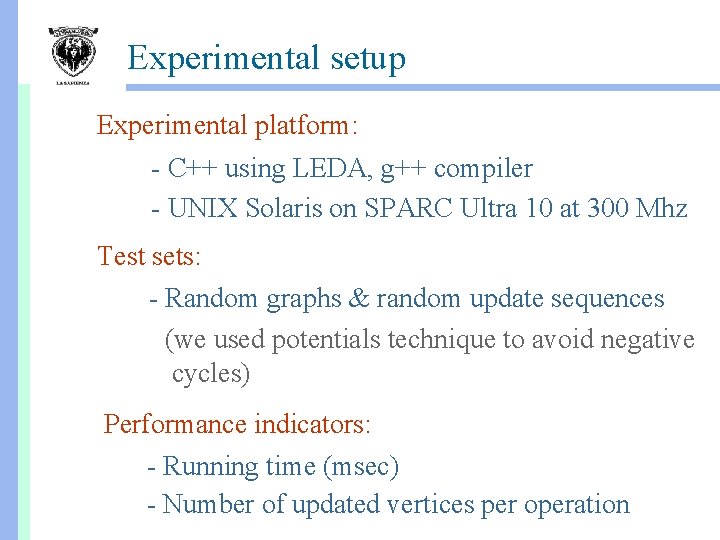
Experimental setup Experimental platform: - C++ using LEDA, g++ compiler - UNIX Solaris on SPARC Ultra 10 at 300 Mhz Test sets: - Random graphs & random update sequences (we used potentials technique to avoid negative cycles) Performance indicators: - Running time (msec) - Number of updated vertices per operation
Static vs. dynamic
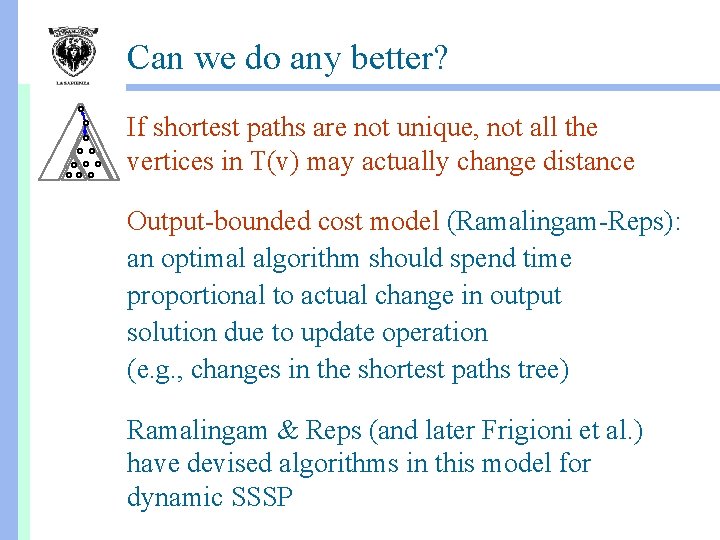
Can we do any better? + If shortest paths are not unique, not all the vertices in T(v) may actually change distance Output-bounded cost model (Ramalingam-Reps): an optimal algorithm should spend time proportional to actual change in output solution due to update operation (e. g. , changes in the shortest paths tree) Ramalingam & Reps (and later Frigioni et al. ) have devised algorithms in this model for dynamic SSSP
Static vs. dynamic
Number of updated vertices +
Further readings Ramalingam & Reps’ approach + RR algorithm: [Ramalingam-Reps’ 96] G. Ramalingam, Thomas W. Reps: An Incremental Algorithm for a Generalization of the Shortest-Path Problem. J. Algorithms 21(2): 267 -305 (1996) RRL algorithm + experiments: [Demetrescu’ 01] C. Demetrescu, Fully Dynamic Algorithms for Path Problems on Directed Graphs, Ph. D. Dissertation, University of Rome “La Sapienza”, April 2001 Other computational study (not covered in this lecture): Luciana S. Buriol, Mauricio G. C. Resende and Mikkel Thorup, Speeding up dynamic shortest paths http: //citeseer. ist. psu. edu/689842. html