
Dynamic Shortest Paths Camil Demetrescu University of Rome

- Slides: 31
Dynamic Shortest Paths Camil Demetrescu University of Rome “La Sapienza” Giuseppe F. Italiano University of Rome “Tor Vergata”
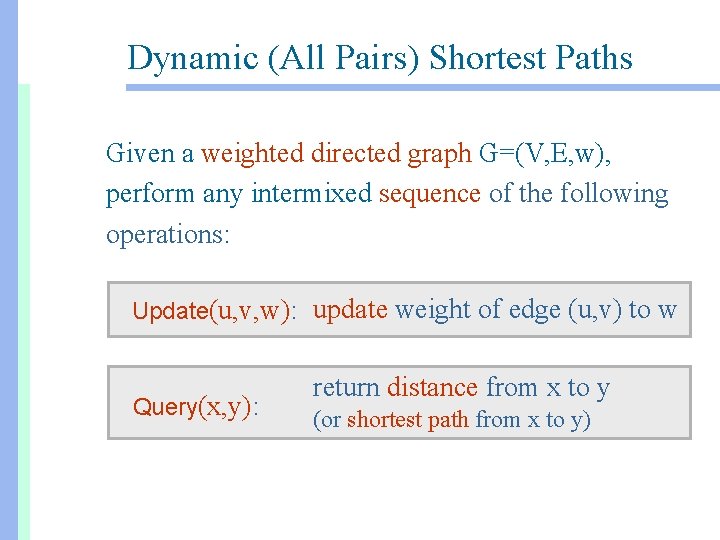
Dynamic (All Pairs) Shortest Paths Given a weighted directed graph G=(V, E, w), perform any intermixed sequence of the following operations: Update(u, v, w): update weight of edge (u, v) to w Query(x, y): return distance from x to y (or shortest path from x to y)
Previous work on dynamic APSP # papers 65 -69 70 -74 75 -79 80 -84 85 -89 90 -94 95 -99 00 -
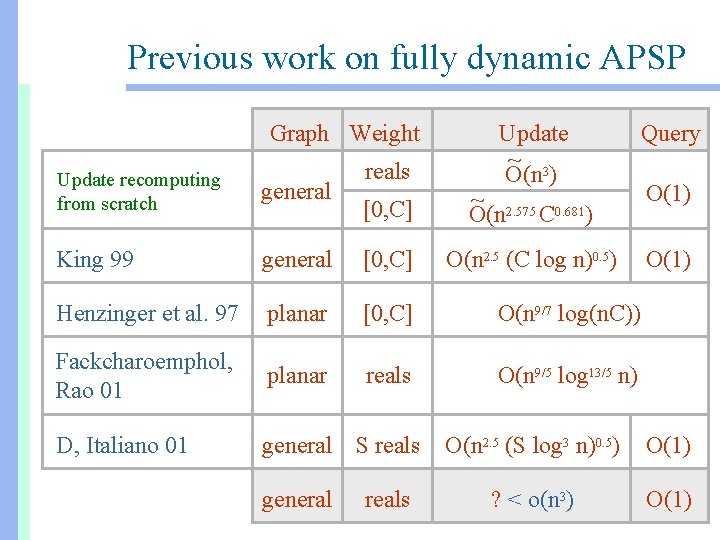
Previous work on fully dynamic APSP Graph Weight Update ~ 3 O(n ) Query [0, C] ~ 2. 575 0. 681 O(n C ) O(1) O(n 2. 5 (C log n)0. 5) O(1) reals Update recomputing from scratch general King 99 general [0, C] Henzinger et al. 97 planar [0, C] O(n 9/7 log(n. C)) Fackcharoemphol, Rao 01 planar reals O(n 9/5 log 13/5 n) D, Italiano 01 general S reals general reals O(n 2. 5 (S log 3 n)0. 5) O(1) ? < o(n 3) O(1)
A new approach New combinatorial properties of graphs: Uniform paths
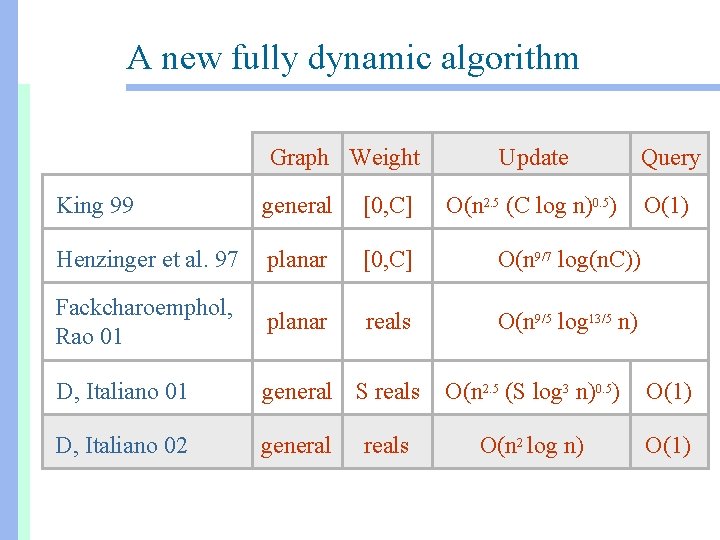
A new fully dynamic algorithm Graph Weight Update Query O(n 2. 5 (C log n)0. 5) O(1) King 99 general [0, C] Henzinger et al. 97 planar [0, C] O(n 9/7 log(n. C)) Fackcharoemphol, Rao 01 planar reals O(n 9/5 log 13/5 n) D, Italiano 01 general S reals D, Italiano 02 general reals O(n 2. 5 (S log 3 n)0. 5) O(1) O(n 2 log n) O(1)
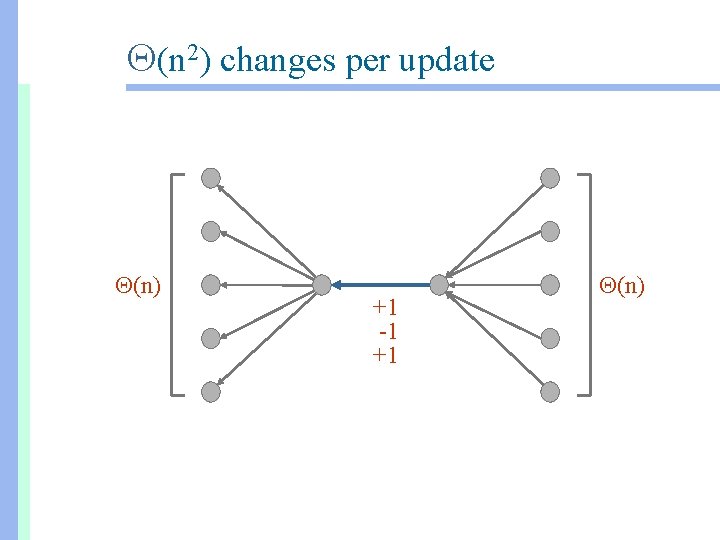
(n 2) changes per update (n) +1 -1 +1 (n)
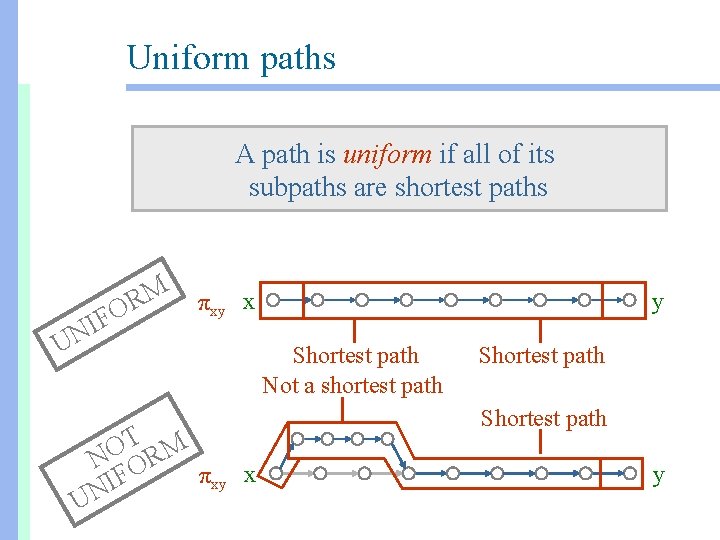
Uniform paths A path is uniform if all of its subpaths are shortest paths M R FO I UN πxy x T M O N OR π x F xy I N U y Shortest path Not a shortest path Shortest path y
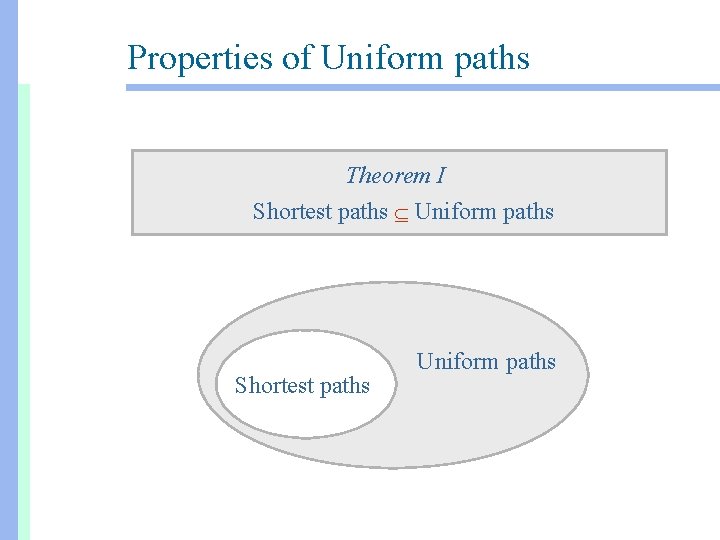
Properties of Uniform paths Theorem I Shortest paths Uniform paths Shortest paths Uniform paths
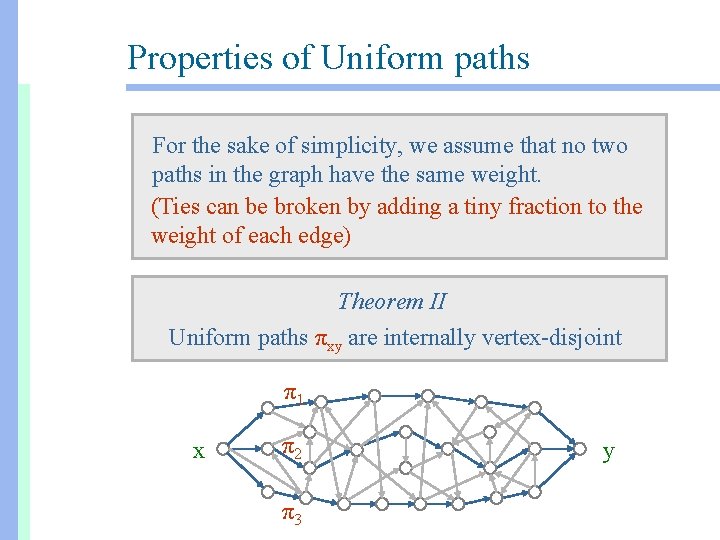
Properties of Uniform paths For the sake of simplicity, we assume that no two paths in the graph have the same weight. (Ties can be broken by adding a tiny fraction to the weight of each edge) Theorem II Uniform paths πxy are internally vertex-disjoint π1 x π2 π3 y
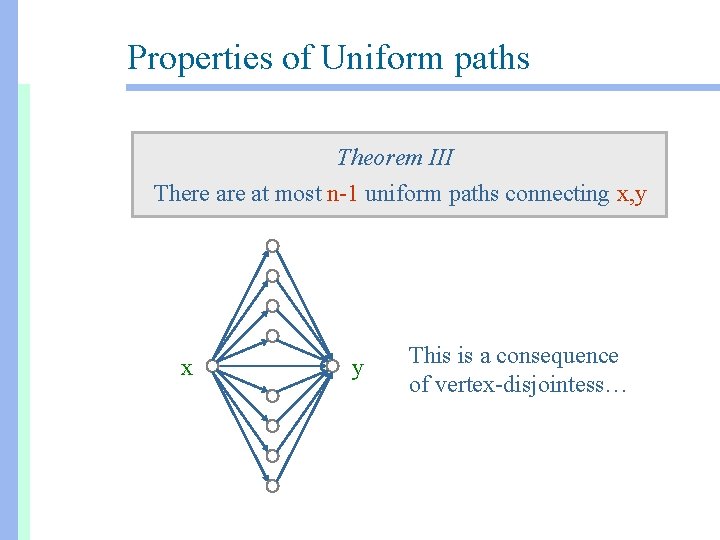
Properties of Uniform paths Theorem III There at most n-1 uniform paths connecting x, y x y This is a consequence of vertex-disjointess…
Dynamic graphs We call dynamic graph a sequence of graphs <G 0, …, Gk> such that, for any t, Gt-1 and Gt differ in the weight of exactly one edge
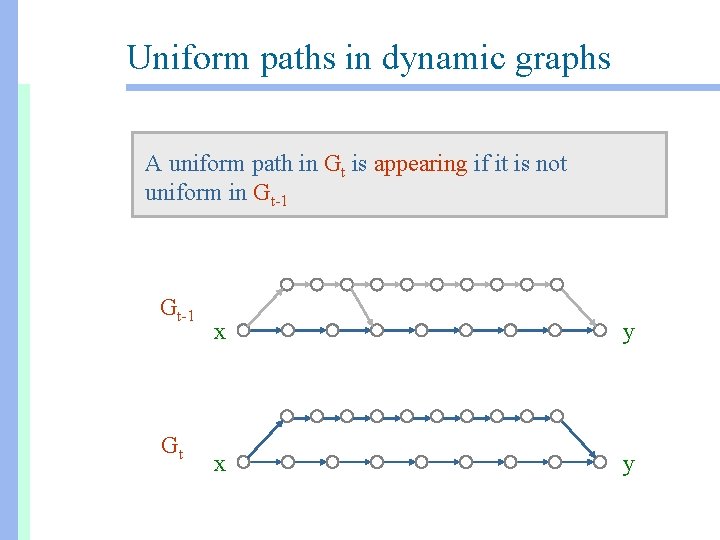
Uniform paths in dynamic graphs A uniform path in Gt is appearing if it is not uniform in Gt-1 Gt x y
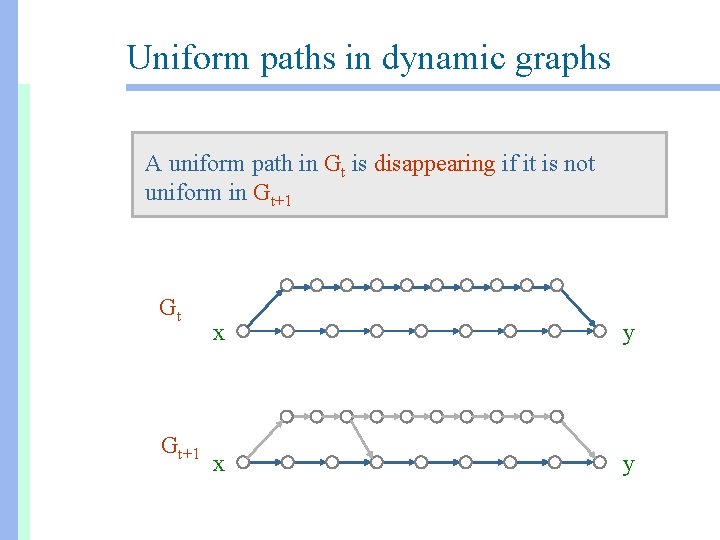
Uniform paths in dynamic graphs A uniform path in Gt is disappearing if it is not uniform in Gt+1 Gt Gt+1 x y
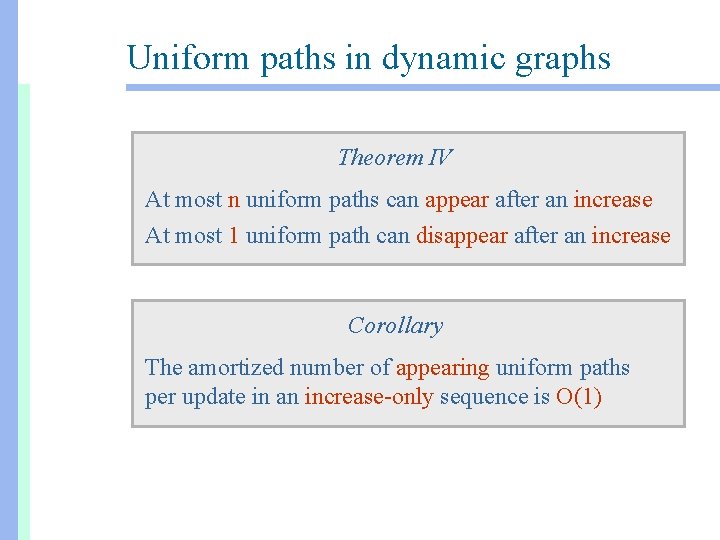
Uniform paths in dynamic graphs Theorem IV At most n uniform paths can appear after an increase At most 1 uniform path can disappear after an increase Corollary The amortized number of appearing uniform paths per update in an increase-only sequence is O(1)
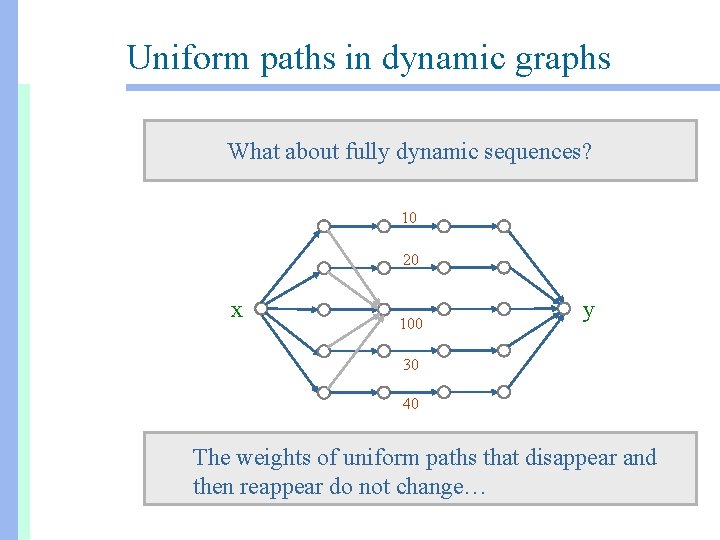
Uniform paths in dynamic graphs What about fully dynamic sequences? 10 20 x 100 y 30 40 The weights of uniform paths that disappear and then reappear do not change…
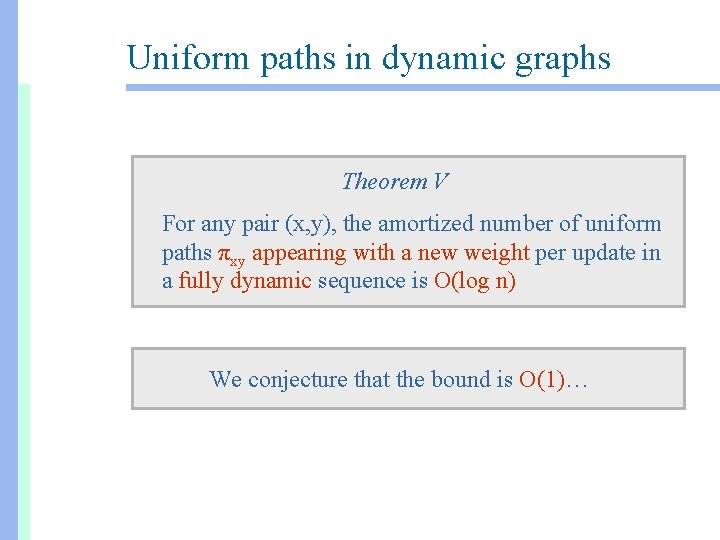
Uniform paths in dynamic graphs Theorem V For any pair (x, y), the amortized number of uniform paths πxy appearing with a new weight per update in a fully dynamic sequence is O(log n) We conjecture that the bound is O(1)…
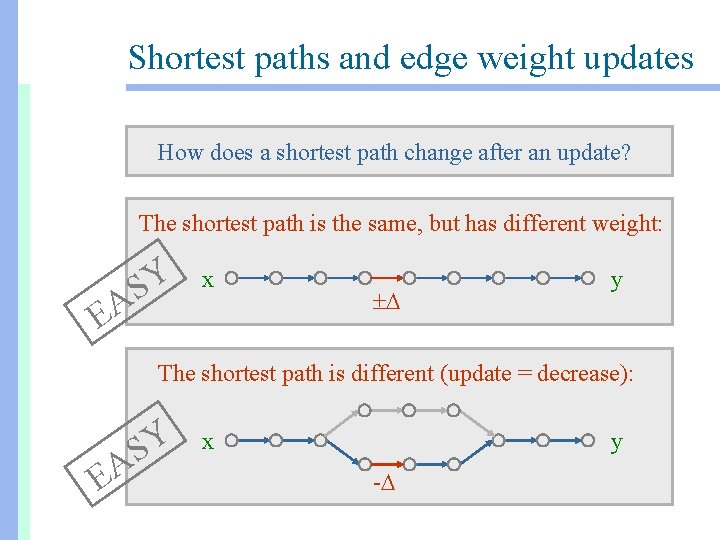
Shortest paths and edge weight updates How does a shortest path change after an update? The shortest path is the same, but has different weight: SY EA x y The shortest path is different (update = decrease): E Y S A x y -
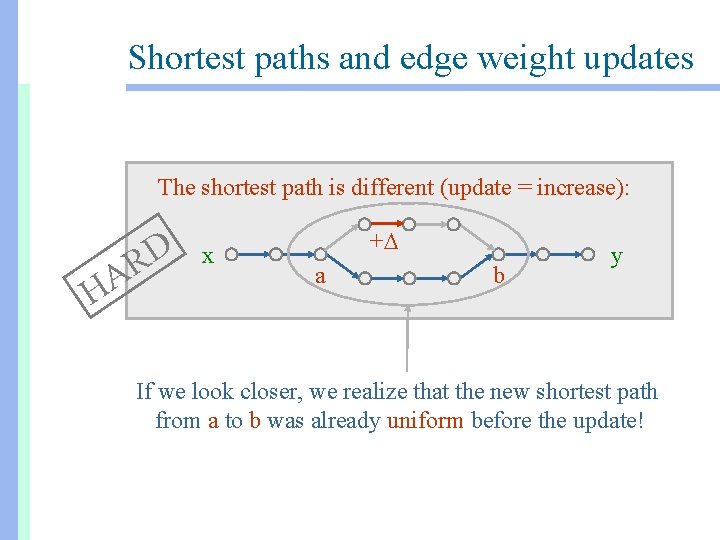
Shortest paths and edge weight updates The shortest path is different (update = increase): A H D R x + a b y If we look closer, we realize that the new shortest path from a to b was already uniform before the update!
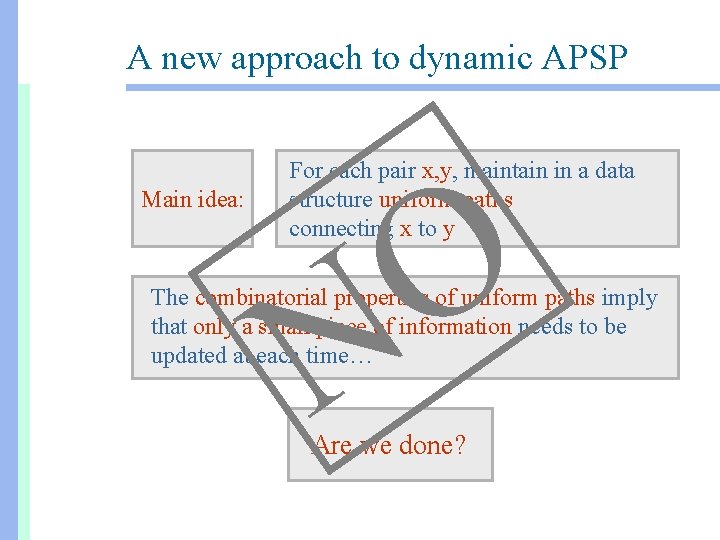
A new approach to dynamic APSP Main idea: For each pair x, y, maintain in a data structure uniform paths connecting x to y O N The combinatorial properties of uniform paths imply that only a small piece of information needs to be updated at each time… Are we done?
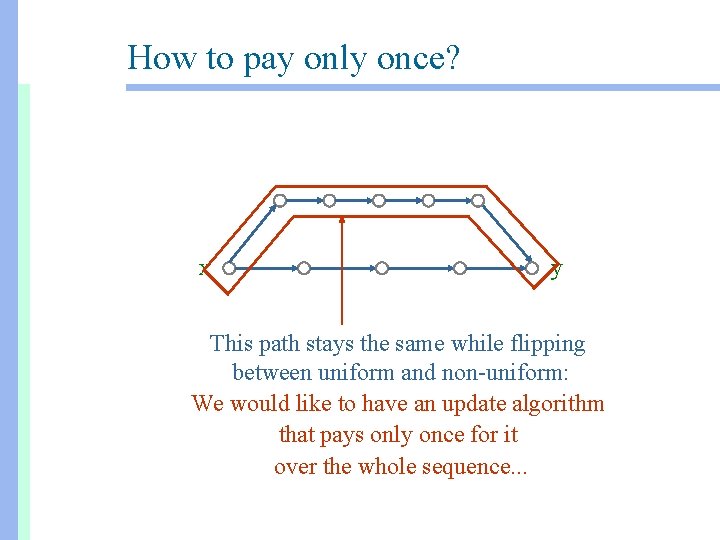
How to pay only once? x y This path stays the same while flipping between uniform and non-uniform: We would like to have an update algorithm that pays only once for it over the whole sequence. . .
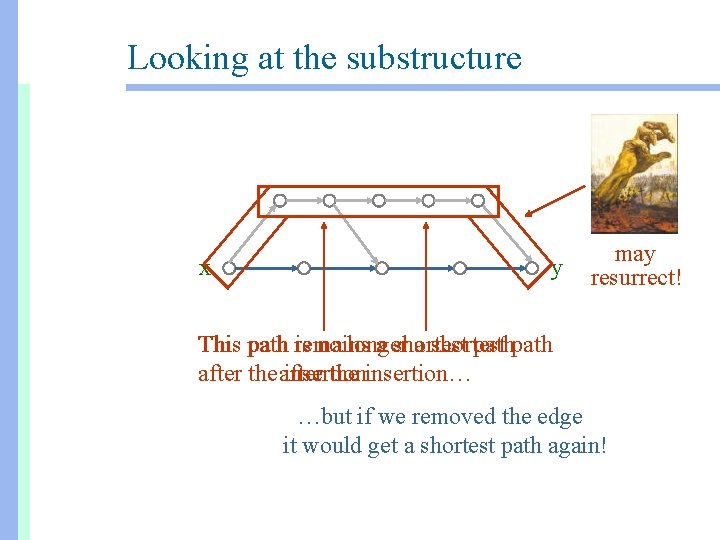
Looking at the substructure x y may resurrect! This path remains is no longer a shortest path after the after insertion the insertion… …but if we removed the edge it would get a shortest path again!
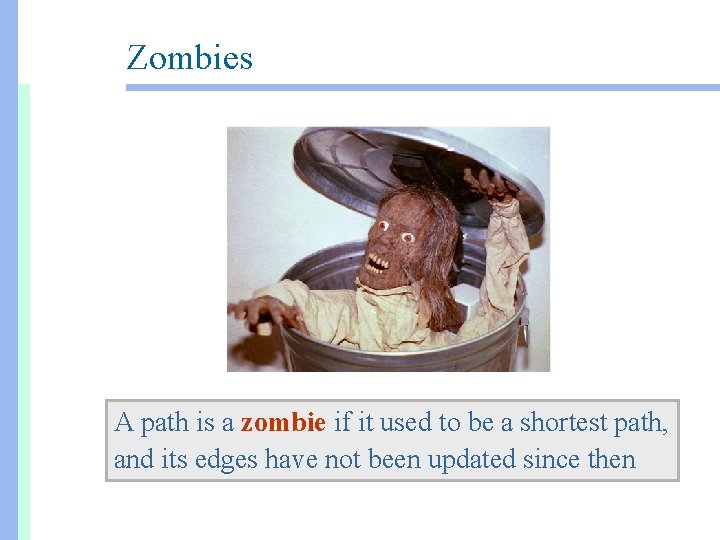
Zombies A path is a zombie if it used to be a shortest path, and its edges have not been updated since then
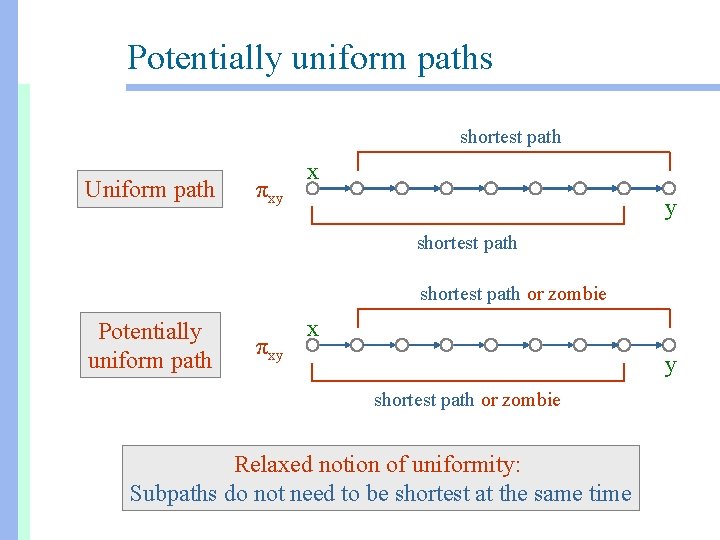
Potentially uniform paths shortest path Uniform path πxy x y shortest path or zombie Potentially uniform path πxy x y shortest path or zombie Relaxed notion of uniformity: Subpaths do not need to be shortest at the same time
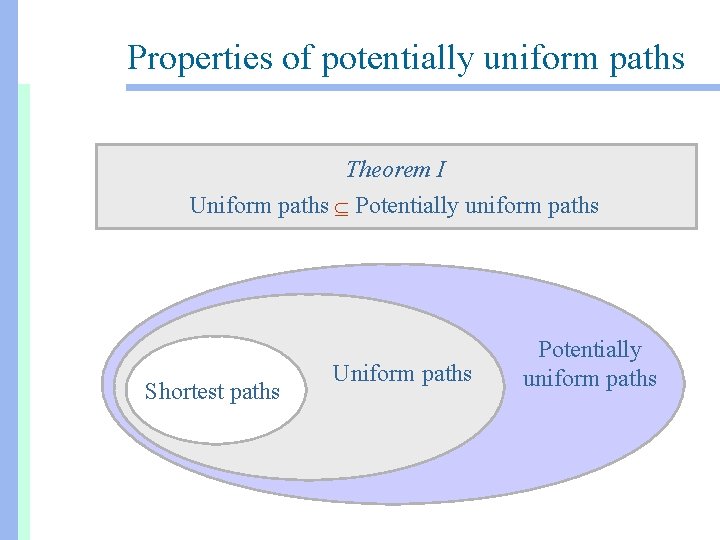
Properties of potentially uniform paths Theorem I Uniform paths Potentially uniform paths Shortest paths Uniform paths Potentially uniform paths
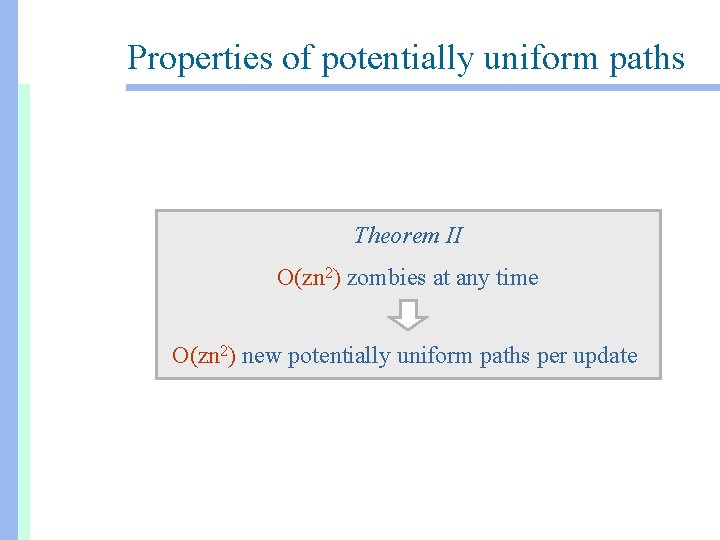
Properties of potentially uniform paths Theorem II O(zn 2) zombies at any time O(zn 2) new potentially uniform paths per update
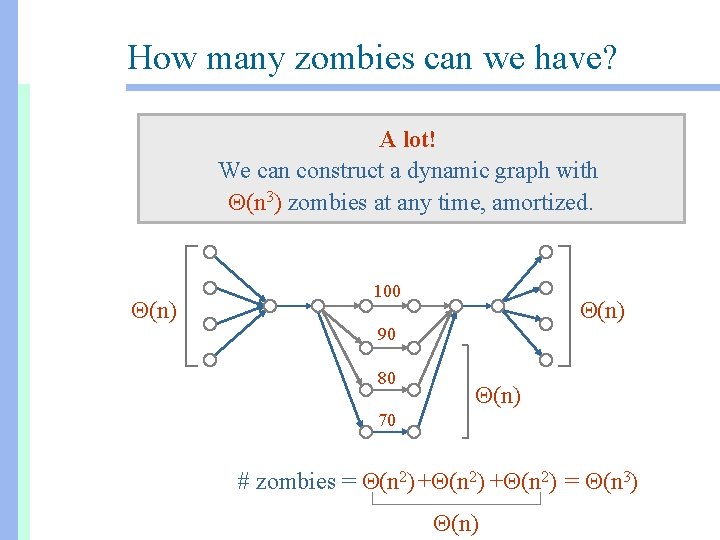
How many zombies can we have? A lot! We can construct a dynamic graph with (n 3) zombies at any time, amortized. (n) 100 (n) 90 80 (n) 70 # zombies = (n 2)+ (n 2) = (n 3) (n)
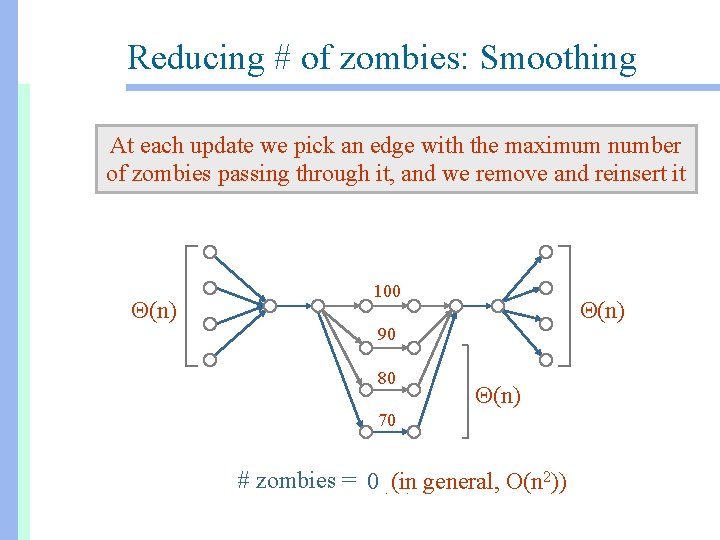
Reducing # of zombies: Smoothing At each update we pick an edge with the maximum number of zombies passing through it, and we remove and reinsert it (n) 100 (n) 90 80 (n) 70 2) general, O(n 2)) # zombies = (n 0 (in
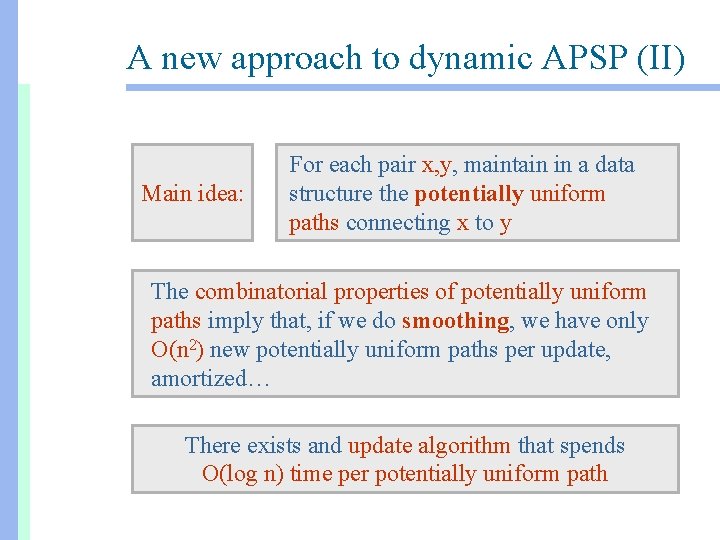
A new approach to dynamic APSP (II) Main idea: For each pair x, y, maintain in a data structure the potentially uniform paths connecting x to y The combinatorial properties of potentially uniform paths imply that, if we do smoothing, we have only O(n 2) new potentially uniform paths per update, amortized… There exists and update algorithm that spends O(log n) time per potentially uniform path
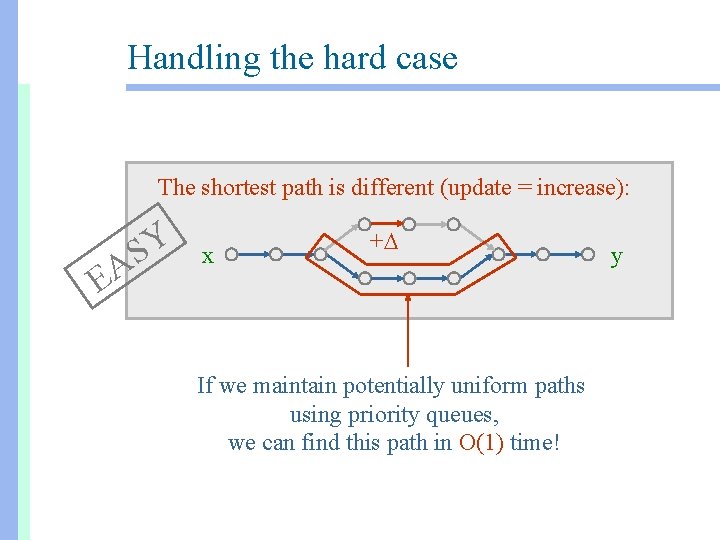
Handling the hard case The shortest path is different (update = increase): EA SY x + If we maintain potentially uniform paths using priority queues, we can find this path in O(1) time! y
Conclusions Uniform paths are the heart of dynamic shortest paths Combinatorially well-behaved in dynamic graphs New approach based on maintaining potentially uniform paths Solves the problem in its full generality Applications to Railway Optimization Problems?