
Dynamic Sample Selection for Approximate Query Processing Brian
Dynamic Sample Selection for Approximate Query Processing Brian Babcock Stanford University Surajit Chaudhuri Microsoft Research Gautam Das Microsoft Research
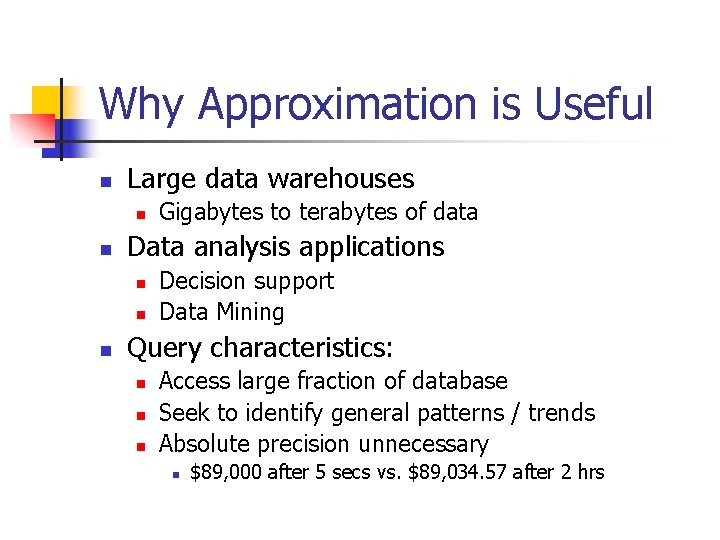
Why Approximation is Useful n Large data warehouses n n Data analysis applications n n n Gigabytes to terabytes of data Decision support Data Mining Query characteristics: n n n Access large fraction of database Seek to identify general patterns / trends Absolute precision unnecessary n $89, 000 after 5 secs vs. $89, 034. 57 after 2 hrs
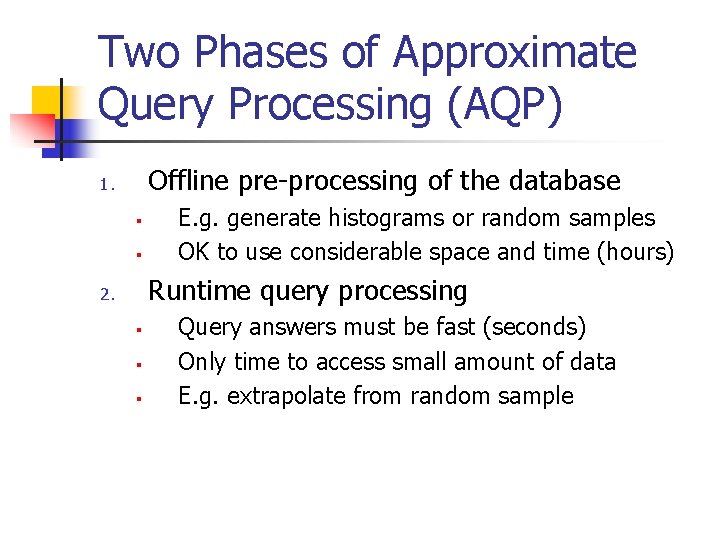
Two Phases of Approximate Query Processing (AQP) Offline pre-processing of the database 1. § § E. g. generate histograms or random samples OK to use considerable space and time (hours) Runtime query processing 2. § § § Query answers must be fast (seconds) Only time to access small amount of data E. g. extrapolate from random sample
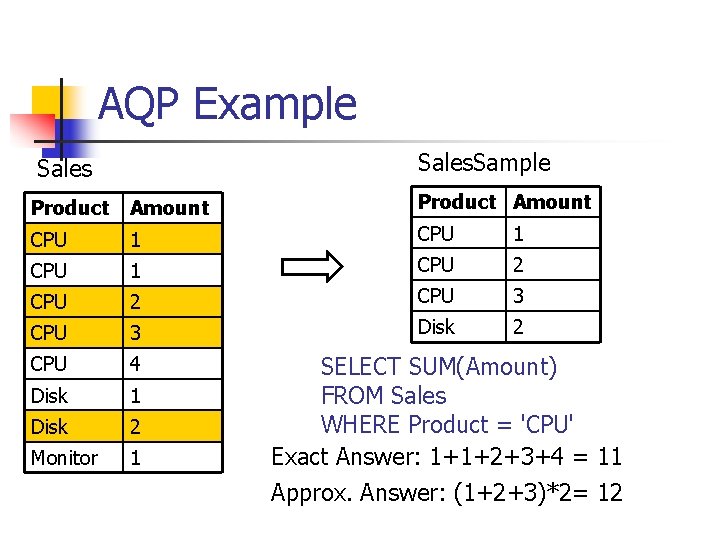
AQP Example Sales. Sample Sales Product Amount CPU 1 CPU 2 CPU 3 Disk 2 CPU 4 Disk 1 Disk 2 Monitor 1 SELECT SUM(Amount) FROM Sales WHERE Product = 'CPU' Exact Answer: 1+1+2+3+4 = 11 Approx. Answer: (1+2+3)*2= 12
Non-uniform Sampling n n “Biased” samples often more accurate than uniform samples All data records are not created equal n n n Frequently queried values Extreme high and low values Uncommon values Optimal bias differs from query to query Past work: carefully select biased sample to give good answers for many queries
Related Work n Non-sampling-based approaches n n Online Aggregation Hellerstein, Haas, and Wang 97 Histograms Ioannidis and Poosala 99 Wavelets Chakrabarti, Garofalakis, Rastogi, and Shim 00 Sampling-based approaches n n n AQUA project Acharya, Gibbons, and Poosala 99 Congressional Acharya, Gibbons, and Poosala 00 Self-Tuning Ganti, Lee, and Ramakrishnan 00 Outliers Chaudhuri, Das, Datar, Motwani, and Narasayya 01 Workload Chaudhuri, Das, and Narasayya 01
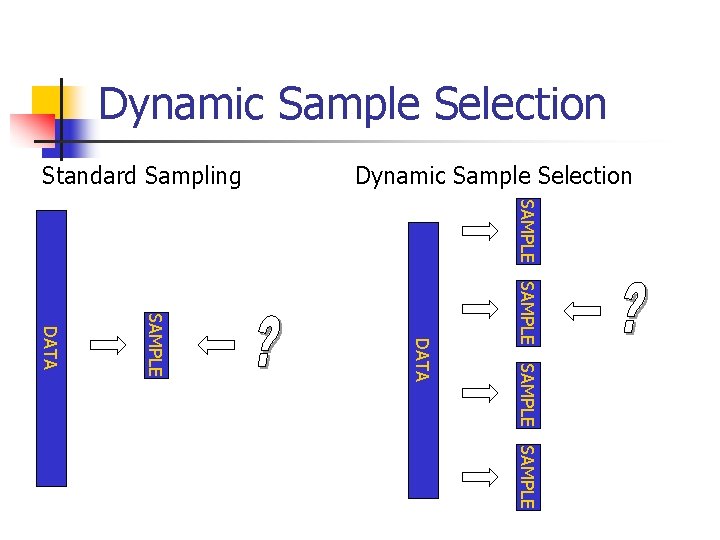
Dynamic Sample Selection Standard Sampling Dynamic Sample Selection SAMPLE DATA SAMPLE
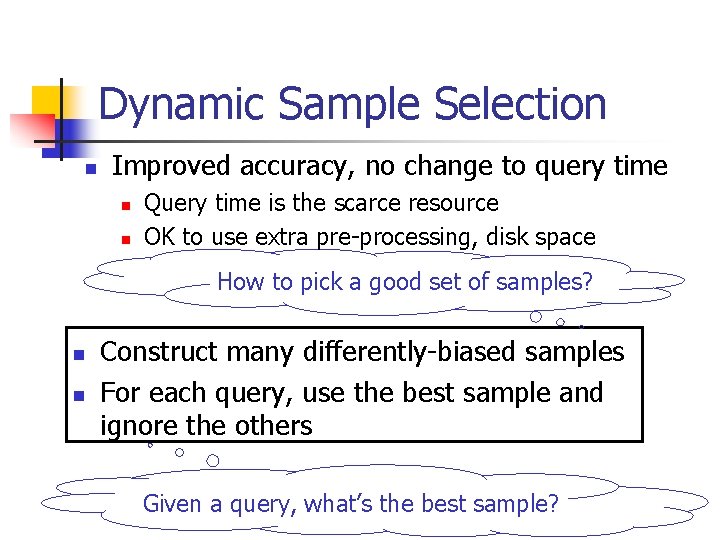
Dynamic Sample Selection n Improved accuracy, no change to query time n n Query time is the scarce resource OK to use extra pre-processing, disk space How to pick a good set of samples? n n Construct many differently-biased samples For each query, use the best sample and ignore the others Given a query, what’s the best sample?
Small vs. Large Groups n Consider group-by aggregation queries. n n Number of records per group may vary widely Problem: Rare values are under-represented in uniform sample n n E. g. Total sales of CPUs in each state E. g. Avg sale price for each product in each state “California” much more common than “Alaska” only appears a few times in the sample Approximate answer for “Alaska” likely to be bad In a group-by query, small groups are hard
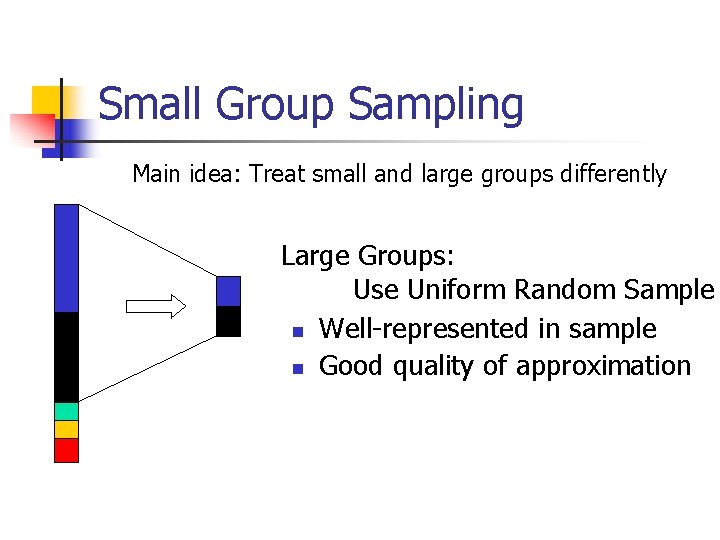
Small Group Sampling Main idea: Treat small and large groups differently Large Groups: Use Uniform Random Sample n Well-represented in sample n Good quality of approximation
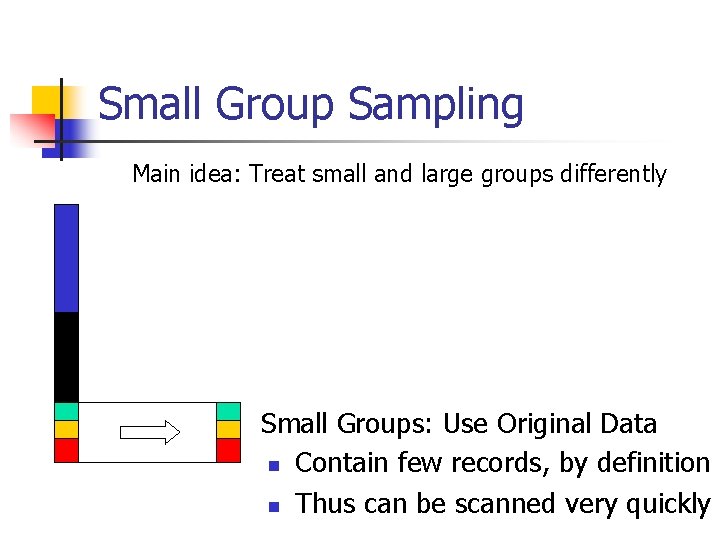
Small Group Sampling Main idea: Treat small and large groups differently Small Groups: Use Original Data n Contain few records, by definition n Thus can be scanned very quickly
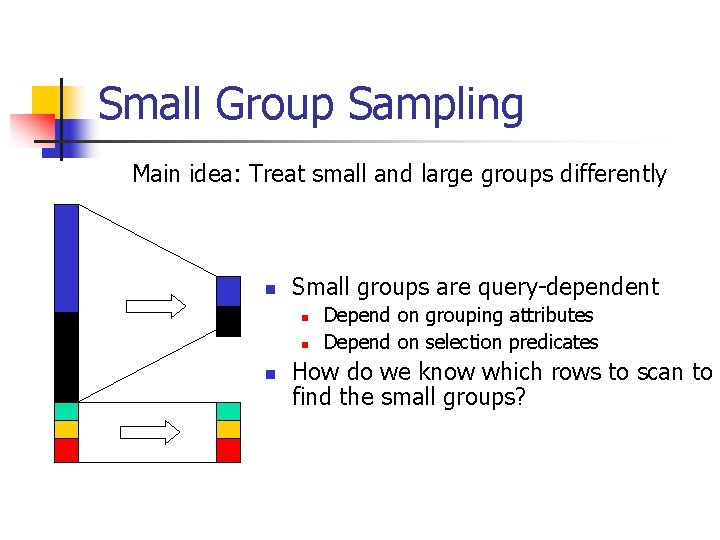
Small Group Sampling Main idea: Treat small and large groups differently n Small groups are query-dependent n n n Depend on grouping attributes Depend on selection predicates How do we know which rows to scan to find the small groups?
Finding the Small Groups n n Heuristic idea: Most small groups in most queries have a rare value for at least one grouping attribute Small group in this query rare value in entire DB n n Not always true (snowblower sales in California) Summary of Small Group Sampling: n n n Identify rare values during pre-processing Store rows with rare values in a different (small) table for each attribute: the small groups tables At query time, scan small groups table for each grouping attribute
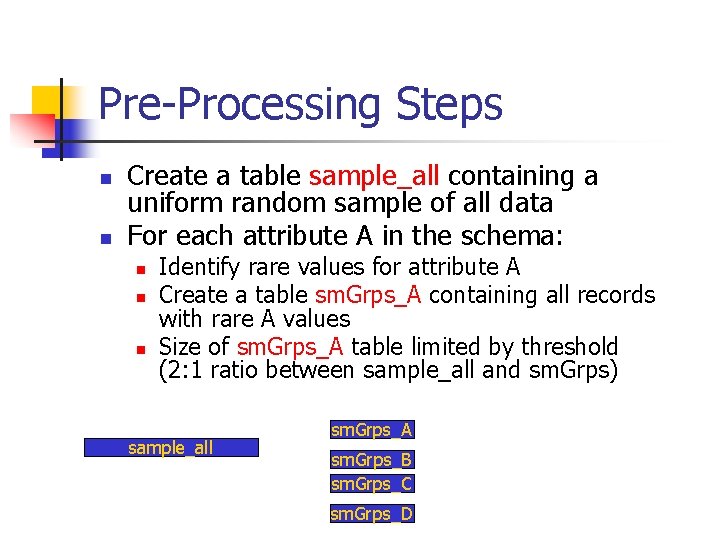
Pre-Processing Steps n n Create a table sample_all containing a uniform random sample of all data For each attribute A in the schema: n n n Identify rare values for attribute A Create a table sm. Grps_A containing all records with rare A values Size of sm. Grps_A table limited by threshold (2: 1 ratio between sample_all and sm. Grps) sample_all sm. Grps_A sm. Grps_B sm. Grps_C sm. Grps_D
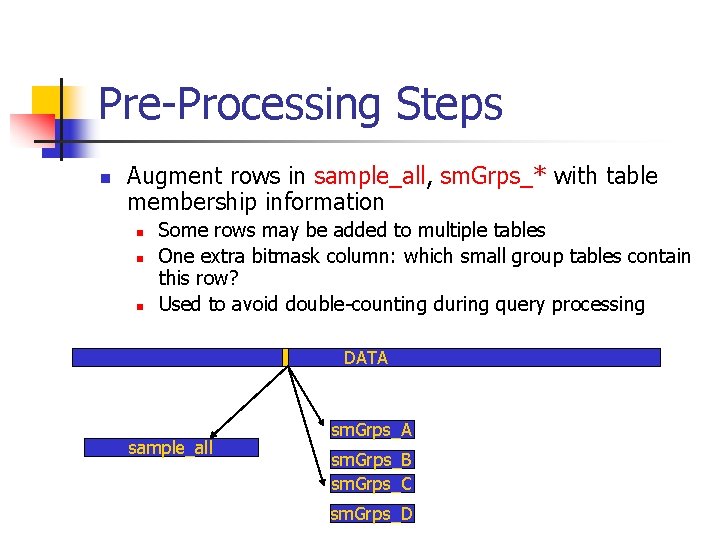
Pre-Processing Steps n Augment rows in sample_all, sm. Grps_* with table membership information n Some rows may be added to multiple tables One extra bitmask column: which small group tables contain this row? Used to avoid double-counting during query processing DATA sample_all sm. Grps_A sm. Grps_B sm. Grps_C sm. Grps_D
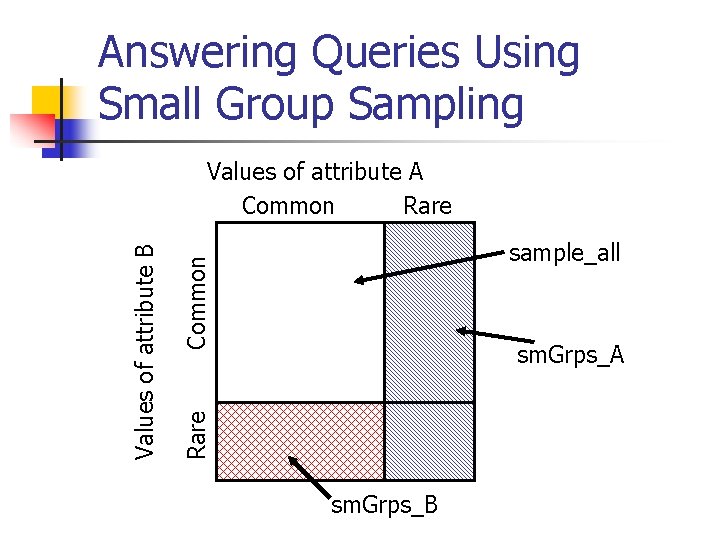
Answering Queries Using Small Group Sampling Common sample_all sm. Grps_A Rare Values of attribute B Values of attribute A Common Rare sm. Grps_B
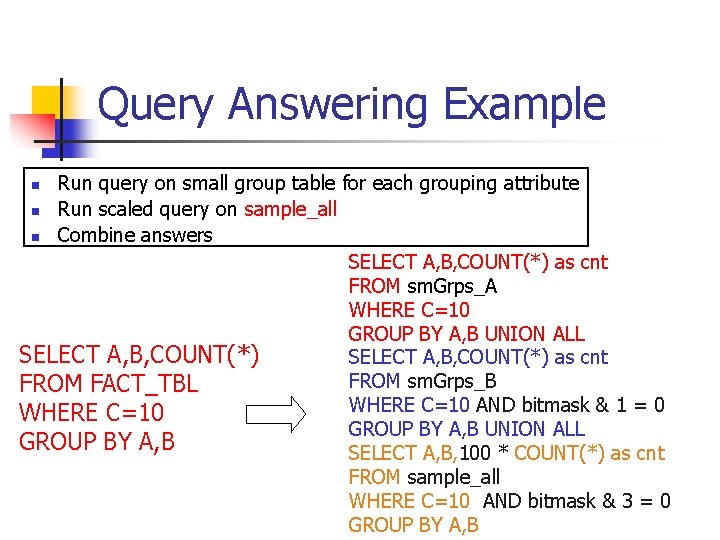
Query Answering Example Run query on small group table for each grouping attribute n Run scaled query on sample_all n Combine answers SELECT A, B, COUNT(*) as cnt FROM sm. Grps_A WHERE C=10 GROUP BY A, B UNION ALL SELECT A, B, COUNT(*) as cnt FROM sm. Grps_B FROM FACT_TBL WHERE C=10 AND bitmask & 1 = 0 WHERE C=10 GROUP BY A, B UNION ALL GROUP BY A, B SELECT A, B, 100 * COUNT(*) as cnt FROM sample_all WHERE C=10 AND bitmask & 3 = 0 GROUP BY A, B n
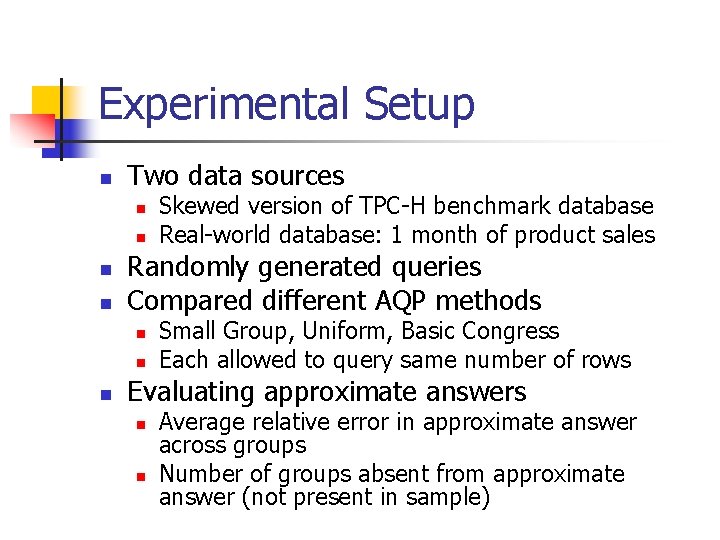
Experimental Setup n Two data sources n n Randomly generated queries Compared different AQP methods n n n Skewed version of TPC-H benchmark database Real-world database: 1 month of product sales Small Group, Uniform, Basic Congress Each allowed to query same number of rows Evaluating approximate answers n n Average relative error in approximate answer across groups Number of groups absent from approximate answer (not present in sample)
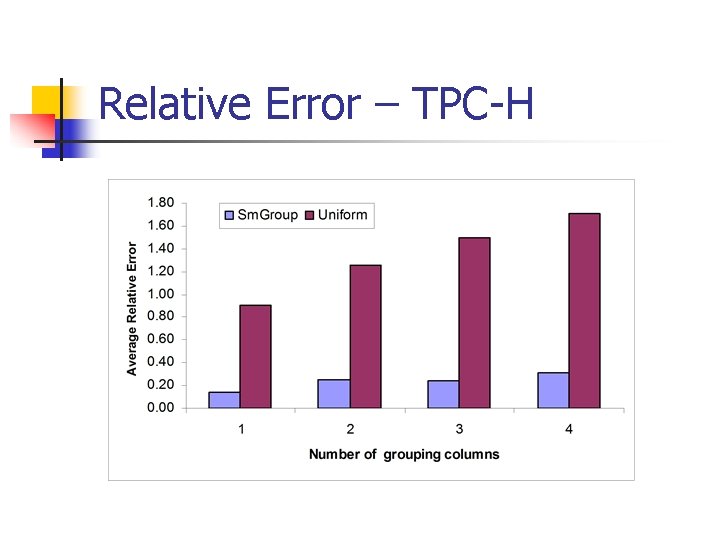
Relative Error – TPC-H
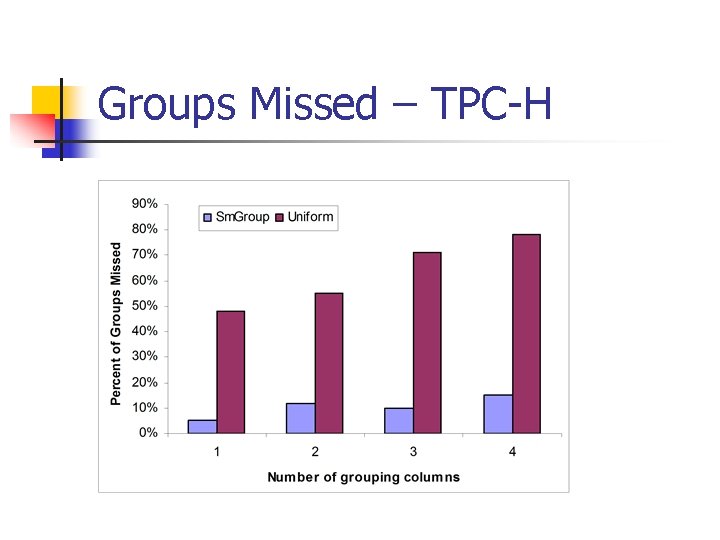
Groups Missed – TPC-H
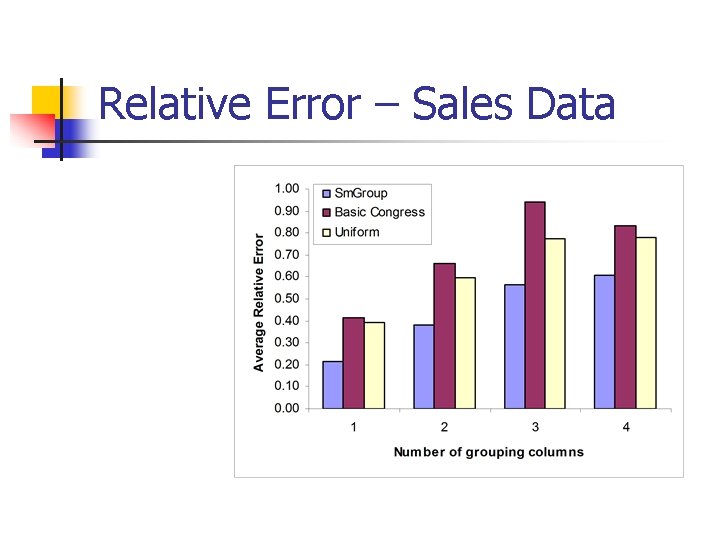
Relative Error – Sales Data
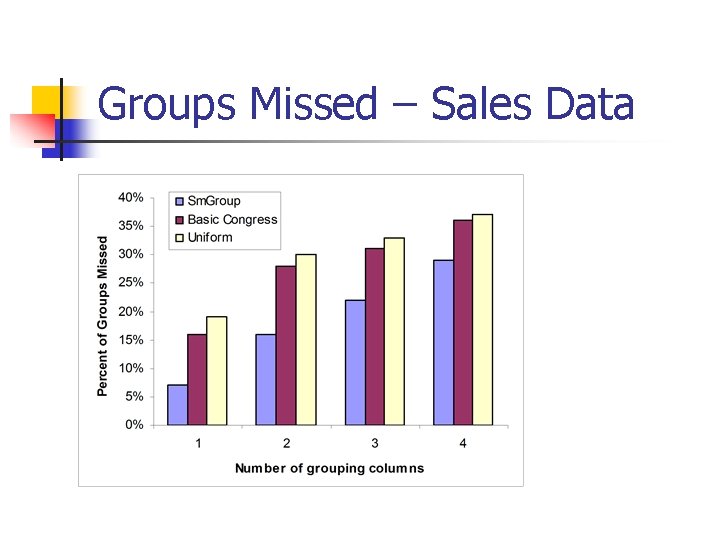
Groups Missed – Sales Data
Summary n Dynamic Sample Selection n n Gain accuracy at the cost of disk space. Non-uniform samples are good, but different ones are good for different queries. Build lots of different non-uniform samples. For each query, pick the best sample. Small Group Sampling n n n Treat large and small groups differently. Uniform sampling works well for large groups. Small groups are cheap to scan in their entirety.
- Slides: 23