
Dynamic Routing EIGRP CH 52 6 7 Dynamic
- Slides: 54
Dynamic Routing EIGRP CH 5(2), 6 , 7
Dynamic Routing CH 5(2)
Introduction: In general, the operations of a dynamic routing protocol can be described as follows: 1. The router sends and receives routing messages on its interfaces. 2. The router shares routing messages and routing information with other routers that are using the same routing protocol. 3. Routers exchange routing information to learn about remote networks. 4. When a router detects a topology change, the routing protocol can advertise this change to other routers.
Cold Start: When a router powers up, it knows nothing about the network topology. It does not even know that there are devices on the other end of its links. The only information that a router has is from its own saved configuration file stored in NVRAM. After a router boots successfully, it applies the saved configuration. If the IP addressing is configured correctly, then the router initially discovers its own directly connected networks.
Network Discovery q. If a routing protocol is configured, the next step is for the router to begin exchanging routing updates to learn about any remote routes. q. The router sends an update packet out all interfaces that are enabled on the router. The update contains the information in the routing table, which currently is all directly connected networks. q. At the same time, the router also receives and processes similar updates from other connected routers. Upon receiving an update, the router checks it for new network information. Any networks that are not currently listed in the routing table are added.
Exchanging the Routing Information q. Continuing the journey toward convergence, the routers exchange the next round of periodic updates. Each router again checks the updates for new information. q. After routers within a network have converged, the router can then use the information within the routing table to determine the best path to reach a destination.
Achieving Convergence q. The network has converged when all routers have complete and accurate information about the entire network. q. Convergence time is the time it takes routers to share information, calculate best paths, and update their routing tables. q. A network is not completely operable until the network has converged; therefore, most networks require short convergence times. q. Convergence is both collaborative and independent. The routers share information with each other, but must independently calculate the impacts of the topology change on their own routes. q. Convergence properties include the speed of propagation of routing information and the calculation of optimal paths. q. Routing protocols can be rated based on the speed to convergence; the faster the convergence, the better the routing protocol.
Distance Vector Dynamic Routing
Distance Vector Technologies q. Distance vector routing protocols share updates between neighbors. q. Routers using distance vector routing are not aware of the network topology. q. Some distance vector routing protocols send periodic updates. For example, RIP sends a periodic update to all of its neighbors every 30 seconds. q. RIPv 1 sends these updates as broadcasts to the all-hosts IPv 4 address of 255. q. Instead of using broadcasts like RIP, RIPv 2 and EIGRP can use multicast addresses to reach only specific neighbor routers. q. EIGRP can also use a unicast message to reach one specific neighbor router. q. Additionally, EIGRP only sends updates when needed, instead of periodically.
Distance Vector Algorithm The algorithm used for the routing protocols defines the following processes: q. Mechanism for sending and receiving routing information q. Mechanism for calculating the best paths and installing routes in the routing table q. Mechanism for detecting and reacting to topology changes
Routing Information Protocol (RIP) RIPv 1 has the following key characteristics: q. Routing updates are broadcasted (255. 255) every 30 seconds. q. The hop count is used as the metric for path selection. q. A hop count greater than 15 hops is deemed infinite (too far). That 15 th hop router would not propagate the routing update to the next router. RIPv 2 included the following improvements: q. Classless routing protocol - It supports VLSM and CIDR, because it includes the subnet mask in the routing updates. q. Increased efficiency - It forwards updates to multicast address 224. 0. 0. 9, instead of the broadcast address 255. q. Reduced routing entries - It supports manual route summarization on any interface. q. Secure - It supports an authentication mechanism to secure routing table updates between neighbors.
Enhanced Interior-Gateway Routing Protocol (EIGRP) The Interior Gateway Routing Protocol (IGRP): q. Bandwidth, delay, load, and reliability are used to create a composite metric. q. Routing updates are broadcast every 90 seconds, by default. q. Maximum limit of 255 hops Enhanced IGRP (EIGRP): q. It does not send periodic updates. Only routing table changes are propagated, whenever a change occurs. qsends out bounded updates whenever there is a change in the topology. q. A small Hello message is periodically exchanged to maintain adjacencies with neighboring routers. q. Maintains all the routes received from neighbors (not only the best paths) in a topology table. q. Rapid convergence quses the DUAL algorithm to provide almost instantaneous convergence during a route failover.
Link-state Dynamic Routing
Shortest Path First Protocols q. Link-state routing protocols are also known as shortest path first protocols and are built around Edsger Dijkstra's shortest path first (SPF) algorithm. q. The IPv 4 link-state routing protocols are shown in the figure: q. Open Shortest Path First (OSPF) q. Intermediate System-to-Intermediate System (IS-IS)
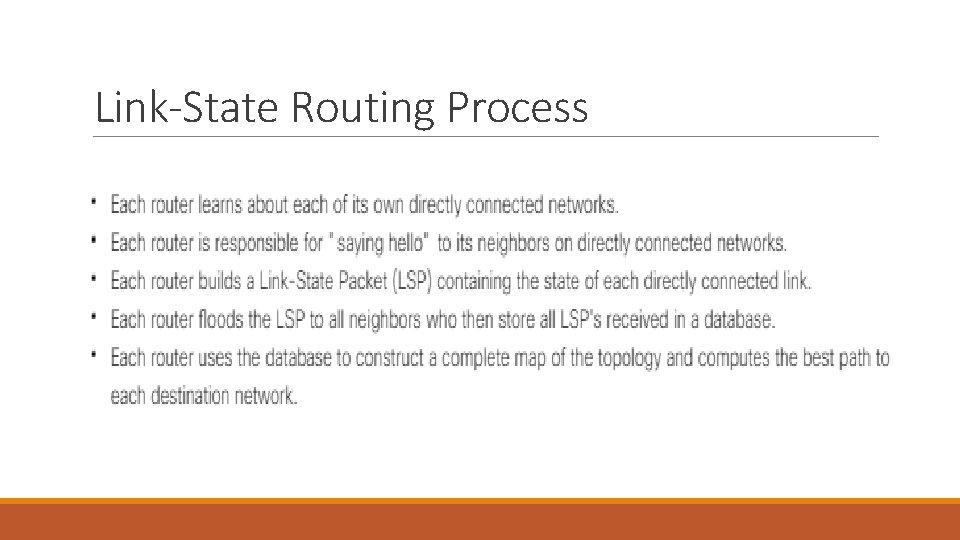
Link-State Routing Process
Link-State Routing Process ◦ the link-state information includes: q. The interface's IPv 4 address and subnet mask q. The type of network, such as Ethernet (broadcast) or Serial point-to-point link q. The cost of that link q. Any neighbor routers on that link ◦ Routers with link-state routing protocols use a Hello protocol to discover any neighbors on its link: q. A neighbor is any other router that is enabled with the same link-state routing protocol. q. When two link-state routers learn that they are neighbors, they form an adjacency. q. These small Hello packets continue to be exchanged between two adjacent neighbors and serve as a keepalive function to monitor the state of the neighbor. q. If a router stops receiving Hello packets from a neighbor, that neighbor is considered unreachable and the adjacency is broken.
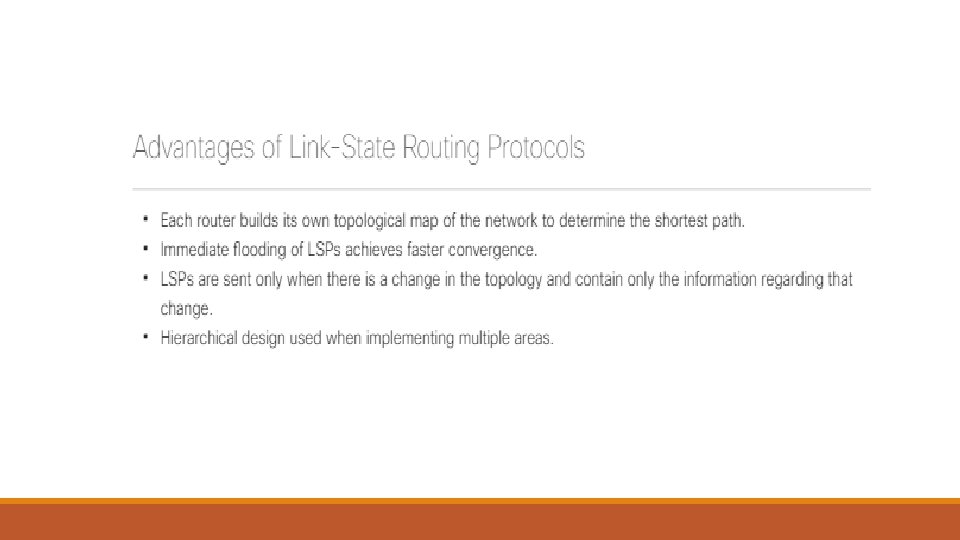
Link-State Routing Process ◦ each router builds a link-state packet (LSP) containing the state of each directly connected link. q. A router can only build a link-state after it has received link-state packets from adjacent routers. It then constructs its SPF tree from the least cost routes to remote networks which are used to populate its routing table. ◦ each router floods the LSP to all neighbors, who then store all LSPs received in a database: q. Each router floods its link-state information to all other link-state routers in the routing area. q. Whenever a router receives an LSP from a neighboring router, it immediately sends that LSP out all other interfaces except the interface that received the LSP. q. This process creates a flooding effect of LSPs from all routers throughout the routing area. qlink-state routing protocols calculate the SPF algorithm after the flooding is complete. As a result, link-state routing protocols reach convergence very quickly. q. LSPs do not need to be sent periodically. Only when the initial startup of the routing process and a change in the topology.
Link-State Routing Process ◦ each router uses the database to construct a complete map of the topology and computes the best path to each destination network. q. With a complete link-state database, router can now use the database and the shortest path first (SPF) algorithm to calculate the preferred path or shortest path to each network resulting in the SPF tree.
EIGRP CH 6
Features of EIGRP: qestablishes neighbor adjacencies qsupports equal and unequal cost load balancing quses the DUAL algorithm qsends partial and bounded updates qmulticasts updates to other EIGRP routers.
Features of EIGRP: q. EIGRP has a default AD of 90 for internal routes and 170 for routes imported from an external source. q. EIGRP authentication allows a router to accept routing information only from other routers that are configured with the same password. q. EIGRP is designed to route several network layer protocols by using the PDMs (protocoldependent modules). q. Protocol-dependent modules (PDMs) give EIGRP the capability to route multiple Layer 3 protocols, such as IPv 4 and IPv 6. PDMs maintain a separate neighbor table, topology table, and routing table for each protocol. q. EIGRP uses Reliable Transport Protocol (RTP) for the delivery and reception of EIGRP packets. Because EIGRP supports routing different network layer protocol including IPv 4, IPv 6, IPX, and Apple. Talk, it cannot use UDP or TCP.
EIGRP Packets: There are five packet types used by EIGRP: q. Hello q. Update q. Acknowledgment q. Query q. Reply
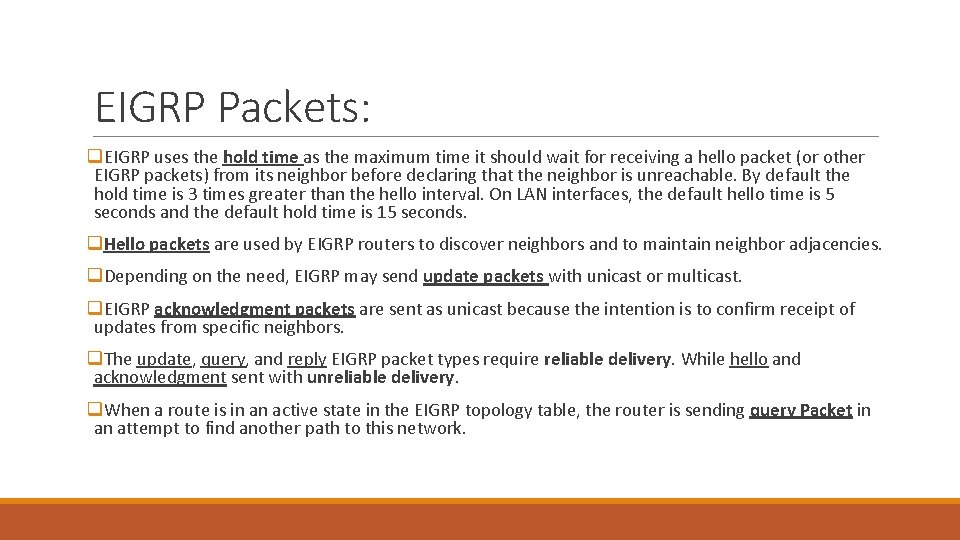
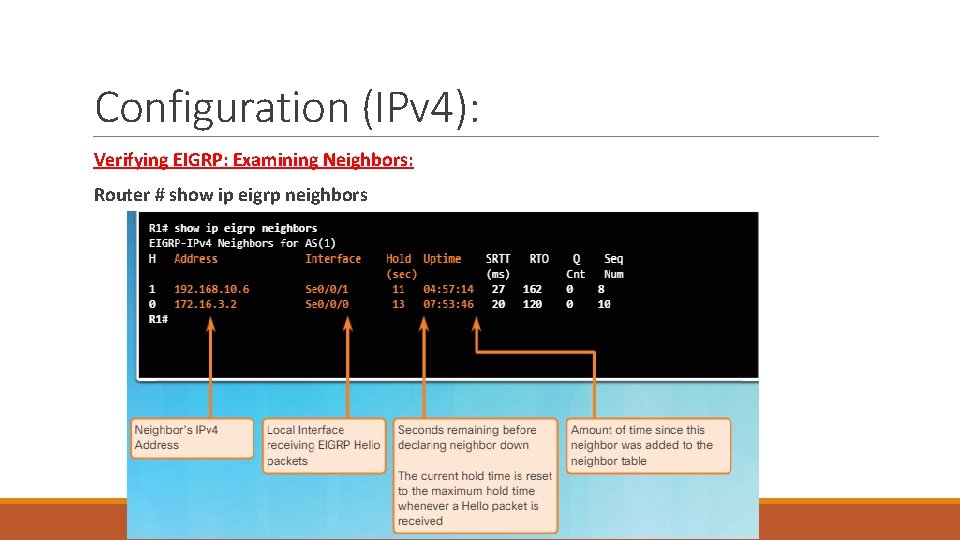
EIGRP Packets: q. EIGRP uses the hold time as the maximum time it should wait for receiving a hello packet (or other EIGRP packets) from its neighbor before declaring that the neighbor is unreachable. By default the hold time is 3 times greater than the hello interval. On LAN interfaces, the default hello time is 5 seconds and the default hold time is 15 seconds. q. Hello packets are used by EIGRP routers to discover neighbors and to maintain neighbor adjacencies. q. Depending on the need, EIGRP may send update packets with unicast or multicast. q. EIGRP acknowledgment packets are sent as unicast because the intention is to confirm receipt of updates from specific neighbors. q. The update, query, and reply EIGRP packet types require reliable delivery. While hello and acknowledgment sent with unreliable delivery. q. When a route is in an active state in the EIGRP topology table, the router is sending query Packet in an attempt to find another path to this network.
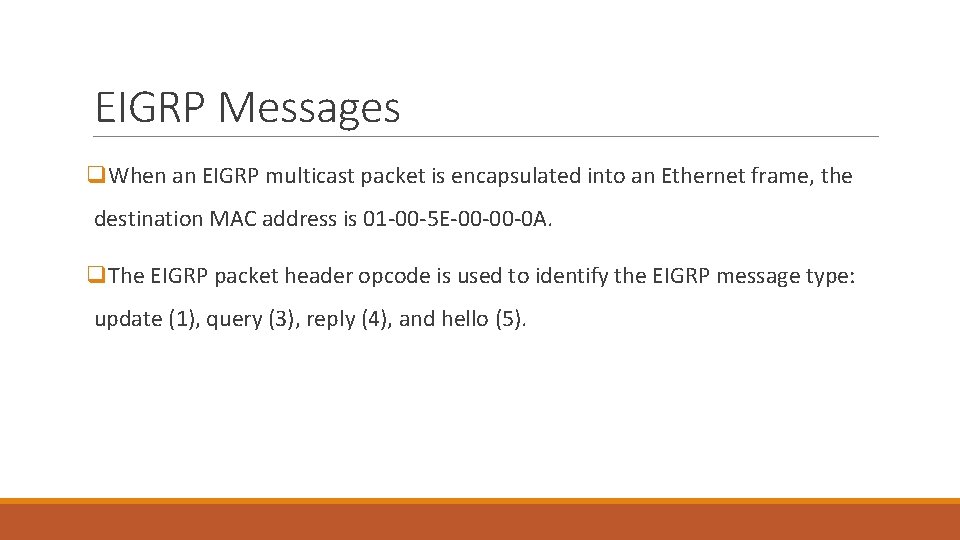
EIGRP Messages q. When an EIGRP multicast packet is encapsulated into an Ethernet frame, the destination MAC address is 01 -00 -5 E-00 -00 -0 A. q. The EIGRP packet header opcode is used to identify the EIGRP message type: update (1), query (3), reply (4), and hello (5).
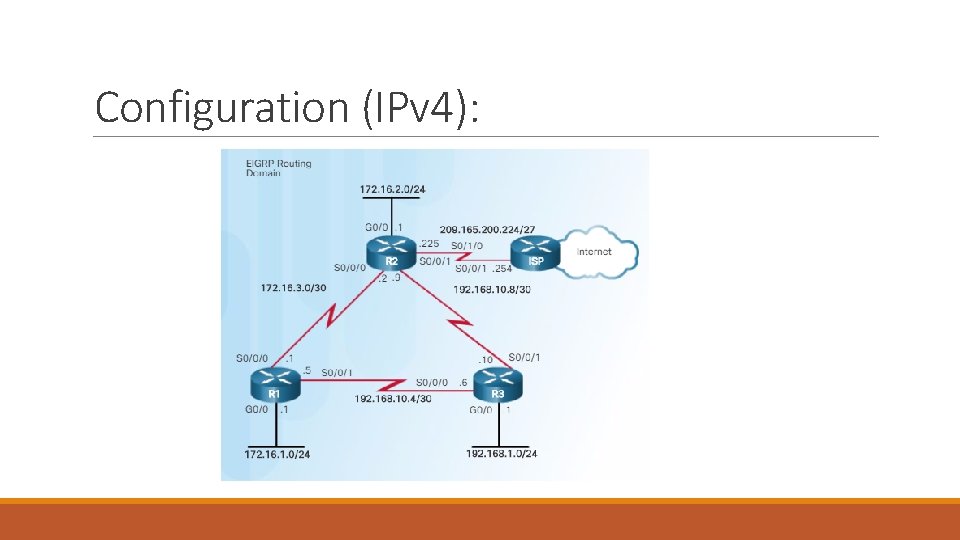
Configuration (IPv 4):
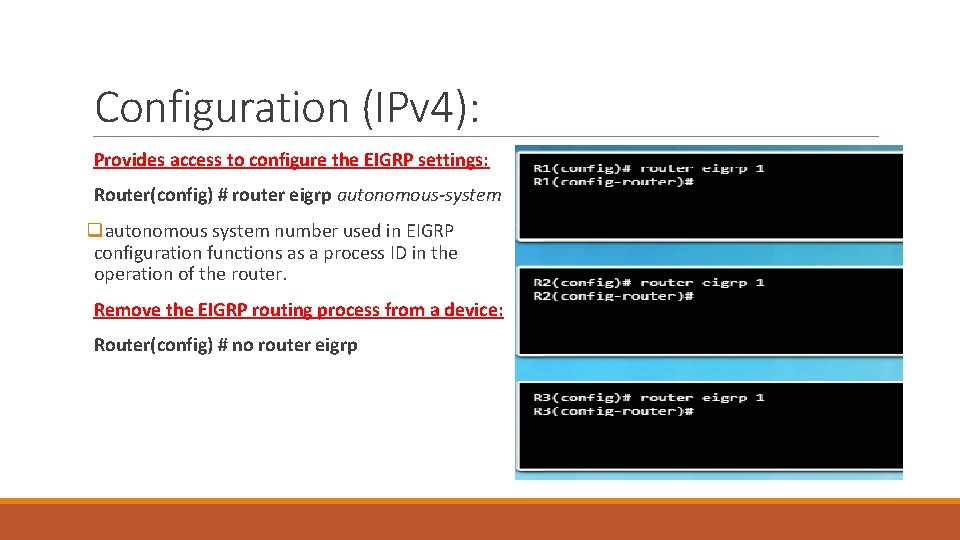
Configuration (IPv 4): Provides access to configure the EIGRP settings: Router(config) # router eigrp autonomous-system qautonomous system number used in EIGRP configuration functions as a process ID in the operation of the router. Remove the EIGRP routing process from a device: Router(config) # no router eigrp
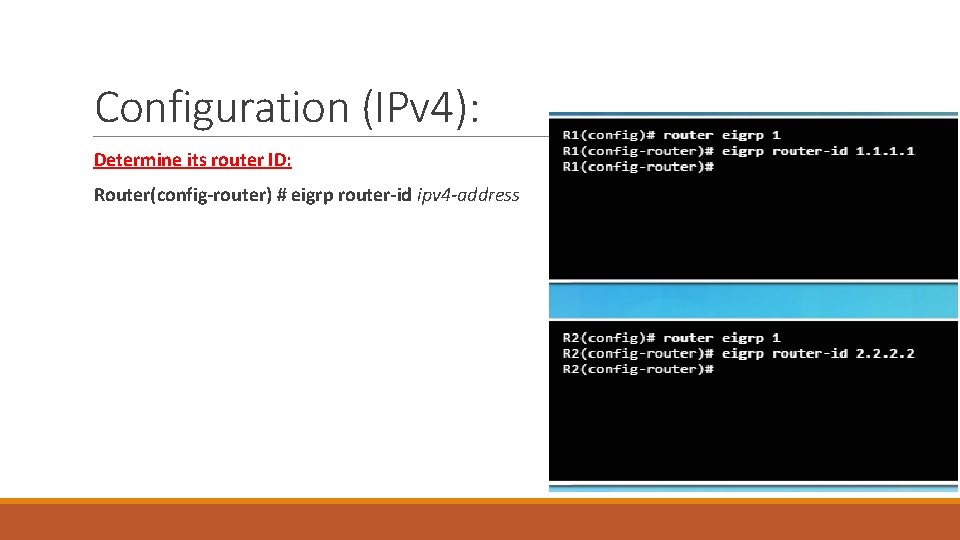
Configuration (IPv 4): Determine its router ID: Router(config-router) # eigrp router-id ipv 4 -address
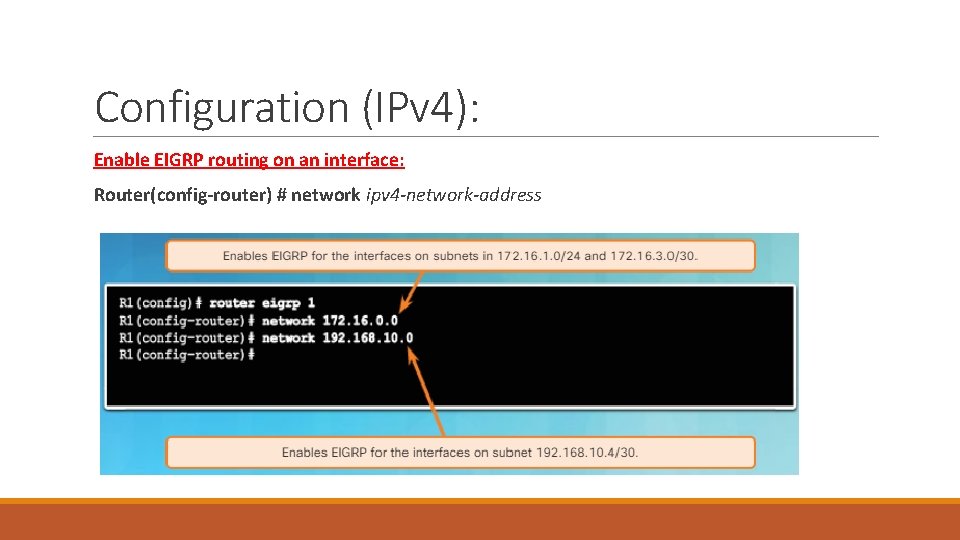
Configuration (IPv 4): Enable EIGRP routing on an interface: Router(config-router) # network ipv 4 -network-address
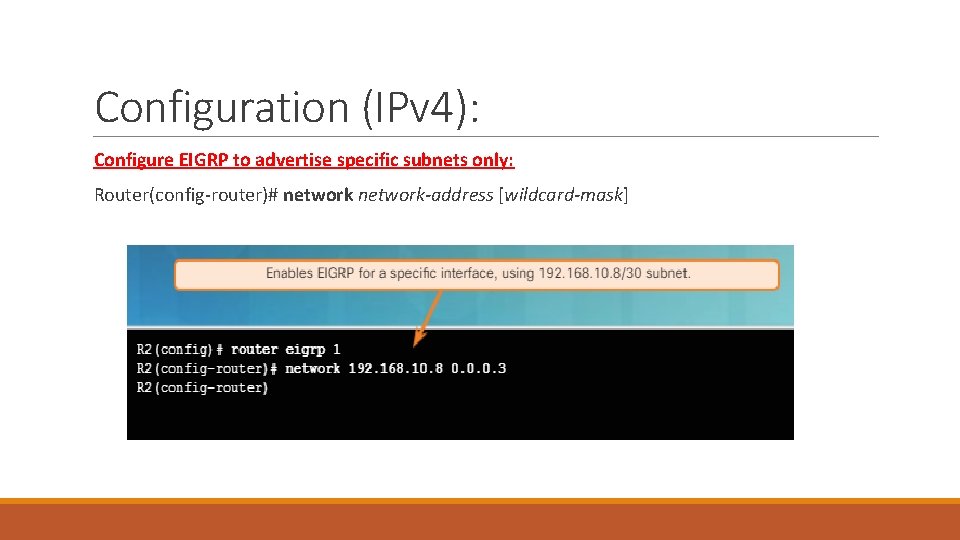
Configuration (IPv 4): Configure EIGRP to advertise specific subnets only: Router(config-router)# network-address [wildcard-mask]
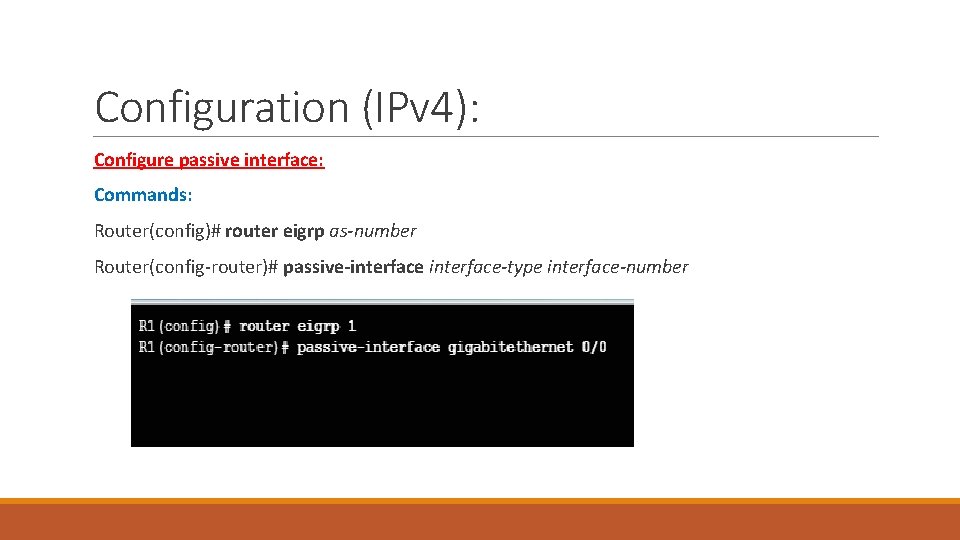
Configuration (IPv 4): Configure passive interface: q. As soon as a new interface is enabled within the EIGRP network, EIGRP attempts to form a neighbor adjacency with any neighboring routers to send and receive EIGRP updates. q. The passive-interface command can be used to prevent the neighbor adjacencies. q. There are two primary reasons for enabling the passive-interface command: q. To suppress unnecessary update traffic, such as when an interface is a LAN interface, with no other routers connected q. To increase security controls, such as preventing unknown rogue routing devices from receiving EIGRP updates
Configuration (IPv 4): Configure passive interface: Commands: Router(config)# router eigrp as-number Router(config-router)# passive-interface-type interface-number
Configuration (IPv 4): Verifying EIGRP: Examining Neighbors: Router # show ip eigrp neighbors
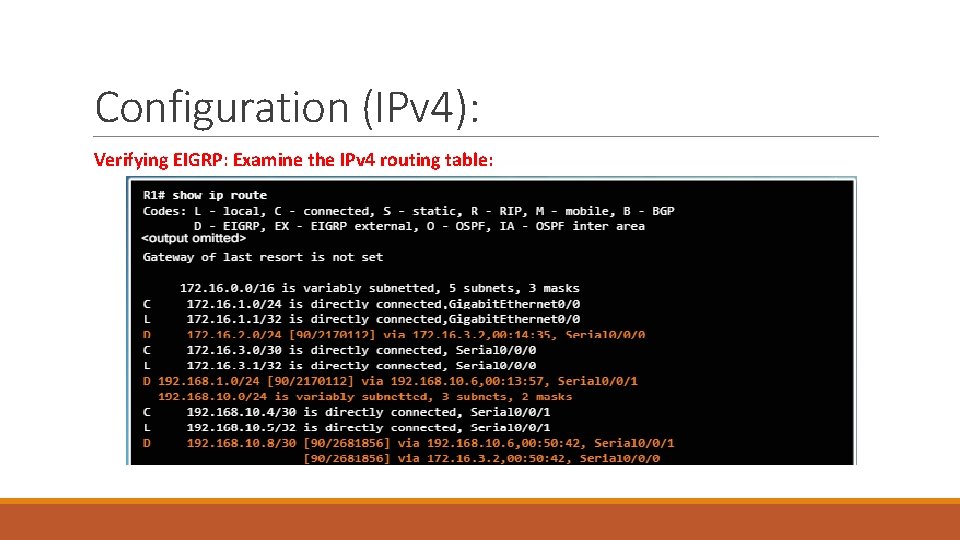
Configuration (IPv 4): Verifying EIGRP: Examine the IPv 4 routing table:
EIGRP Initial Route Discovery q. Before two EIGRP routers can become neighbors, several parameters contained in the exchanged hello packets between the two routers must match. The two routers must use the same EIGRP metric parameters (such as bandwidth and delay) and they both must be configured for the same autonomous system number. Type of Tables: q. Each EIGRP router maintains a neighbor table, which contains a list of routers on shared links that have an EIGRP adjacency with this router. The neighbor table is used to track the status of these EIGRP neighbors. q. EIGRP routers maintain a topology table that includes entries for every destination that the router learns from directly connected EIGRP neighbors. q. Routing table includes entries only the best path.
EIGRP Composite Metric q. By default, EIGRP uses bandwidth and delay values in its composite metric to calculate the preferred path to a network. q. The bandwidth metric is a static value. On older routers, the serial link bandwidth metric defaults to 1544 kb/s. On newer routers, such as the Cisco 4321, serial link bandwidth defaults to the clock rate used on the link. Modify the bandwidth metric: Router(config-if)# bandwidth kilobits-bandwidth-value q. Use the no bandwidth command to restore the default value. q. The show interfaces command is used to show the delay, in microseconds, of a specified interface. This command will also provide the default delay value or an administratively configured value. The show running-config command will only display an administratively configured value.
DUAL Concepts EIGRP uses the Diffusing Update Algorithm (DUAL) to provide the best loop-free path and loopfree backup paths. DUAL uses several terms: q. Successor §A successor is a neighboring router that is used for packet forwarding and is the least-cost route to the destination network. §The IP address of a successor is shown in a routing table entry right after the word via. q. Feasible Distance (FD) §FD is the lowest calculated metric to reach the destination network. §FD is the metric listed in the routing table entry as the second number inside the brackets.
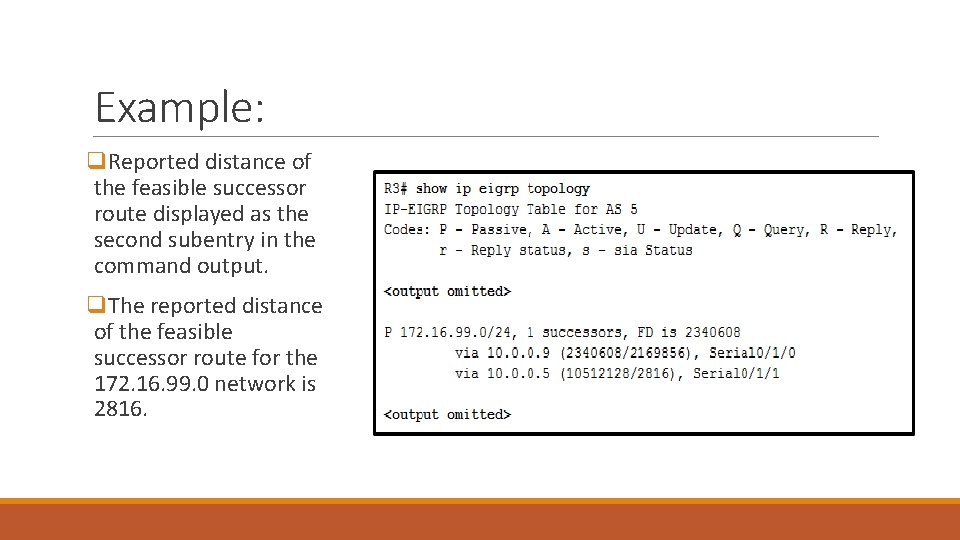
DUAL Concepts DUAL uses several terms: q. Feasible Successor (FS) §Feasible successors are installed in the EIGRP routing table when the successor becomes unavailable. Feasible successors are backup routes that are have a metric higher than that of successors. §An FS is a neighbor that has a loop-free backup path to the same network as the successor, and it satisfies the Feasibility Condition (FC). q. Reported Distance (RD). §The reported distance is simply an EIGRP neighbor’s feasible distance to the same destination network. §The reported distance is the metric that a router reports to a neighbor about its own cost to that network.
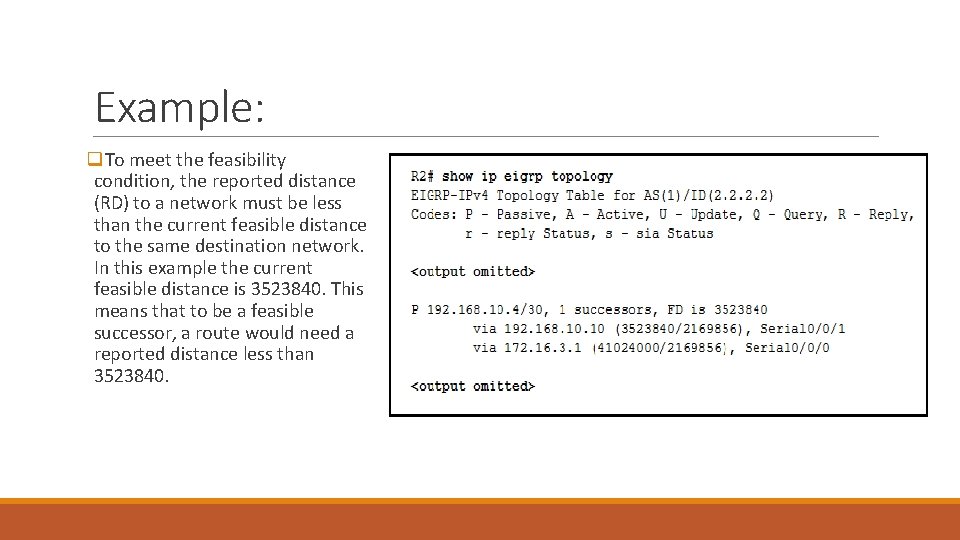
DUAL Concepts DUAL uses several terms: q. Feasible Condition or Feasibility Condition (FC) §The EIGRP feasible condition (FC) is met when the reported distance (RD) on a neighbor router to a network is less than the local router feasible distance (FD) to the same destination network. Note: If the connection to the successor of a network is lost and there is no feasible successor in the topology database, DUAL will put the network into the active state and actively query the neighbors for a new successor. when the network is reachable and traffic is normal, the network will be put in the passive mode.
Example: q. Reported distance of the feasible successor route displayed as the second subentry in the command output. q. The reported distance of the feasible successor route for the 172. 16. 99. 0 network is 2816.
Example: q. To meet the feasibility condition, the reported distance (RD) to a network must be less than the current feasible distance to the same destination network. In this example the current feasible distance is 3523840. This means that to be a feasible successor, a route would need a reported distance less than 3523840.
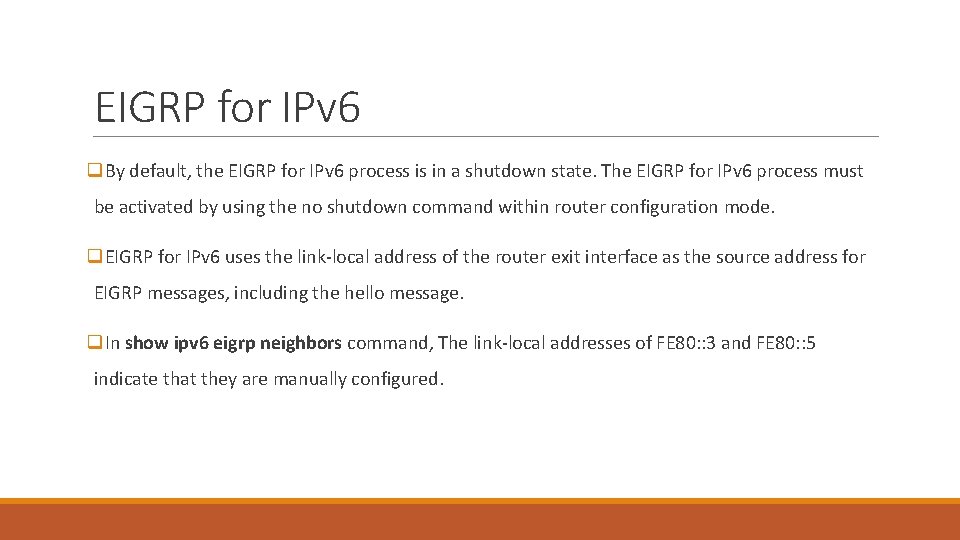
EIGRP for IPv 6 q. By default, the EIGRP for IPv 6 process is in a shutdown state. The EIGRP for IPv 6 process must be activated by using the no shutdown command within router configuration mode. q. EIGRP for IPv 6 uses the link-local address of the router exit interface as the source address for EIGRP messages, including the hello message. q. In show ipv 6 eigrp neighbors command, The link-local addresses of FE 80: : 3 and FE 80: : 5 indicate that they are manually configured.
EIGRP CH 7
EIGRP Automatic Summarization q. One of the most common tuning methods of EIGRP is enabling and disabling automatic route summarization. q. Summarization decreases the number of entries in routing updates and lowers the number of entries in local routing tables. q. It also reduces bandwidth utilization for routing updates and results in faster routing table lookups.
Configuring EIGRP Automatic Summarization q. To enable automatic summarization for EIGRP, use the auto-summary command in router configuration mode: R 1(config)# router eigrp as-number R 1(config-router)# auto-summary q. The no form of this command is used to disable automatic summarization.
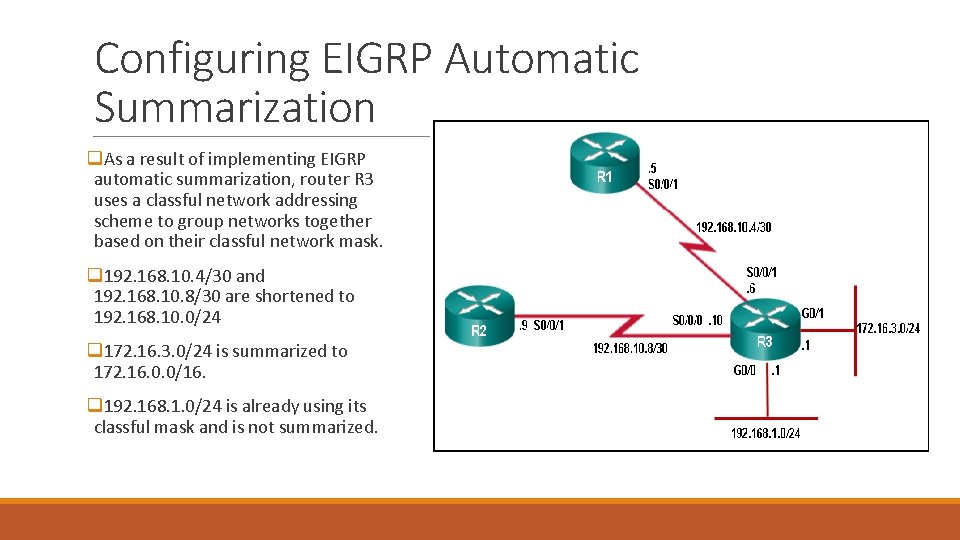
Configuring EIGRP Automatic Summarization q. As a result of implementing EIGRP automatic summarization, router R 3 uses a classful network addressing scheme to group networks together based on their classful network mask. q 192. 168. 10. 4/30 and 192. 168. 10. 8/30 are shortened to 192. 168. 10. 0/24 q 172. 16. 3. 0/24 is summarized to 172. 16. 0. 0/16. q 192. 168. 1. 0/24 is already using its classful mask and is not summarized.
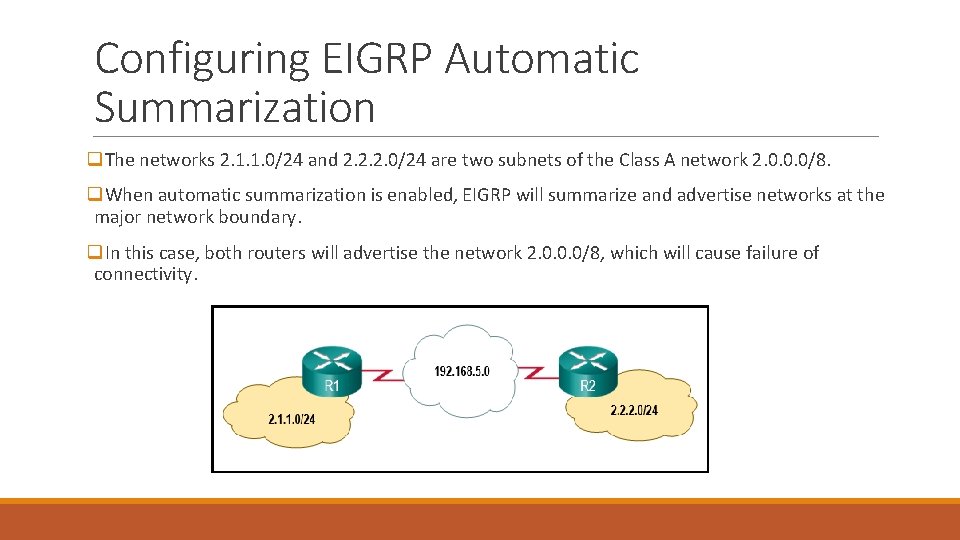
Configuring EIGRP Automatic Summarization q. The networks 2. 1. 1. 0/24 and 2. 2. 2. 0/24 are two subnets of the Class A network 2. 0. 0. 0/8. q. When automatic summarization is enabled, EIGRP will summarize and advertise networks at the major network boundary. q. In this case, both routers will advertise the network 2. 0. 0. 0/8, which will cause failure of connectivity.
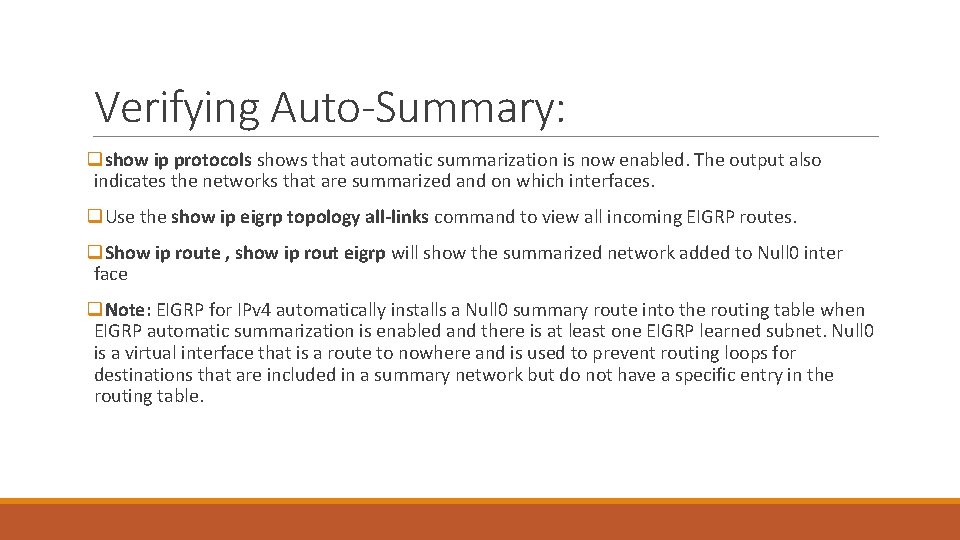
Verifying Auto-Summary: qshow ip protocols shows that automatic summarization is now enabled. The output also indicates the networks that are summarized and on which interfaces. q. Use the show ip eigrp topology all-links command to view all incoming EIGRP routes. q. Show ip route , show ip rout eigrp will show the summarized network added to Null 0 inter face q. Note: EIGRP for IPv 4 automatically installs a Null 0 summary route into the routing table when EIGRP automatic summarization is enabled and there is at least one EIGRP learned subnet. Null 0 is a virtual interface that is a route to nowhere and is used to prevent routing loops for destinations that are included in a summary network but do not have a specific entry in the routing table.
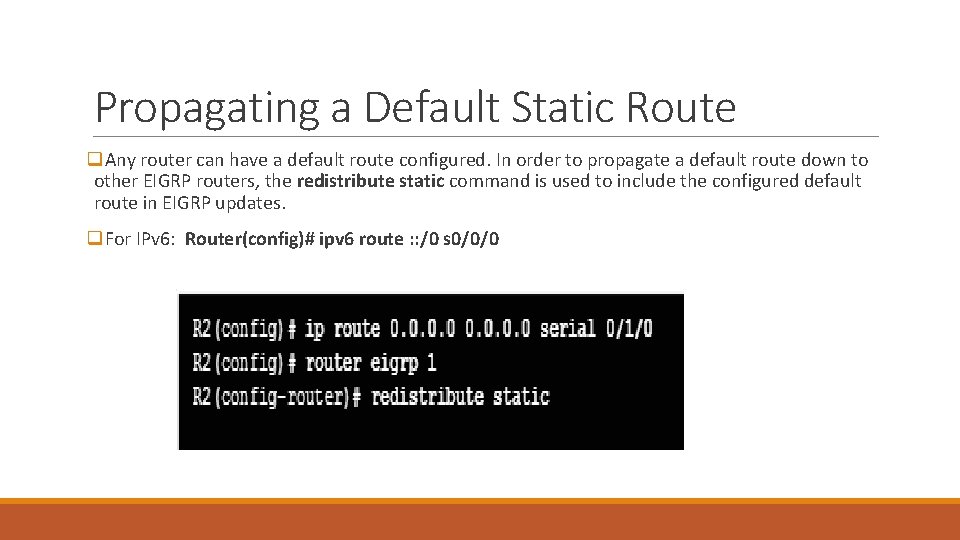
Propagating a Default Static Route q. Any router can have a default route configured. In order to propagate a default route down to other EIGRP routers, the redistribute static command is used to include the configured default route in EIGRP updates. q. For IPv 6: Router(config)# ipv 6 route : : /0 s 0/0/0
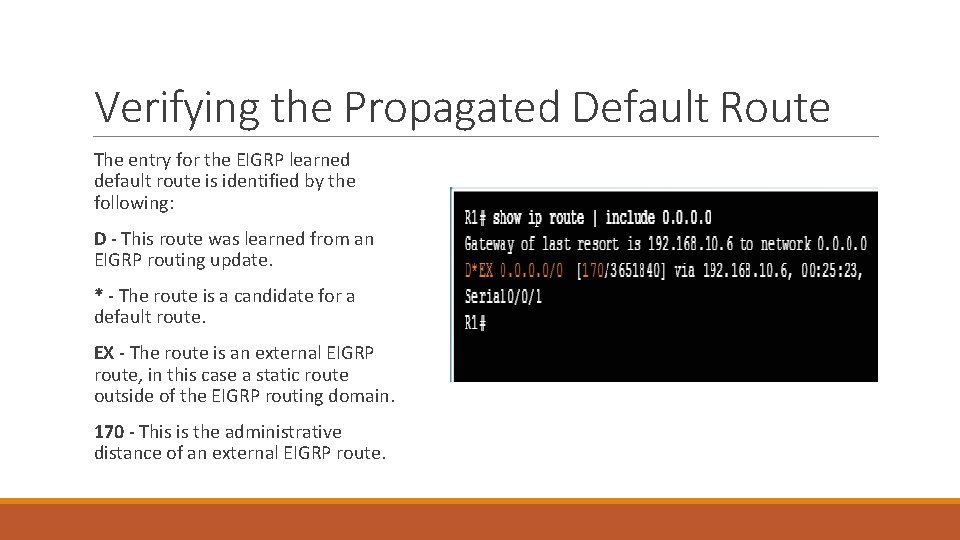
Verifying the Propagated Default Route The entry for the EIGRP learned default route is identified by the following: D - This route was learned from an EIGRP routing update. * - The route is a candidate for a default route. EX - The route is an external EIGRP route, in this case a static route outside of the EIGRP routing domain. 170 - This is the administrative distance of an external EIGRP route.
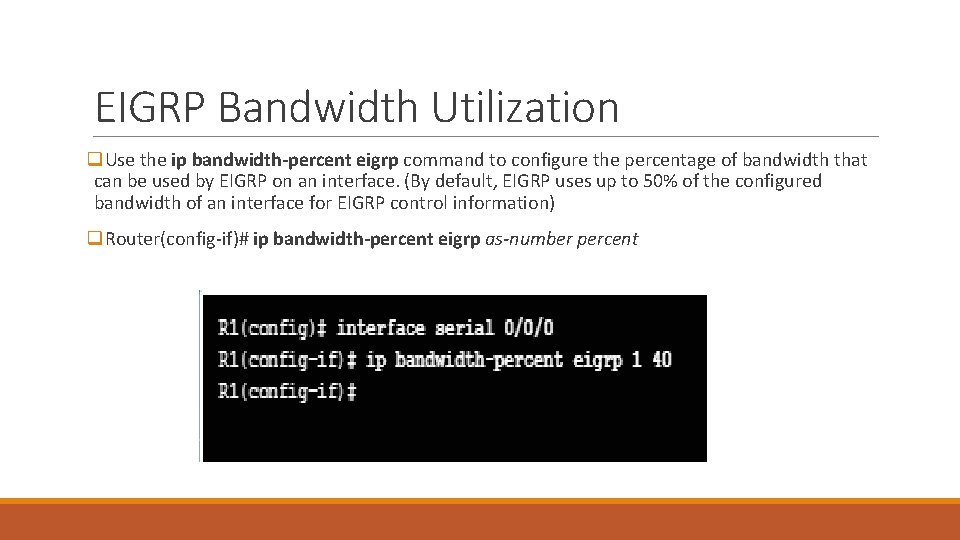
EIGRP Bandwidth Utilization q. Use the ip bandwidth-percent eigrp command to configure the percentage of bandwidth that can be used by EIGRP on an interface. (By default, EIGRP uses up to 50% of the configured bandwidth of an interface for EIGRP control information) q. Router(config-if)# ip bandwidth-percent eigrp as-number percent
Unequal-Cost Load Balancing q. For load balancing, EIGRP will by default install up to four equal-cost paths to the same destination network in the routing table. q. When a packet is process-switched, load balancing over equal-cost paths occurs on a perpacket basis. When packets are fast-switched, load balancing over equal-cost paths occurs on a per-destination basis. q. EIGRP for IPv 4 and IPv 6 can also balance traffic across multiple routes that have different metrics. This type of balancing is called unequal-cost load balancing. Setting a value using the variance command in router configuration mode enables EIGRP to install multiple loop-free routes with unequal cost in a local routing table. q. The default variance for EIGRP is 1.
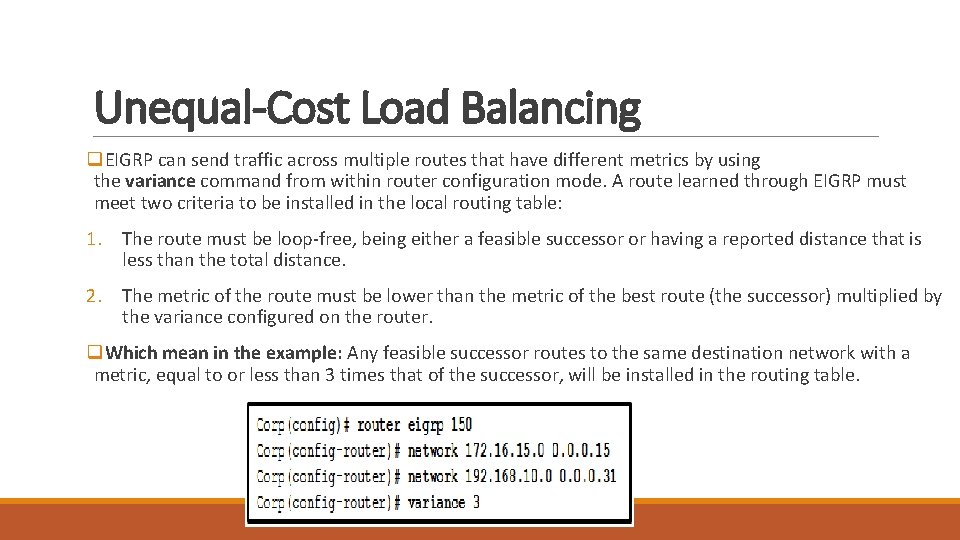
Unequal-Cost Load Balancing q. EIGRP can send traffic across multiple routes that have different metrics by using the variance command from within router configuration mode. A route learned through EIGRP must meet two criteria to be installed in the local routing table: 1. The route must be loop-free, being either a feasible successor or having a reported distance that is less than the total distance. 2. The metric of the route must be lower than the metric of the best route (the successor) multiplied by the variance configured on the router. q. Which mean in the example: Any feasible successor routes to the same destination network with a metric, equal to or less than 3 times that of the successor, will be installed in the routing table.