
Dynamic Programming General Idea Problem can be divided
Dynamic Programming General Idea • Problem can be divided into stages with a policy decision required at each stage. (Solution is a sequence of decisions) • Each stage has a number of states associated with it. • The effect of the policy decision at each stage is to transform the current state into a state in the next stage. • Given a current state, the optimal policy for the remaining stages is independent from the policy adopted in the previous stages. (The decision at the current stage is based on the results of the previous stage, but decisions are independent) Young CS 530 Adv. Algo Dynamic Programming 1
Dynamic Programming General Idea “Principle of optimality” : A decision sequence can be optimal only if the decision sequence that takes us from the outcome of the initial decision is itself optimal. eliminates “not optimal” subsequences • The solution procedure begins by finding the optimal policy for the last stage. (backward approach) Then, a recursive relationship that represents the optimal policy for each stage can be generated. Young CS 530 Adv. Algo Dynamic Programming 2
Greedy & Dynamic Programming Greedy: - Consider only 1 seq. of decisions Dynamic Programming: - Consider many seq. of decisions - Try all possibilities Young CS 530 Adv. Algo Dynamic Programming 3
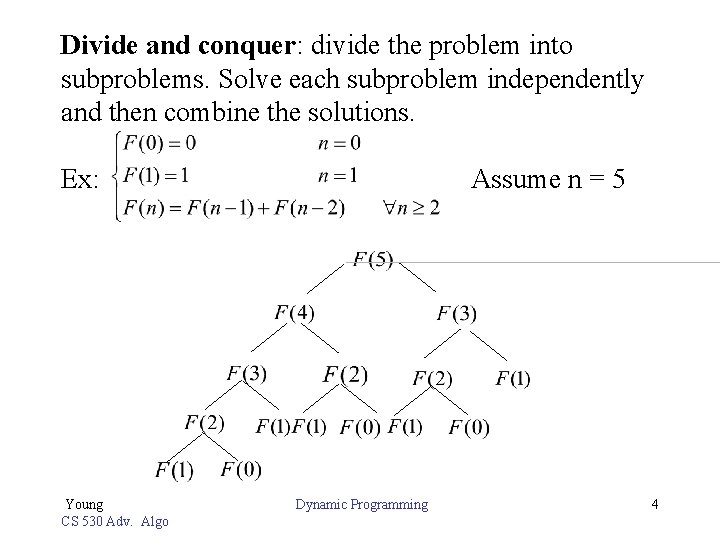
Divide and conquer: divide the problem into subproblems. Solve each subproblem independently and then combine the solutions. Ex: Young CS 530 Adv. Algo Assume n = 5 Dynamic Programming 4
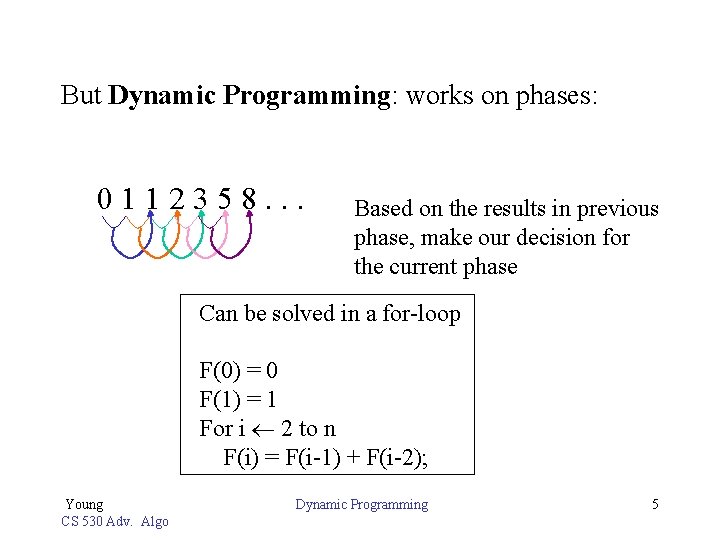
But Dynamic Programming: works on phases: 0112358. . . Based on the results in previous phase, make our decision for the current phase Can be solved in a for-loop F(0) = 0 F(1) = 1 For i 2 to n F(i) = F(i-1) + F(i-2); Young CS 530 Adv. Algo Dynamic Programming 5
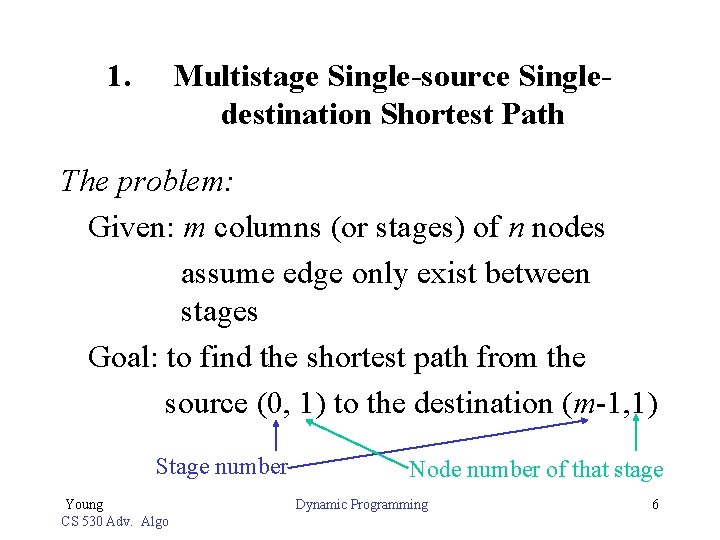
1. Multistage Single-source Singledestination Shortest Path The problem: Given: m columns (or stages) of n nodes assume edge only exist between stages Goal: to find the shortest path from the source (0, 1) to the destination (m-1, 1) Stage number Young CS 530 Adv. Algo Node number of that stage Dynamic Programming 6
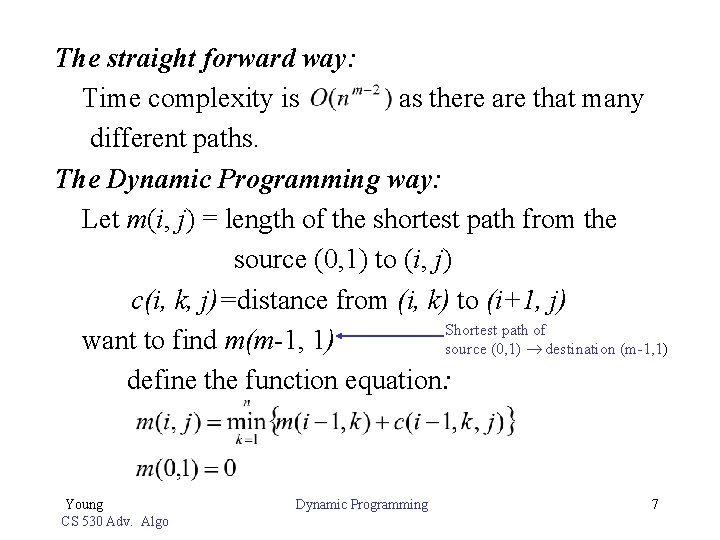
The straight forward way: Time complexity is as there are that many different paths. The Dynamic Programming way: Let m(i, j) = length of the shortest path from the source (0, 1) to (i, j) c(i, k, j)=distance from (i, k) to (i+1, j) Shortest path of want to find m(m-1, 1) source (0, 1) destination (m-1, 1) define the function equation: Young CS 530 Adv. Algo Dynamic Programming 7
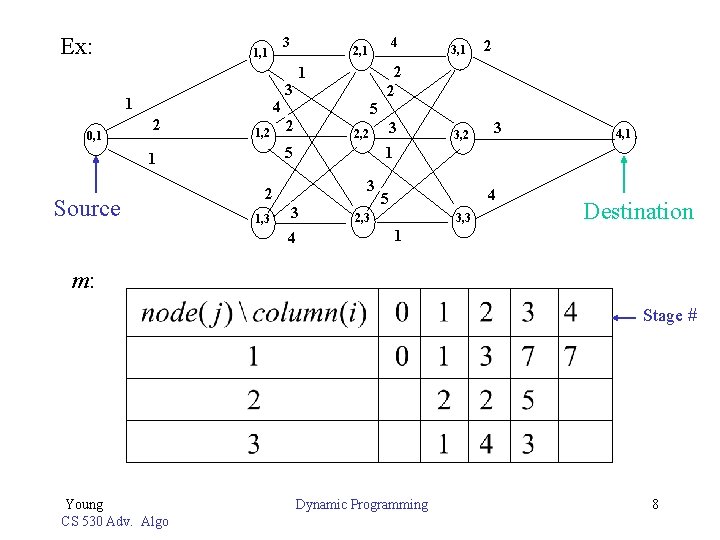
Ex: 1 0, 1 3 1, 1 4 2 1, 2 3 1 5 2 2, 2 5 1 Source 4 2, 1 3 3 4 2 2 2 3 3, 2 3 4, 1 1 2 1, 3 3, 1 4 5 2, 3 3, 3 Destination 1 m: Stage # Young CS 530 Adv. Algo Dynamic Programming 8
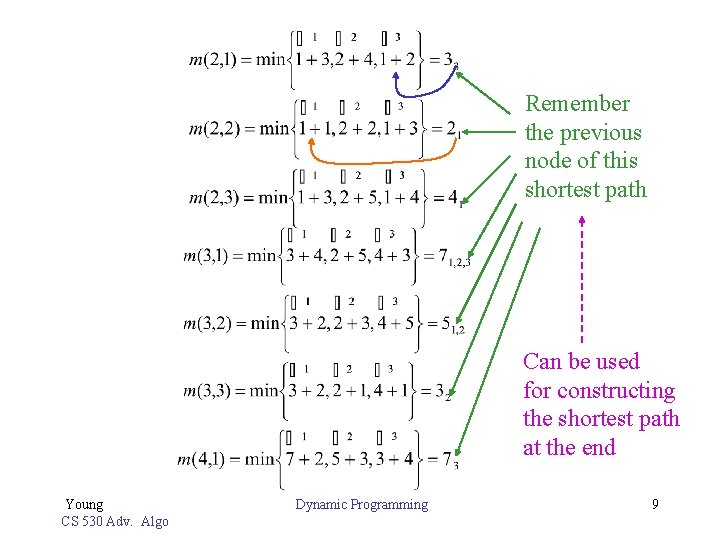
Remember the previous node of this shortest path Can be used for constructing the shortest path at the end Young CS 530 Adv. Algo Dynamic Programming 9
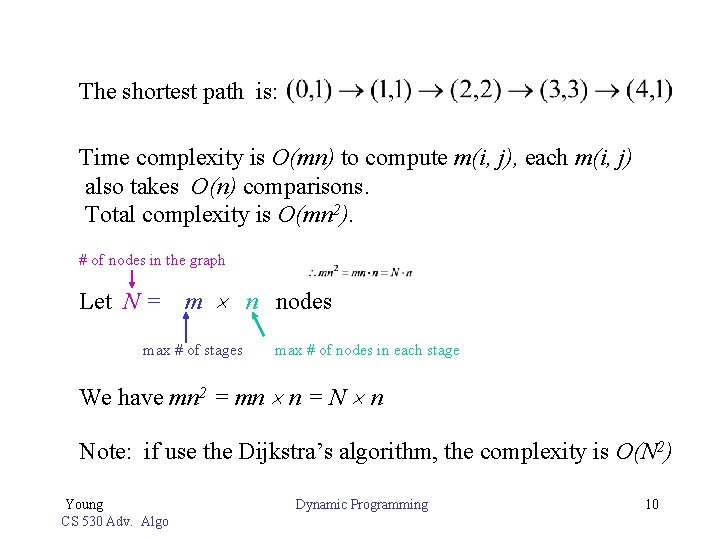
The shortest path is: Time complexity is O(mn) to compute m(i, j), each m(i, j) also takes O(n) comparisons. Total complexity is O(mn 2). # of nodes in the graph Let N = m n nodes max # of stages max # of nodes in each stage We have mn 2 = mn n = N n Note: if use the Dijkstra’s algorithm, the complexity is O(N 2) Young CS 530 Adv. Algo Dynamic Programming 10
Revisit Dynamic Programming • The problem can be divided into stages. • Need to make decisions at each stage. • The decision for the current stage(based on the results of the previous stage) is independent from that of the previous stages, e. g. look at node 3, 1 of the multistage shortest path problem, it chooses among 3 decisions from nodes 2, 1 or 2, 2 or 2, 3 but it is independent from how node 2, 1 (2, 2 or 2, 3) makes its decision. Note that we find shortest paths from the source to all three nodes 2, 1 and 2, 2 and 2, 3, but some of them may not be used on the shortest path at all. • But every decision must be optimal, so that the overall result is optimal. This is called “Principle of Optimality”. Young CS 530 Adv. Algo Dynamic Programming 11
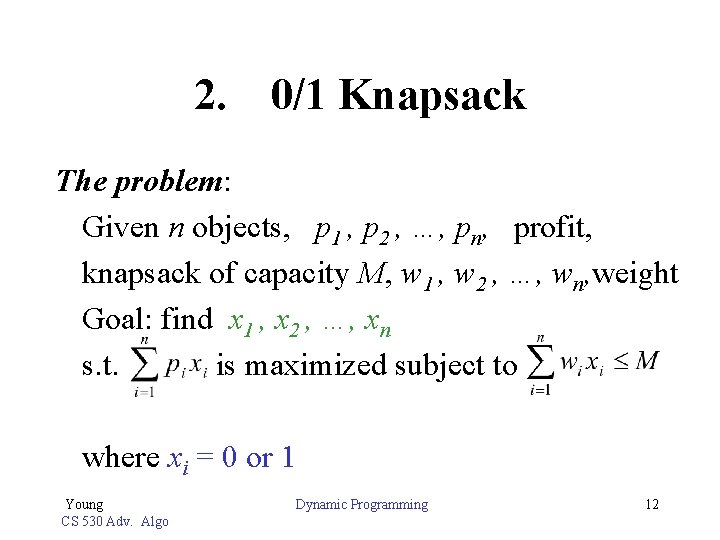
2. 0/1 Knapsack The problem: Given n objects, p 1 , p 2 , …, pn, profit, knapsack of capacity M, w 1 , w 2 , …, wn, weight Goal: find x 1 , x 2 , …, xn s. t. is maximized subject to where xi = 0 or 1 Young CS 530 Adv. Algo Dynamic Programming 12
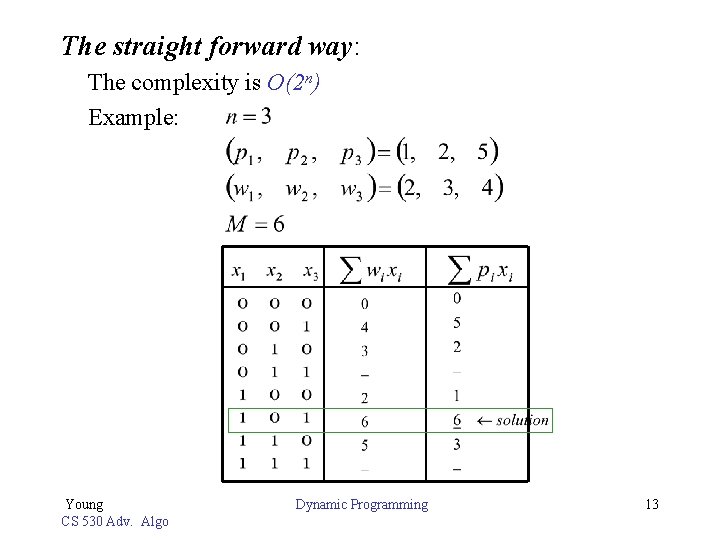
The straight forward way: The complexity is O(2 n) Example: Young CS 530 Adv. Algo Dynamic Programming 13
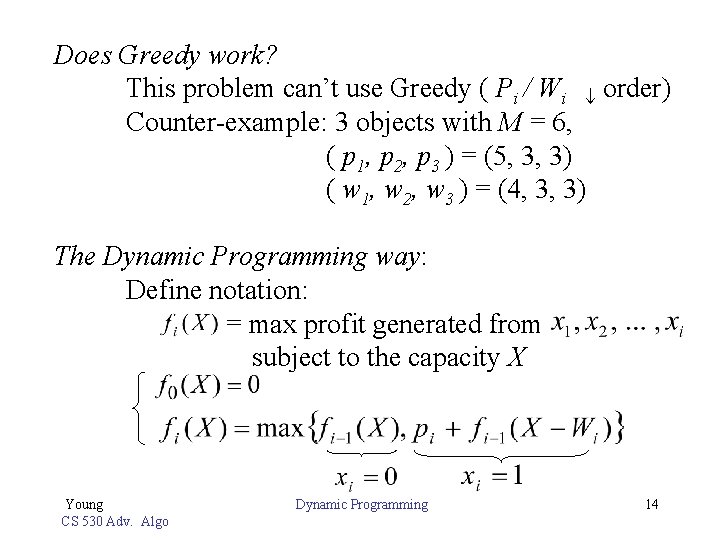
Does Greedy work? This problem can’t use Greedy ( Pi / Wi order) Counter-example: 3 objects with M = 6, ( p 1, p 2, p 3 ) = (5, 3, 3) ( w 1, w 2, w 3 ) = (4, 3, 3) The Dynamic Programming way: Define notation: = max profit generated from subject to the capacity X Young CS 530 Adv. Algo Dynamic Programming 14
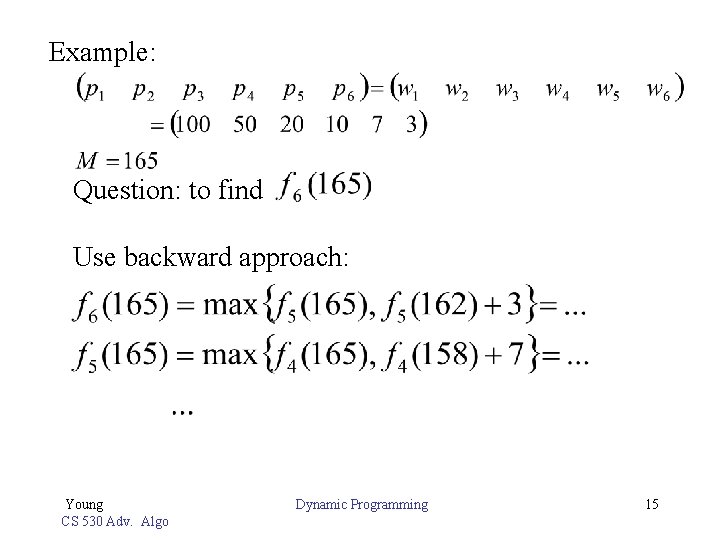
Example: Question: to find Use backward approach: Young CS 530 Adv. Algo Dynamic Programming 15
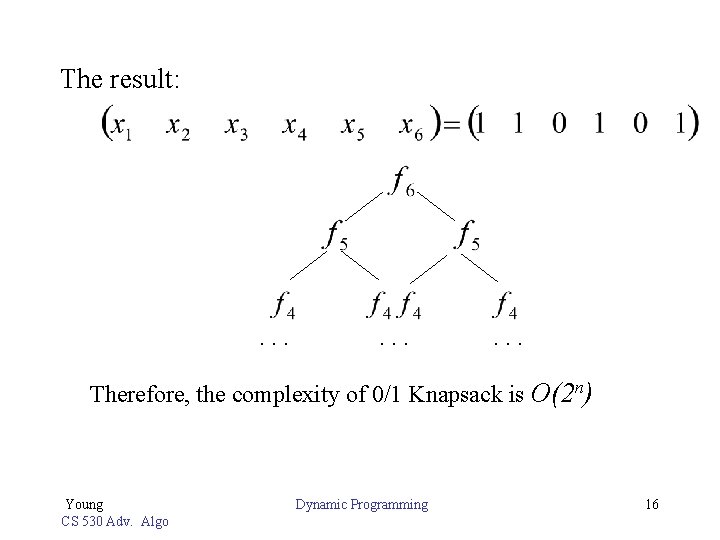
The result: . . Therefore, the complexity of 0/1 Knapsack is O(2 n) Young CS 530 Adv. Algo Dynamic Programming 16
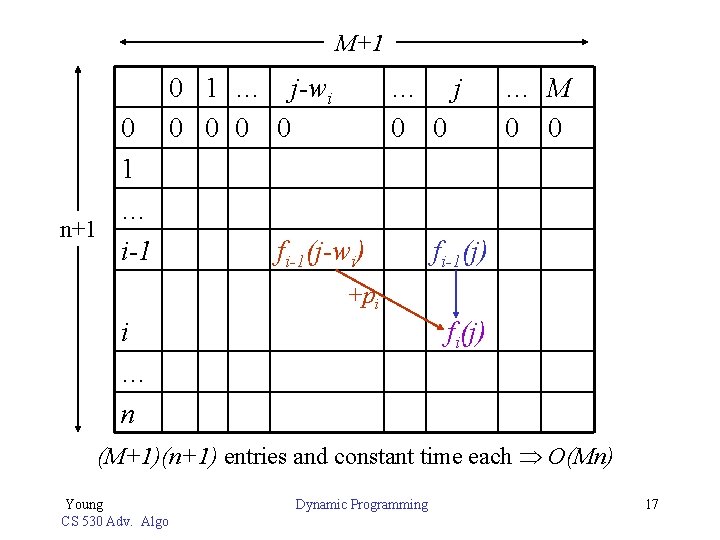
M+1 0 1 … n+1 i-1 0 1 … j-wi 0 0 … j 0 0 fi-1(j-wi) … M 0 0 fi-1(j) +pi i … n fi(j) (M+1)(n+1) entries and constant time each O(Mn) Young CS 530 Adv. Algo Dynamic Programming 17
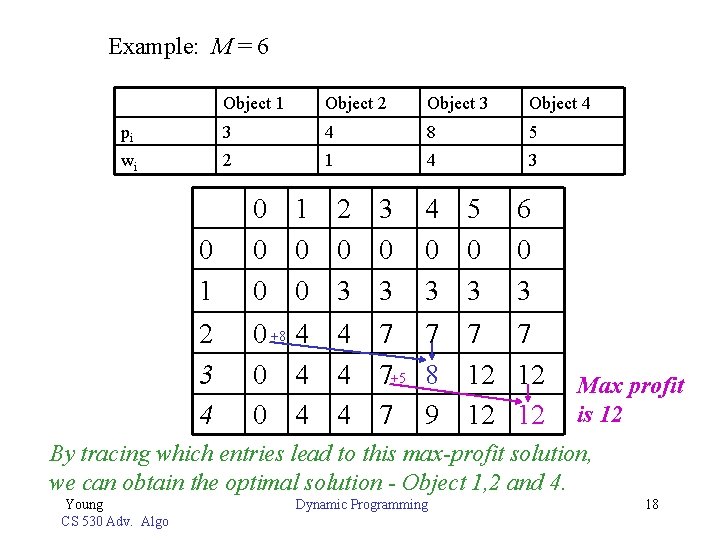
Example: M = 6 Object 1 Object 2 Object 3 Object 4 pi 3 4 8 5 wi 2 1 4 3 0 1 0 0 2 0 3 3 0 3 4 0 3 2 3 4 0 +8 4 0 4 4 7 7 7+5 8 7 9 5 0 3 6 0 3 7 7 12 12 Max profit is 12 By tracing which entries lead to this max-profit solution, we can obtain the optimal solution - Object 1, 2 and 4. Young CS 530 Adv. Algo Dynamic Programming 18
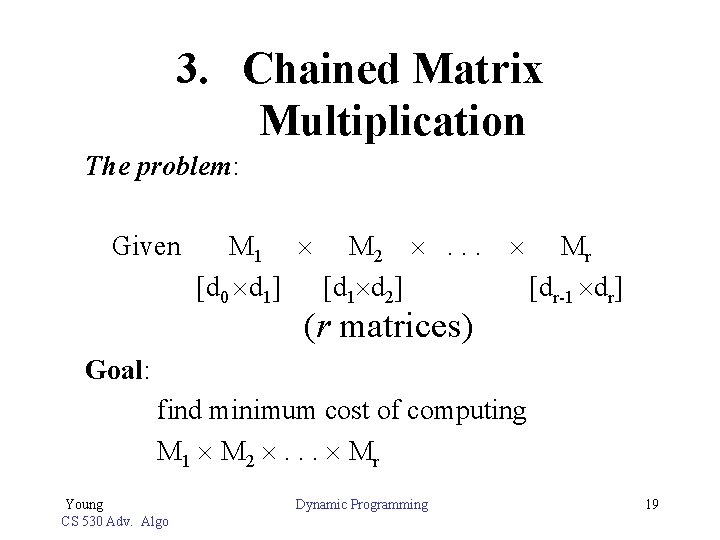
3. Chained Matrix Multiplication The problem: Given M 1 M 2 . . . [d 0 d 1] [d 1 d 2] (r matrices) Mr [dr-1 dr] Goal: find minimum cost of computing M 1 M 2 . . . Mr Young CS 530 Adv. Algo Dynamic Programming 19
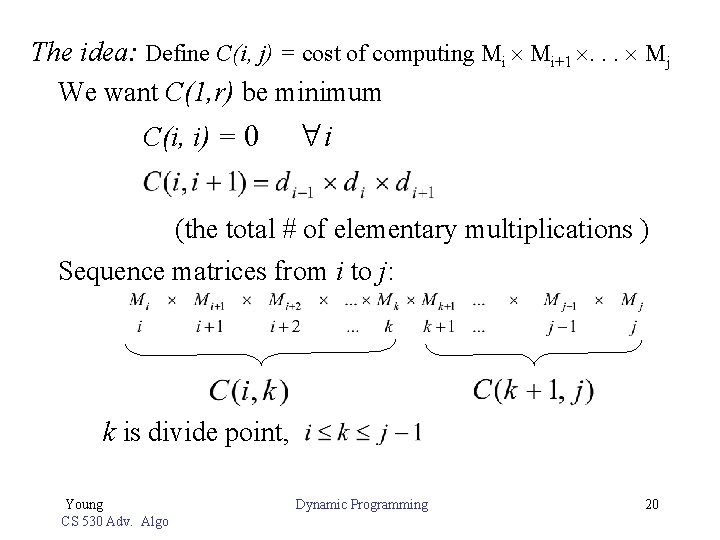
The idea: Define C(i, j) = cost of computing Mi Mi+1 . . . Mj We want C(1, r) be minimum C(i, i) = 0 i (the total # of elementary multiplications ) Sequence matrices from i to j: k is divide point, Young CS 530 Adv. Algo Dynamic Programming 20
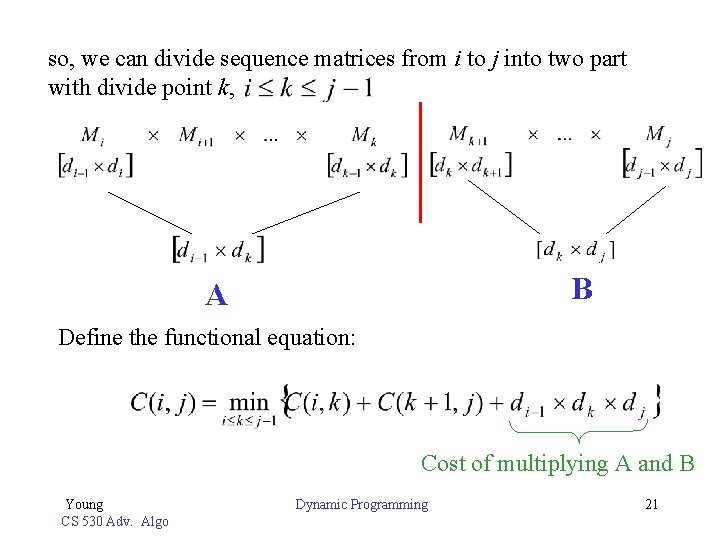
so, we can divide sequence matrices from i to j into two part with divide point k, B A Define the functional equation: Cost of multiplying A and B Young CS 530 Adv. Algo Dynamic Programming 21
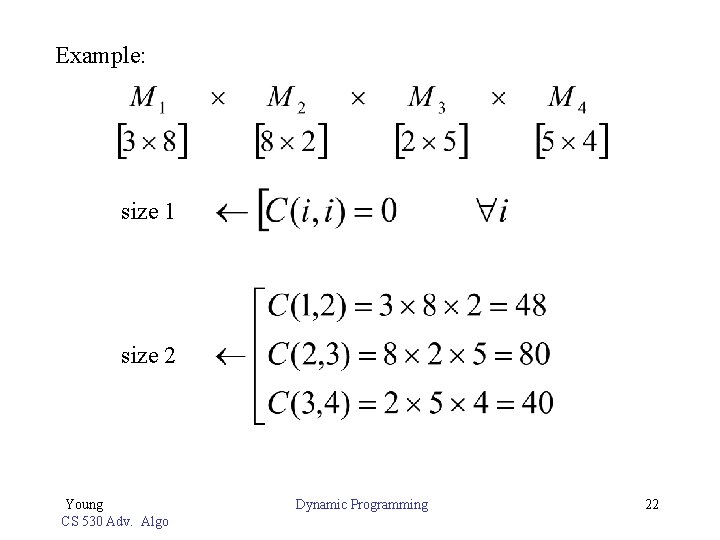
Example: size 1 size 2 Young CS 530 Adv. Algo Dynamic Programming 22
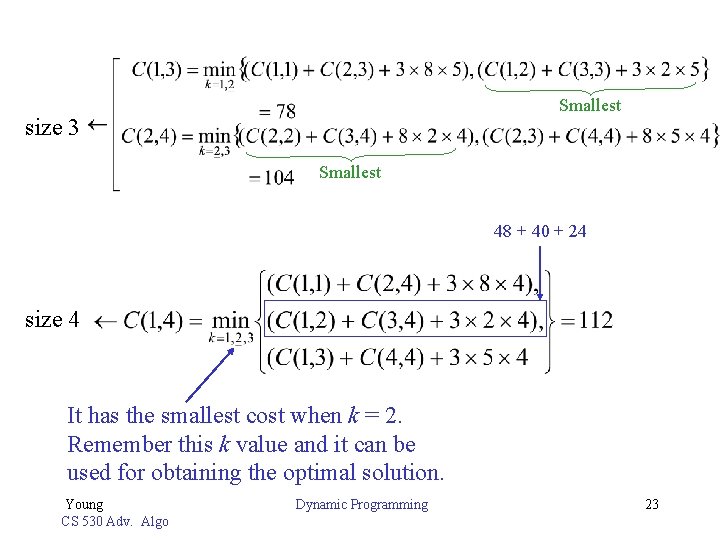
Smallest size 3 Smallest 48 + 40 + 24 size 4 It has the smallest cost when k = 2. Remember this k value and it can be used for obtaining the optimal solution. Young CS 530 Adv. Algo Dynamic Programming 23
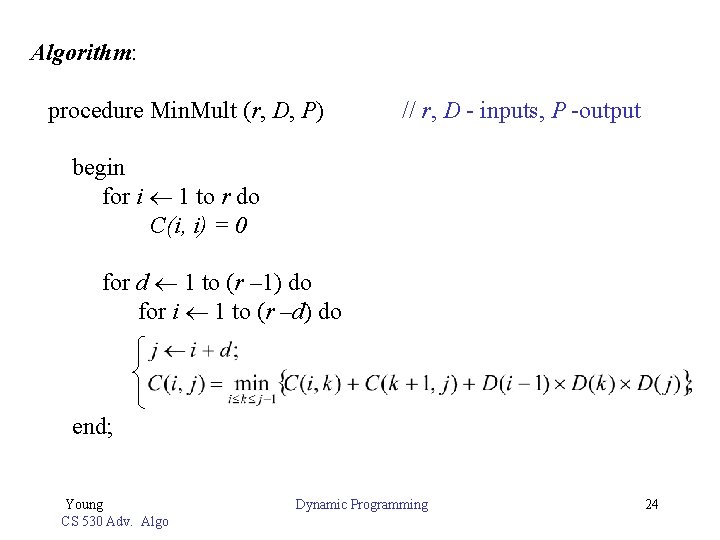
Algorithm: procedure Min. Mult (r, D, P) // r, D - inputs, P -output begin for i 1 to r do C(i, i) = 0 for d 1 to (r – 1) do for i 1 to (r –d) do end; Young CS 530 Adv. Algo Dynamic Programming 24
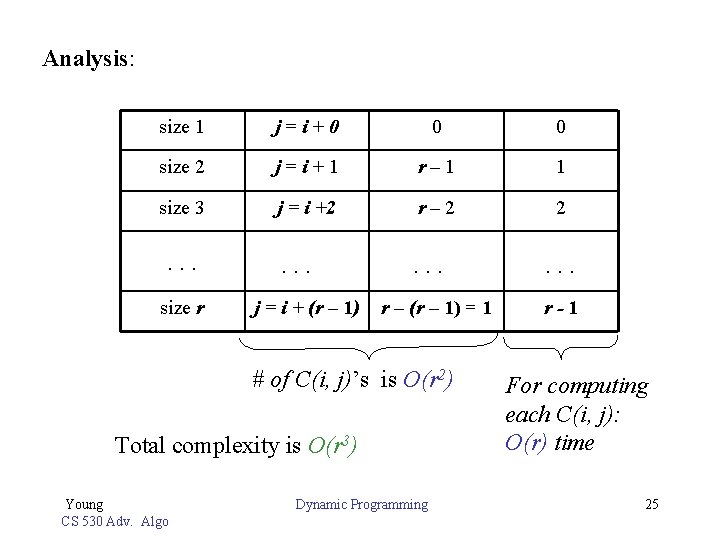
Analysis: size 1 j=i+0 0 0 size 2 j=i+1 r– 1 1 size 3 j = i +2 r– 2 2 . . size r j = i + (r – 1) r – (r – 1) = 1 # of C(i, j)’s is O(r 2) Total complexity is O(r 3) Young CS 530 Adv. Algo Dynamic Programming . . . r-1 For computing each C(i, j): O(r) time 25
- Slides: 25