
Dynamic Programming and Applications Capacity Expansion Water Resources
- Slides: 27
Dynamic Programming and Applications Capacity Expansion Water Resources Planning and Management: M 4 L 4 D Nagesh Kumar, IISc
Objectives Ø To discuss the Capacity Expansion Problem Ø To explain and develop recursive equations for both backward approach and forward approach Ø To demonstrate the method using a numerical example 2 Water Resources Planning and Management: M 4 L 4 D Nagesh Kumar, IISc
Capacity Expansion Problem Consider a municipality planning to increase the capacity of its infrastructure (ex: water treatment plant, water supply system etc) in future Sequential increments are to be made in specified time intervals The capacity at the beginning of time period t be St Required capacity at the end of that time period be Kt Thus, be the added capacity in each time period Cost of expansion at each time period can be expressed as a function of and 3 , i. e. Water Resources Planning and Management: M 4 L 4 D Nagesh Kumar, IISc
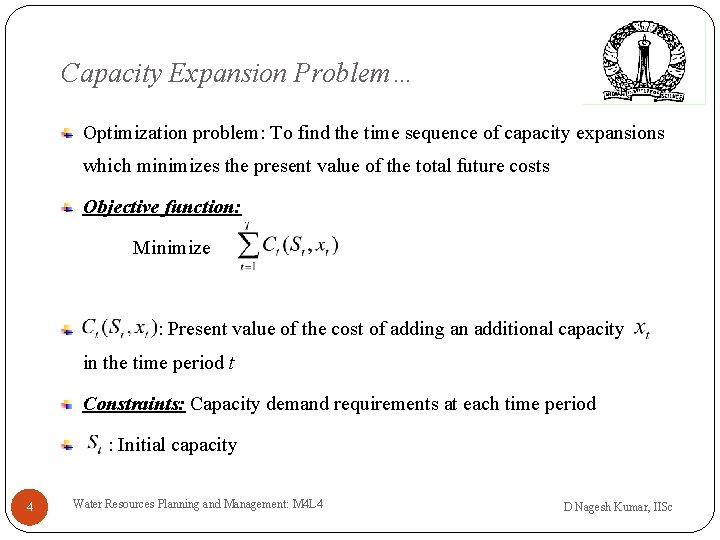
Capacity Expansion Problem… Optimization problem: To find the time sequence of capacity expansions which minimizes the present value of the total future costs Objective function: Minimize : Present value of the cost of adding an additional capacity in the time period t Constraints: Capacity demand requirements at each time period : Initial capacity 4 Water Resources Planning and Management: M 4 L 4 D Nagesh Kumar, IISc
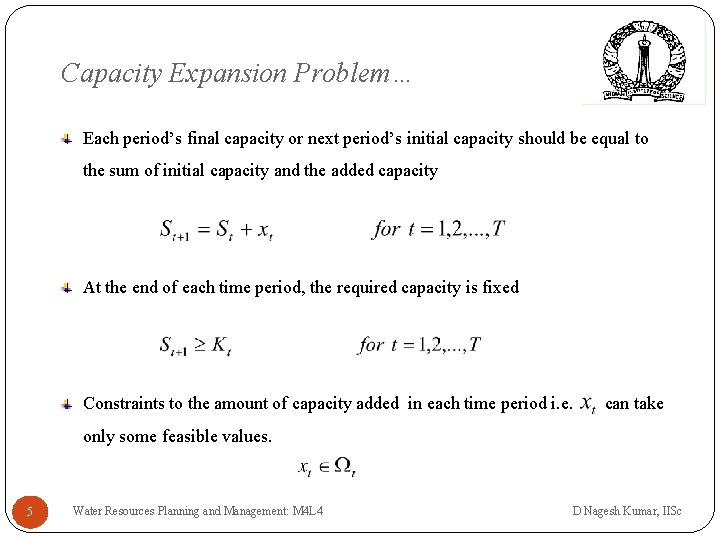
Capacity Expansion Problem… Each period’s final capacity or next period’s initial capacity should be equal to the sum of initial capacity and the added capacity At the end of each time period, the required capacity is fixed Constraints to the amount of capacity added in each time period i. e. can take only some feasible values. 5 Water Resources Planning and Management: M 4 L 4 D Nagesh Kumar, IISc
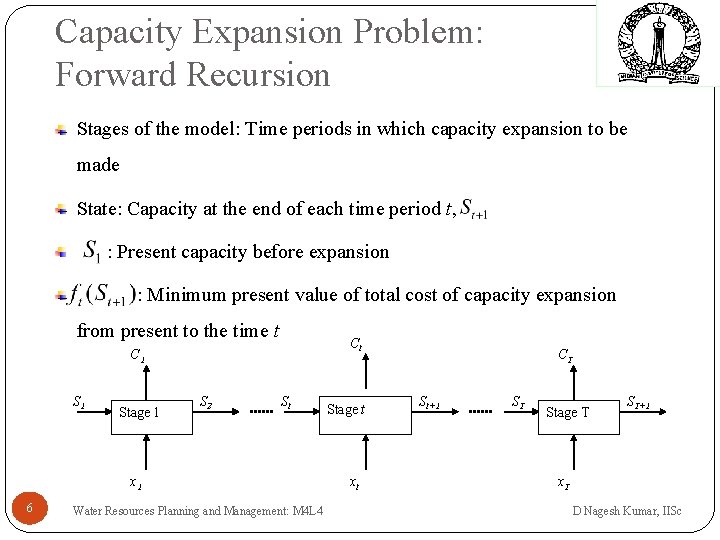
Capacity Expansion Problem: Forward Recursion Stages of the model: Time periods in which capacity expansion to be made State: Capacity at the end of each time period t, : Present capacity before expansion : Minimum present value of total cost of capacity expansion from present to the time t Ct C 1 Stage 1 S 2 St x 1 6 Water Resources Planning and Management: M 4 L 4 Stage t xt CT St+1 ST Stage T ST+1 x. T D Nagesh Kumar, IISc
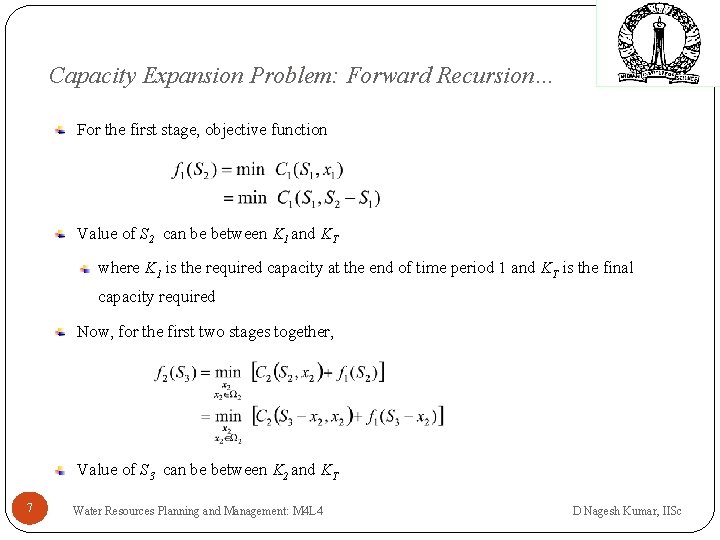
Capacity Expansion Problem: Forward Recursion… For the first stage, objective function Value of S 2 can be between K 1 and KT where K 1 is the required capacity at the end of time period 1 and KT is the final capacity required Now, for the first two stages together, Value of S 3 can be between K 2 and KT 7 Water Resources Planning and Management: M 4 L 4 D Nagesh Kumar, IISc
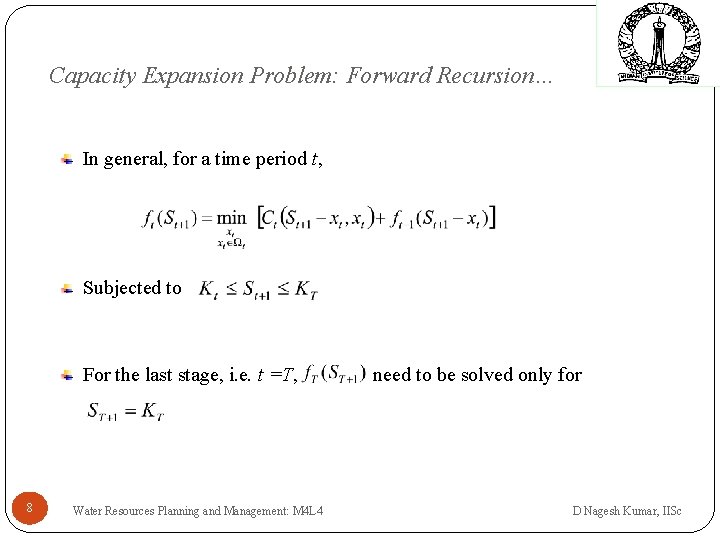
Capacity Expansion Problem: Forward Recursion… In general, for a time period t, Subjected to For the last stage, i. e. t =T, 8 Water Resources Planning and Management: M 4 L 4 need to be solved only for D Nagesh Kumar, IISc
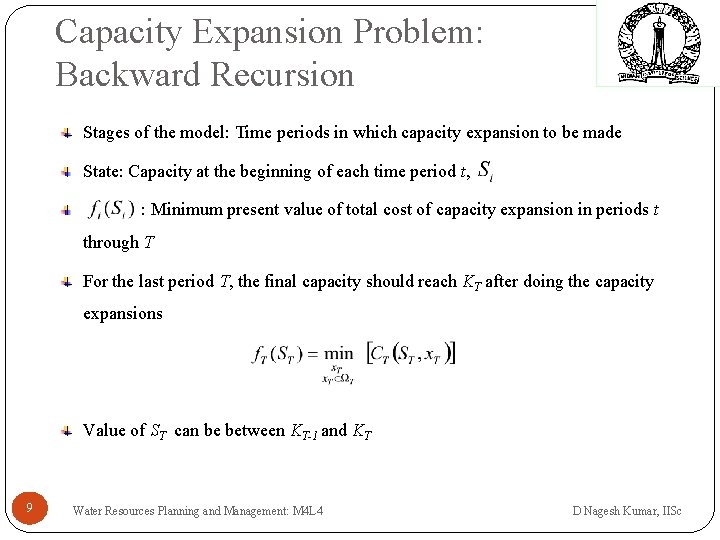
Capacity Expansion Problem: Backward Recursion Stages of the model: Time periods in which capacity expansion to be made State: Capacity at the beginning of each time period t, : Minimum present value of total cost of capacity expansion in periods t through T For the last period T, the final capacity should reach KT after doing the capacity expansions Value of ST can be between KT-1 and KT 9 Water Resources Planning and Management: M 4 L 4 D Nagesh Kumar, IISc
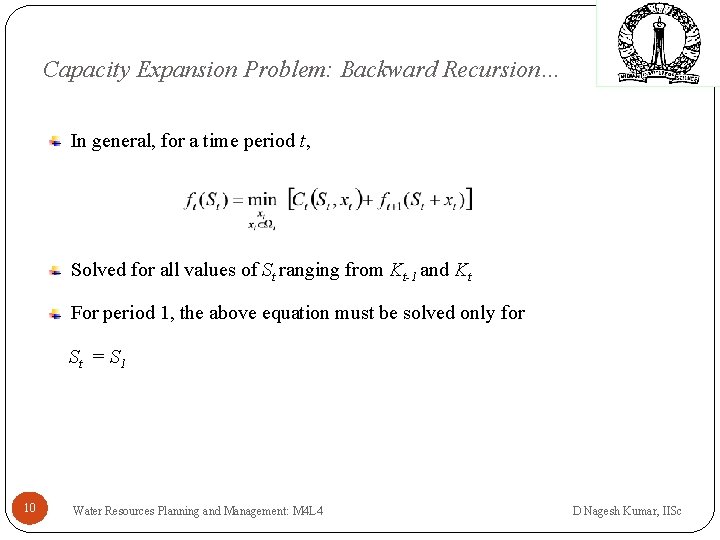
Capacity Expansion Problem: Backward Recursion… In general, for a time period t, Solved for all values of St ranging from Kt-1 and Kt For period 1, the above equation must be solved only for St = S 1 10 Water Resources Planning and Management: M 4 L 4 D Nagesh Kumar, IISc
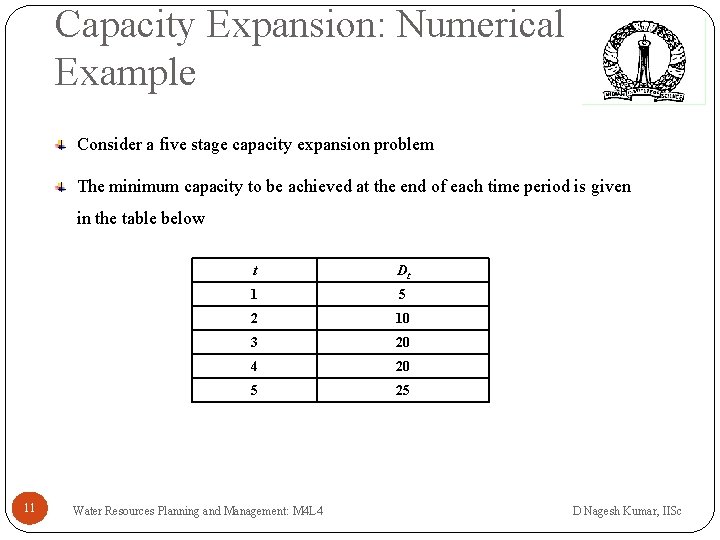
Capacity Expansion: Numerical Example Consider a five stage capacity expansion problem The minimum capacity to be achieved at the end of each time period is given in the table below 11 t Dt 1 5 2 10 3 20 4 20 5 25 Water Resources Planning and Management: M 4 L 4 D Nagesh Kumar, IISc
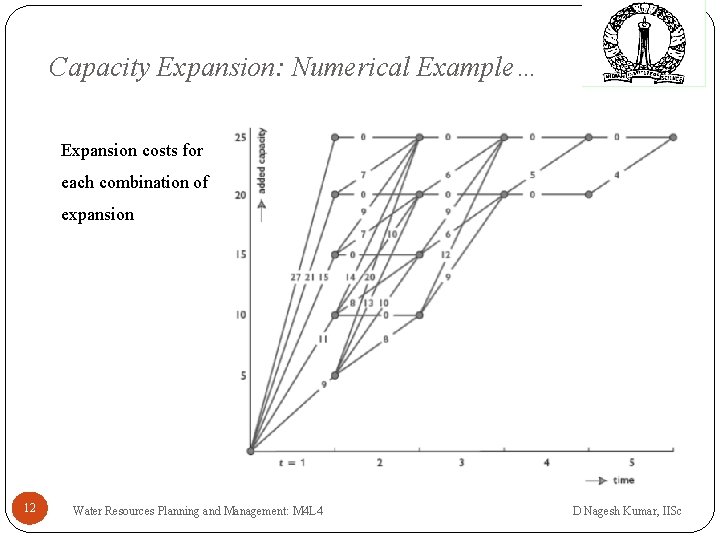
Capacity Expansion: Numerical Example… Expansion costs for each combination of expansion 12 Water Resources Planning and Management: M 4 L 4 D Nagesh Kumar, IISc
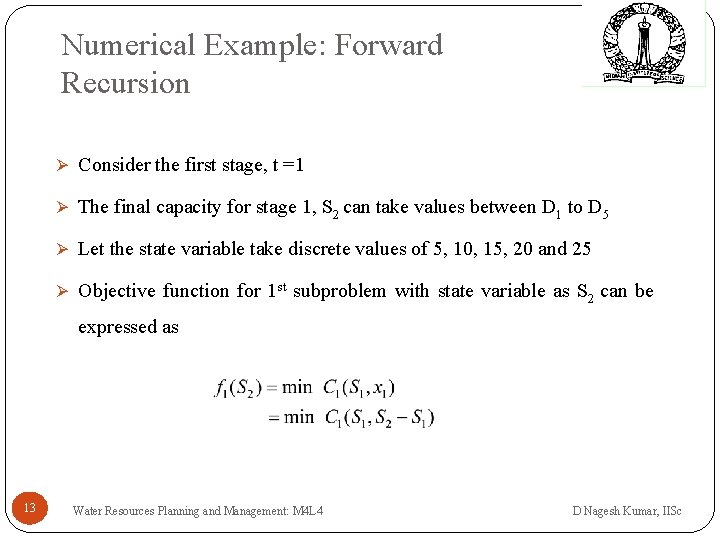
Numerical Example: Forward Recursion Ø Consider the first stage, t =1 Ø The final capacity for stage 1, S 2 can take values between D 1 to D 5 Ø Let the state variable take discrete values of 5, 10, 15, 20 and 25 Ø Objective function for 1 st subproblem with state variable as S 2 can be expressed as 13 Water Resources Planning and Management: M 4 L 4 D Nagesh Kumar, IISc
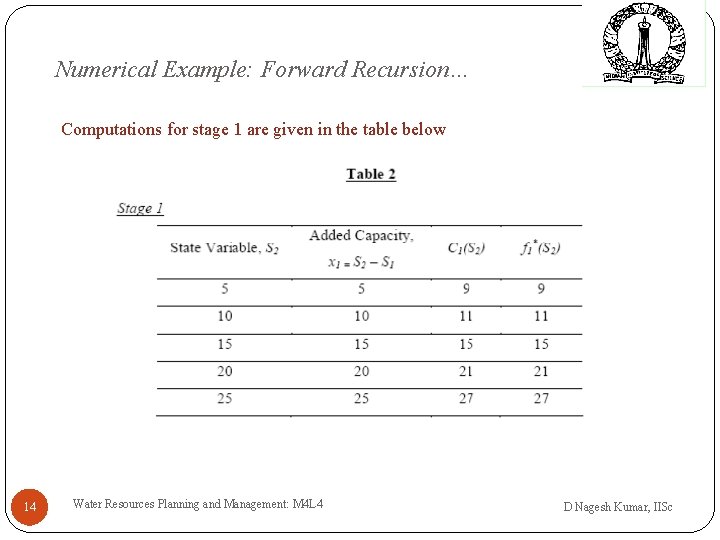
Numerical Example: Forward Recursion… Computations for stage 1 are given in the table below 14 Water Resources Planning and Management: M 4 L 4 D Nagesh Kumar, IISc
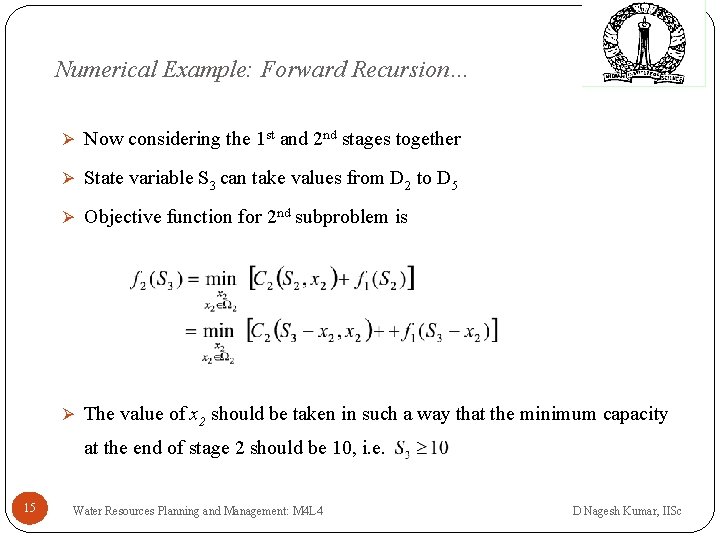
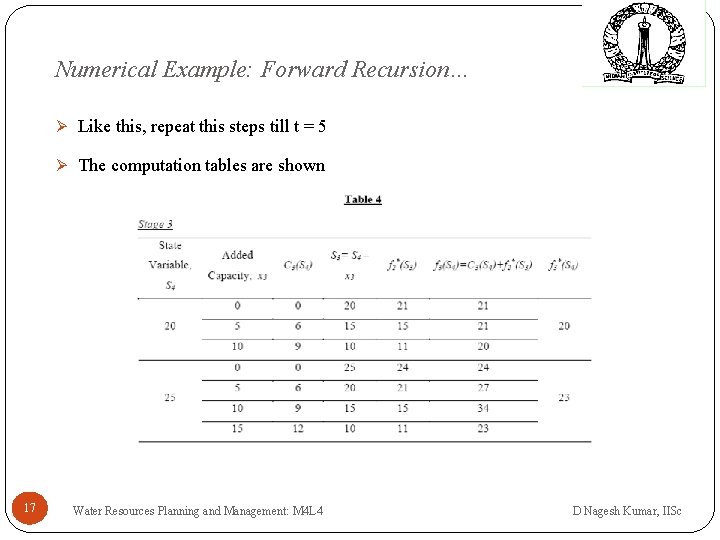
Numerical Example: Forward Recursion… Ø Now considering the 1 st and 2 nd stages together Ø State variable S 3 can take values from D 2 to D 5 Ø Objective function for 2 nd subproblem is Ø The value of x 2 should be taken in such a way that the minimum capacity at the end of stage 2 should be 10, i. e. 15 Water Resources Planning and Management: M 4 L 4 D Nagesh Kumar, IISc
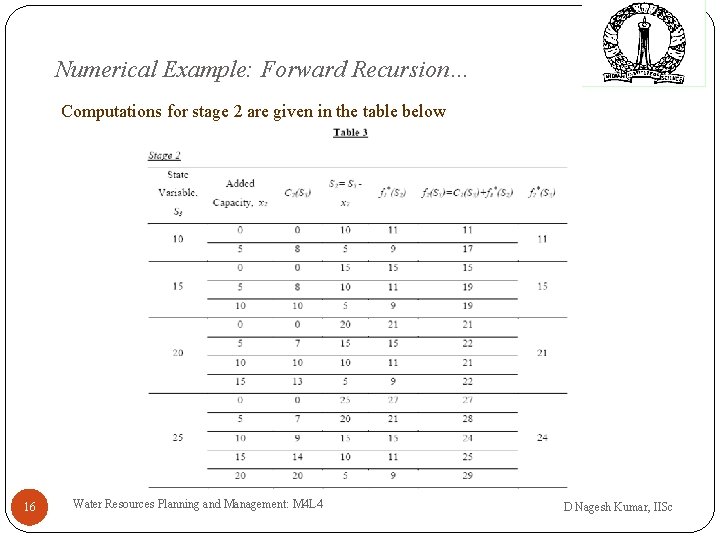
Numerical Example: Forward Recursion… Computations for stage 2 are given in the table below 16 Water Resources Planning and Management: M 4 L 4 D Nagesh Kumar, IISc
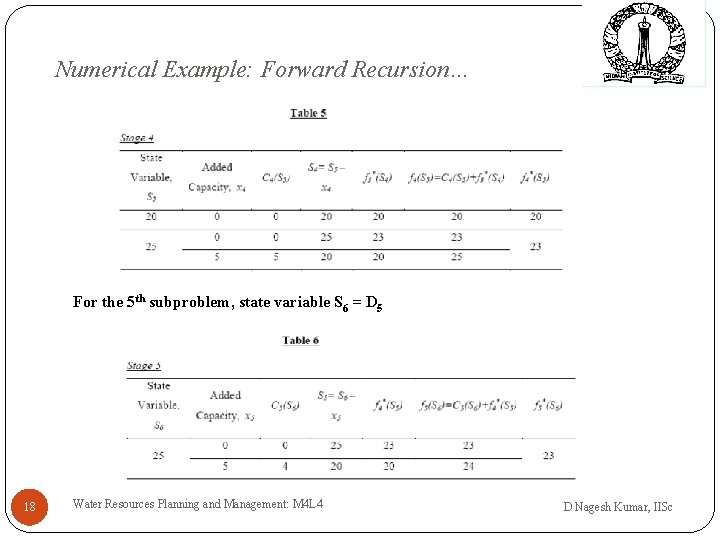
Numerical Example: Forward Recursion… Ø Like this, repeat this steps till t = 5 Ø The computation tables are shown 17 Water Resources Planning and Management: M 4 L 4 D Nagesh Kumar, IISc
Numerical Example: Forward Recursion… For the 5 th subproblem, state variable S 6 = D 5 18 Water Resources Planning and Management: M 4 L 4 D Nagesh Kumar, IISc
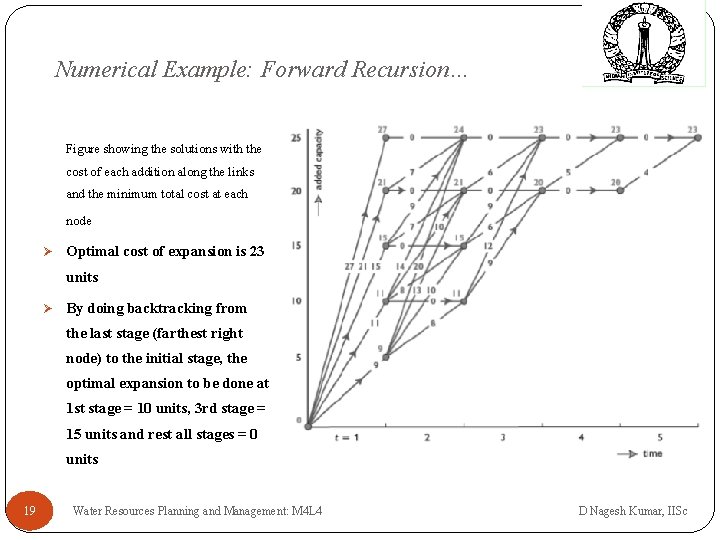
Numerical Example: Forward Recursion… Figure showing the solutions with the cost of each addition along the links and the minimum total cost at each node Ø Optimal cost of expansion is 23 units Ø By doing backtracking from the last stage (farthest right node) to the initial stage, the optimal expansion to be done at 1 st stage = 10 units, 3 rd stage = 15 units and rest all stages = 0 units 19 Water Resources Planning and Management: M 4 L 4 D Nagesh Kumar, IISc
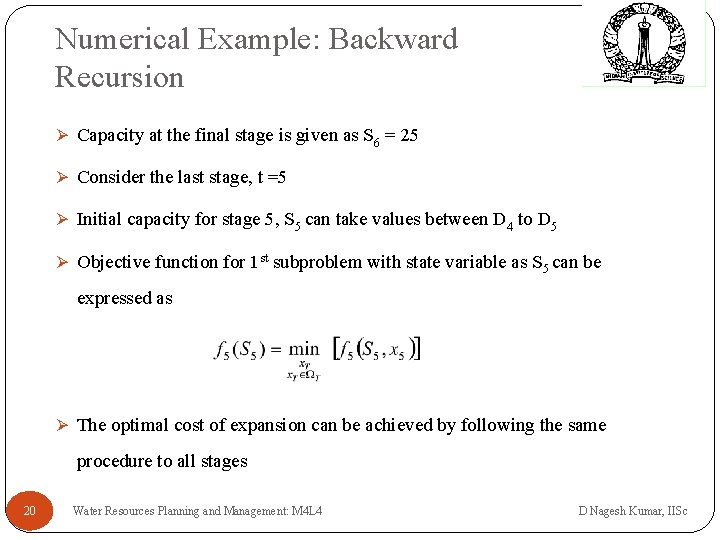
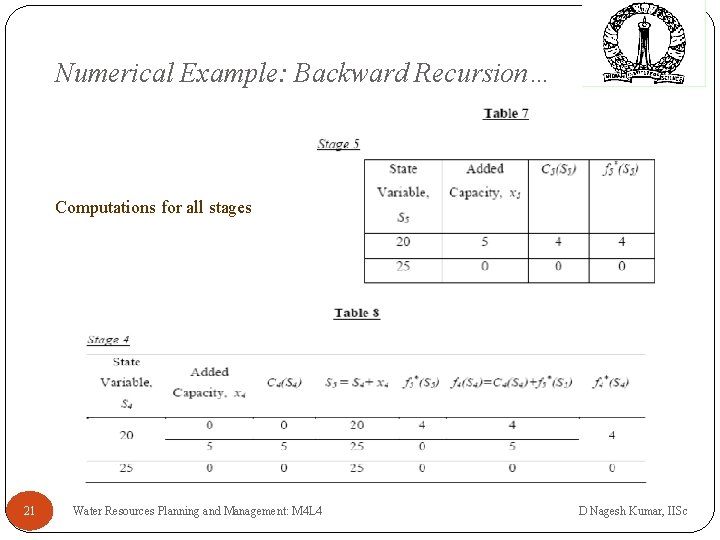
Numerical Example: Backward Recursion Ø Capacity at the final stage is given as S 6 = 25 Ø Consider the last stage, t =5 Ø Initial capacity for stage 5, S 5 can take values between D 4 to D 5 Ø Objective function for 1 st subproblem with state variable as S 5 can be expressed as Ø The optimal cost of expansion can be achieved by following the same procedure to all stages 20 Water Resources Planning and Management: M 4 L 4 D Nagesh Kumar, IISc
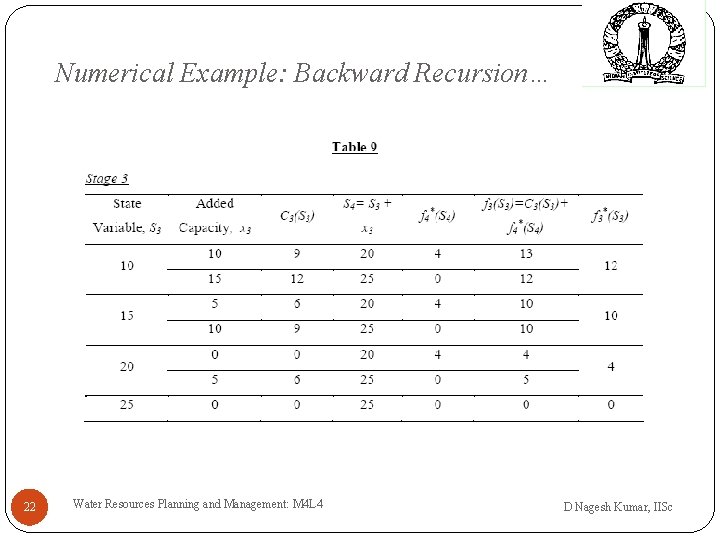
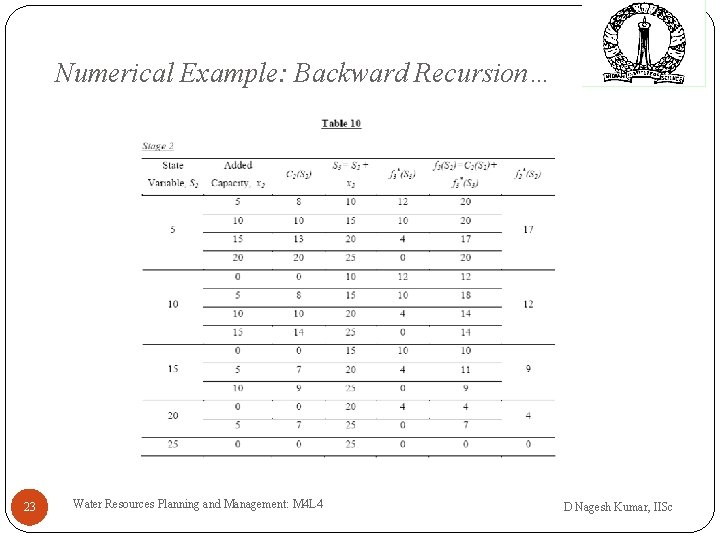
Numerical Example: Backward Recursion… Computations for all stages 21 Water Resources Planning and Management: M 4 L 4 D Nagesh Kumar, IISc
Numerical Example: Backward Recursion… 22 Water Resources Planning and Management: M 4 L 4 D Nagesh Kumar, IISc
Numerical Example: Backward Recursion… 23 Water Resources Planning and Management: M 4 L 4 D Nagesh Kumar, IISc
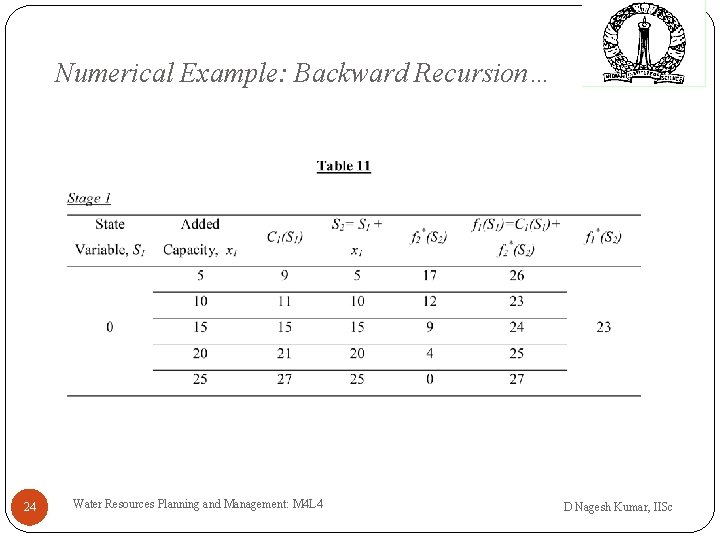
Numerical Example: Backward Recursion… 24 Water Resources Planning and Management: M 4 L 4 D Nagesh Kumar, IISc
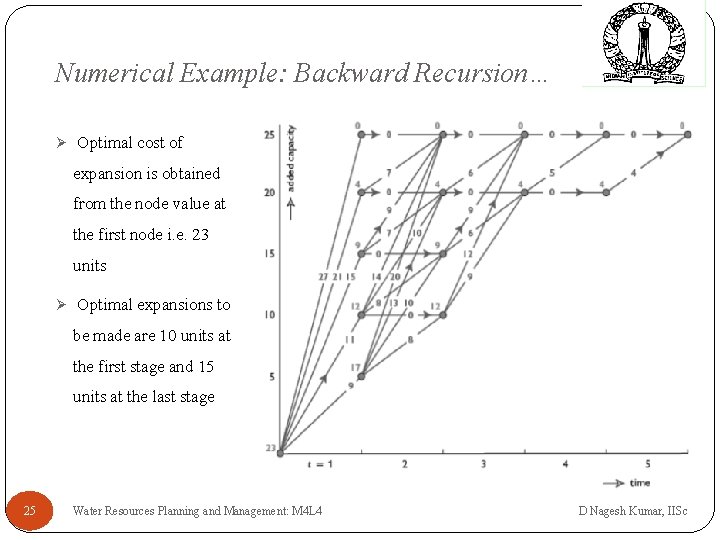
Numerical Example: Backward Recursion… Ø Optimal cost of expansion is obtained from the node value at the first node i. e. 23 units Ø Optimal expansions to be made are 10 units at the first stage and 15 units at the last stage 25 Water Resources Planning and Management: M 4 L 4 D Nagesh Kumar, IISc
Capacity Expansion Problem: Uncertainty The future demand the future cost of expansion in this problem are highly uncertain Hence, the solution obtained cannot be used for making expansions till the end period, T But, decisions about the expansion to be done in the current period can be very well done through this For the uncertainty on current period decisions to be less , the final period T should be selected far away from the current period 26 Water Resources Planning and Management: M 4 L 4 D Nagesh Kumar, IISc
Thank You Water Resources Planning and Management: M 4 L 4 D Nagesh Kumar, IISc