
Dynamic Processes Lecture 1 Lecture Notes MOLECULAR SIMULATIONS
- Slides: 18
Dynamic Processes: Lecture 1 Lecture Notes MOLECULAR SIMULATIONS ALL YOU (N)EVER WANTED TO KNOW Julia M. Goodfellow Crystallography, Birkbeck
WHY DO SIMULATIONS? Numerical simulations fall between experiments and theoretical methods n Where there are no available experimental data n Where it is difficult or impossible to get exptl data n Add atomic insight Crystallography, Birkbeck
AIMS AND OBJECTIVES n Please see overview of the course on ‘Dynamic Processes’ which lists the aims and objectives of this course unit and each letter Crystallography, Birkbeck
What is molecular simulation/modelling ? Quantum Mechanical Methods n Knowledge based methods n Classical Methods based on concept of energy function describing interaction between atoms n Crystallography, Birkbeck
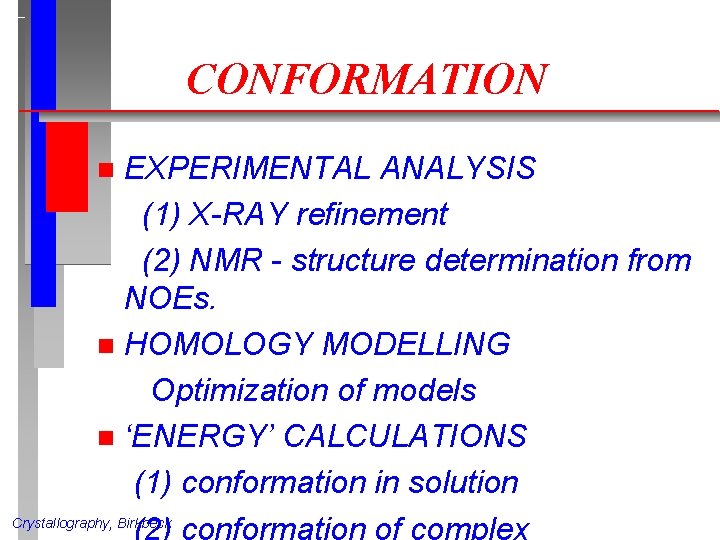
CONFORMATION EXPERIMENTAL ANALYSIS (1) X-RAY refinement (2) NMR - structure determination from NOEs. n HOMOLOGY MODELLING Optimization of models n ‘ENERGY’ CALCULATIONS (1) conformation in solution Crystallography, Birkbeck (2) conformation of complex n
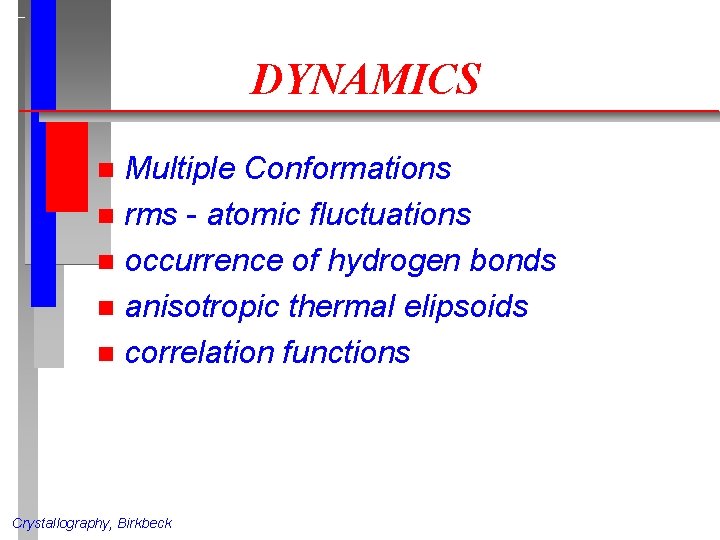
DYNAMICS Multiple Conformations n rms - atomic fluctuations n occurrence of hydrogen bonds n anisotropic thermal elipsoids n correlation functions n Crystallography, Birkbeck
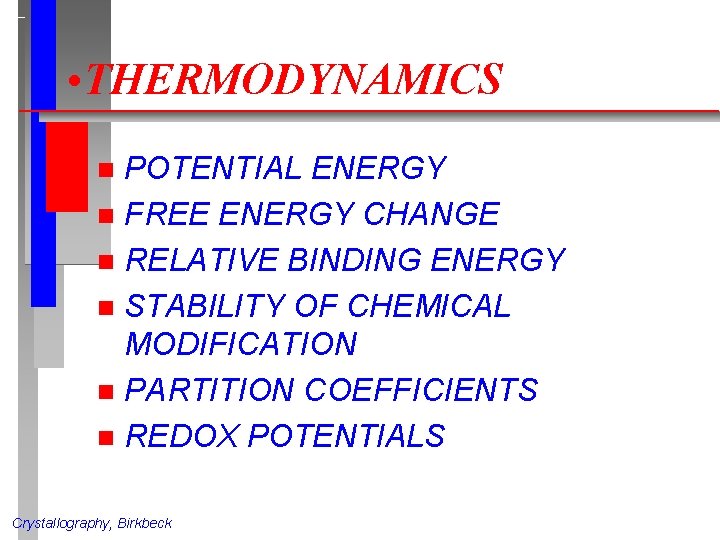
• THERMODYNAMICS POTENTIAL ENERGY n FREE ENERGY CHANGE n RELATIVE BINDING ENERGY n STABILITY OF CHEMICAL MODIFICATION n PARTITION COEFFICIENTS n REDOX POTENTIALS n Crystallography, Birkbeck
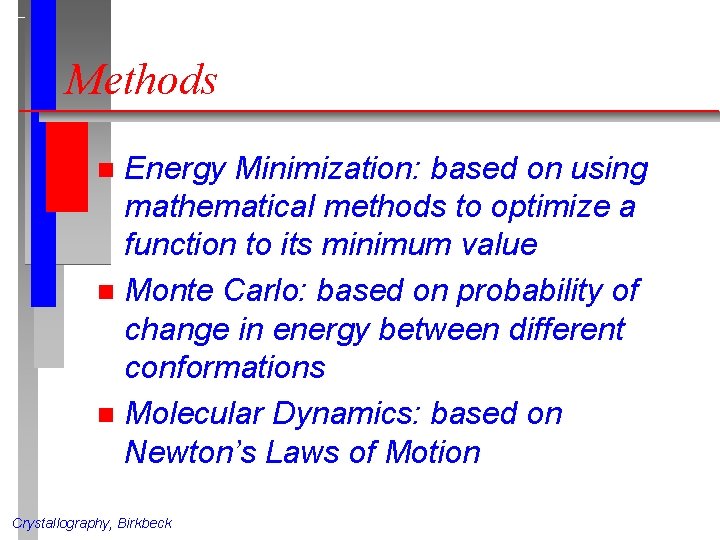
Methods Energy Minimization: based on using mathematical methods to optimize a function to its minimum value n Monte Carlo: based on probability of change in energy between different conformations n Molecular Dynamics: based on Newton’s Laws of Motion n Crystallography, Birkbeck
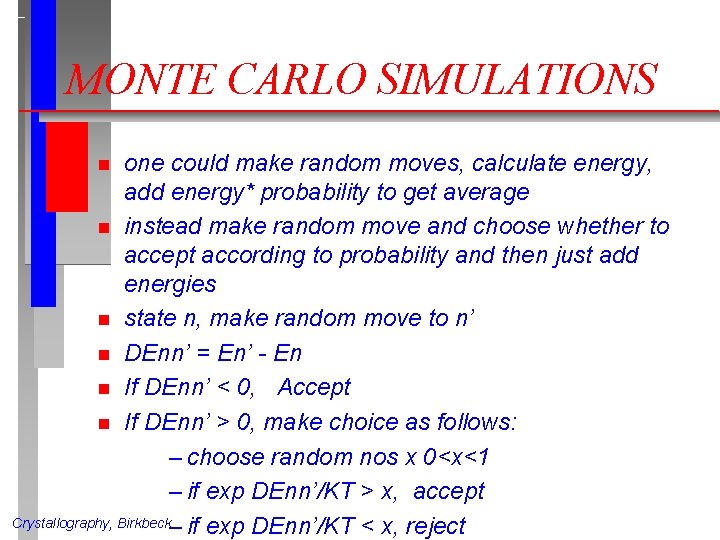
MONTE CARLO SIMULATIONS one could make random moves, calculate energy, add energy* probability to get average n instead make random move and choose whether to accept according to probability and then just add energies n state n, make random move to n’ n DEnn’ = En’ - En n If DEnn’ < 0, Accept n If DEnn’ > 0, make choice as follows: – choose random nos x 0<x<1 – if exp DEnn’/KT > x, accept Crystallography, Birkbeck– if exp DEnn’/KT < x, reject n
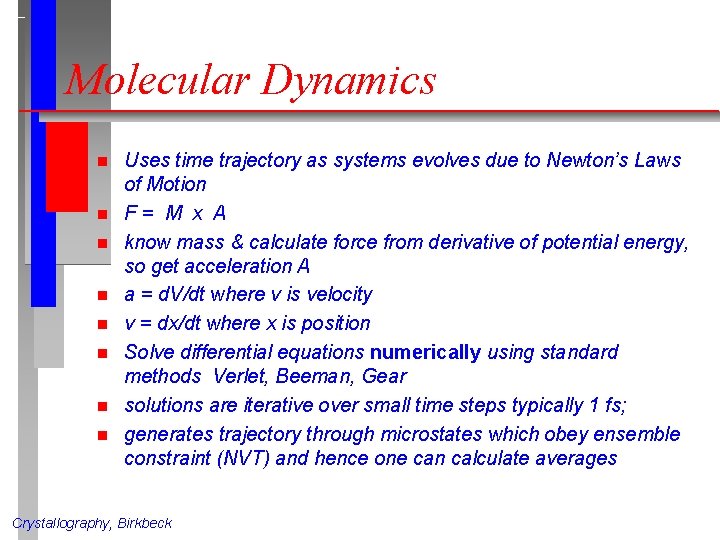
Molecular Dynamics n n n n Uses time trajectory as systems evolves due to Newton’s Laws of Motion F= M x A know mass & calculate force from derivative of potential energy, so get acceleration A a = d. V/dt where v is velocity v = dx/dt where x is position Solve differential equations numerically using standard methods Verlet, Beeman, Gear solutions are iterative over small time steps typically 1 fs; generates trajectory through microstates which obey ensemble constraint (NVT) and hence one can calculate averages Crystallography, Birkbeck
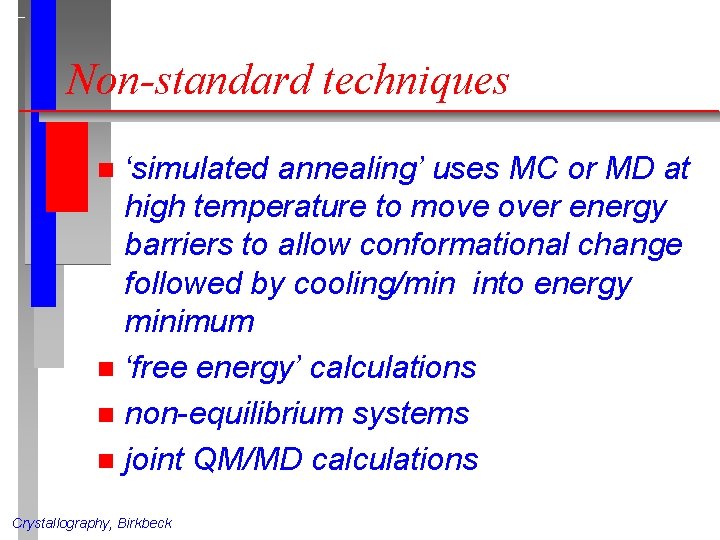
Non-standard techniques ‘simulated annealing’ uses MC or MD at high temperature to move over energy barriers to allow conformational change followed by cooling/min into energy minimum n ‘free energy’ calculations n non-equilibrium systems n joint QM/MD calculations n Crystallography, Birkbeck
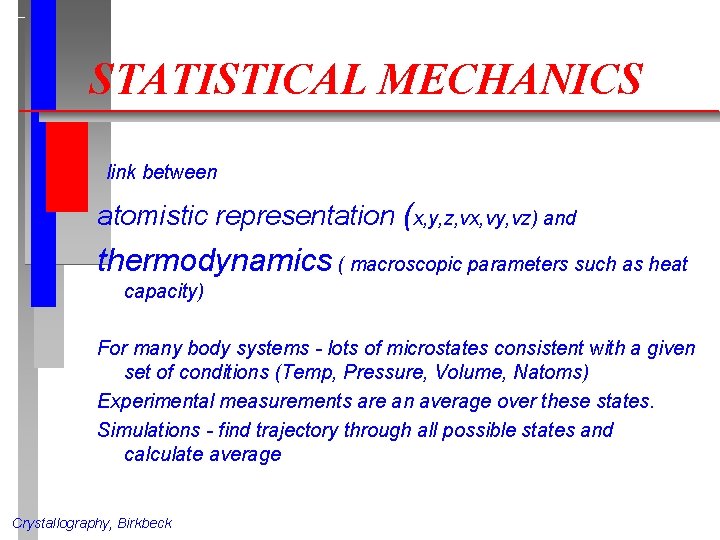
STATISTICAL MECHANICS link between atomistic representation (x, y, z, vx, vy, vz) and thermodynamics ( macroscopic parameters such as heat capacity) For many body systems - lots of microstates consistent with a given set of conditions (Temp, Pressure, Volume, Natoms) Experimental measurements are an average over these states. Simulations - find trajectory through all possible states and calculate average Crystallography, Birkbeck
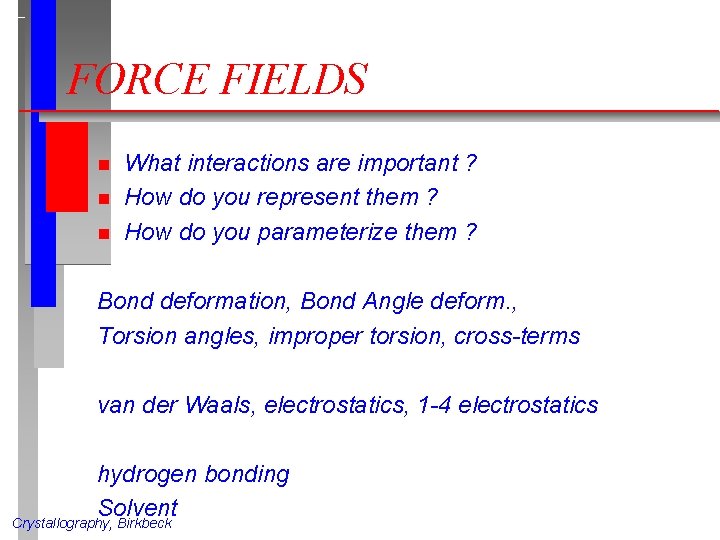
FORCE FIELDS n n n What interactions are important ? How do you represent them ? How do you parameterize them ? Bond deformation, Bond Angle deform. , Torsion angles, improper torsion, cross-terms van der Waals, electrostatics, 1 -4 electrostatics hydrogen bonding Solvent Crystallography, Birkbeck
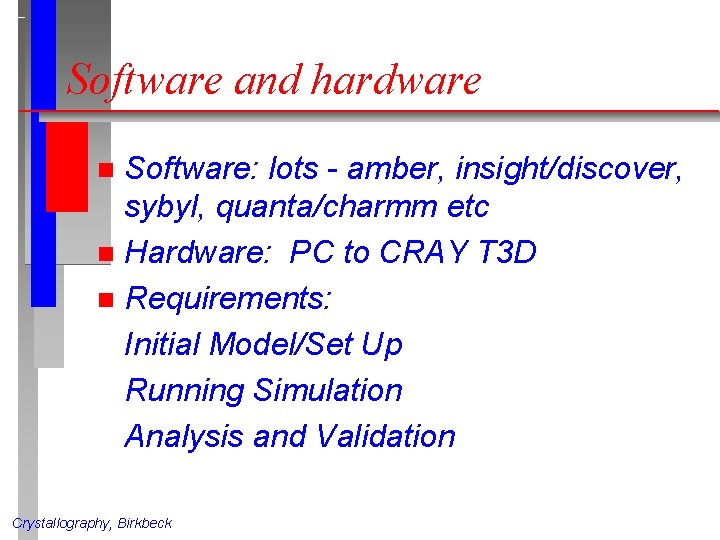
Software and hardware Software: lots - amber, insight/discover, sybyl, quanta/charmm etc n Hardware: PC to CRAY T 3 D n Requirements: Initial Model/Set Up Running Simulation Analysis and Validation n Crystallography, Birkbeck
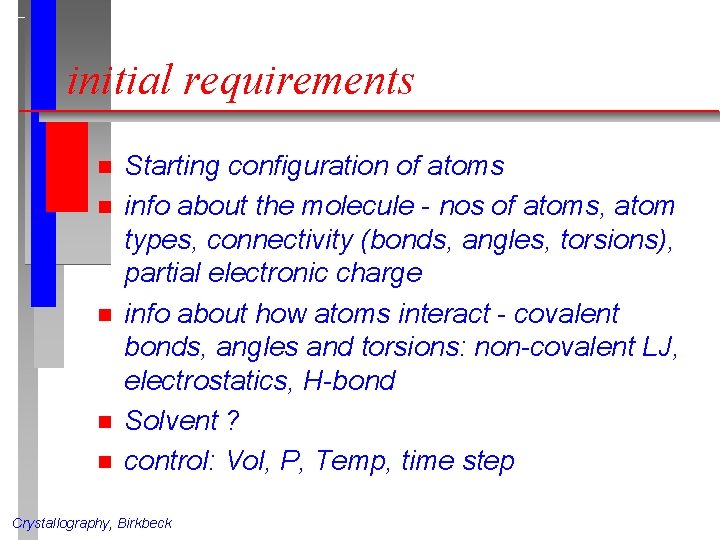
initial requirements n n n Starting configuration of atoms info about the molecule - nos of atoms, atom types, connectivity (bonds, angles, torsions), partial electronic charge info about how atoms interact - covalent bonds, angles and torsions: non-covalent LJ, electrostatics, H-bond Solvent ? control: Vol, P, Temp, time step Crystallography, Birkbeck
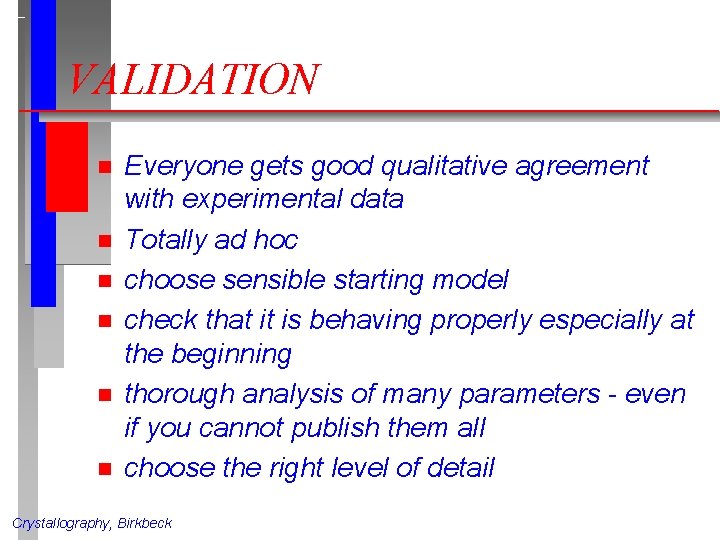
VALIDATION n n n Everyone gets good qualitative agreement with experimental data Totally ad hoc choose sensible starting model check that it is behaving properly especially at the beginning thorough analysis of many parameters - even if you cannot publish them all choose the right level of detail Crystallography, Birkbeck
Future n n n improve assumptions validation need to improve - long range and short range electrostatics need to improve precision of all interactions as compromise between many weak interactions need to increase time beyond ns to ms Need to get quicker so that we can ‘play’ with system. difficult when it takes 3 -6 months a Crystallography, Birkbeck
ATOMISTIC SIMULATIONS APPLICATION AREAS (A) environmental effects on peptide stability: role of solvents in stabilising/ destabilising secondary structure (B) conformation of chemically modified dnas n NOVEL ALGORITHMS Protein folding/unfolding - solvent insertion into cavities; stability and unfolding of different protein architecture n VALIDATION development of systematic protocols for assessing simulations Crystallography, Birkbeck n