
Dynamic Pricing of Services on Indian Railways Neelam
- Slides: 38
Dynamic Pricing of Services on Indian Railways Neelam Sanghi General Manager/IT DFCCIL/IR
Agenda �Revenue Management �Dynamic Pricing �Industries that adopt dynamic Pricing �Airline Industry �Indian Railways �Why Dynamic Pricing in Indian Railways?
Agenda �Case Study �Scope for Dynamic Pricing in IR �IR’s Experiment with Dynamic Pricing �Benefits �Challenges �Dynamic Pricing in Airlines Viz IR �Food For Thought �Interactive session
Revenue Management �Revenue Management is selling the right product to the right customer at the right time at the right price �Dynamic Pricing is one aspect of a complete revenue management programme �The technique is most useful when two characteristics co-exist �The product expires in a point of time �The capacity is fixed well in advance and can be augmented only at a relatively high marginal cost
Dynamic Pricing �These characteristics create the potential for large swings in the opportunity cost of sale �The opportunity cost of sale is a potential foregone subsequent sale �The value of a unit in a shortage situation is the highest value of an unserved customer �Forecasting this value given current sales and available capacity represents dynamic pricing
Dynamic Pricing �The customers are price sensitive �The aim is to sell the “perishable” inventory for maximum revenue �Giving discounts to price-sensitive customers and charging premiums to less price sensitive customers �The customers differ in more ways than just price sensitivity so market needs to be segmented on multiple variables
Dynamic Pricing �Dynamic Pricing is pricing based on demand timing. �The price is not firmly set it changes based on changing circumstances �High demand, higher pricing and vice versa �Segmented Pricing: Some customers may be willing to pay more for faster service, higher quality or more features �Peak User Pricing: Higher prices for “Rush Hour"
Dynamic Pricing in the following �Airlines Industry �Hotels �Car Rental Industry �Ocean Cargo Industry �Retail Industry –Fashion Apparel Industry �Entertainment Industry –ticket pricing �Cruise Lines �Manufacturing Industry
Airline Industry �Prices in the Airline Industry were regulated until 1978 �Price and quantity changes had to be approved by CAB �“American Airlines” is considered the pioneer in dynamic pricing �Advanced software has propelled e-commerce forward with dynamic pricing � In America for example One way fares exceed round trip fares
Airline Industry �Price changes frequently �Low fares on a particular flight being available, then not, and then available again �Listed fares vary depending on the time of the year, time of the week, remaining seats available and remaining time until departure �For example, average prices for round trips between Phoenix and Los Angeles differ depending on whether they originate in Los Angeles or Phoenix
Indian Railways � 114, 500 km of total track over a route of 65000 km � 7500 railway stations �Carries 30 million passengers daily �Transports 2. 8 million tonnes of freight daily �Fourth largest railway network after USA, Russia and China � 1. 36 million employees
Indian Railways �In 1951 the various state Railways were nationalized as 1 unit wholly owned by the Government of India �It is virtually a monopoly in medium-long distance travelling passengers in India but for short distance faces stiff competition from Roadways �Passenger revenues are cross subsidized by freight earnings �Each train has multiple stops
Indian Railways �There are different types of concessions given to different segments of customers like senior citizens, students, military warrants, members of Parliament, Railway employees �Currently static pricing is followed for all trains �Same ticket price all the year round for the same train
Why Dynamic Pricing in IR? PRODUCT OFFERING FULFILLS ALL CRITERION • Product is perishable in nature • Multiple product options available over a significant time period • Vacant capacity exists across similar product offerings • Demand varies across time & similar product offerings
Why Dynamic Pricing in IR? IMPROVEMENT IN COACHING EARNINGS • Filling up vacant capacities through spreading of demand • Increased customer base through below base level fare offering – will benefit the EWS • Exponential increase in revenue for trains in high demand
Why Dynamic Pricing in IR? �Currently the loss in the passenger sector is touching Rs 26, 000 crore in a year �It is being cross subsidised from freight earnings �While the waiting list of Passengers is getting longer and longer yet passenger business is making a loss �Many passengers are willing to pay for travelling in comfort
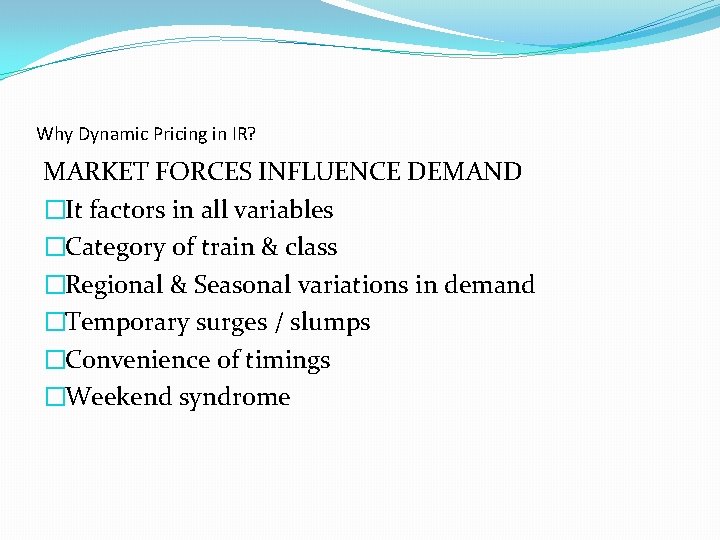
Why Dynamic Pricing in IR? MARKET FORCES INFLUENCE DEMAND �It factors in all variables �Category of train & class �Regional & Seasonal variations in demand �Temporary surges / slumps �Convenience of timings �Weekend syndrome
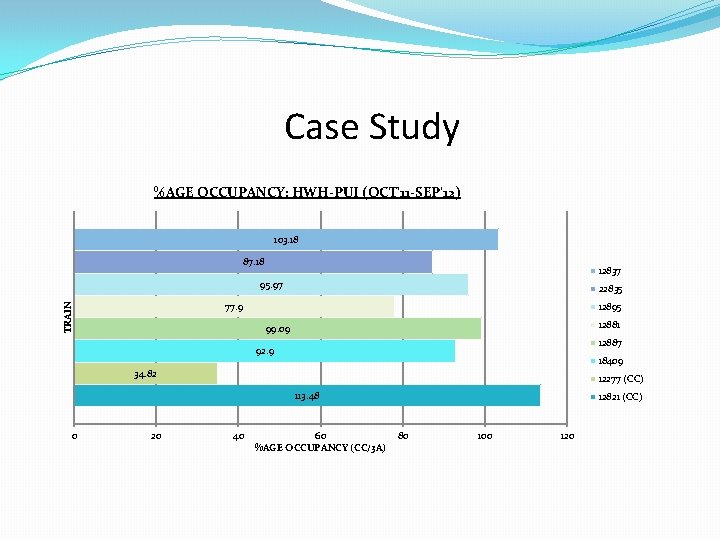
Case Study %AGE OCCUPANCY: HWH-PUI (OCT'11 -SEP'12) 103. 18 87. 18 12837 95. 97 22835 TRAIN 77. 9 12895 12881 99. 09 12887 92. 9 18409 34. 82 12277 (CC) 113. 48 0 20 40 60 %AGE OCCUPANCY (CC/3 A) 12821 (CC) 80 100 120
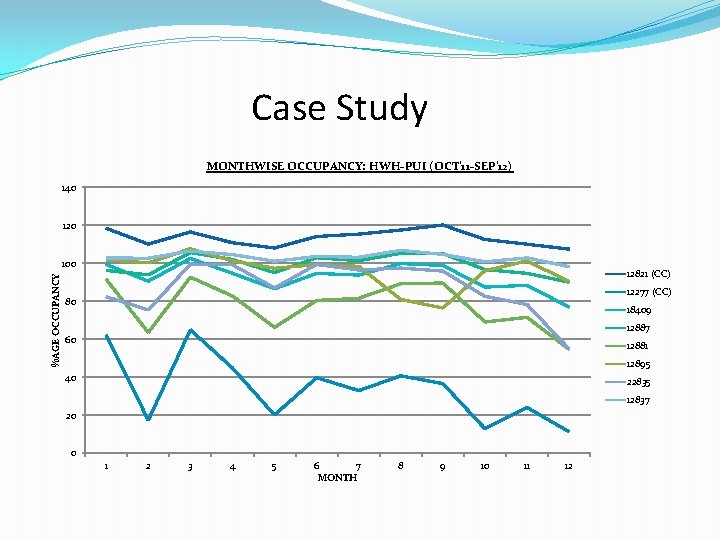
Case Study MONTHWISE OCCUPANCY: HWH-PUI (OCT'11 -SEP'12) 140 120 %AGE OCCUPANCY 100 12821 (CC) 12277 (CC) 80 18409 12887 60 12881 12895 40 22835 12837 20 0 1 2 3 4 5 6 7 MONTH 8 9 10 11 12
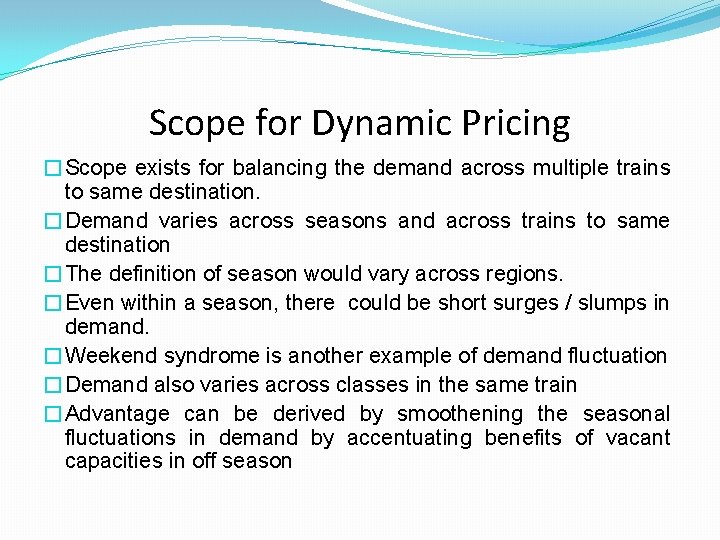
Scope for Dynamic Pricing �Scope exists for balancing the demand across multiple trains to same destination. �Demand varies across seasons and across trains to same destination �The definition of season would vary across regions. �Even within a season, there could be short surges / slumps in demand. �Weekend syndrome is another example of demand fluctuation �Demand also varies across classes in the same train �Advantage can be derived by smoothening the seasonal fluctuations in demand by accentuating benefits of vacant capacities in off season
IR’s experiment with Dynamic Pricing Pilot Project �For the first time, railways experimented with dynamic fares on the pattern of airlines by operating Rajdhani type AC special trains between Delhi and Mumbai �Four trips from 24 th December 2013 till 2 nd January 2014 of the premium AC special trains on the busy New Delhi-Mumbai sector
IR’s experiment with Dynamic Pricing �The fare will vary based upon a pre defined formula �Dynamic fare charged for only confirmed and RAC passengers �Tickets sold on higher rate than the existing rate as per the dynamic pricing policy to encash the peak demand during festive season of Christmas and New Year
IR’s experiment with Dynamic Pricing �The Premier AC special trains will have only AC-2 and AC-3 classes with Rajdhani like facility including catering �The fares to increase depending on demand intensity �The train designed to clear the last minute peak time demand �There are no stoppages enroute
IR’s experiment with Dynamic Pricing �There shall be no waitlist passengers �Advance Reservation for this train would be a maximum of 15 days only �No Concession will be applicable on this train �Free passes/complimentary passes/warrant/concessional voucher etc. shall not be permitted in this train �Adult fares would be charged for all passengers irrespective of their age
IR’s experiment with Dynamic Pricing �Only e-tickets will be permitted for booking through Internet/IRCTC portal �The fare applicable each day /transaction shall be indicated at the time of booking on the IRCTC website �Hence Modification/Duplicate ticket/cluster booking/BPT will not be allowed �Only end to end general quota booking will be applicable �Upgradation option shall not be applicable in this train �The passengers are required to carry the prescribed original photo identity which is used at the time of booking
IR’s experiment with Dynamic Pricing �Current Booking will be allowed at current reservation counters only after Charting as this facility is not available on internet �If current counter is enabled vacant berths left at the time of charting will be offered for current booking at the Originating Station �Tickets at Current Counter will be sold at the “Base Price” (Rajdhani Base Fare plus Tatkal charges) and other supplementary charges like reservation fee, superfast charges, catering charges and service tax as applicable
IR’s experiment with Dynamic Pricing �Coach damage / suspension /addition / profile change will not be applicable within advance reservation period under Dynamic fare policy �However if berth cannot be given to passenger by Indian Railways full refund shall be granted to the passenger manually �No refund shall be granted. However, full refund shall be admissible in case the train is fully cancelled
IR’s experiment with Dynamic Pricing �The menu and tariff of Catering services for the proposed train will be similar to other Rajdhani trains �The days of running of this train and composition of the train shall be as per the notification of the Coaching Directorate of Railway Board / CPTM’s of Zonal Railway �Zonal Railways to arrange wide publicity through media
IR’s experiment with Dynamic Pricing �There was a 30 percent jump in fares in AC-2 �Ticket fares went up by Rs 737 in AC 2 and Rs 627 in AC 3 � 35 per cent jump in AC 3 fares �The trip for Dec 13 was booked to capacity with 746 births sold out in AC 3 and 219 births sold out in AC 2 �This train was equipped with 17 coaches. �Railways plans to introduce DP in 17 more trains
Benefits Increase in passenger earnings by • Filling up vacant capacities through spreading of demand. • Increased customer base through below base level fare offering • Exponential increase in revenue for trains in high demand • Reduced burden on PRS due to increased online behavior • Touting will get discouraged
Benefits �The initial frenzy will cause a surge in the DP, resulting in an immediate slowdown in the booking rate �The difference in highest and lowest fare as seen by the customer will tempt him to less popular trains �The price conscious buyer will shift to vacant capacities in less popular trains, while the price inelastic buyer will continue to book �Phenomenon of full booking within minutes of opening may not happen anymore and confirmed seat availability on popular trains will be spread over larger period �Fares of highly popular trains will continue to be much over the base fare
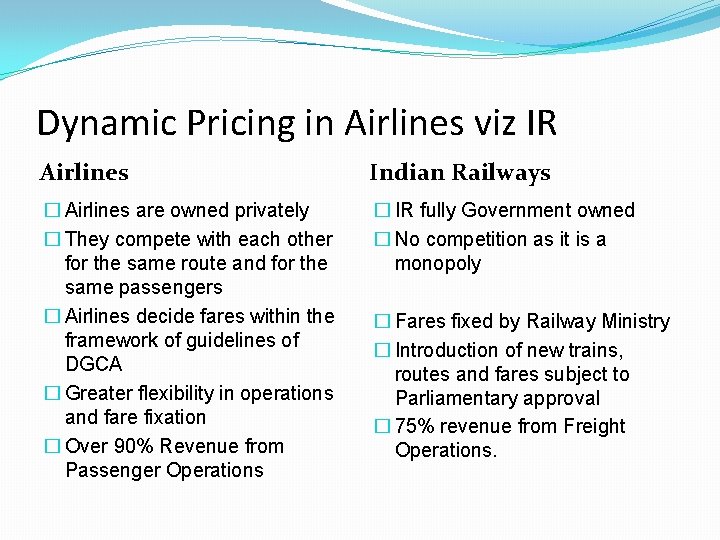
Dynamic Pricing in Airlines viz IR Airlines Indian Railways � Airlines are owned privately � They compete with each other for the same route and for the same passengers � Airlines decide fares within the framework of guidelines of DGCA � Greater flexibility in operations and fare fixation � Over 90% Revenue from Passenger Operations � IR fully Government owned � No competition as it is a monopoly � Fares fixed by Railway Ministry � Introduction of new trains, routes and fares subject to Parliamentary approval � 75% revenue from Freight Operations.
Challenges �Intermediate Station Quotas �Passengers not having access to Internet or IRCTC Portal �Credit card /e-banking required for booking �Dovetailing with existing PRS �Modalities for booking in PRS offices �Data mining with respect to customer preferences for different trains and routes
Challenges �The pilot project confined to 2 nd and 3 rd AC on premium train plying on premium route �The ticket price should be significantly lesser than the low cost airlines �Quality of service like cleanliness, safety, security, punctuality would require considerable improvement
Challenges �Maximum seats in most trains are in the sleeper class �Policy of granting concessions not consistent with dynamic pricing �Profit maximization cannot be the only goal for a Government run organization �Govt has notified a Rail Tariff Authority which will develop an “integrated, transparent and dynamic” pricing mechanism
Food for Thought �“At many companies, little cost-cutting juice can easily be extracted from operations. Pricing is therefore one of the few untapped levers to boost earnings, and companies that start now will be in a good position to profit fully from the next upturn”– Mc. Kinsey Quarterly, 2003 �Dynamic Pricing in IR can be introduced in luxury classes in premium trains during peak seasons
Interactive Session
Thank You