
Dynamic Nuclear Polarization for Neutron Scattering Josh Pierce
- Slides: 36
Dynamic Nuclear Polarization for Neutron Scattering Josh Pierce Neutron Technologies Division Oak Ridge National Laboratory ORNL is managed by UT-Battelle for the US Department of Energy
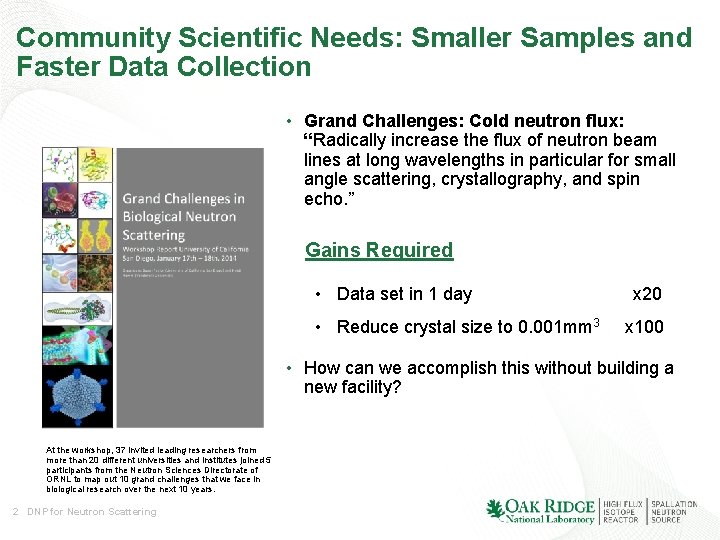
Community Scientific Needs: Smaller Samples and Faster Data Collection • Grand Challenges: Cold neutron flux: “Radically increase the flux of neutron beam lines at long wavelengths in particular for small angle scattering, crystallography, and spin echo. ” Gains Required • Data set in 1 day x 20 • Reduce crystal size to 0. 001 mm 3 x 100 • How can we accomplish this without building a new facility? At the workshop, 37 invited leading researchers from more than 20 different universities and institutes joined 5 participants from the Neutron Sciences Directorate of ORNL to map out 10 grand challenges that we face in biological research over the next 10 years. 2 DNP for Neutron Scattering
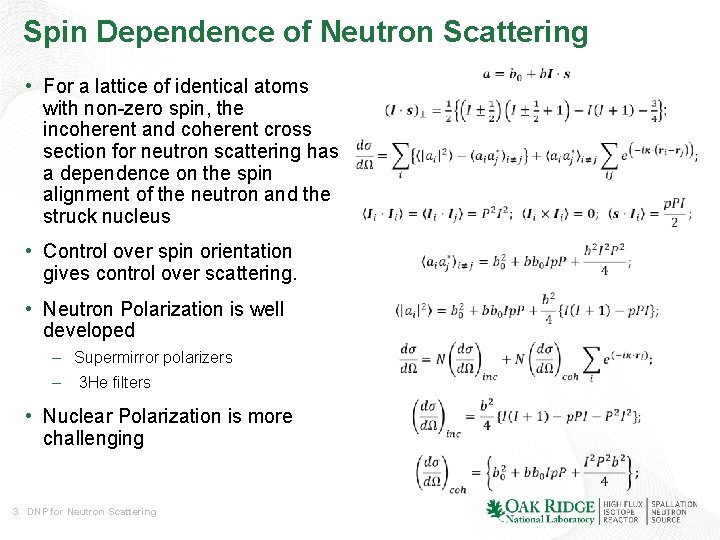
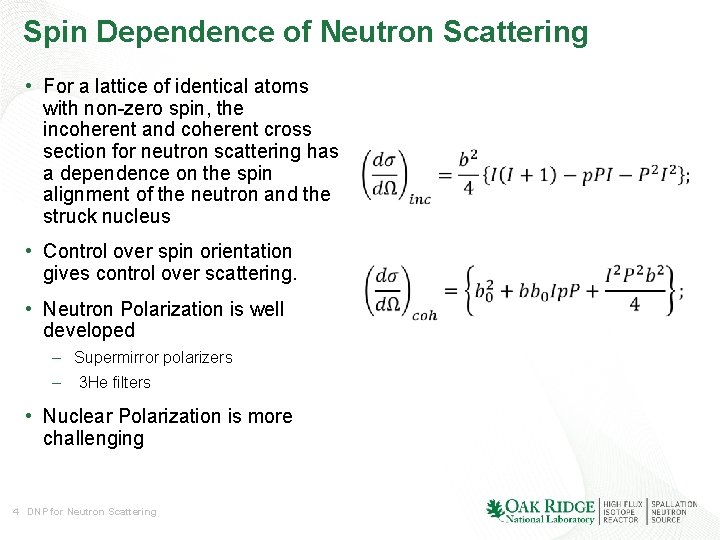
Spin Dependence of Neutron Scattering • For a lattice of identical atoms with non-zero spin, the incoherent and coherent cross section for neutron scattering has a dependence on the spin alignment of the neutron and the struck nucleus • Control over spin orientation gives control over scattering. • Neutron Polarization is well developed – Supermirror polarizers – 3 He filters • Nuclear Polarization is more challenging 3 DNP for Neutron Scattering
Spin Dependence of Neutron Scattering • For a lattice of identical atoms with non-zero spin, the incoherent and coherent cross section for neutron scattering has a dependence on the spin alignment of the neutron and the struck nucleus • Control over spin orientation gives control over scattering. • Neutron Polarization is well developed – Supermirror polarizers – 3 He filters • Nuclear Polarization is more challenging 4 DNP for Neutron Scattering
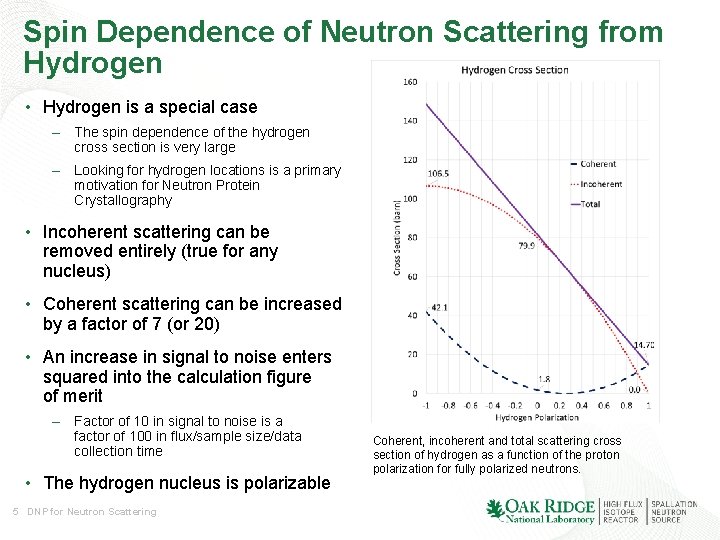
Spin Dependence of Neutron Scattering from Hydrogen • Hydrogen is a special case – The spin dependence of the hydrogen cross section is very large – Looking for hydrogen locations is a primary motivation for Neutron Protein Crystallography • Incoherent scattering can be removed entirely (true for any nucleus) • Coherent scattering can be increased by a factor of 7 (or 20) • An increase in signal to noise enters squared into the calculation figure of merit – Factor of 10 in signal to noise is a factor of 100 in flux/sample size/data collection time • The hydrogen nucleus is polarizable 5 DNP for Neutron Scattering Coherent, incoherent and total scattering cross section of hydrogen as a function of the proton polarization for fully polarized neutrons.
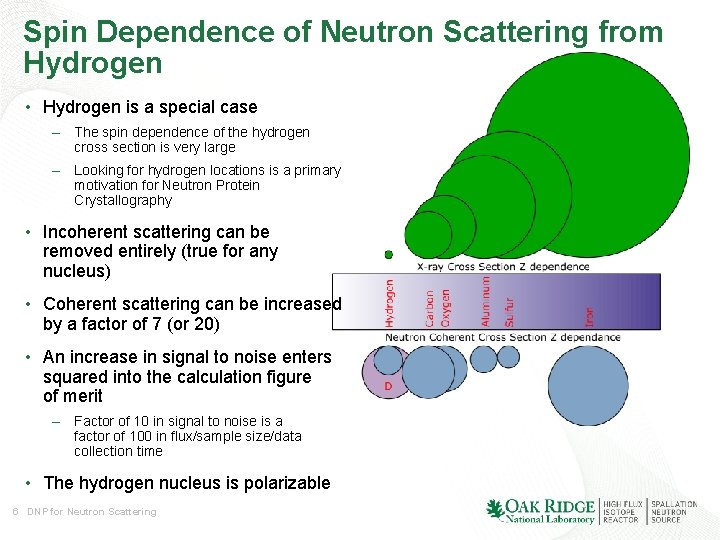
Spin Dependence of Neutron Scattering from Hydrogen • Hydrogen is a special case – The spin dependence of the hydrogen cross section is very large – Looking for hydrogen locations is a primary motivation for Neutron Protein Crystallography • Incoherent scattering can be removed entirely (true for any nucleus) • Coherent scattering can be increased by a factor of 7 (or 20) • An increase in signal to noise enters squared into the calculation figure of merit – Factor of 10 in signal to noise is a factor of 100 in flux/sample size/data collection time • The hydrogen nucleus is polarizable 6 DNP for Neutron Scattering
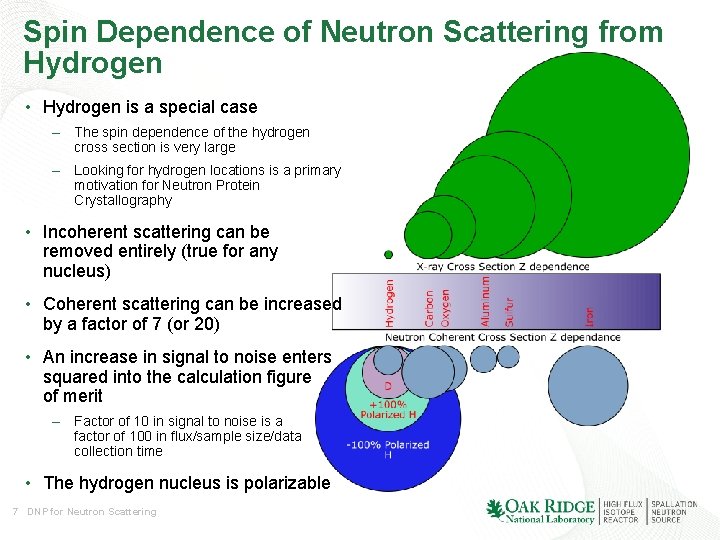
Spin Dependence of Neutron Scattering from Hydrogen • Hydrogen is a special case – The spin dependence of the hydrogen cross section is very large – Looking for hydrogen locations is a primary motivation for Neutron Protein Crystallography • Incoherent scattering can be removed entirely (true for any nucleus) • Coherent scattering can be increased by a factor of 7 (or 20) • An increase in signal to noise enters squared into the calculation figure of merit – Factor of 10 in signal to noise is a factor of 100 in flux/sample size/data collection time • The hydrogen nucleus is polarizable 7 DNP for Neutron Scattering
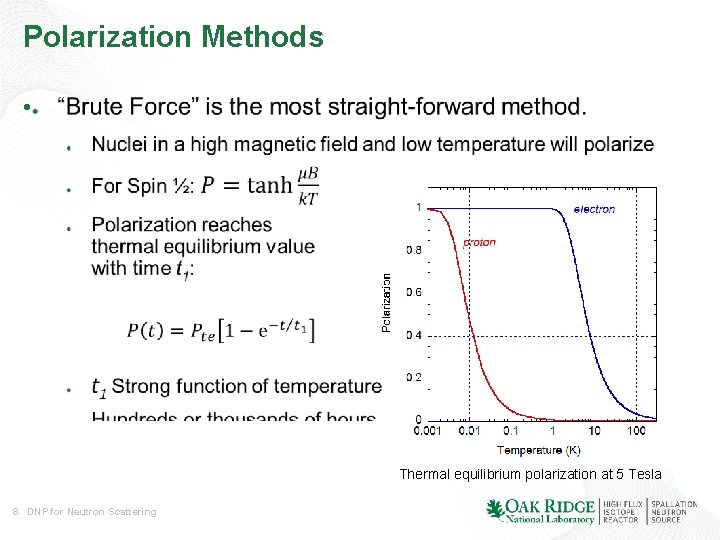
Polarization Methods • Thermal equilibrium polarization at 5 Tesla 8 DNP for Neutron Scattering
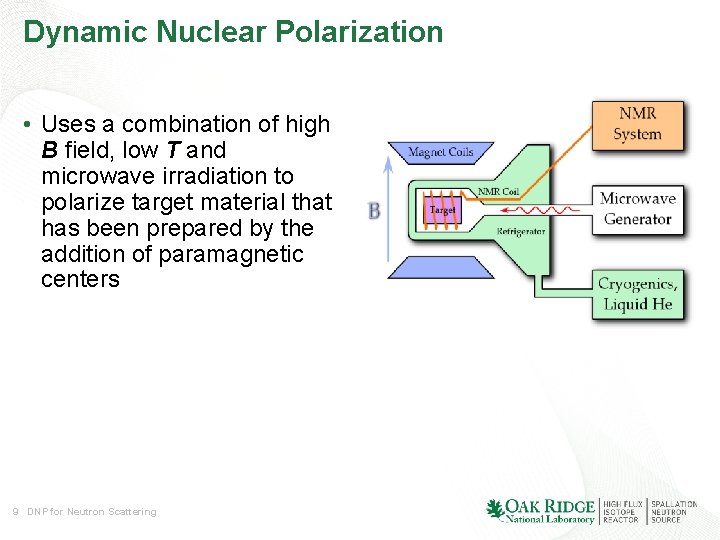
Dynamic Nuclear Polarization • Uses a combination of high B field, low T and microwave irradiation to polarize target material that has been prepared by the addition of paramagnetic centers 9 DNP for Neutron Scattering
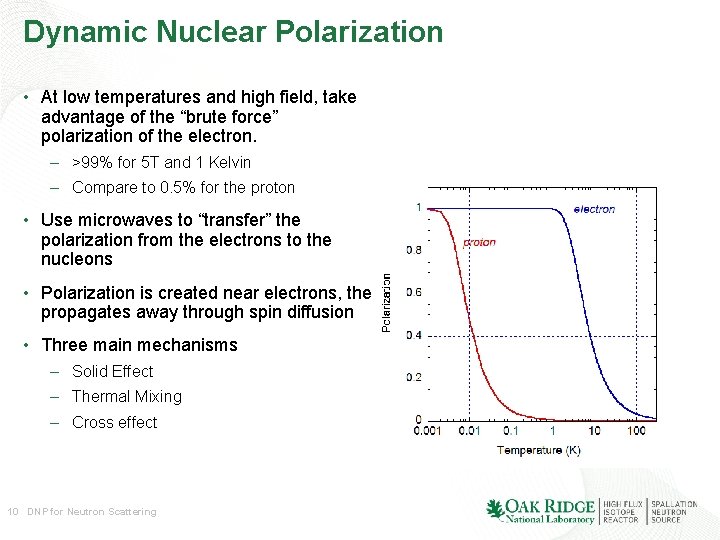
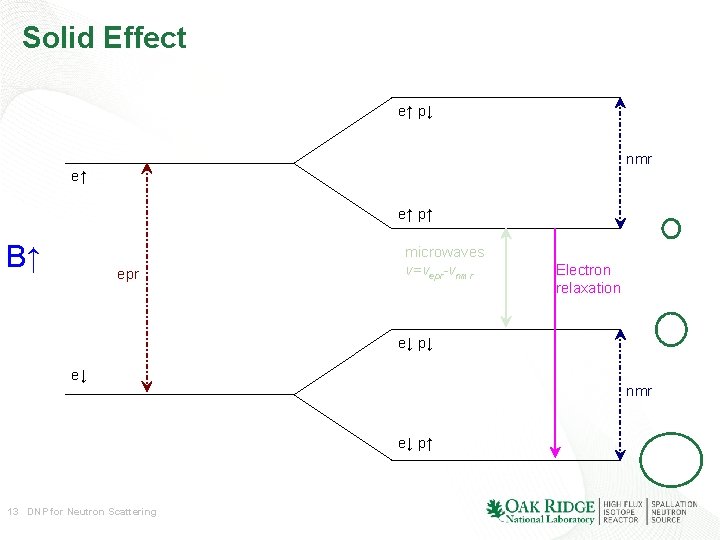
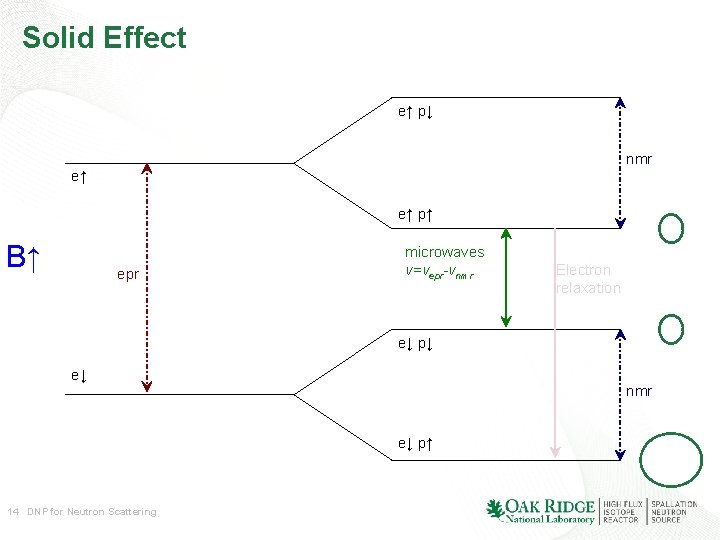
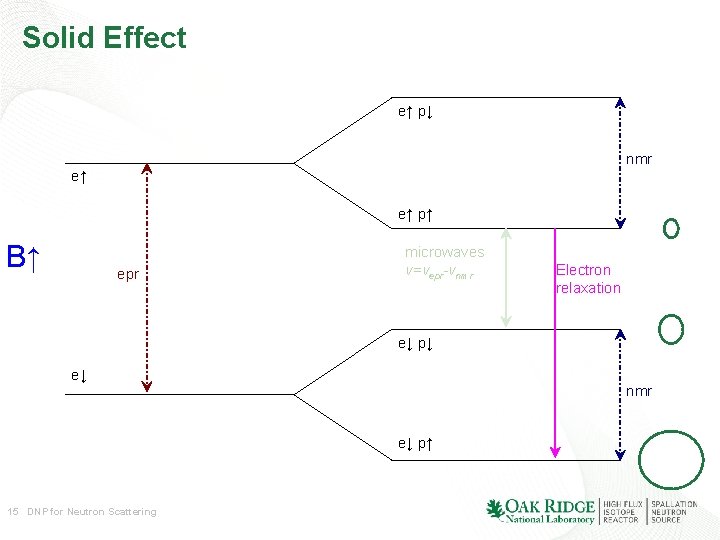
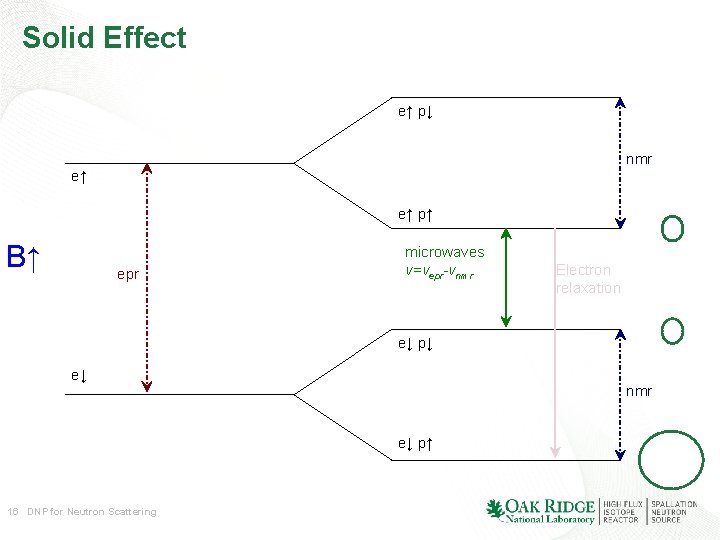
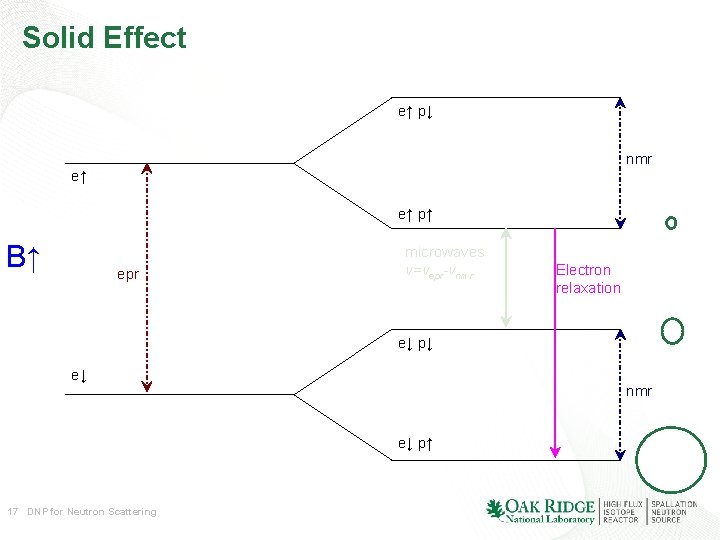
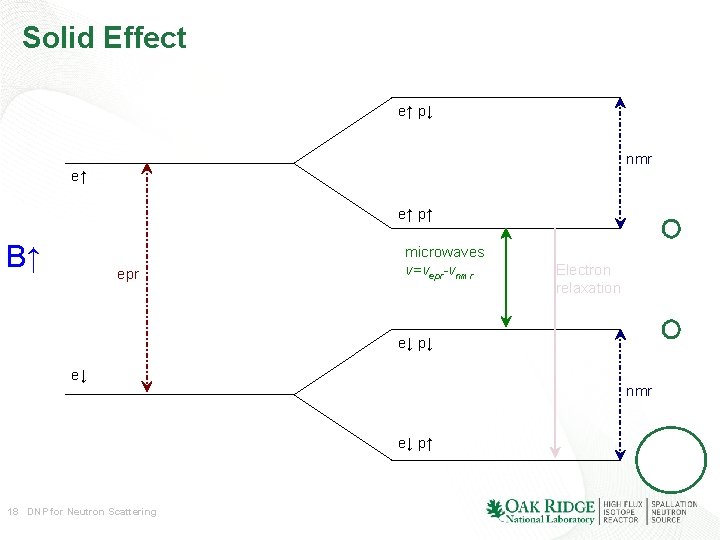
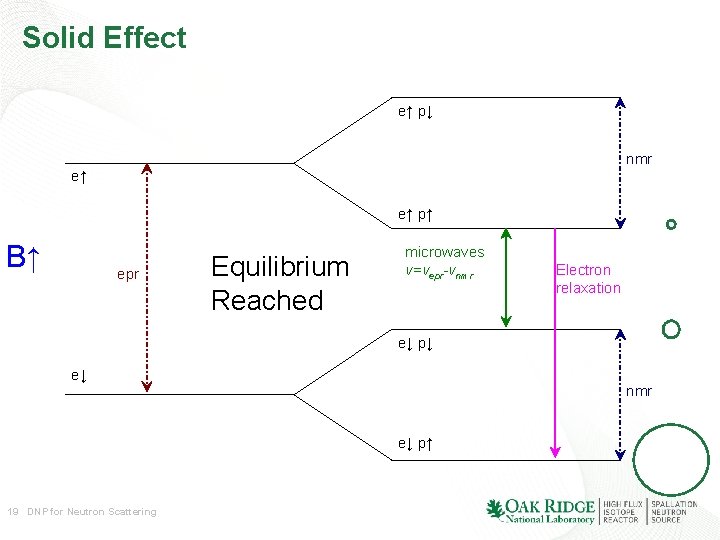
Dynamic Nuclear Polarization • At low temperatures and high field, take advantage of the “brute force” polarization of the electron. – >99% for 5 T and 1 Kelvin – Compare to 0. 5% for the proton • Use microwaves to “transfer” the polarization from the electrons to the nucleons • Polarization is created near electrons, the propagates away through spin diffusion • Three main mechanisms – Solid Effect – Thermal Mixing – Cross effect 10 DNP for Neutron Scattering
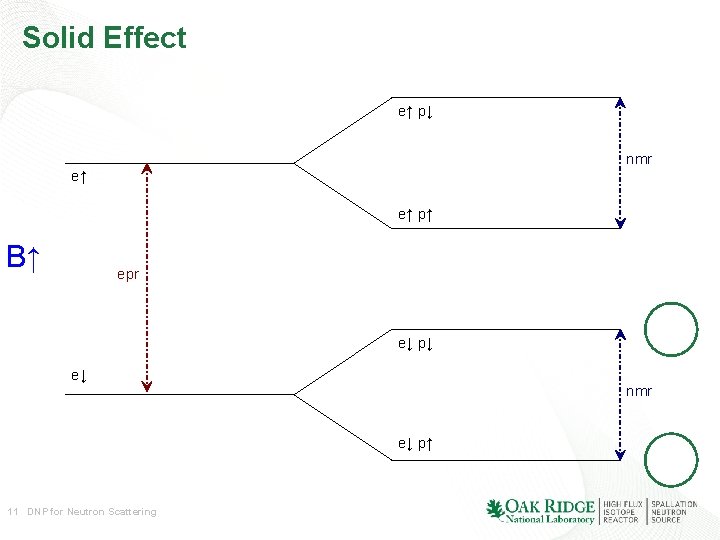
Solid Effect e↑ p↓ nmr e↑ e↑ p↑ B↑ epr e↓ p↓ e↓ nmr e↓ p↑ 11 DNP for Neutron Scattering
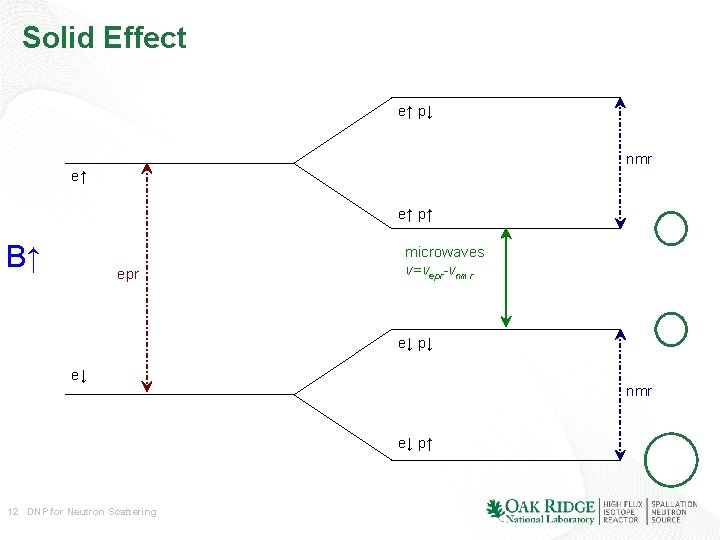
Solid Effect e↑ p↓ nmr e↑ e↑ p↑ B↑ epr microwaves ν=νepr-νnmr e↓ p↓ e↓ nmr e↓ p↑ 12 DNP for Neutron Scattering
Solid Effect e↑ p↓ nmr e↑ e↑ p↑ B↑ epr microwaves ν=νepr-νnmr Electron relaxation e↓ p↓ e↓ nmr e↓ p↑ 13 DNP for Neutron Scattering
Solid Effect e↑ p↓ nmr e↑ e↑ p↑ B↑ epr microwaves ν=νepr-νnmr Electron relaxation e↓ p↓ e↓ nmr e↓ p↑ 14 DNP for Neutron Scattering
Solid Effect e↑ p↓ nmr e↑ e↑ p↑ B↑ epr microwaves ν=νepr-νnmr Electron relaxation e↓ p↓ e↓ nmr e↓ p↑ 15 DNP for Neutron Scattering
Solid Effect e↑ p↓ nmr e↑ e↑ p↑ B↑ epr microwaves ν=νepr-νnmr Electron relaxation e↓ p↓ e↓ nmr e↓ p↑ 16 DNP for Neutron Scattering
Solid Effect e↑ p↓ nmr e↑ e↑ p↑ B↑ epr microwaves ν=νepr-νnmr Electron relaxation e↓ p↓ e↓ nmr e↓ p↑ 17 DNP for Neutron Scattering
Solid Effect e↑ p↓ nmr e↑ e↑ p↑ B↑ epr microwaves ν=νepr-νnmr Electron relaxation e↓ p↓ e↓ nmr e↓ p↑ 18 DNP for Neutron Scattering
Solid Effect e↑ p↓ nmr e↑ e↑ p↑ B↑ epr Equilibrium Reached microwaves ν=νepr-νnmr Electron relaxation e↓ p↓ e↓ nmr e↓ p↑ 19 DNP for Neutron Scattering
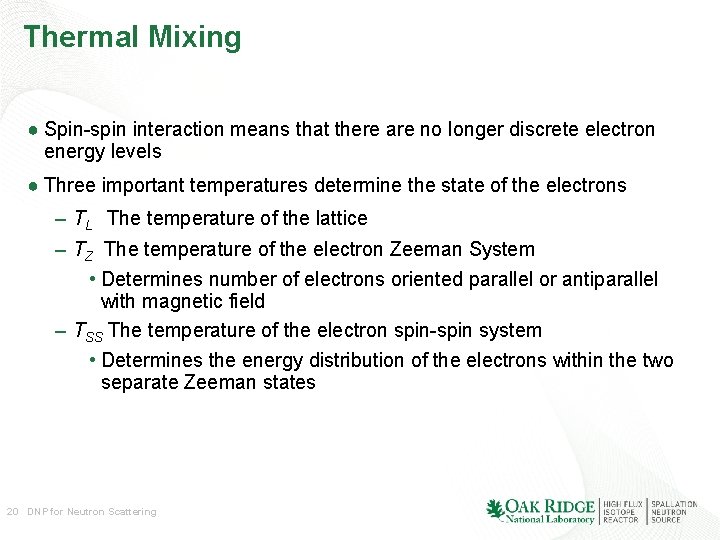
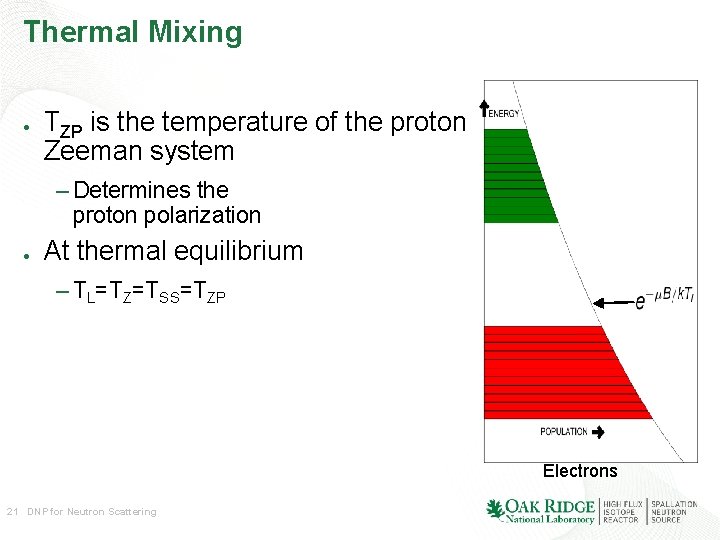
Thermal Mixing ● Spin-spin interaction means that there are no longer discrete electron energy levels ● Three important temperatures determine the state of the electrons – TL The temperature of the lattice – TZ The temperature of the electron Zeeman System • Determines number of electrons oriented parallel or antiparallel with magnetic field – TSS The temperature of the electron spin-spin system • Determines the energy distribution of the electrons within the two separate Zeeman states 20 DNP for Neutron Scattering
Thermal Mixing ● TZP is the temperature of the proton Zeeman system – Determines the proton polarization ● At thermal equilibrium – TL=TZ=TSS=TZP Electrons 21 DNP for Neutron Scattering
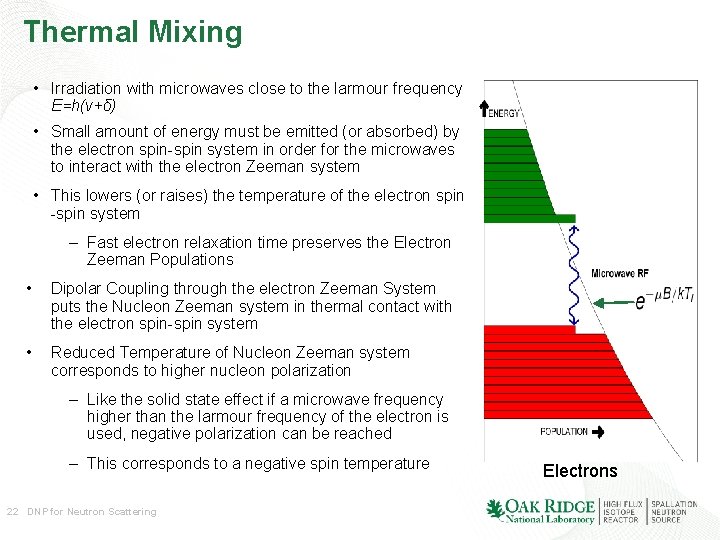
Thermal Mixing • Irradiation with microwaves close to the larmour frequency E=h(ν+δ) • Small amount of energy must be emitted (or absorbed) by the electron spin-spin system in order for the microwaves to interact with the electron Zeeman system • This lowers (or raises) the temperature of the electron spin -spin system – Fast electron relaxation time preserves the Electron Zeeman Populations • Dipolar Coupling through the electron Zeeman System puts the Nucleon Zeeman system in thermal contact with the electron spin-spin system • Reduced Temperature of Nucleon Zeeman system corresponds to higher nucleon polarization – Like the solid state effect if a microwave frequency higher than the larmour frequency of the electron is used, negative polarization can be reached – This corresponds to a negative spin temperature 22 DNP for Neutron Scattering Electrons
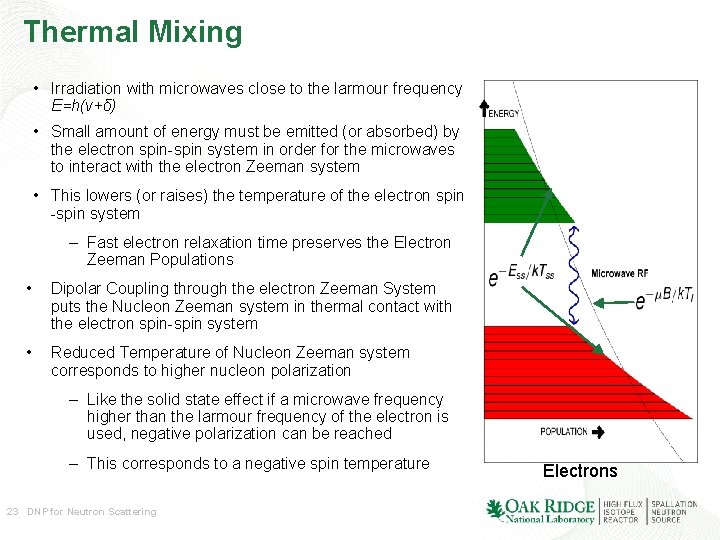
Thermal Mixing • Irradiation with microwaves close to the larmour frequency E=h(ν+δ) • Small amount of energy must be emitted (or absorbed) by the electron spin-spin system in order for the microwaves to interact with the electron Zeeman system • This lowers (or raises) the temperature of the electron spin -spin system – Fast electron relaxation time preserves the Electron Zeeman Populations • Dipolar Coupling through the electron Zeeman System puts the Nucleon Zeeman system in thermal contact with the electron spin-spin system • Reduced Temperature of Nucleon Zeeman system corresponds to higher nucleon polarization – Like the solid state effect if a microwave frequency higher than the larmour frequency of the electron is used, negative polarization can be reached – This corresponds to a negative spin temperature 23 DNP for Neutron Scattering Electrons
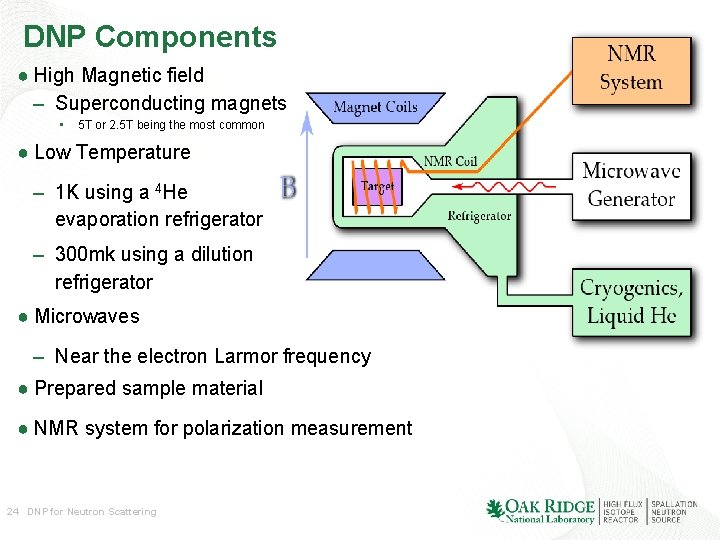
DNP Components ● High Magnetic field – Superconducting magnets • 5 T or 2. 5 T being the most common ● Low Temperature – 1 K using a 4 He evaporation refrigerator – 300 mk using a dilution refrigerator ● Microwaves – Near the electron Larmor frequency ● Prepared sample material ● NMR system for polarization measurement 24 DNP for Neutron Scattering
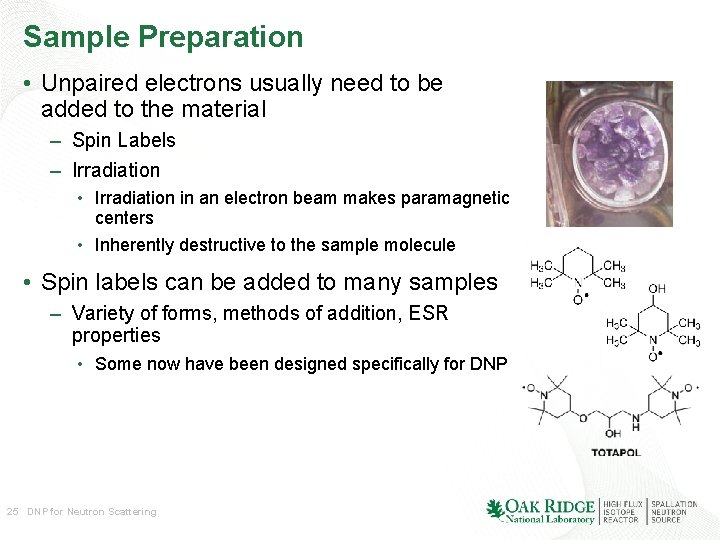
Sample Preparation • Unpaired electrons usually need to be added to the material – Spin Labels – Irradiation • Irradiation in an electron beam makes paramagnetic centers • Inherently destructive to the sample molecule • Spin labels can be added to many samples – Variety of forms, methods of addition, ESR properties • Some now have been designed specifically for DNP 25 DNP for Neutron Scattering
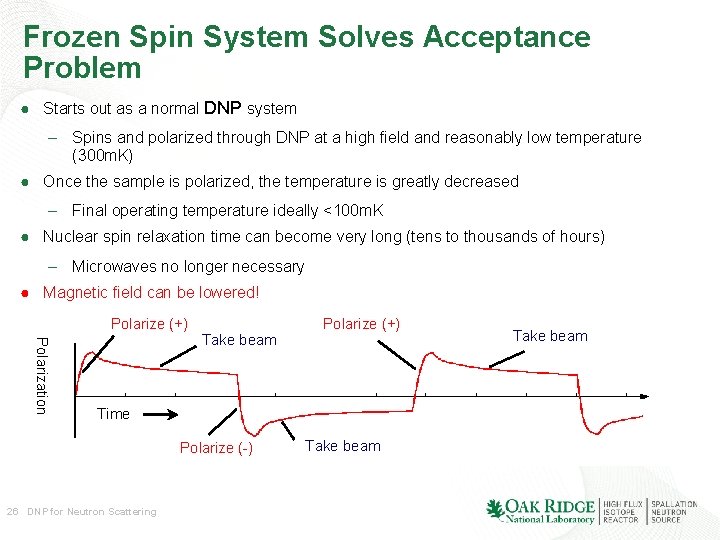
Frozen Spin System Solves Acceptance Problem ● Starts out as a normal DNP system – Spins and polarized through DNP at a high field and reasonably low temperature (300 m. K) ● Once the sample is polarized, the temperature is greatly decreased – Final operating temperature ideally <100 m. K ● Nuclear spin relaxation time can become very long (tens to thousands of hours) – Microwaves no longer necessary ● Magnetic field can be lowered! Polarize (+) Polarization Take beam Polarize (+) Time Polarize (-) 26 DNP for Neutron Scattering Take beam
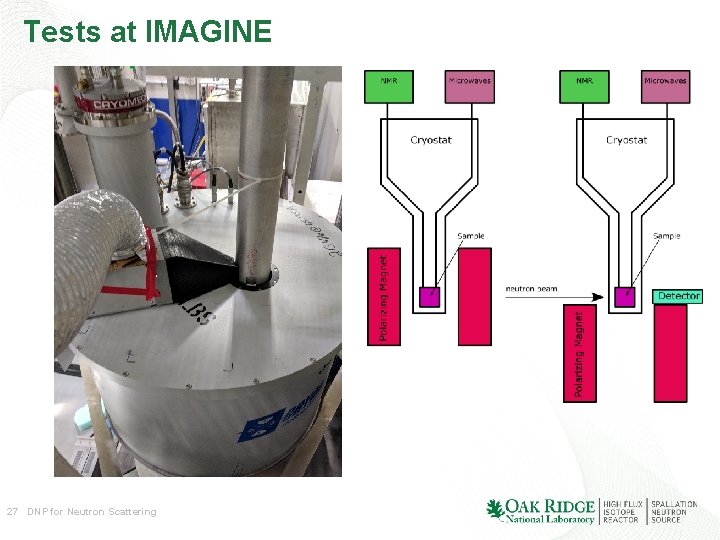
Tests at IMAGINE 27 DNP for Neutron Scattering
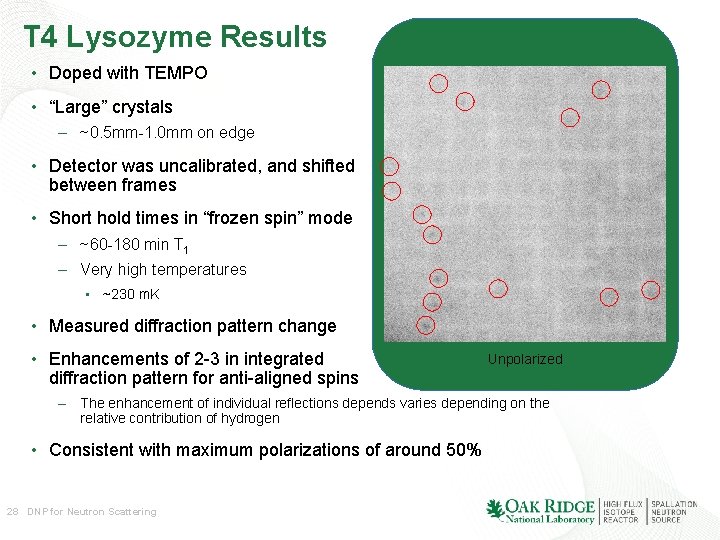
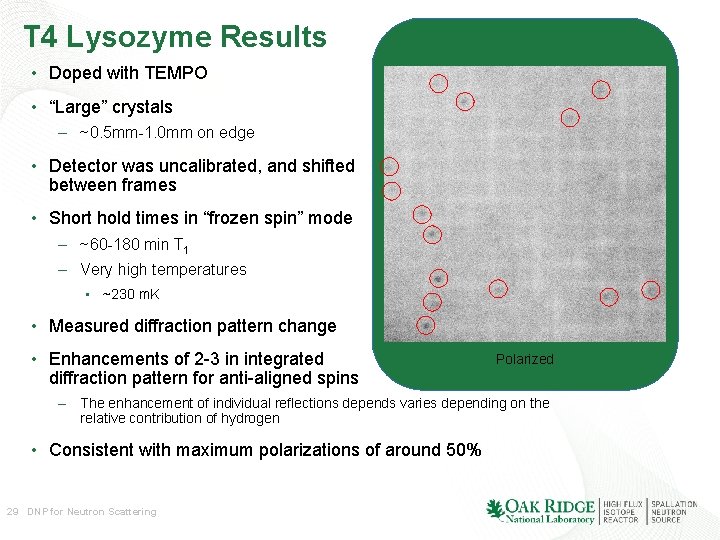
T 4 Lysozyme Results • Doped with TEMPO • “Large” crystals – ~0. 5 mm-1. 0 mm on edge • Detector was uncalibrated, and shifted between frames • Short hold times in “frozen spin” mode – ~60 -180 min T 1 – Very high temperatures • ~230 m. K • Measured diffraction pattern change • Enhancements of 2 -3 in integrated diffraction pattern for anti-aligned spins Unpolarized – The enhancement of individual reflections depends varies depending on the relative contribution of hydrogen • Consistent with maximum polarizations of around 50% 28 DNP for Neutron Scattering
T 4 Lysozyme Results • Doped with TEMPO • “Large” crystals – ~0. 5 mm-1. 0 mm on edge • Detector was uncalibrated, and shifted between frames • Short hold times in “frozen spin” mode – ~60 -180 min T 1 – Very high temperatures • ~230 m. K • Measured diffraction pattern change • Enhancements of 2 -3 in integrated diffraction pattern for anti-aligned spins Polarized – The enhancement of individual reflections depends varies depending on the relative contribution of hydrogen • Consistent with maximum polarizations of around 50% 29 DNP for Neutron Scattering
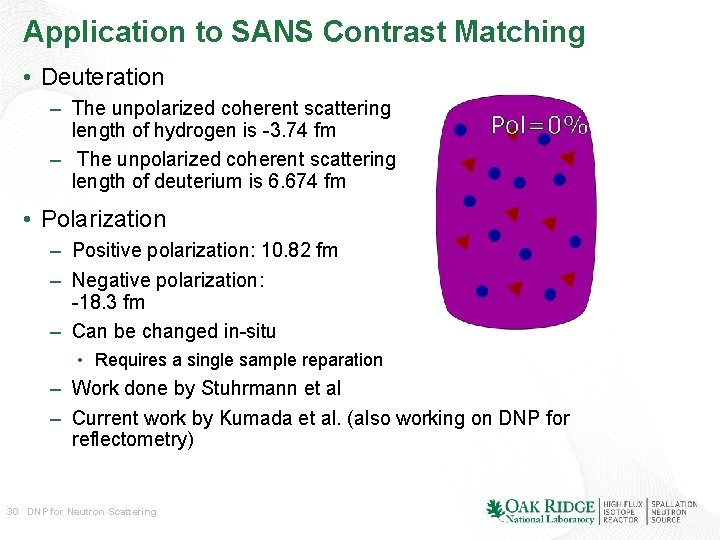
Application to SANS Contrast Matching • Deuteration – The unpolarized coherent scattering length of hydrogen is -3. 74 fm – The unpolarized coherent scattering length of deuterium is 6. 674 fm • Polarization – Positive polarization: 10. 82 fm – Negative polarization: -18. 3 fm – Can be changed in-situ • Requires a single sample reparation – Work done by Stuhrmann et al – Current work by Kumada et al. (also working on DNP for reflectometry) 30 DNP for Neutron Scattering
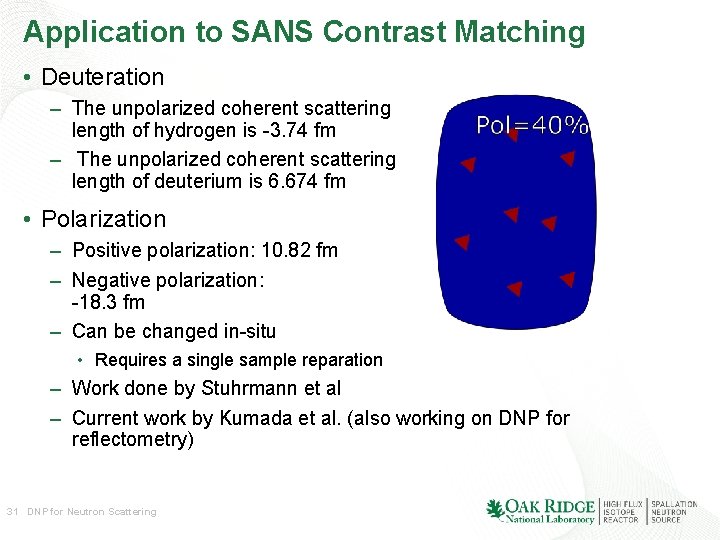
Application to SANS Contrast Matching • Deuteration – The unpolarized coherent scattering length of hydrogen is -3. 74 fm – The unpolarized coherent scattering length of deuterium is 6. 674 fm • Polarization – Positive polarization: 10. 82 fm – Negative polarization: -18. 3 fm – Can be changed in-situ • Requires a single sample reparation – Work done by Stuhrmann et al – Current work by Kumada et al. (also working on DNP for reflectometry) 31 DNP for Neutron Scattering
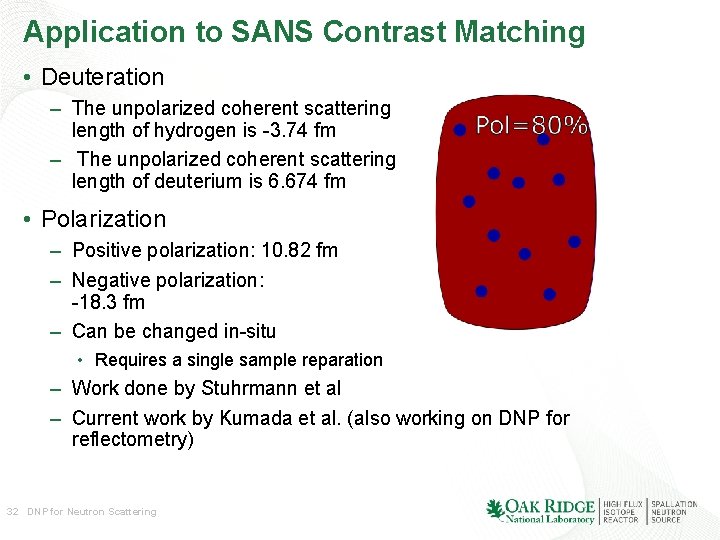
Application to SANS Contrast Matching • Deuteration – The unpolarized coherent scattering length of hydrogen is -3. 74 fm – The unpolarized coherent scattering length of deuterium is 6. 674 fm • Polarization – Positive polarization: 10. 82 fm – Negative polarization: -18. 3 fm – Can be changed in-situ • Requires a single sample reparation – Work done by Stuhrmann et al – Current work by Kumada et al. (also working on DNP for reflectometry) 32 DNP for Neutron Scattering
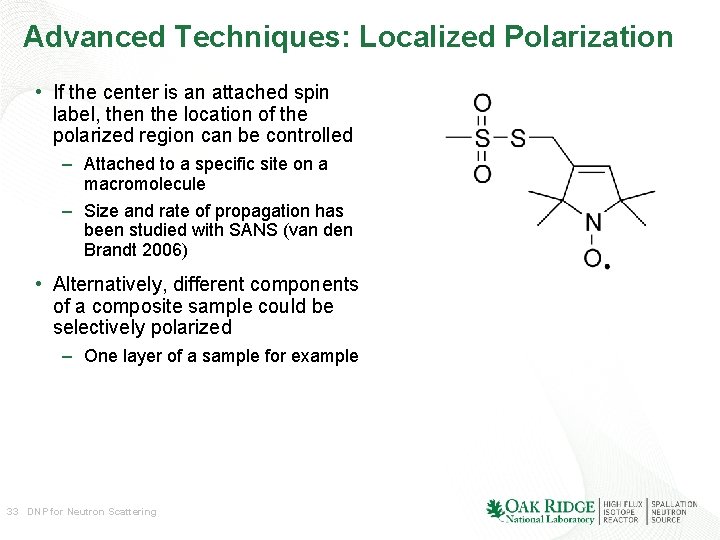
Advanced Techniques: Localized Polarization • If the center is an attached spin label, then the location of the polarized region can be controlled – Attached to a specific site on a macromolecule – Size and rate of propagation has been studied with SANS (van den Brandt 2006) • Alternatively, different components of a composite sample could be selectively polarized – One layer of a sample for example 33 DNP for Neutron Scattering
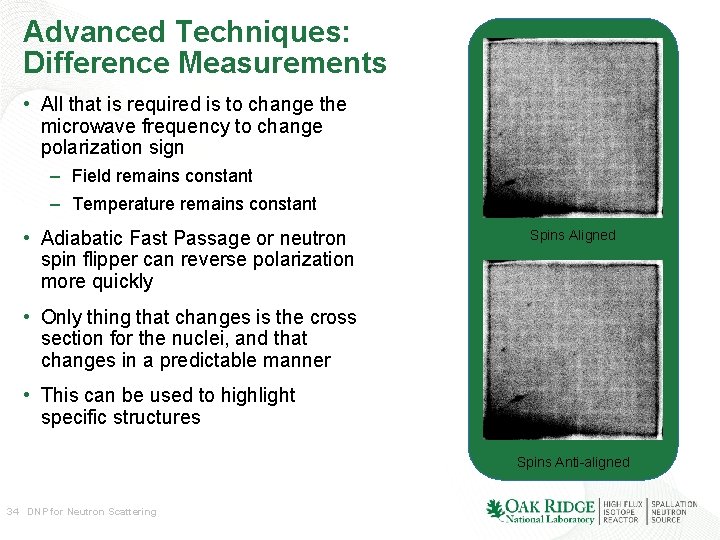
Advanced Techniques: Difference Measurements • All that is required is to change the microwave frequency to change polarization sign – Field remains constant – Temperature remains constant • Adiabatic Fast Passage or neutron spin flipper can reverse polarization more quickly Spins Aligned • Only thing that changes is the cross section for the nuclei, and that changes in a predictable manner • This can be used to highlight specific structures Spins Anti-aligned 34 DNP for Neutron Scattering
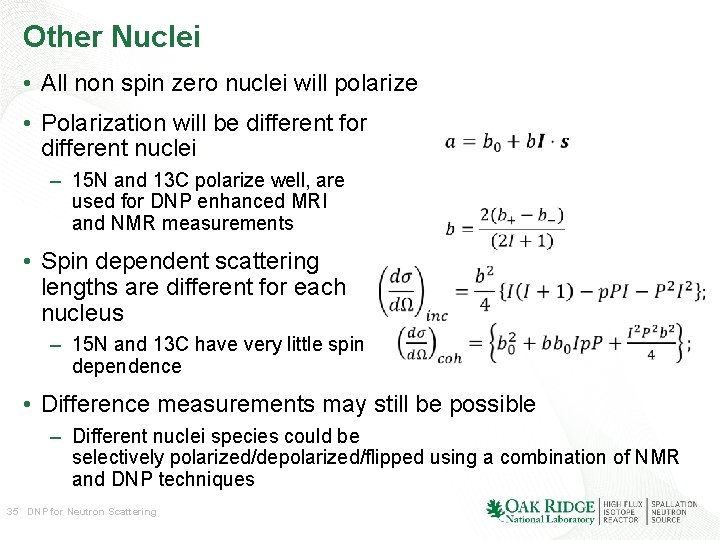
Other Nuclei • All non spin zero nuclei will polarize • Polarization will be different for different nuclei – 15 N and 13 C polarize well, are used for DNP enhanced MRI and NMR measurements • Spin dependent scattering lengths are different for each nucleus – 15 N and 13 C have very little spin dependence • Difference measurements may still be possible – Different nuclei species could be selectively polarized/depolarized/flipped using a combination of NMR and DNP techniques 35 DNP for Neutron Scattering
Conclusion • The nuclear spin dependence of neutron scattering can be used to manipulate scattering • Polarized hydrogen has a large potential benefit to protein crystallography – Could allow the use of sustainably smaller samples or greatly reduced data collection time • DNP is an effective means to polarize the hydrogen within a sample – Sample preparation and sample environment requirements are substantial • Control of scattering opens up the possibility for new measurement techniques 36 DNP for Neutron Scattering