
Dynamic Models of Portfolio Credit Risk A Simplified


- Slides: 29
Dynamic Models of Portfolio Credit Risk: A Simplified Approach John Hull Princeton Credit Conference May 2008 Copyright © John Hull 2008 1
7 th Edition Out! Copyright © John Hull 2008 2
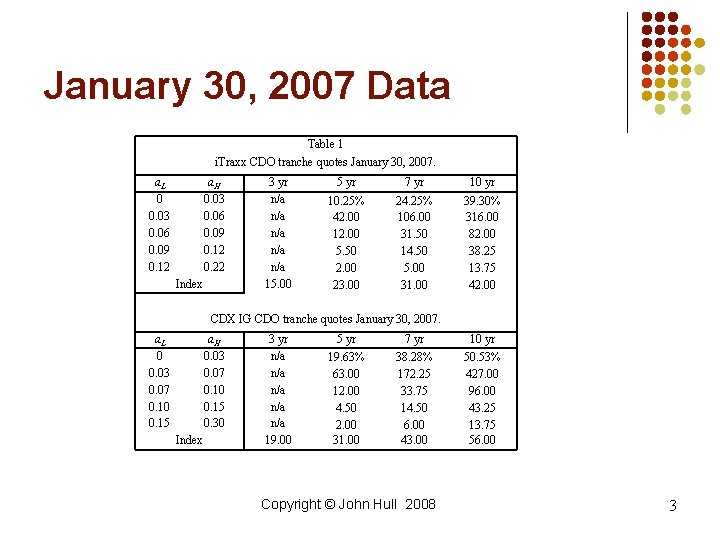
January 30, 2007 Data Table 1 i. Traxx CDO tranche quotes January 30, 2007. a. L 0 0. 03 0. 06 0. 09 0. 12 a. H 0. 03 0. 06 0. 09 0. 12 0. 22 Index 3 yr n/a n/a n/a 15. 00 5 yr 7 yr 10. 25% 42. 00 12. 00 5. 50 2. 00 23. 00 24. 25% 106. 00 31. 50 14. 50 5. 00 31. 00 39. 30% 316. 00 82. 00 38. 25 13. 75 42. 00 CDX IG CDO tranche quotes January 30, 2007. a. L 0 0. 03 0. 07 0. 10 0. 15 a. H 0. 03 0. 07 0. 10 0. 15 0. 30 Index 3 yr n/a n/a n/a 19. 00 5 yr 7 yr 10 yr 19. 63% 63. 00 12. 00 4. 50 2. 00 31. 00 38. 28% 172. 25 33. 75 14. 50 6. 00 43. 00 50. 53% 427. 00 96. 00 43. 25 13. 75 56. 00 Copyright © John Hull 2008 3
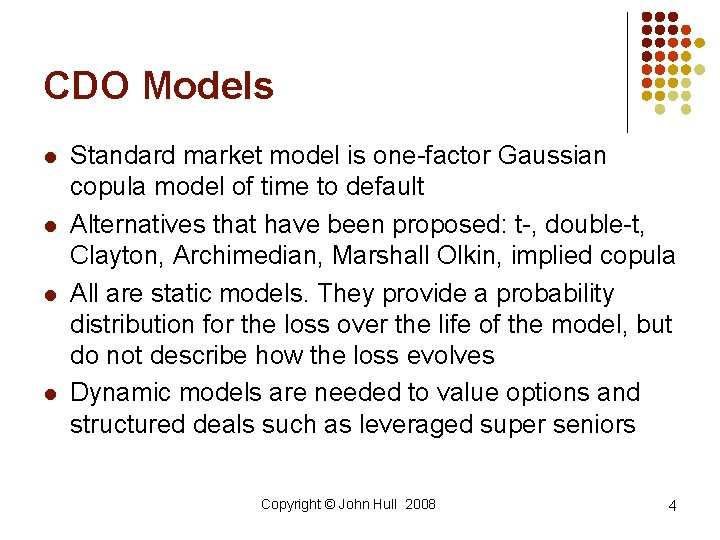
CDO Models l l Standard market model is one-factor Gaussian copula model of time to default Alternatives that have been proposed: t-, double-t, Clayton, Archimedian, Marshall Olkin, implied copula All are static models. They provide a probability distribution for the loss over the life of the model, but do not describe how the loss evolves Dynamic models are needed to value options and structured deals such as leveraged super seniors Copyright © John Hull 2008 4
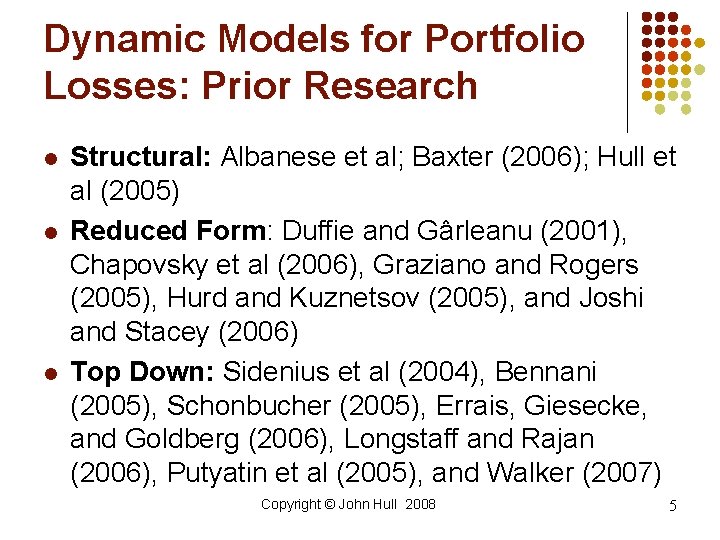
Dynamic Models for Portfolio Losses: Prior Research l l l Structural: Albanese et al; Baxter (2006); Hull et al (2005) Reduced Form: Duffie and Gârleanu (2001), Chapovsky et al (2006), Graziano and Rogers (2005), Hurd and Kuznetsov (2005), and Joshi and Stacey (2006) Top Down: Sidenius et al (2004), Bennani (2005), Schonbucher (2005), Errais, Giesecke, and Goldberg (2006), Longstaff and Rajan (2006), Putyatin et al (2005), and Walker (2007) Copyright © John Hull 2008 5
Our Objective l l Build a simple dynamic model of the evolution of losses that is easy to implement and easy to calibrate to market data The model is developed as a reduced form model, but can also be presented as a top down model Copyright © John Hull 2008 6
Specific vs General Models l l l Specific models track the evolution of default risk on a single name or portfolio that remains fixed (e. g. describes how credit spread for a particular company evolves) General models track the evolution of default risk on a single name or portfolio that is updated so that it always has certain properties (e. g. describes how the average spread for an A-rated company evolves) We focus on specific models Copyright © John Hull 2008 7
CDO Valuation l l Key to valuing a CDO lies in the calculation of expected tranche principal on payment dates l Expected payment on a payment date equals spread times expected tranche principal on that date l Expected payoff between payment dates equals reduction in expected tranche principal between the dates l Expected accrual payments can be calculated from expected payoffs Expected tranche principal at time t can be calculated from the cumulative default probabilities up to time t and recovery rates of companies in the portfolio Copyright © John Hull 2008 8
The Model l Instead of modeling the hazard rate, h(t) we model This is –ln[S(t)] where S(t) is the survival probability calculated from the path followed by the hazard rate between times 0 and t Filtration: We assume that at time t we know the path followed by S between time zero and time t and the number of defaults up to time t Copyright © John Hull 2008 9
The Model (Homogeneous Case) where dq represents a jump that has intensity l and jump size H l. Dt X X + m. Dt + H X + m. Dt 1 -l. Dt m and l are functions only of time and H is a function of the number of jumps so far. m > 0, H > 0. Copyright © John Hull 2008 10
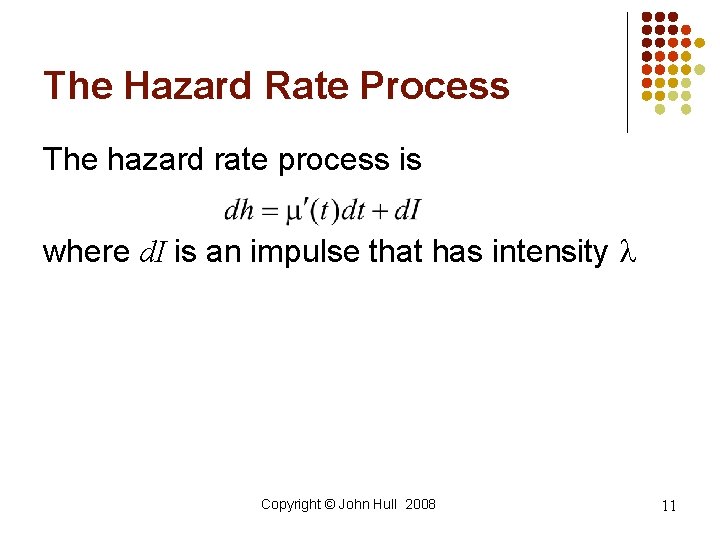
The Hazard Rate Process The hazard rate process is where d. I is an impulse that has intensity l Copyright © John Hull 2008 11
Analytic Results and Binomial Trees l Once m(t), l(t), and the size of the jth jump, Hj, have been specified the model can be used to value analytically l CDOs l Forward CDOs l Options on CDOs l For other instruments a binomial tree can be used Copyright © John Hull 2008 12
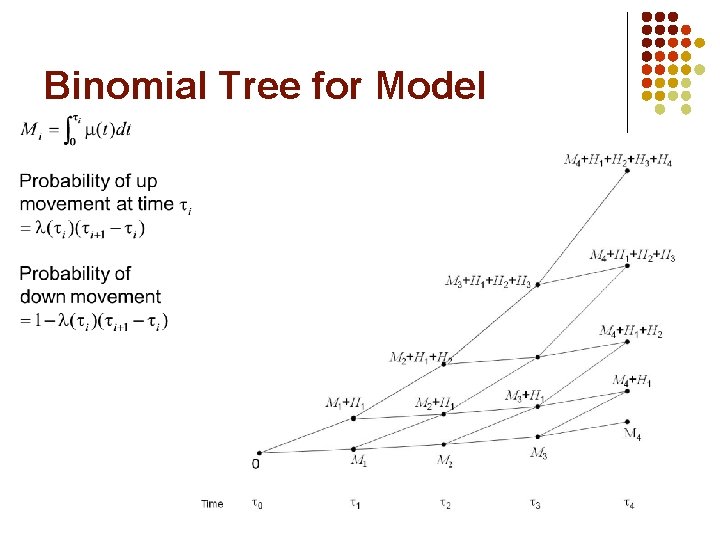
Binomial Tree for Model Copyright © John Hull 2008 13
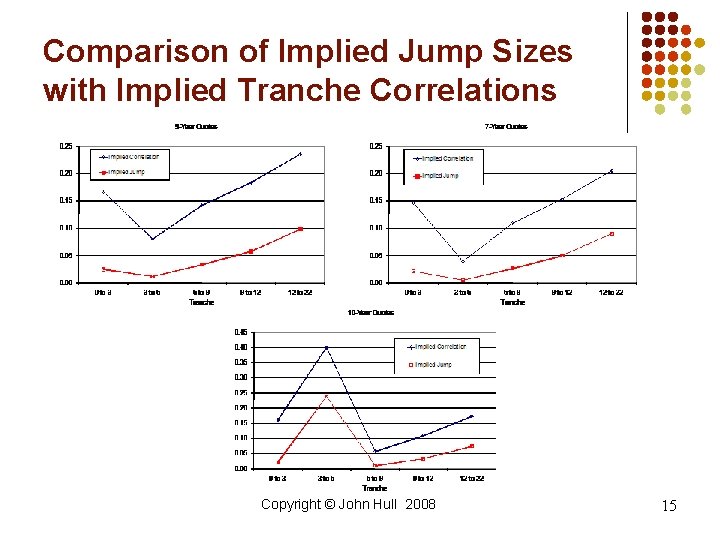
Simplest Version of Model l l Jump size is constant and m(t), is zero Jump intensity, l(t) is chosen to match the term structure of CDS spreads There is then a one-to-one correspondence between tranche quotes and jump size Implied jump sizes are similar to implied correlations Copyright © John Hull 2008 14
Comparison of Implied Jump Sizes with Implied Tranche Correlations Copyright © John Hull 2008 15
Possible Extensions to Fit All Market Data l l Multiple processes each with its own jump size and intensity Intensity and jump size changing in different intervals: 0 to 5 yrs, 5 to 7 yrs, and 7 to 10 yrs Model can (in principle) fit all quotes simultaneously We have chosen to focus on extensions where there are relatively few parameters Copyright © John Hull 2008 16
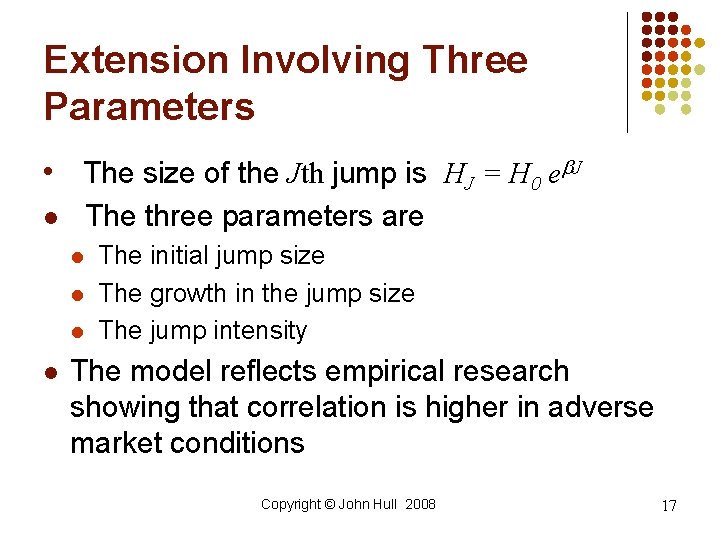
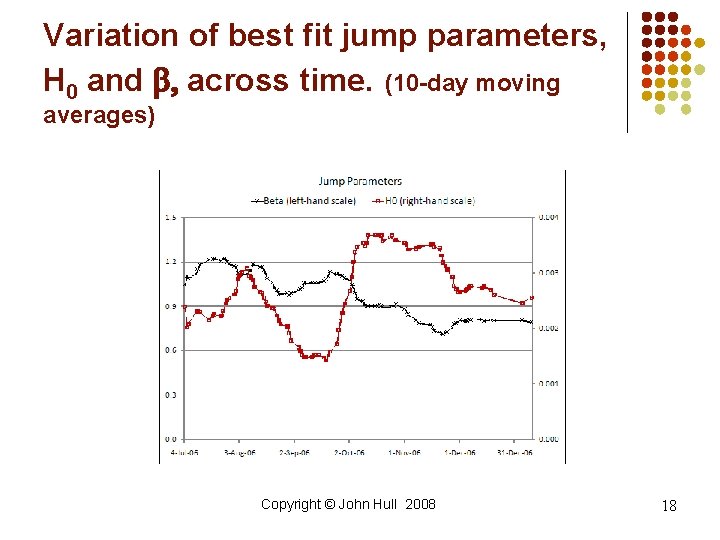
Extension Involving Three Parameters l l The size of the Jth jump is HJ = H 0 eb. J The three parameters are l l The initial jump size The growth in the jump size The jump intensity The model reflects empirical research showing that correlation is higher in adverse market conditions Copyright © John Hull 2008 17
Variation of best fit jump parameters, H 0 and b, across time. (10 -day moving averages) Copyright © John Hull 2008 18
Variation of jump intensity (10 -day moving averages) Copyright © John Hull 2008 19
Evolution of Loss Distribution on January 30, 2007 for 3 -parameter model. Copyright © John Hull 2008 20
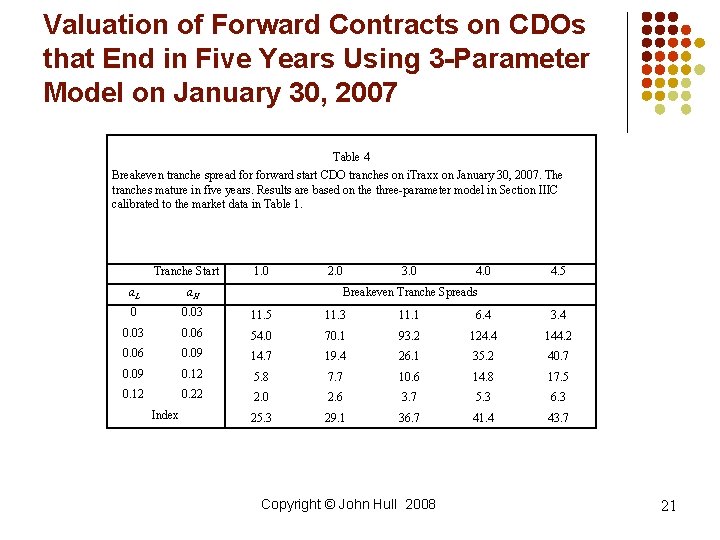
Valuation of Forward Contracts on CDOs that End in Five Years Using 3 -Parameter Model on January 30, 2007 Table 4 Breakeven tranche spread forward start CDO tranches on i. Traxx on January 30, 2007. The tranches mature in five years. Results are based on the three-parameter model in Section IIIC calibrated to the market data in Table 1. Tranche Start 1. 0 2. 0 3. 0 4. 5 a. L a. H 0 0. 03 11. 5 11. 3 11. 1 6. 4 3. 4 0. 03 0. 06 54. 0 70. 1 93. 2 124. 4 144. 2 0. 06 0. 09 14. 7 19. 4 26. 1 35. 2 40. 7 0. 09 0. 12 5. 8 7. 7 10. 6 14. 8 17. 5 0. 12 0. 22 2. 0 2. 6 3. 7 5. 3 6. 3 25. 3 29. 1 36. 7 41. 4 43. 7 Index Breakeven Tranche Spreads Copyright © John Hull 2008 21
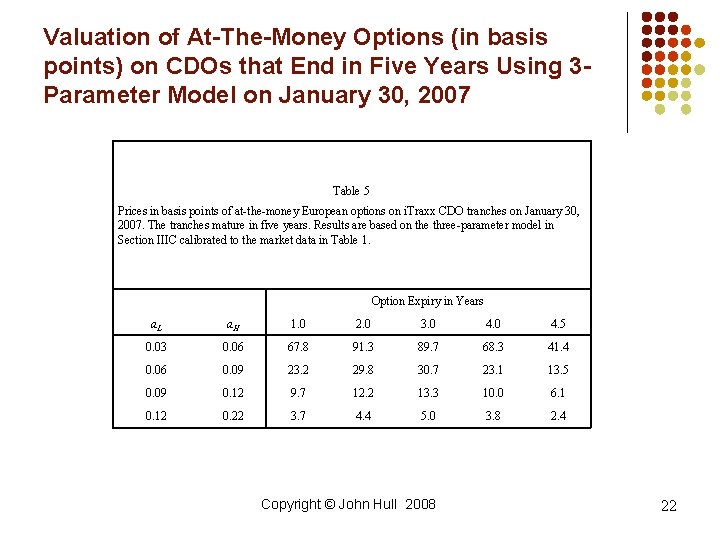
Valuation of At-The-Money Options (in basis points) on CDOs that End in Five Years Using 3 Parameter Model on January 30, 2007 Table 5 Prices in basis points of at-the-money European options on i. Traxx CDO tranches on January 30, 2007. The tranches mature in five years. Results are based on the three-parameter model in Section IIIC calibrated to the market data in Table 1. Option Expiry in Years a. L a. H 1. 0 2. 0 3. 0 4. 5 0. 03 0. 06 67. 8 91. 3 89. 7 68. 3 41. 4 0. 06 0. 09 23. 2 29. 8 30. 7 23. 1 13. 5 0. 09 0. 12 9. 7 12. 2 13. 3 10. 0 6. 1 0. 12 0. 22 3. 7 4. 4 5. 0 3. 8 2. 4 Copyright © John Hull 2008 22
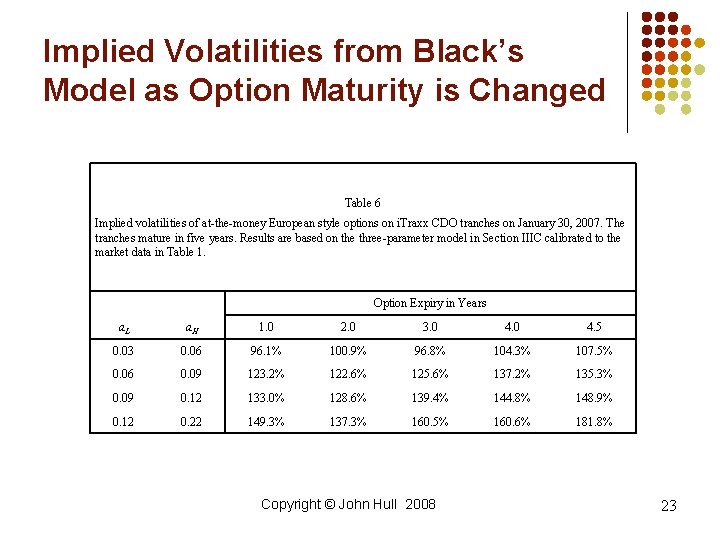
Implied Volatilities from Black’s Model as Option Maturity is Changed Table 6 Implied volatilities of at-the-money European style options on i. Traxx CDO tranches on January 30, 2007. The tranches mature in five years. Results are based on the three-parameter model in Section IIIC calibrated to the market data in Table 1. Option Expiry in Years a. L a. H 1. 0 2. 0 3. 0 4. 5 0. 03 0. 06 96. 1% 100. 9% 96. 8% 104. 3% 107. 5% 0. 06 0. 09 123. 2% 122. 6% 125. 6% 137. 2% 135. 3% 0. 09 0. 12 133. 0% 128. 6% 139. 4% 144. 8% 148. 9% 0. 12 0. 22 149. 3% 137. 3% 160. 5% 160. 6% 181. 8% Copyright © John Hull 2008 23
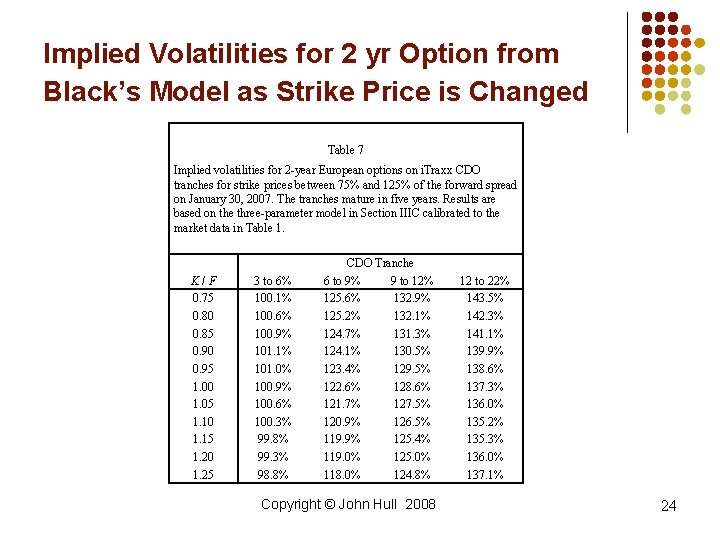
Implied Volatilities for 2 yr Option from Black’s Model as Strike Price is Changed Table 7 Implied volatilities for 2 -year European options on i. Traxx CDO tranches for strike prices between 75% and 125% of the forward spread on January 30, 2007. The tranches mature in five years. Results are based on the three-parameter model in Section IIIC calibrated to the market data in Table 1. K/F 0. 75 0. 80 0. 85 0. 90 0. 95 1. 00 1. 05 1. 10 1. 15 1. 20 1. 25 3 to 6% 100. 1% 100. 6% 100. 9% 101. 1% 101. 0% 100. 9% 100. 6% 100. 3% 99. 8% 99. 3% 98. 8% CDO Tranche 6 to 9% 9 to 12% 125. 6% 132. 9% 125. 2% 132. 1% 124. 7% 131. 3% 124. 1% 130. 5% 123. 4% 129. 5% 122. 6% 128. 6% 121. 7% 127. 5% 120. 9% 126. 5% 119. 9% 125. 4% 119. 0% 125. 0% 118. 0% 124. 8% Copyright © John Hull 2008 12 to 22% 143. 5% 142. 3% 141. 1% 139. 9% 138. 6% 137. 3% 136. 0% 135. 2% 135. 3% 136. 0% 137. 1% 24
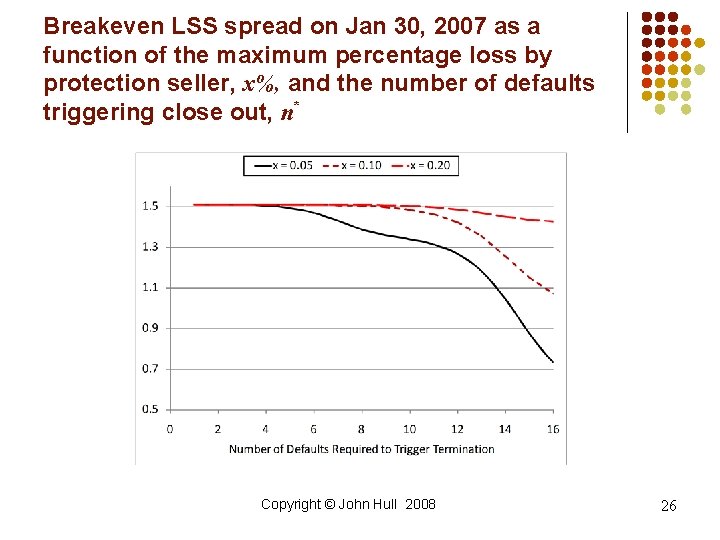
Leverage Super Senior with Loss Trigger l l Total exposure of seller of protection is limited to a fraction x of the tranche notional When losses reach some level the buyer of protection cancel the deal and seller has to pay the value of the tranche to the buyer. Define n* as the number of losses triggering cancellation Copyright © John Hull 2008 25
Breakeven LSS spread on Jan 30, 2007 as a function of the maximum percentage loss by protection seller, x%, and the number of defaults triggering close out, n* Copyright © John Hull 2008 26
Extensions Model can be extended so that l l l Different companies have different CDS spreads The recovery rate is negatively correlated with the default rate i. Traxx and CDX jumps are modeled jointly Copyright © John Hull 2008 27
Bespokes l l l Calibrate homogeneous model to i. Traxx and CDX IG If all names are North American, use a nonhomogeneous model where underlying companies have the CDX IG jumps and their own drifts. If there a mixture of European and North American names use a non-homogeneous model where the i. Traxx and CDX IG jumps are modeled jointly Copyright © John Hull 2008 28
Conclusions l l l It is possible to develop a simple dynamic model for losses on a portfolio by modeling the cumulative default probability for a representative company The only way of fitting the market appears to be by assuming that there is a small probability of a series of progressively bigger jumps in the cumulative probability. As credit market deteriorates default correlation becomes higher Copyright © John Hull 2008 29