
Dynamic Models of Largescale Brain Activity Shengpei Wang
Dynamic Models of Large-scale Brain Activity Shengpei Wang 2020. 05. 14
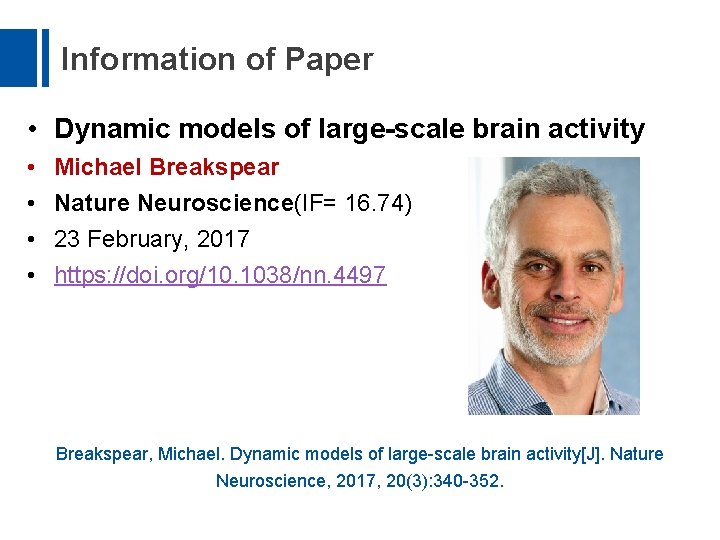
Information of Paper • Dynamic models of large-scale brain activity • • Michael Breakspear Nature Neuroscience(IF= 16. 74) 23 February, 2017 https: //doi. org/10. 1038/nn. 4497 Breakspear, Michael. Dynamic models of large-scale brain activity[J]. Nature Neuroscience, 2017, 20(3): 340 -352.
Content 1. Highlights 2. Introduction 3. Dynamic models: core concepts 4. Principles of collective neural behavior 5. Neural activity: empirical findings 6. Emerging topics 7. Discussion
1. Highlights • Modeling large-scale brain activity with nonlinear dynamical systems theory allows the integration of experimental data from multiple modalities into a common framework that facilitates prediction, testing and possible refutation; • The core assumptions that underlie this computational approach, the methodological framework that fosters the translation of theory into the laboratory, and the emerging body of supporting evidence; • Collective, nonlinear dynamics are central to adaptive cortical activity; • Aberrant dynamic processes appear to underlie a number of brain disorders.
2. Introduction • The origin of spikes in single neurons was essentially solved by the Nobel-prize winning Hodgkin–Huxley model developed in the 1950 s. • Movement and perception do not typically arise from the spikes of single neurons but by the collective behavior of many cortical, thalamic and spinal neurons in large-scale systems of the brain; • Macroscopic functional imaging data such as functional magnetic resonance imaging (f. MRI) and electroencephalography (EEG) reflect the collective activity of thousands of neurons; • There no broadly accepted mathematical theory for the collective activity of neuronal populations. • The analysis of cognitive and functional neuroimaging data has thus largely proceeded without formal biophysical models of the underlying large-scale neuronal activity.
2. Introduction • Is such a macroscopic model conceivable in neuroscience, and if so, where are the guideposts? • Mean field neural models • Such models do not describe the behavior of individual spiking neurons, but rather the collective action of populations of neurons; • These models have found broad success in modeling seizures, encephalopathies, sleep, anesthesia, resting-state brain networks and the human alpha rhythm, and as a tool for multimodal data fusion. • Technical advances in model inversion (estimating the likelihood and parameters of a model from empirical data) place mean field models within reach of widespread application to cognitive neuroscience.
2. Introduction • Yet the penetration of dynamic models of large-scale brain activity into mainstream neuroscience has been slow, and they may be unknown to many neuroscientists. • Reasons: technical, historical and cultural; • Models of collective neuronal activity can be crucial to an understanding of perception and behavior, as well as the determinants of large-scale neuroimaging data. • This review provides a didactic introduction to dynamic models of largescale brain activity, from the tenets of the underlying theory to challenges, controversies and recent breakthroughs.
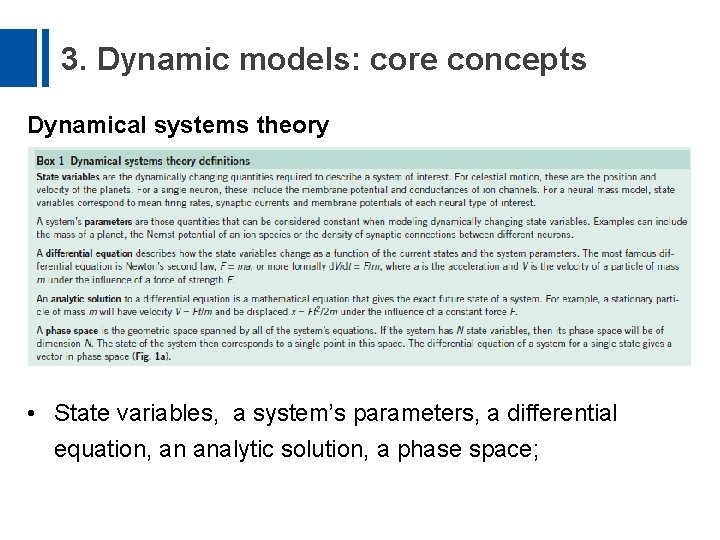
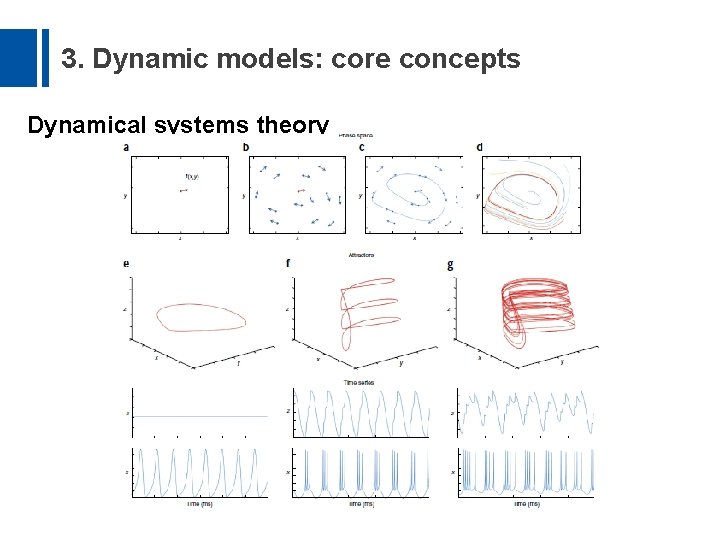
3. Dynamic models: core concepts Dynamical systems theory • State variables, a system’s parameters, a differential equation, an analytic solution, a phase space;

3. Dynamic models: core concepts Dynamical systems theory • Flow, orbit, attractor, saddle, metastability, criticality, a numerical simulation
3. Dynamic models: core concepts Dynamical systems theory

3. Dynamic models: core concepts Bifurcations and multistability • An attractor is structurally stable when a small change in the system’s parameters leads to a slight change in its shape. • If the attractor changes dramatically, it is said to be unstable, and the corresponding parameter value is called a bifurcation point. • In some systems, two or more attractors can coexist for the same set of parameters, enclosed by their basins of attraction and separated by basin boundaries. Such a system is said to be multistable.
3. Dynamic models: core concepts Noise and stochastic calculus • The activity of a population of neurons embodied in the brain inevitably occurs in the presence of noise; Such fluctuations arise from both internal and external sources; • Models of large-scale brain dynamics are thus rooted in stochastic calculus. • they derive from differential equations for pools of spiking neurons with two key ingredients: a coupling term and a stochastic term; The resulting ensemble dynamics reflect this mix of nonlinear neural dynamics, interneural coupling and noise.
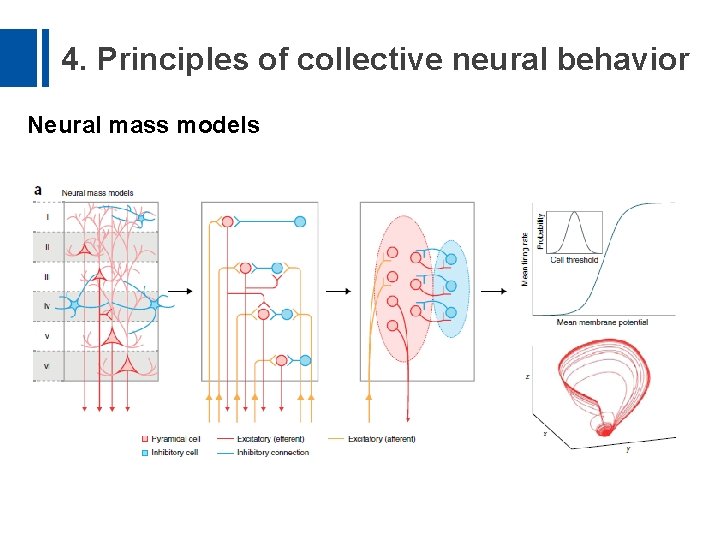
4. Principles of collective neural behavior Single-cell spikes are highly nonlinear, but do such nonlinearities appear in macroscopic neuronal activity, and, if so, what processes ‘transport’ nonlinear dynamics across scales? • The neural ensemble approach • Neural mass models
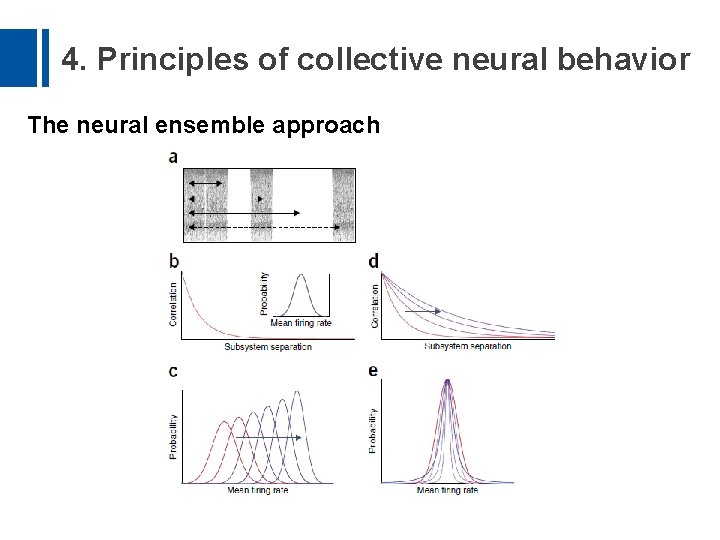
4. Principles of collective neural behavior The neural ensemble approach
4. Principles of collective neural behavior Neural mass models
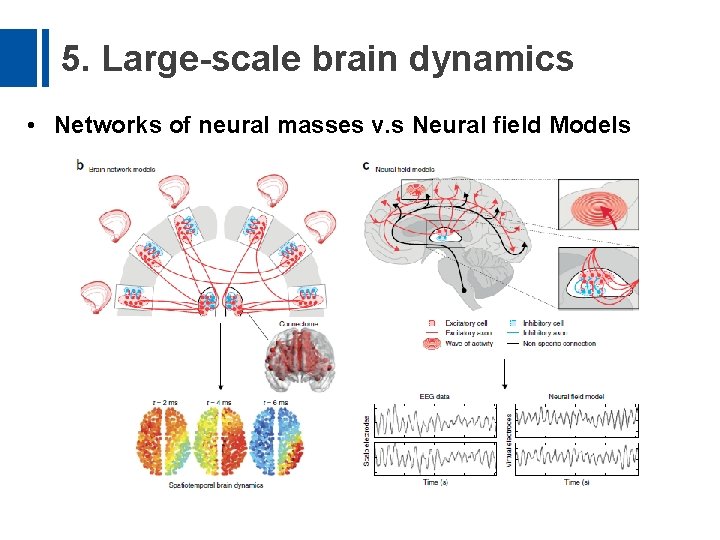
5. Large-scale brain dynamics • Networks of neural masses v. s Neural field Models
5. Large-scale brain dynamics • Networks of neural masses v. s Neural field Models
6. Neural activity: empirical findings • Models of large-scale brain dynamics thus derive from detailed, theoretical treatments of neural population dynamics. • However, the validity of a dynamic model of the brain is ultimately an empirical question: what is the evidence that such models can explain, predict and unify neurophysiological data? What tools are required to appraise this question?
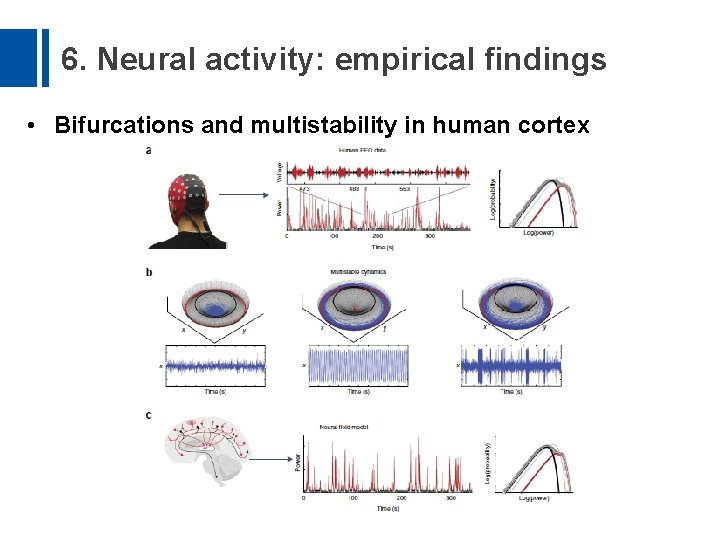
6. Neural activity: empirical findings • Bifurcations and multistability in human cortex
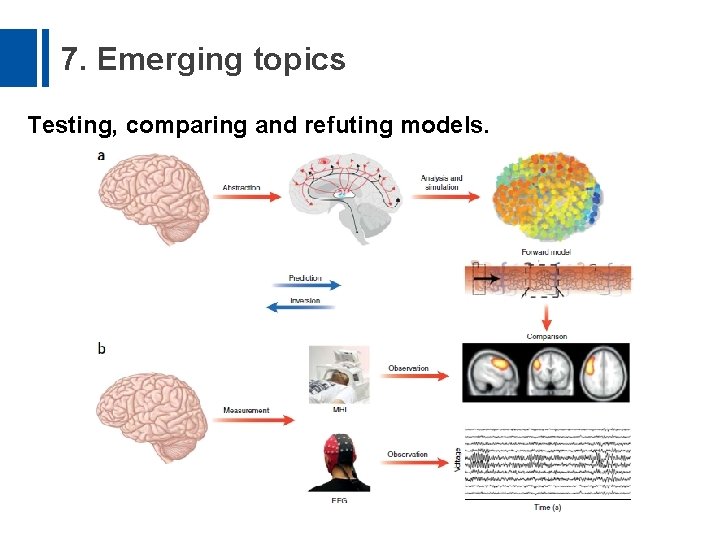
7. Emerging topics Testing, comparing and refuting models.
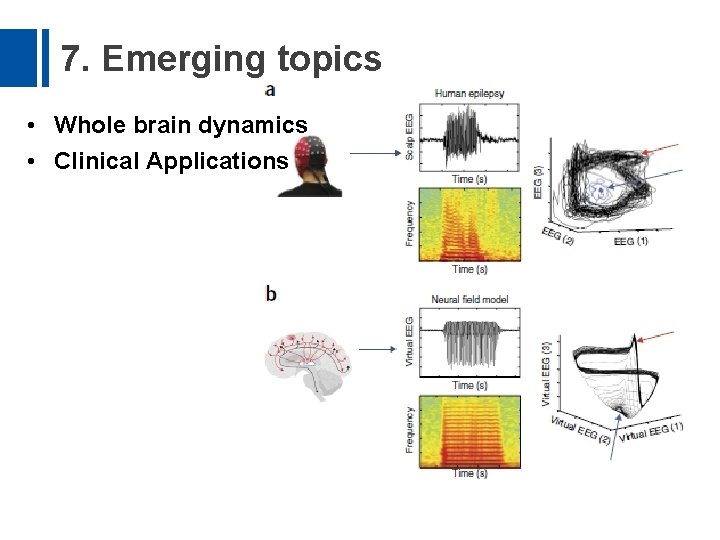
7. Emerging topics • Whole brain dynamics • Clinical Applications
8. Discussion • Models of large-scale neuronal dynamics are unique in their capacity to explain, predict and integrate neuronal activity at the macroscopic scale of perception, behavior and functional imaging data. • The conceptual underpinnings of these models are increasingly supported by analyses of empirical data. • By integrating diverse empirical findings into a unifying framework that can be iteratively refined (or refuted), dynamic models may also help address the ‘reproducibility crisis’ in neuroscience. • These arguments suggest an increasingly central role for models of large-scale brain activity in understanding the neural origins of functional imaging data, such as oscillations and network dynamics, in health and disease.

Thanks!
- Slides: 23