
Dynamic Language Learning Progressions UCLA to DLLP org

- Slides: 21
Dynamic Language Learning Progressions @ UCLA to DLLP. org Alison L. Bailey
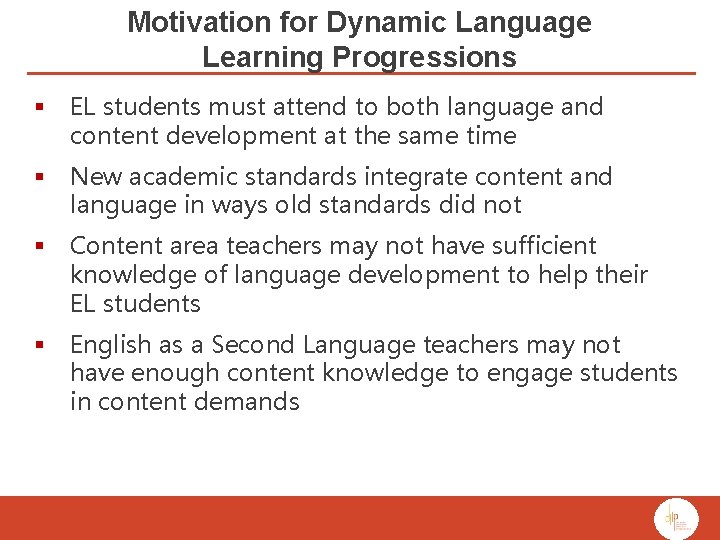
Motivation for Dynamic Language Learning Progressions § EL students must attend to both language and content development at the same time § New academic standards integrate content and language in ways old standards did not § Content area teachers may not have sufficient knowledge of language development to help their EL students § English as a Second Language teachers may not have enough content knowledge to engage students in content demands
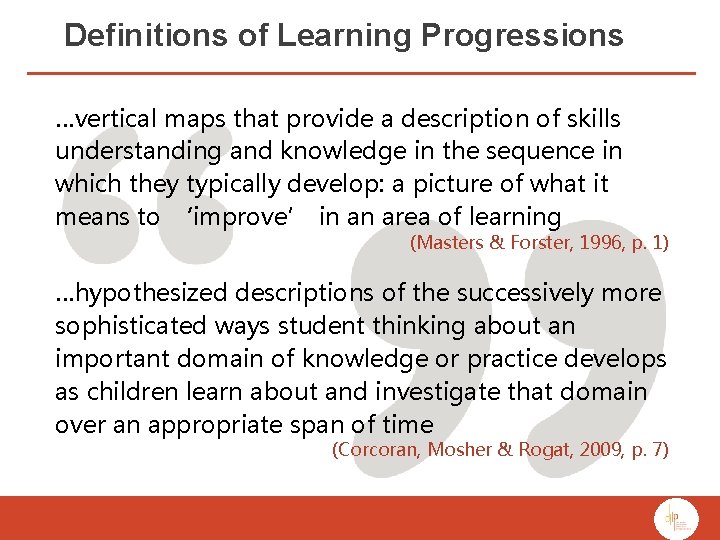
Definitions of Learning Progressions …vertical maps that provide a description of skills understanding and knowledge in the sequence in which they typically develop: a picture of what it means to ‘improve’ in an area of learning (Masters & Forster, 1996, p. 1) …hypothesized descriptions of the successively more sophisticated ways student thinking about an important domain of knowledge or practice develops as children learn about and investigate that domain over an appropriate span of time (Corcoran, Mosher & Rogat, 2009, p. 7)
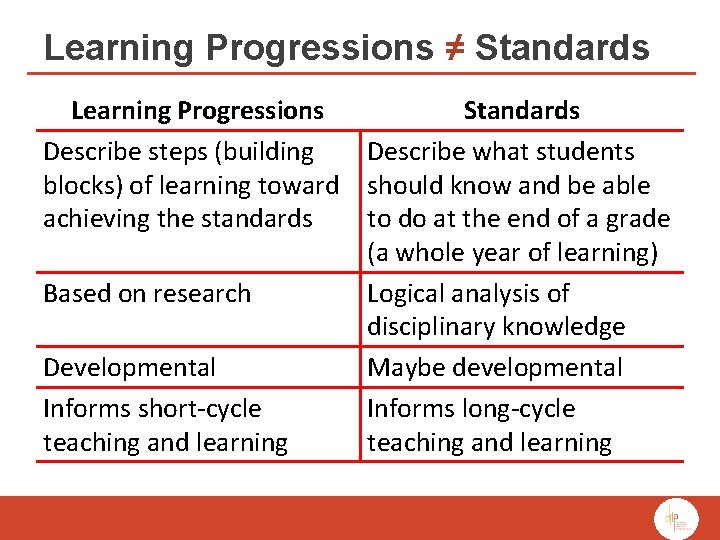
Learning Progressions ≠ Standards Learning Progressions Standards Describe steps (building Describe what students blocks) of learning toward should know and be able achieving the standards to do at the end of a grade (a whole year of learning) Based on research Logical analysis of disciplinary knowledge Developmental Maybe developmental Informs short-cycle Informs long-cycle teaching and learning
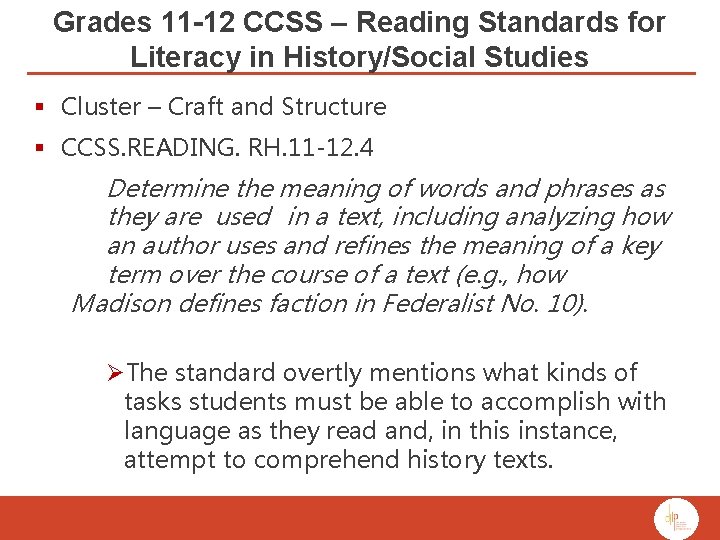
Grades 11 -12 CCSS – Reading Standards for Literacy in History/Social Studies § Cluster – Craft and Structure § CCSS. READING. RH. 11 -12. 4 Determine the meaning of words and phrases as they are used in a text, including analyzing how an author uses and refines the meaning of a key term over the course of a text (e. g. , how Madison defines faction in Federalist No. 10). ØThe standard overtly mentions what kinds of tasks students must be able to accomplish with language as they read and, in this instance, attempt to comprehend history texts.
Unpacking Inherent Language Demands: Do we know how and at what rate they progress? § Standard 4 presupposes a host of other language skills and knowledge not overtly acknowledged § To demonstrate the skills covered in this standard, students must be able to: Ø use the conventions of providing formal definitions Ø talk or write about word choice Ø talk and write about semantic refinement as an object of study Ø understand use the language of sequencing in order to keep track of word usage across the text (Bailey & Wolf, 2013)
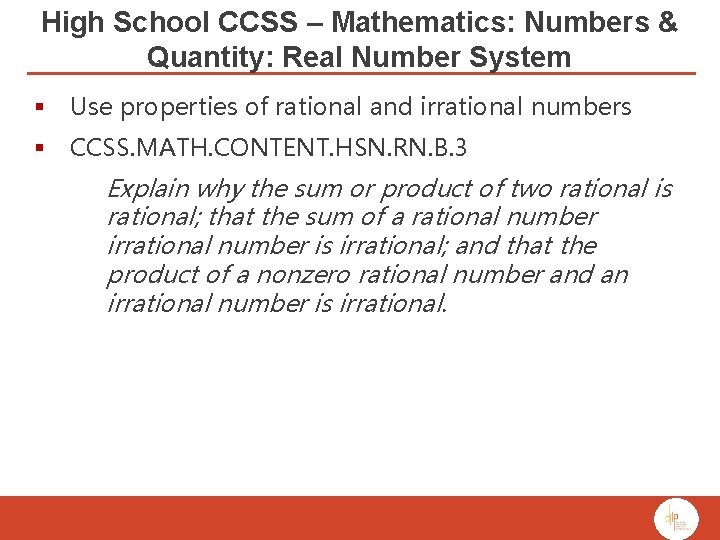
High School CCSS – Mathematics: Numbers & Quantity: Real Number System § Use properties of rational and irrational numbers § CCSS. MATH. CONTENT. HSN. RN. B. 3 Explain why the sum or product of two rational is rational; that the sum of a rational number irrational number is irrational; and that the product of a nonzero rational number and an irrational number is irrational.
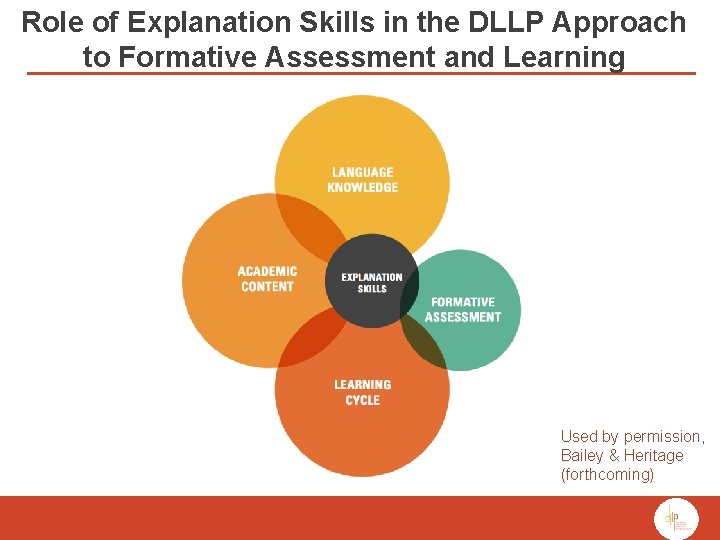
Role of Explanation Skills in the DLLP Approach to Formative Assessment and Learning Used by permission, Bailey & Heritage (forthcoming)
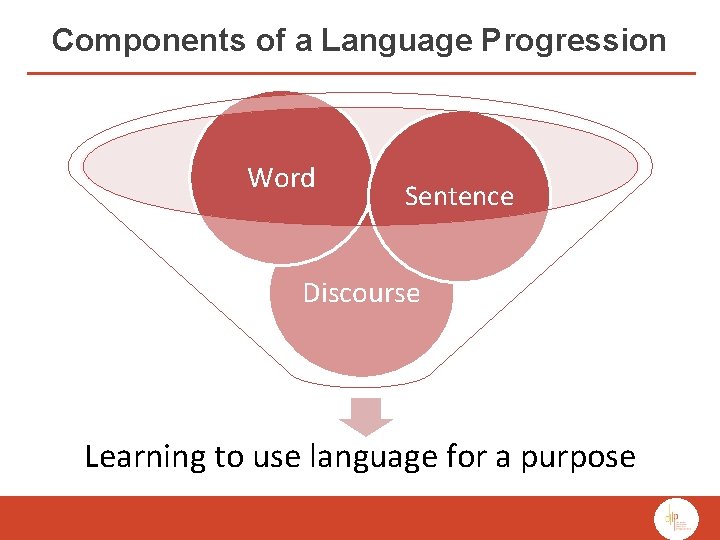
Components of a Language Progression Word Sentence Discourse Learning to use language for a purpose
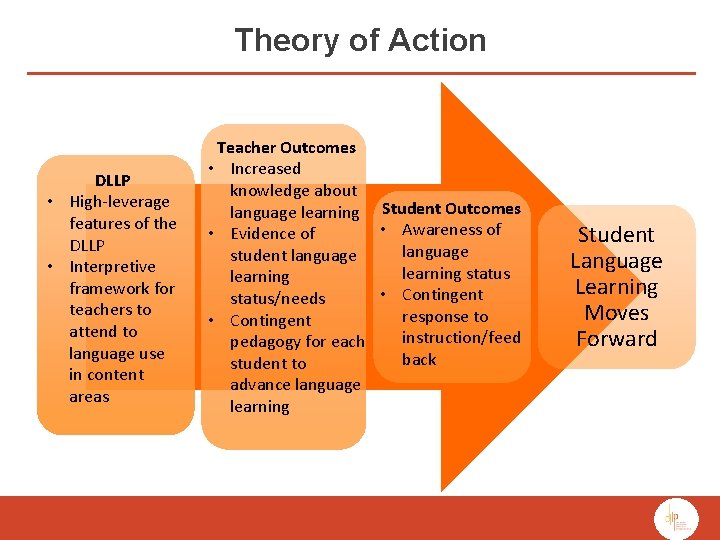
Theory of Action DLLP • High-leverage features of the DLLP • Interpretive framework for teachers to attend to language use in content areas Teacher Outcomes • Increased knowledge about language learning Student Outcomes • Awareness of • Evidence of language student language learning status learning • Contingent status/needs response to • Contingent instruction/feed pedagogy for each back student to advance language learning Student Language Learning Moves Forward
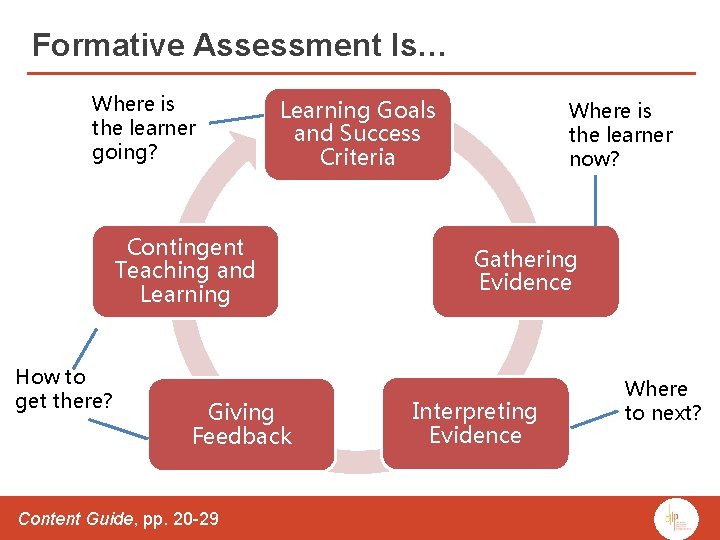
Formative Assessment Is… Where is the learner going? Learning Goals and Success Criteria Contingent Teaching and Learning How to get there? Giving Feedback Content Guide, pp. 20 -29 Where is the learner now? Gathering Evidence Interpreting Evidence Where to next?
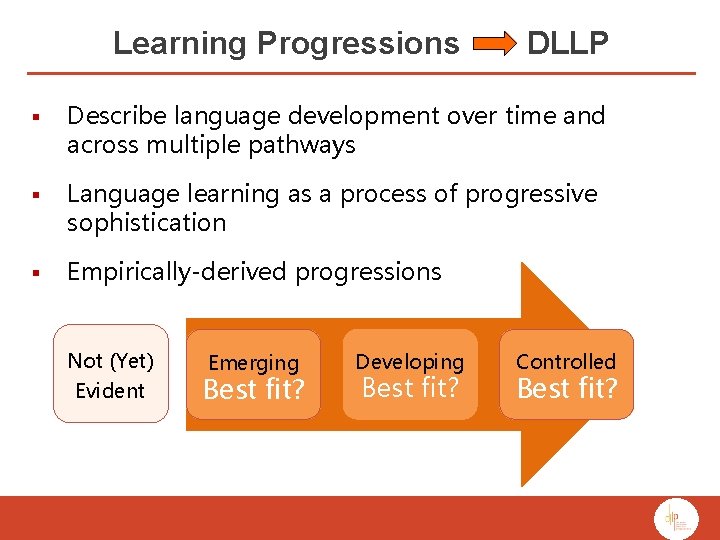
Learning Progressions DLLP § Describe language development over time and across multiple pathways § Language learning as a process of progressive sophistication § Empirically-derived progressions Not (Yet) Evident Emerging Best fit? Developing Best fit? Controlled Best fit?
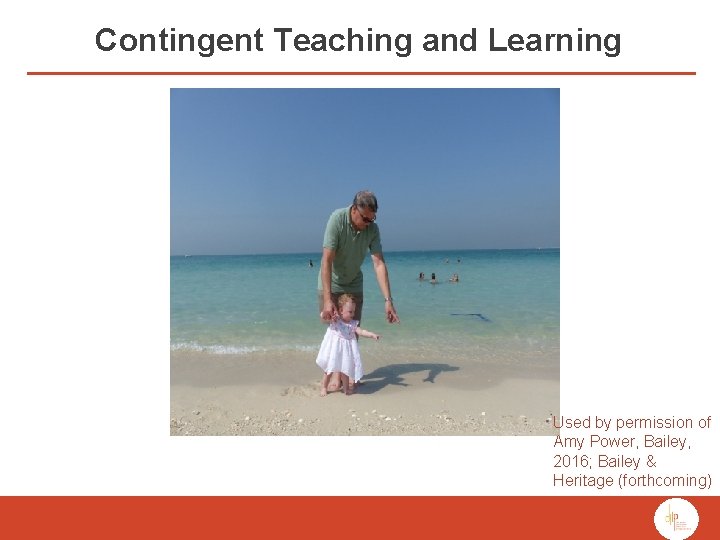
Contingent Teaching and Learning Used by permission of Amy Power, Bailey, 2016; Bailey & Heritage (forthcoming)
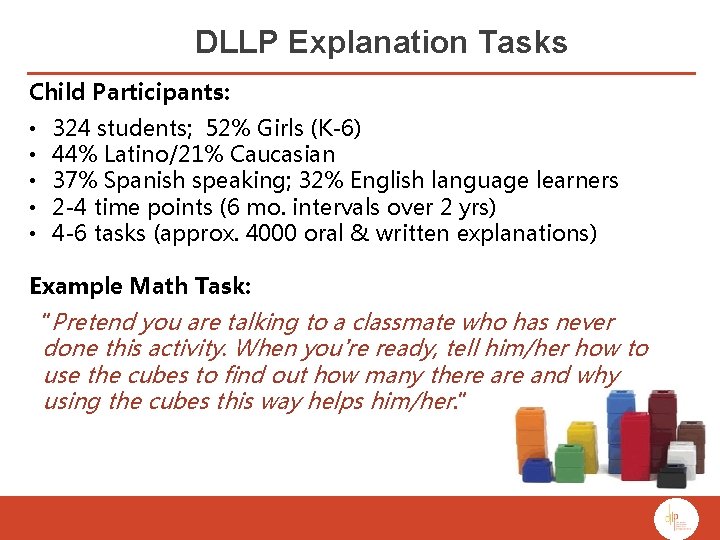
DLLP Explanation Tasks Child Participants: • • • 324 students; 52% Girls (K-6) 44% Latino/21% Caucasian 37% Spanish speaking; 32% English language learners 2 -4 time points (6 mo. intervals over 2 yrs) 4 -6 tasks (approx. 4000 oral & written explanations) Example Math Task: “Pretend you are talking to a classmate who has never done this activity. When you're ready, tell him/her how to use the cubes to find out how many there and why using the cubes this way helps him/her. ”
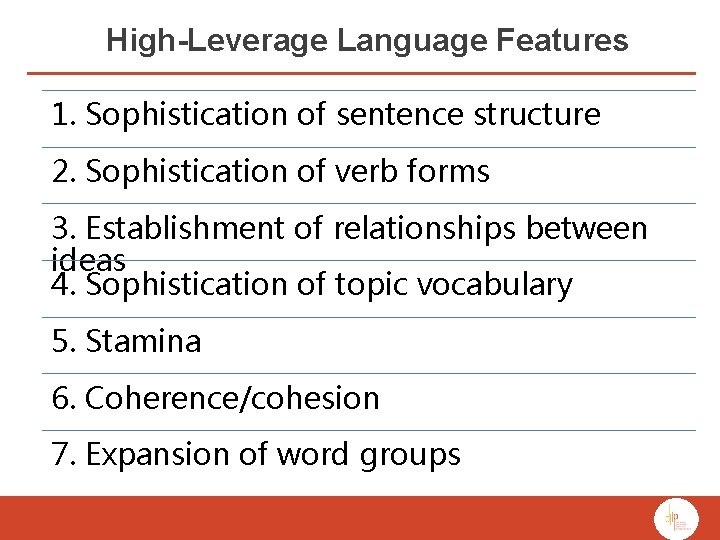
High-Leverage Language Features 1. Sophistication of sentence structure 2. Sophistication of verb forms 3. Establishment of relationships between ideas 4. Sophistication of topic vocabulary 5. Stamina 6. Coherence/cohesion 7. Expansion of word groups
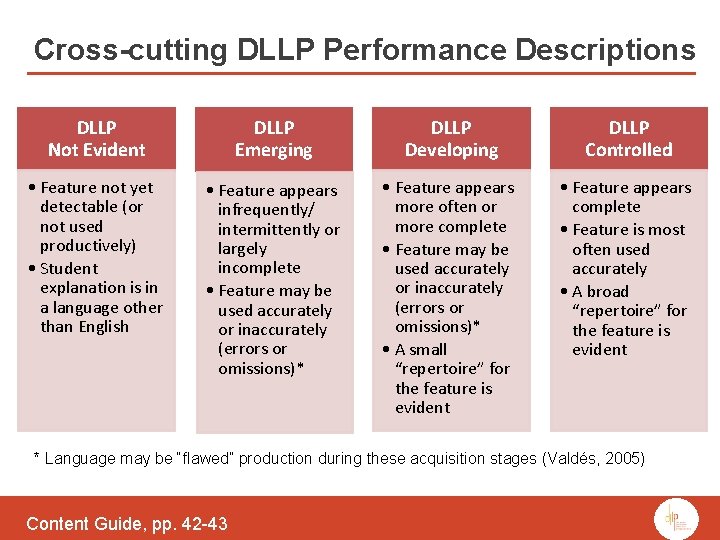
Cross-cutting DLLP Performance Descriptions DLLP Not Evident DLLP Emerging DLLP Developing DLLP Controlled • Feature not yet detectable (or not used productively) • Student explanation is in a language other than English • Feature appears infrequently/ intermittently or largely incomplete • Feature may be used accurately or inaccurately (errors or omissions)* • Feature appears more often or more complete • Feature may be used accurately or inaccurately (errors or omissions)* • A small “repertoire” for the feature is evident • Feature appears complete • Feature is most often used accurately • A broad “repertoire” for the feature is evident * Language may be “flawed” production during these acquisition stages (Valdés, 2005) Content Guide, pp. 42 -43
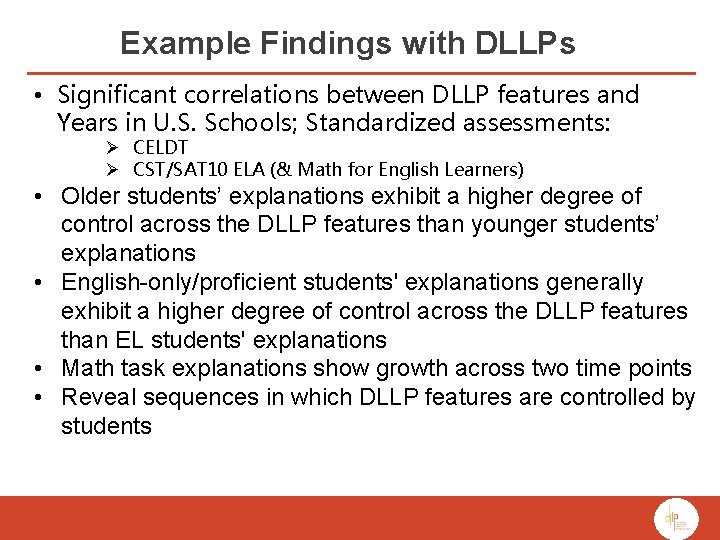
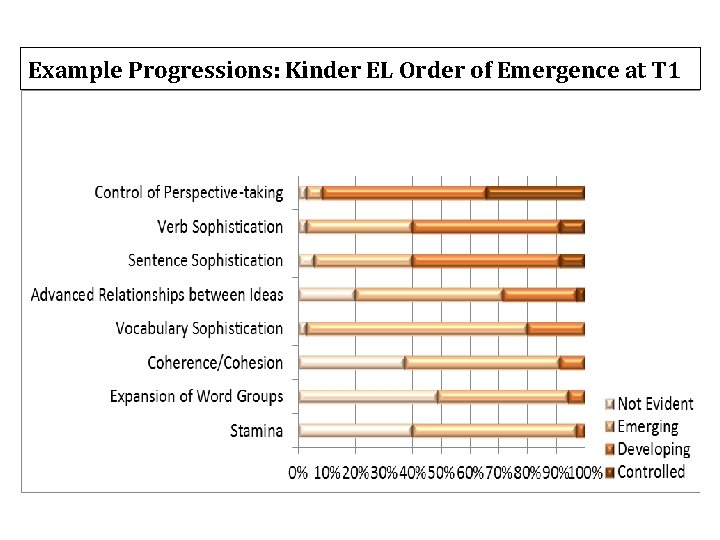
Example Findings with DLLPs • Significant correlations between DLLP features and Years in U. S. Schools; Standardized assessments: Ø CELDT Ø CST/SAT 10 ELA (& Math for English Learners) • Older students’ explanations exhibit a higher degree of control across the DLLP features than younger students’ explanations • English-only/proficient students' explanations generally exhibit a higher degree of control across the DLLP features than EL students' explanations • Math task explanations show growth across two time points • Reveal sequences in which DLLP features are controlled by students
Example Progressions: Kinder EL Order of Emergence at T 1
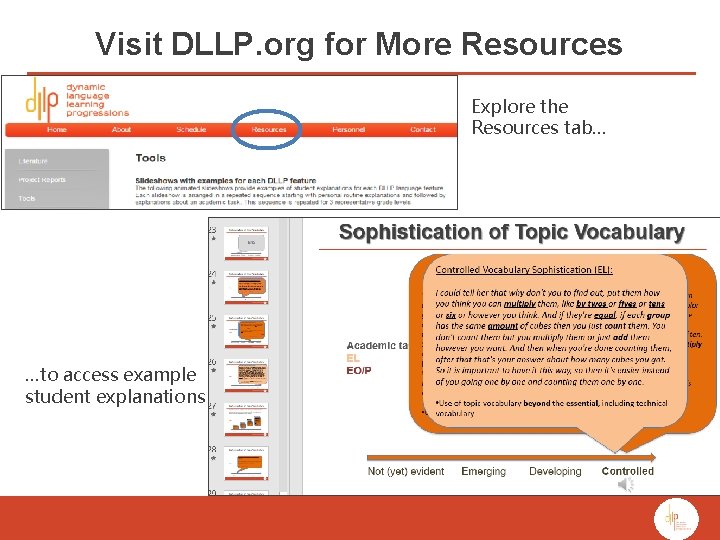
Visit DLLP. org for More Resources Explore the Resources tab… …to access example student explanations
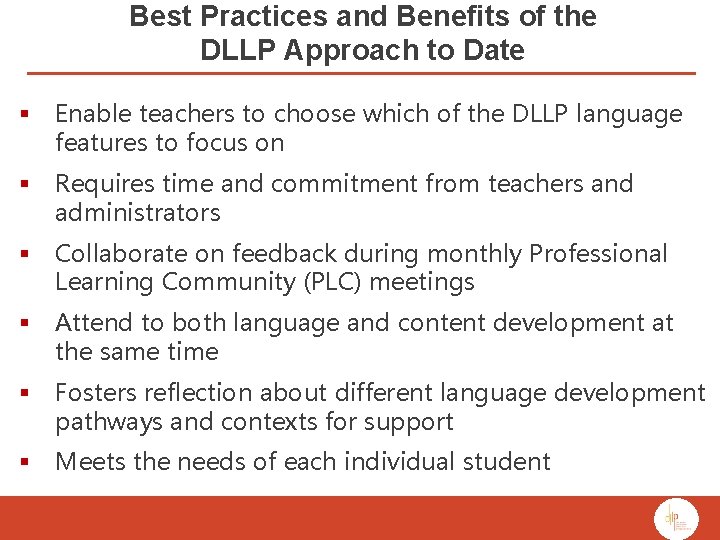
Best Practices and Benefits of the DLLP Approach to Date § Enable teachers to choose which of the DLLP language features to focus on § Requires time and commitment from teachers and administrators § Collaborate on feedback during monthly Professional Learning Community (PLC) meetings § Attend to both language and content development at the same time § Fosters reflection about different language development pathways and contexts for support § Meets the needs of each individual student
For more information, please email: abailey@gseis. ucla. edu dllp. org