
Dynamic Decision Making in Complex Task Environments Principles
- Slides: 16
Dynamic Decision Making in Complex Task Environments: Principles and Neural Mechanisms Annual Workshop Introduction August, 2008
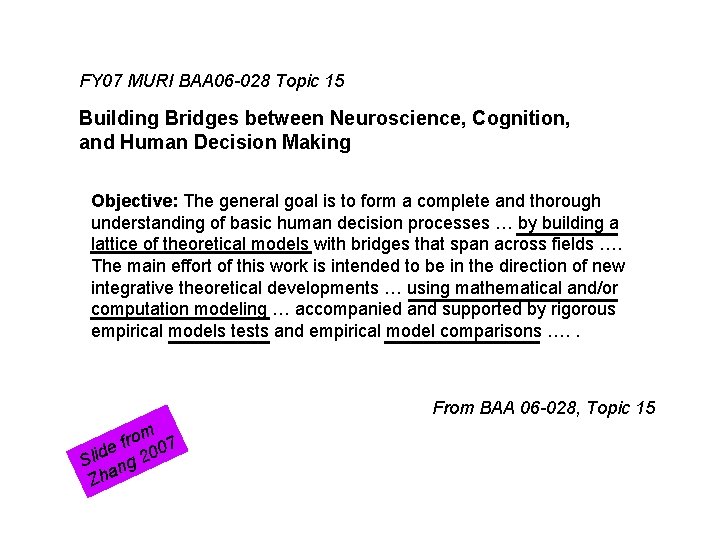
FY 07 MURI BAA 06 -028 Topic 15 Building Bridges between Neuroscience, Cognition, and Human Decision Making Objective: The general goal is to form a complete and thorough understanding of basic human decision processes … by building a lattice of theoretical models with bridges that span across fields …. The main effort of this work is intended to be in the direction of new integrative theoretical developments … using mathematical and/or computation modeling … accompanied and supported by rigorous empirical models tests and empirical model comparisons …. . From BAA 06 -028, Topic 15 om 7 r f e 0 Slid ng 20 Zha
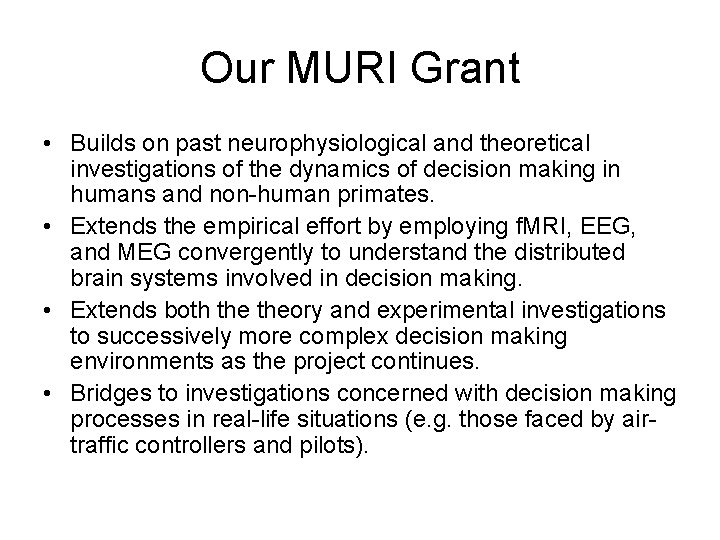
Our MURI Grant • Builds on past neurophysiological and theoretical investigations of the dynamics of decision making in humans and non-human primates. • Extends the empirical effort by employing f. MRI, EEG, and MEG convergently to understand the distributed brain systems involved in decision making. • Extends both theory and experimental investigations to successively more complex decision making environments as the project continues. • Bridges to investigations concerned with decision making processes in real-life situations (e. g. those faced by airtraffic controllers and pilots).
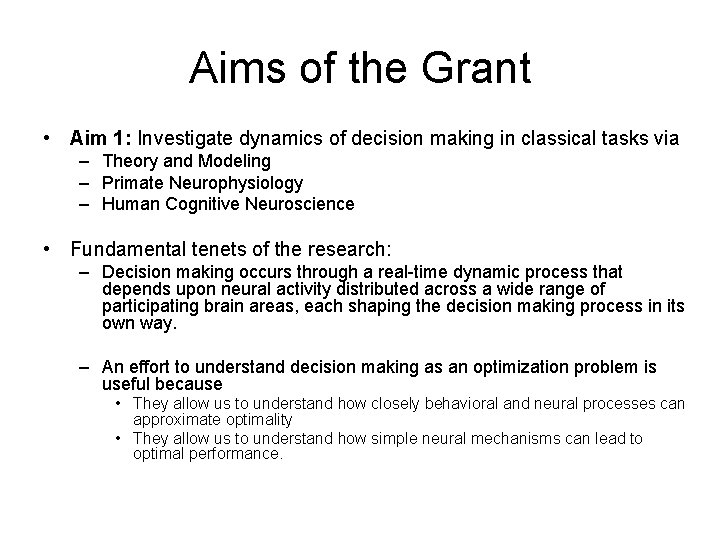
Aims of the Grant • Aim 1: Investigate dynamics of decision making in classical tasks via – Theory and Modeling – Primate Neurophysiology – Human Cognitive Neuroscience • Fundamental tenets of the research: – Decision making occurs through a real-time dynamic process that depends upon neural activity distributed across a wide range of participating brain areas, each shaping the decision making process in its own way. – An effort to understand decision making as an optimization problem is useful because • They allow us to understand how closely behavioral and neural processes can approximate optimality • They allow us to understand how simple neural mechanisms can lead to optimal performance.
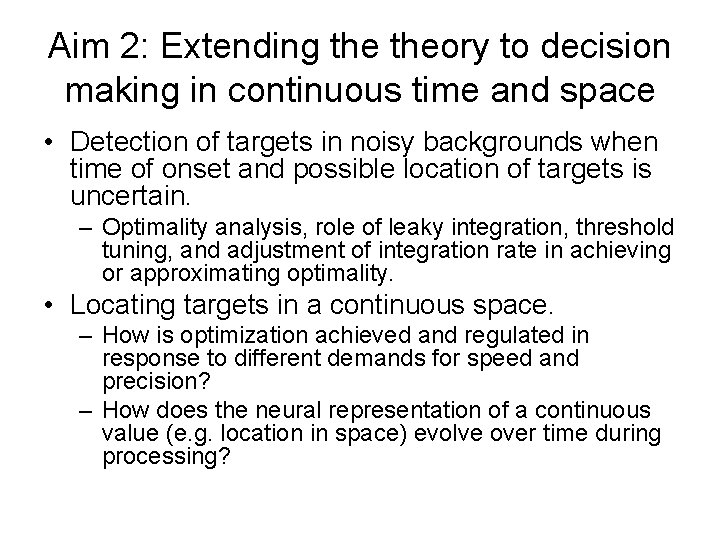
Aim 2: Extending theory to decision making in continuous time and space • Detection of targets in noisy backgrounds when time of onset and possible location of targets is uncertain. – Optimality analysis, role of leaky integration, threshold tuning, and adjustment of integration rate in achieving or approximating optimality. • Locating targets in a continuous space. – How is optimization achieved and regulated in response to different demands for speed and precision? – How does the neural representation of a continuous value (e. g. location in space) evolve over time during processing?
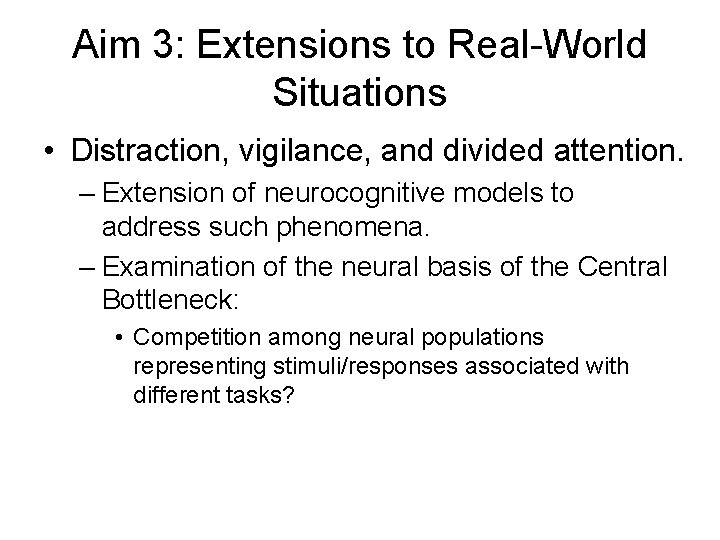
Aim 3: Extensions to Real-World Situations • Distraction, vigilance, and divided attention. – Extension of neurocognitive models to address such phenomena. – Examination of the neural basis of the Central Bottleneck: • Competition among neural populations representing stimuli/responses associated with different tasks?
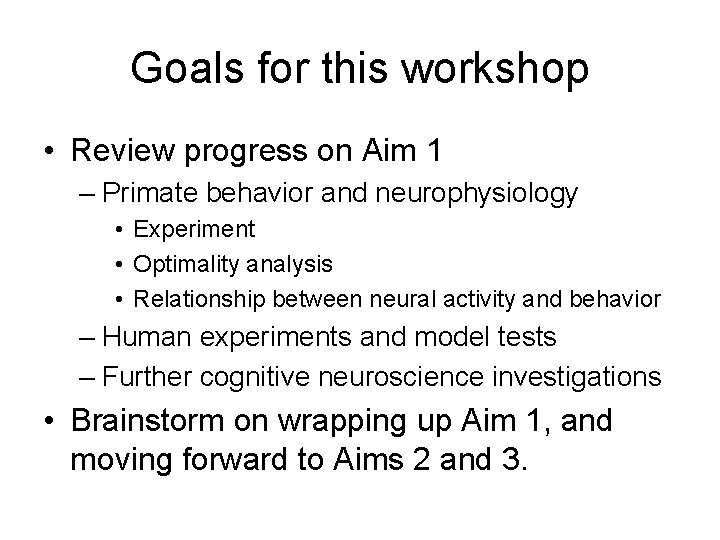
Goals for this workshop • Review progress on Aim 1 – Primate behavior and neurophysiology • Experiment • Optimality analysis • Relationship between neural activity and behavior – Human experiments and model tests – Further cognitive neuroscience investigations • Brainstorm on wrapping up Aim 1, and moving forward to Aims 2 and 3.
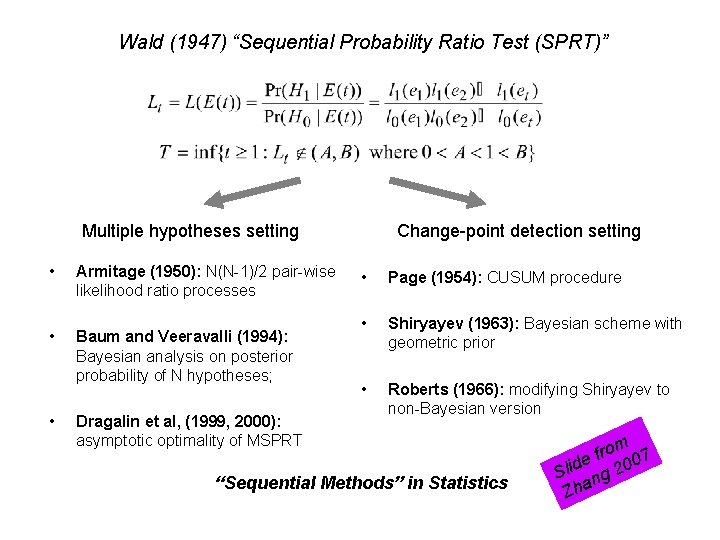
Wald (1947) “Sequential Probability Ratio Test (SPRT)” Multiple hypotheses setting • Armitage (1950): N(N-1)/2 pair-wise likelihood ratio processes • Baum and Veeravalli (1994): Bayesian analysis on posterior probability of N hypotheses; • Dragalin et al, (1999, 2000): asymptotic optimality of MSPRT Change-point detection setting • Page (1954): CUSUM procedure • Shiryayev (1963): Bayesian scheme with geometric prior • Roberts (1966): modifying Shiryayev to non-Bayesian version “Sequential Methods” in Statistics om 7 r f e 0 Slid ng 20 Zha
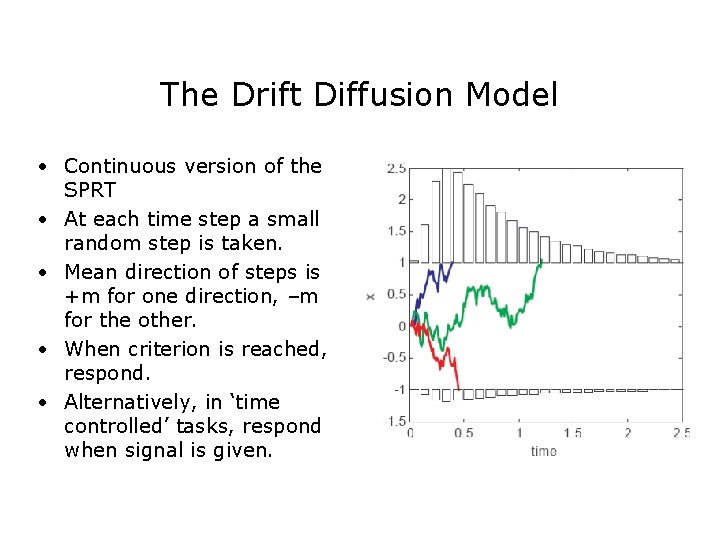
The Drift Diffusion Model • Continuous version of the SPRT • At each time step a small random step is taken. • Mean direction of steps is +m for one direction, –m for the other. • When criterion is reached, respond. • Alternatively, in ‘time controlled’ tasks, respond when signal is given.
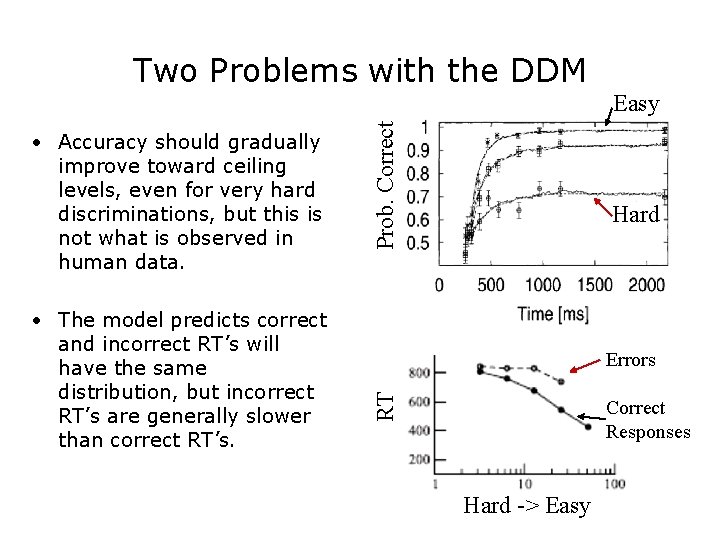
Two Problems with the DDM • The model predicts correct and incorrect RT’s will have the same distribution, but incorrect RT’s are generally slower than correct RT’s. Hard Errors RT • Accuracy should gradually improve toward ceiling levels, even for very hard discriminations, but this is not what is observed in human data. Prob. Correct Easy Correct Responses Hard -> Easy
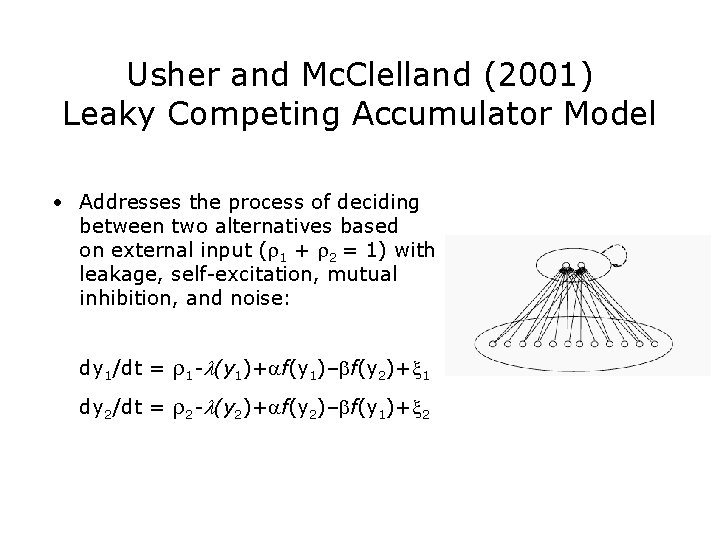
Usher and Mc. Clelland (2001) Leaky Competing Accumulator Model • Addresses the process of deciding between two alternatives based on external input (r 1 + r 2 = 1) with leakage, self-excitation, mutual inhibition, and noise: dy 1/dt = r 1 -l(y 1)+af(y 1)–bf(y 2)+x 1 dy 2/dt = r 2 -l(y 2)+af(y 2)–bf(y 1)+x 2
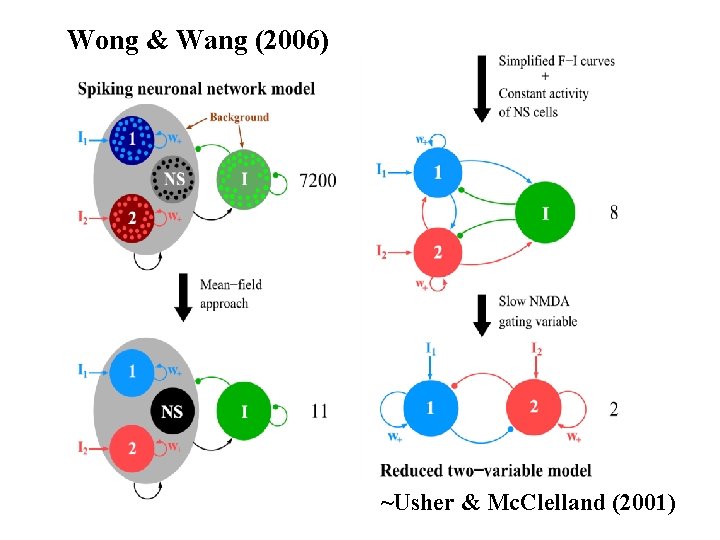
Wong & Wang (2006) ~Usher & Mc. Clelland (2001)
Contributions from Princeton • Holmes et al: – Mathematical analysis of dynamical models of decision making. – Investigations of optimality and deviations from optimality. – Relations between models and levels of description • Cohen et al: – Neural basis of executive function and cognitive control. – Functional brain imaging and neurally grounded models in many areas of cognitive neuroscience.
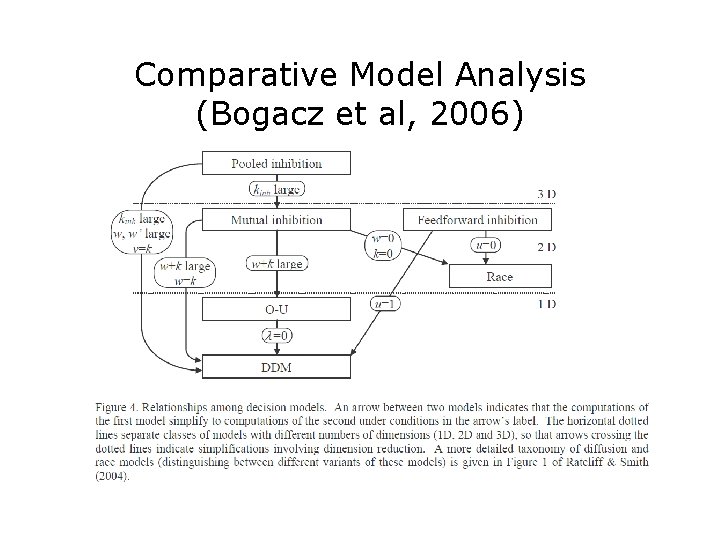
Comparative Model Analysis (Bogacz et al, 2006)
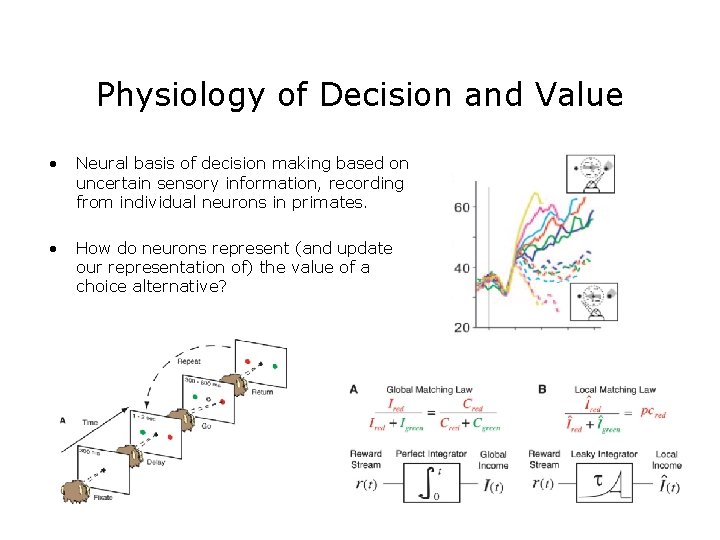
Physiology of Decision and Value • Neural basis of decision making based on uncertain sensory information, recording from individual neurons in primates. • How do neurons represent (and update our representation of) the value of a choice alternative?
Other Participants • Urban lab: – Biophysical processes that allow neurons to oscillate and synchronize their activity – Roles of oscillation and synchrony in information processing in neural circuits – Urban-Mc. Clelland collaboration: • Use of MEG to investigate functional synchronization of neural populations across brain areas. – Will extend to decision making in concert with ongoing EEG investigations. • Johnston / Lachter: – Processing limitations affecting throughput, accuracy, and timely responding in human operators. – Attentional limitations and the central bottleneck revealed in dual task situations. – MURI work: investigating decision dynamics using continuous response measures.