
Dynamic Control of RealTime Communication RTC using SDN
- Slides: 18
Dynamic Control of Real-Time Communication (RTC) using SDN: A case study of a 5 G end-to-end service Samuel Jero, Vijay K. Gurbani, Ray Miller, Bruce Cilli, Charles Payette, Sameer Sharma Purdue University and Nokia Bell Laboratories NOMS 2016 1
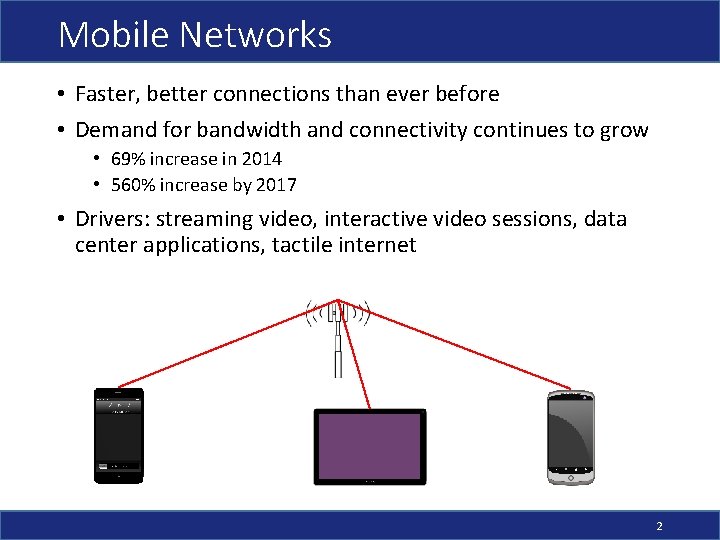
Mobile Networks • Faster, better connections than ever before • Demand for bandwidth and connectivity continues to grow • 69% increase in 2014 • 560% increase by 2017 • Drivers: streaming video, interactive video sessions, data center applications, tactile internet 2
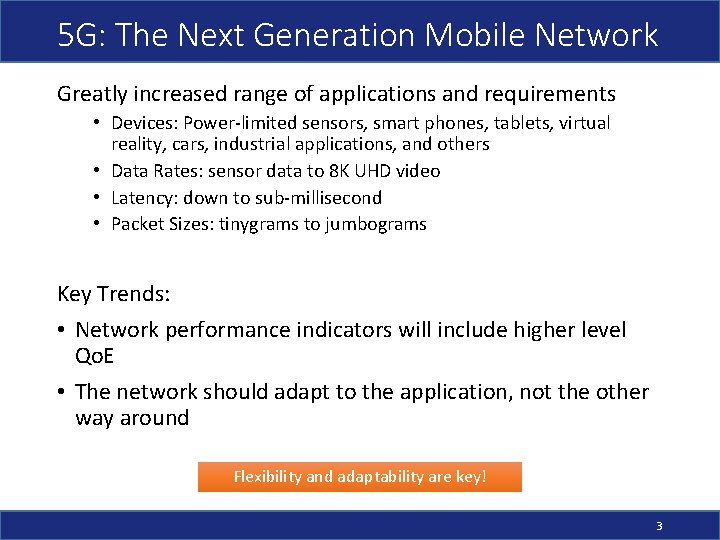
5 G: The Next Generation Mobile Network Greatly increased range of applications and requirements • Devices: Power-limited sensors, smart phones, tablets, virtual reality, cars, industrial applications, and others • Data Rates: sensor data to 8 K UHD video • Latency: down to sub-millisecond • Packet Sizes: tinygrams to jumbograms Key Trends: • Network performance indicators will include higher level Qo. E • The network should adapt to the application, not the other way around Flexibility and adaptability are key! 3
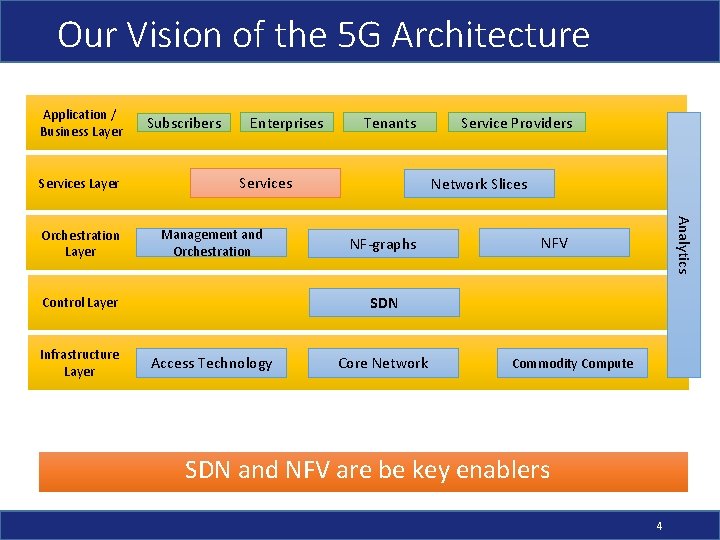
Our Vision of the 5 G Architecture Application / Business Layer Services Layer Enterprises Services Management and Orchestration Service Providers Network Slices NF-graphs NFV SDN Control Layer Infrastructure Layer Tenants Analytics Orchestration Layer Subscribers Access Technology Core Network Commodity Compute SDN and NFV are be key enablers 4
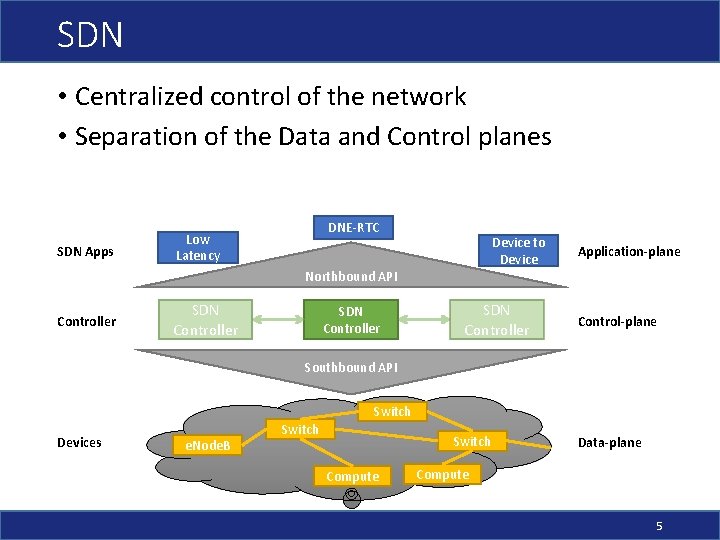
SDN • Centralized control of the network • Separation of the Data and Control planes SDN Apps DNE-RTC Low Latency Device to Device Northbound API Controller SDN Controller Application-plane Control-plane Southbound API Switch Devices e. Node. B Switch Compute Data-plane Compute 5
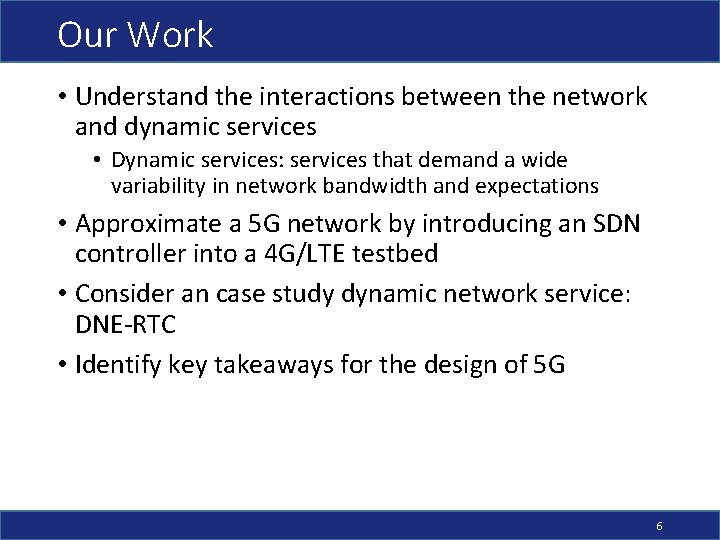
Our Work • Understand the interactions between the network and dynamic services • Dynamic services: services that demand a wide variability in network bandwidth and expectations • Approximate a 5 G network by introducing an SDN controller into a 4 G/LTE testbed • Consider an case study dynamic network service: DNE-RTC • Identify key takeaways for the design of 5 G 6
Outline • Motivation • 5 G Architecture • OTT-RTC and NE-RTC • DNE-RTC: a dynamic network service • The 4 G/LTE Network • Our proof of concept Implementation • Takeaways 7
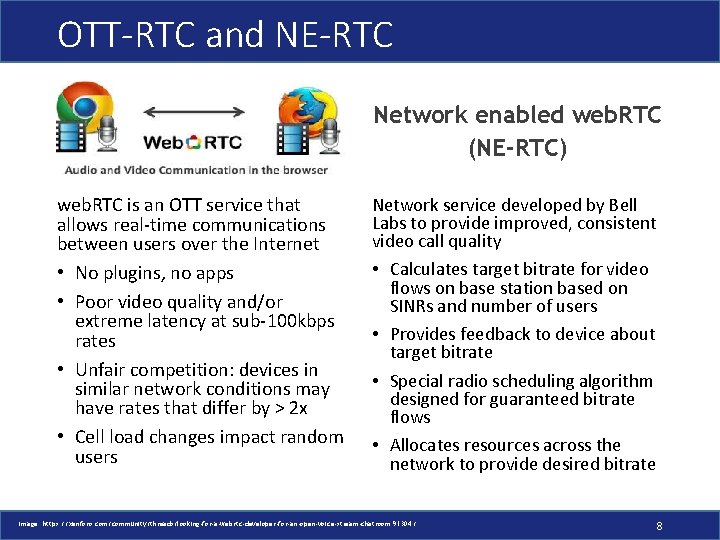
OTT-RTC and NE-RTC Network enabled web. RTC (NE-RTC) web. RTC is an OTT service that allows real-time communications between users over the Internet • No plugins, no apps • Poor video quality and/or extreme latency at sub-100 kbps rates • Unfair competition: devices in similar network conditions may have rates that differ by > 2 x • Cell load changes impact random users Network service developed by Bell Labs to provide improved, consistent video call quality • Calculates target bitrate for video flows on base station based on SINRs and number of users • Provides feedback to device about target bitrate • Special radio scheduling algorithm designed for guaranteed bitrate flows • Allocates resources across the network to provide desired bitrate Image: https: //xenforo. com/community/threads/looking-for-a-webrtc-developer-for-an-open-voice-stream-chatroom. 91304 / 8
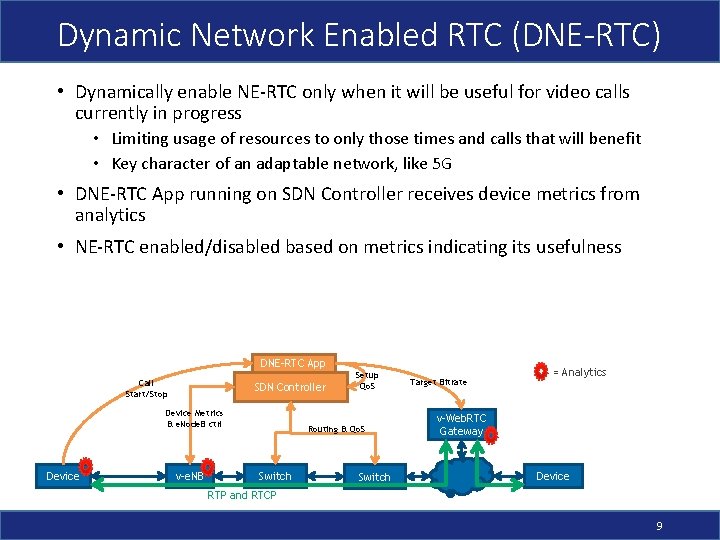
Dynamic Network Enabled RTC (DNE-RTC) • Dynamically enable NE-RTC only when it will be useful for video calls currently in progress • Limiting usage of resources to only those times and calls that will benefit • Key character of an adaptable network, like 5 G • DNE-RTC App running on SDN Controller receives device metrics from analytics • NE-RTC enabled/disabled based on metrics indicating its usefulness DNE-RTC App Call Start/Stop SDN Controller Device Metrics & e. Node. B ctrl Device v-e. NB Setup Qo. S Routing & Qo. S Switch Target Bitrate = Analytics v-Web. RTC Gateway Device RTP and RTCP 9
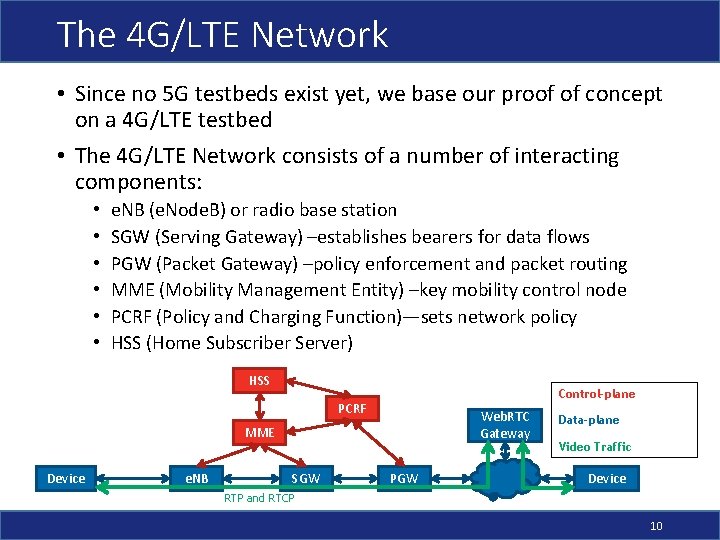
The 4 G/LTE Network • Since no 5 G testbeds exist yet, we base our proof of concept on a 4 G/LTE testbed • The 4 G/LTE Network consists of a number of interacting components: • • • e. NB (e. Node. B) or radio base station SGW (Serving Gateway) –establishes bearers for data flows PGW (Packet Gateway) –policy enforcement and packet routing MME (Mobility Management Entity) –key mobility control node PCRF (Policy and Charging Function)—sets network policy HSS (Home Subscriber Server) HSS Control-plane PCRF Web. RTC Gateway MME Device e. NB SGW PGW Data-plane Video Traffic Device RTP and RTCP 10
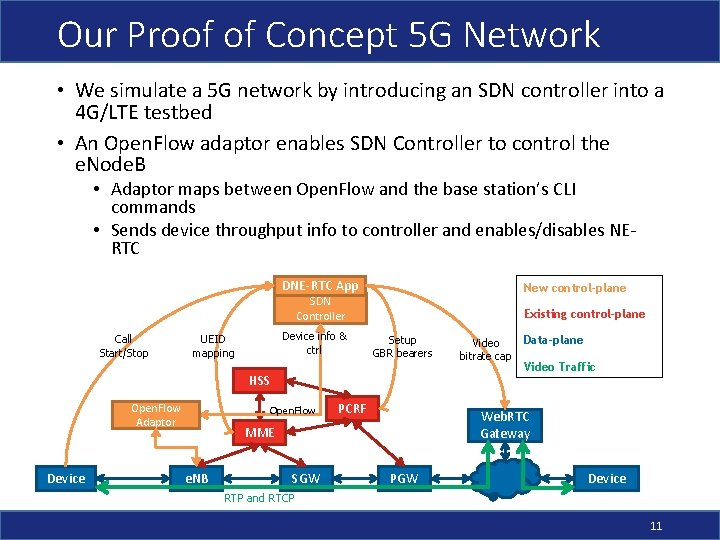
Our Proof of Concept 5 G Network • We simulate a 5 G network by introducing an SDN controller into a 4 G/LTE testbed • An Open. Flow adaptor enables SDN Controller to control the e. Node. B • Adaptor maps between Open. Flow and the base station’s CLI commands • Sends device throughput info to controller and enables/disables NERTC DNE-RTC App New control-plane SDN Controller Call Start/Stop Device info & ctrl UEID mapping Existing control-plane Setup GBR bearers HSS Open. Flow Adaptor Device Open. Flow PCRF SGW Data-plane Video Traffic Web. RTC Gateway MME e. NB Video bitrate cap PGW Device RTP and RTCP 11
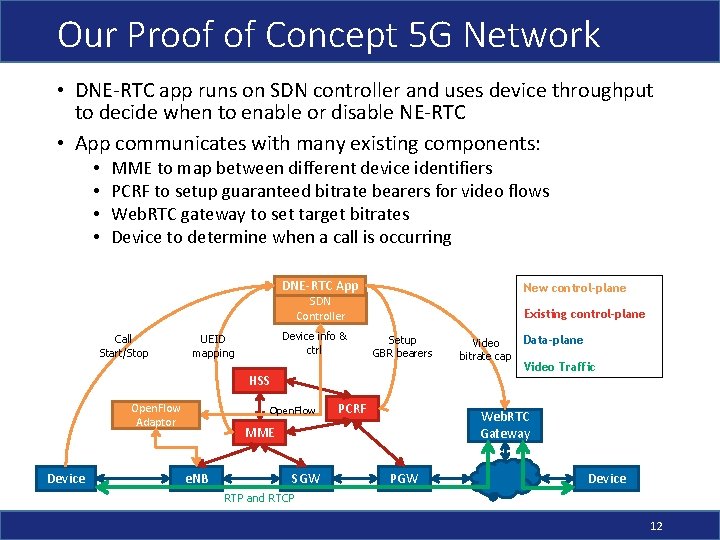
Our Proof of Concept 5 G Network • DNE-RTC app runs on SDN controller and uses device throughput to decide when to enable or disable NE-RTC • App communicates with many existing components: • • MME to map between different device identifiers PCRF to setup guaranteed bitrate bearers for video flows Web. RTC gateway to set target bitrates Device to determine when a call is occurring DNE-RTC App New control-plane SDN Controller Call Start/Stop Device info & ctrl UEID mapping Existing control-plane Setup GBR bearers HSS Open. Flow Adaptor Device Open. Flow PCRF SGW Data-plane Video Traffic Web. RTC Gateway MME e. NB Video bitrate cap PGW Device RTP and RTCP 12
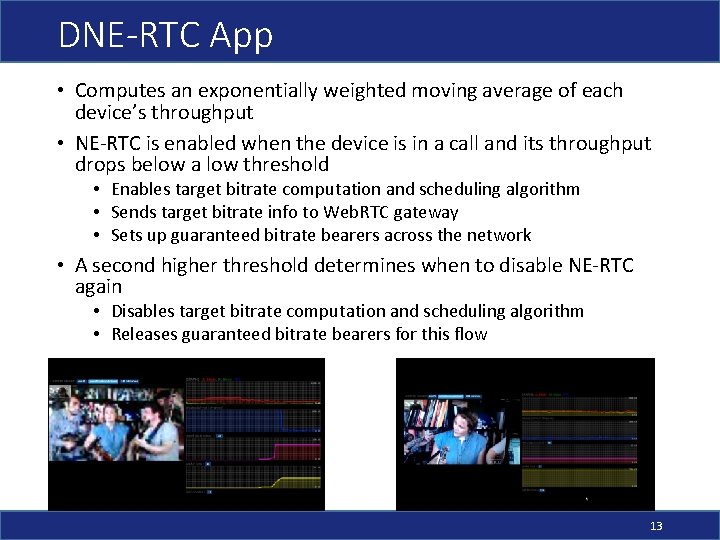
DNE-RTC App • Computes an exponentially weighted moving average of each device’s throughput • NE-RTC is enabled when the device is in a call and its throughput drops below a low threshold • Enables target bitrate computation and scheduling algorithm • Sends target bitrate info to Web. RTC gateway • Sets up guaranteed bitrate bearers across the network • A second higher threshold determines when to disable NE-RTC again • Disables target bitrate computation and scheduling algorithm • Releases guaranteed bitrate bearers for this flow 13
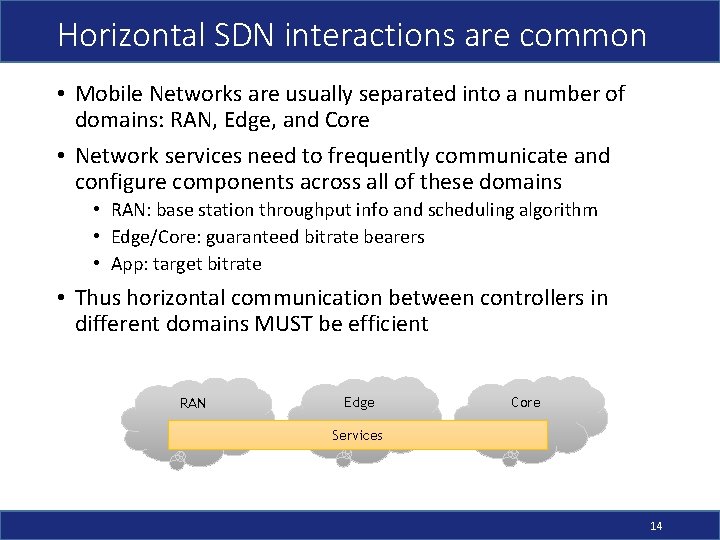
Horizontal SDN interactions are common • Mobile Networks are usually separated into a number of domains: RAN, Edge, and Core • Network services need to frequently communicate and configure components across all of these domains • RAN: base station throughput info and scheduling algorithm • Edge/Core: guaranteed bitrate bearers • App: target bitrate • Thus horizontal communication between controllers in different domains MUST be efficient RAN Edge Core Services 14
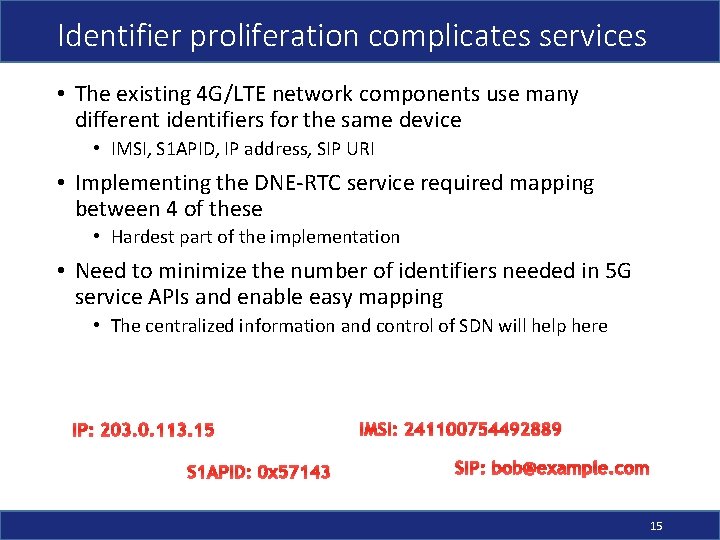
Identifier proliferation complicates services • The existing 4 G/LTE network components use many different identifiers for the same device • IMSI, S 1 APID, IP address, SIP URI • Implementing the DNE-RTC service required mapping between 4 of these • Hardest part of the implementation • Need to minimize the number of identifiers needed in 5 G service APIs and enable easy mapping • The centralized information and control of SDN will help here IP: 203. 0. 113. 15 S 1 APID: 0 x 57143 IMSI: 241100754492889 SIP: bob@example. com 15
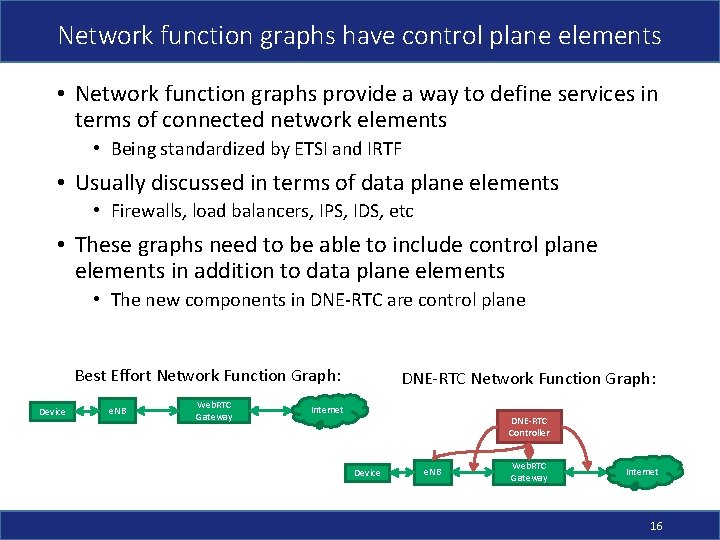
Network function graphs have control plane elements • Network function graphs provide a way to define services in terms of connected network elements • Being standardized by ETSI and IRTF • Usually discussed in terms of data plane elements • Firewalls, load balancers, IPS, IDS, etc • These graphs need to be able to include control plane elements in addition to data plane elements • The new components in DNE-RTC are control plane Best Effort Network Function Graph: Device e. NB Web. RTC Gateway DNE-RTC Network Function Graph: Internet DNE-RTC Controller Device e. NB Web. RTC Gateway Internet 16
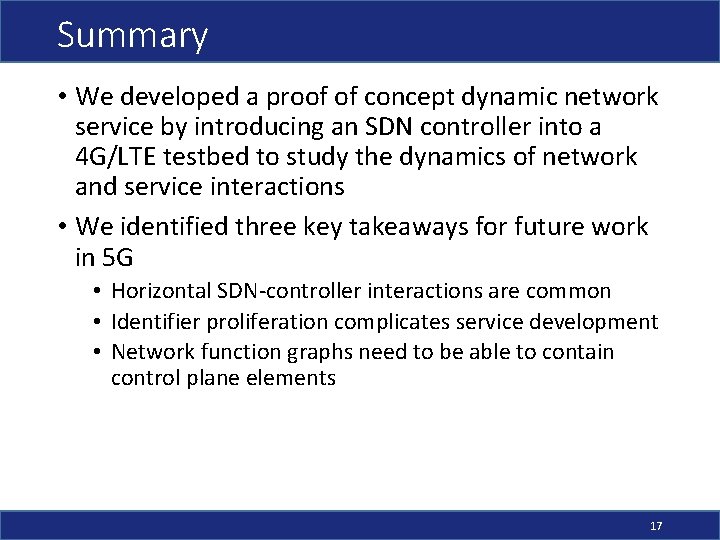
Summary • We developed a proof of concept dynamic network service by introducing an SDN controller into a 4 G/LTE testbed to study the dynamics of network and service interactions • We identified three key takeaways for future work in 5 G • Horizontal SDN-controller interactions are common • Identifier proliferation complicates service development • Network function graphs need to be able to contain control plane elements 17
Questions? ? ? || /* */ 18