
Dynamic Component Substitutability Analysis Edmund Clarke Natasha Sharygina
Dynamic Component Substitutability Analysis Edmund Clarke Natasha Sharygina* Nishant Sinha Carnegie Mellon University The University of Lugano
Motivation • Model checking is a highly time consuming, labor intensive effort • For example, a system of 25 components (~20 K LOC) and 100+ properties might take up to a month of verification effort • Discourages its widespread use when system evolves
Software Evolution • Software evolution is inevitable in any real system: – Changing requirements – Bug fixes – Product changes (underlying platform, thirdparty, etc. )
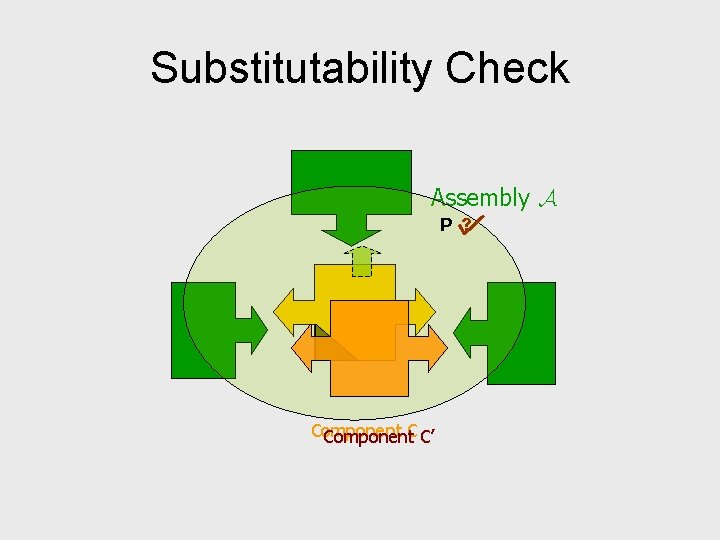
Substitutability Check Assembly A P ? Component. C C’
Motivation • Component-based Software – Software modules shipped by separate developers – Undergo several updates/bug-fixes during their lifecycle • Component assembly verification – Necessary on upgrade of any component – High costs of complete global verification – Instead check for substitutability of new component
Substitutability Check • Incremental in nature • Two phases: – Containment check • All local behaviors (services) of the previous component contained in new one – Compatibility check • Safety with respect to other components in assembly: all global specifications still hold
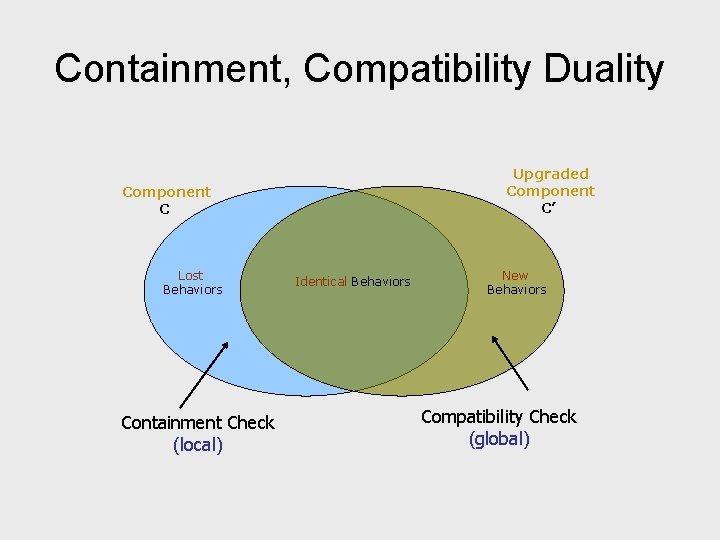
Containment, Compatibility Duality Upgraded Component C’ Component C Lost Behaviors Containment Check (local) Identical Behaviors New Behaviors Compatibility Check (global)
Substitutability Check • Approaches – Obtain a finite behavioral model of all components by abstraction: Labeled Kripke structures – Containment: • Use under- and over- approximations – Compatibility: • Use dynamic assume-guarantee reasoning
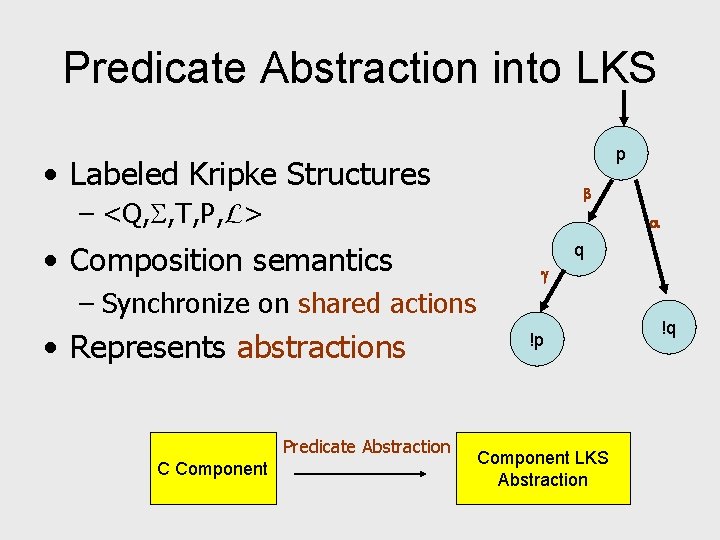
Predicate Abstraction into LKS p • Labeled Kripke Structures – <Q, , T, P, L> • Composition semantics q – Synchronize on shared actions • Represents abstractions Predicate Abstraction C Component !p Component LKS Abstraction !q
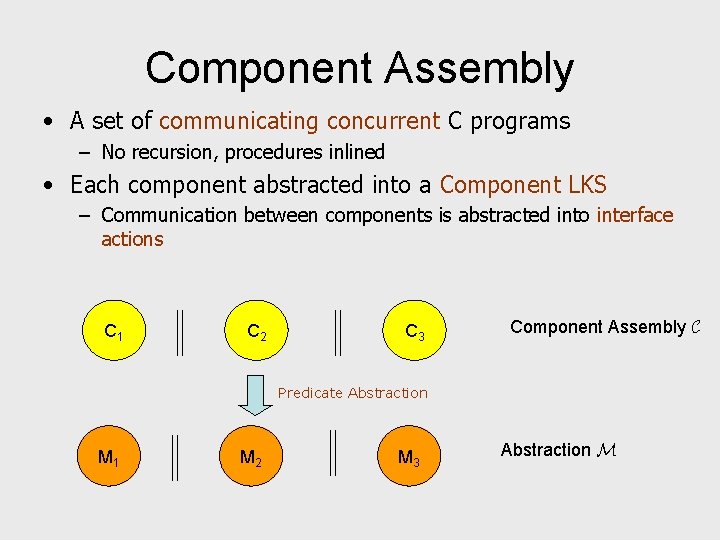
Component Assembly • A set of communicating concurrent C programs – No recursion, procedures inlined • Each component abstracted into a Component LKS – Communication between components is abstracted into interface actions C 1 C 2 C 3 Component Assembly C Predicate Abstraction M 1 M 2 M 3 Abstraction M
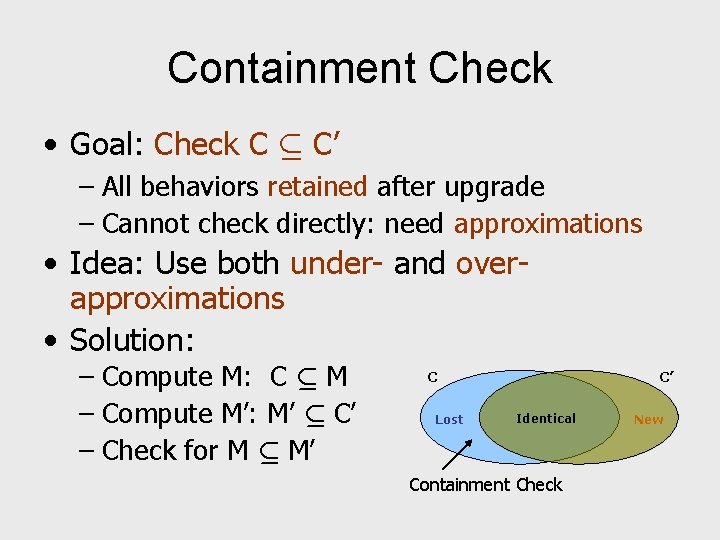
Containment Check • Goal: Check C µ C’ – All behaviors retained after upgrade – Cannot check directly: need approximations • Idea: Use both under- and overapproximations • Solution: – Compute M: C µ M – Compute M’: M’ µ C’ – Check for M µ M’ C Lost C’ Identical Containment Check New
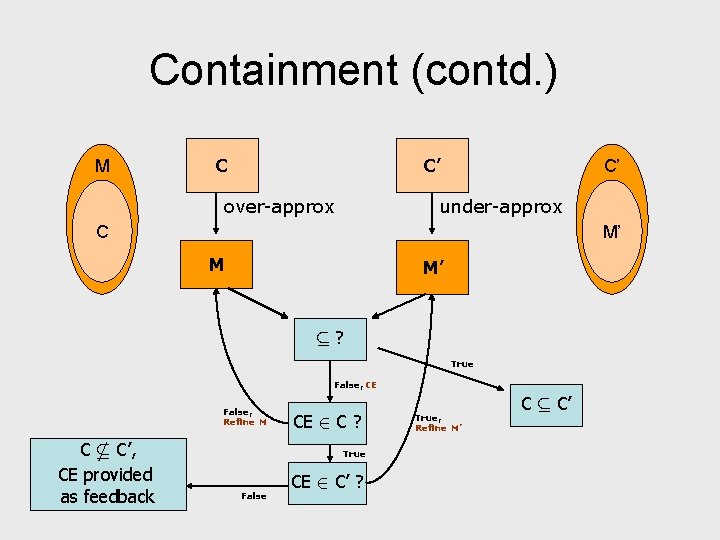
Containment (contd. ) M C C’ over-approx C’ under-approx C M’ M M’ µ? True False, CE False, Refine M C * C’, CE provided as feedback CE 2 C ? True False CE 2 C’ ? True, Refine M’ C µ C’
Containment (contd. ) • Computing over-approximation – Conventional predicate abstraction • Computing under-approximation – Modified predicate abstraction – Compute Must transitions instead of May
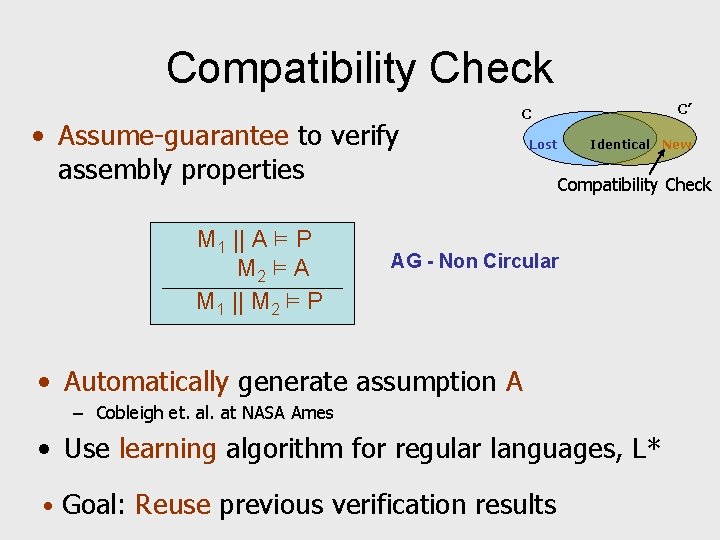
Compatibility Check • Assume-guarantee to verify assembly properties M 1 || A ² P M 2 ² A M 1 || M 2 ² P C’ C Lost Identical New Compatibility Check AG - Non Circular • Automatically generate assumption A – Cobleigh et. al. at NASA Ames • Use learning algorithm for regular languages, L* • Goal: Reuse previous verification results
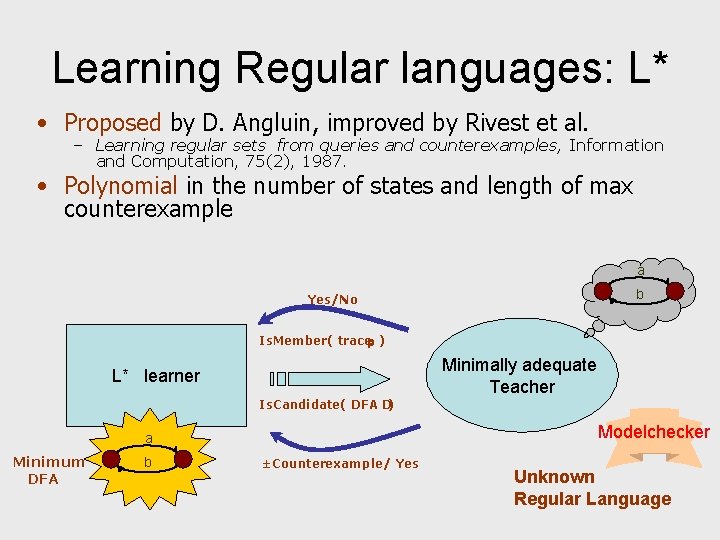
Learning Regular languages: L* • Proposed by D. Angluin, improved by Rivest et al. – Learning regular sets from queries and counterexamples, Information and Computation, 75(2), 1987. • Polynomial in the number of states and length of max counterexample a b Yes/No Is. Member( trace ) Minimally adequate Teacher L* learner Is. Candidate( DFA D) Modelchecker a Minimum DFA b ±Counterexample/ Yes Unknown Regular Language
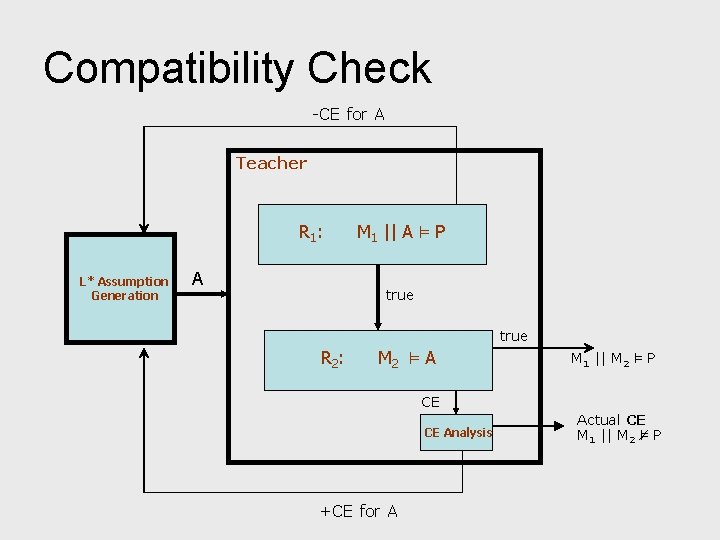
Compatibility Check -CE for A Teacher R 1 : L* Assumption Generation A M 1 || A ² P true R 2 : M 2 ² A M 1 || M 2 ² P CE CE Analysis +CE for A Actual CE M 1 || M 2 2 P
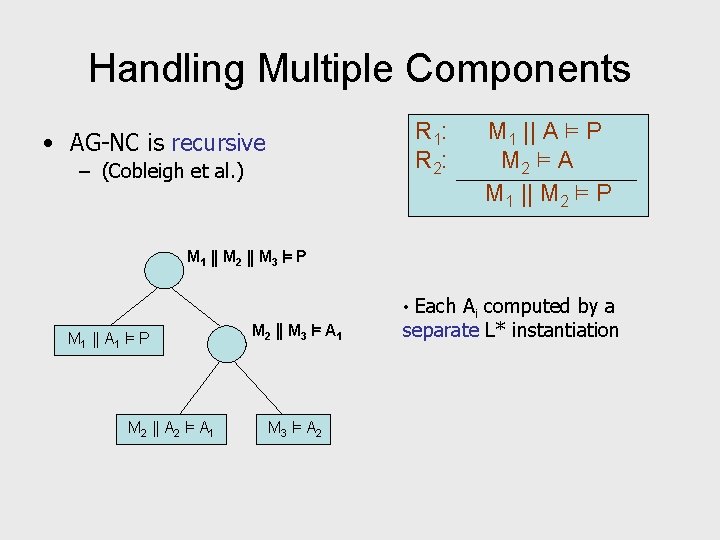
Handling Multiple Components R 1: R 2: • AG-NC is recursive – (Cobleigh et al. ) M 1 || A ² P M 2 ² A M 1 || M 2 ² P M 1 k M 2 k M 3 ² P M 1 k A 1 ² P M 2 k A 2 ² A 1 M 2 k M 3 ² A 1 M 3 ² A 2 • Each Ai computed by a separate L* instantiation
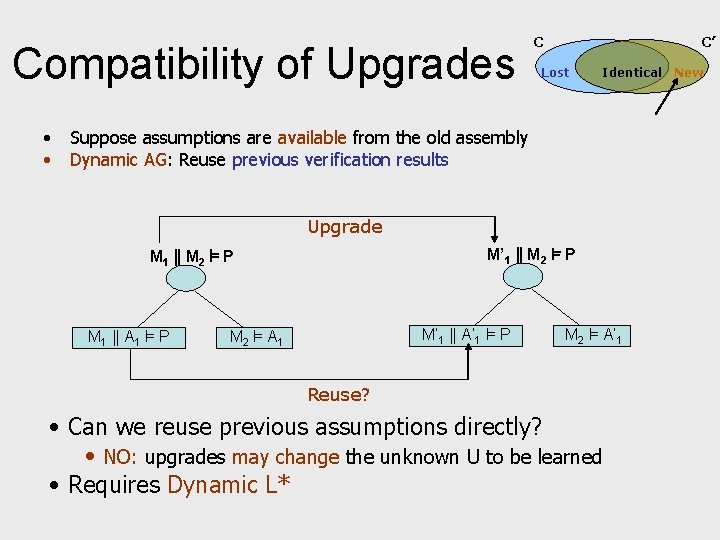
Compatibility of Upgrades • • C C’ Lost Identical New Suppose assumptions are available from the old assembly Dynamic AG: Reuse previous verification results Upgrade M’ 1 k M 2 ² P M 1 k A 1 ² P M’ 1 k A’ 1 ² P M 2 ² A 1 M 2 ² A’ 1 Reuse? • Can we reuse previous assumptions directly? • NO: upgrades may change the unknown U to be learned • Requires Dynamic L*
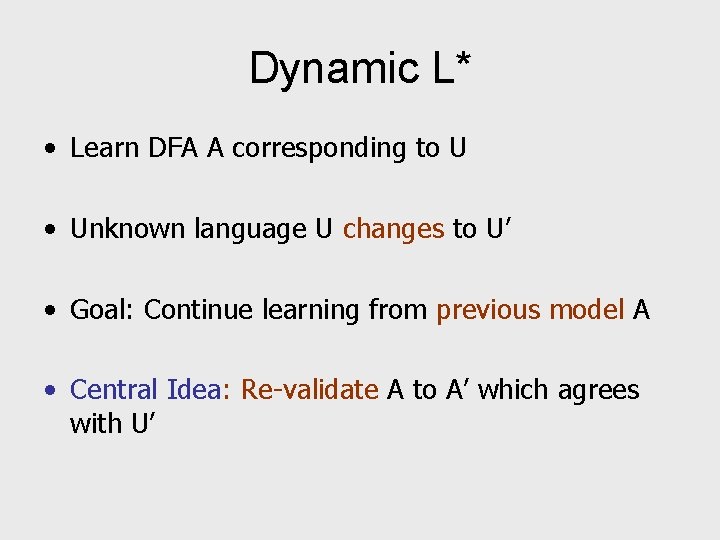
Dynamic L* • Learn DFA A corresponding to U • Unknown language U changes to U’ • Goal: Continue learning from previous model A • Central Idea: Re-validate A to A’ which agrees with U’
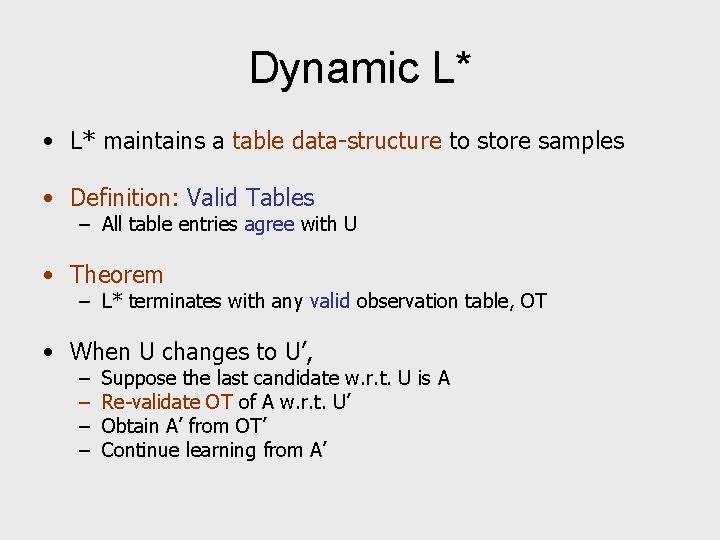
Dynamic L* • L* maintains a table data-structure to store samples • Definition: Valid Tables – All table entries agree with U • Theorem – L* terminates with any valid observation table, OT • When U changes to U’, – – Suppose the last candidate w. r. t. U is A Re-validate OT of A w. r. t. U’ Obtain A’ from OT’ Continue learning from A’
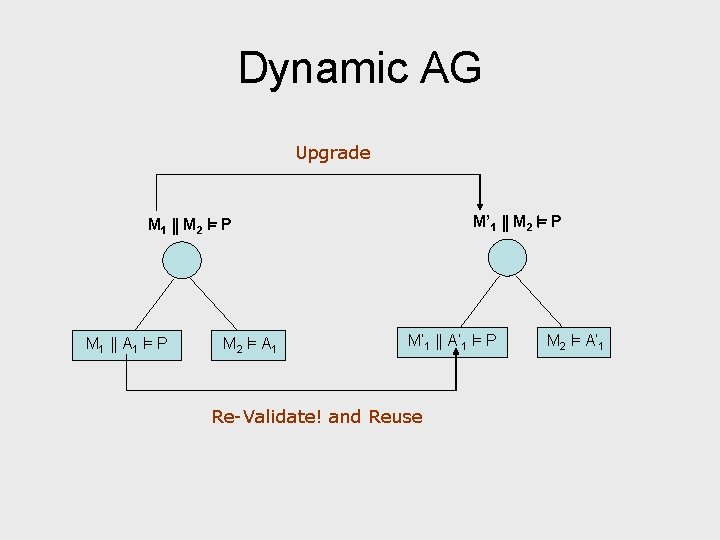
Dynamic AG Upgrade M’ 1 k M 2 ² P M 1 k A 1 ² P M 2 ² A 1 M’ 1 k A’ 1 ² P Re-Validate! and Reuse M 2 ² A’ 1
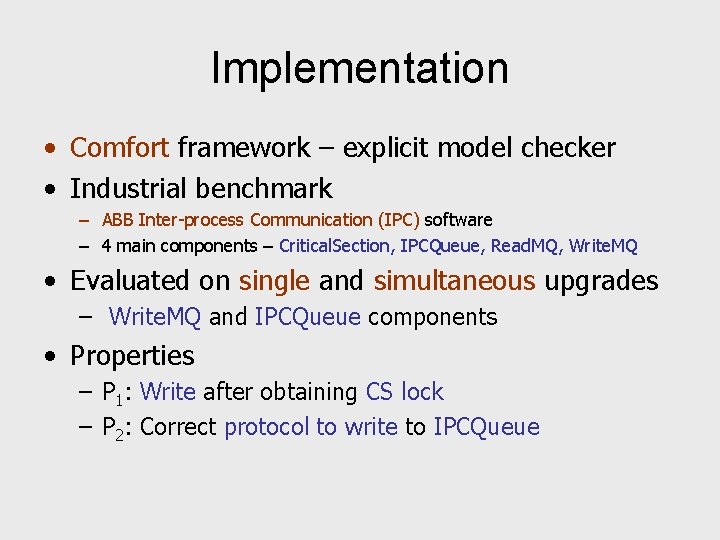
Implementation • Comfort framework – explicit model checker • Industrial benchmark – ABB Inter-process Communication (IPC) software – 4 main components – Critical. Section, IPCQueue, Read. MQ, Write. MQ • Evaluated on single and simultaneous upgrades – Write. MQ and IPCQueue components • Properties – P 1: Write after obtaining CS lock – P 2: Correct protocol to write to IPCQueue
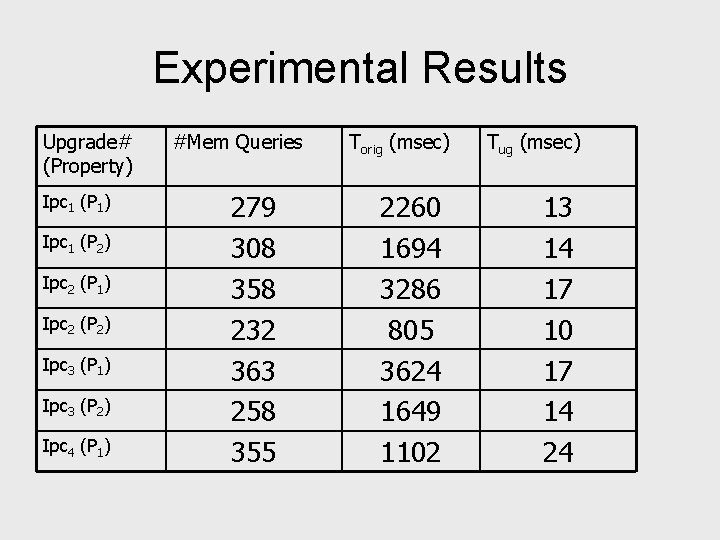
Experimental Results Upgrade# (Property) Ipc 1 (P 1) Ipc 1 (P 2) Ipc 2 (P 1) Ipc 2 (P 2) Ipc 3 (P 1) Ipc 3 (P 2) Ipc 4 (P 1) #Mem Queries 279 308 358 232 363 258 355 Torig (msec) 2260 1694 3286 805 3624 1649 1102 Tug (msec) 13 14 17 10 17 14 24
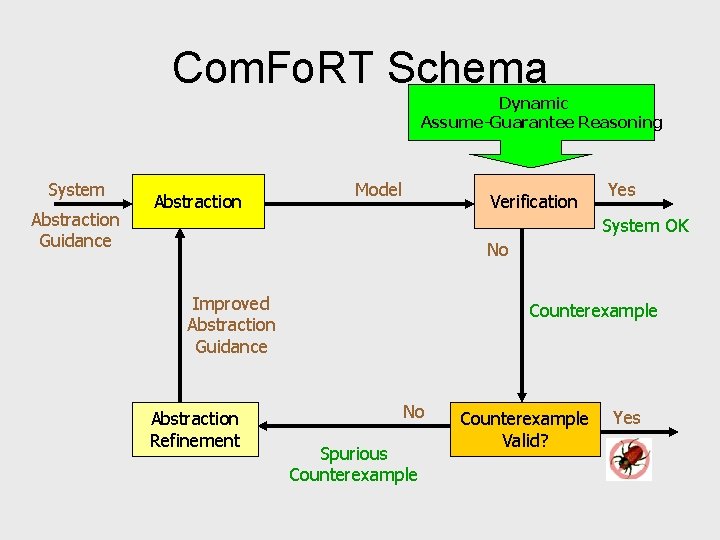
Com. Fo. RT Schema Dynamic Assume-Guarantee Reasoning System Abstraction Guidance Abstraction Model Verification Yes System OK No Improved Abstraction Guidance Abstraction Refinement Counterexample No Spurious Counterexample Valid? Yes
Conclusion • Automated Substitutability Checking – Containment and Compatibility – Reuses previous verification results – Handles multiple upgrades – Built upon CEGAR framework • Implementation – Com. Fo. RT framework – Promising results on an industrial example
Future Directions • Symbolic analysis, i. e. , using SATABS • Assume-Guarantee for Liveness • Other AG Rules, e. g. , Circular • Combining static analysis with dynamic testing for facilitate abstraction and learning

Ph. D. position is open • New EU project on verification of evolving networked software – Collaboration with IBM, ABB, VTT, Uni Milano and Oxford
- Slides: 27