
Dynamic Capabilities and Strategic Management David J Teece
Dynamic Capabilities and Strategic Management David J. Teece, Gary Pisano and Amy Shuen (1997) Strategic Management Journal, Vol. 18: 7 509 -533.
Focus, Methods and Motivation of This Paper �Focus: How do firms achieve and sustain competitive advantage? �Motivation: Strategic theory replete with analyses of firmlevel strategies for sustaining and safeguarding extent competitive advantage. Not enough research on how and why firms build competitive advantage in regimes of rapid change. (Question: Is asking “Why” on existing theory a way to develop new topic? ) �Methods: Develop the dynamic capabilities approach; approach relevant in a Schumpeterian world of innovationbased competition, price/performance rivalry, increasing
Notes about the Methods �Joseph Alois Schumpeter (8 February 1883 – 8 January 1950)was an Austrian-American economist and political scientist. He popularized the term "creative destruction" in economics. �Creative destruction is a term originally derived from Marxist Economic Theory which refers to the linked processes of the accumulation and annihilation [ə'naɪəleɪt] of wealth under capitalism. �Important work: Evolutionary economics History of Economic Analysis Business cycles Schumpeter and Keynesianism Schumpeter and capitalism's demise Schumpeter and democratic theory Schumpeter and entrepreneurship Schumpeter and Innovation
Structure of This Paper �Review of Existing and Accepted Framework �Dynamic Capabilities Framework �Conclusions �Future Research
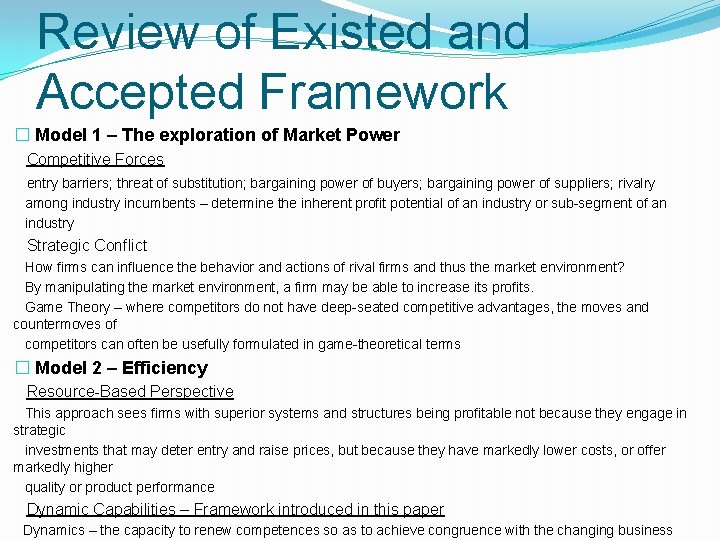
Review of Existed and Accepted Framework � Model 1 – The exploration of Market Power Competitive Forces entry barriers; threat of substitution; bargaining power of buyers; bargaining power of suppliers; rivalry among industry incumbents – determine the inherent profit potential of an industry or sub-segment of an industry Strategic Conflict How firms can influence the behavior and actions of rival firms and thus the market environment? By manipulating the market environment, a firm may be able to increase its profits. Game Theory – where competitors do not have deep-seated competitive advantages, the moves and countermoves of competitors can often be usefully formulated in game-theoretical terms � Model 2 – Efficiency Resource-Based Perspective This approach sees firms with superior systems and structures being profitable not because they engage in strategic investments that may deter entry and raise prices, but because they have markedly lower costs, or offer markedly higher quality or product performance Dynamic Capabilities – Framework introduced in this paper Dynamics – the capacity to renew competences so as to achieve congruence with the changing business
Framework of “Dynamic Capabilities Framework” �Terminology �Market and Strategic Capabilities �Process, Positions and Paths �Reliability and Imitatability of Organizational Process and Positions (Prof. , in the paper, it is written imitatability, but why it is not in google? )
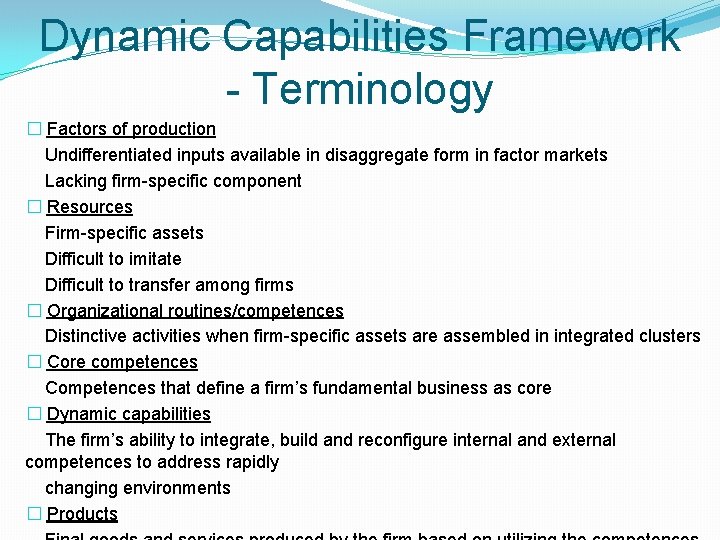
Dynamic Capabilities Framework - Terminology � Factors of production Undifferentiated inputs available in disaggregate form in factor markets Lacking firm-specific component � Resources Firm-specific assets Difficult to imitate Difficult to transfer among firms � Organizational routines/competences Distinctive activities when firm-specific assets are assembled in integrated clusters � Core competences Competences that define a firm’s fundamental business as core � Dynamic capabilities The firm’s ability to integrate, build and reconfigure internal and external competences to address rapidly changing environments � Products
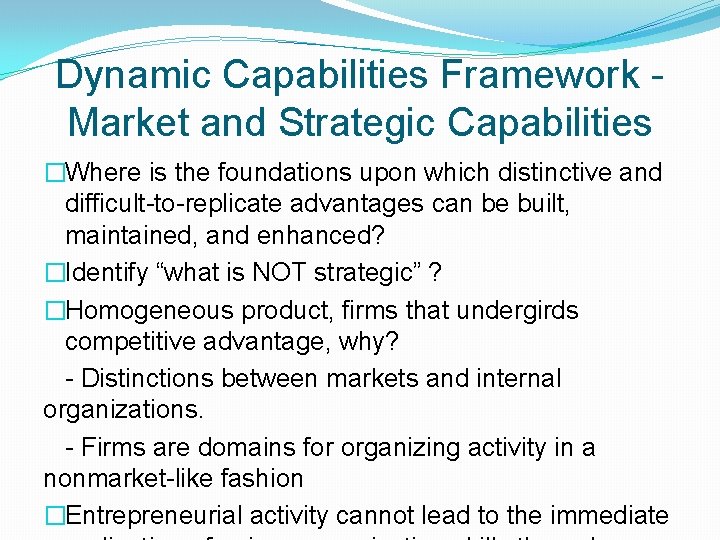
Dynamic Capabilities Framework - Market and Strategic Capabilities �Where is the foundations upon which distinctive and difficult-to-replicate advantages can be built, maintained, and enhanced? �Identify “what is NOT strategic” ? �Homogeneous product, firms that undergirds competitive advantage, why? - Distinctions between markets and internal organizations. - Firms are domains for organizing activity in a nonmarket-like fashion �Entrepreneurial activity cannot lead to the immediate
Dynamic Capabilities Framework – Process of the (Process, Positions and Paths) Organizational and Managerial Processes �Coordination/integration (a static concept) Internal and external Often display high levels of coherence The frequent failure of incumbents to introduce new technologies results from the mismatch of organizational processes �Learning (a dynamic concept) A process by which repetition and experimentation enable tasks to be performed better and quicker, and enables new production opportunities to be identified �Reconfiguration and transformation Firms must develop process to minimize low pay-off The ability to scan the environment, to evaluate markets and competitors, to quickly accomplish reconfiguration and transformation ahead of competition
Dynamic Capabilities Framework – Position of the (Process, Positions and Paths) �Positions Technological assets: Ownership protection and utilization of technology assets are key differentiators among firms Complementary assets: Typically lie downstream Financial assets: what a firm can do in short order = F(Balance Sheet) Reputational assets: a summarize of infor. about firms and Structural assets: The formal/informal structure of organizations Institutional assets: Public policy; institution a critical element of the business environment Market (structure) assets: Product market position, important but often overplayed
Dynamic Capabilities Framework – Paths of the (Process, Positions and Paths) Paths �Path dependencies – F(current position, the path ahead) 1, “History matters. 2, Learning is a process of trial, feedback and evaluation. transaction and production specific past investments and routines constrain the firm’s future behavior 3, The “lock-in” degree caused by switching cost = F(user learning, repidity of tech change; amount of ferment in the competitive environment, etc. ) �Technological opportunities Tech opportunities not completely exogenous to industry; can be firmspecific; firms looking at different choices �Assessment
Reliability and Imitatability of Organizational Process and Positions �Reliability 1, Involves transferring or redeploying competences from one concrete economic setting to another. 2, Competences and capabilities and the routines they rest on, are difficult to replicate. 3, Routines and competences - attributable to local or regional forces that shape firms’ capabilities at early stages in their lives 4, Two types of strategic value flow from replication: a) the ability to support geographic and product line expansion b) the indication that the firm has the foundations in place for learning and improvement �Imitation
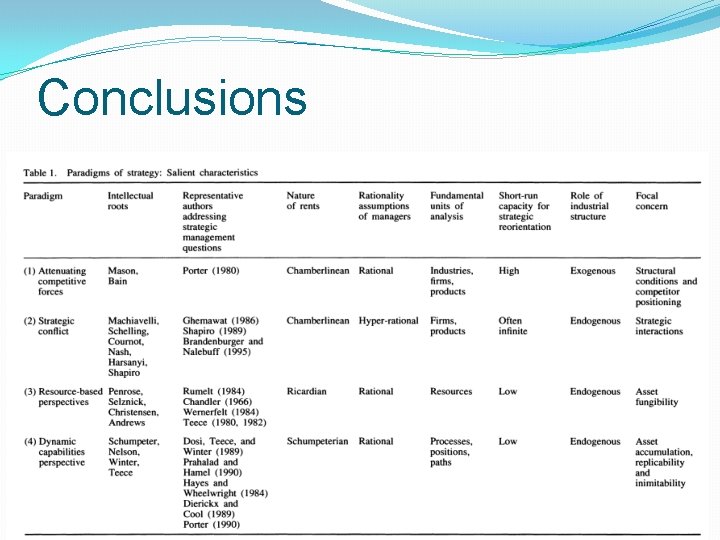
Conclusions
Conclusions Efficiency vs. Market Power � Except in special circumstances, too much “Strategizing” can lead firms to underinvest in core competences and neglect dynamic capabilities and thus harm long-term competitiveness. Normative Implications: capabilities approach tends to steer managers toward creating distinctive and difficult to imitate advantages and avoiding games with customers and competitors � Unit of Analysis and Analytic focus - in capabilities/ resources/ conflict framework, strategy analysis must be situational. � Strategic Change – Competitive/conflict framework see strategic choice occurring with relative facility � Entry Strategy – “Resources/ capabilities framework” “entry decision” “competences, capabilities and competition ” � Entry Timing - “Resources/ capabilities framework” “interaction between specialized assets and rivalry”
Future Research �Further theoretical research needed to tighten the framework �Empirical test needed to help people understand how the frameworks �Suggestions from the Author: Strategy researchers cooperate with researchers in the fields of Innovation, Manufacturing, Organizational Behavior and Business History.

- Slides: 16