
Dynamic Aperture Optimization of storage ring based colliders
Dynamic Aperture Optimization of storage ring based colliders with Multi-Objective Algorithm ZHANG, Yuan WANG, Yiwei WANG, Dou GENG, Huiping ICFA Mini-Workshop on Dynamic Aperture of Circular Accelerator, 1 -3 November 2017, IHEP, Beijing, China Many Thanks: J. Qiang(LBNL), K. Oide(KEK), D. Zhou(KEK)
Outline • Introduction • Algorithm • Application • Summary

Multi-objective genetic algorithm (MOGA) • Application in storage ring based light source is very popular and successful • APS/DLS, ELEGANT, M. Borland, Workshop on Future Light Sources in 48 th ICFA Beam Dynamics • NSLSII,L. Yang, Y. Li, W. Guo and S. Krinsky, 054001 (2011) • SLS, BMAD, M. Ehrlichman , ar. Xiv: 1603. 02459 • HEPS, Accelerator Toolbox, Y. Jiao and G. Xu, • … PRST-AB, 14,
Different Algorithm • Particle Swarm, SPEAR 3, X. Huang, J. Safranek, NIMA 757, 48, 2014 • Differential Evolution, J. Qiang et al. , IPAC’ 13 • Downhill Simplex, Super. KEKB, FCC, K. Oide et al. • …….
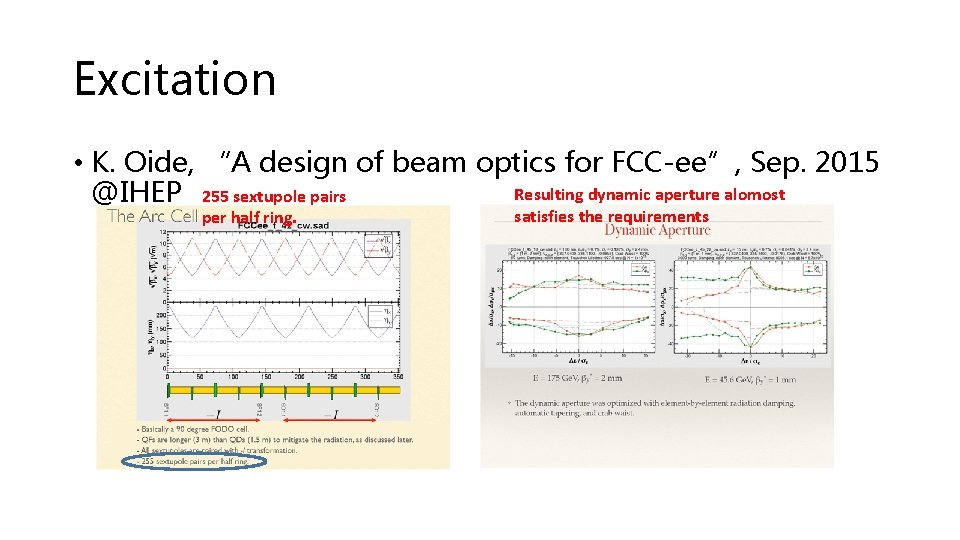
Excitation • K. Oide, “A design of beam optics for FCC-ee”, Sep. 2015 Resulting dynamic aperture alomost @IHEP 255 sextupole pairs per half ring. satisfies the requirements
Why we did the job? • We need to optimize the DA of CEPC • We want to try the direct DA optimization in collider, just as the community has done in light source • Different optimization algorithm is worth to be tried • SAD(http: //acc-physics. kek. jp/sad/) is used for the DA determination. It is a parallel code, but the scalability is not very good. A MPI-based parallel code to call SAD will be much more efficient.
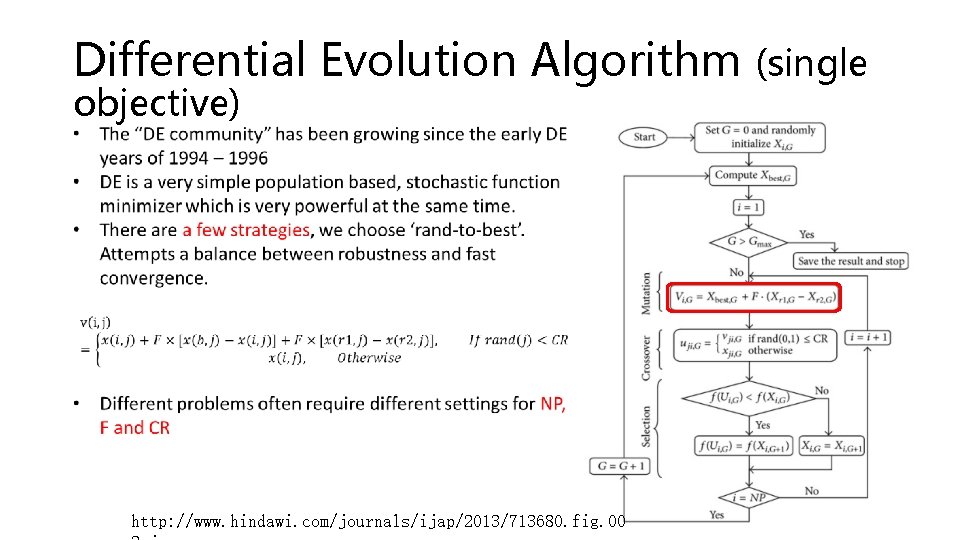
Differential Evolution Algorithm (single objective) http: //www. hindawi. com/journals/ijap/2013/713680. fig. 00

Multi-objective Optimization • Most problems in nature have several (possibly conflicting) objectives to be satisfied. • Many of these problems are frequently treated as singleobjective optimization problems by transforming all but one objective into constraints. • The term optimize means finding such a solution which would give the values of all the objective functions acceptable to the decision maker. Kung et al. , J. ACM 22, 4 (Oct. 1975), 469 -476 Giuseppe Narzisi, “Multi-Objective Optimization”, 2008
MODE: Multi-Objective optimization by Differential Evolution The parallel algorithm is referencing to J. Qiang(IPAC’ 13) 1. Initialize the population of parameter vectors 2. Generate the offspring population using the above differential evolution algorithm 3. Find the non-dominated population, which are treated as the best solutions in DE to generate offspring 4. Sorting all the population, select the best NP solution as the parents 5. Return to step 2, if stopping condition not met
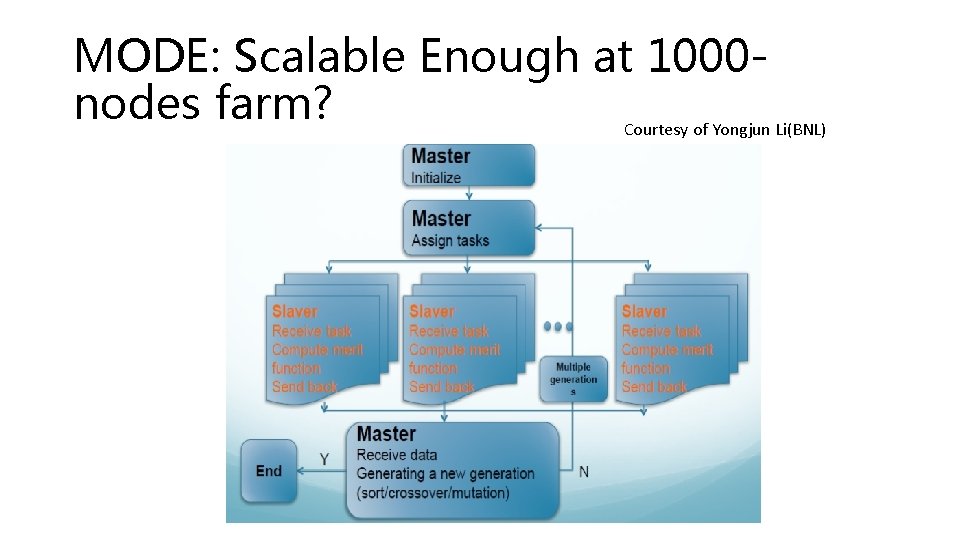
MODE: Scalable Enough at 1000 nodes farm? Courtesy of Yongjun Li(BNL)

New Parallel Paradigm High Parallel + High Scalability • Even the time taken by different task is different • Even some node is very busy
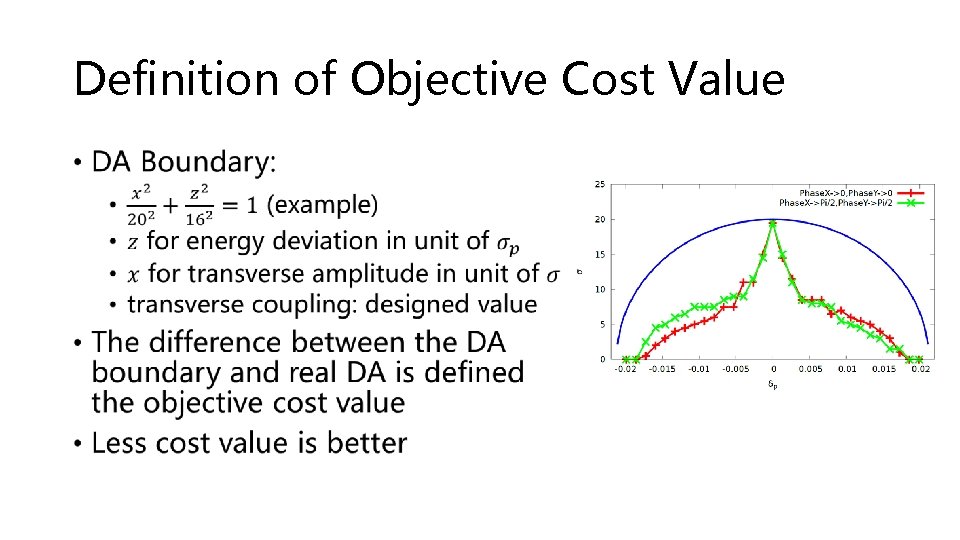
Definition of Objective Cost Value •
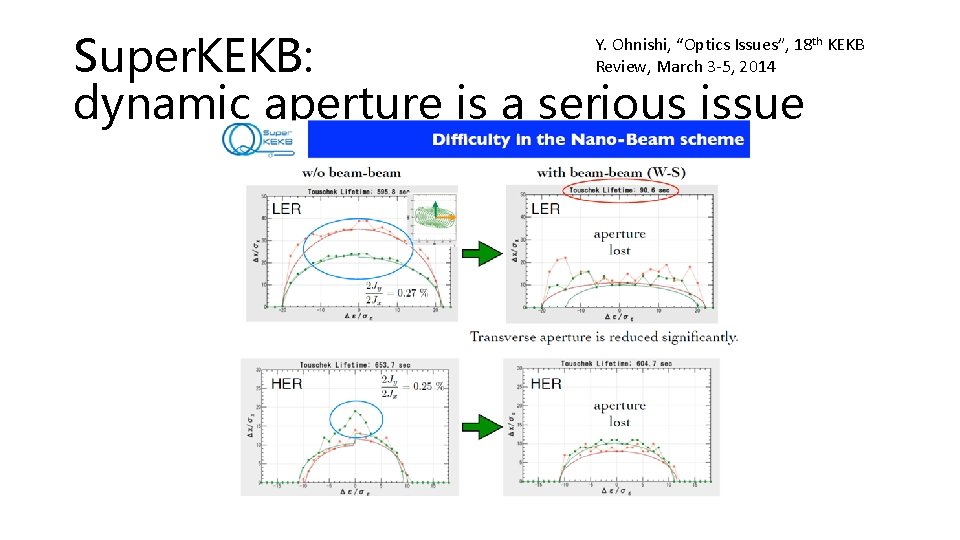
Super. KEKB: dynamic aperture is a serious issue Y. Ohnishi, “Optics Issues”, 18 th KEKB Review, March 3 -5, 2014
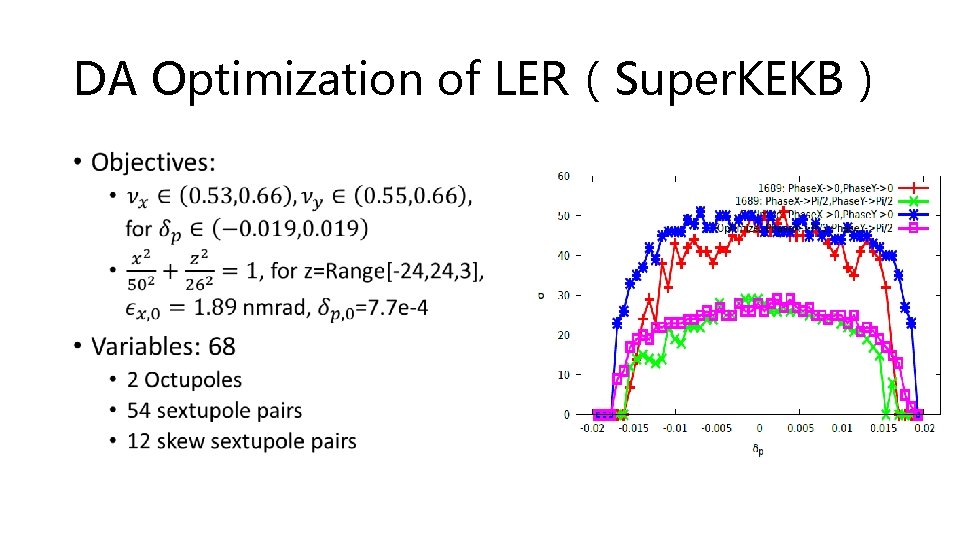
DA Optimization of LER(Super. KEKB) •
CEPC DA Optimization Knobs 50 knobs in total • IR sextupoles: (10) • Arc Sextupole (32) • Phase advance (8)
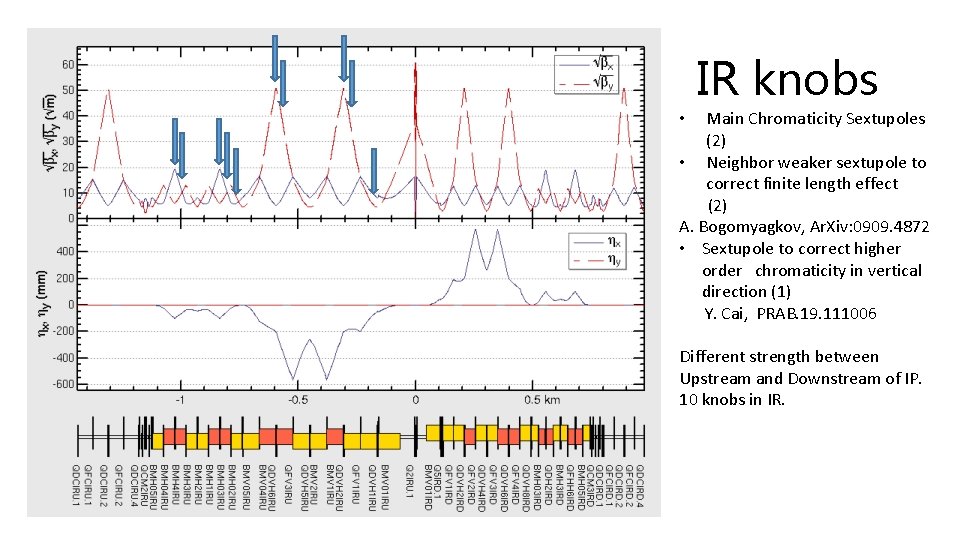
IR knobs Main Chromaticity Sextupoles (2) • Neighbor weaker sextupole to correct finite length effect (2) A. Bogomyagkov, Ar. Xiv: 0909. 4872 • Sextupole to correct higher order chromaticity in vertical direction (1) Y. Cai, PRAB. 19. 111006 • Different strength between Upstream and Downstream of IP. 10 knobs in IR.
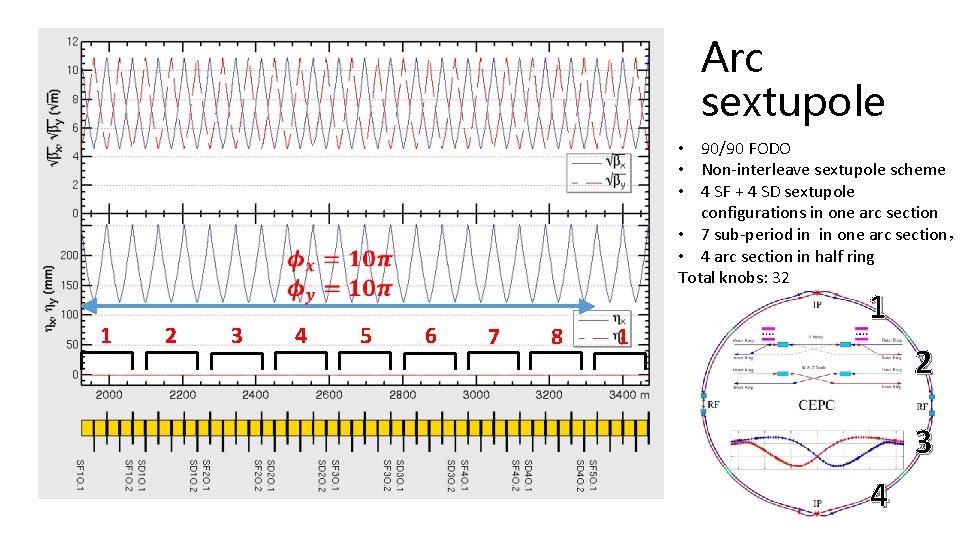
Arc sextupole • 90/90 FODO • Non-interleave sextupole scheme • 4 SF + 4 SD sextupole configurations in one arc section • 7 sub-period in in one arc section, • 4 arc section in half ring Total knobs: 32 1 2 3 4 5 6 7 8 1 1 2 3 4
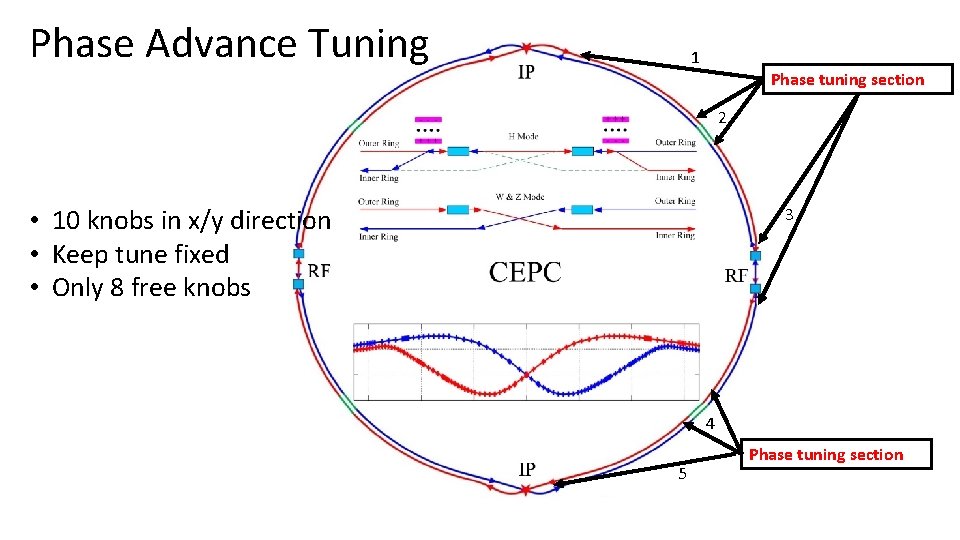
Phase Advance Tuning 1 Phase tuning section 2 • 10 knobs in x/y direction • Keep tune fixed • Only 8 free knobs 3 4 5 Phase tuning section

Contribution from phase advance
Some Try of Speed-up/Optimization Method Brute-force dynamic aperture tracking is very time consuming • More strategy of DE algorithm are randomly selected used • The objective is first eased, for example only track 50 turns instead of 100 or 200 turns. • The time consuming cost function is calculated only when the necessary constraints be satisfied. [ar. Xiv: 1603. 02459] • First try to optimize with less variables, then more variables. • Iteration with non-dominated solution
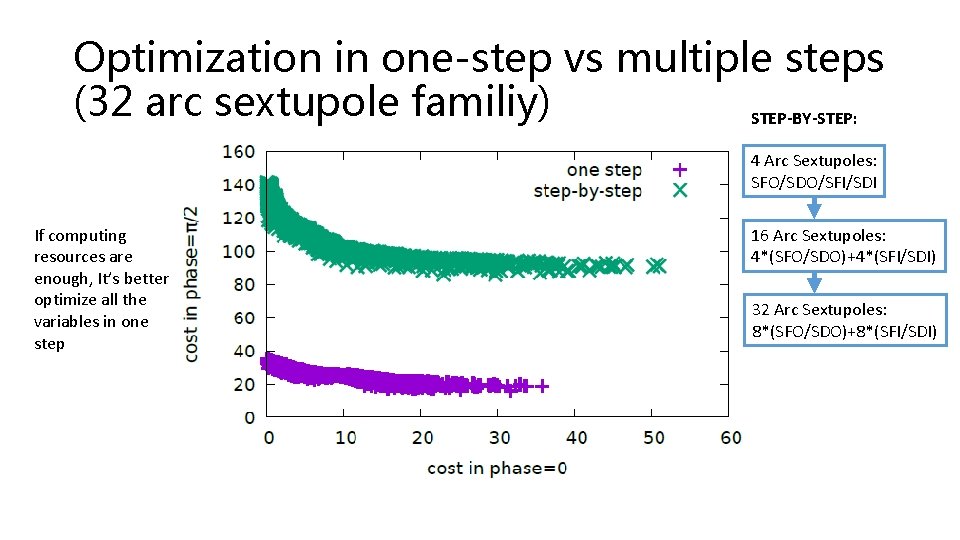
Optimization in one-step vs multiple steps (32 arc sextupole familiy) STEP-BY-STEP: 4 Arc Sextupoles: SFO/SDO/SFI/SDI If computing resources are enough, It’s better optimize all the variables in one step 16 Arc Sextupoles: 4*(SFO/SDO)+4*(SFI/SDI) 32 Arc Sextupoles: 8*(SFO/SDO)+8*(SFI/SDI)
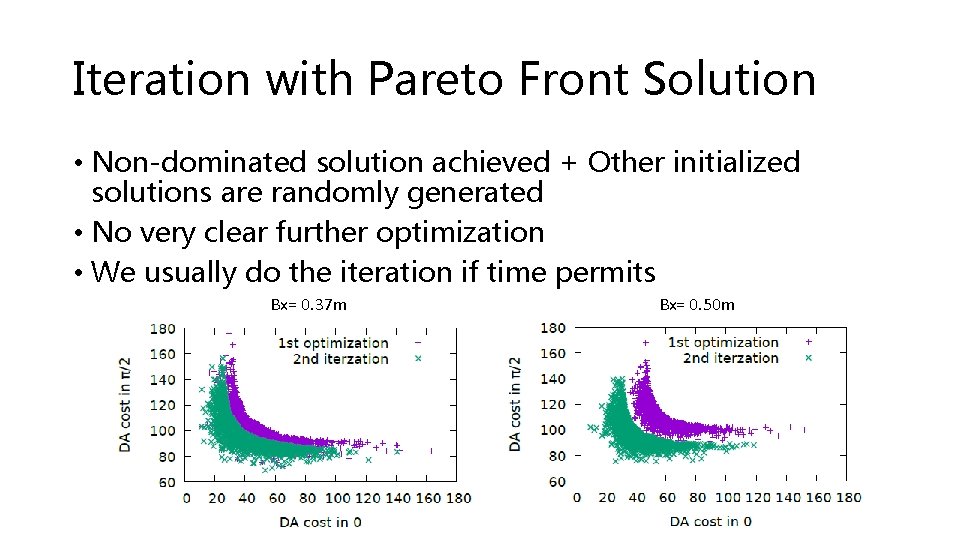
Iteration with Pareto Front Solution • Non-dominated solution achieved + Other initialized solutions are randomly generated • No very clear further optimization • We usually do the iteration if time permits Bx= 0. 37 m Bx= 0. 50 m
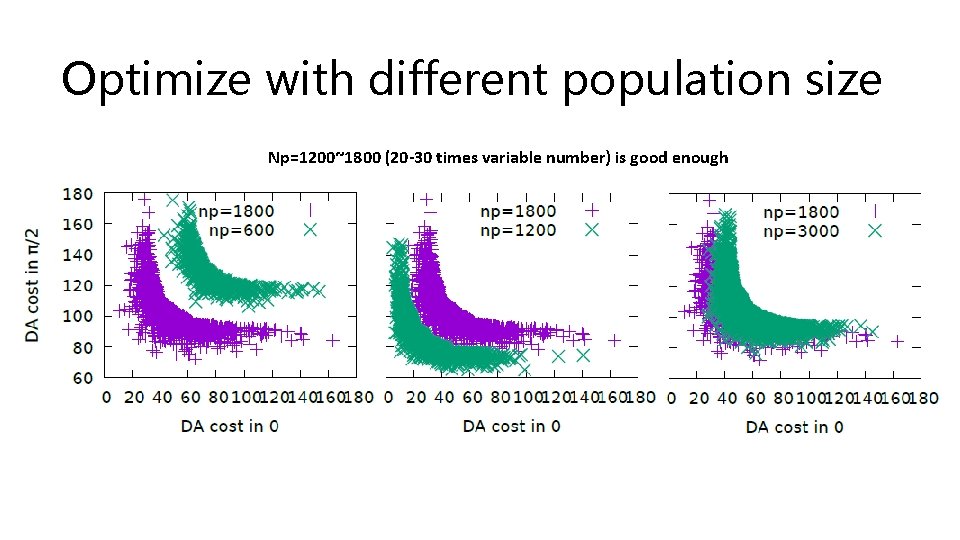
Optimize with different population size Np=1200~1800 (20 -30 times variable number) is good enough
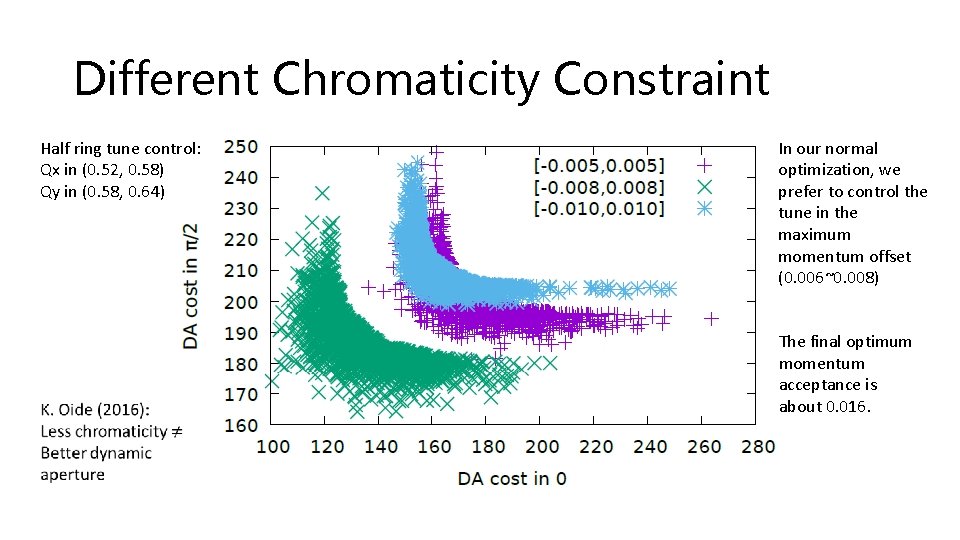
Different Chromaticity Constraint Half ring tune control: Qx in (0. 52, 0. 58) Qy in (0. 58, 0. 64) In our normal optimization, we prefer to control the tune in the maximum momentum offset (0. 006~0. 008) The final optimum momentum acceptance is about 0. 016.

Bx=0. 17 m Bx=0. 37 m
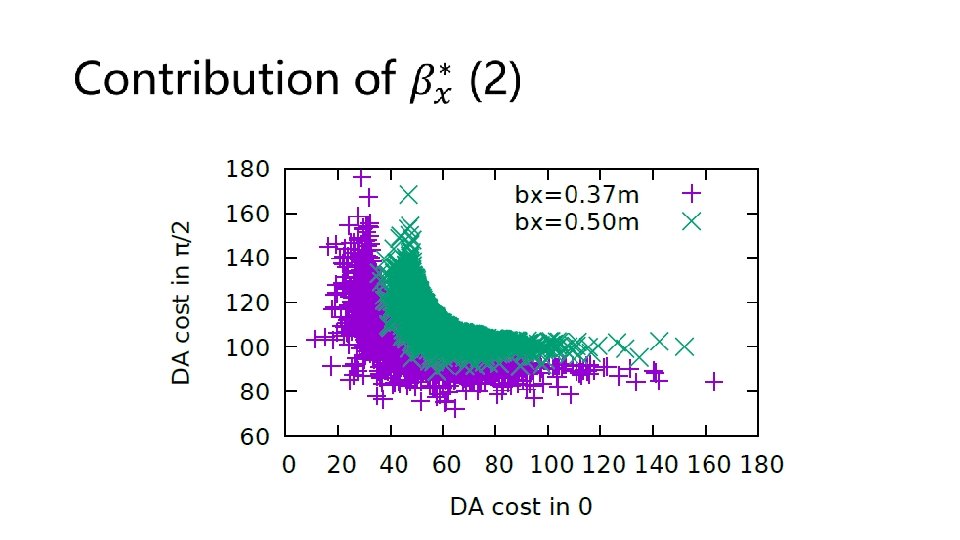

More sextupole configurations
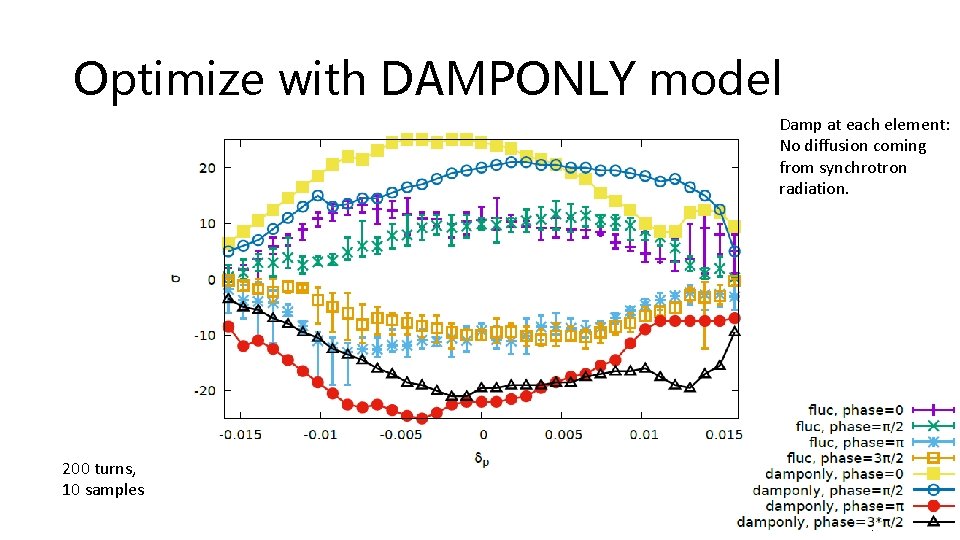
Optimize with DAMPONLY model Damp at each element: No diffusion coming from synchrotron radiation. 200 turns, 10 samples
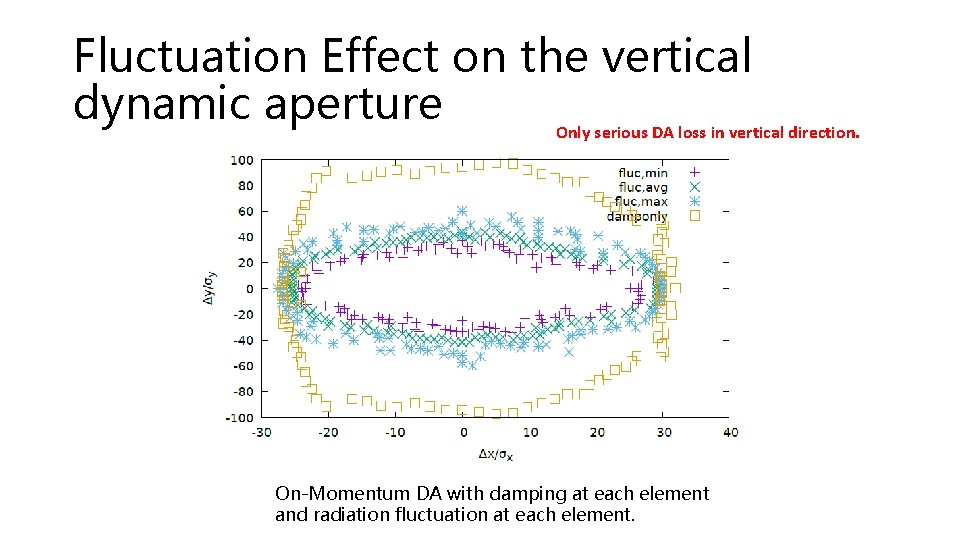
Fluctuation Effect on the vertical dynamic aperture Only serious DA loss in vertical direction. On-Momentum DA with damping at each element and radiation fluctuation at each element.
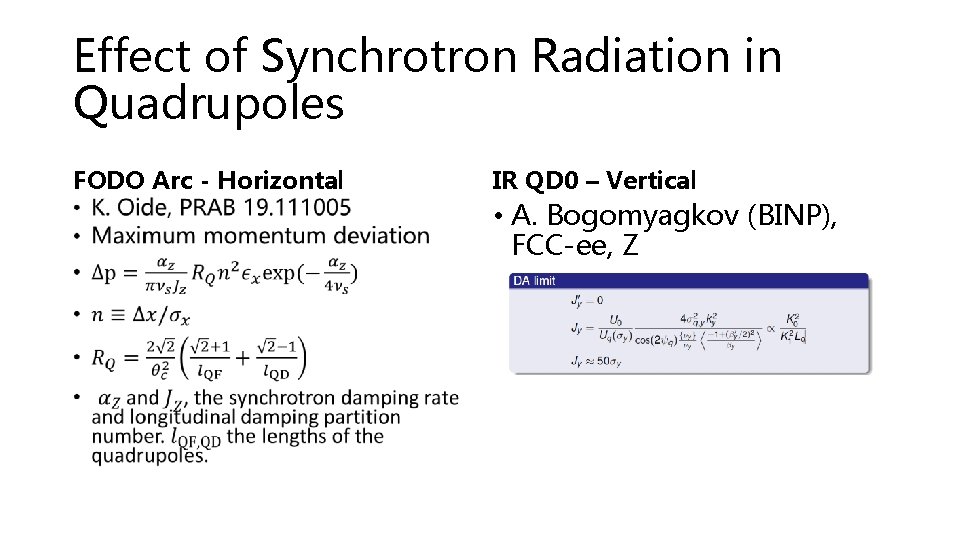
Effect of Synchrotron Radiation in Quadrupoles FODO Arc - Horizontal IR QD 0 – Vertical • • A. Bogomyagkov (BINP), FCC-ee, Z
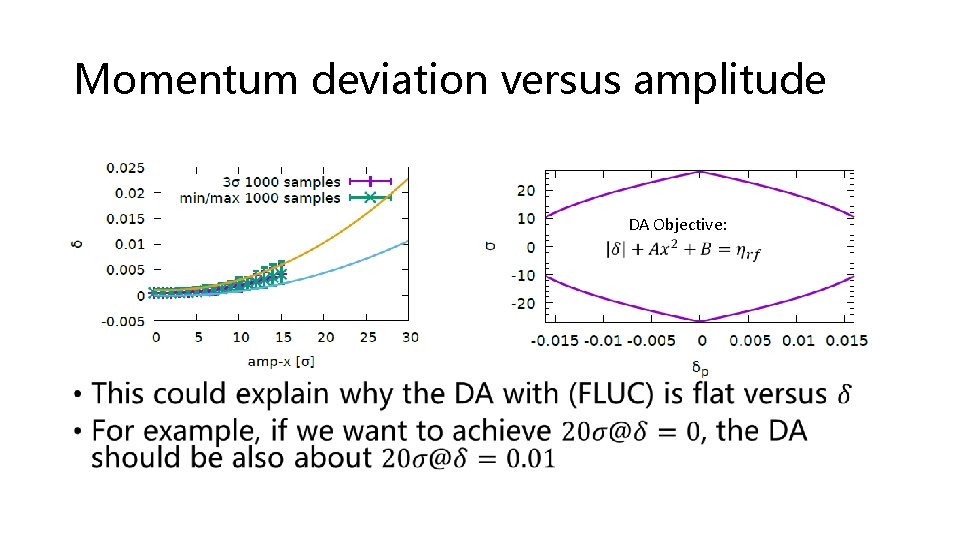
Momentum deviation versus amplitude DA Objective: •
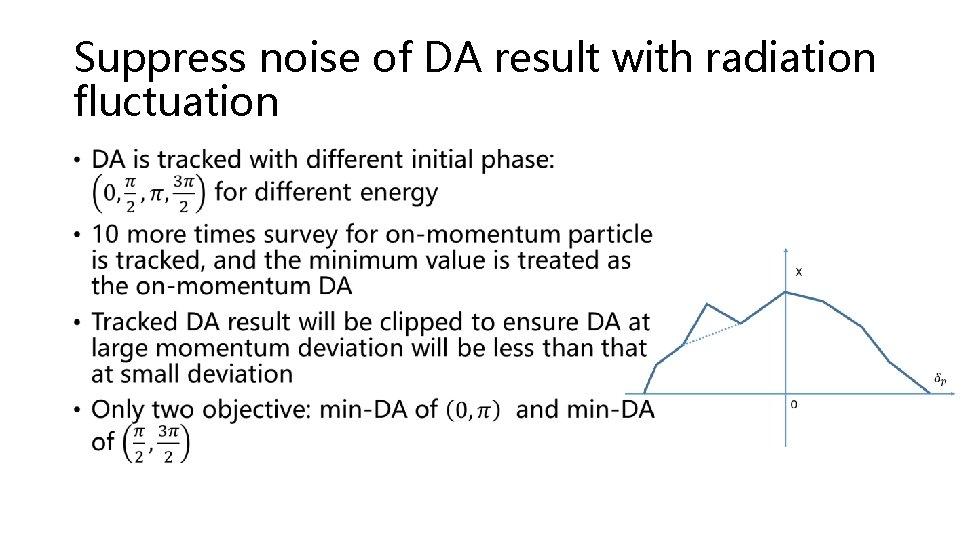
Suppress noise of DA result with radiation fluctuation •
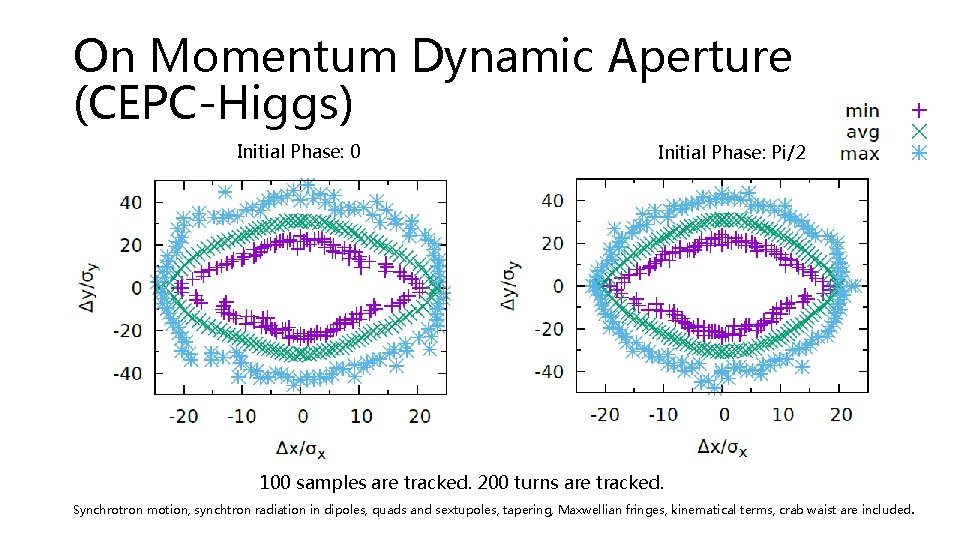
On Momentum Dynamic Aperture (CEPC-Higgs) Initial Phase: 0 Initial Phase: Pi/2 100 samples are tracked. 200 turns are tracked. Synchrotron motion, synchtron radiation in dipoles, quads and sextupoles, tapering, Maxwellian fringes, kinematical terms, crab waist are included.
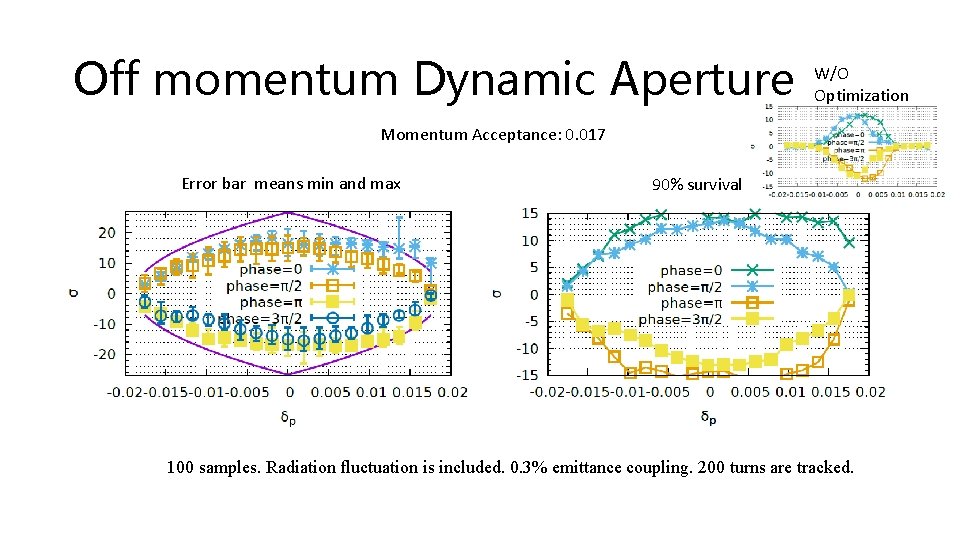
Off momentum Dynamic Aperture W/O Optimization Momentum Acceptance: 0. 017 Error bar means min and max 90% survival 100 samples. Radiation fluctuation is included. 0. 3% emittance coupling. 200 turns are tracked.

Chromaticity
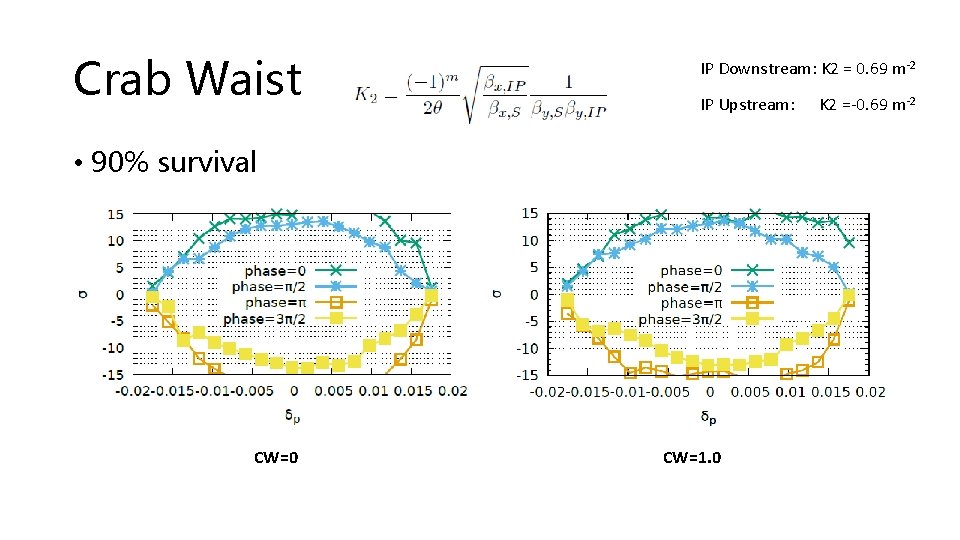
Crab Waist IP Downstream: K 2 = 0. 69 m-2 IP Upstream: • 90% survival CW=0 CW=1. 0 K 2 =-0. 69 m-2

Summary •

• backup
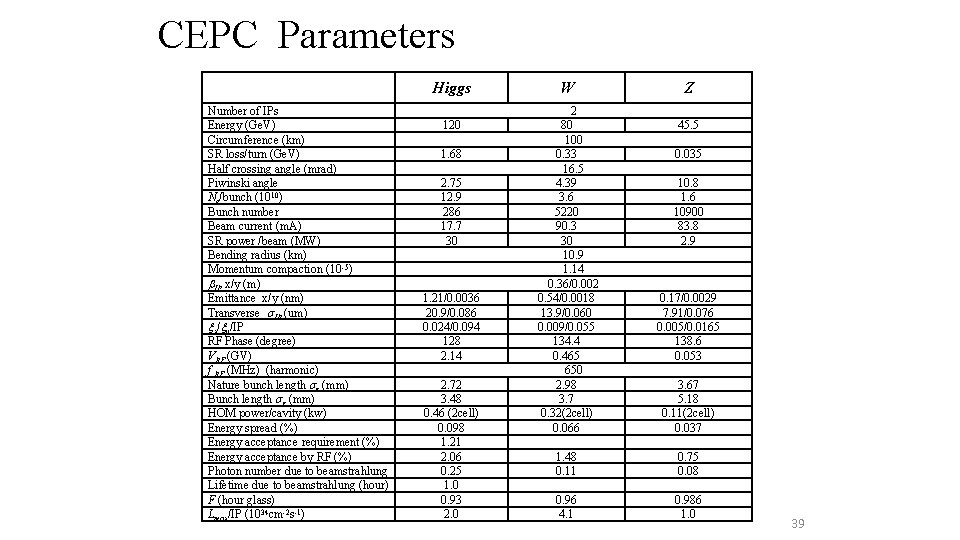
CEPC Parameters Higgs Number of IPs Energy (Ge. V) Circumference (km) SR loss/turn (Ge. V) Half crossing angle (mrad) Piwinski angle Ne/bunch (1010) Bunch number Beam current (m. A) SR power /beam (MW) Bending radius (km) Momentum compaction (10 -5) IP x/y (m) Emittance x/y (nm) Transverse IP (um) x/ y/IP RF Phase (degree) VRF (GV) f RF (MHz) (harmonic) Nature bunch length z (mm) Bunch length z (mm) HOM power/cavity (kw) Energy spread (%) Energy acceptance requirement (%) Energy acceptance by RF (%) Photon number due to beamstrahlung Lifetime due to beamstrahlung (hour) F (hour glass) Lmax/IP (1034 cm-2 s-1) 120 1. 68 2. 75 12. 9 286 17. 7 30 1. 21/0. 0036 20. 9/0. 086 0. 024/0. 094 128 2. 14 2. 72 3. 48 0. 46 (2 cell) 0. 098 1. 21 2. 06 0. 25 1. 0 0. 93 2. 0 W 2 80 100 0. 33 16. 5 4. 39 3. 6 5220 90. 3 30 10. 9 1. 14 0. 36/0. 002 0. 54/0. 0018 13. 9/0. 060 0. 009/0. 055 134. 4 0. 465 650 2. 98 3. 7 0. 32(2 cell) 0. 066 Z 45. 5 0. 035 10. 8 1. 6 10900 83. 8 2. 9 0. 17/0. 0029 7. 91/0. 076 0. 005/0. 0165 138. 6 0. 053 3. 67 5. 18 0. 11(2 cell) 0. 037 1. 48 0. 11 0. 75 0. 08 0. 96 4. 1 0. 986 1. 0 39
- Slides: 39