
Dynamic and Impact Analysis of Aerospace Vehicles Using
- Slides: 25
Dynamic and Impact Analysis of Aerospace Vehicles Using ABAQUS/Explicit Presented at the 2004 FEMCI Workshop NASA/GSFC, Greenbelt, MD Kyle C. Indermuehle Product Management – Aerospace Applications ATA Engineering -- ABAQUS Copyright 2004 ABAQUS, Inc.
Dynamic and Impact Analysis of Aerospace Vehicles using ABAQUS/Explicit Aerospace Vehicles are Complex Systems With Numerous Different Analyses that Need to Be Performed • Aerospace systems are exposed to various loading conditions that all need to be fully analyzed – Static, dynamic, thermal, acoustic, operational • Typical satellite analyses include: – Dynamic analysis for shipping, launch, and operation – Detailed component stress and margin calculations – Mechanism analysis for deployment of solar panels and reflector – Thermal analysis for in-orbit operation • These analyses are typically performed in the linear domain – Often the modal domain for dynamic problems • But, there are some load cases that cannot be analyzed linearly… Copyright 2004 ABAQUS, Inc. 2
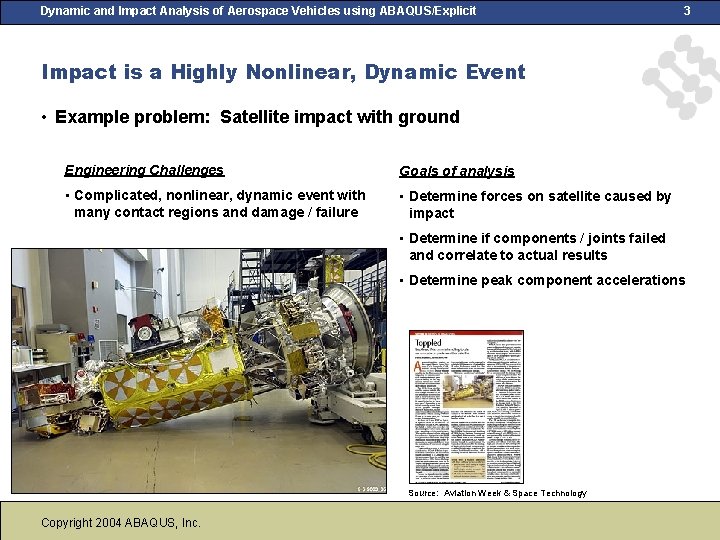
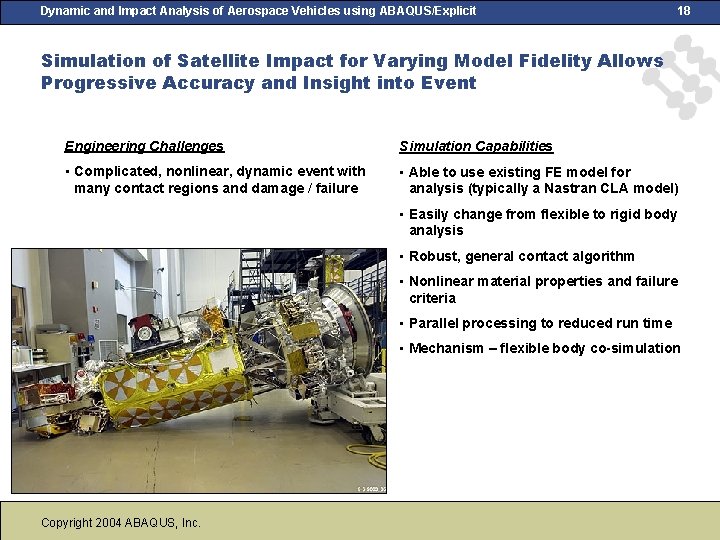
Dynamic and Impact Analysis of Aerospace Vehicles using ABAQUS/Explicit 3 Impact is a Highly Nonlinear, Dynamic Event • Example problem: Satellite impact with ground Engineering Challenges Goals of analysis • Complicated, nonlinear, dynamic event with many contact regions and damage / failure • Determine forces on satellite caused by impact • Determine if components / joints failed and correlate to actual results • Determine peak component accelerations Source: Aviation Week & Space Technology Copyright 2004 ABAQUS, Inc.
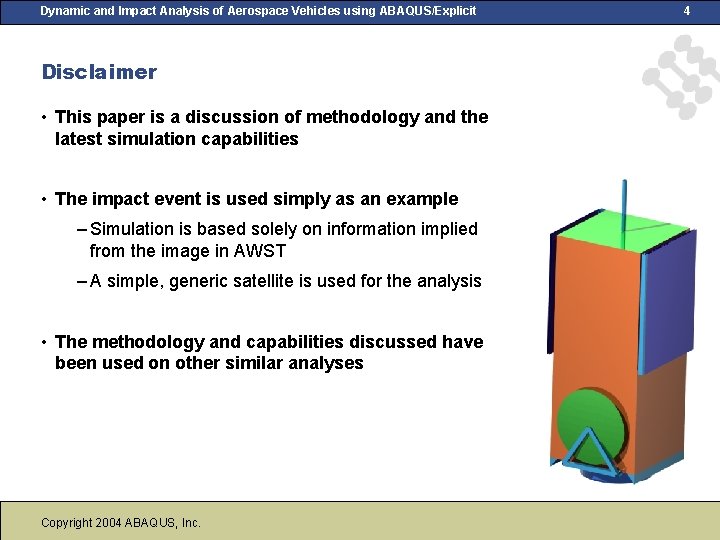
Dynamic and Impact Analysis of Aerospace Vehicles using ABAQUS/Explicit Disclaimer • This paper is a discussion of methodology and the latest simulation capabilities • The impact event is used simply as an example – Simulation is based solely on information implied from the image in AWST – A simple, generic satellite is used for the analysis • The methodology and capabilities discussed have been used on other similar analyses Copyright 2004 ABAQUS, Inc. 4
Dynamic and Impact Analysis of Aerospace Vehicles using ABAQUS/Explicit Methodology for Impact Analysis is to Start Simple and Add Increasing Complexity • Methodology – Perform simple rigid body / mechanism dynamic analysis • Allows for quick insight into event – Perform flexible body impact dynamic analysis • More accurate simulation of true event – Perform flexible body impact analysis with failure models • Accounting for joint / material failure further increases accuracy of simulation • Workflow – Translate NASTRAN FEM to ABAQUS – Perform rigid body / mechanism dynamic analysis – Perform flexible body dynamic analysis using ABAQUS /Explicit – Perform flexible body analysis with failure using ABAQUS /Explicit Copyright 2004 ABAQUS, Inc. 5
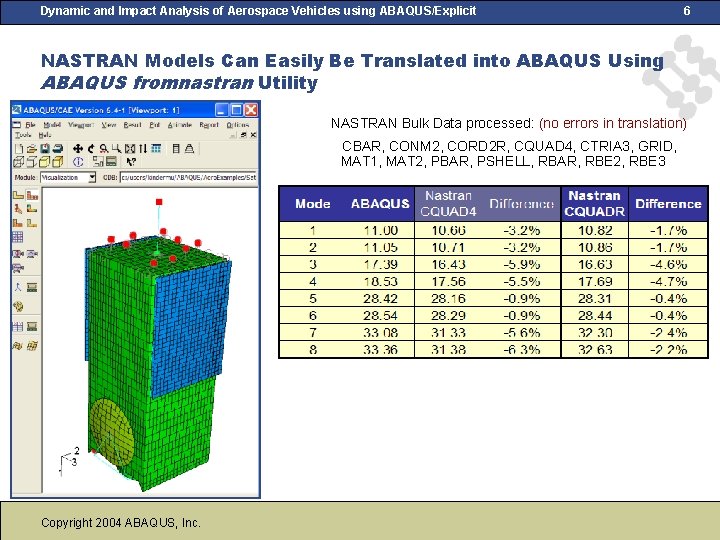
Dynamic and Impact Analysis of Aerospace Vehicles using ABAQUS/Explicit 6 NASTRAN Models Can Easily Be Translated into ABAQUS Using ABAQUS fromnastran Utility NASTRAN Bulk Data processed: (no errors in translation) CBAR, CONM 2, CORD 2 R, CQUAD 4, CTRIA 3, GRID, MAT 1, MAT 2, PBAR, PSHELL, RBAR, RBE 2, RBE 3 Copyright 2004 ABAQUS, Inc.
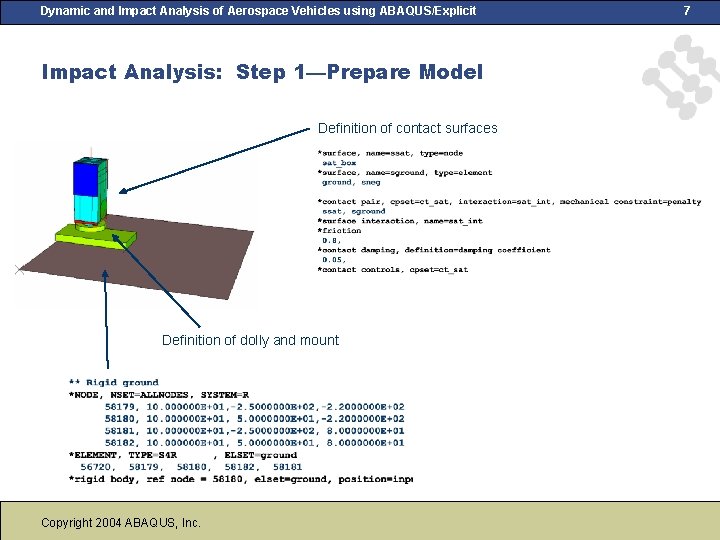
Dynamic and Impact Analysis of Aerospace Vehicles using ABAQUS/Explicit Impact Analysis: Step 1—Prepare Model Definition of contact surfaces Definition of dolly and mount Copyright 2004 ABAQUS, Inc. 7
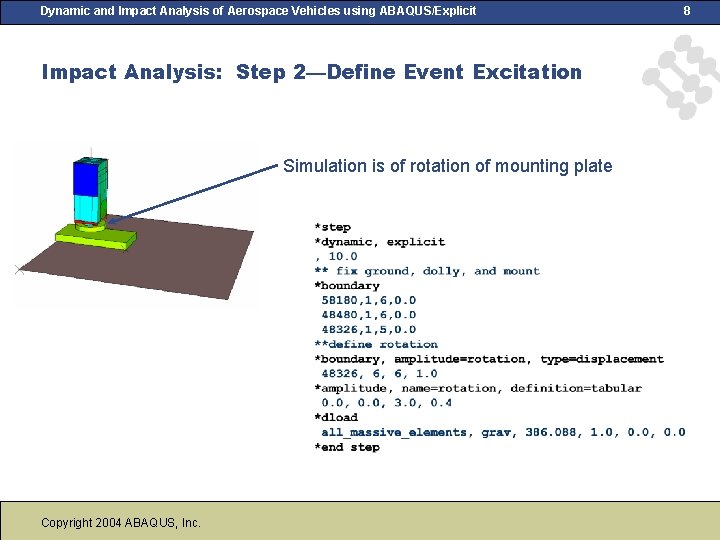
Dynamic and Impact Analysis of Aerospace Vehicles using ABAQUS/Explicit Impact Analysis: Step 2—Define Event Excitation Simulation is of rotation of mounting plate Copyright 2004 ABAQUS, Inc. 8
Dynamic and Impact Analysis of Aerospace Vehicles using ABAQUS/Explicit Impact Analysis: Step 3—Run Simulation • Model is ready to run – Full FEM translated from NASTRAN • Assumption is that this is a legacy model – Rigid ground, dolly, and mount defined – Contact surfaces and surface friction defined – Event excitation defined • Initial estimation of stable time increment is 1 e-8 seconds – For 10 -second simulation this means 1 e 9 time steps – Run will take 4+ hours Copyright 2004 ABAQUS, Inc. 9
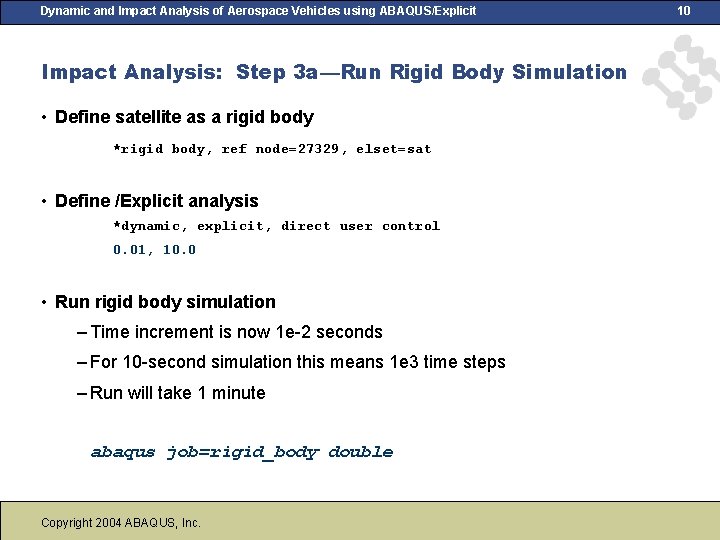
Dynamic and Impact Analysis of Aerospace Vehicles using ABAQUS/Explicit Impact Analysis: Step 3 a—Run Rigid Body Simulation • Define satellite as a rigid body *rigid body, ref node=27329, elset=sat • Define /Explicit analysis *dynamic, explicit, direct user control 0. 01, 10. 0 • Run rigid body simulation – Time increment is now 1 e-2 seconds – For 10 -second simulation this means 1 e 3 time steps – Run will take 1 minute abaqus job=rigid_body double Copyright 2004 ABAQUS, Inc. 10
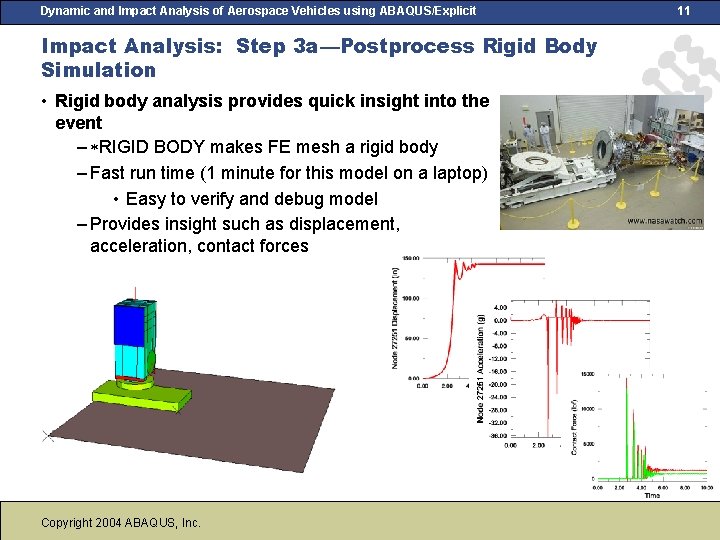
Dynamic and Impact Analysis of Aerospace Vehicles using ABAQUS/Explicit Impact Analysis: Step 3 a—Postprocess Rigid Body Simulation • Rigid body analysis provides quick insight into the event – *RIGID BODY makes FE mesh a rigid body – Fast run time (1 minute for this model on a laptop) • Easy to verify and debug model – Provides insight such as displacement, acceleration, contact forces Copyright 2004 ABAQUS, Inc. 11
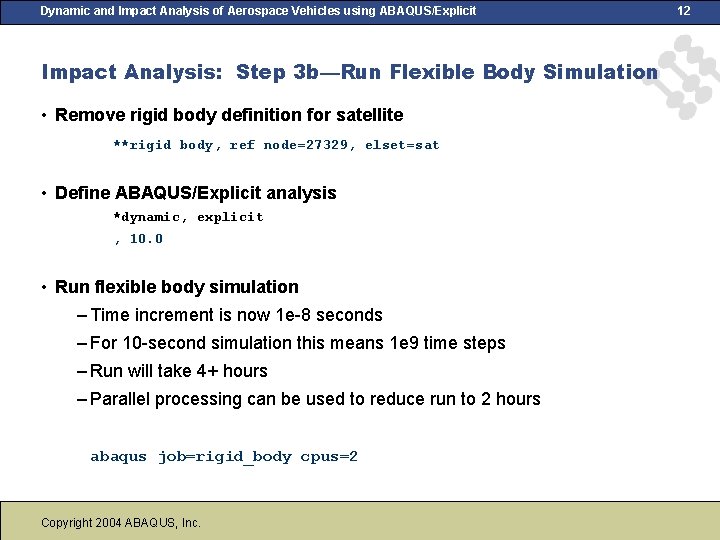
Dynamic and Impact Analysis of Aerospace Vehicles using ABAQUS/Explicit Impact Analysis: Step 3 b—Run Flexible Body Simulation • Remove rigid body definition for satellite **rigid body, ref node=27329, elset=sat • Define ABAQUS/Explicit analysis *dynamic, explicit , 10. 0 • Run flexible body simulation – Time increment is now 1 e-8 seconds – For 10 -second simulation this means 1 e 9 time steps – Run will take 4+ hours – Parallel processing can be used to reduce run to 2 hours abaqus job=rigid_body cpus=2 Copyright 2004 ABAQUS, Inc. 12
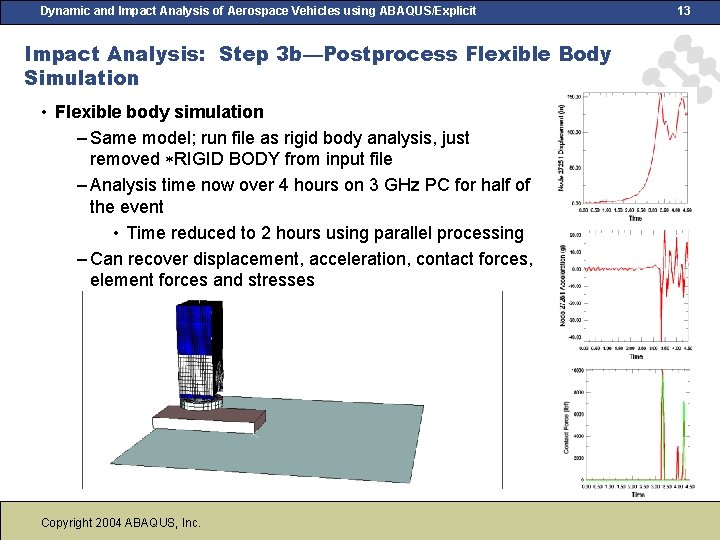
Dynamic and Impact Analysis of Aerospace Vehicles using ABAQUS/Explicit Impact Analysis: Step 3 b—Postprocess Flexible Body Simulation • Flexible body simulation – Same model; run file as rigid body analysis, just removed *RIGID BODY from input file – Analysis time now over 4 hours on 3 GHz PC for half of the event • Time reduced to 2 hours using parallel processing – Can recover displacement, acceleration, contact forces, element forces and stresses Copyright 2004 ABAQUS, Inc. 13
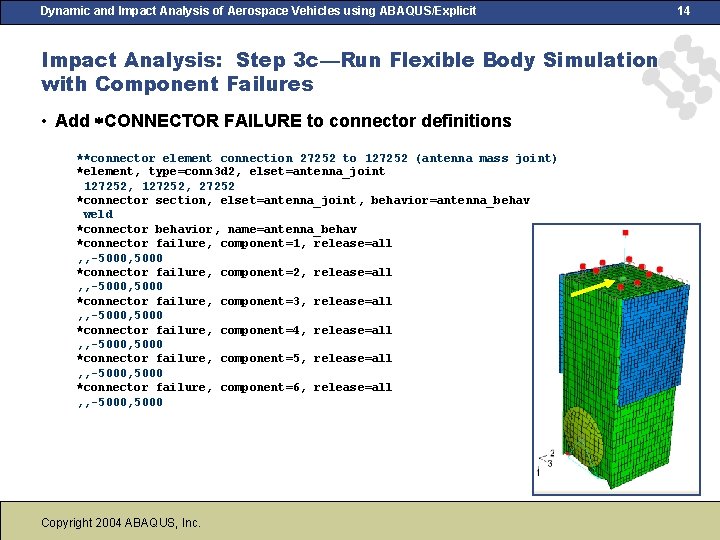
Dynamic and Impact Analysis of Aerospace Vehicles using ABAQUS/Explicit Impact Analysis: Step 3 c—Run Flexible Body Simulation with Component Failures • Add *CONNECTOR FAILURE to connector definitions **connector element connection 27252 to 127252 (antenna mass joint) *element, type=conn 3 d 2, elset=antenna_joint 127252, 27252 *connector section, elset=antenna_joint, behavior=antenna_behav weld *connector behavior, name=antenna_behav *connector failure, component=1, release=all , , -5000, 5000 *connector failure, component=2, release=all , , -5000, 5000 *connector failure, component=3, release=all , , -5000, 5000 *connector failure, component=4, release=all , , -5000, 5000 *connector failure, component=5, release=all , , -5000, 5000 *connector failure, component=6, release=all , , -5000, 5000 Copyright 2004 ABAQUS, Inc. 14
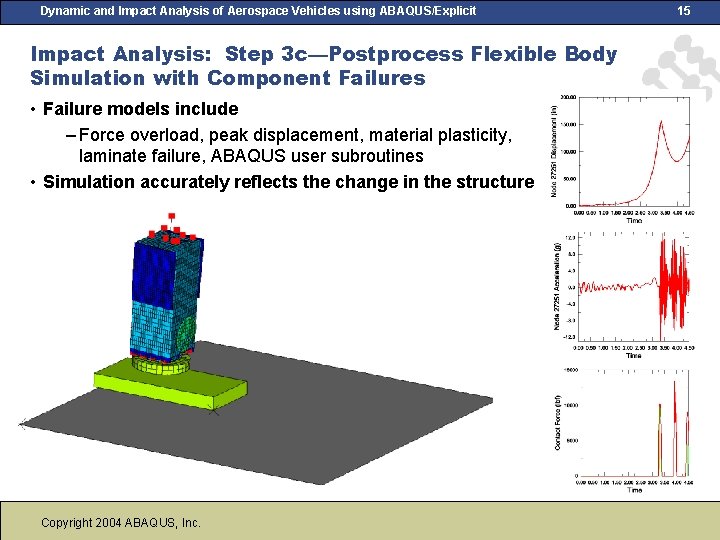
Dynamic and Impact Analysis of Aerospace Vehicles using ABAQUS/Explicit Impact Analysis: Step 3 c—Postprocess Flexible Body Simulation with Component Failures • Failure models include – Force overload, peak displacement, material plasticity, laminate failure, ABAQUS user subroutines • Simulation accurately reflects the change in the structure Copyright 2004 ABAQUS, Inc. 15
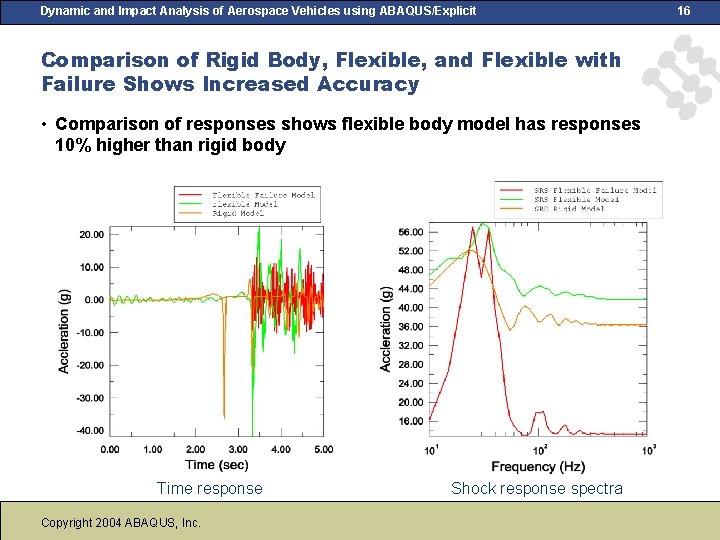
Dynamic and Impact Analysis of Aerospace Vehicles using ABAQUS/Explicit Comparison of Rigid Body, Flexible, and Flexible with Failure Shows Increased Accuracy • Comparison of responses shows flexible body model has responses 10% higher than rigid body Time response Copyright 2004 ABAQUS, Inc. Shock response spectra 16
Dynamic and Impact Analysis of Aerospace Vehicles using ABAQUS/Explicit Methodology Used for Analysis of Satellite Impact Was to Start Simple and Add Increasing Complexity • Methodology – Use existing loads / dynamics model for analysis • Can translate from NASTRAN using fromnastran utility – Define impact analysis • Define ground, dolly, and mount (rigid) • Define contact surfaces – Perform simple rigid body/mechanism dynamic analysis • Allows for quick insight into event – Perform flexible body impact dynamic analysis • More accurate simulation of true event – Perform flexible body impact analysis with failure models • Accounting for joint/material failure further increases accuracy of simulation Copyright 2004 ABAQUS, Inc. 17
Dynamic and Impact Analysis of Aerospace Vehicles using ABAQUS/Explicit 18 Simulation of Satellite Impact for Varying Model Fidelity Allows Progressive Accuracy and Insight into Event Engineering Challenges Simulation Capabilities • Complicated, nonlinear, dynamic event with many contact regions and damage / failure • Able to use existing FE model for analysis (typically a Nastran CLA model) • Easily change from flexible to rigid body analysis • Robust, general contact algorithm • Nonlinear material properties and failure criteria • Parallel processing to reduced run time • Mechanism – flexible body co-simulation Copyright 2004 ABAQUS, Inc.
Dynamic and Impact Analysis of Aerospace Vehicles using ABAQUS/Explicit Current Software Technology Provides the Capability to Perform Multiple Simulations in One Toolkit • Unified FEA – Fewer software products needed – More and smarter reuse of models and results – Better technical solution through coupled analysis – Reduced data management • One FE model and one software code to perform – Dynamic analysis – Nonlinear static analysis – Mechanism simulations – Impact/crash – Structural-thermal coupled problems Copyright 2004 ABAQUS, Inc. 19
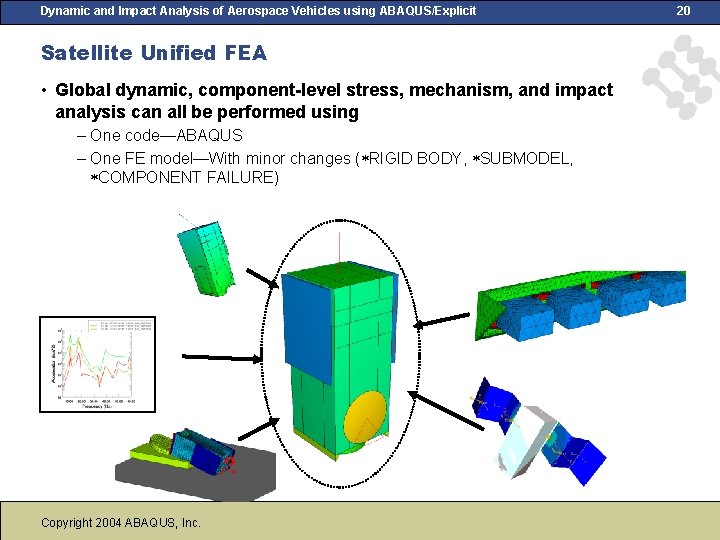
Dynamic and Impact Analysis of Aerospace Vehicles using ABAQUS/Explicit Satellite Unified FEA • Global dynamic, component-level stress, mechanism, and impact analysis can all be performed using – One code—ABAQUS – One FE model—With minor changes (*RIGID BODY, *SUBMODEL, *COMPONENT FAILURE) Copyright 2004 ABAQUS, Inc. 20
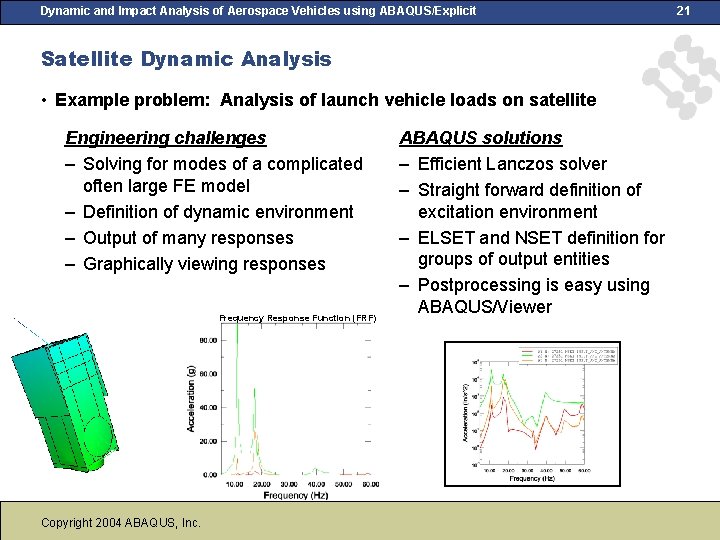
Dynamic and Impact Analysis of Aerospace Vehicles using ABAQUS/Explicit Satellite Dynamic Analysis • Example problem: Analysis of launch vehicle loads on satellite Engineering challenges – Solving for modes of a complicated often large FE model – Definition of dynamic environment – Output of many responses – Graphically viewing responses Frequency Response Function (FRF) Copyright 2004 ABAQUS, Inc. ABAQUS solutions – Efficient Lanczos solver – Straight forward definition of excitation environment – ELSET and NSET definition for groups of output entities – Postprocessing is easy using ABAQUS/Viewer 21
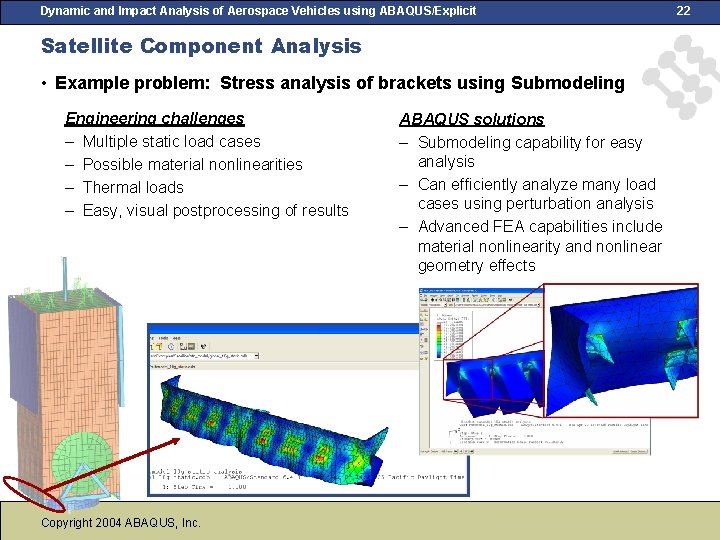
Dynamic and Impact Analysis of Aerospace Vehicles using ABAQUS/Explicit Satellite Component Analysis • Example problem: Stress analysis of brackets using Submodeling Engineering challenges – Multiple static load cases – Possible material nonlinearities – Thermal loads – Easy, visual postprocessing of results Copyright 2004 ABAQUS, Inc. ABAQUS solutions – Submodeling capability for easy analysis – Can efficiently analyze many load cases using perturbation analysis – Advanced FEA capabilities include material nonlinearity and nonlinear geometry effects 22
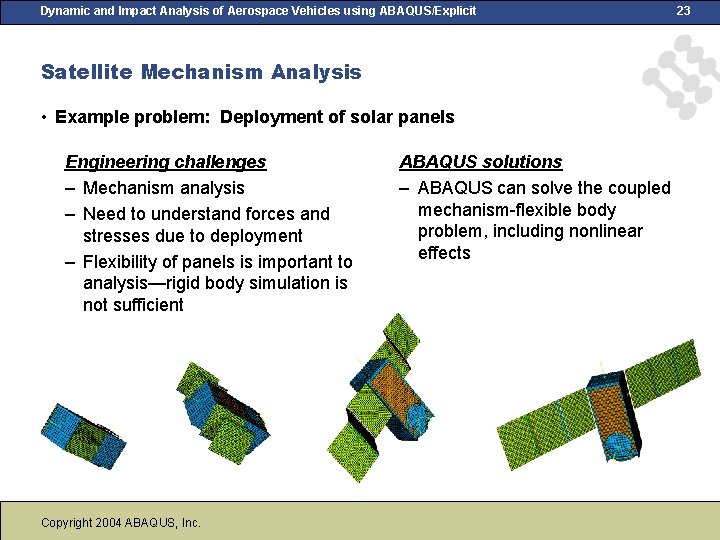
Dynamic and Impact Analysis of Aerospace Vehicles using ABAQUS/Explicit Satellite Mechanism Analysis • Example problem: Deployment of solar panels Engineering challenges – Mechanism analysis – Need to understand forces and stresses due to deployment – Flexibility of panels is important to analysis—rigid body simulation is not sufficient Copyright 2004 ABAQUS, Inc. ABAQUS solutions – ABAQUS can solve the coupled mechanism-flexible body problem, including nonlinear effects 23
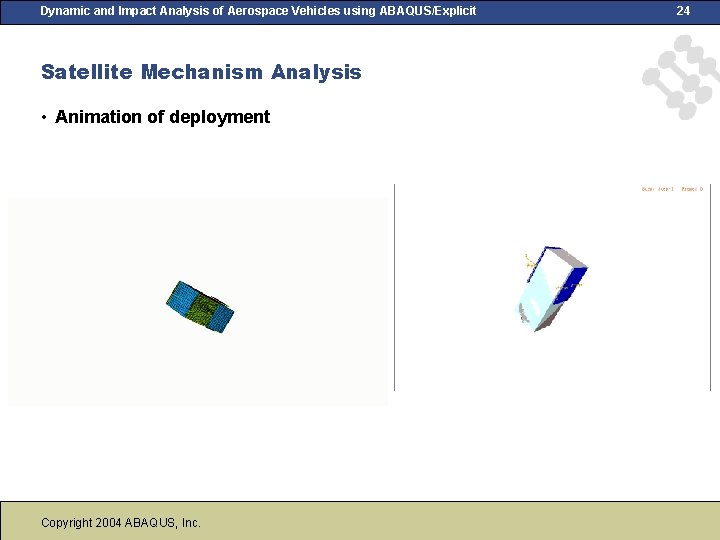
Dynamic and Impact Analysis of Aerospace Vehicles using ABAQUS/Explicit Satellite Mechanism Analysis • Animation of deployment Copyright 2004 ABAQUS, Inc. 24
Dynamic and Impact Analysis of Aerospace Vehicles using ABAQUS/Explicit Presented at the 2004 FEMCI Workshop NASA/GSFC, Greenbelt, MD Kyle C. Indermuehle Mike Sasdelli ATA Engineering / ABAQUS East Copyright 2004 ABAQUS, Inc. 858. 792. 3958 410. 420. 8587