
DVM 2105 A INTRODUCTION TO INTERNATIONAL DEVELOPMENT Week
- Slides: 15
DVM 2105 A INTRODUCTION TO INTERNATIONAL DEVELOPMENT Week 3: History and Theories of Development Part 2
Lecture Outline – History and Theories Review (Week 3 Part 1) Concepts in the history of development Theories of Development: Modernization Theory Dependency Theory In green, to be continued in week 6 Neoliberal Theory “Another Development” (Post-Modern and Post-Colonial Theories) Key Concepts to Know (from the last 2 weeks)
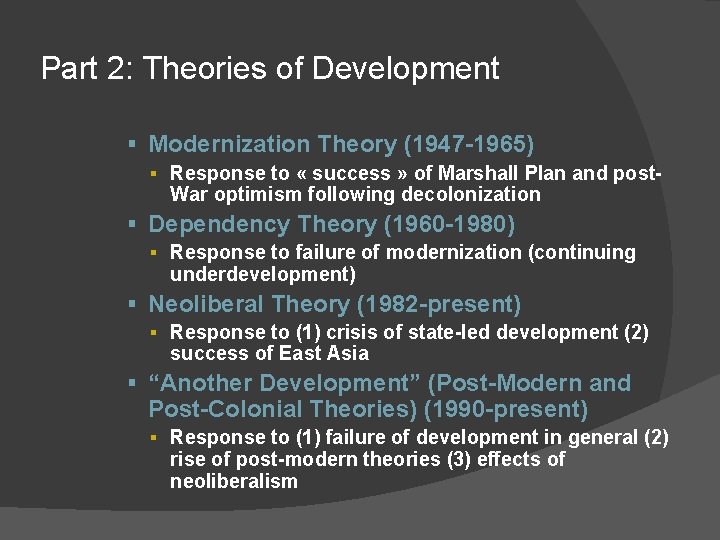
Part 2: Theories of Development § Modernization Theory (1947 -1965) § Response to « success » of Marshall Plan and post- War optimism following decolonization § Dependency Theory (1960 -1980) § Response to failure of modernization (continuing underdevelopment) § Neoliberal Theory (1982 -present) § Response to (1) crisis of state-led development (2) success of East Asia § “Another Development” (Post-Modern and Post-Colonial Theories) (1990 -present) § Response to (1) failure of development in general (2) rise of post-modern theories (3) effects of neoliberalism
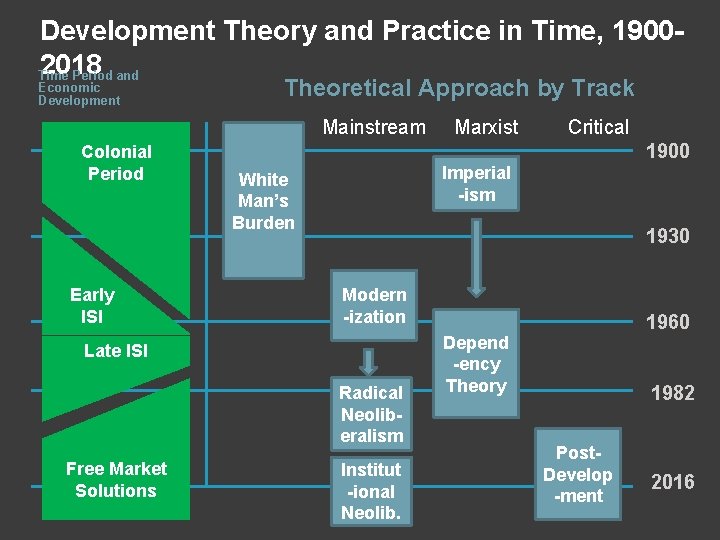
Development Theory and Practice in Time, 19002018 Time Period and Economic Development Theoretical Approach by Track Mainstream Marxist Critical Colonial Period Early ISI 1900 Imperial -ism White Man’s Burden 1930 Modern -ization Late ISI Radical Neoliberalism Free Market Solutions Institut -ional Neolib. 1960 Depend -ency Theory 1982 Post- Develop -ment 2016
Modernization Theory (1950 -1960 s) … Repeating the European experience Emerged in the post-WWII period, theoretically linked to both Marshall Plan and Cold War Based on contrast between modern and traditional societies… development viewed as traditional societies evolving continuously into modern societies over time (changes in society, values, economy) « Development economics » (as described by Desai) is part of this broader trend and optimism Identifies the social variables and institutional factors necessary for this evolution
Modernization Theory (1950 -1960 s) … Repeating the European experience Sociological modernization theory (T. Parsons and B. F. Hoselitz) Economic development is also a change in social structure, culture and values Need to destroy the economic basis of traditional vested interests and traditional values Need a social group to spearhead change (entrepreneurs) Talcott Parsons: the Pattern Variables 5 roles or « social relations » that change with development KEY POINT: personality, values, social roles evolve from traditional to modern in a continuous process
Modernization Theory (1950 -1960 s) … Repeating the European experience Psychological modernization theory (Mc. Clelland) Psychlogical factors important for growth, particularly the « need for achievement » Economic modernization theory (W. W. Rostow) Countries go through the same 5 « stages of growth » (1) Traditional society (ag, low productivity, non-scientific) (2) Preconditions for Take-Off (expanding trade, nation state) (3) Take off (growth becomes permanent feature; investment goes up to 10%) (4) Road to maturity (economy modernized, ISI, new technology, diversification) (5) Age of mass consumption (focus on consumption and services, welfare and security)
Modernization Theory (1950 -1960 s) … Repeating the European experience Critique of Modernization Theory Too simplistic and rigid: assumed all countries developed in same way from a « natural » starting point Eurocentric: copy experience of Europe (or US) without understanding of how experience of colonialism changed development potential Ahistorical, does not account for diversity of experience FUNDAMENTAL PROBLEM: Many countries did not seem to develop in this period – esp by 1960 s
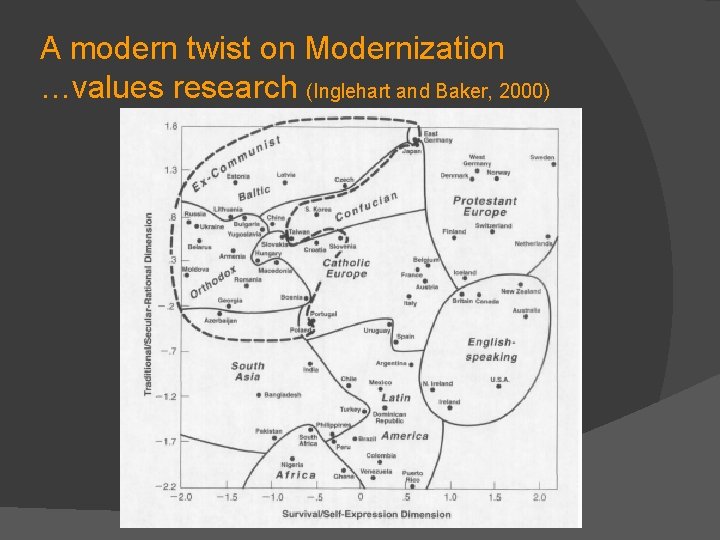
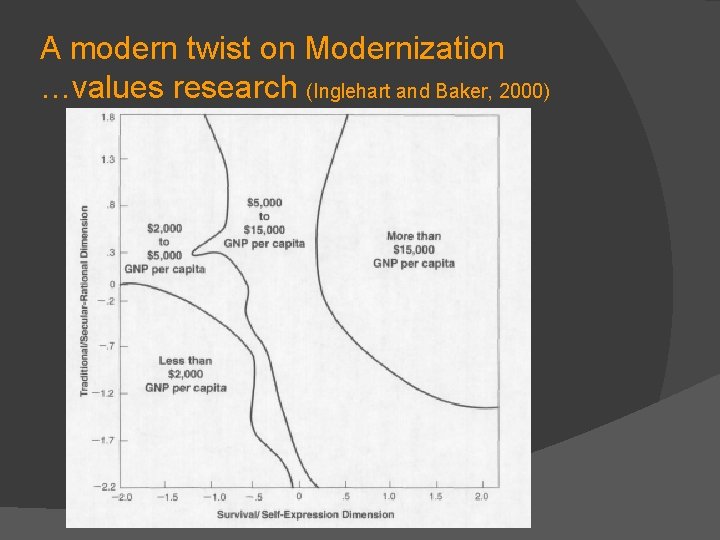
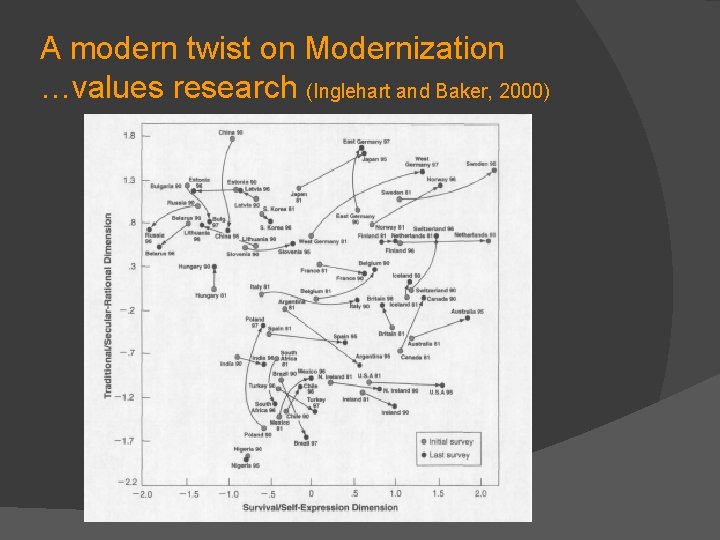
A modern twist on Modernization …values research (Inglehart and Baker, 2000) 2 key dimensions from World Values Survey, 1981 -98 Traditional (religion, familty authority) versus Secular-Rational Survival (material concerns) versus Self-Expression (individual fulfillment) Conclusions Industrialization does cause a shift to both more secular-rationa and self-expression values Cultural change and the persistence of traditional values (values are path-dependent based on cultural zone, Protestant, Confucian, etc. ) BUT not convergence, move on parallel trajectories Economic collapse reversal towards traditional and survival US is an exceptional case (self-expression and traditional)
A modern twist on Modernization …values research (Inglehart and Baker, 2000)
A modern twist on Modernization …values research (Inglehart and Baker, 2000)
A modern twist on Modernization …values research (Inglehart and Baker, 2000)
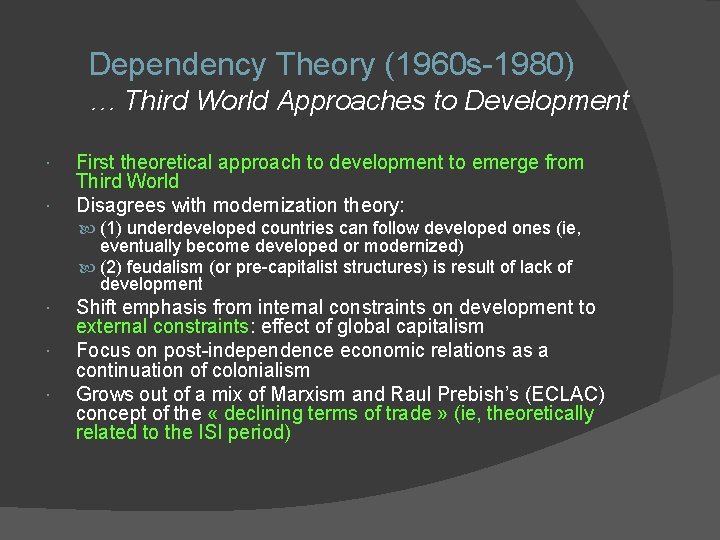
Dependency Theory (1960 s-1980) … Third World Approaches to Development First theoretical approach to development to emerge from Third World Disagrees with modernization theory: (1) underdeveloped countries can follow developed ones (ie, eventually become developed or modernized) (2) feudalism (or pre-capitalist structures) is result of lack of development Shift emphasis from internal constraints on development to external constraints: effect of global capitalism Focus on post-independence economic relations as a continuation of colonialism Grows out of a mix of Marxism and Raul Prebish’s (ECLAC) concept of the « declining terms of trade » (ie, theoretically related to the ISI period)
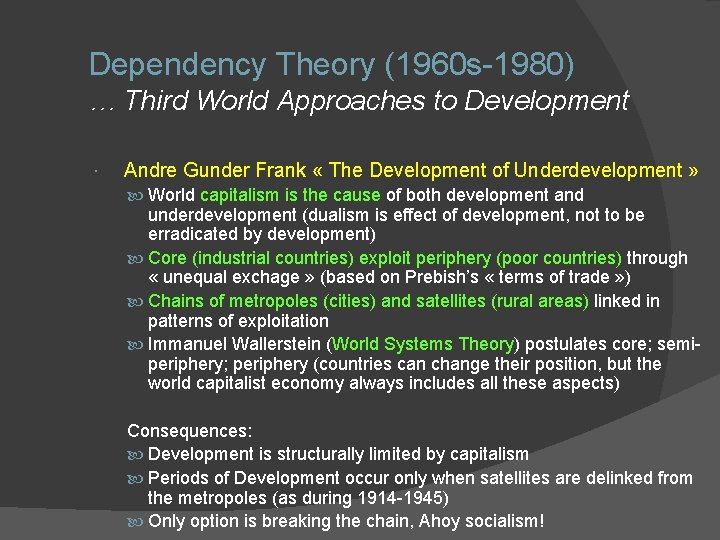
Dependency Theory (1960 s-1980) … Third World Approaches to Development Andre Gunder Frank « The Development of Underdevelopment » World capitalism is the cause of both development and underdevelopment (dualism is effect of development, not to be erradicated by development) Core (industrial countries) exploit periphery (poor countries) through « unequal exchage » (based on Prebish’s « terms of trade » ) Chains of metropoles (cities) and satellites (rural areas) linked in patterns of exploitation Immanuel Wallerstein (World Systems Theory) postulates core; semiperiphery; periphery (countries can change their position, but the world capitalist economy always includes all these aspects) Consequences: Development is structurally limited by capitalism Periods of Development occur only when satellites are delinked from the metropoles (as during 1914 -1945) Only option is breaking the chain, Ahoy socialism!
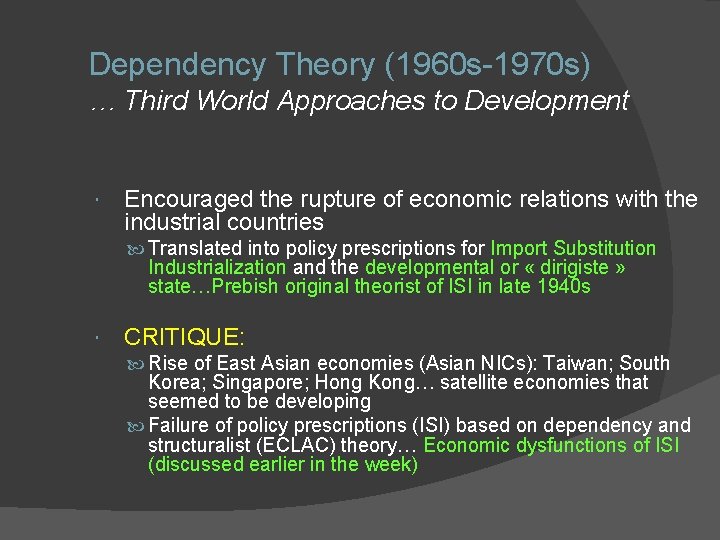
Dependency Theory (1960 s-1970 s) … Third World Approaches to Development Encouraged the rupture of economic relations with the industrial countries Translated into policy prescriptions for Import Substitution Industrialization and the developmental or « dirigiste » state…Prebish original theorist of ISI in late 1940 s CRITIQUE: Rise of East Asian economies (Asian NICs): Taiwan; South Korea; Singapore; Hong Kong… satellite economies that seemed to be developing Failure of policy prescriptions (ISI) based on dependency and structuralist (ECLAC) theory… Economic dysfunctions of ISI (discussed earlier in the week)