
DVBT Development in Austria Overview About ORS DVBT
DVB-T Development in Austria
Overview § § § About ORS DVB-T in Austria Cost of Distribution Digital Roll out Reaching the People Change of TV Landscape 01. 04. 2008 DVB-T Development in Austria Seite 1

ATO Phases & Coverage Now: 92% coverage for MUX A and 74% coverage for MUX B phase 3 ATO 4. 6. 2007 Upper Austria Salzburg phase 1 ATO 5. 3. 2007 Vorarlberg phase 2 ATO 7. 5. 2007 Tirol About ORS phase 5 ATO 22. 10. 2007 Vienna Lower Austria Burgenland phase 4 ATO 24. 9. 2007 Carinthia Styria Conditions of DVB-T reception Roof antenna Exterior antenna Indoor aerial 01. 04. 2008 DVB-T Development in Austria Seite 2
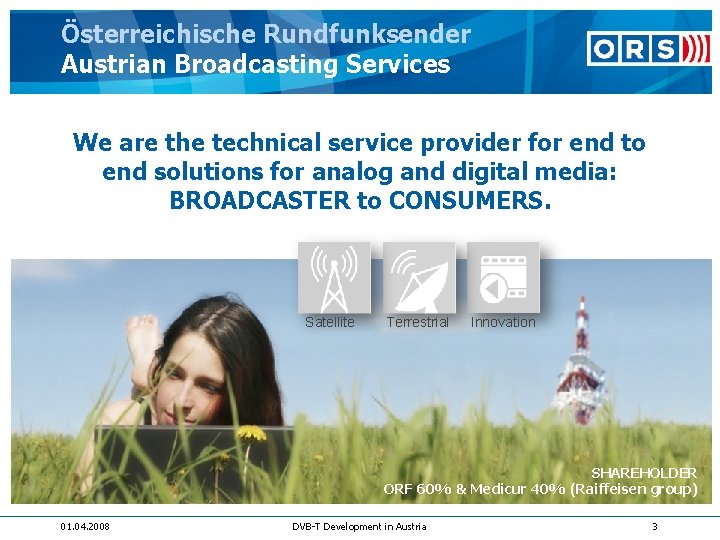
Österreichische Rundfunksender Austrian Broadcasting Services We are the technical service provider for end to end solutions for analog and digital media: BROADCASTER to CONSUMERS. Satellite Terrestrial Innovation SHAREHOLDER ORF 60% & Medicur 40% (Raiffeisen group) 01. 04. 2008 DVB-T Development in Austria 3
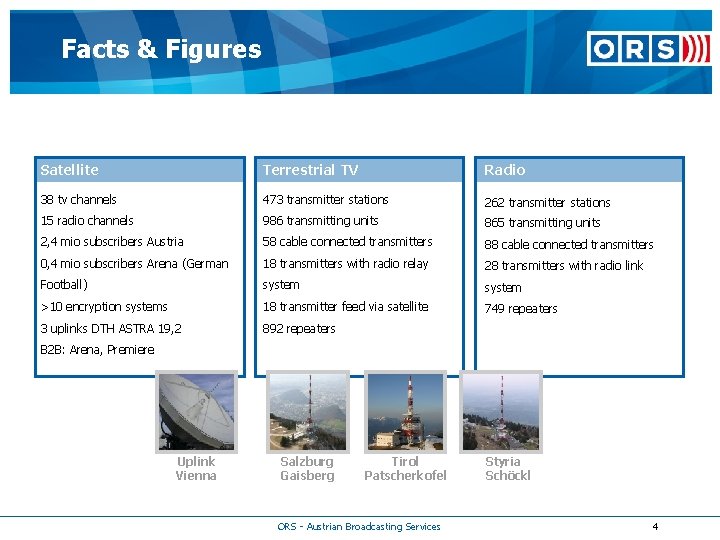
Facts & Figures Satellite Terrestrial TV Radio 38 tv channels 473 transmitter stations 262 transmitter stations 15 radio channels 986 transmitting units 865 transmitting units 2, 4 mio subscribers Austria 58 cable connected transmitters 88 cable connected transmitters 0, 4 mio subscribers Arena (German 18 transmitters with radio relay 28 transmitters with radio link Football) system >10 encryption systems 18 transmitter feed via satellite 749 repeaters 3 uplinks DTH ASTRA 19, 2 892 repeaters B 2 B: Arena, Premiere Uplink Vienna Salzburg Gaisberg Tirol Patscherkofel ORS - Austrian Broadcasting Services Styria Schöckl 4
Customers & Partners 01. 04. 2008 DVB-T Development in Austria Seite 5
ATO Phases & Coverage Now: 92% coverage for MUX A and 74% coverage for MUX B phase 3 ATO 4. 6. 2007 Upper Austria Salzburg phase 1 ATO 5. 3. 2007 Vorarlberg phase 2 ATO 7. 5. 2007 Tirol DVB-T in Austria phase 5 ATO 22. 10. 2007 Vienna Lower Austria Burgenland phase 4 ATO 24. 9. 2007 Carinthia Styria Conditions of DVB-T reception Roof antenna Exterior antenna Indoor aerial 01. 04. 2008 DVB-T Development in Austria Seite 6
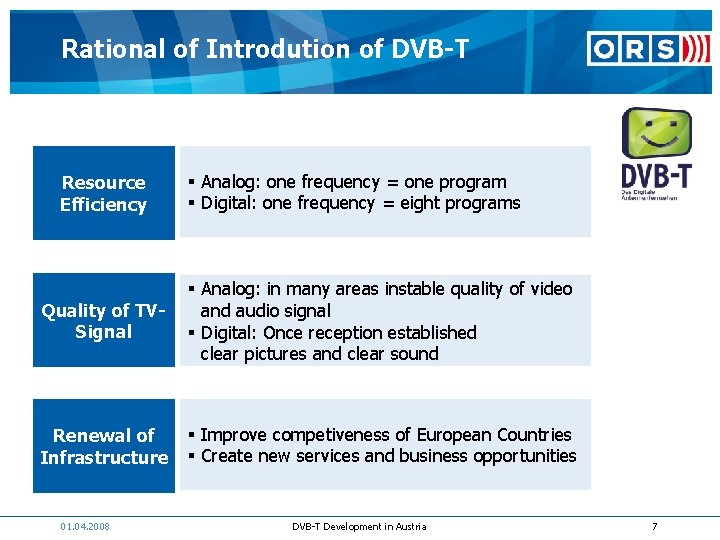
Rational of Introdution of DVB-T Resource Efficiency § Analog: one frequency = one program § Digital: one frequency = eight programs Quality of TVSignal § Analog: in many areas instable quality of video and audio signal § Digital: Once reception established clear pictures and clear sound Renewal of Infrastructure § Improve competiveness of European Countries § Create new services and business opportunities 01. 04. 2008 DVB-T Development in Austria 7
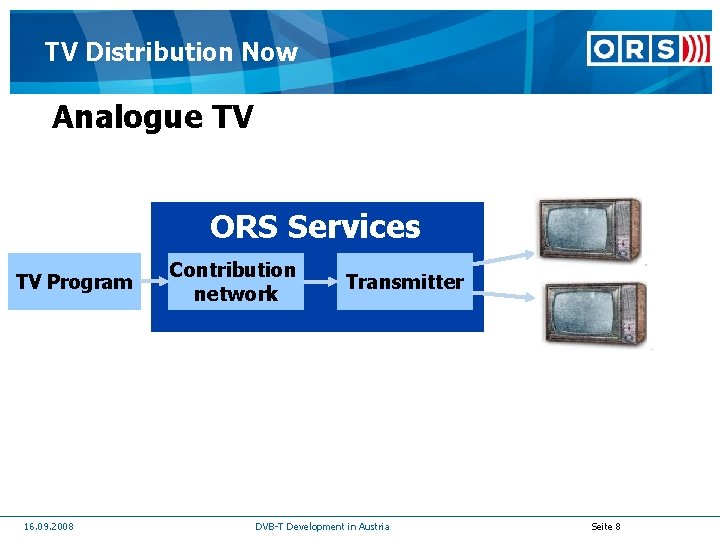
TV Distribution Now Analogue TV ORS Services TV Program 16. 09. 2008 Contribution network Transmitter DVB-T Development in Austria Seite 8
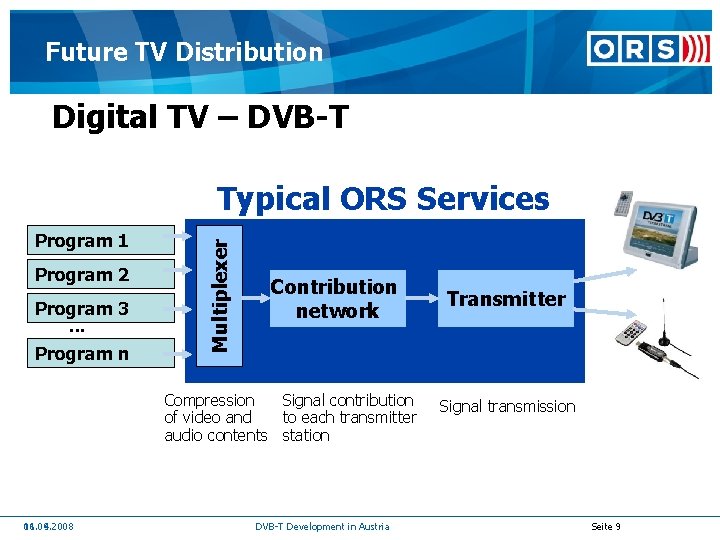
Future TV Distribution Digital TV – DVB-T Program 1 Program 2 Program 3. . . Program n Multiplexer Typical ORS Services Contribution network Compression Signal contribution of video and to each transmitter audio contents station 16. 09. 2008 01. 04. 2008 DVB-T Development in Austria Transmitter Signal transmission Seite 9
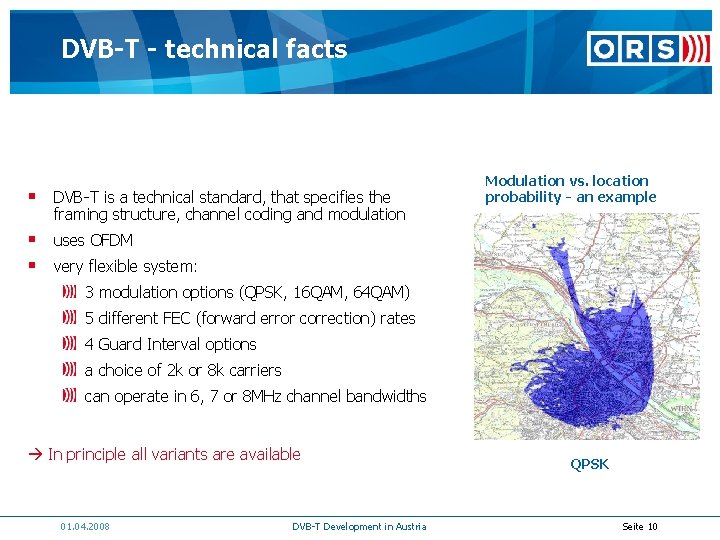
DVB-T - technical facts § DVB-T is a technical standard, that specifies the framing structure, channel coding and modulation Modulation vs. location probability - an example § uses OFDM § very flexible system: 3 modulation options (QPSK, 16 QAM, 64 QAM) 5 different FEC (forward error correction) rates 4 Guard Interval options a choice of 2 k or 8 k carriers can operate in 6, 7 or 8 MHz channel bandwidths In principle all variants are available 01. 04. 2008 DVB-T Development in Austria QPSK Seite 10
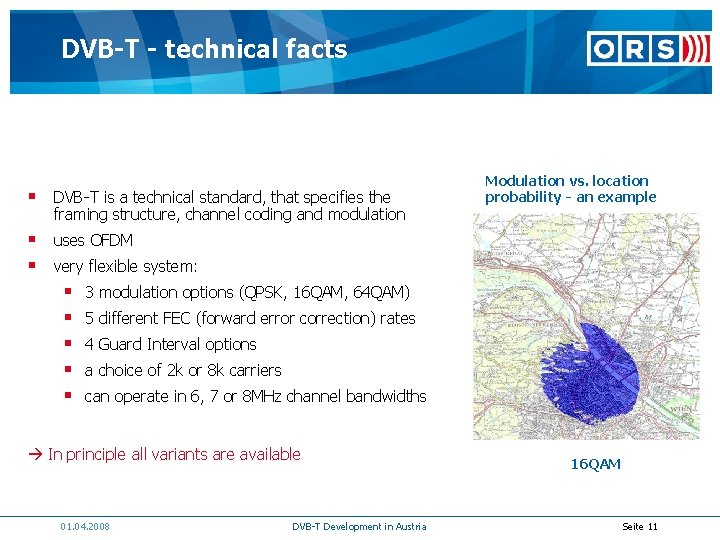
DVB-T - technical facts § DVB-T is a technical standard, that specifies the framing structure, channel coding and modulation Modulation vs. location probability - an example § uses OFDM § very flexible system: § 3 modulation options (QPSK, 16 QAM, 64 QAM) § 5 different FEC (forward error correction) rates § 4 Guard Interval options § a choice of 2 k or 8 k carriers § can operate in 6, 7 or 8 MHz channel bandwidths In principle all variants are available 01. 04. 2008 DVB-T Development in Austria 16 QAM Seite 11
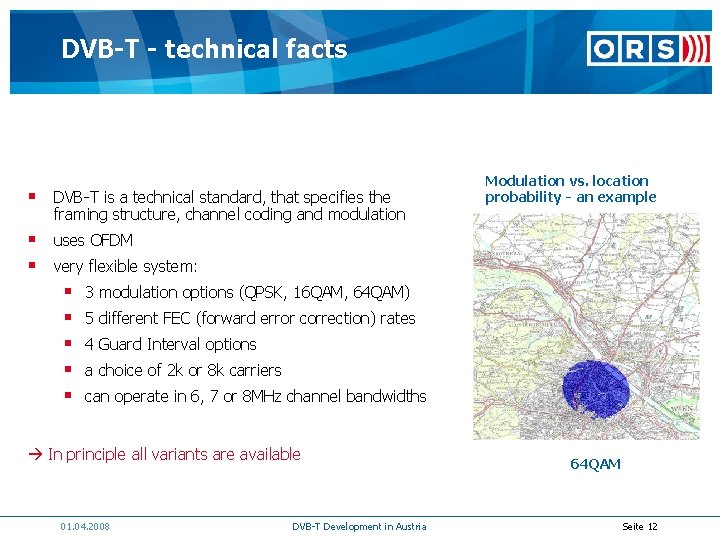
DVB-T - technical facts § DVB-T is a technical standard, that specifies the framing structure, channel coding and modulation Modulation vs. location probability - an example § uses OFDM § very flexible system: § 3 modulation options (QPSK, 16 QAM, 64 QAM) § 5 different FEC (forward error correction) rates § 4 Guard Interval options § a choice of 2 k or 8 k carriers § can operate in 6, 7 or 8 MHz channel bandwidths In principle all variants are available 01. 04. 2008 DVB-T Development in Austria 64 QAM Seite 12
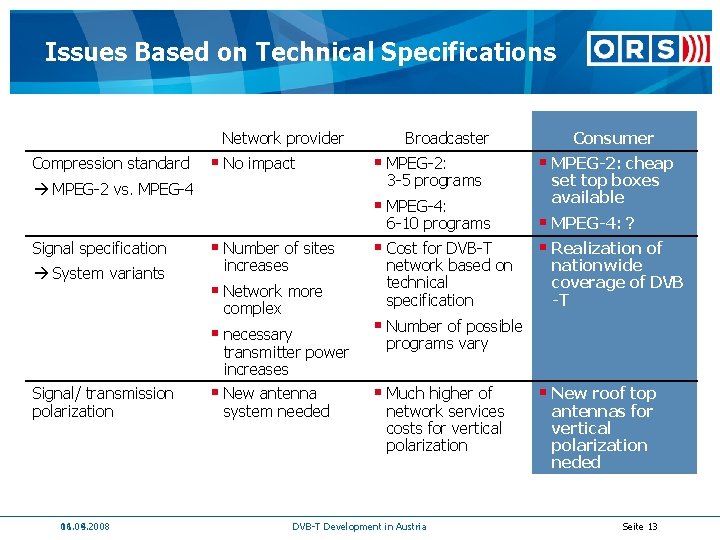
Issues Based on Technical Specifications Network provider Compression standard § No impact MPEG-2 vs. MPEG-4 Broadcaster § MPEG-2: 3 -5 programs § MPEG-4: 6 -10 programs Signal specification System variants § Number of sites increases § Network more complex 16. 09. 2008 01. 04. 2008 network based on technical specification § necessary § Number of possible § New antenna § Much higher of transmitter power increases Signal/ transmission polarization § Cost for DVB-T system needed Consumer § MPEG-2: cheap set top boxes available § MPEG-4: ? § Realization of nationwide coverage of DVB -T programs vary network services costs for vertical polarization DVB-T Development in Austria § New roof top antennas for vertical polarization neded Seite 13
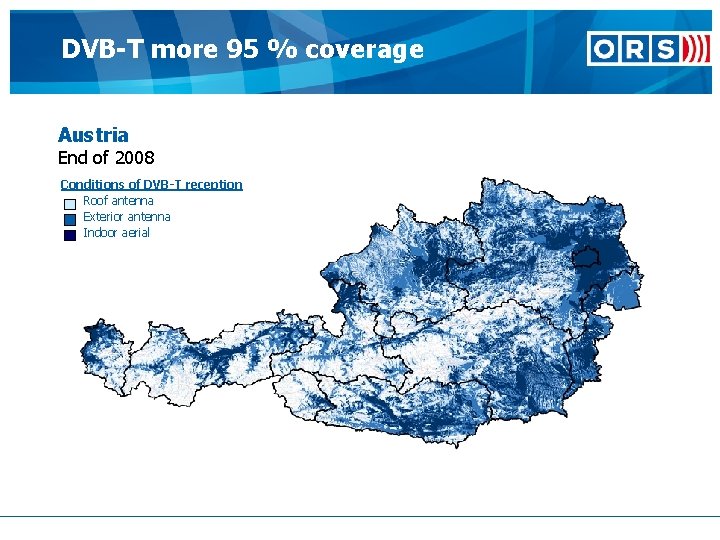
DVB-T more 95 % coverage Austria End of 2008 Conditions of DVB-T reception Roof antenna Exterior antenna Indoor aerial
ATO Phases & Coverage Now: 92% coverage for MUX A and 74% coverage for MUX B phase 3 ATO 4. 6. 2007 Upper Austria Salzburg phase 1 ATO 5. 3. 2007 Vorarlberg phase 5 ATO 22. 10. 2007 Vienna Lower Austria Burgenland phase 2 ATO 7. 5. 2007 Tirol Distribution Costs phase 4 ATO 24. 9. 2007 Carinthia Styria Conditions of DVB-T reception Roof antenna Exterior antenna Indoor aerial 01. 04. 2008 DVB-T Development in Austria Seite 15
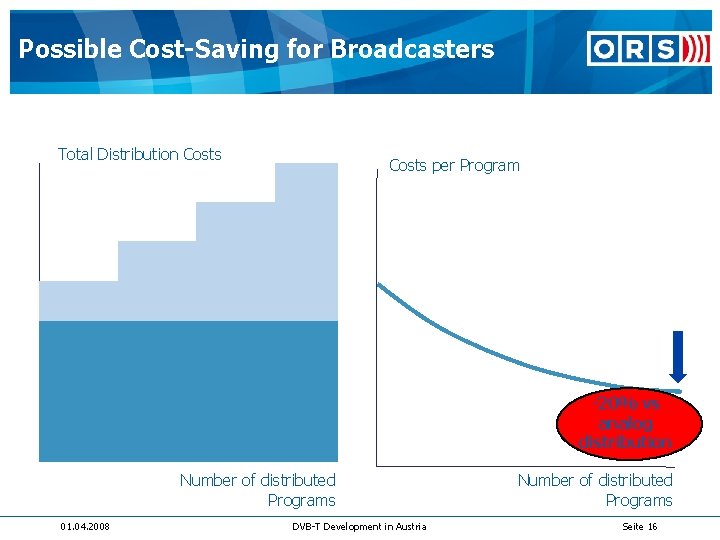
Possible Cost-Saving for Broadcasters Total Distribution Costs per Program -20% vs analog distribution Number of distributed Programs 01. 04. 2008 DVB-T Development in Austria Number of distributed Programs Seite 16
ATO Phases & Coverage Now: 92% coverage for MUX A and 74% coverage for MUX B phase 3 ATO 4. 6. 2007 Upper Austria Salzburg phase 1 ATO 5. 3. 2007 Vorarlberg phase 5 ATO 22. 10. 2007 Vienna Lower Austria Burgenland phase 2 ATO 7. 5. 2007 Tirol Digital Roll out phase 4 ATO 24. 9. 2007 Carinthia Styria Conditions of DVB-T reception Roof antenna Exterior antenna Indoor aerial 01. 04. 2008 DVB-T Development in Austria Seite 17
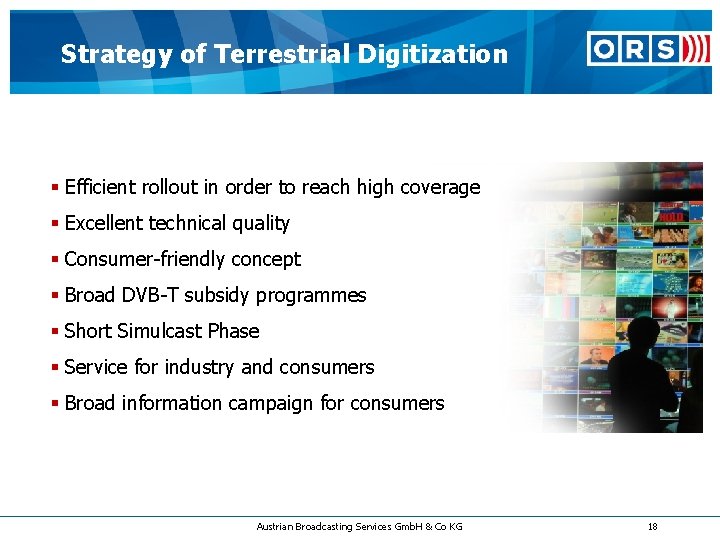
Strategy of Terrestrial Digitization § Efficient rollout in order to reach high coverage § Excellent technical quality § Consumer-friendly concept § Broad DVB-T subsidy programmes § Short Simulcast Phase § Service for industry and consumers § Broad information campaign for consumers Austrian Broadcasting Services Gmb. H & Co KG 18
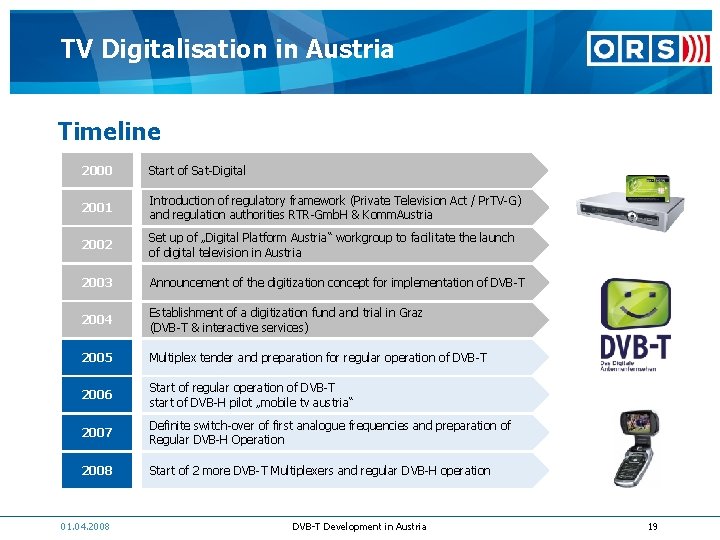
TV Digitalisation in Austria Timeline 2000 Start of Sat-Digital 2001 Introduction of regulatory framework (Private Television Act / Pr. TV-G) and regulation authorities RTR-Gmb. H & Komm. Austria 2002 Set up of „Digital Platform Austria“ workgroup to facilitate the launch of digital television in Austria 2003 Announcement of the digitization concept for implementation of DVB-T 2004 Establishment of a digitization fund and trial in Graz (DVB-T & interactive services) 2005 Multiplex tender and preparation for regular operation of DVB-T 2006 Start of regular operation of DVB-T start of DVB-H pilot „mobile tv austria“ 2007 Definite switch-over of first analogue frequencies and preparation of Regular DVB-H Operation 2008 Start of 2 more DVB-T Multiplexers and regular DVB-H operation 01. 04. 2008 DVB-T Development in Austria 19
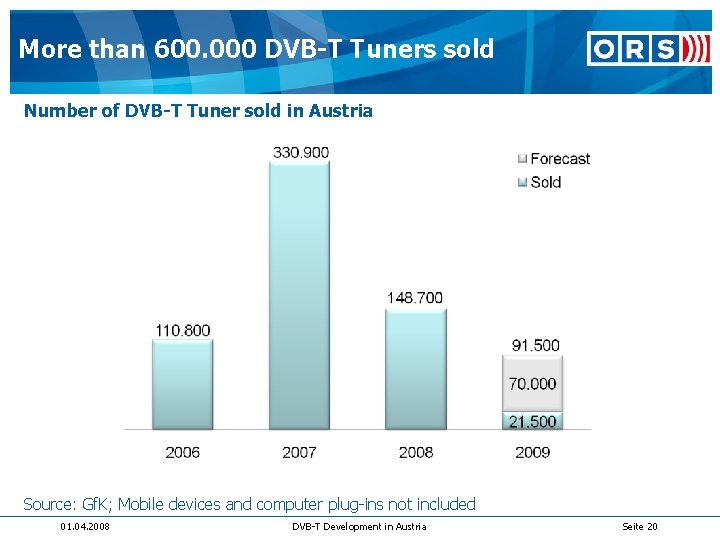
More than 600. 000 DVB-T Tuners sold Number of DVB-T Tuner sold in Austria Source: Gf. K; Mobile devices and computer plug-ins not included 01. 04. 2008 DVB-T Development in Austria Seite 20

ATO Phases & Coverage Now: 92% coverage for MUX A and 74% coverage for MUX B phase 3 ATO 4. 6. 2007 Upper Austria Salzburg phase 1 ATO 5. 3. 2007 Vorarlberg phase 5 ATO 22. 10. 2007 Vienna Lower Austria Burgenland phase 2 ATO 7. 5. 2007 Tirol Reaching People phase 4 ATO 24. 9. 2007 Carinthia Styria Conditions of DVB-T reception Roof antenna Exterior antenna Indoor aerial 01. 04. 2008 DVB-T Development in Austria Seite 21

Colaboraation of All Relevant Players Government Electronics Industry/Retailers Regulation Authority RTR Private TV Public TV NGOs (workers chamber, chamber of commerce) Austrian Broadcasting Services Gmb. H & Co KG 22
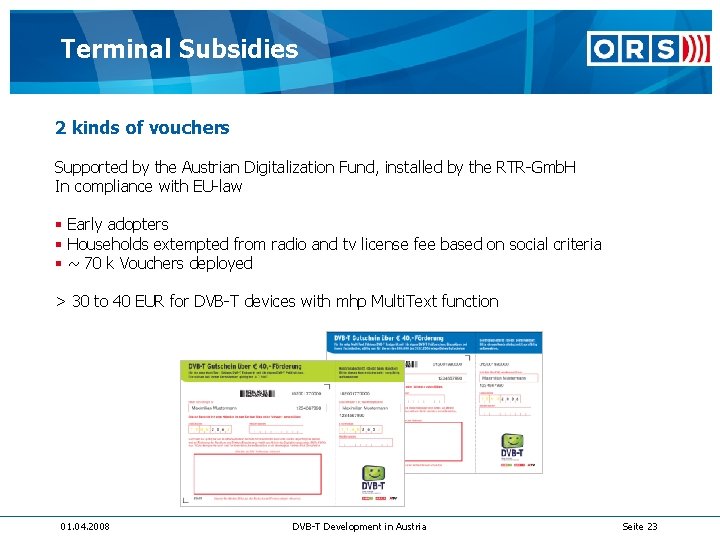
Terminal Subsidies 2 kinds of vouchers Supported by the Austrian Digitalization Fund, installed by the RTR-Gmb. H In compliance with EU-law § Early adopters § Households extempted from radio and tv license fee based on social criteria § ~ 70 k Vouchers deployed > 30 to 40 EUR for DVB-T devices with mhp Multi. Text function 01. 04. 2008 DVB-T Development in Austria Seite 23
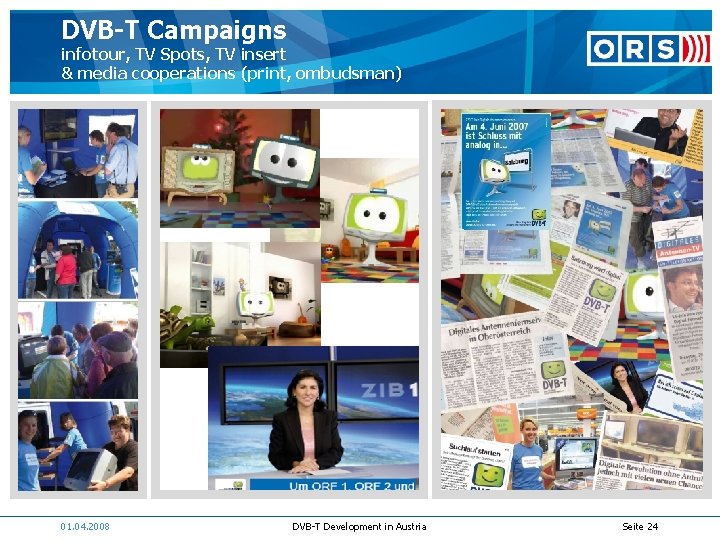
DVB-T Campaigns infotour, TV Spots, TV insert & media cooperations (print, ombudsman) 01. 04. 2008 DVB-T Development in Austria Seite 24
Changing TV Landscape 01. 04. 2008 DVB-T Development Titel in Austria Seite 25
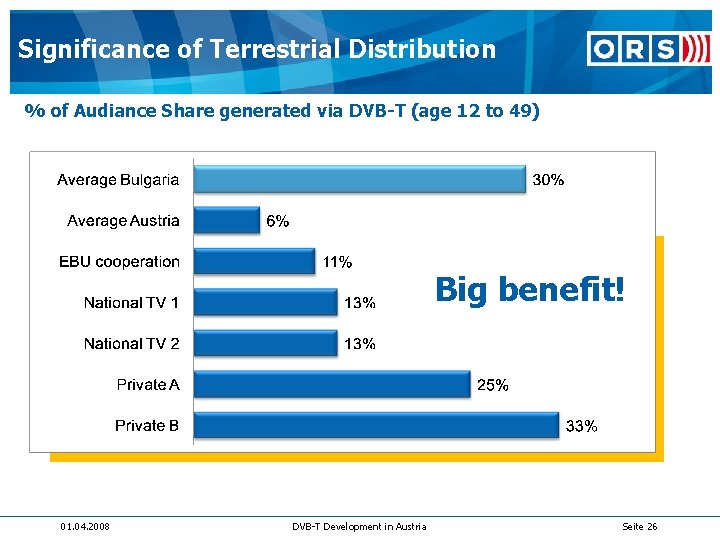
Significance of Terrestrial Distribution % of Audiance Share generated via DVB-T (age 12 to 49) Big benefit! 01. 04. 2008 DVB-T Development in Austria Seite 26
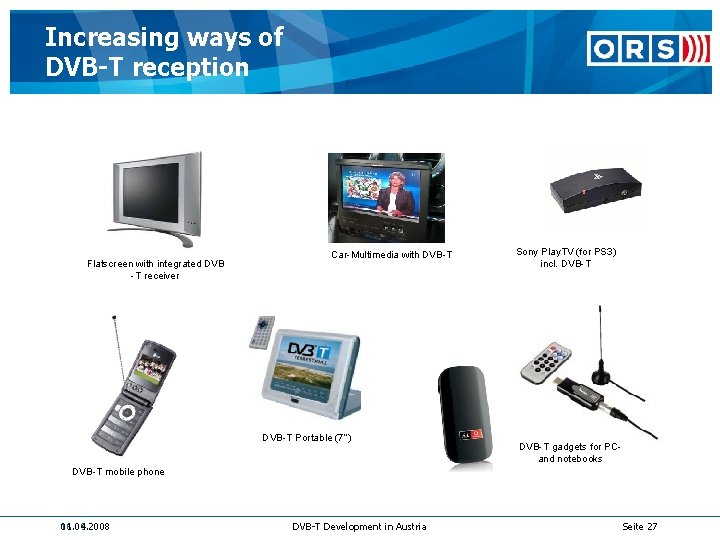
Increasing ways of DVB-T reception Flatscreen with integrated DVB -T receiver Car-Multimedia with DVB-T Portable (7‘‘) Sony Play. TV (for PS 3) incl. DVB-T gadgets for PCand notebooks DVB-T mobile phone 16. 09. 2008 01. 04. 2008 DVB-T Development in Austria Seite 27
Summary – How to make DVB-T an success § DVB-T: a great opportunity to make the TV- experience even better in every sense § Success is only secured by close cooperation of all partners – private and public § Only optimal use of infrastructure allows efficient solution for the broadcasters § Customers need to be convinced of the benefits DVB-T can create – Communication is crucial! Austrian Broadcasting Services Gmb. H & Co KG Seite 28

Austrian Broadcasting Services Gmb. H & Co KG Slide 29
- Slides: 30