
Duties of the Cardiovascular System Transportation of oxygen
- Slides: 9
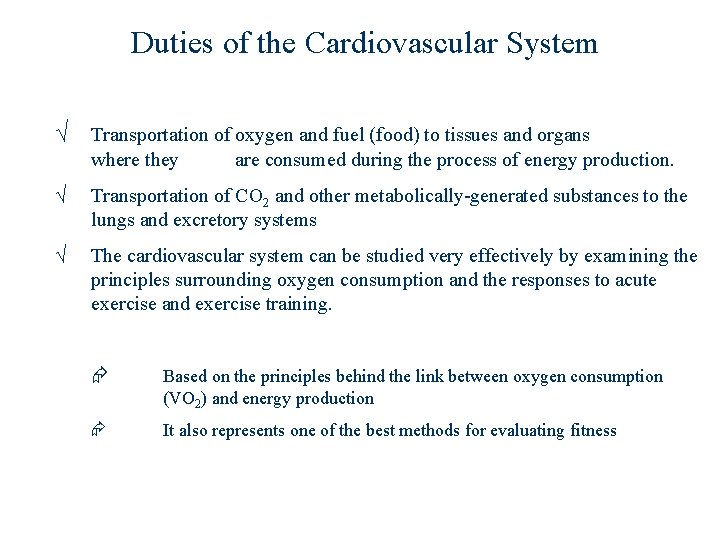
Duties of the Cardiovascular System √ Transportation of oxygen and fuel (food) to tissues and organs where they are consumed during the process of energy production. √ Transportation of CO 2 and other metabolically-generated substances to the lungs and excretory systems √ The cardiovascular system can be studied very effectively by examining the principles surrounding oxygen consumption and the responses to acute exercise and exercise training. Æ Based on the principles behind the link between oxygen consumption (VO 2) and energy production Æ It also represents one of the best methods for evaluating fitness
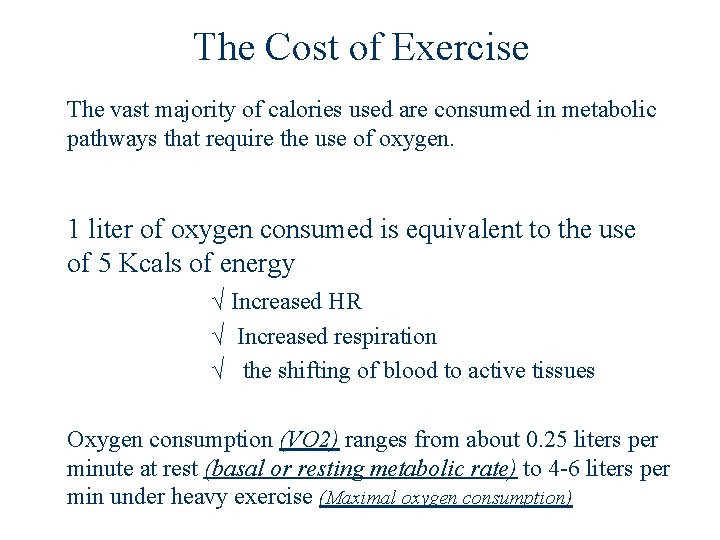
The Cost of Exercise The vast majority of calories used are consumed in metabolic pathways that require the use of oxygen. 1 liter of oxygen consumed is equivalent to the use of 5 Kcals of energy √ Increased HR √ Increased respiration √ the shifting of blood to active tissues Oxygen consumption (VO 2) ranges from about 0. 25 liters per minute at rest (basal or resting metabolic rate) to 4 -6 liters per min under heavy exercise (Maximal oxygen consumption)
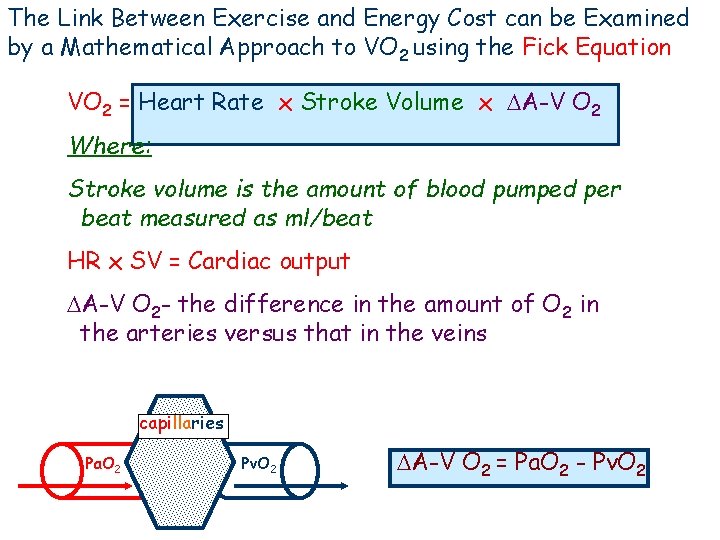
The Link Between Exercise and Energy Cost can be Examined by a Mathematical Approach to VO 2 using the Fick Equation VO 2 = Heart Rate x Stroke Volume x A-V O 2 Where: Stroke volume is the amount of blood pumped per beat measured as ml/beat HR x SV = Cardiac output A-V O 2 - the difference in the amount of O 2 in the arteries versus that in the veins capillaries Pa. O 2 Pv. O 2 A-V O 2 = Pa. O 2 - Pv. O 2
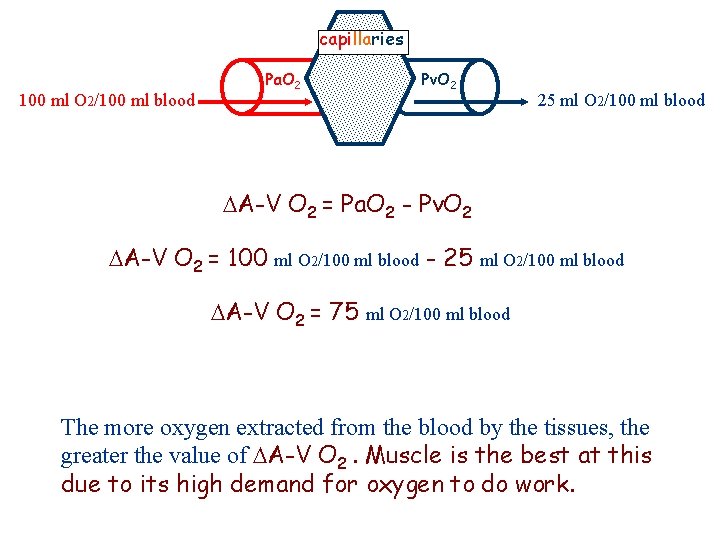
capillaries 100 ml O 2/100 ml blood Pa. O 2 Pv. O 2 25 ml O 2/100 ml blood A-V O 2 = Pa. O 2 - Pv. O 2 A-V O 2 = 100 ml O 2/100 ml blood A-V O 2 = 75 - 25 ml O 2/100 ml blood The more oxygen extracted from the blood by the tissues, the greater the value of A-V O 2. Muscle is the best at this due to its high demand for oxygen to do work.
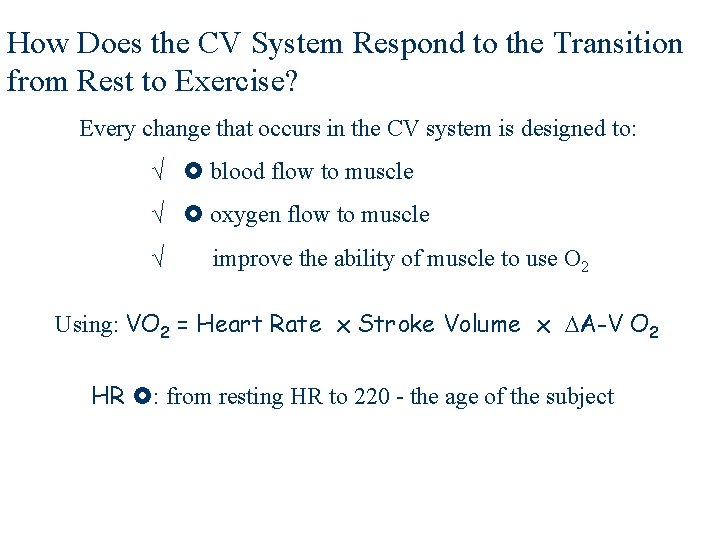
How Does the CV System Respond to the Transition from Rest to Exercise? Every change that occurs in the CV system is designed to: √ blood flow to muscle √ oxygen flow to muscle √ improve the ability of muscle to use O 2 Using: VO 2 = Heart Rate x Stroke Volume x A-V O 2 HR : from resting HR to 220 - the age of the subject
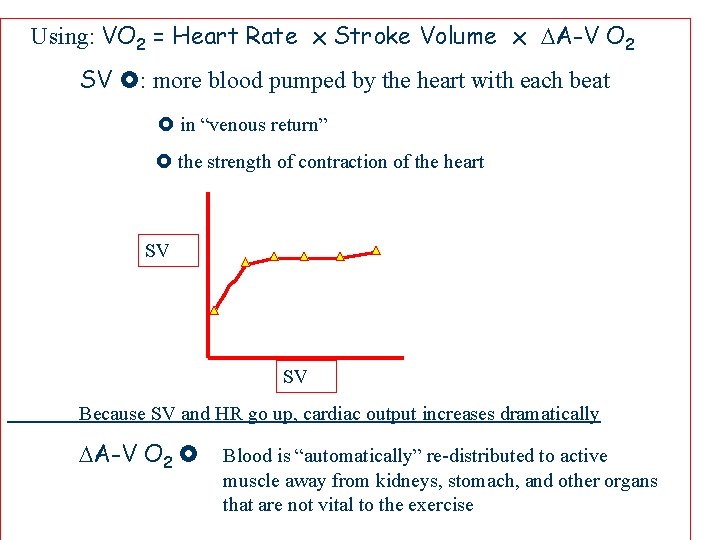
Using: VO 2 = Heart Rate x Stroke Volume x A-V O 2 SV : more blood pumped by the heart with each beat in “venous return” the strength of contraction of the heart SV SV Because SV and HR go up, cardiac output increases dramatically A-V O 2 Blood is “automatically” re-distributed to active muscle away from kidneys, stomach, and other organs that are not vital to the exercise
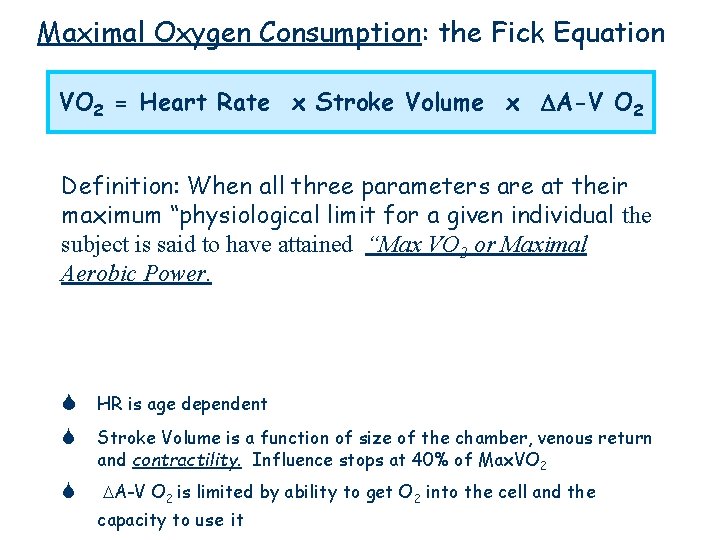
Maximal Oxygen Consumption: the Fick Equation VO 2 = Heart Rate x Stroke Volume x A-V O 2 Definition: When all three parameters are at their maximum “physiological limit for a given individual the subject is said to have attained “Max VO 2 or Maximal Aerobic Power. S HR is age dependent S Stroke Volume is a function of size of the chamber, venous return and contractility. Influence stops at 40% of Max. VO 2 S A-V O 2 is limited by ability to get O 2 into the cell and the capacity to use it
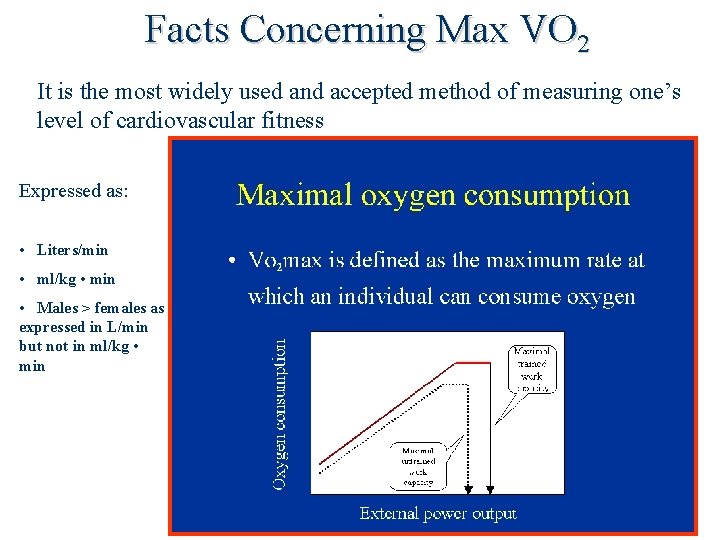
Facts Concerning Max VO 2 It is the most widely used and accepted method of measuring one’s level of cardiovascular fitness Expressed as: • Liters/min • ml/kg • min • Males > females as expressed in L/min but not in ml/kg • min
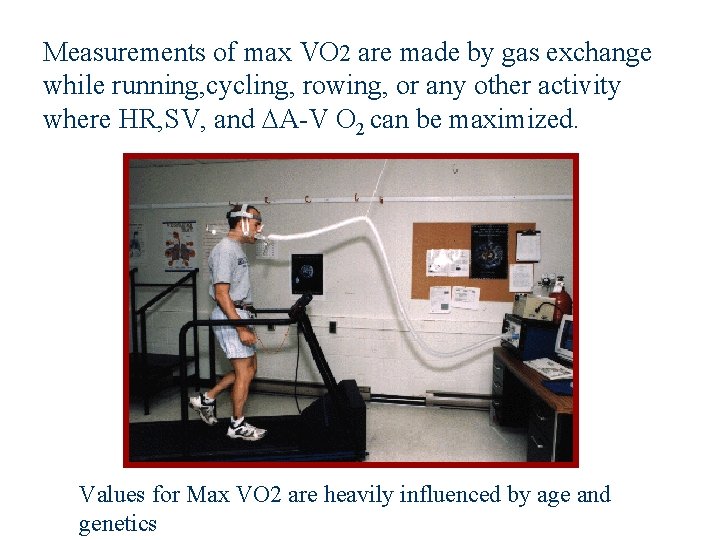
Measurements of max VO 2 are made by gas exchange while running, cycling, rowing, or any other activity where HR, SV, and A-V O 2 can be maximized. Values for Max VO 2 are heavily influenced by age and genetics