
Dutch Approach to Risk Assessment of Genotoxic Carcinogens


- Slides: 35
Dutch Approach to Risk Assessment of Genotoxic Carcinogens Beoordeling van Dinant Kroese beroepsmatige blootstelling in de praktijk van de regelgeving TNO | Knowledge for Business …een vruchtbare combinatie The skin is not the limit……. . Joop J. van Hemmen TNO Senior Research Fellow in Occupational Toxicology TNO Chemistry, Food & Chemical Risk Analysis Chemical Exposure assessment Te. ACH Dutch Approach to RA of GCTechnical Assistance in the Field of Chemicals Slide 1
TNO: Netherlands Organisation for Applied Scientific Research • Knowledge and Technology Provider • Established in 1932 (by Act of Parliament) • • • Dutch Approach to RA of GC Independent from Government Revenue Generating Not for Profit Second largest of its kind in Europe 5500 employees Serving 5 Core Areas 2
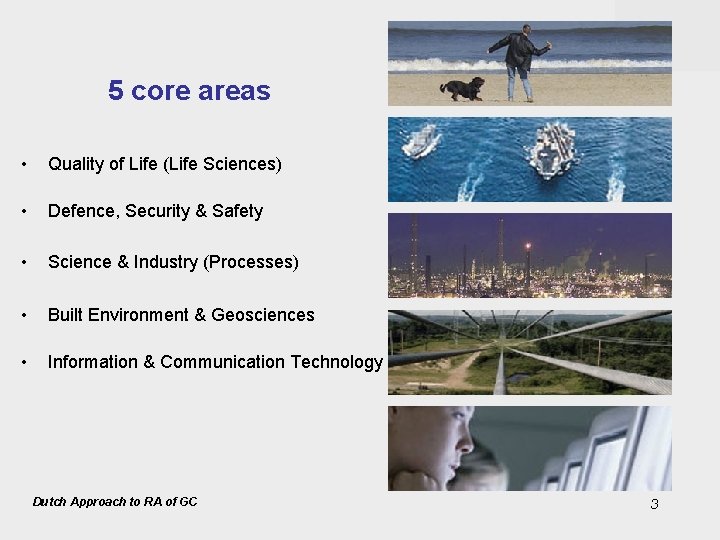
5 core areas • Quality of Life (Life Sciences) • Defence, Security & Safety • Science & Industry (Processes) • Built Environment & Geosciences • Information & Communication Technology Dutch Approach to RA of GC 3
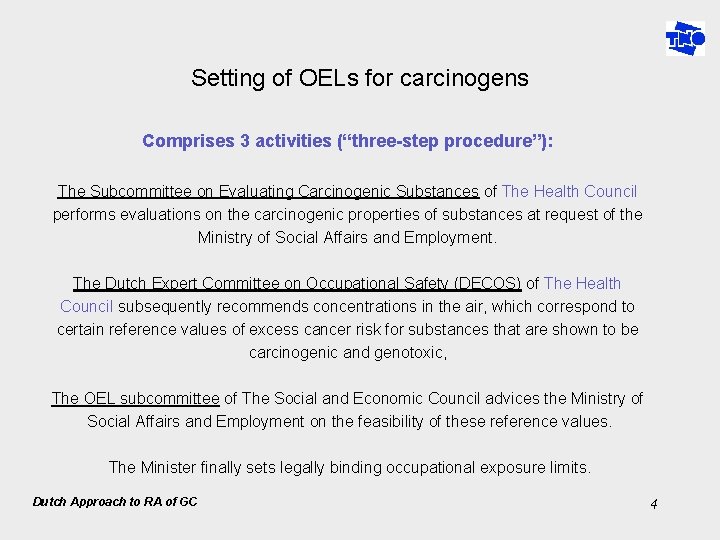
Setting of OELs for carcinogens Comprises 3 activities (“three-step procedure”): The Subcommittee on Evaluating Carcinogenic Substances of The Health Council performs evaluations on the carcinogenic properties of substances at request of the Ministry of Social Affairs and Employment. The Dutch Expert Committee on Occupational Safety (DECOS) of The Health Council subsequently recommends concentrations in the air, which correspond to certain reference values of excess cancer risk for substances that are shown to be carcinogenic and genotoxic, The OEL subcommittee of The Social and Economic Council advices the Ministry of Social Affairs and Employment on the feasibility of these reference values. The Minister finally sets legally binding occupational exposure limits. Dutch Approach to RA of GC 4
Health Council of The Netherlands Independent advisory board of the government of which members are selected from the scientific and healthcare communities. The areas of activity are health and healthcare, health and nutrition, and health and environment. Advisory reports are produced in autonomous, multidisciplinary ad-hoc or semi-permanent committees comprising both members of the council and external experts. Dutch Approach to RA of GC 5
Social and Economic Council of The Netherlands The SER is an independent advisory board to the government in which employers and employees are participating. Committees are responsible for the advices to the government. Dutch Approach to RA of GC 6
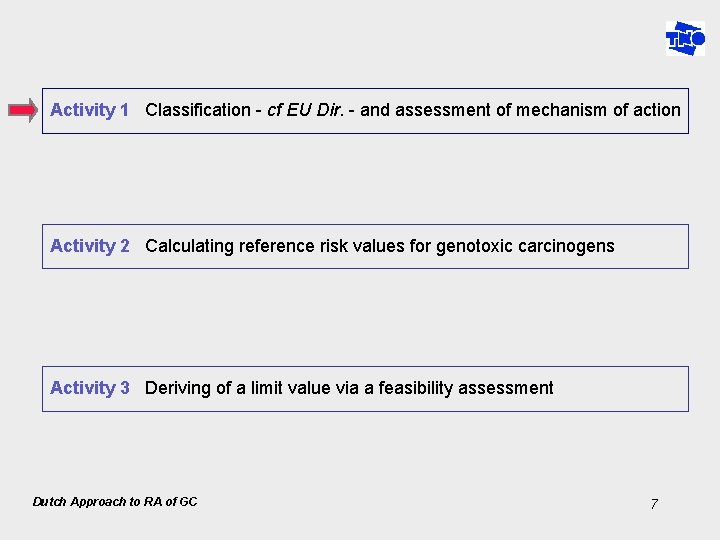
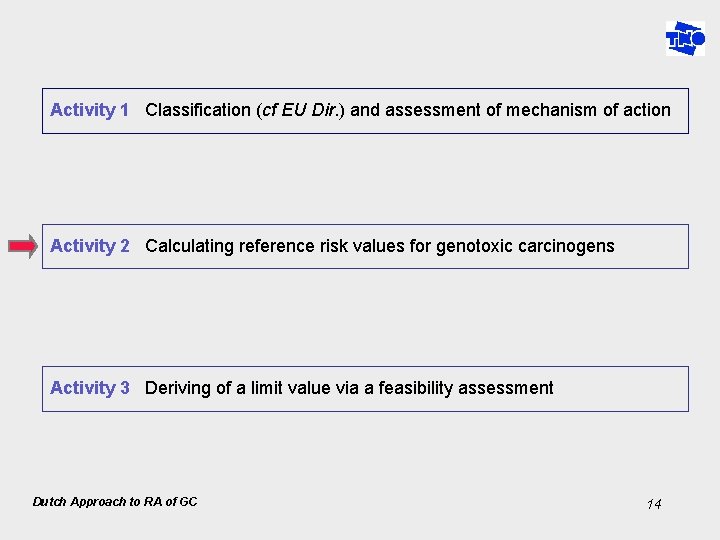
Activity 1 Classification - cf EU Dir. - and assessment of mechanism of action Activity 2 Calculating reference risk values for genotoxic carcinogens Activity 3 Deriving of a limit value via a feasibility assessment Dutch Approach to RA of GC 7
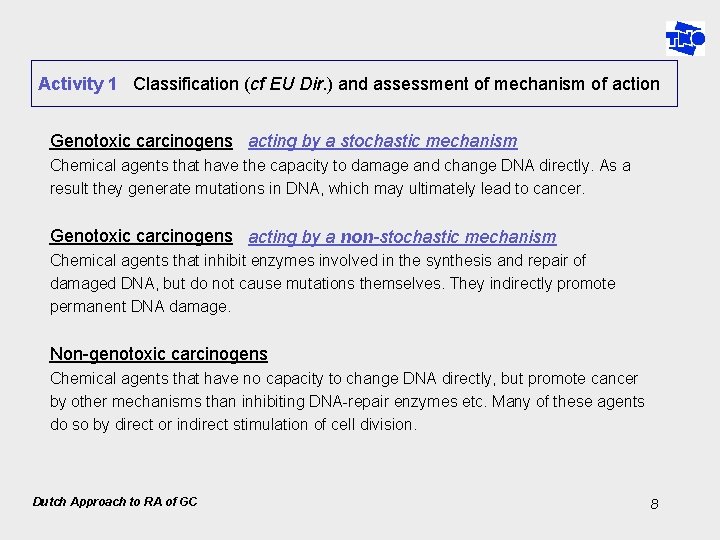
Activity 1 Classification (cf EU Dir. ) and assessment of mechanism of action Genotoxic carcinogens acting by a stochastic mechanism Chemical agents that have the capacity to damage and change DNA directly. As a result they generate mutations in DNA, which may ultimately lead to cancer. Genotoxic carcinogens acting by a non-stochastic mechanism Chemical agents that inhibit enzymes involved in the synthesis and repair of damaged DNA, but do not cause mutations themselves. They indirectly promote permanent DNA damage. Non-genotoxic carcinogens Chemical agents that have no capacity to change DNA directly, but promote cancer by other mechanisms than inhibiting DNA-repair enzymes etc. Many of these agents do so by direct or indirect stimulation of cell division. Dutch Approach to RA of GC 8
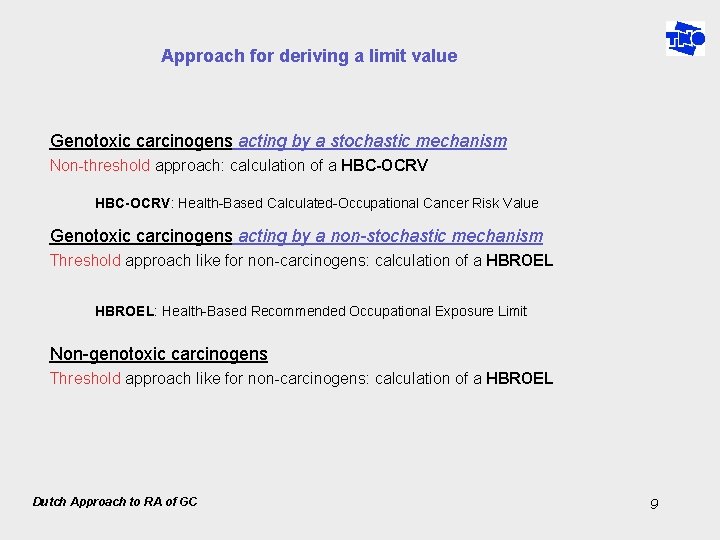
Approach for deriving a limit value Genotoxic carcinogens acting by a stochastic mechanism Non-threshold approach: calculation of a HBC-OCRV: Health-Based Calculated-Occupational Cancer Risk Value Genotoxic carcinogens acting by a non-stochastic mechanism Threshold approach like for non-carcinogens: calculation of a HBROEL: Health-Based Recommended Occupational Exposure Limit Non-genotoxic carcinogens Threshold approach like for non-carcinogens: calculation of a HBROEL Dutch Approach to RA of GC 9
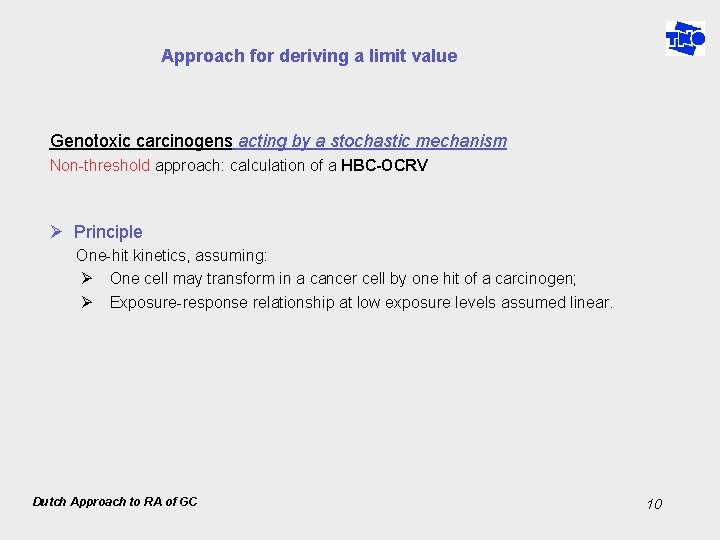
Approach for deriving a limit value Genotoxic carcinogens acting by a stochastic mechanism Non-threshold approach: calculation of a HBC-OCRV Ø Principle One-hit kinetics, assuming: Ø One cell may transform in a cancer cell by one hit of a carcinogen; Ø Exposure-response relationship at low exposure levels assumed linear. Dutch Approach to RA of GC 10
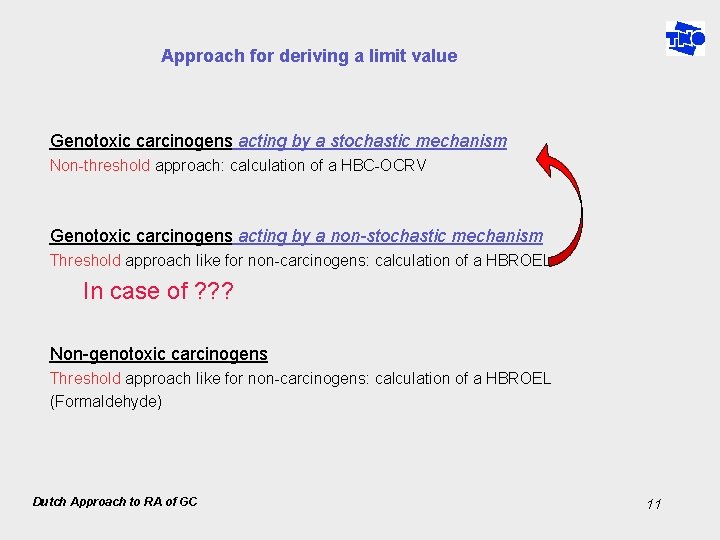
Approach for deriving a limit value Genotoxic carcinogens acting by a stochastic mechanism Non-threshold approach: calculation of a HBC-OCRV Genotoxic carcinogens acting by a non-stochastic mechanism Threshold approach like for non-carcinogens: calculation of a HBROEL In case of ? ? ? Non-genotoxic carcinogens Threshold approach like for non-carcinogens: calculation of a HBROEL (Formaldehyde) Dutch Approach to RA of GC 11
Report cover Dutch Approach to RA of GC 12
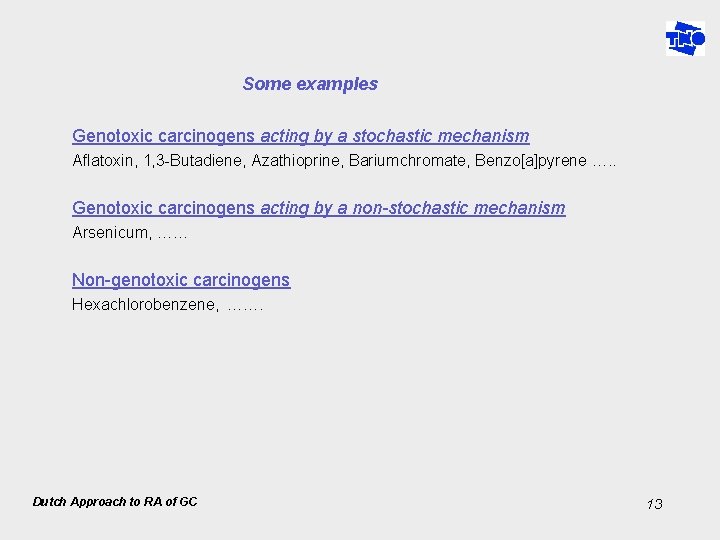
Some examples Genotoxic carcinogens acting by a stochastic mechanism Aflatoxin, 1, 3 -Butadiene, Azathioprine, Bariumchromate, Benzo[a]pyrene …. . Genotoxic carcinogens acting by a non-stochastic mechanism Arsenicum, …… Non-genotoxic carcinogens Hexachlorobenzene, ……. Dutch Approach to RA of GC 13
Activity 1 Classification (cf EU Dir. ) and assessment of mechanism of action Activity 2 Calculating reference risk values for genotoxic carcinogens Activity 3 Deriving of a limit value via a feasibility assessment Dutch Approach to RA of GC 14
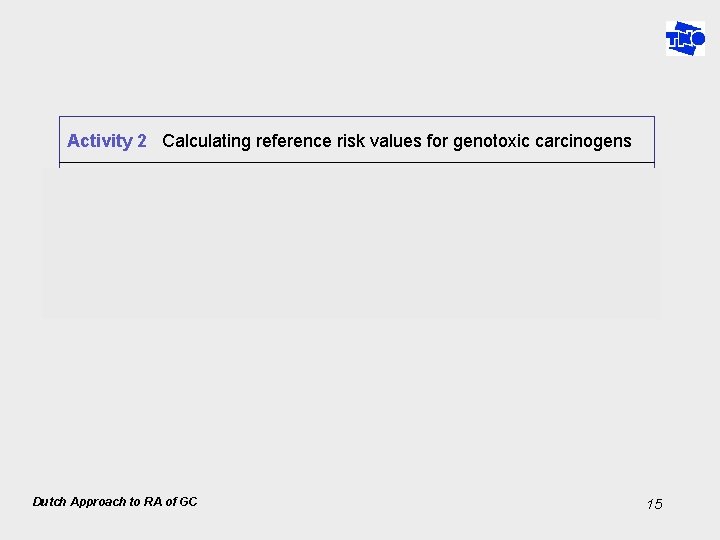
Activity 2 Calculating reference risk values for genotoxic carcinogens Step 1 Selection of key study Step 2 Calculating carcinogenic activity Iconcentration Step 3 Calculating cancer risk for workplace exposure: HBC-ORCV Step 4 Calculating reference values of excess cancer Dutch Approach to RA of GC 15
Step 1 Selection of key study Ø Preferably human cancer mortality data. However, in most cases it has to be based on animal data. Dutch Approach to RA of GC 16
Step 1 Selection of key study Ø Preferably human cancer mortality data. However, in most cases it has to be based on animal data. There is as yet no guidance for calculating a HBC-OCRV based on human data In practice different approaches have been applied: - A simple linear extrapolation using life tables if appropriate, - Using available dose response (using life tables if appropriate) See Goldbohm et al. , (2006) Risk estimation for carcinogens based on epidemiological data: A structural approach, illustrated by an example chromium. Regul. Toxicol. and Pharmacol. , 44, 294 -310. Dutch Approach to RA of GC 17
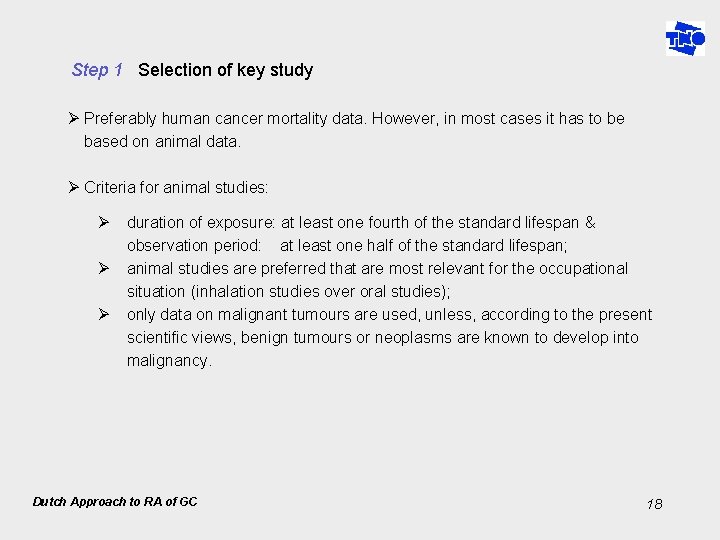
Step 1 Selection of key study Ø Preferably human cancer mortality data. However, in most cases it has to be based on animal data. Ø Criteria for animal studies: Ø Ø Ø duration of exposure: at least one fourth of the standard lifespan & observation period: at least one half of the standard lifespan; animal studies are preferred that are most relevant for the occupational situation (inhalation studies over oral studies); only data on malignant tumours are used, unless, according to the present scientific views, benign tumours or neoplasms are known to develop into malignancy. Dutch Approach to RA of GC 18
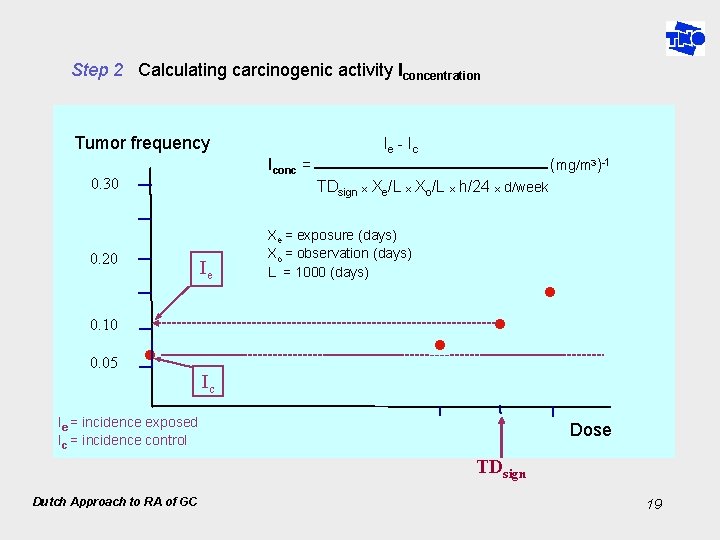
Step 2 Calculating carcinogenic activity Iconcentration Tumor frequency Iconc = 0. 30 ( mg/m 3)-1 TDsign x Xe/L x Xo/L x h/24 x d/week 0. 20 Ie 0. 10 0. 05 Ie - Ic • Xe = exposure (days) Xo = observation (days) L = 1000 (days) • • • Ic Ie = incidence exposed Ic = incidence control Dose TDsign Dutch Approach to RA of GC 19
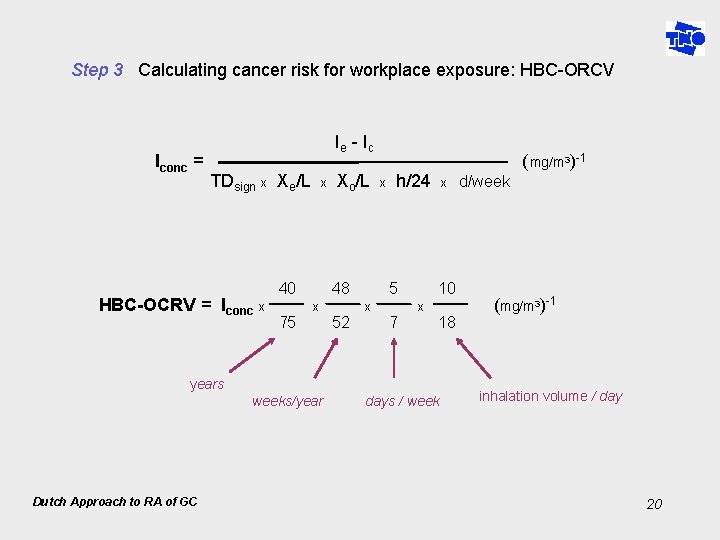
Step 3 Calculating cancer risk for workplace exposure: HBC-ORCV Iconc = Ie - Ic TDsign x Xe/L HBC-OCRV = Iconc x x 40 Xo/L 48 x 75 x h/24 5 x 52 ( mg/m 3)-1 x 10 x 7 18 years weeks/year Dutch Approach to RA of GC days / week d/week (mg/m 3)-1 inhalation volume / day 20
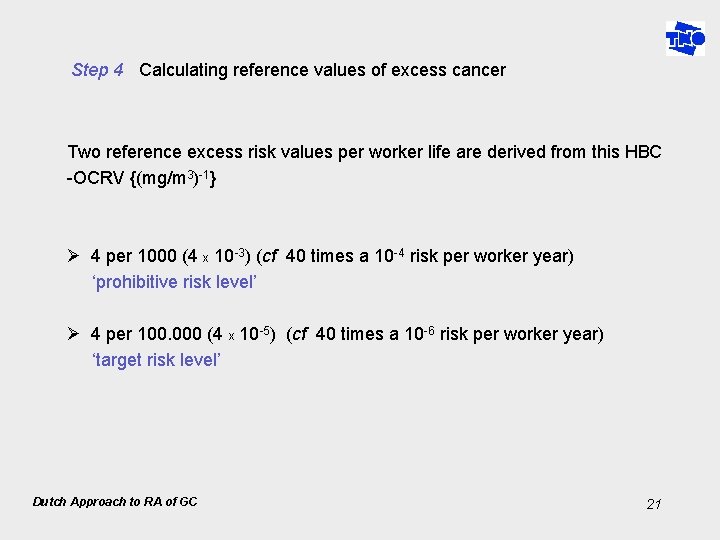
Step 4 Calculating reference values of excess cancer Two reference excess risk values per worker life are derived from this HBC -OCRV {(mg/m 3)-1} Ø 4 per 1000 (4 x 10 -3) (cf 40 times a 10 -4 risk per worker year) ‘prohibitive risk level’ Ø 4 per 100. 000 (4 x 10 -5) (cf 40 times a 10 -6 risk per worker year) ‘target risk level’ Dutch Approach to RA of GC 21
Report cover Dutch Approach to RA of GC 22
Some remarks It is assumed that no differences exist between experimental animals and humans with respect to kinetics, mechanism of tumour induction, target susceptibility etc. However, in case relevant data on differences between experimental animals and humans are available, these will be taken into account. Dutch Approach to RA of GC 23
Activity 1 Classification (cf EU Dir. ) and assessment of mechanism of action Activity 2 Calculating reference risk values for genotoxic carcinogens Activity 3 Deriving of a limit value via a feasibility assessment Dutch Approach to RA of GC 24
Activity 3 Derivation of a limit value via a feasibility assessment second step in “three-step procedure” Substances that are genotoxic carcinogenic will be subjected to a feasibility evaluation (technical and economical), which is given as an advice to the Minister of Social Affairs Dutch Approach to RA of GC 25
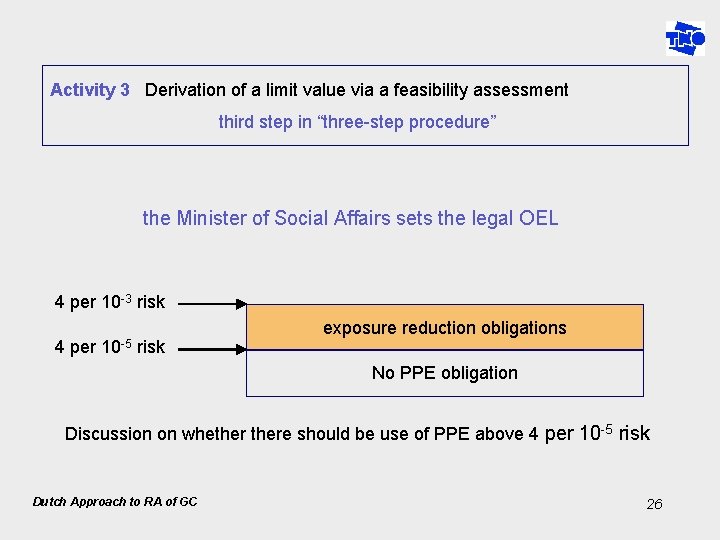
Activity 3 Derivation of a limit value via a feasibility assessment third step in “three-step procedure” the Minister of Social Affairs sets the legal OEL 4 per 10 -3 risk 4 per 10 -5 risk exposure reduction obligations No PPE obligation Discussion on whethere should be use of PPE above 4 per 10 -5 risk Dutch Approach to RA of GC 26
References Calculating Cancer Risk. Health Council of the Netherlands: Dutch Expert Committee on Occupational Standards (DECOS). The Hague, 1995. Publication No. 1995/06 WGD www. gr. nl www. healthcouncil. nl DECOS is currently revising its Guidelines; Publication is expected end 2009. Dutch Approach to RA of GC 27
Special thanks to: Ms Aafje van der Burght Scientific secretary of Subcommittee Evaluating Carcinogenic Substances & DECOS Both Committees of the Health Council of the Netherlands Dutch Approach to RA of GC 28
Thank you for your attention! Dutch Approach to RA of GC 29
Dutch Approach to RA of GC 30
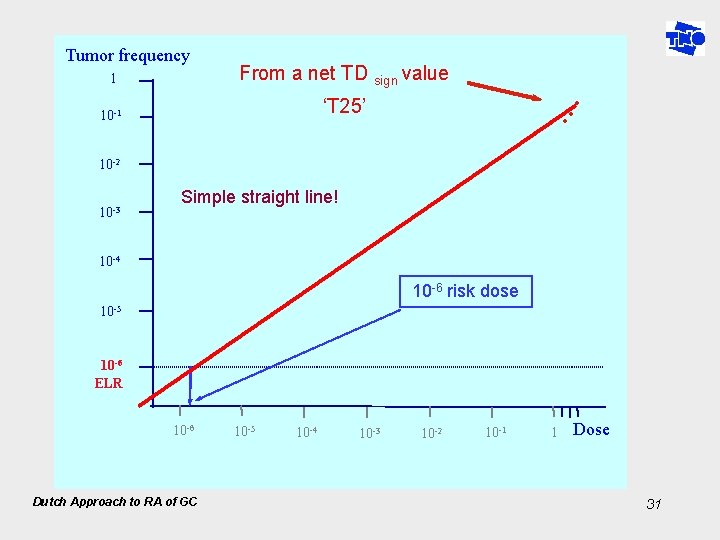
Tumor frequency 1 From a net TD sign value 10 -1 ‘T 25’ • • • 10 -2 10 -3 Simple straight line! 10 -4 10 -6 risk dose 10 -5 10 -6 ELR 10 -6 Dutch Approach to RA of GC 10 -5 10 -4 10 -3 10 -2 10 -1 1 Dose 31
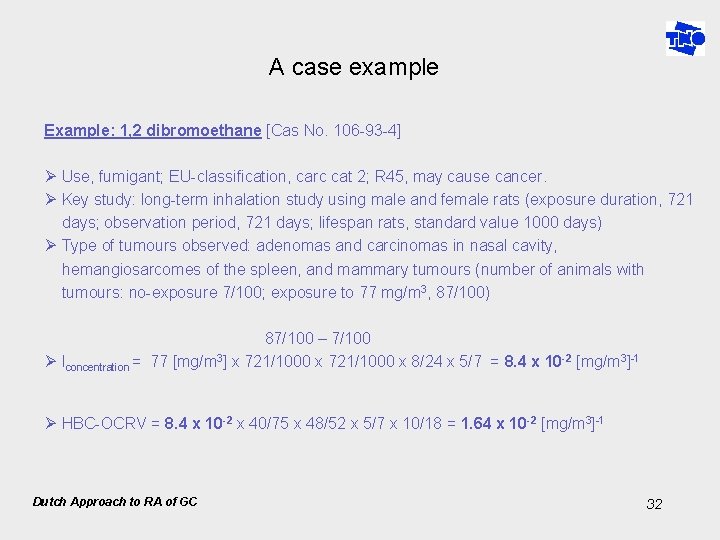
A case example Example: 1, 2 dibromoethane [Cas No. 106 -93 -4] Ø Use, fumigant; EU-classification, carc cat 2; R 45, may cause cancer. Ø Key study: long-term inhalation study using male and female rats (exposure duration, 721 days; observation period, 721 days; lifespan rats, standard value 1000 days) Ø Type of tumours observed: adenomas and carcinomas in nasal cavity, hemangiosarcomes of the spleen, and mammary tumours (number of animals with tumours: no-exposure 7/100; exposure to 77 mg/m 3, 87/100) 87/100 – 7/100 Ø Iconcentration = 77 [mg/m 3] x 721/1000 x 8/24 x 5/7 = 8. 4 x 10 -2 [mg/m 3]-1 Ø HBC-OCRV = 8. 4 x 10 -2 x 40/75 x 48/52 x 5/7 x 10/18 = 1. 64 x 10 -2 [mg/m 3]-1 Dutch Approach to RA of GC 32
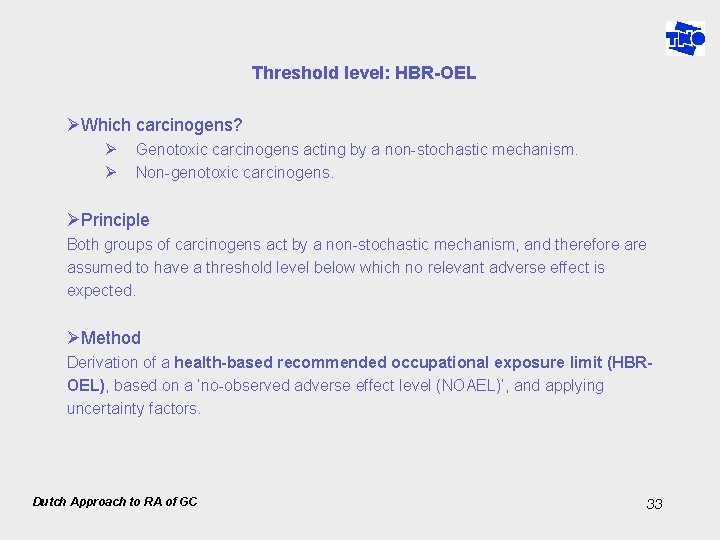
Threshold level: HBR-OEL ØWhich carcinogens? Ø Ø Genotoxic carcinogens acting by a non-stochastic mechanism. Non-genotoxic carcinogens. ØPrinciple Both groups of carcinogens act by a non-stochastic mechanism, and therefore assumed to have a threshold level below which no relevant adverse effect is expected. ØMethod Derivation of a health-based recommended occupational exposure limit (HBROEL), based on a ‘no-observed adverse effect level (NOAEL)’, and applying uncertainty factors. Dutch Approach to RA of GC 33
Dutch Approach to RA of GC 34
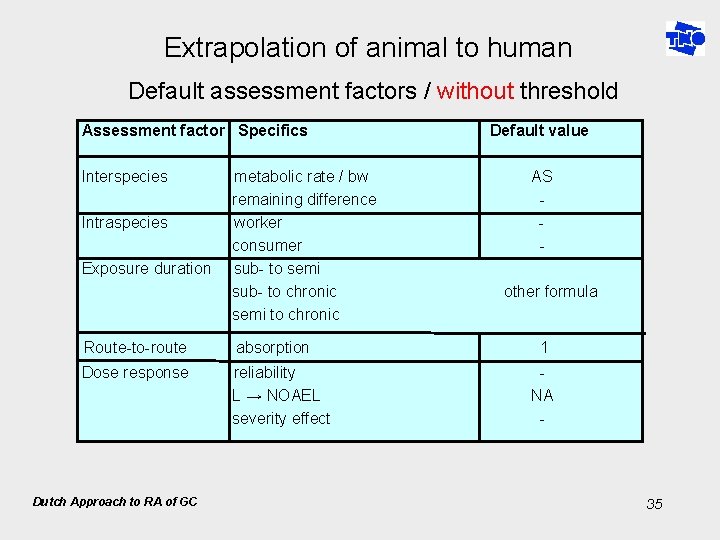
Extrapolation of animal to human Default assessment factors / without threshold Assessment factor Specifics Interspecies Intraspecies Exposure duration metabolic rate / bw remaining difference worker consumer sub- to semi sub- to chronic semi to chronic Route-to-route absorption Dose response reliability L → NOAEL severity effect Dutch Approach to RA of GC Default value AS other formula 1 NA - 35