
DURABLE EFFICACY OF DOLUTEGRAVIR DTG PLUS LAMIVUDINE 3
DURABLE EFFICACY OF DOLUTEGRAVIR (DTG) PLUS LAMIVUDINE (3 TC) IN ANTIRETROVIRAL TREATMENT –NAIVE ADULTS WITH HIV-1 INFECTION: 96 WEEK RESULTS FROM THE GEMINI STUDIES P Cahn, 1 J Sierra Madero, 2 J Arribas, 3 A Antinori, 4 R Ortiz, 5 A Clarke, 6, 7 C-C Hung, 8 J Rockstroh, 9 P-M Girard, 10 J Sievers, 11 C Man, 12 R Urbaityte, 13 M Underwood, 12 A Tenorio, 12 K Pappa, 12 B Wynne, 12 M Gartland, 12 M Aboud, 11 J van Wyk, 11 KY Smith 12 1 Fundación Huesped, Buenos Aires, Argentina; 2 Instituto Nacional de Ciencias Médicas y Nutrición Salvador Zubirán, Mexico City, Mexico; La Paz, Madrid, Spain; 4 Istituto Nazionale per le Malattie Infettive Lazzaro Spallanzani, Rome, Italy; 5 Bliss Healthcare Services, Orlando, FL, USA; 6 Royal Sussex County Hospital, Brighton, UK; 7 Brighton & Sussex Medical School, Brighton, UK; 8 National Taiwan University Hospital, Taipei, Taiwan; 9 Rheinische Friedrich-Wilhelms Universität, Bonn, Germany; 10 Hôpital Saint Antoine, Paris, France; 11 Vii. V Healthcare, Brentford, UK; 12 Vii. V Healthcare, Research Triangle Park, NC, USA; 13 Glaxo. Smith. Kline, Stockley Park, UK 3 Hospital 10 th IAS Conference on HIV Science; July 21– 24, 2019; Mexico City, Mexico
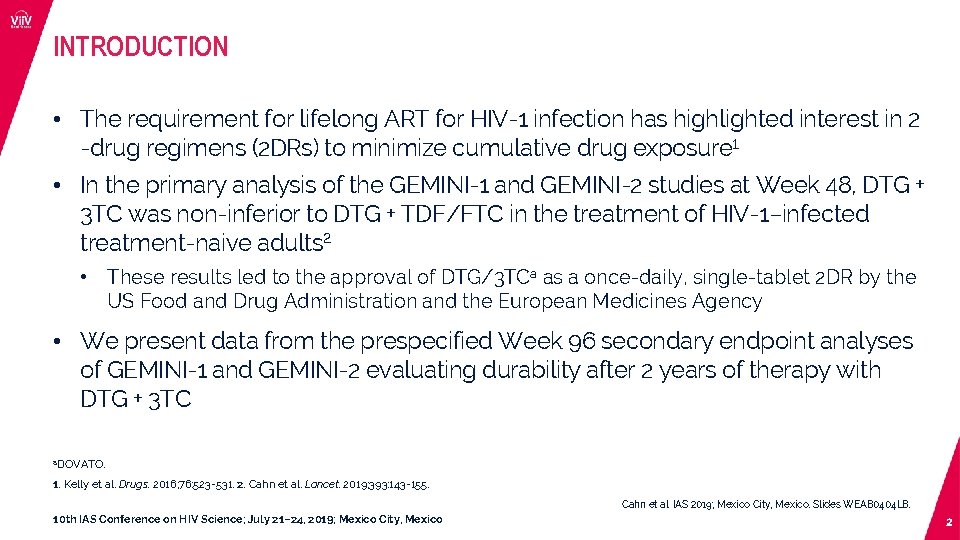
INTRODUCTION • The requirement for lifelong ART for HIV-1 infection has highlighted interest in 2 -drug regimens (2 DRs) to minimize cumulative drug exposure 1 • In the primary analysis of the GEMINI-1 and GEMINI-2 studies at Week 48, DTG + 3 TC was non-inferior to DTG + TDF/FTC in the treatment of HIV-1–infected treatment-naive adults 2 • These results led to the approval of DTG/3 TCa as a once-daily, single-tablet 2 DR by the US Food and Drug Administration and the European Medicines Agency • We present data from the prespecified Week 96 secondary endpoint analyses of GEMINI-1 and GEMINI-2 evaluating durability after 2 years of therapy with DTG + 3 TC a. DOVATO. 1. Kelly et al. Drugs. 2016; 76: 523 -531. 2. Cahn et al. Lancet. 2019; 393: 143 -155. Cahn et al. IAS 2019; Mexico City, Mexico. Slides WEAB 0404 LB. 10 th IAS Conference on HIV Science; July 21– 24, 2019; Mexico City, Mexico 2
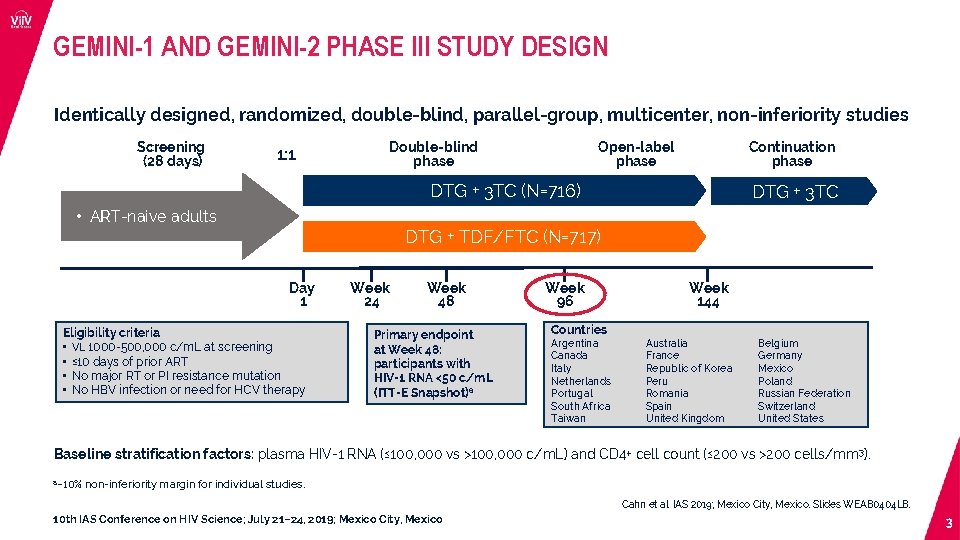
GEMINI-1 AND GEMINI-2 PHASE III STUDY DESIGN Identically designed, randomized, double-blind, parallel-group, multicenter, non-inferiority studies Screening (28 days) 1: 1 Double-blind phase Open-label phase Continuation phase DTG + 3 TC (N=716) DTG + 3 TC • ART-naive adults DTG + TDF/FTC (N=717) Day 1 Eligibility criteria • VL 1000 -500, 000 c/m. L at screening • ≤ 10 days of prior ART • No major RT or PI resistance mutation • No HBV infection or need for HCV therapy Week 24 Week 48 Primary endpoint at Week 48: participants with HIV-1 RNA <50 c/m. L (ITT-E Snapshot)a Week 96 Week 144 Countries Argentina Canada Italy Netherlands Portugal South Africa Taiwan Australia France Republic of Korea Peru Romania Spain United Kingdom Belgium Germany Mexico Poland Russian Federation Switzerland United States Baseline stratification factors: plasma HIV-1 RNA (≤ 100, 000 vs >100, 000 c/m. L) and CD 4+ cell count (≤ 200 vs >200 cells/mm 3). a− 10% non-inferiority margin for individual studies. Cahn et al. IAS 2019; Mexico City, Mexico. Slides WEAB 0404 LB. 10 th IAS Conference on HIV Science; July 21– 24, 2019; Mexico City, Mexico 3
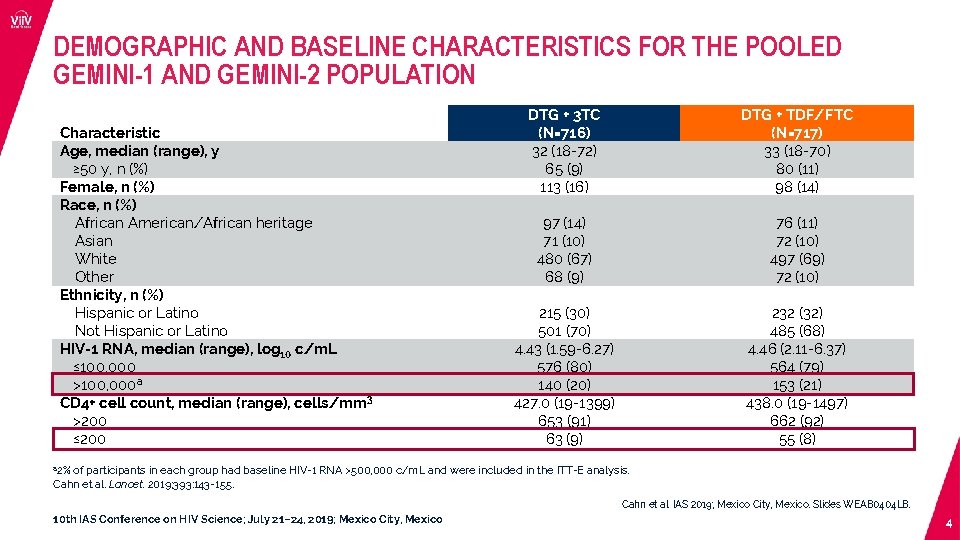
DEMOGRAPHIC AND BASELINE CHARACTERISTICS FOR THE POOLED GEMINI-1 AND GEMINI-2 POPULATION Characteristic Age, median (range), y ≥ 50 y, n (%) Female, n (%) Race, n (%) African American/African heritage Asian White Other Ethnicity, n (%) Hispanic or Latino Not Hispanic or Latino HIV-1 RNA, median (range), log 10 c/m. L ≤ 100, 000 >100, 000 a CD 4+ cell count, median (range), cells/mm 3 >200 ≤ 200 DTG + 3 TC (N=716) 32 (18 -72) 65 (9) 113 (16) DTG + TDF/FTC (N=717) 33 (18 -70) 80 (11) 98 (14) 97 (14) 71 (10) 480 (67) 68 (9) 76 (11) 72 (10) 497 (69) 72 (10) 215 (30) 501 (70) 4. 43 (1. 59 -6. 27) 576 (80) 140 (20) 427. 0 (19 -1399) 653 (91) 63 (9) 232 (32) 485 (68) 4. 46 (2. 11 -6. 37) 564 (79) 153 (21) 438. 0 (19 -1497) 662 (92) 55 (8) a 2% of participants in each group had baseline HIV-1 RNA >500, 000 c/m. L and were included in the ITT-E analysis. Cahn et al. Lancet. 2019; 393: 143 -155. Cahn et al. IAS 2019; Mexico City, Mexico. Slides WEAB 0404 LB. 10 th IAS Conference on HIV Science; July 21– 24, 2019; Mexico City, Mexico 4
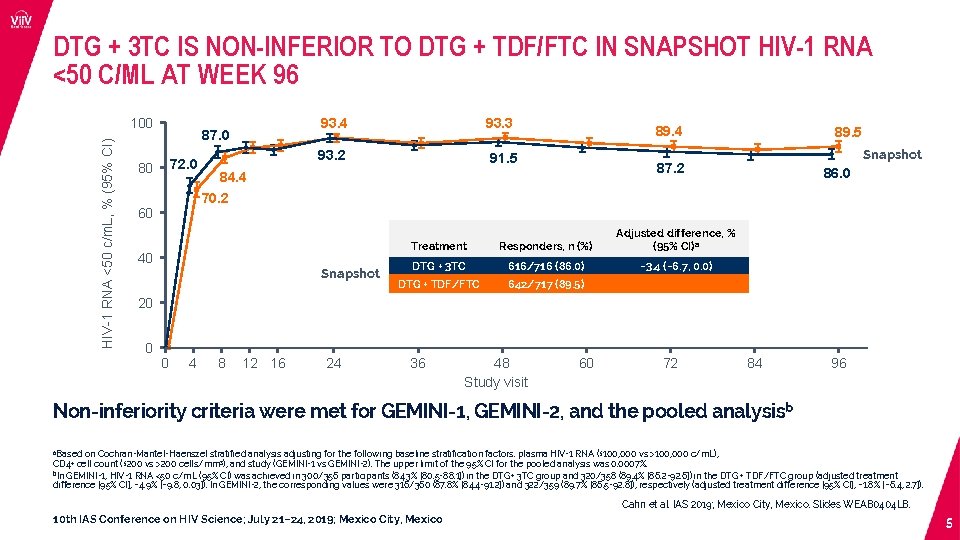
DTG + 3 TC IS NON-INFERIOR TO DTG + TDF/FTC IN SNAPSHOT HIV-1 RNA <50 C/ML AT WEEK 96 HIV-1 RNA <50 c/m. L, % (95% CI) 100 87. 0 72. 0 80 93. 3 93. 4 93. 2 89. 4 91. 5 89. 5 Snapshot 87. 2 84. 4 86. 0 70. 2 60 40 Snapshot Treatment Responders, n (%) Adjusted difference, % (95% CI)a DTG + 3 TC 616/716 (86. 0) − 3. 4 (− 6. 7, 0. 0) DTG + TDF/FTC 642/717 (89. 5) 20 0 0 4 8 12 16 24 36 48 Study visit 60 72 84 96 Non-inferiority criteria were met for GEMINI-1, GEMINI-2, and the pooled analysisb a. Based on Cochran-Mantel-Haenszel stratified analysis adjusting for the following baseline stratification factors: plasma HIV-1 RNA (≤ 100, 000 vs >100, 000 c/m. L), CD 4+ cell count (≤ 200 vs >200 cells/mm 3), and study (GEMINI-1 vs GEMINI-2). The upper limit of the 95% CI for the pooled analysis was 0. 0007%. b. In GEMINI-1, HIV-1 RNA <50 c/m. L (95% CI) was achieved in 300/356 participants (84. 3% [80. 5 -88. 1]) in the DTG + 3 TC group and 320/358 (89. 4% [86. 2 -92. 6]) in the DTG + TDF/FTC group (adjusted treatment difference [95% CI], − 4. 9% [− 9. 8, 0. 03]). In GEMINI-2, the corresponding values were 316/360 (87. 8% [84. 4 -91. 2]) and 322/359 (89. 7% [86. 5 -92. 8]), respectively (adjusted treatment difference [95% CI], − 1. 8% [− 6. 4, 2. 7]). Cahn et al. IAS 2019; Mexico City, Mexico. Slides WEAB 0404 LB. 10 th IAS Conference on HIV Science; July 21– 24, 2019; Mexico City, Mexico 5
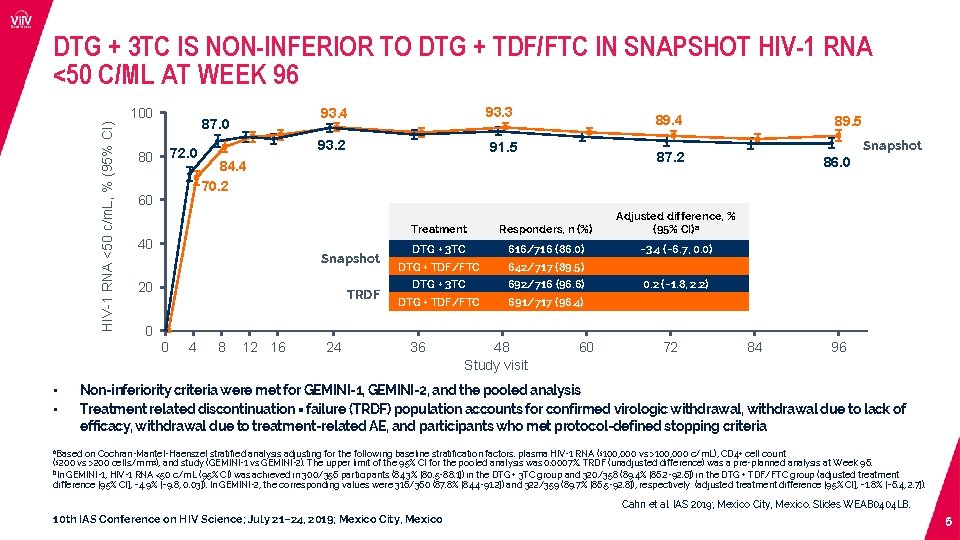
DTG + 3 TC IS NON-INFERIOR TO DTG + TDF/FTC IN SNAPSHOT HIV-1 RNA <50 C/ML AT WEEK 96 HIV-1 RNA <50 c/m. L, % (95% CI) 100 72. 0 80 60 93. 2 89. 4 91. 5 Snapshot 20 TRDF 89. 5 Snapshot 87. 2 84. 4 70. 2 40 Treatment Responders, n (%) Adjusted difference, % (95% CI)a DTG + 3 TC 616/716 (86. 0) − 3. 4 (− 6. 7, 0. 0) DTG + TDF/FTC 642/717 (89. 5) DTG + 3 TC 692/716 (96. 6) DTG + TDF/FTC 691/717 (96. 4) 86. 0 0. 2 (− 1. 8, 2. 2) 0 0 • • 93. 3 93. 4 87. 0 4 8 12 16 24 36 48 Study visit 60 72 84 96 Non-inferiority criteria were met for GEMINI-1, GEMINI-2, and the pooled analysis Treatment related discontinuation = failure (TRDF) population accounts for confirmed virologic withdrawal, withdrawal due to lack of efficacy, withdrawal due to treatment-related AE, and participants who met protocol-defined stopping criteria a. Based on Cochran-Mantel-Haenszel stratified analysis adjusting for the following baseline stratification factors: plasma HIV-1 RNA (≤ 100, 000 vs >100, 000 c/m. L), CD 4+ cell count (≤ 200 vs >200 cells/mm 3), and study (GEMINI-1 vs GEMINI-2). The upper limit of the 95% CI for the pooled analysis was 0. 0007%. TRDF (unadjusted difference) was a pre-planned analysis at Week 96. b. In GEMINI-1, HIV-1 RNA <50 c/m. L (95% CI) was achieved in 300/356 participants (84. 3% [80. 5 -88. 1]) in the DTG + 3 TC group and 320/358 (89. 4% [86. 2 -92. 6]) in the DTG + TDF/FTC group (adjusted treatment difference [95% CI], − 4. 9% [− 9. 8, 0. 03]). In GEMINI-2, the corresponding values were 316/360 (87. 8% [84. 4 -91. 2]) and 322/359 (89. 7% [86. 5 -92. 8]), respectively (adjusted treatment difference [95% CI], − 1. 8% [− 6. 4, 2. 7]). Cahn et al. IAS 2019; Mexico City, Mexico. Slides WEAB 0404 LB. 10 th IAS Conference on HIV Science; July 21– 24, 2019; Mexico City, Mexico 6
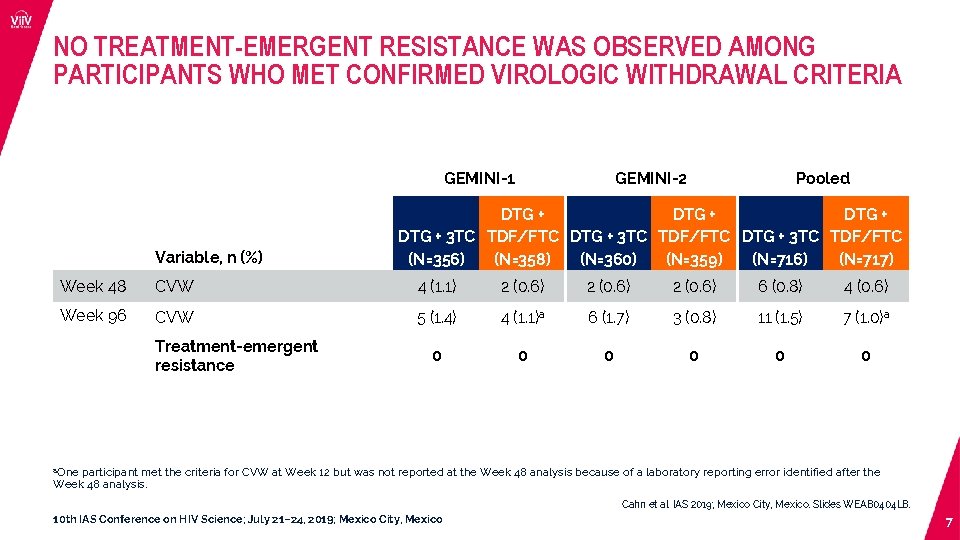
NO TREATMENT-EMERGENT RESISTANCE WAS OBSERVED AMONG PARTICIPANTS WHO MET CONFIRMED VIROLOGIC WITHDRAWAL CRITERIA GEMINI-1 Variable, n (%) GEMINI-2 Pooled DTG + 3 TC TDF/FTC DTG + 3 TC TDF/FTC (N=356) (N=358) (N=360) (N=359) (N=716) (N=717) Week 48 CVW 4 (1. 1) 2 (0. 6) 6 (0. 8) 4 (0. 6) Week 96 CVW 5 (1. 4) 4 (1. 1)a 6 (1. 7) 3 (0. 8) 11 (1. 5) 7 (1. 0)a 0 0 0 Treatment-emergent resistance a One participant met the criteria for CVW at Week 12 but was not reported at the Week 48 analysis because of a laboratory reporting error identified after the Week 48 analysis. Cahn et al. IAS 2019; Mexico City, Mexico. Slides WEAB 0404 LB. 10 th IAS Conference on HIV Science; July 21– 24, 2019; Mexico City, Mexico 7
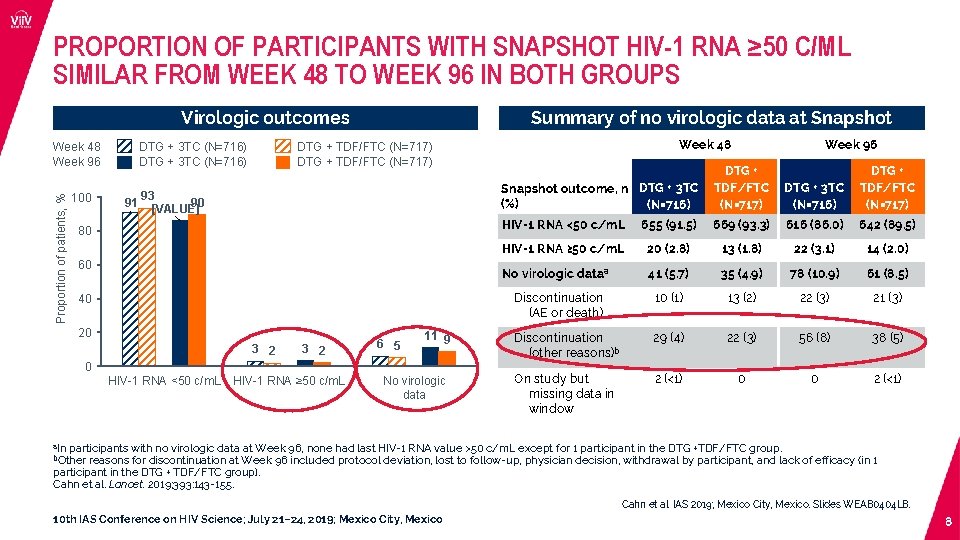
PROPORTION OF PARTICIPANTS WITH SNAPSHOT HIV-1 RNA ≥ 50 C/ML SIMILAR FROM WEEK 48 TO WEEK 96 IN BOTH GROUPS Virologic outcomes Proportion of patients, % Week 48 Week 96 100 DTG + 3 TC (N=716) Summary of no virologic data at Snapshot 93 90 91 [VALUE] 80 60 40 20 3 2 6 5 11 9 0 HIV-1 RNA <50 c/m. L Week 48 DTG + TDF/FTC (N=717) HIV-1 RNA ≥ 50 c/m. L No virologic data Week 96 Snapshot outcome, n DTG + 3 TC (%) (N=716) DTG + TDF/FTC (N=717) DTG + 3 TC (N=716) DTG + TDF/FTC (N=717) HIV-1 RNA <50 c/m. L 655 (91. 5) 669 (93. 3) 616 (86. 0) 642 (89. 5) HIV-1 RNA ≥ 50 c/m. L 20 (2. 8) 13 (1. 8) 22 (3. 1) 14 (2. 0) No virologic dataa 41 (5. 7) 35 (4. 9) 78 (10. 9) 61 (8. 5) Discontinuation (AE or death) 10 (1) 13 (2) 22 (3) 21 (3) Discontinuation (other reasons)b 29 (4) 22 (3) 56 (8) 38 (5) On study but missing data in window 2 (<1) 0 0 2 (<1) a. In participants with no virologic data at Week 96, none had last HIV-1 RNA value >50 c/m. L except for 1 participant in the DTG +TDF/FTC group. reasons for discontinuation at Week 96 included protocol deviation, lost to follow-up, physician decision, withdrawal by participant, and lack of efficacy (in 1 participant in the DTG + TDF/FTC group). Cahn et al. Lancet. 2019; 393: 143 -155. b. Other Cahn et al. IAS 2019; Mexico City, Mexico. Slides WEAB 0404 LB. 10 th IAS Conference on HIV Science; July 21– 24, 2019; Mexico City, Mexico 8
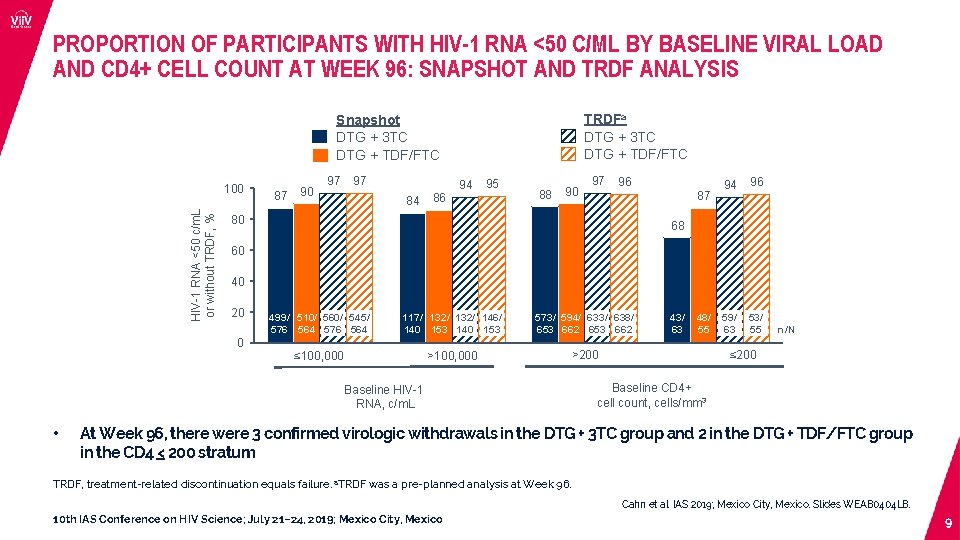
PROPORTION OF PARTICIPANTS WITH HIV-1 RNA <50 C/ML BY BASELINE VIRAL LOAD AND CD 4+ CELL COUNT AT WEEK 96: SNAPSHOT AND TRDF ANALYSIS TRDFa DTG + 3 TC DTG + TDF/FTC Snapshot DTG + 3 TC DTG + TDF/FTC HIV-1 RNA <50 c/m. L or without TRDF, % 100 87 90 97 97 84 86 94 95 88 90 96 87 80 94 96 59/ 63 53/ 55 68 60 40 20 0 499/ 510/ 560/ 545/ 576 564 117/ 132/ 146/ 140 153 573/ 594/ 633/ 638/ 653 662 ≤ 100, 000 >200 Baseline HIV-1 RNA, c/m. L • 97 43/ 63 48/ 55 n/N ≤ 200 Baseline CD 4+ cell count, cells/mm 3 At Week 96, there were 3 confirmed virologic withdrawals in the DTG + 3 TC group and 2 in the DTG + TDF/FTC group in the CD 4 < 200 stratum TRDF, treatment-related discontinuation equals failure. a. TRDF was a pre-planned analysis at Week 96. Cahn et al. IAS 2019; Mexico City, Mexico. Slides WEAB 0404 LB. 10 th IAS Conference on HIV Science; July 21– 24, 2019; Mexico City, Mexico 9
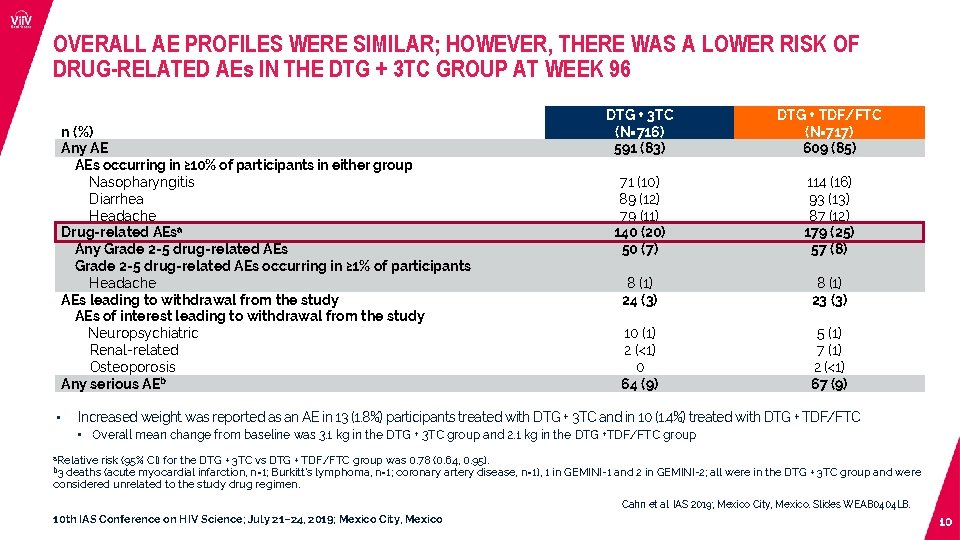
OVERALL AE PROFILES WERE SIMILAR; HOWEVER, THERE WAS A LOWER RISK OF DRUG-RELATED AEs IN THE DTG + 3 TC GROUP AT WEEK 96 n (%) Any AE AEs occurring in ≥ 10% of participants in either group Nasopharyngitis Diarrhea Headache Drug-related AEsa Any Grade 2 -5 drug-related AEs occurring in ≥ 1% of participants Headache AEs leading to withdrawal from the study AEs of interest leading to withdrawal from the study Neuropsychiatric Renal-related Osteoporosis Any serious AEb • DTG + 3 TC (N=716) 591 (83) DTG + TDF/FTC (N=717) 609 (85) 71 (10) 89 (12) 79 (11) 140 (20) 50 (7) 114 (16) 93 (13) 87 (12) 179 (25) 57 (8) 8 (1) 24 (3) 8 (1) 23 (3) 10 (1) 2 (<1) 0 64 (9) 5 (1) 7 (1) 2 (<1) 67 (9) Increased weight was reported as an AE in 13 (1. 8%) participants treated with DTG + 3 TC and in 10 (1. 4%) treated with DTG + TDF/FTC • Overall mean change from baseline was 3. 1 kg in the DTG + 3 TC group and 2. 1 kg in the DTG +TDF/FTC group a. Relative risk (95% CI) for the DTG + 3 TC vs DTG + TDF/FTC group was 0. 78 (0. 64, 0. 95). deaths (acute myocardial infarction, n=1; Burkitt’s lymphoma, n=1; coronary artery disease, n=1), 1 in GEMINI-1 and 2 in GEMINI-2; all were in the DTG + 3 TC group and were considered unrelated to the study drug regimen. b 3 Cahn et al. IAS 2019; Mexico City, Mexico. Slides WEAB 0404 LB. 10 th IAS Conference on HIV Science; July 21– 24, 2019; Mexico City, Mexico 10
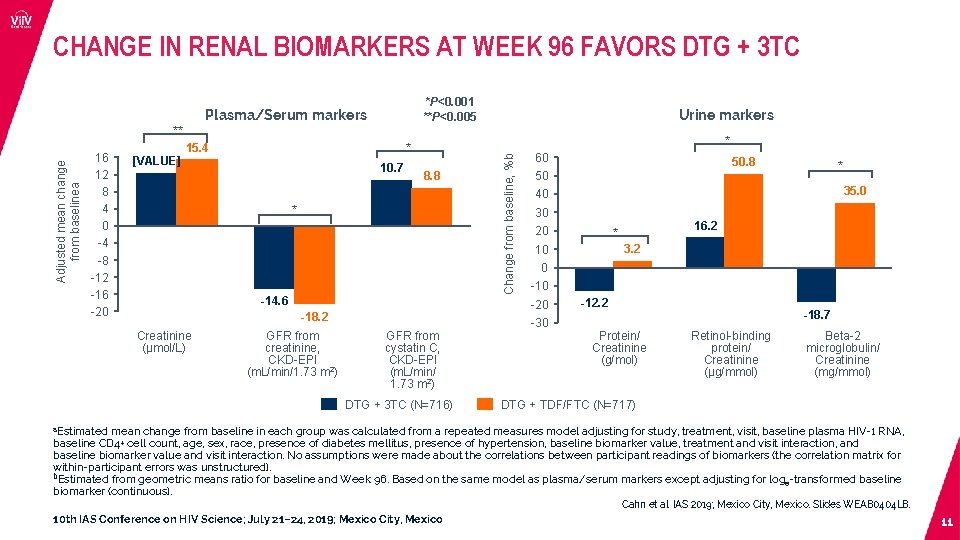
CHANGE IN RENAL BIOMARKERS AT WEEK 96 FAVORS DTG + 3 TC Adjusted mean change from baselinea * * 15. 4 [VALUE] 10. 7 8. 8 * -14. 6 GFR from creatinine, CKD-EPI (m. L/min/1. 73 m 2) 60 GFR from cystatin C, CKD-EPI (m. L/min/ 1. 73 m 2) DTG + 3 TC (N=716) 50. 8 * 50 35. 0 40 30 20 16. 2 * 3. 2 10 0 -10 -20 -18. 2 Creatinine (µmol/L) Urine markers Change from baseline, %b Plasma/Serum markers ** 16 12 8 4 0 -4 -8 -12 -16 -20 *P<0. 001 **P<0. 005 -30 -12. 2 -18. 7 Protein/ Creatinine (g/mol) Retinol-binding protein/ Creatinine (µg/mmol) Beta-2 microglobulin/ Creatinine (mg/mmol) DTG + TDF/FTC (N=717) a. Estimated mean change from baseline in each group was calculated from a repeated measures model adjusting for study, treatment, visit, baseline plasma HIV-1 RNA, baseline CD 4+ cell count, age, sex, race, presence of diabetes mellitus, presence of hypertension, baseline biomarker value, treatment and visit interaction, and baseline biomarker value and visit interaction. No assumptions were made about the correlations between participant readings of biomarkers (the correlation matrix for within-participant errors was unstructured). b. Estimated from geometric means ratio for baseline and Week 96. Based on the same model as plasma/serum markers except adjusting for log -transformed baseline e biomarker (continuous). Cahn et al. IAS 2019; Mexico City, Mexico. Slides WEAB 0404 LB. 10 th IAS Conference on HIV Science; July 21– 24, 2019; Mexico City, Mexico 11
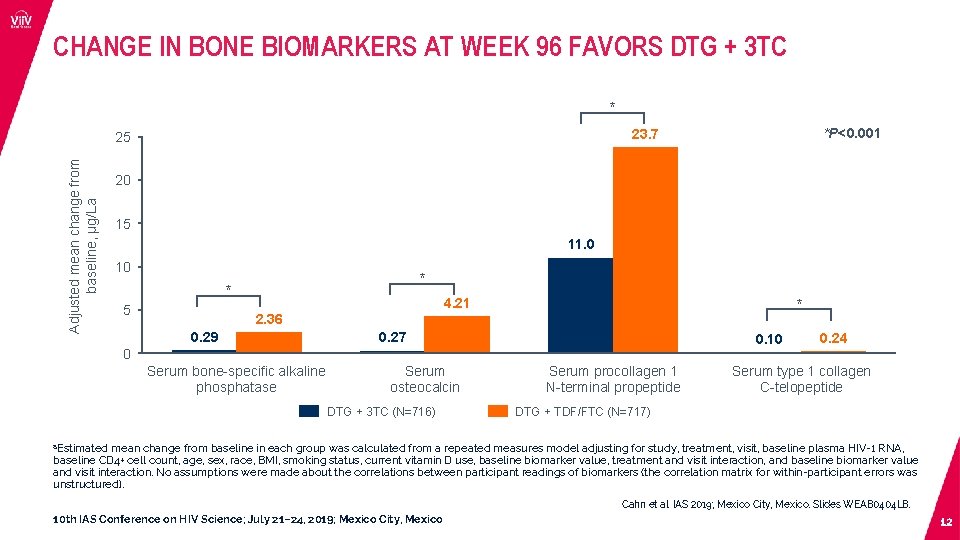
CHANGE IN BONE BIOMARKERS AT WEEK 96 FAVORS DTG + 3 TC * Adjusted mean change from baseline, µg/La *P<0. 001 23. 7 25 20 15 11. 0 10 * * 5 * 4. 21 2. 36 0. 29 0. 27 0. 10 0 Serum bone-specific alkaline phosphatase Serum osteocalcin DTG + 3 TC (N=716) Serum procollagen 1 N-terminal propeptide 0. 24 Serum type 1 collagen C-telopeptide DTG + TDF/FTC (N=717) a. Estimated mean change from baseline in each group was calculated from a repeated measures model adjusting for study, treatment, visit, baseline plasma HIV-1 RNA, baseline CD 4+ cell count, age, sex, race, BMI, smoking status, current vitamin D use, baseline biomarker value, treatment and visit interaction, and baseline biomarker value and visit interaction. No assumptions were made about the correlations between participant readings of biomarkers (the correlation matrix for within-participant errors was unstructured). Cahn et al. IAS 2019; Mexico City, Mexico. Slides WEAB 0404 LB. 10 th IAS Conference on HIV Science; July 21– 24, 2019; Mexico City, Mexico 12
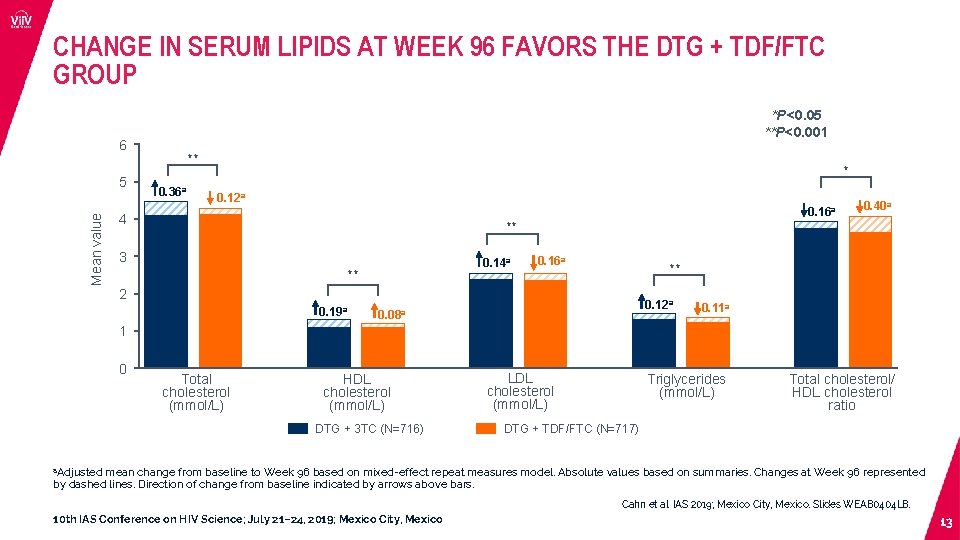
CHANGE IN SERUM LIPIDS AT WEEK 96 FAVORS THE DTG + TDF/FTC GROUP *P<0. 05 **P<0. 001 6 Mean value 5 ** 0. 36 a * 0. 12 a 4 0. 16 a ** 3 0. 14 a ** 2 0. 19 a 0. 16 a 0. 40 a ** 0. 12 a 0. 08 a 0. 11 a 1 0 Total cholesterol (mmol/L) HDL cholesterol (mmol/L) DTG + 3 TC (N=716) LDL cholesterol (mmol/L) Triglycerides (mmol/L) Total cholesterol/ HDL cholesterol ratio DTG + TDF/FTC (N=717) a. Adjusted mean change from baseline to Week 96 based on mixed-effect repeat measures model. Absolute values based on summaries. Changes at Week 96 represented by dashed lines. Direction of change from baseline indicated by arrows above bars. Cahn et al. IAS 2019; Mexico City, Mexico. Slides WEAB 0404 LB. 10 th IAS Conference on HIV Science; July 21– 24, 2019; Mexico City, Mexico 13
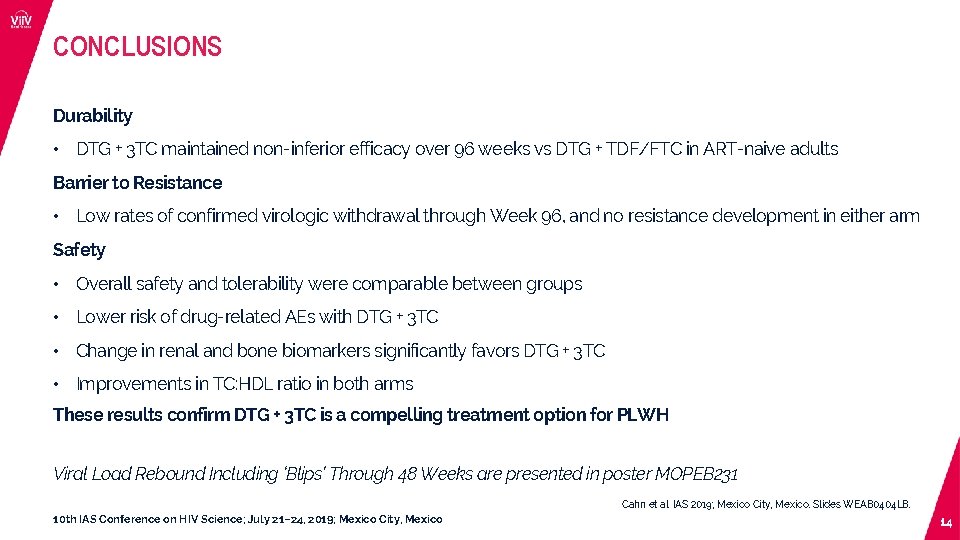
CONCLUSIONS Durability • DTG + 3 TC maintained non-inferior efficacy over 96 weeks vs DTG + TDF/FTC in ART-naive adults Barrier to Resistance • Low rates of confirmed virologic withdrawal through Week 96, and no resistance development in either arm Safety • Overall safety and tolerability were comparable between groups • Lower risk of drug-related AEs with DTG + 3 TC • Change in renal and bone biomarkers significantly favors DTG + 3 TC • Improvements in TC: HDL ratio in both arms These results confirm DTG + 3 TC is a compelling treatment option for PLWH Viral Load Rebound Including ‘Blips’ Through 48 Weeks are presented in poster MOPEB 231 Cahn et al. IAS 2019; Mexico City, Mexico. Slides WEAB 0404 LB. 10 th IAS Conference on HIV Science; July 21– 24, 2019; Mexico City, Mexico 14
ACKNOWLEDGMENTS We thank the study participants; their families and caregivers; investigators and site staff who participated in the study; and the Vii. V Healthcare, Glaxo. Smith. Kline, Pharmaceutical Product Development, and Parexel study team members Argentina Cahn Cassetti David Figueras Figueroa Losso Lopardo Lupo Porteiro Sánchez Australia Bloch Cooper Finlayson Kelleher Koh Lewis Mc. Mahon Moore Roth Shields Belgium De Wit Belgium (cont) Florence Goffard Demeester Lacor Vandercam Vandekerckhove Canada Angel Baril Conway de Pokomandy Szabo Walmsley France Bouchaud Chidiac Delobel Girard Goujard Katlama Molina Pialoux Philibert Germany Bogner Esser Krznaric Lehmann Rockstroh Spinner Stellbrink Stephan Stoehr Italy Antinori Barchi Caramello Castelli Cattelan D’Arminio Montforte Di Biargo Di Perri Gori Gulminetti Lazzarin Maggiolo Menzaghi Italy (cont) Migliorino Mussini Penco Puoti Quirino Rizzardini Sighinolfi Viale Mexico Amaya Tapia Andrade Villanueva Granados Reyes Sierra-Madero Perez Rios Santoscoy Gomez Netherlands Den Hollander Rijnders Peru Hidalgo Hercilla Illescas Poland Olczak Portugal Correia Pacheco Mansinho Saraiva da Cunha Sarmento e Castro Serrão Teófilo Romania Arbune Jianu Oprea Preotescu Prisacariu Russia Belonosova Borodkina Chernova Gankina Kizhlo Kulagin Kurina Nagimova Russia (cont) Pokrovsky Riamova Voronin Yakovlev South Africa Kaplan South Korea Lee Kim S-W Kim S-I Kim WJ Spain Antela Lopez Arribas Lopez Casado Osorio Castabo Carracedo De Los Santos Gil Estrada Perez Falco Ferrer Force Galinda Puerto Garcia Deltoro Gatell Spain (cont) Goenaga Sanchez Gonzalez Cordon Knobel Lopez Bernaldo de Quiros Losa Garcia Masia Montero-Alsonso Ocampo Hermida Pasquau Liapo Portilla Sogorb Pulido Rivero Roman Santos Fernandez Torres Perea Troya Viciana Switzerland Calmy Hauser Fehr Taiwan Cheng Huang Hung Ko Lin Lu Tseng Wang Wong Wu Yang USA Arduino Benson Berhe Bredeek Brinson Campbell Crofoot Cunningham De. Jesus Dretler Eron USA (cont) Fichtenbaum Flamm Goldstein Gupta Hagins Hoffman-Terry Jayaweera Kinder Klein Mc. Donald Mills Nahass Ortiz Osiyemi Overton Parks Prelutsky Ramgopal Schrader Sha Simon Sims Skiest USA (cont) Slim Tashima Thedinger United Kingdom Clarke Gazzard Fox Johnson Kegg Khoo Mazhude Orkin Schembri Ustianowski Cahn et al. IAS 2019; Mexico City, Mexico. Slides WEAB 0404 LB. 10 th IAS Conference on HIV Science; July 21– 24, 2019; Mexico City, Mexico 15
- Slides: 15