
Duplex Assessment of Venous Hemodynamics Claude FRANCESCHI Roberto
Duplex Assessment of Venous Hemodynamics Claude FRANCESCHI, Roberto DELFRATE Paris France, Cremona Italy
Hemodynamics knowledge is the backbone of nowadays performance in Diagnosis and Treatment of Arterial and Cardiac disease Hemodynamics ignorance is the reason for the still raw diagnosis and treatment of the Venous Disease despite the advanced technologies that cannot compensate theoretical lacks
Venous Hemodynamics knowledge demands a peculiar intellectual effort because: Not teached in most universities Poorly promoted ( known? ) by the majority of Phlebology Opinion Leaders and Scientific Societies and More complex than arterial
Duplex aims at assessing the peculiar hemodynamic status of the venous system of every leg Because venous insufficiency configurations are various according to each specific hemodynamic conditions
So, Duplex assessment of venous hemodynamics is the key point for an accurate diagnosis and appropriate treatment PROVIDED that it is lighted by appropriate hemodynamic concepts
Which are the basic concepts ?
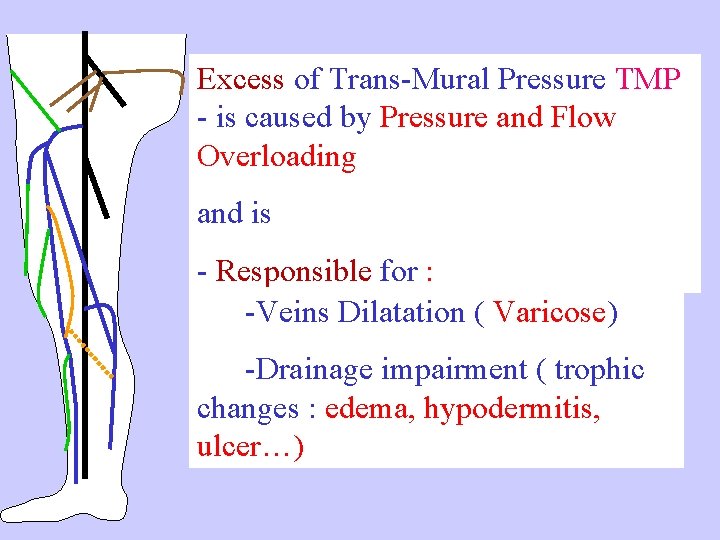
Excess of Trans-Mural Pressure TMP - is caused by Pressure and Flow Overloading and is - Responsible for : -Veins Dilatation ( Varicose) -Drainage impairment ( trophic changes : edema, hypodermitis, ulcer…)
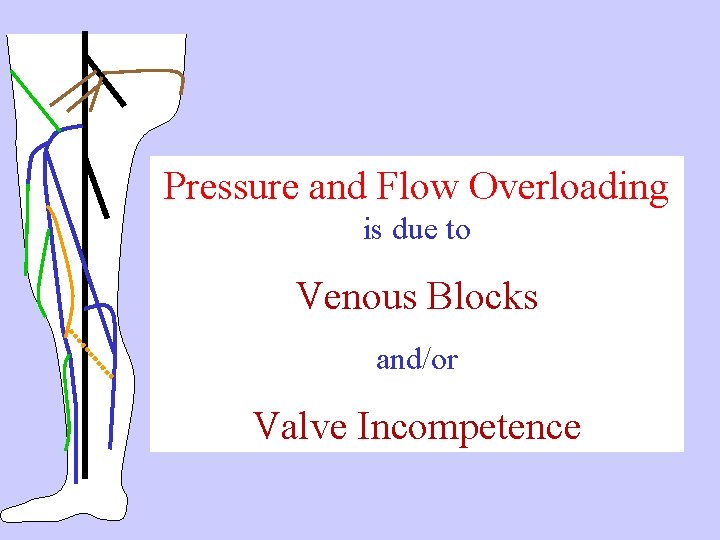
Pressure and Flow Overloading is due to Venous Blocks and/or Valve Incompetence

Venous Blocks are responsible for -Permanent Venous Pressure Excess -Compensatory collateral varicose veins (Open Shunts)
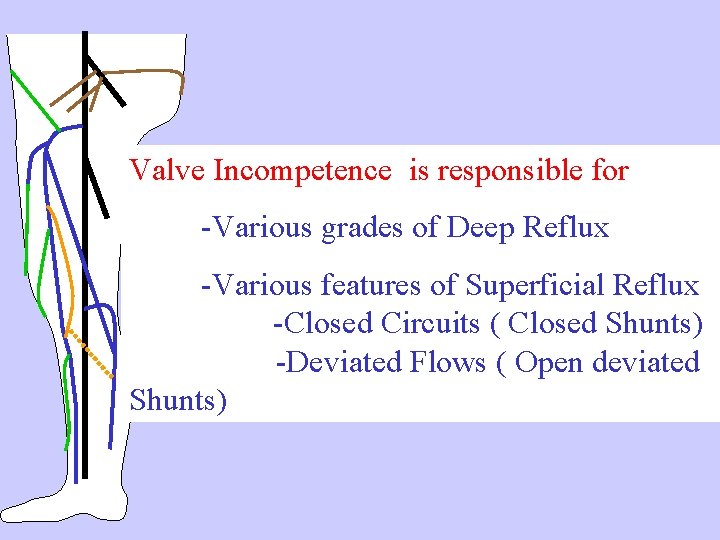
Valve Incompetence is responsible for -Various grades of Deep Reflux -Various features of Superficial Reflux -Closed Circuits ( Closed Shunts) -Deviated Flows ( Open deviated Shunts)
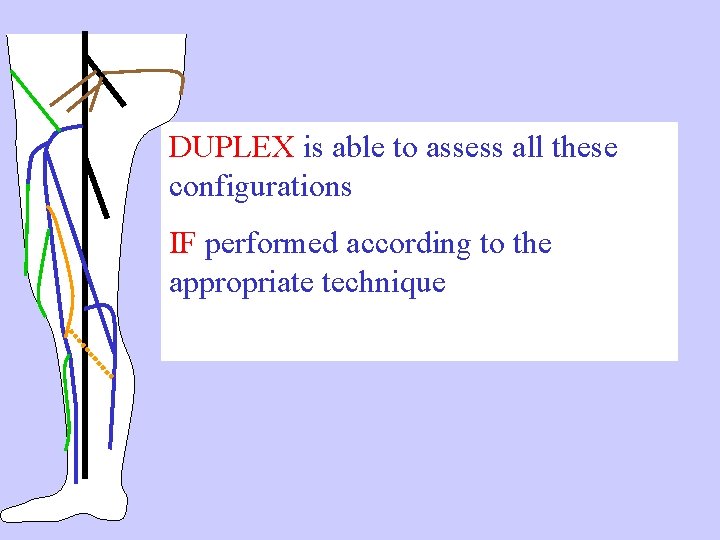
DUPLEX is able to assess all these configurations IF performed according to the appropriate technique
Hemodynamic Manœuvres Are Mandatory to elicit the hemodynamic impairments
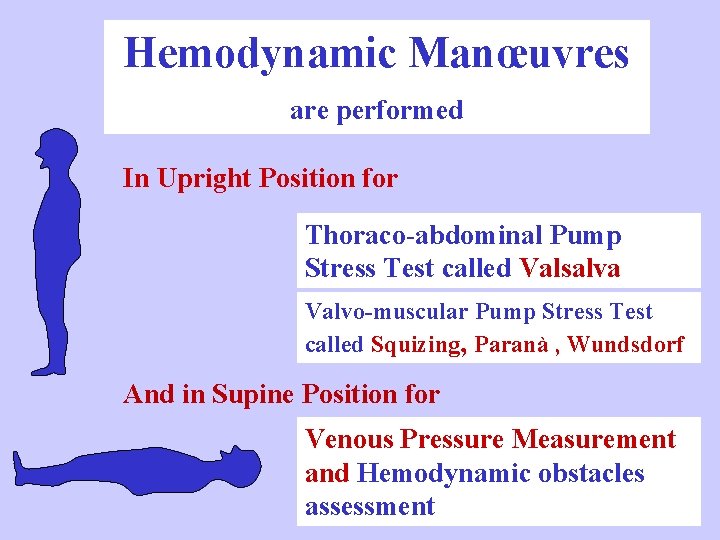
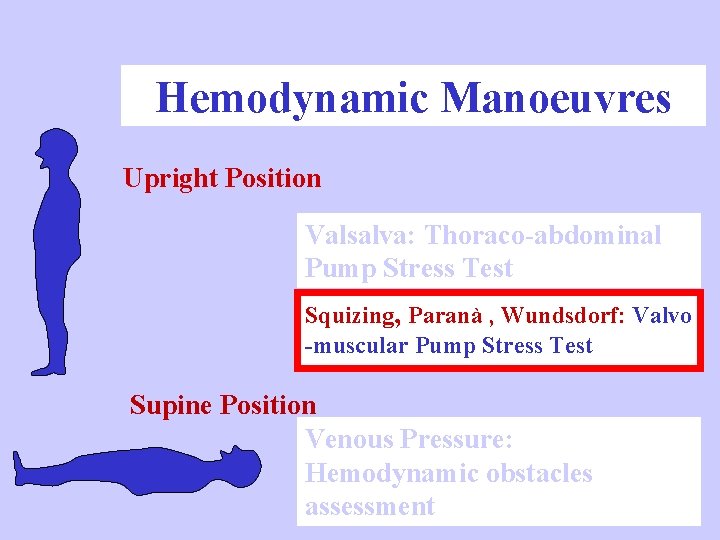
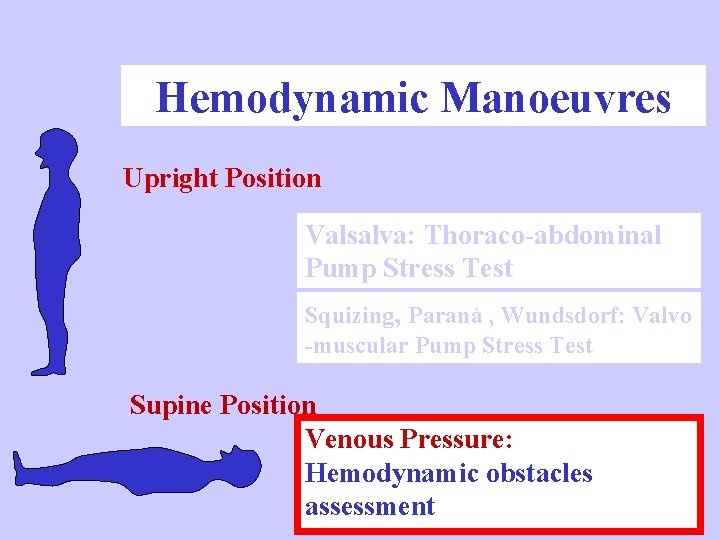
Hemodynamic Manœuvres are performed In Upright Position for Thoraco-abdominal Pump Stress Test called Valsalva Valvo-muscular Pump Stress Test called Squizing, Paranà , Wundsdorf And in Supine Position for Venous Pressure Measurement and Hemodynamic obstacles assessment
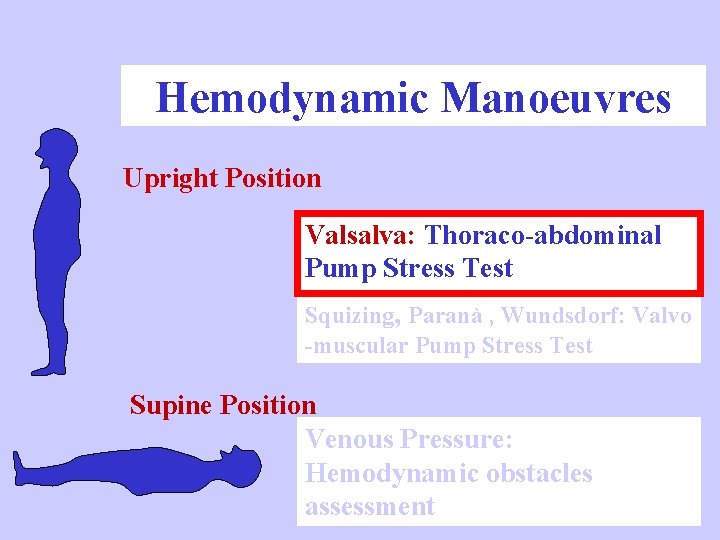
Hemodynamic Manoeuvres Upright Position Valsalva: Thoraco-abdominal Pump Stress Test Squizing, Paranà , Wundsdorf: Valvo -muscular Pump Stress Test Supine Position Venous Pressure: Hemodynamic obstacles assessment
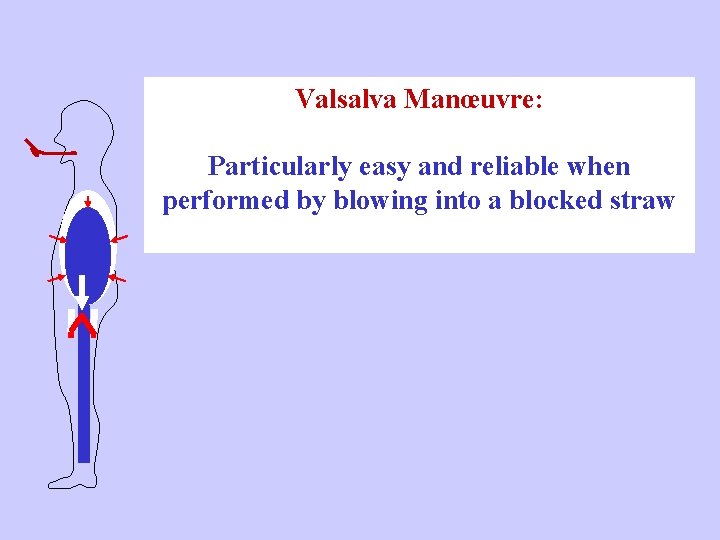
Valsalva Manœuvre: Particularly easy and reliable when performed by blowing into a blocked straw
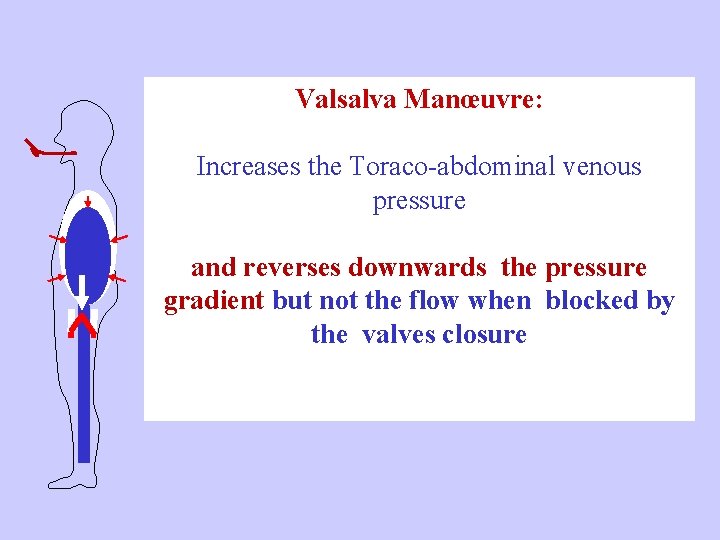
Valsalva Manœuvre: Increases the Toraco-abdominal venous pressure and reverses downwards the pressure gradient but not the flow when blocked by the valves closure
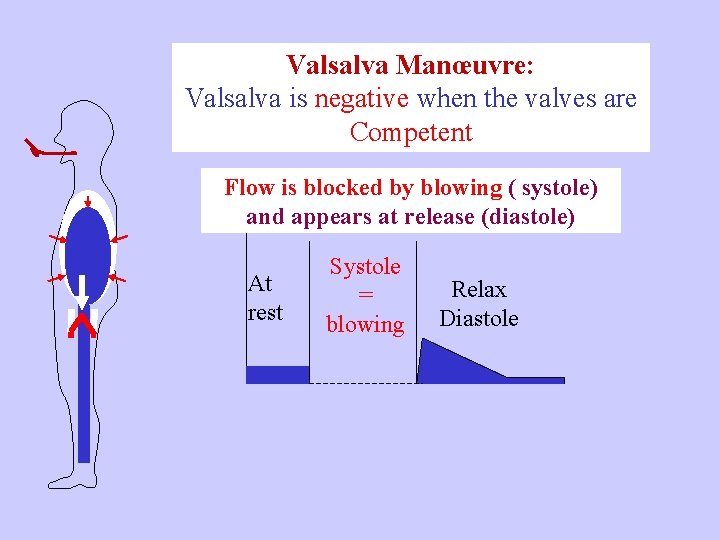
Valsalva Manœuvre: Valsalva is negative when the valves are Competent Flow is blocked by blowing ( systole) and appears at release (diastole) At rest Systole = blowing Relax Diastole
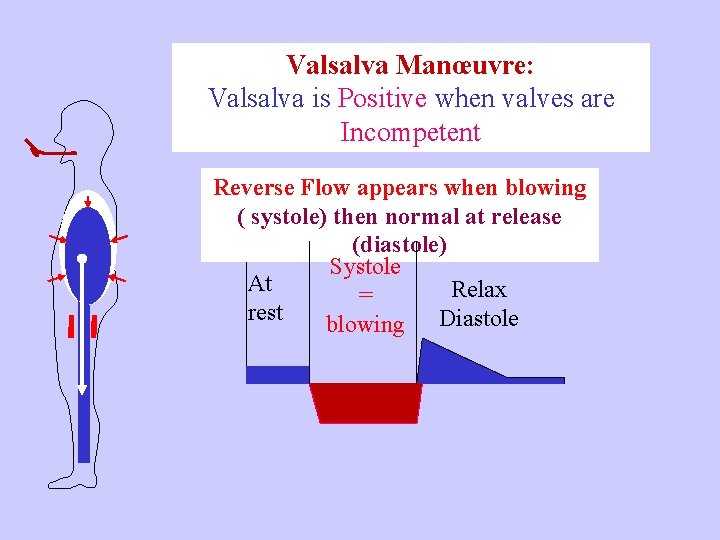
Valsalva Manœuvre: Valsalva is Positive when valves are Incompetent Reverse Flow appears when blowing ( systole) then normal at release (diastole) Systole At Relax = rest blowing Diastole
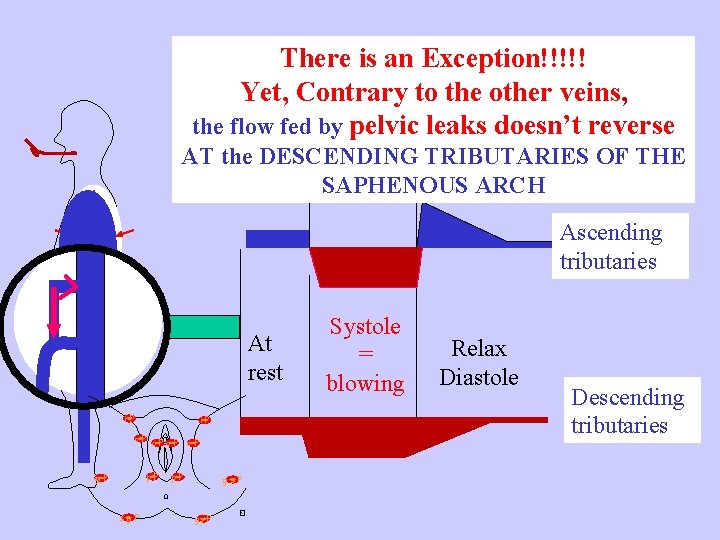
There is an Exception!!!!! Yet, Contrary to the other veins, the flow fed by pelvic leaks doesn’t reverse Systole Relax AT the. At DESCENDING TRIBUTARIES OF THE = rest SAPHENOUS ARCH blowing Diastole Ascending tributaries At rest i. P o. P c. P o. P p. P ig P sg. P p. P gs P Systole = blowing Relax Diastole Descending tributaries
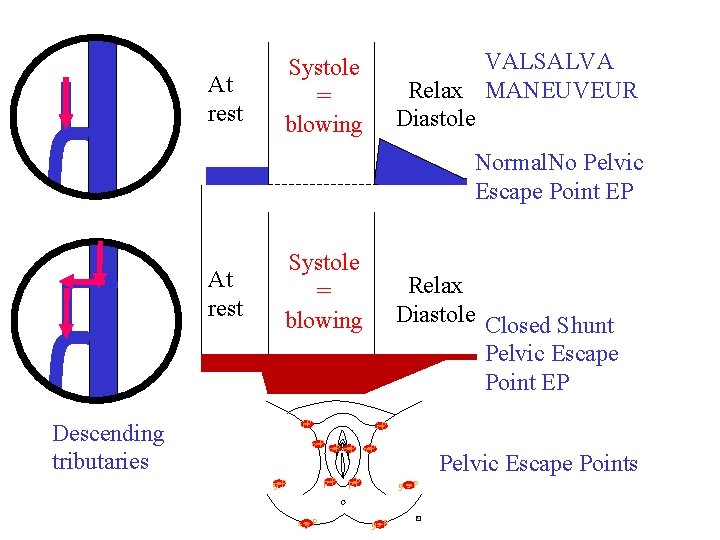
At rest VALSALVA Relax MANEUVEUR Diastole Systole = blowing Normal. No Pelvic Escape Point EP At rest Systole = blowing Relax Diastole Closed Shunt Pelvic Escape Point EP i. P Descending tributaries i. P o. P c. P o. P p. P ig P sg. P p. P Pelvic Escape Points gs. P gs P
Hemodynamic Manoeuvres Upright Position Valsalva: Thoraco-abdominal Pump Stress Test Squizing, Paranà , Wundsdorf: Valvo -muscular Pump Stress Test Supine Position Venous Pressure: Hemodynamic obstacles assessment
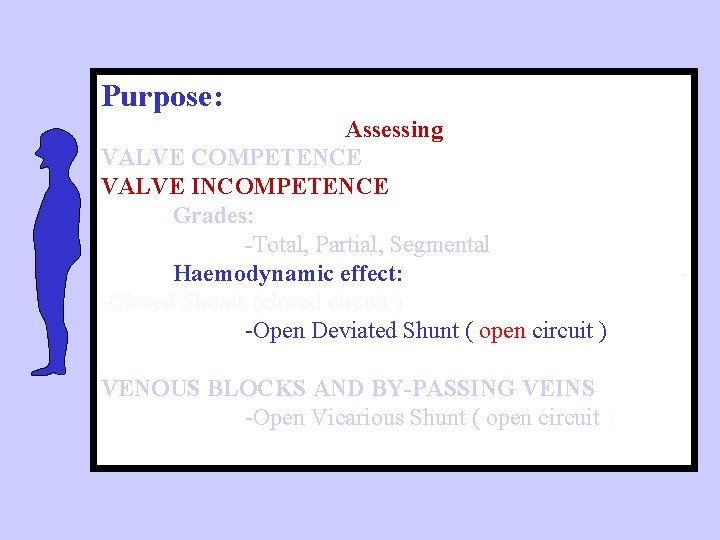
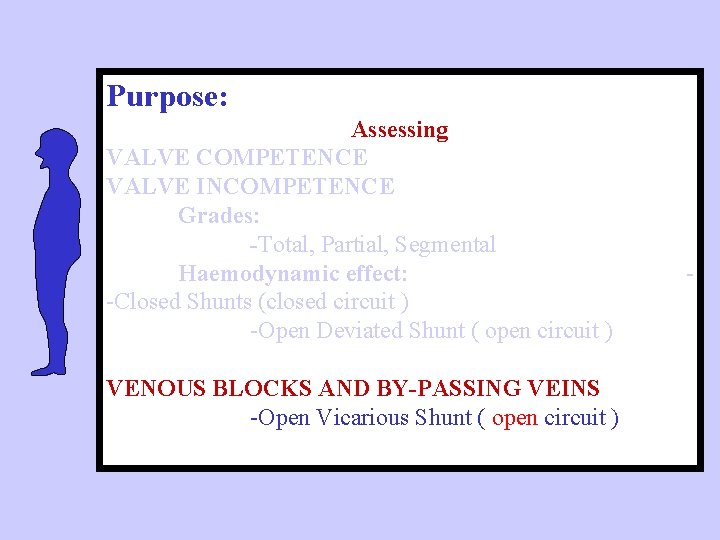
The Purpose is: Assessing -VALVE COMPETENCE -VALVE INCOMPETENCE Grades: -Total, Partial, Segmental Haemodynamic effect: -Closed Shunts (closed circuit ) -Open Deviated Shunt ( open circuit ) - -VENOUS BLOCKS AND BY-PASSING VEINS -Open Vicarious Shunt ( open circuit )
Purpose: Assessing VALVE COMPETENCE VALVE INCOMPETENCE Grades: -Total, Partial, Segmental, Closed Shunt Haemodynamic effect: -Open Deviated Shunt ( open circuit ) -Closed Shunts (closed circuit ) VENOUS BLOCKS AND BY-PASSING VEINS -Open Vicarious Shunt ( open circuit )
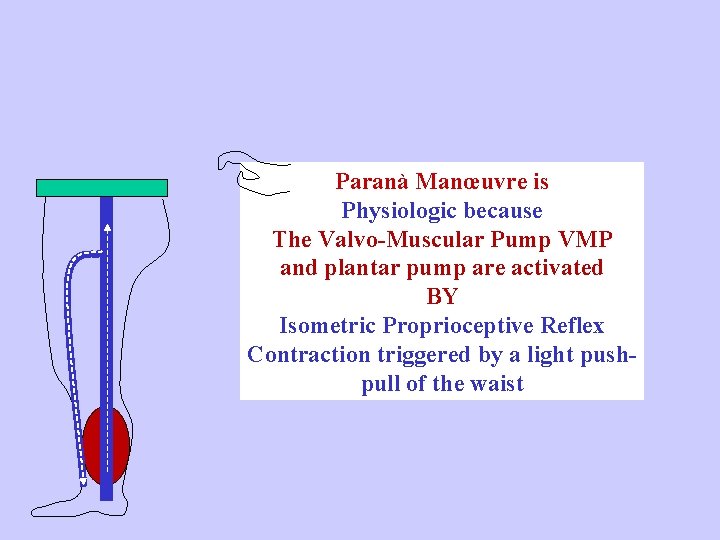
Paranà Manœuvre is Physiologic because The Valvo-Muscular Pump VMP and plantar pump are activated BY Isometric Proprioceptive Reflex Contraction triggered by a light pushpull of the waist
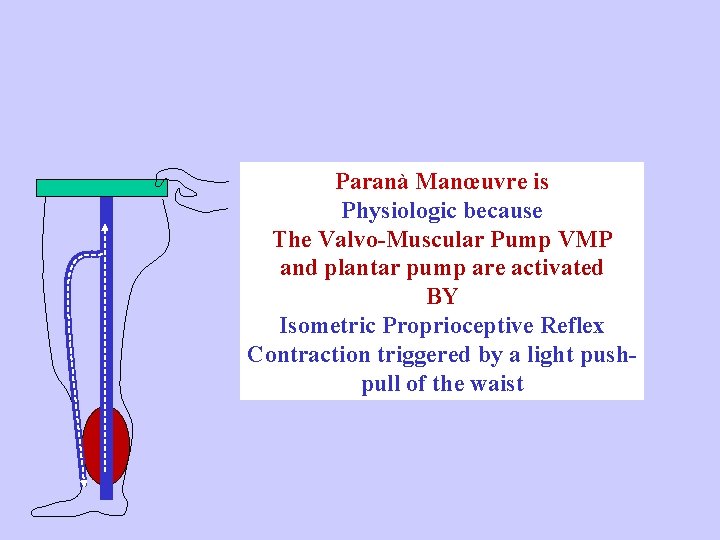
Paranà Manœuvre is Physiologic because The Valvo-Muscular Pump VMP and plantar pump are activated BY Isometric Proprioceptive Reflex Contraction triggered by a light pushpull of the waist
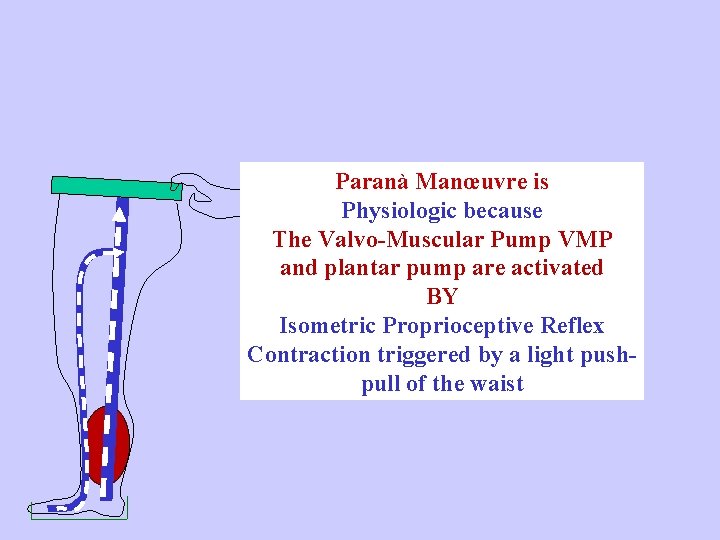
Paranà Manœuvre is Physiologic because The Valvo-Muscular Pump VMP and plantar pump are activated BY Isometric Proprioceptive Reflex Contraction triggered by a light pushpull of the waist
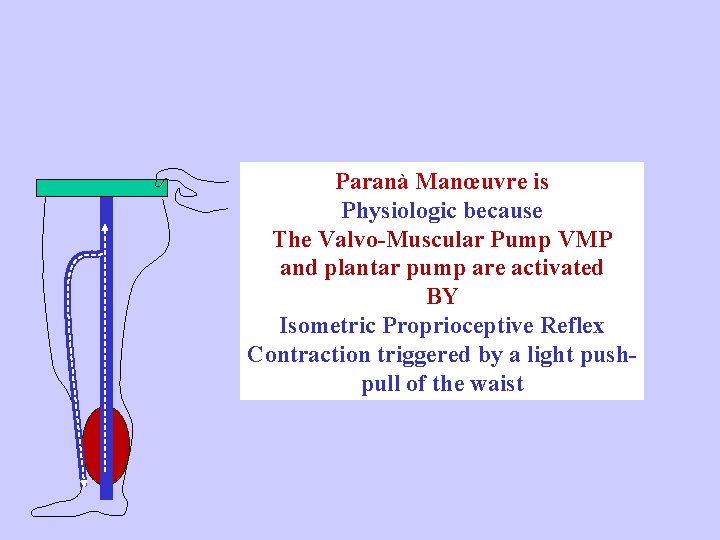
Paranà Manœuvre is Physiologic because The Valvo-Muscular Pump VMP and plantar pump are activated BY Isometric Proprioceptive Reflex Contraction triggered by a light pushpull of the waist
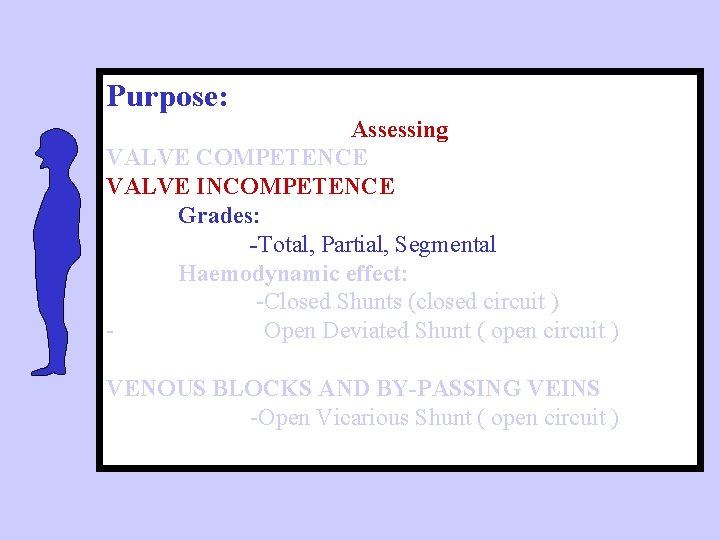
Purpose: Assessing VALVE COMPETENCE VALVE INCOMPETENCE Grades: -Total, Partial, Segmental Haemodynamic effect: -Closed Shunts (closed circuit ) Open Deviated Shunt ( open circuit ) VENOUS BLOCKS AND BY-PASSING VEINS -Open Vicarious Shunt ( open circuit )
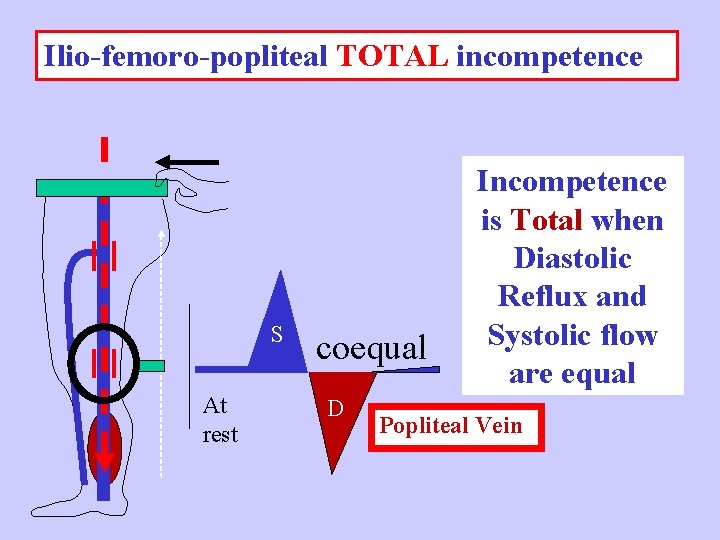
Ilio-femoro-popliteal TOTAL incompetence S At rest coequal D Incompetence is Total when Diastolic Reflux and Systolic flow are equal Popliteal Vein
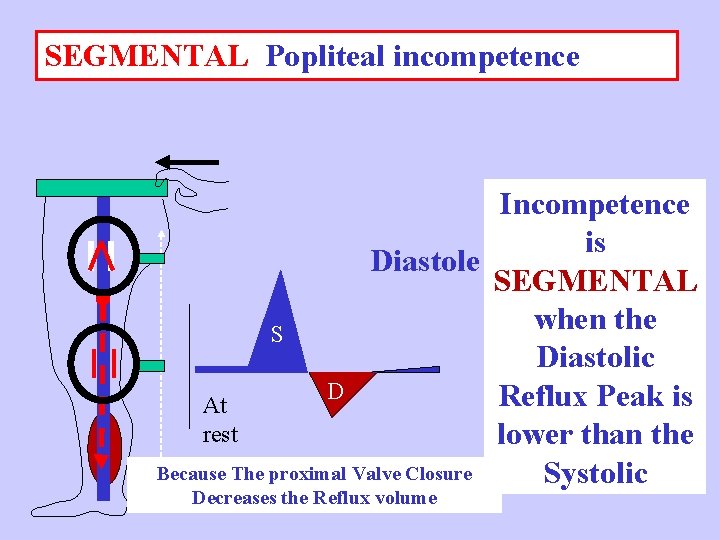
SEGMENTAL Popliteal incompetence Incompetence is Diastole SEGMENTAL when the S Diastolic D Reflux Peak is At rest lower than the Because The proximal Valve Closure Systolic Decreases the Reflux volume
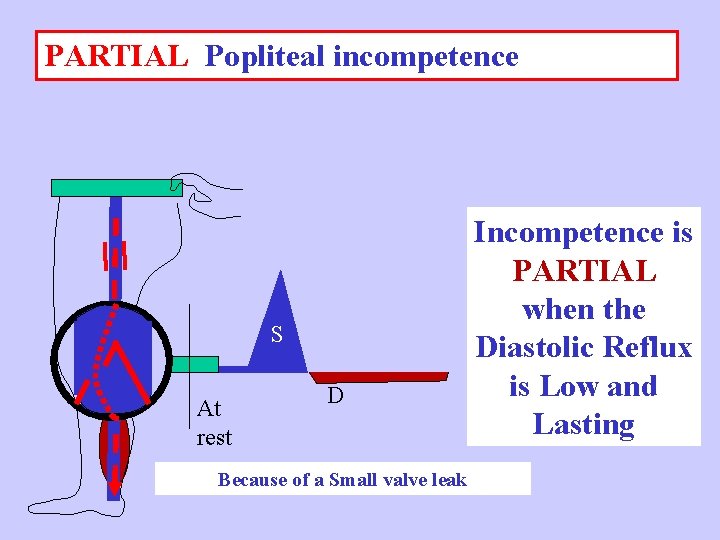
PARTIAL Popliteal incompetence S At rest D Because of a Small valve leak Incompetence is PARTIAL when the Diastolic Reflux is Low and Lasting
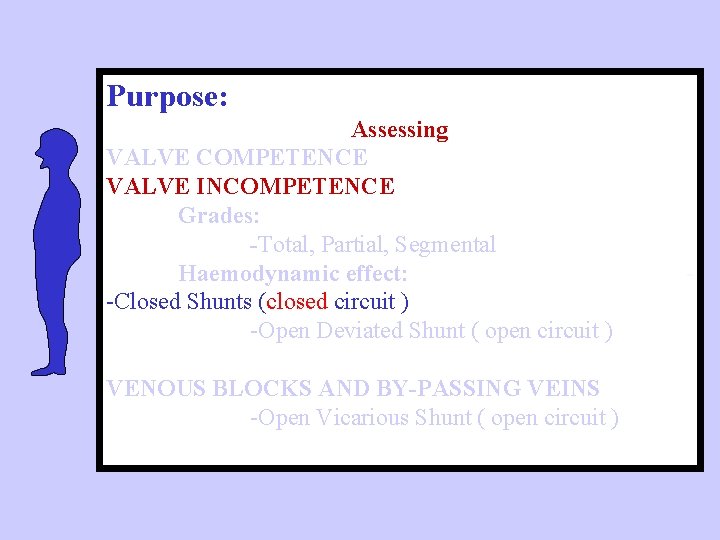
Purpose: Assessing VALVE COMPETENCE VALVE INCOMPETENCE Grades: -Total, Partial, Segmental Haemodynamic effect: -Closed Shunts (closed circuit ) -Open Deviated Shunt ( open circuit ) VENOUS BLOCKS AND BY-PASSING VEINS -Open Vicarious Shunt ( open circuit ) -
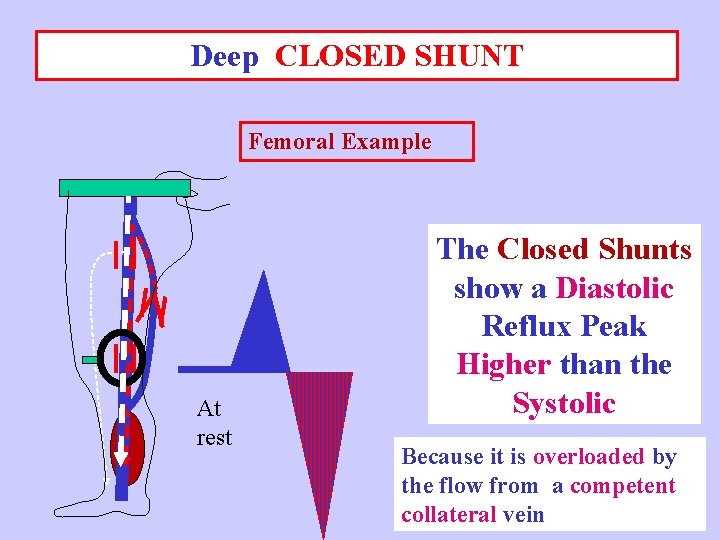
Deep CLOSED SHUNT Femoral Example At rest The Closed Shunts show a Diastolic Reflux Peak Higher than the Systolic Because it is overloaded by the flow from a competent collateral vein
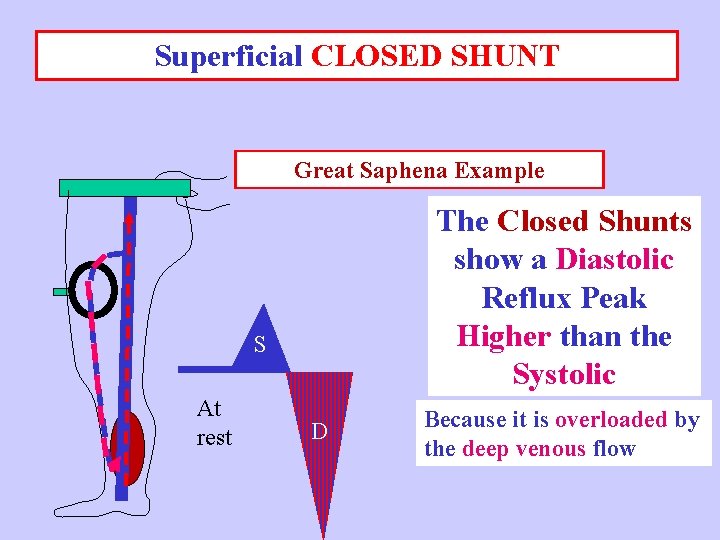
Superficial CLOSED SHUNT Great Saphena Example The Closed Shunts show a Diastolic Reflux Peak Higher than the Systolic S At rest D Because it is overloaded by the deep venous flow
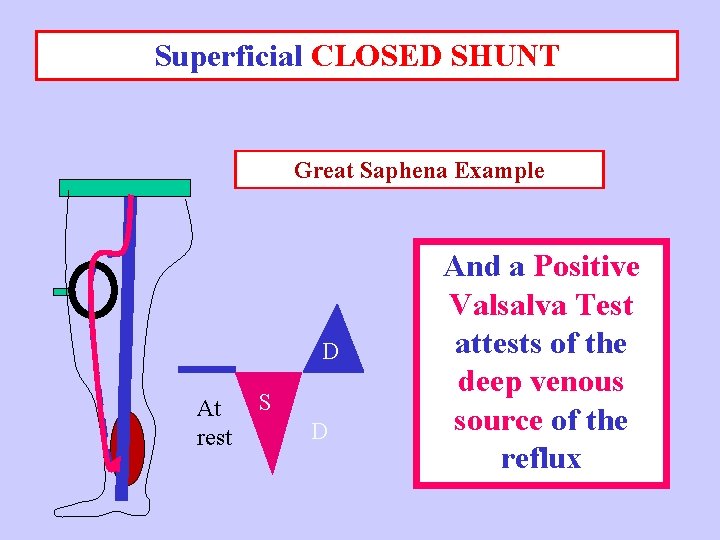
Superficial CLOSED SHUNT Great Saphena Example D At rest S D And a Positive Valsalva Test attests of the deep venous source of the reflux
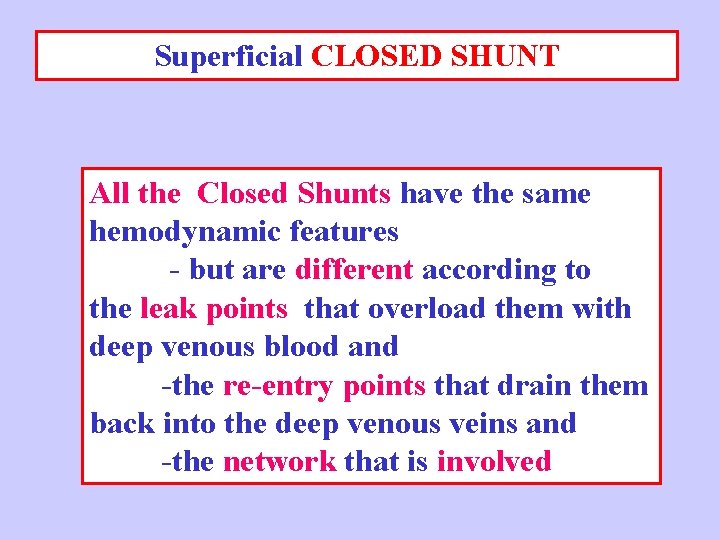
Superficial CLOSED SHUNT All the Closed Shunts have the same hemodynamic features - but are different according to the leak points that overload them with deep venous blood and -the re-entry points that drain them back into the deep venous veins and -the network that is involved
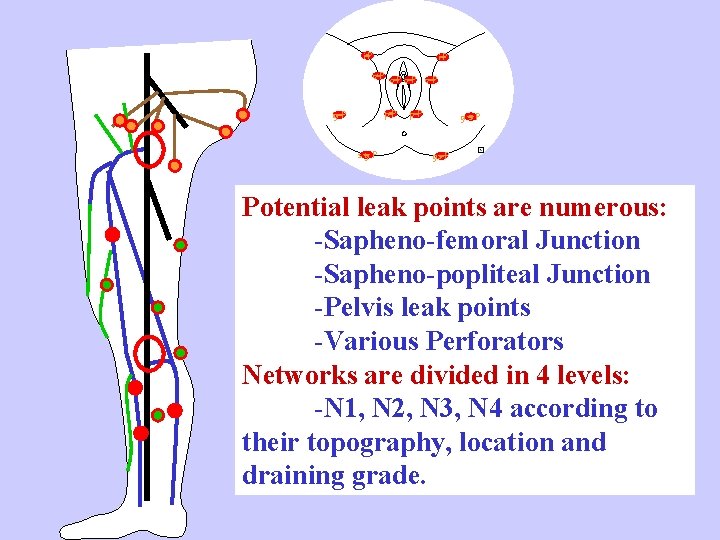
i. P o. P c. P o. P p. P ig P sg. P p. P gs P Potential leak points are numerous: -Sapheno-femoral Junction -Sapheno-popliteal Junction -Pelvis leak points -Various Perforators Networks are divided in 4 levels: -N 1, N 2, N 3, N 4 according to their topography, location and draining grade.
Purpose: Assessing VALVE COMPETENCE VALVE INCOMPETENCE Grades: -Total, Partial, Segmental Haemodynamic effect: -Closed Shunts (closed circuit ) -Open Deviated Shunt ( open circuit ) VENOUS BLOCKS AND BY-PASSING VEINS -Open Vicarious Shunt ( open circuit ) -
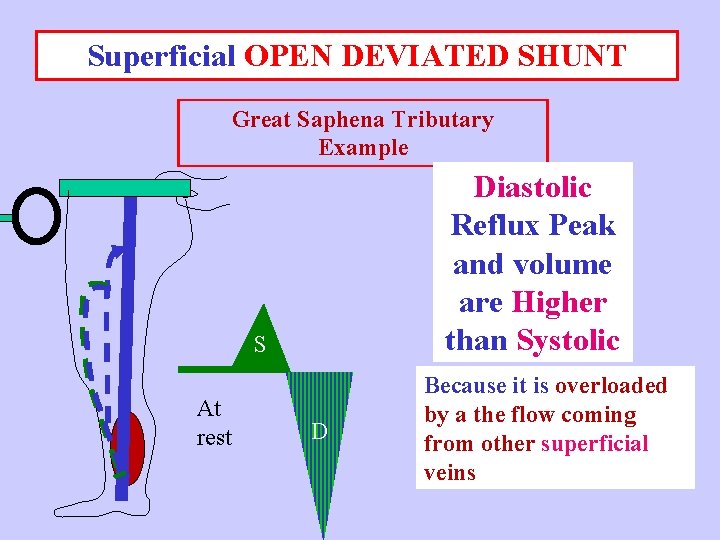
Superficial OPEN DEVIATED SHUNT Great Saphena Tributary Example Diastolic Reflux Peak and volume are Higher than Systolic S At rest D Because it is overloaded by a the flow coming from other superficial veins
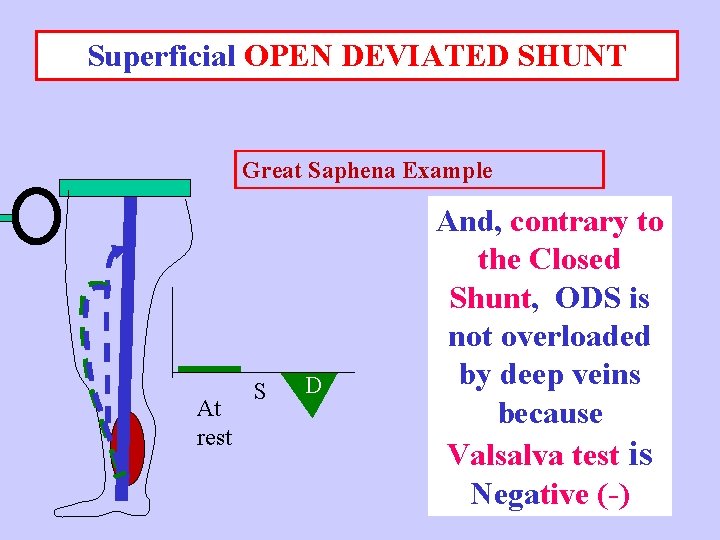
Superficial OPEN DEVIATED SHUNT Great Saphena Example At rest S D And, contrary to the Closed Shunt, ODS is not overloaded by deep veins because Valsalva test is Negative (-)
Purpose: Assessing VALVE COMPETENCE VALVE INCOMPETENCE Grades: -Total, Partial, Segmental Haemodynamic effect: -Closed Shunts (closed circuit ) -Open Deviated Shunt ( open circuit ) VENOUS BLOCKS AND BY-PASSING VEINS -Open Vicarious Shunt ( open circuit ) -
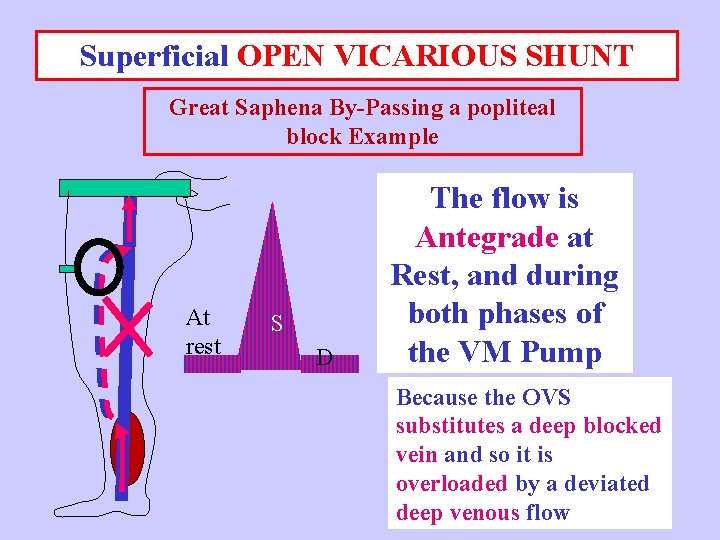
Superficial OPEN VICARIOUS SHUNT Great Saphena By-Passing a popliteal block Example At rest S D The flow is Antegrade at Rest, and during both phases of the VM Pump Because the OVS substitutes a deep blocked vein and so it is overloaded by a deviated deep venous flow
Hemodynamic Manoeuvres Upright Position Valsalva: Thoraco-abdominal Pump Stress Test Squizing, Paranà , Wundsdorf: Valvo -muscular Pump Stress Test Supine Position Venous Pressure: Hemodynamic obstacles assessment
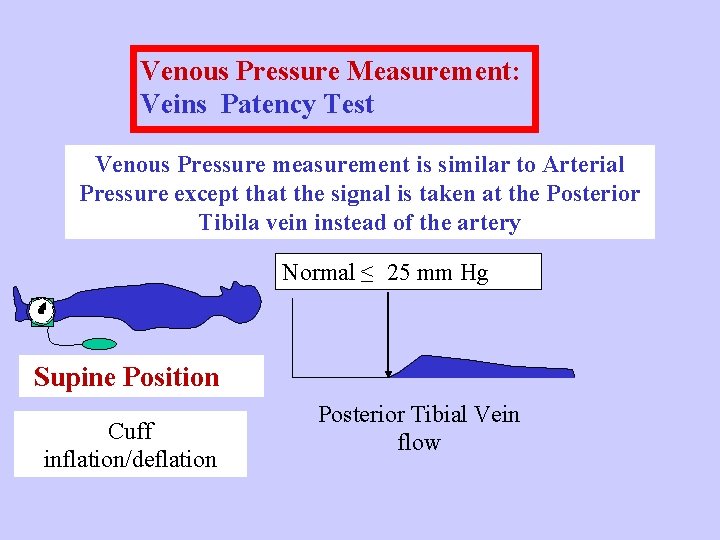
Venous Pressure Measurement: Veins Patency Test Venous Pressure measurement is similar to Arterial Pressure except that the signal is taken at the Posterior Tibila vein instead of the artery Normal ≤ 25 mm Hg Supine Position Cuff inflation/deflation Posterior Tibial Vein flow
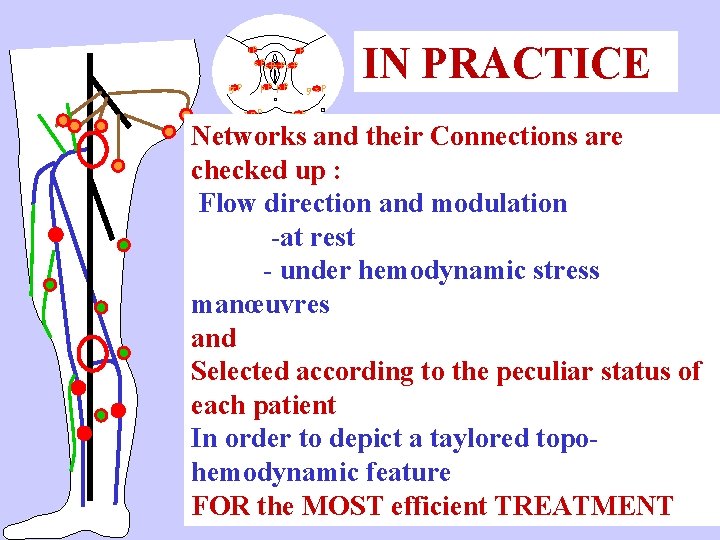
i. P o Pc Pc P o P ig P p. P sg. P gs. P IN PRACTICE gs P Networks and their Connections are checked up : Flow direction and modulation -at rest - under hemodynamic stress manœuvres and Selected according to the peculiar status of each patient In order to depict a taylored topohemodynamic feature FOR the MOST efficient TREATMENT
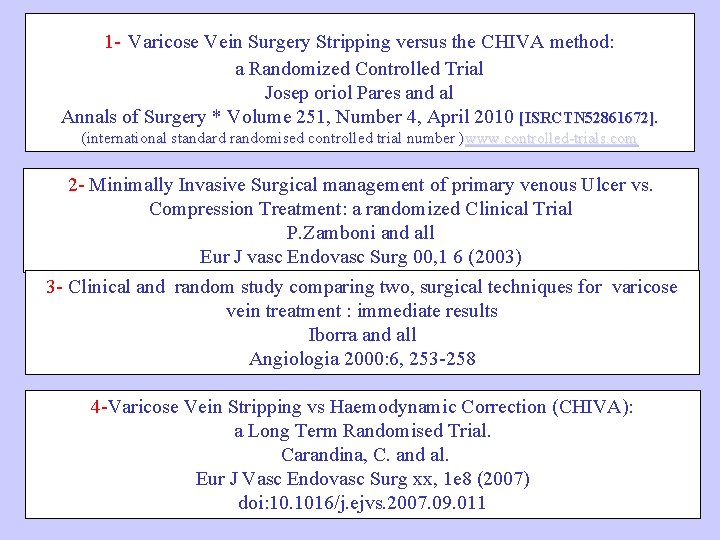
The validity of this Duplex method is proved by RCT where CHIVA, based on these theoretical models, is demonstrated Superior to Gold standards Stripping and Compression
1 - Varicose Vein Surgery Stripping versus the CHIVA method: a Randomized Controlled Trial Josep oriol Pares and al Annals of Surgery * Volume 251, Number 4, April 2010 [ISRCTN 52861672]. (international standard randomised controlled trial number )www. controlled-trials. com 2 - Minimally Invasive Surgical management of primary venous Ulcer vs. Compression Treatment: a randomized Clinical Trial P. Zamboni and all Eur J vasc Endovasc Surg 00, 1 6 (2003) 3 - Clinical and random study comparing two, surgical techniques for varicose vein treatment : immediate results Iborra and all Angiologia 2000: 6, 253 -258 4 -Varicose Vein Stripping vs Haemodynamic Correction (CHIVA): a Long Term Randomised Trial. Carandina, C. and al. Eur J Vasc Endovasc Surg xx, 1 e 8 (2007) doi: 10. 1016/j. ejvs. 2007. 09. 011
For a comprehensive information
- Slides: 48