
dup dup 2 include unistd h int dupint
![pipe #include <unistd. h> int pipe(int filedes[2]); return : 0 if OK, -1 on](https://slidetodoc.com/presentation_image_h/7629fc0aead18a99420e98c39aa487ab/image-5.jpg "pipe #include <unistd. h> int pipe(int filedes[2]); return : 0 if OK, -1 on")
![pipe filedes[0] is open for reading and filedes[1] is open for writing. n Output](https://slidetodoc.com/presentation_image_h/7629fc0aead18a99420e98c39aa487ab/image-6.jpg "pipe filedes[0] is open for reading and filedes[1] is open for writing. n Output")
![pipe after fork user process fd[0] parent process fd[1] fd[0] child process fd[1] fd[0]](https://slidetodoc.com/presentation_image_h/7629fc0aead18a99420e98c39aa487ab/image-7.jpg "pipe after fork user process fd[0] parent process fd[1] fd[0] child process fd[1] fd[0]")
![Pipes parent child: parent closes fd[1] child closes fd[0] parent child: parent closes fd[0]](https://slidetodoc.com/presentation_image_h/7629fc0aead18a99420e98c39aa487ab/image-8.jpg "Pipes parent child: parent closes fd[1] child closes fd[0] parent child: parent closes fd[0]")
- Slides: 10
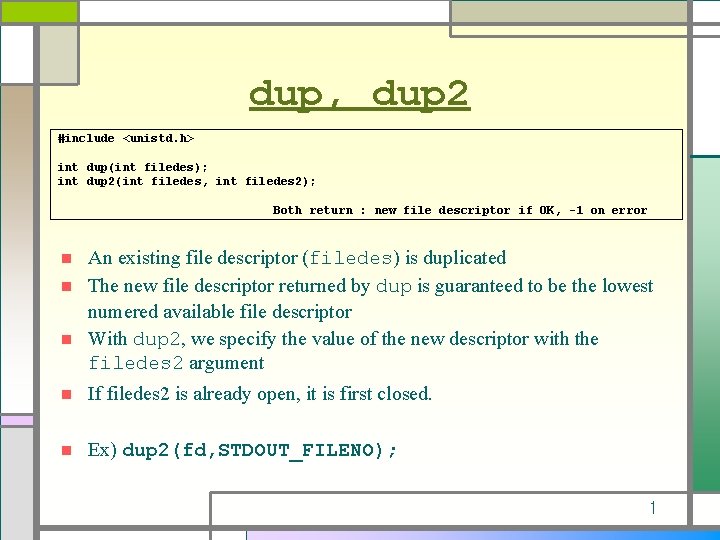
dup, dup 2 #include <unistd. h> int dup(int filedes); int dup 2(int filedes, int filedes 2); Both return : new file descriptor if OK, -1 on error An existing file descriptor (filedes) is duplicated n The new file descriptor returned by dup is guaranteed to be the lowest numered available file descriptor n With dup 2, we specify the value of the new descriptor with the filedes 2 argument n n If filedes 2 is already open, it is first closed. n Ex) dup 2(fd, STDOUT_FILENO); 1
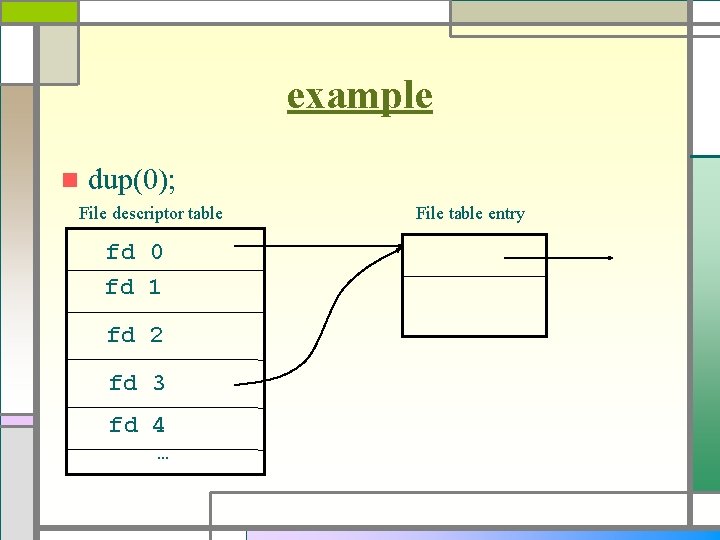
example n dup(0); File descriptor table fd 0 fd 1 fd 2 fd 3 fd 4 … File table entry
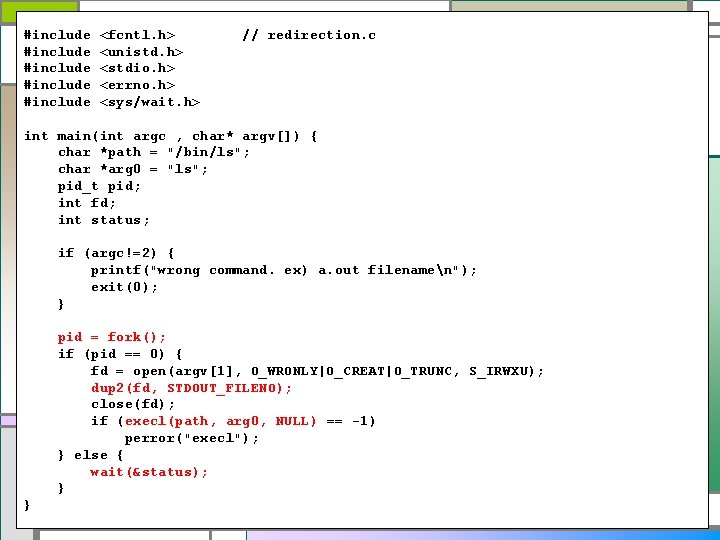
#include #include <fcntl. h> <unistd. h> <stdio. h> <errno. h> <sys/wait. h> // redirection. c int main(int argc , char* argv[]) { char *path = "/bin/ls"; char *arg 0 = "ls"; pid_t pid; int fd; int status; if (argc!=2) { printf("wrong command. ex) a. out filenamen"); exit(0); } pid = fork(); if (pid == 0) { fd = open(argv[1], O_WRONLY|O_CREAT|O_TRUNC, S_IRWXU); dup 2(fd, STDOUT_FILENO); close(fd); if (execl(path, arg 0, NULL) == -1) perror("execl"); } else { wait(&status); } } 3
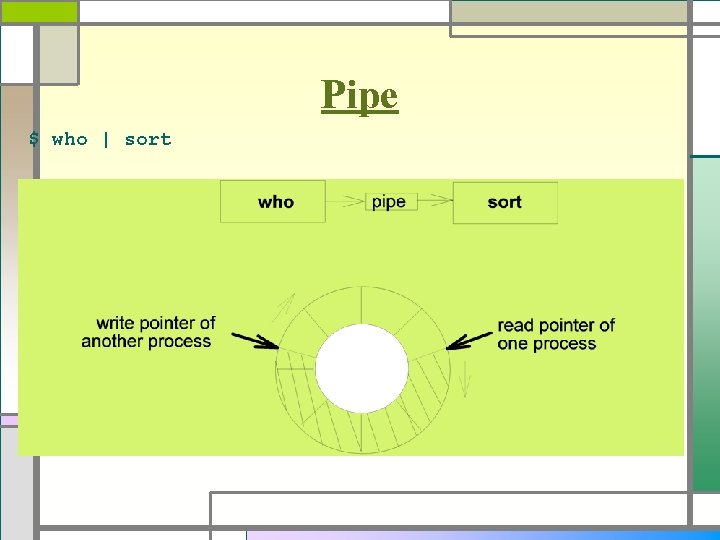
Pipe $ who | sort
pipe #include <unistd. h> int pipe(int filedes[2]); return : 0 if OK, -1 on error Two file descriptors are returned through the fd argument • fd[0]: can be used to read from the pipe, and • fd[1]: can be used to write to the pipe Anything that is written on fd[1] may be read by fd[0]. • This is of no use in a single process. • However, between processes, it gives a method of communication The pipe() system call gives parent-child processes a way to communicate with each other. 5
pipe filedes[0] is open for reading and filedes[1] is open for writing. n Output of filedes[1] is the input for filedes[0] n 6
pipe after fork user process fd[0] parent process fd[1] fd[0] child process fd[1] fd[0] pipe kernel fd[1]
Pipes parent child: parent closes fd[1] child closes fd[0] parent child: parent closes fd[0] child closes fd[1] parent fd[1] child parent fd[0] child fd[1] pipe kernel Page 8
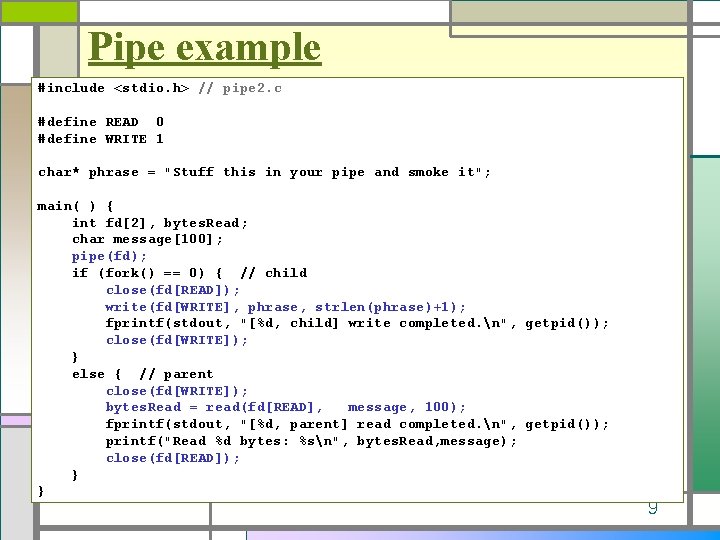
Pipe example #include <stdio. h> // pipe 2. c #define READ 0 #define WRITE 1 char* phrase = "Stuff this in your pipe and smoke it"; main( ) { int fd[2], bytes. Read; char message[100]; pipe(fd); if (fork() == 0) { // child close(fd[READ]); write(fd[WRITE], phrase, strlen(phrase)+1); fprintf(stdout, "[%d, child] write completed. n", getpid()); close(fd[WRITE]); } else { // parent close(fd[WRITE]); bytes. Read = read(fd[READ], message, 100); fprintf(stdout, "[%d, parent] read completed. n", getpid()); printf("Read %d bytes: %sn", bytes. Read, message); close(fd[READ]); } } 9
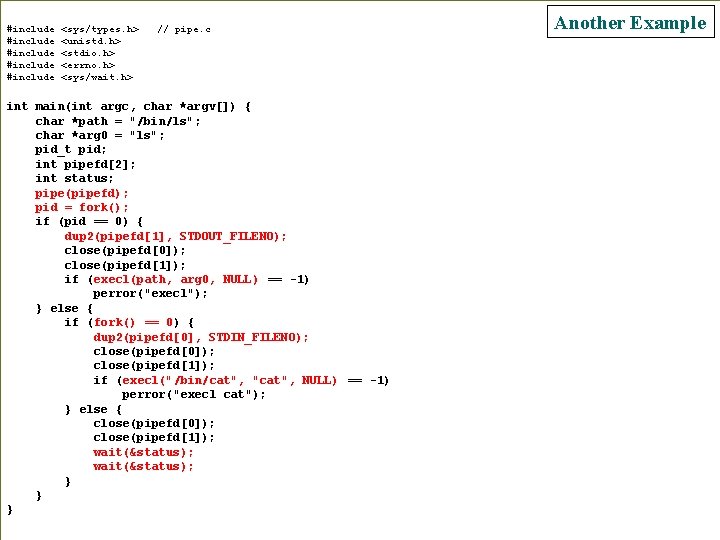
#include #include <sys/types. h> <unistd. h> <stdio. h> <errno. h> <sys/wait. h> // pipe. c int main(int argc, char *argv[]) { char *path = "/bin/ls"; char *arg 0 = "ls"; pid_t pid; int pipefd[2]; int status; pipe(pipefd); pid = fork(); if (pid == 0) { dup 2(pipefd[1], STDOUT_FILENO); close(pipefd[0]); close(pipefd[1]); if (execl(path, arg 0, NULL) == -1) perror("execl"); } else { if (fork() == 0) { dup 2(pipefd[0], STDIN_FILENO); close(pipefd[0]); close(pipefd[1]); if (execl("/bin/cat", "cat", NULL) == -1) perror("execl cat"); } else { close(pipefd[0]); close(pipefd[1]); wait(&status); } } } Another Example 10