
Dung beetles Environmental and economic benefits and how
Dung beetles! Environmental and economic benefits and how the business of dung beetles has developed Dr Shaun A. Forgie
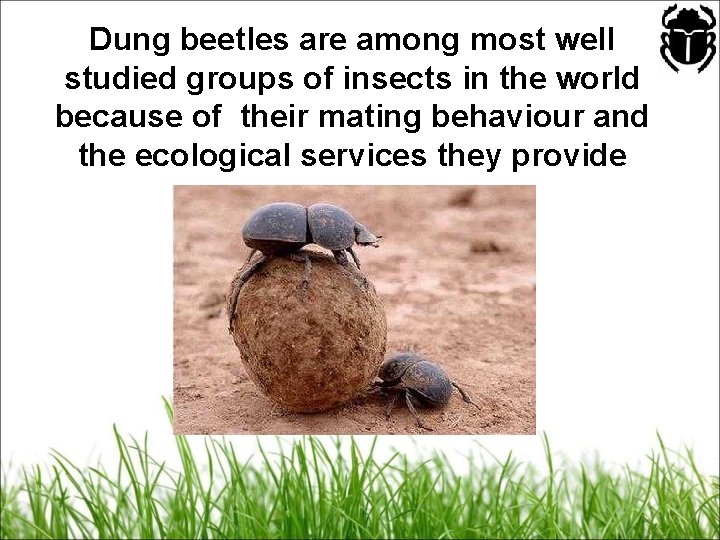
Dung beetles are among most well studied groups of insects in the world because of their mating behaviour and the ecological services they provide
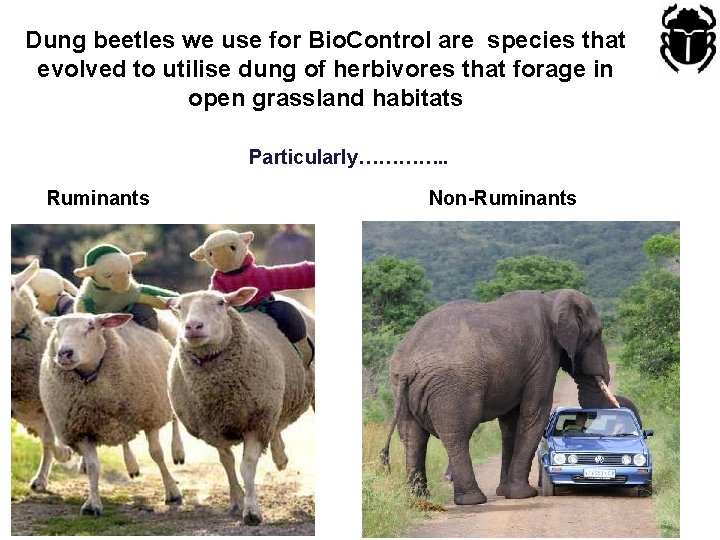
Dung beetles we use for Bio. Control are species that evolved to utilise dung of herbivores that forage in open grassland habitats Particularly…………. . Ruminants Non-Ruminants
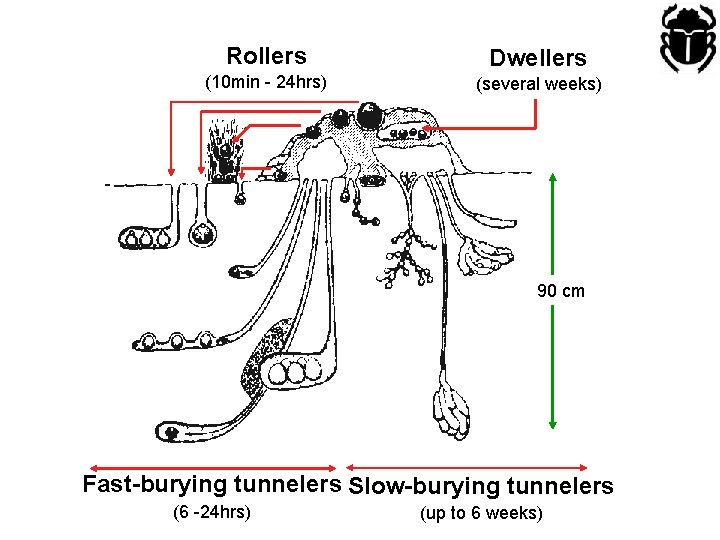
Rollers Dwellers (10 min - 24 hrs) (several weeks) 90 cm Fast-burying tunnelers Slow-burying tunnelers (6 -24 hrs) (up to 6 weeks)
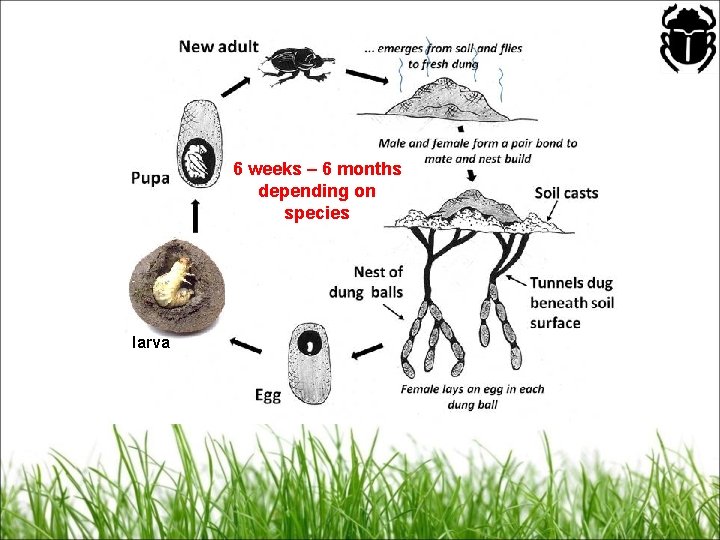
6 weeks – 6 months depending on species larva
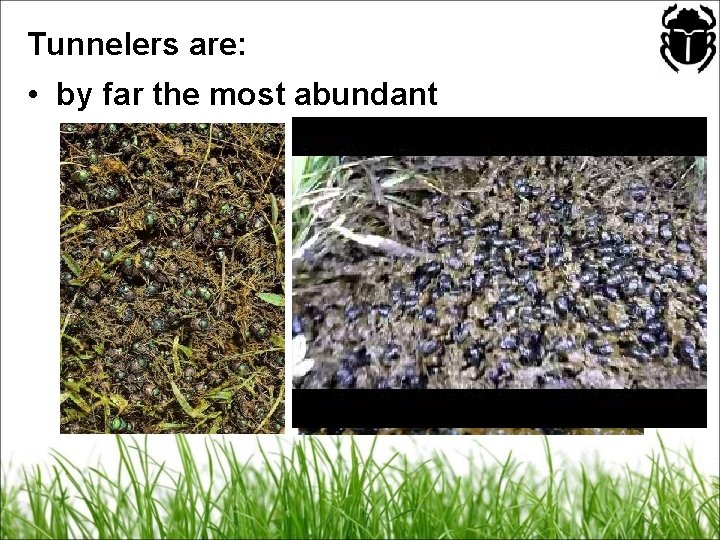
Tunnelers are: • by far the most abundant
What dung beetles do we already have in NZ? Native dung beetles. • NZ has only 15 species. • All live in native forests and don’t live in livestock pastures.
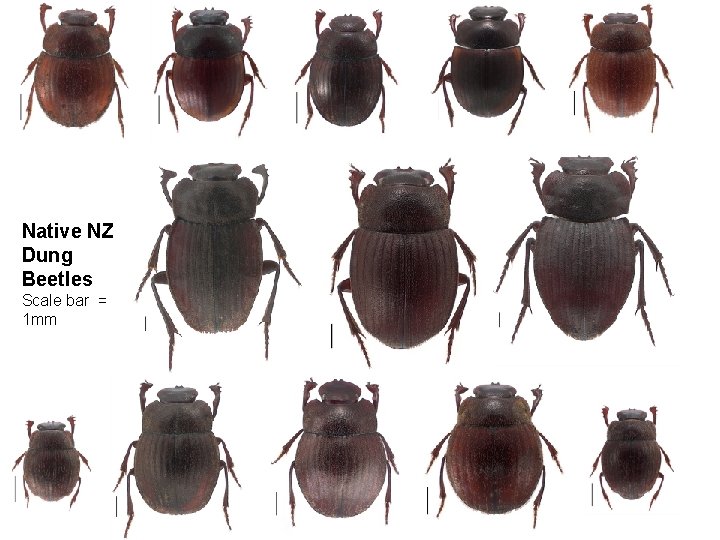
Native NZ Dung Beetles Scale bar = 1 mm
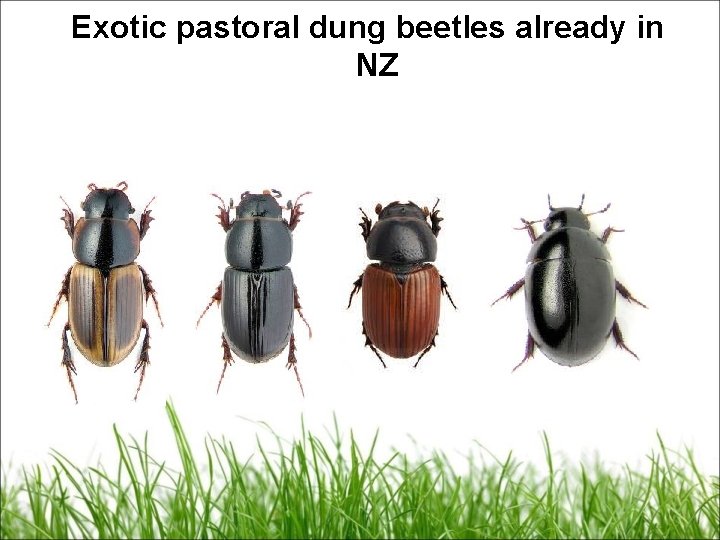
Exotic pastoral dung beetles already in NZ
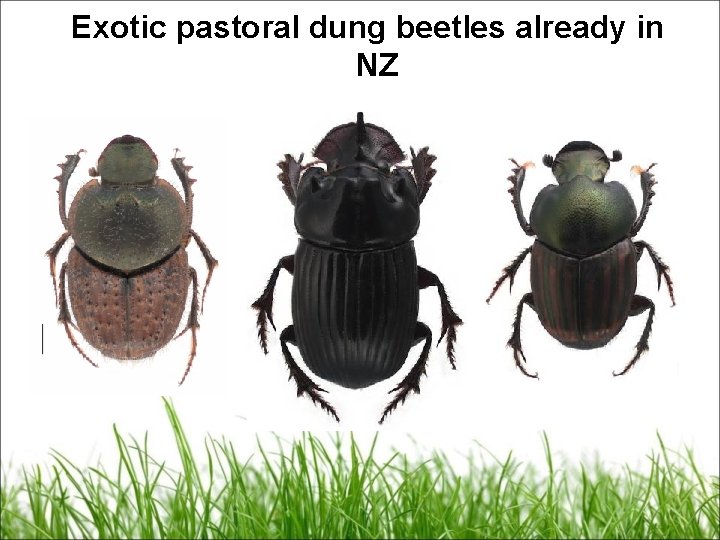
Exotic pastoral dung beetles already in NZ
Why are we introducing dung beetles What’s the problem?
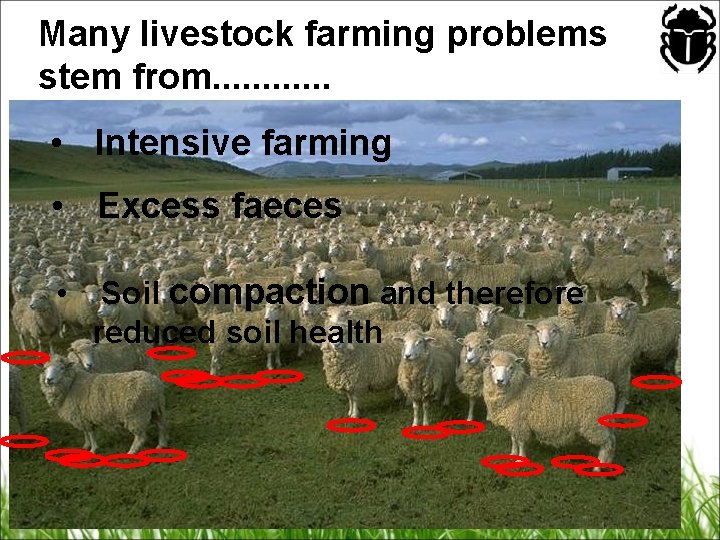
Many livestock farming problems stem from. . . • Intensive farming • Excess faeces • Soil compaction and therefore reduced soil health
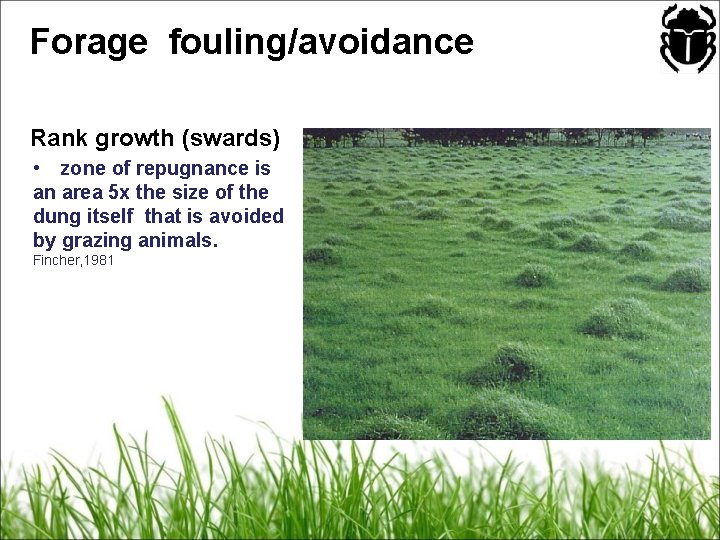
Forage fouling/avoidance Rank growth (swards) • zone of repugnance is an area 5 x the size of the dung itself that is avoided by grazing animals. Fincher, 1981
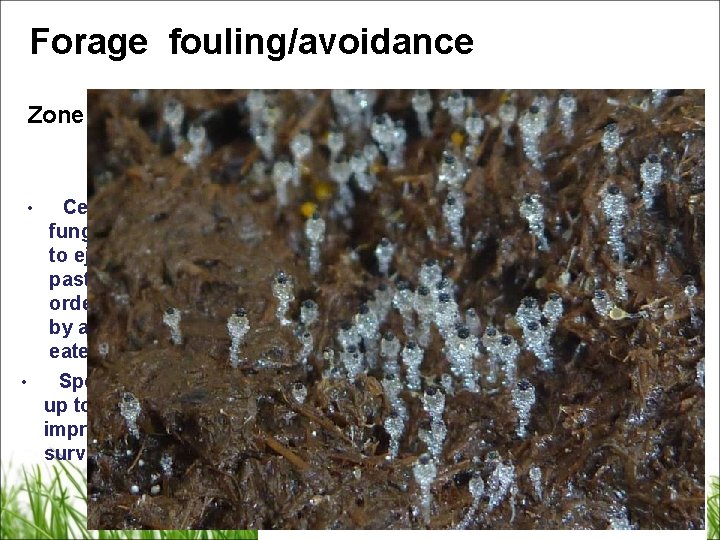
Forage fouling/avoidance Zone of repugnance • • Certain dung living fungi have evolved to eject its spores past the zone in order to get eaten by another grass eater Spores are ejected up to 2 meters to improve chances of survival Image courtesy of: http: //www. bbc. co. uk/nature/images/ic/credit/640 x 395/p/pi/pilobolus_crystallinus/p ilobolus_crystallinus_1. jpg
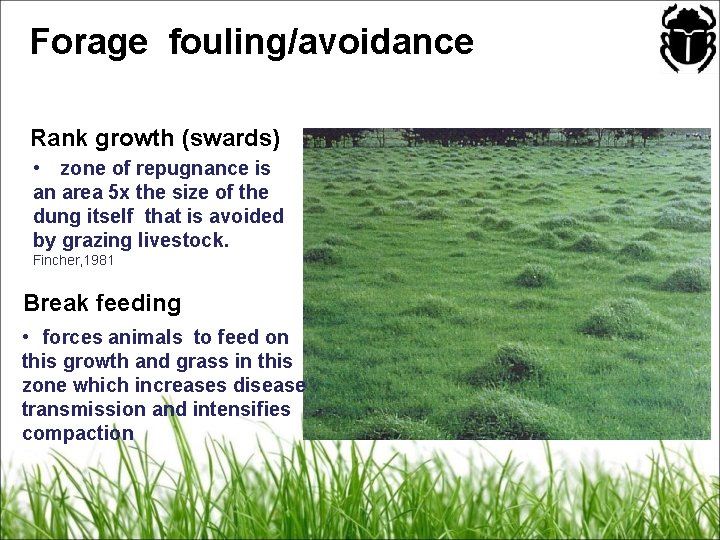
Forage fouling/avoidance Rank growth (swards) • zone of repugnance is an area 5 x the size of the dung itself that is avoided by grazing livestock. Fincher, 1981 Break feeding • forces animals to feed on this growth and grass in this zone which increases disease transmission and intensifies compaction
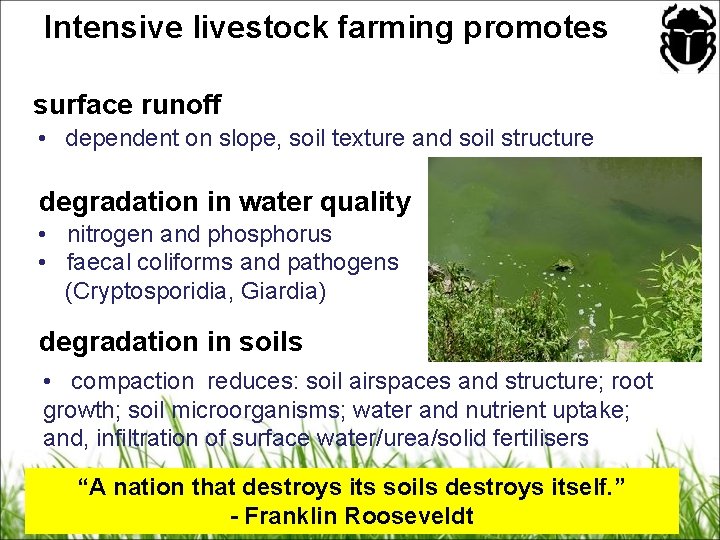
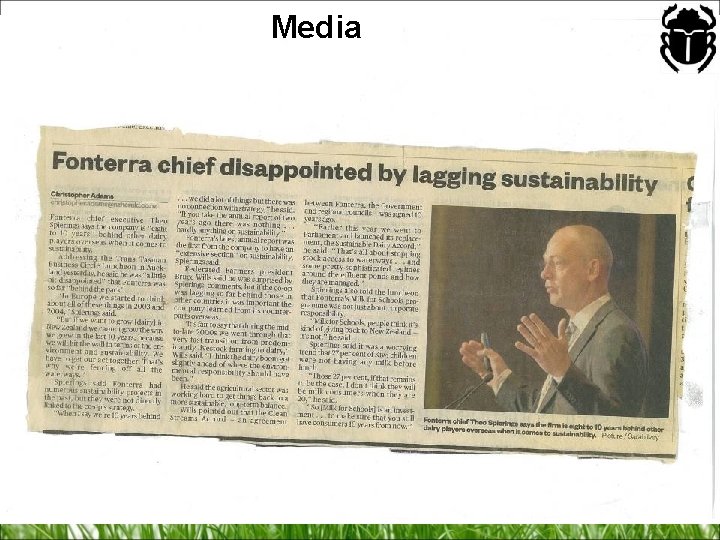
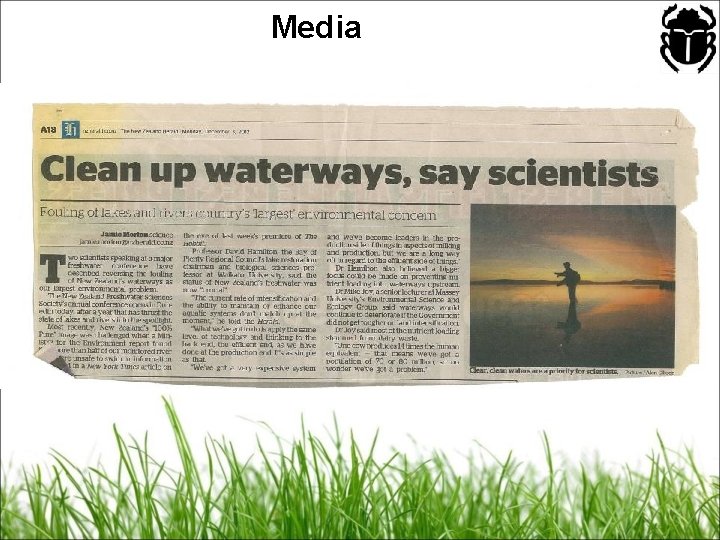
Intensive livestock farming promotes surface runoff • dependent on slope, soil texture and soil structure degradation in water quality • nitrogen and phosphorus • faecal coliforms and pathogens (Cryptosporidia, Giardia) degradation in soils • compaction reduces: soil airspaces and structure; root growth; soil microorganisms; water and nutrient uptake; and, infiltration of surface water/urea/solid fertilisers “A nation that destroys its soils destroys itself. ” - Franklin Rooseveldt
Media
Media
Media
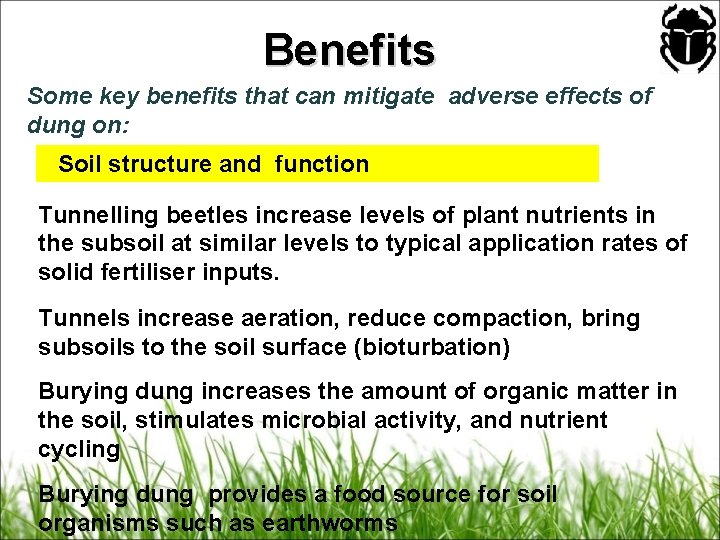
Benefits Some key benefits that can mitigate adverse effects of dung on: Soil structure and function Tunnelling beetles increase levels of plant nutrients in the subsoil at similar levels to typical application rates of solid fertiliser inputs. Tunnels increase aeration, reduce compaction, bring subsoils to the soil surface (bioturbation) Burying dung increases the amount of organic matter in the soil, stimulates microbial activity, and nutrient cycling Burying dung provides a food source for soil organisms such as earthworms
Benefits Water issues Tunnelling and improvements to the physical structure of soils have a “flow-on” effect which can include: 1) Improved water infiltration reduces surface ponding, assists agricultural inputs (lime, fertilisers) to enter the upper soil profile and reduce the level of contaminants entering the waterways… (Waterhouse 1974; Bormemissza 1976; Doube 2005 b) 2) …which leads to improved water quality (Doube 2008)
Benefits Pasture quality Dung beetles can make a substantial contribution to ensuring that forage fouling is kept to a minimum Several studies show “dung + beetles” results in significant increases in: § plant height § above ground biomass § grain production § protein levels § nitrogen content Root biomass and growing depth is significantly increased improving water holding capacity and drought tolerance
Benefits Reducing pest species Many studies have shown significant reduction in numbers and/or reinfection rates of gut parasites § § § Miller et al. (1961) Fincher (1973 a, 1975) Waterhouse (1974) Bryan (1973, 1976) Fincher & Stewart (1979) § § § Bergstrom (1983) Gronvold et al. (1992) Mathison & Ditrich (1999) Le Jambre (2009) Forgie et al. (2014. In prep. ) Many studies have shown significant reduction in numbers dung breeding pest flies § 95% in Hawai’i (Bornemissza 1970) § 88% in Australia (Ridsdill-Smith & Matthiessen, 1988)
Benefits Carbon Removal of decomposing organic matter (dung) from the soil surface leads to…… 1) increase in soil carbon content through the burial of dung 2) increased plant root production through improvements to soil physical, biological and chemical properties (Doube 2008) By rapidly manipulating fresh dung, dung beetles will aerate wet dung pads, thereby reduce anaerobic conditions needed for methane production (Jarvis et al 1995; Holter 1996)
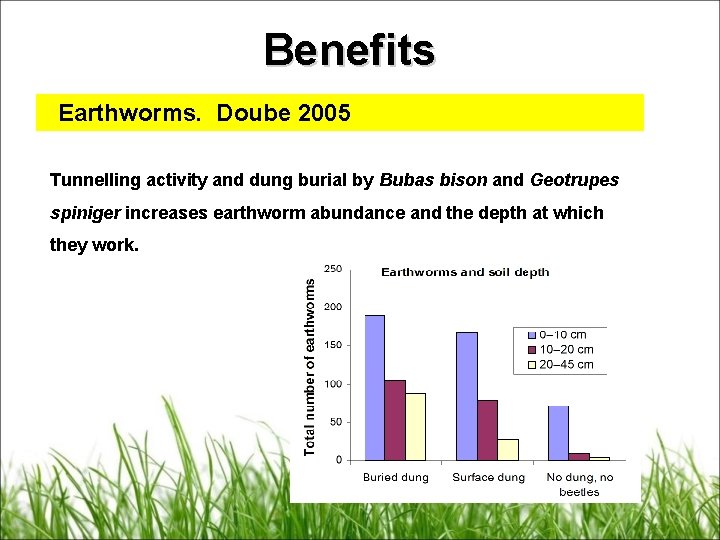
Benefits Earthworms. Doube 2005 Tunnelling activity and dung burial by Bubas bison and Geotrupes spiniger increases earthworm abundance and the depth at which they work.

Economic Benefits
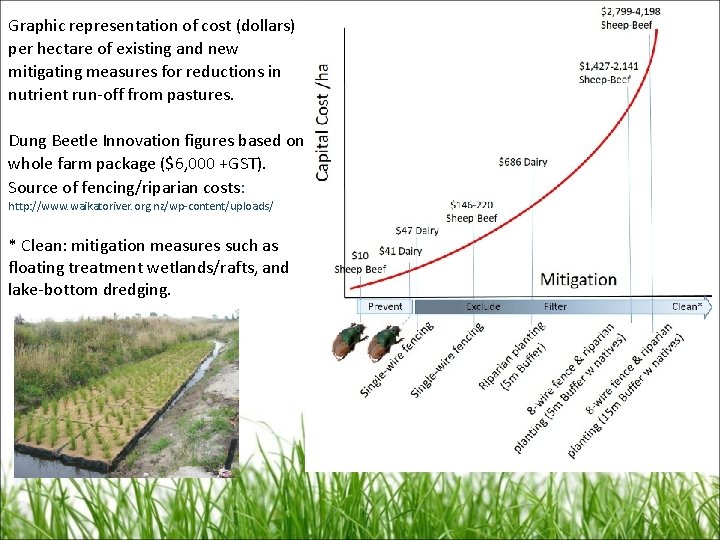
Graphic representation of cost (dollars) per hectare of existing and new mitigating measures for reductions in nutrient run-off from pastures. Dung Beetle Innovation figures based on whole farm package ($6, 000 +GST). Source of fencing/riparian costs: http: //www. waikatoriver. org. nz/wp-content/uploads/ * Clean: mitigation measures such as floating treatment wetlands/rafts, and lake-bottom dredging.
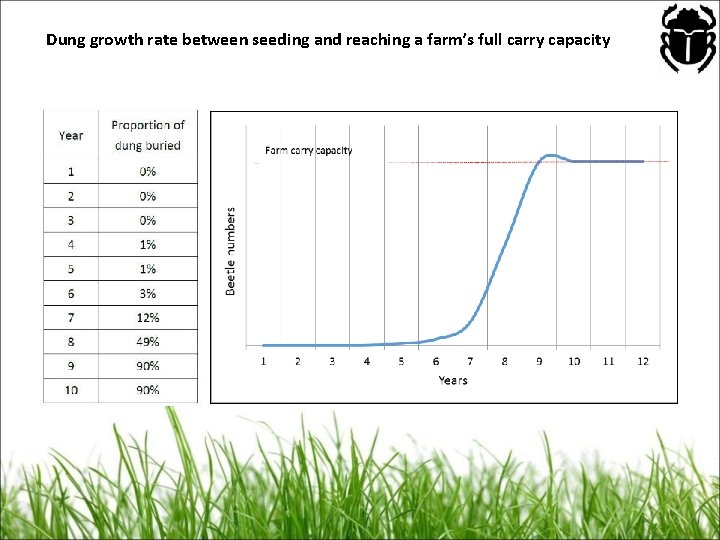
Dung growth rate between seeding and reaching a farm’s full carry capacity
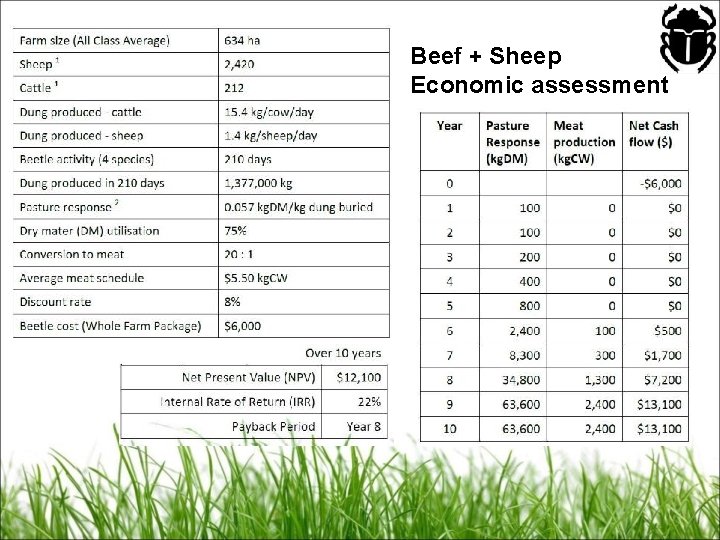
Beef + Sheep Economic assessment
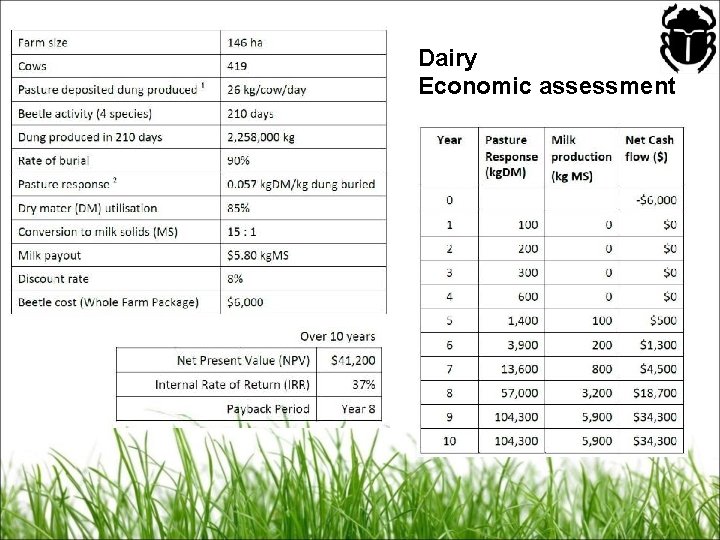
Dairy Economic assessment
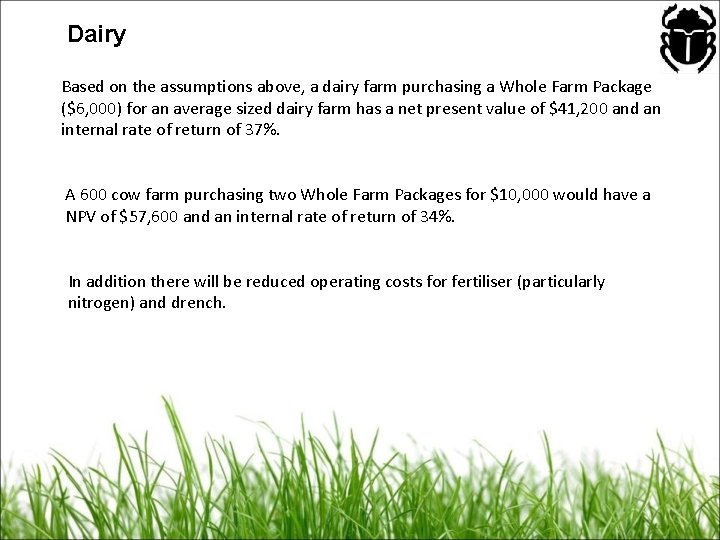
Dairy Based on the assumptions above, a dairy farm purchasing a Whole Farm Package ($6, 000) for an average sized dairy farm has a net present value of $41, 200 and an internal rate of return of 37%. A 600 cow farm purchasing two Whole Farm Packages for $10, 000 would have a NPV of $57, 600 and an internal rate of return of 34%. In addition there will be reduced operating costs for fertiliser (particularly nitrogen) and drench.
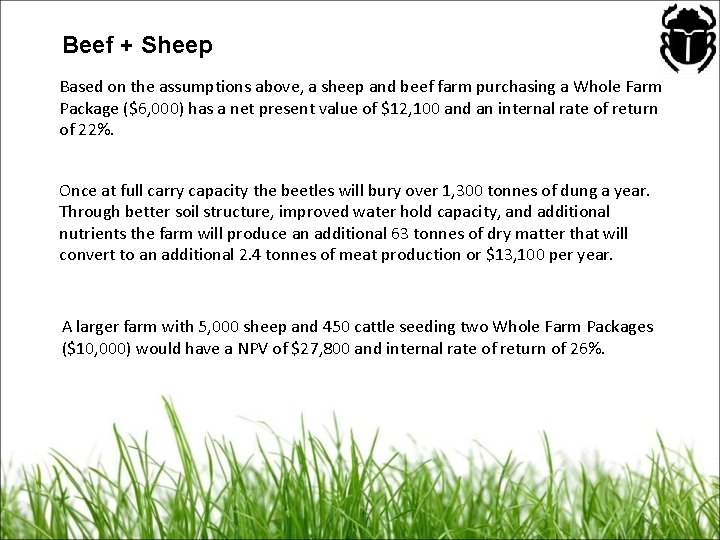
Beef + Sheep Based on the assumptions above, a sheep and beef farm purchasing a Whole Farm Package ($6, 000) has a net present value of $12, 100 and an internal rate of return of 22%. Once at full carry capacity the beetles will bury over 1, 300 tonnes of dung a year. Through better soil structure, improved water hold capacity, and additional nutrients the farm will produce an additional 63 tonnes of dry matter that will convert to an additional 2. 4 tonnes of meat production or $13, 100 per year. A larger farm with 5, 000 sheep and 450 cattle seeding two Whole Farm Packages ($10, 000) would have a NPV of $27, 800 and internal rate of return of 26%.
Who introduced dung beetles to NZ?
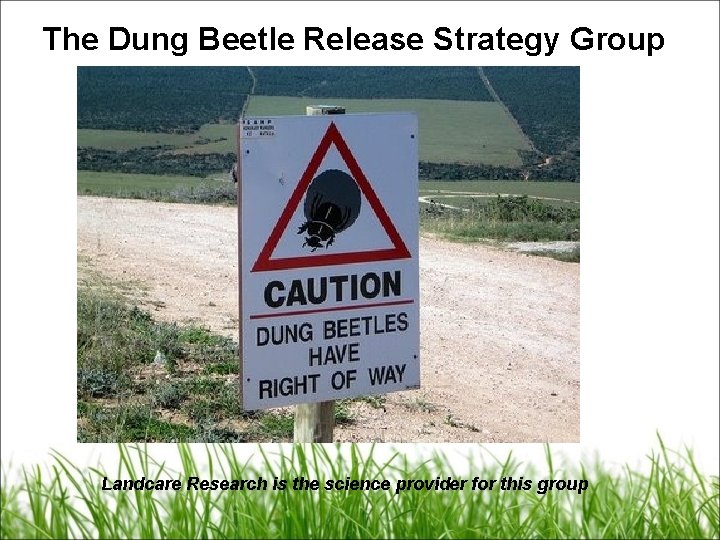
The Dung Beetle Release Strategy Group Landcare Research is the science provider for this group
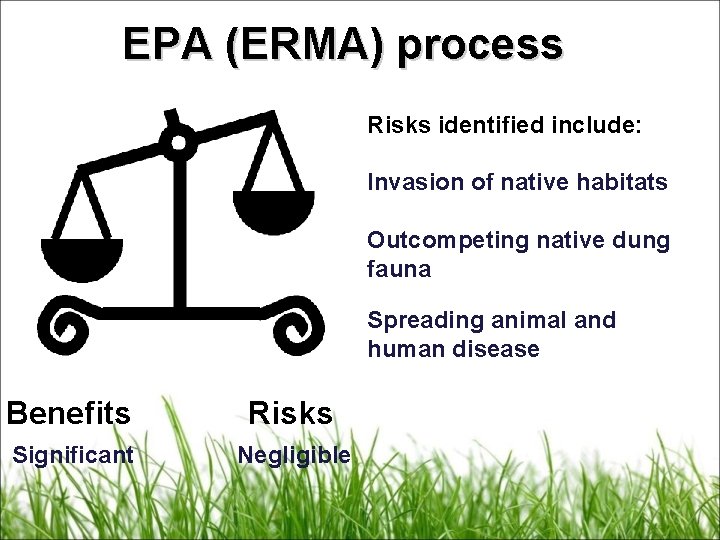
EPA (ERMA) process Risks identified include: Invasion of native habitats Outcompeting native dung fauna Spreading animal and human disease Benefits Risks Significant Negligible
Selection Criteria At least 11 species needed to control livestock dung 24 -7, 365 days a year throughout NZ. . • All species occupy differing but overlapping seasonal activity periods • Some species are day active, others night active or active only at dawn and dusk • All species are habitat specific to open grasslands • All species evolved to feed specifically on the dung of herbivorous mammals • Climatic suitability
EPA granted permission for importation and full unconditional release of all 11 species of dung beetle for use in NZ pastureland.
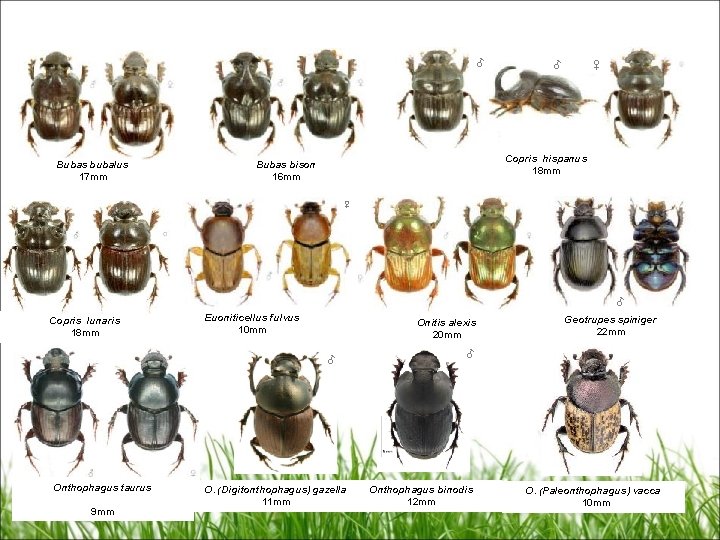
♂ Bubas bubalus 17 mm ♂ ♀ Copris hispanus 18 mm Bubas bison 16 mm ♀ ♂ Copris lunaris 18 mm Euoniticellus fulvus 10 mm Onitis alexis 20 mm ♂ Onthophagus taurus 9 mm O. (Digitonthophagus) gazella 11 mm Geotrupes spiniger 22 mm ♂ Onthophagus binodis 12 mm O. (Paleonthophagus) vacca 10 mm
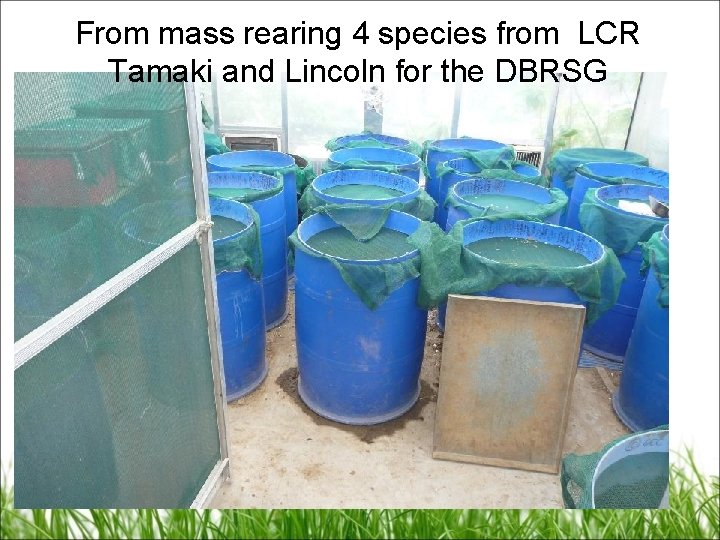
From mass rearing 4 species from LCR Tamaki and Lincoln for the DBRSG
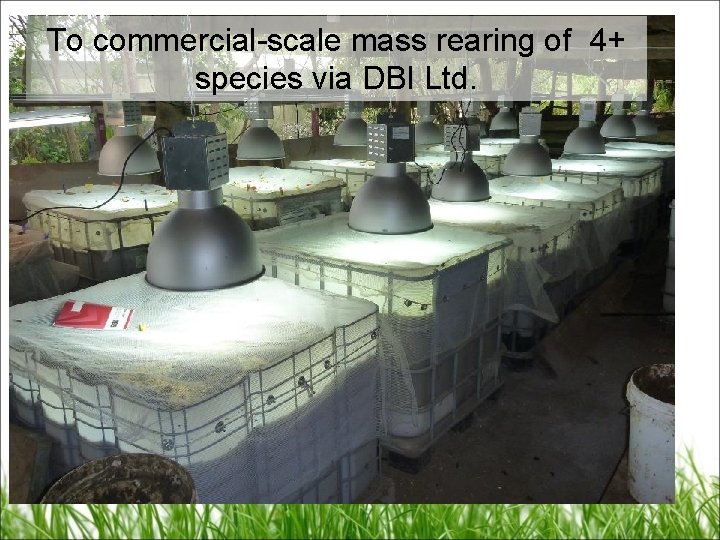
To commercial-scale mass rearing of 4+ species via DBI Ltd.
Founded in 2014 Mission: To rebalance New Zealand’s pastoral farming systems; through the sale, management and research of dung beetles.
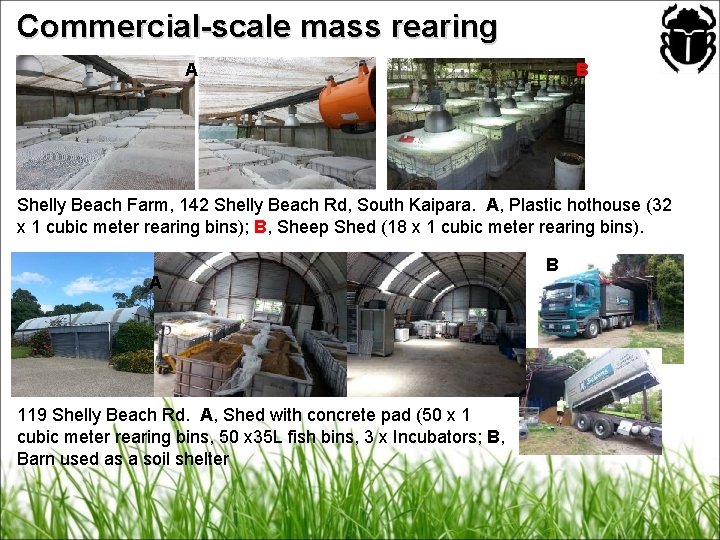
Commercial-scale mass rearing A B Shelly Beach Farm, 142 Shelly Beach Rd, South Kaipara. A, Plastic hothouse (32 x 1 cubic meter rearing bins); B, Sheep Shed (18 x 1 cubic meter rearing bins). A 119 Shelly Beach Rd. A, Shed with concrete pad (50 x 1 cubic meter rearing bins, 50 x 35 L fish bins, 3 x Incubators; B, Barn used as a soil shelter B
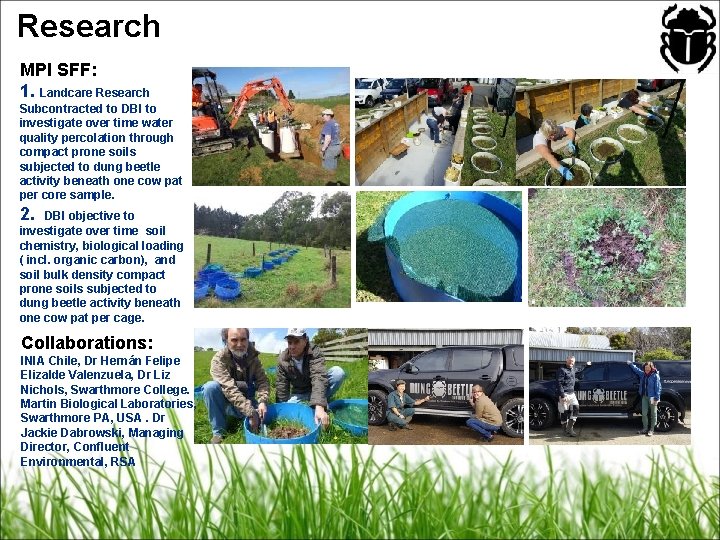
Research MPI SFF: 1. Landcare Research Subcontracted to DBI to investigate over time water quality percolation through compact prone soils subjected to dung beetle activity beneath one cow pat per core sample. 2. DBI objective to investigate over time soil chemistry, biological loading ( incl. organic carbon), and soil bulk density compact prone soils subjected to dung beetle activity beneath one cow pat per cage. Collaborations: INIA Chile, Dr Hernán Felipe Elizalde Valenzuela, Dr Liz Nichols, Swarthmore College. Martin Biological Laboratories, Swarthmore PA, USA. Dr Jackie Dabrowski, Managing Director, Confluent Environmental, RSA
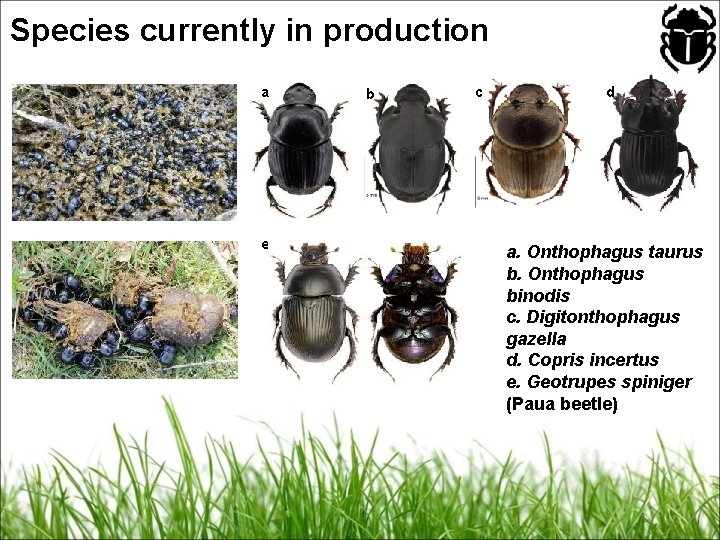
Species currently in production a e b c d a. Onthophagus taurus b. Onthophagus binodis c. Digitonthophagus gazella d. Copris incertus e. Geotrupes spiniger (Paua beetle)
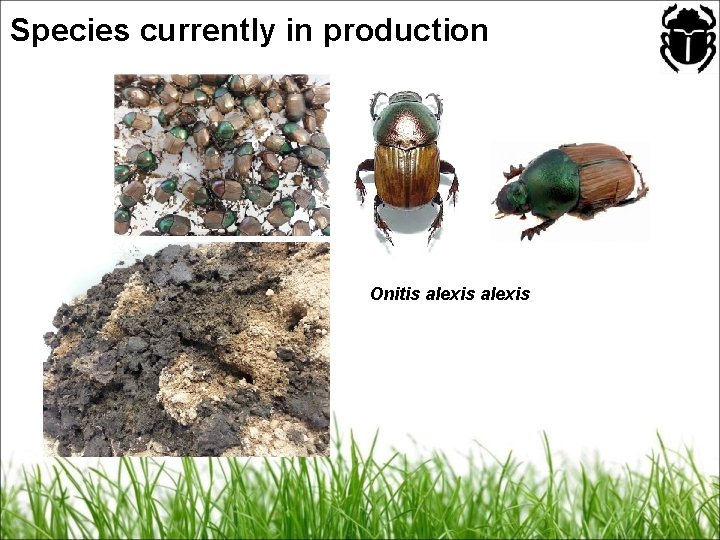
Species currently in production Onitis alexis
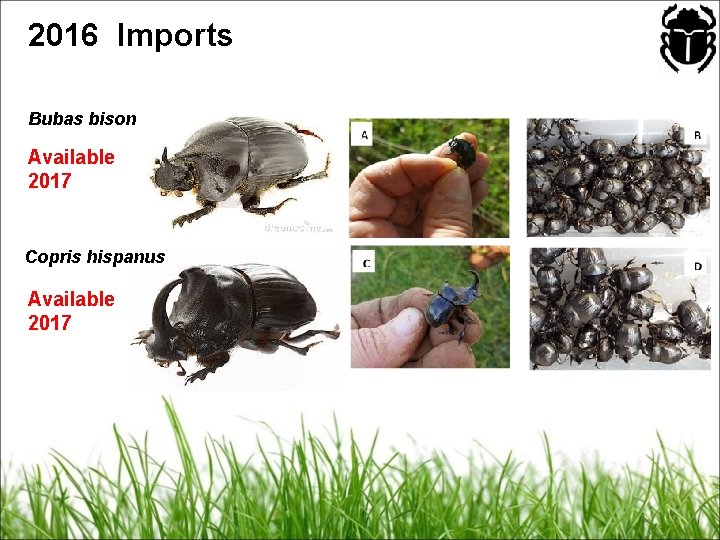
2016 Imports Bubas bison Available 2017 Copris hispanus Available 2017
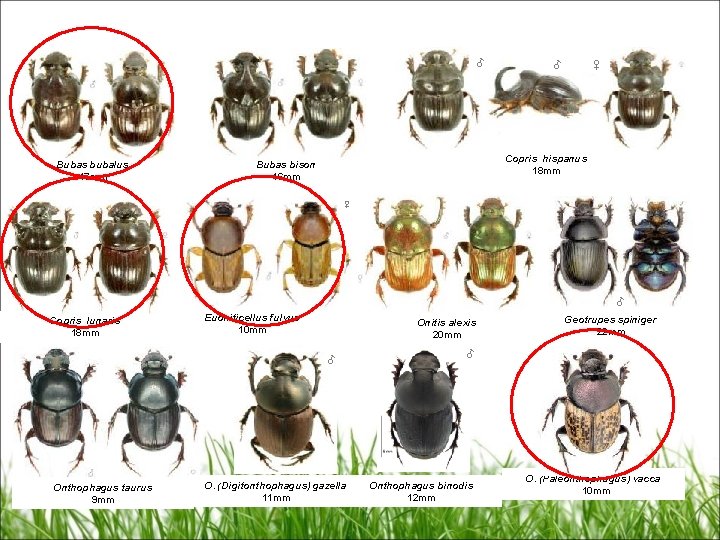
♂ Bubas bubalus 17 mm ♂ ♀ Copris hispanus 18 mm Bubas bison 16 mm ♀ ♂ Copris lunaris 18 mm Euoniticellus fulvus 10 mm Onitis alexis 20 mm ♂ Onthophagus taurus 9 mm O. (Digitonthophagus) gazella 11 mm Geotrupes spiniger 22 mm ♂ Onthophagus binodis 12 mm O. (Paleonthophagus) vacca 10 mm
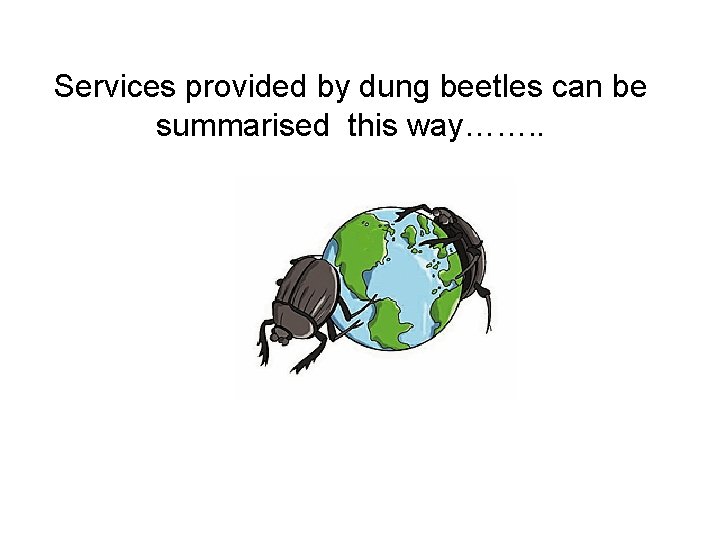
NO Dung-Burying Beetles With Dung-Burying Beetles Services provided by dung beetles can be summarised this way……. . Reduced: • • • soil structure & health nutrient recycling infiltration rates pasture productivity grass root biomass & depth Increased: • • • forage foul surface runoff water pollution Increased: • • micro organisms earthworm biomass & depth water & nutrient conservation water quality – leachate & non leachate • • pasture productivity Plant nitrogen content, protein levels, height & biomass soil structure & health water & nutrient conservation Reduced: • • forage foul surface runoff • • • organic carbon capture nutrient recycling micro organisms earthworm biomass & depth grass root biomass & depth water quality – leachate & non leachate
- Slides: 48