
Dulce et Decorum Est by Wilfred Owen Background
Dulce et Decorum Est by Wilfred Owen

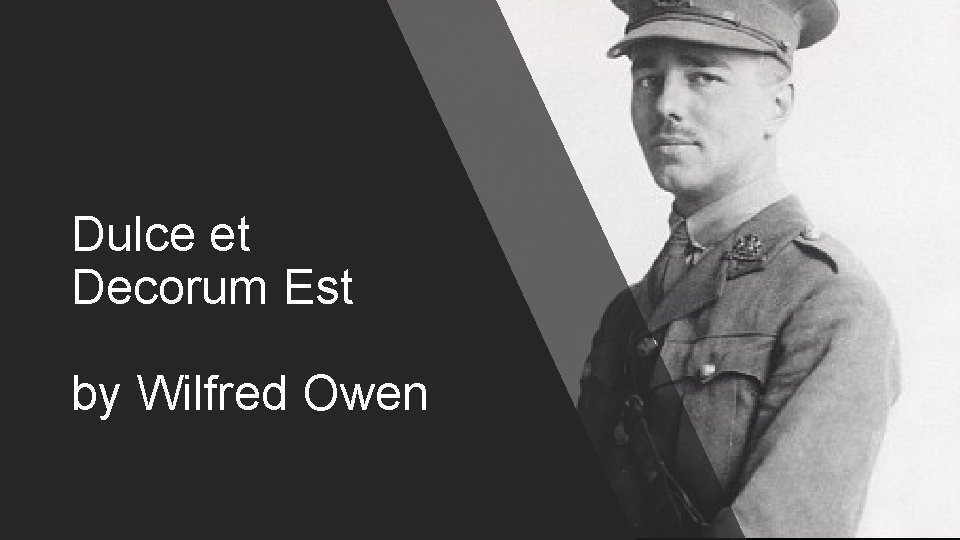
Background Information Wilfred Owen fought and died in the First World War. Much of his poetry is about the horrors of that conflict. At the start of WW 1 young men signed up in droves to fight for their country and the chance to be a hero. They were encouraged by propaganda and poems such as Jessi Pope’s “Who’s for the game? ” which compared war to being like a big game of rugby. “Dulce Et Decorum Est” is an anti war poem that Owen wrote as response to the propaganda poetry. Owen signed up to fight and was a vocal supporter of the war, however once he had experienced the realities of war he wrote this poem to discourage young men from enlisting and inform the British public about the horrors of war.
Readings • Dulce et Decorum Est – read by Christopher Ecclestone • Dulce et Decorum Est – Animation • Dulce et Decorum Est – Christopher Eccleston & Animation
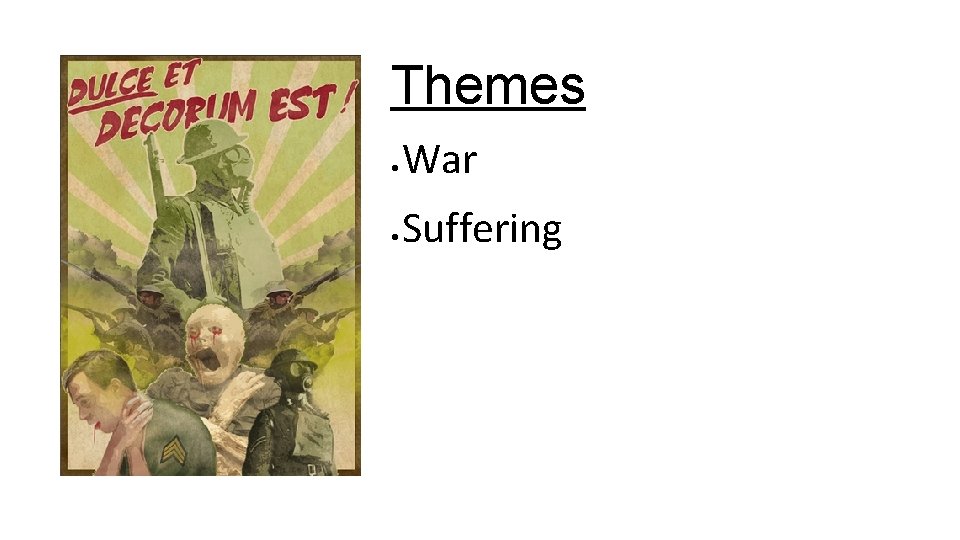
Themes · · War Suffering
Essay questions This poem would be suitable for a great range of poetry questions in the exam, but especially the following: • Questions asking you to choose a poem about a place or event • Questions asking you to choose a poem which explores an important issue/serious topic • Questions asking you to choose a poem which has a clear tone/mood/atmosphere or conveys strong emotions • Questions that ask you to choose a poem about a personal experience
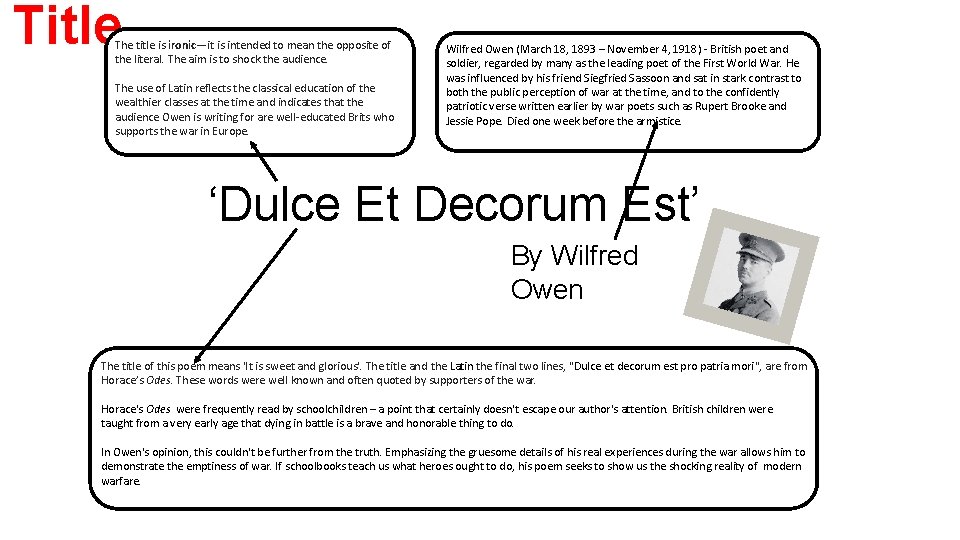
Title The title is ironic—it is intended to mean the opposite of the literal. The aim is to shock the audience. The use of Latin reflects the classical education of the wealthier classes at the time and indicates that the audience Owen is writing for are well-educated Brits who supports the war in Europe. Wilfred Owen (March 18, 1893 – November 4, 1918) - British poet and soldier, regarded by many as the leading poet of the First World War. He was influenced by his friend Siegfried Sassoon and sat in stark contrast to both the public perception of war at the time, and to the confidently patriotic verse written earlier by war poets such as Rupert Brooke and Jessie Pope. Died one week before the armistice. ‘Dulce Et Decorum Est’ By Wilfred Owen The title of this poem means 'It is sweet and glorious'. The title and the Latin the final two lines, "Dulce et decorum est pro patria mori", are from Horace’s Odes. These words were well known and often quoted by supporters of the war. Horace's Odes were frequently read by schoolchildren – a point that certainly doesn't escape our author's attention. British children were taught from a very early age that dying in battle is a brave and honorable thing to do. In Owen's opinion, this couldn't be further from the truth. Emphasizing the gruesome details of his real experiences during the war allows him to demonstrate the emptiness of war. If schoolbooks teach us what heroes ought to do, his poem seeks to show us the shocking reality of modern warfare.
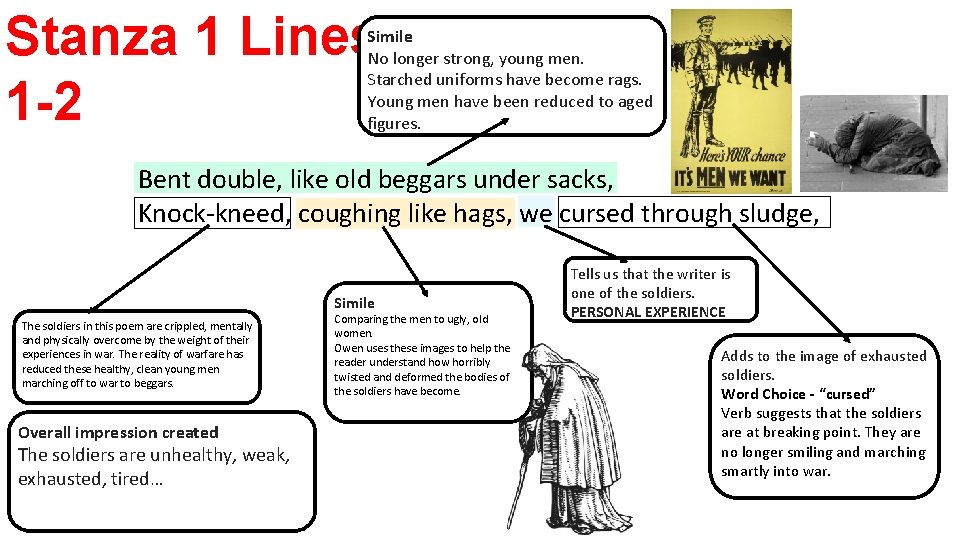
Stanza 1 Lines 1 -2 Simile No longer strong, young men. Starched uniforms have become rags. Young men have been reduced to aged figures. Bent double, like old beggars under sacks, Knock-kneed, coughing like hags, we cursed through sludge, Simile The soldiers in this poem are crippled, mentally and physically overcome by the weight of their experiences in war. The reality of warfare has reduced these healthy, clean young men marching off to war to beggars. Overall impression created The soldiers are unhealthy, weak, exhausted, tired… Comparing the men to ugly, old women. Owen uses these images to help the reader understand how horribly twisted and deformed the bodies of the soldiers have become. Tells us that the writer is one of the soldiers. PERSONAL EXPERIENCE Adds to the image of exhausted soldiers. Word Choice - “cursed” Verb suggests that the soldiers are at breaking point. They are no longer smiling and marching smartly into war.
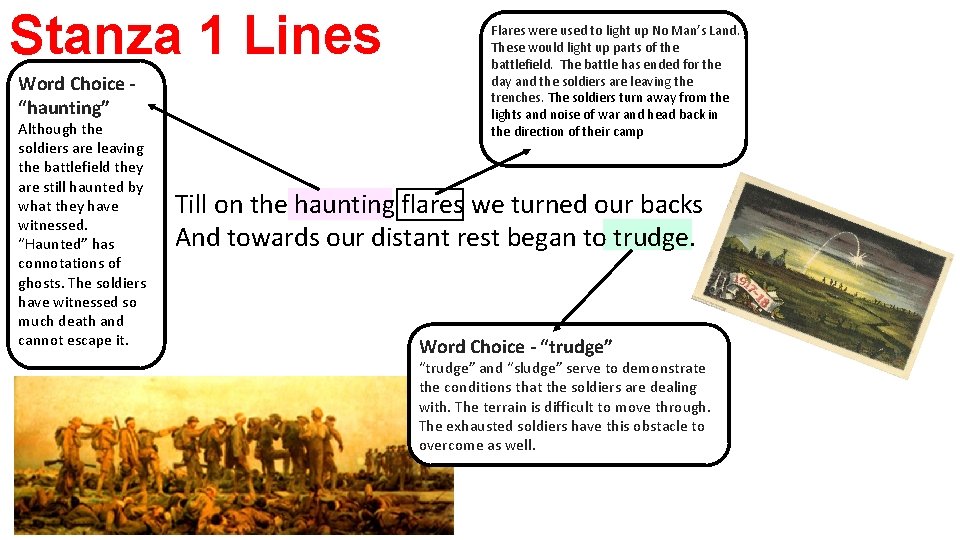
Stanza 1 Lines 3 -4 Word Choice “haunting” Although the soldiers are leaving the battlefield they are still haunted by what they have witnessed. “Haunted” has connotations of ghosts. The soldiers have witnessed so much death and cannot escape it. Flares were used to light up No Man’s Land. These would light up parts of the battlefield. The battle has ended for the day and the soldiers are leaving the trenches. The soldiers turn away from the lights and noise of war and head back in the direction of their camp Till on the haunting flares we turned our backs And towards our distant rest began to trudge. Word Choice - “trudge” and “sludge” serve to demonstrate the conditions that the soldiers are dealing with. The terrain is difficult to move through. The exhausted soldiers have this obstacle to overcome as well.
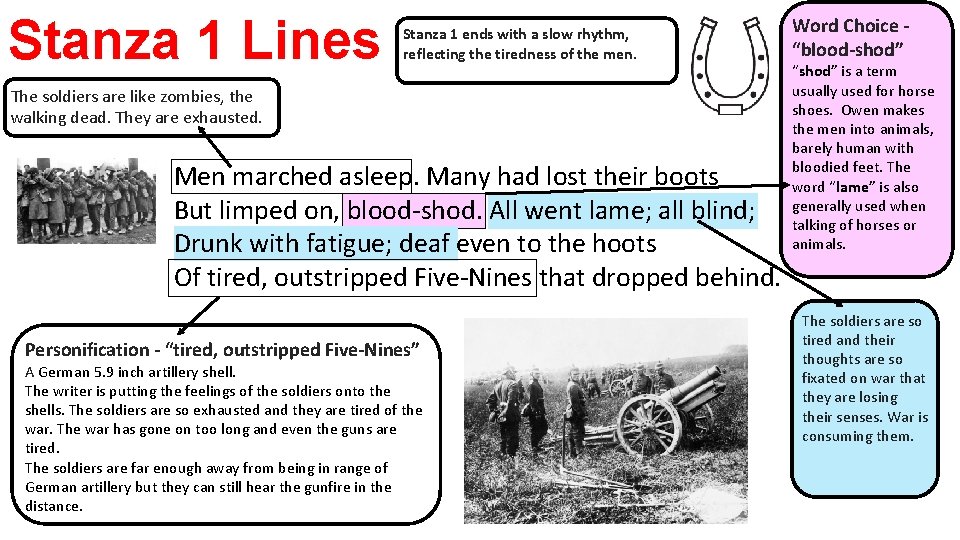
Stanza 1 Lines 5 -8 Stanza 1 ends with a slow rhythm, reflecting the tiredness of the men. The soldiers are like zombies, the walking dead. They are exhausted. Men marched asleep. Many had lost their boots But limped on, blood-shod. All went lame; all blind; Drunk with fatigue; deaf even to the hoots Of tired, outstripped Five-Nines that dropped behind. Personification - “tired, outstripped Five-Nines” A German 5. 9 inch artillery shell. The writer is putting the feelings of the soldiers onto the shells. The soldiers are so exhausted and they are tired of the war. The war has gone on too long and even the guns are tired. The soldiers are far enough away from being in range of German artillery but they can still hear the gunfire in the distance. Word Choice “blood-shod” “shod” is a term usually used for horse shoes. Owen makes the men into animals, barely human with bloodied feet. The word “lame” is also generally used when talking of horses or animals. The soldiers are so tired and their thoughts are so fixated on war that they are losing their senses. War is consuming them.
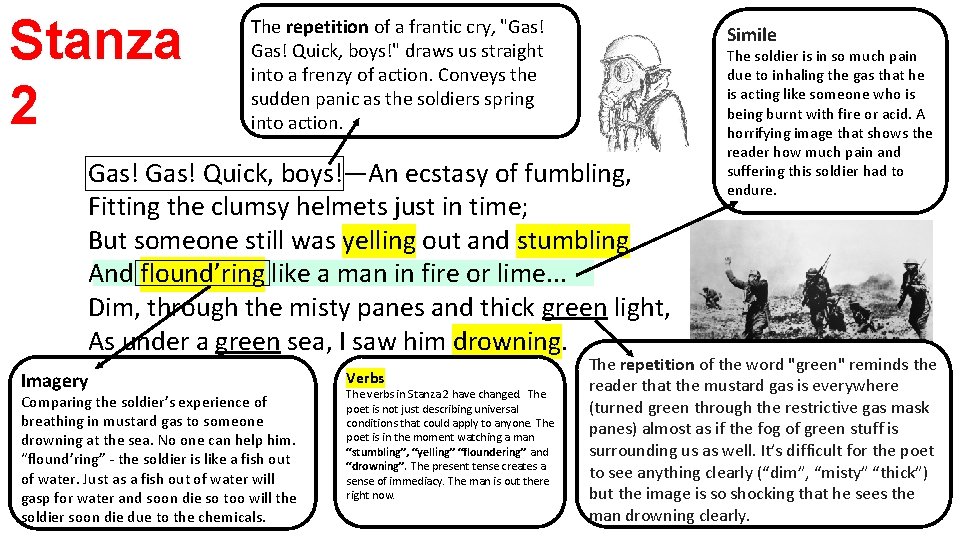
Stanza 2 The repetition of a frantic cry, "Gas! Quick, boys!" draws us straight into a frenzy of action. Conveys the sudden panic as the soldiers spring into action. Simile Gas! Quick, boys!—An ecstasy of fumbling, Fitting the clumsy helmets just in time; But someone still was yelling out and stumbling And flound’ring like a man in fire or lime. . . Dim, through the misty panes and thick green light, As under a green sea, I saw him drowning. Imagery Comparing the soldier’s experience of breathing in mustard gas to someone drowning at the sea. No one can help him. “flound’ring” - the soldier is like a fish out of water. Just as a fish out of water will gasp for water and soon die so too will the soldier soon die due to the chemicals. Verbs The verbs in Stanza 2 have changed. The poet is not just describing universal conditions that could apply to anyone. The poet is in the moment watching a man “stumbling”, “yelling” “floundering” and “drowning”. The present tense creates a sense of immediacy. The man is out there right now. The soldier is in so much pain due to inhaling the gas that he is acting like someone who is being burnt with fire or acid. A horrifying image that shows the reader how much pain and suffering this soldier had to endure. The repetition of the word "green" reminds the reader that the mustard gas is everywhere (turned green through the restrictive gas mask panes) almost as if the fog of green stuff is surrounding us as well. It’s difficult for the poet to see anything clearly (“dim”, “misty” “thick”) but the image is so shocking that he sees the man drowning clearly.
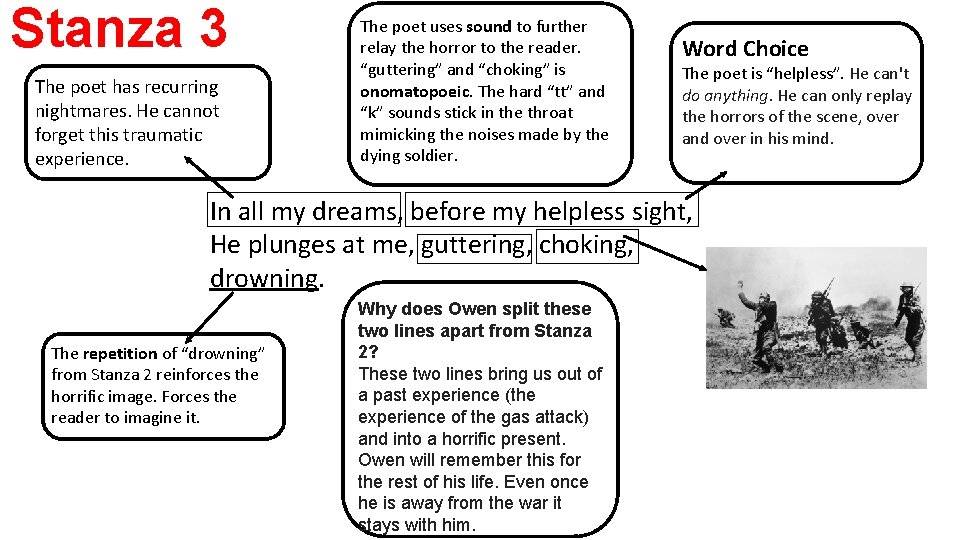
Stanza 3 The poet has recurring nightmares. He cannot forget this traumatic experience. The poet uses sound to further relay the horror to the reader. “guttering” and “choking” is onomatopoeic. The hard “tt” and “k” sounds stick in the throat mimicking the noises made by the dying soldier. Word Choice The poet is “helpless”. He can't do anything. He can only replay the horrors of the scene, over and over in his mind. In all my dreams, before my helpless sight, He plunges at me, guttering, choking, drowning. The repetition of “drowning” from Stanza 2 reinforces the horrific image. Forces the reader to imagine it. Why does Owen split these two lines apart from Stanza 2? These two lines bring us out of a past experience (the experience of the gas attack) and into a horrific present. Owen will remember this for the rest of his life. Even once he is away from the war it stays with him.
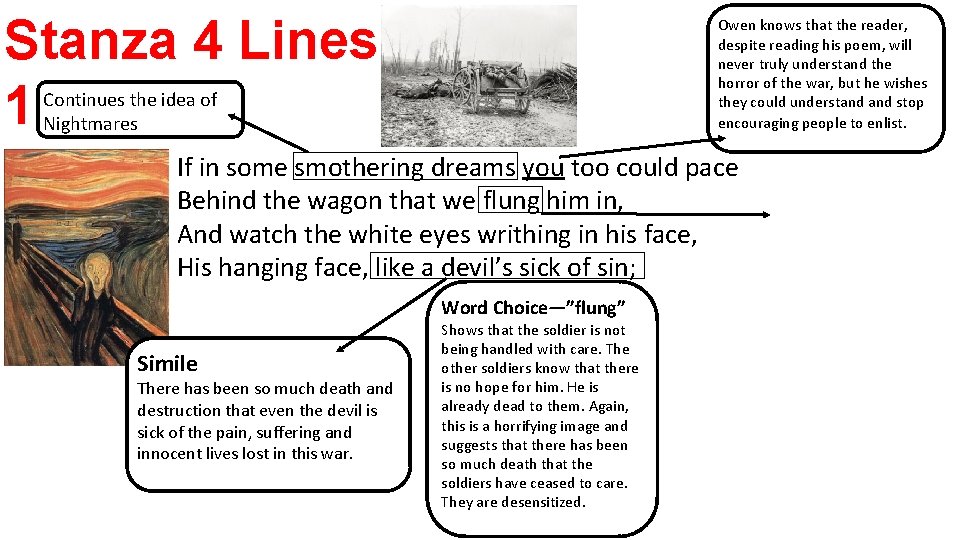
Stanza 4 Lines 1 -4 Owen knows that the reader, despite reading his poem, will never truly understand the horror of the war, but he wishes they could understand stop encouraging people to enlist. Continues the idea of Nightmares If in some smothering dreams you too could pace Behind the wagon that we flung him in, And watch the white eyes writhing in his face, His hanging face, like a devil’s sick of sin; Word Choice—”flung” Simile There has been so much death and destruction that even the devil is sick of the pain, suffering and innocent lives lost in this war. Shows that the soldier is not being handled with care. The other soldiers know that there is no hope for him. He is already dead to them. Again, this is a horrifying image and suggests that there has been so much death that the soldiers have ceased to care. They are desensitized.
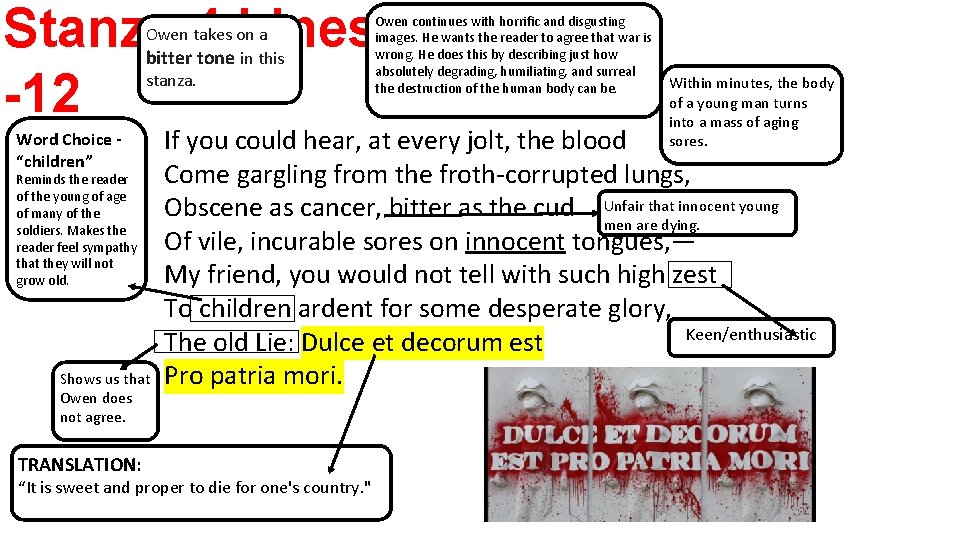
Stanza 4 Lines 5 -12 Owen takes on a bitter tone in this stanza. Word Choice “children” Reminds the reader of the young of age of many of the soldiers. Makes the reader feel sympathy that they will not grow old. Shows us that Owen does not agree. TRANSLATION: Owen continues with horrific and disgusting images. He wants the reader to agree that war is wrong. He does this by describing just how absolutely degrading, humiliating, and surreal the destruction of the human body can be. Within minutes, the body of a young man turns into a mass of aging sores. If you could hear, at every jolt, the blood Come gargling from the froth-corrupted lungs, Obscene as cancer, bitter as the cud Unfair that innocent young men are dying. Of vile, incurable sores on innocent tongues, — My friend, you would not tell with such high zest To children ardent for some desperate glory, Keen/enthusiastic The old Lie: Dulce et decorum est Pro patria mori. “It is sweet and proper to die for one's country. "

Dulce et Decorum Est Example Essay • Annotate/highlight parts of the essay to ensure you understand how to structure your essay in the exam and what to include. • Introduction – TAGLS • Main Body paragraph – Topic Sentence, Link to the task, Evidence, Analysis, Evaluation. (At least 3 pieces of evidence + analysis per paragraph) • Techniques names (simile, word choice, pace, onomatopoeia, personification, alliteration, etc) • Varied vocabulary (horrifying, shocking, terrifying, harrowing etc. ) • Place markers (At the beginning, near the start, later, in the next stanza, finally, etc. ) • Conclusion • A clear link to the task throughout
- Slides: 14