
Dublin City Community Coop Lot 2 5 Dublin
Dublin City Community Coop Lot 2 -5 Dublin Inner City 2018 SICAP Case Study
Dublin City Community Coop The Dublin Inner City Community Co-operative Society Limited (‘the Coop’) is an alliance of 13 grassroots inner city community development organisations which have come together to ensure the much-needed development and delivery of social, economic and cultural services continue within our communities. All 13 Coop member organisations receive funding via the Coop under the national Social Inclusion Community Activation (SICAP) Programme and operate in the most disadvantaged areas of Dublin’s inner city.
Case Study within a Context This case study reviews a child protection case in which Coop member CASPr played a key role. The Coop chose this piece of work because: 1. It is a clear demonstration of the critical role that SICAP plays in supporting essential, holistic and effective services to the most vulnerable in our society. 2. It exemplifies the importance and effectiveness of collaboration. 3. It highlights the importance of the role of local community based organisations. Without this kind of local link collaborations such as this one would be limited in the success they could achieve.
Collaboration • This case is a good example of the effectiveness of multi-agency collaboration and what’s possible when statutory and community organisations work together united in the aim of ensuring the safety and care of the children involved. • The Coop was reminded of the importance of: • Clear roles being set and adhered to. • Each organisation/person being accountable for and understanding clearly their roles with the family. • Working in collaboration with professionals who can make decisions ensures that the work is more efficient and can lead to more successful outcomes.
The Important Role of Local Community Development Organisations • The Coop’s/CASPr’s involvement was critical to the successful outcomes of this case. CASPr is. an organisation created by the people for the people and as such has the trust of, and access to the local community which statutory agencies could seldom hope to achieve. • Without SICAP funding CASPr would struggle to remain in existence or at best its services would be severely curtailed.
Community After Schools Project CASPr’s aim is to counter Educational Disadvantage in the North East Inner City of Dublin in order to contribute to the elimination of poverty in the community.
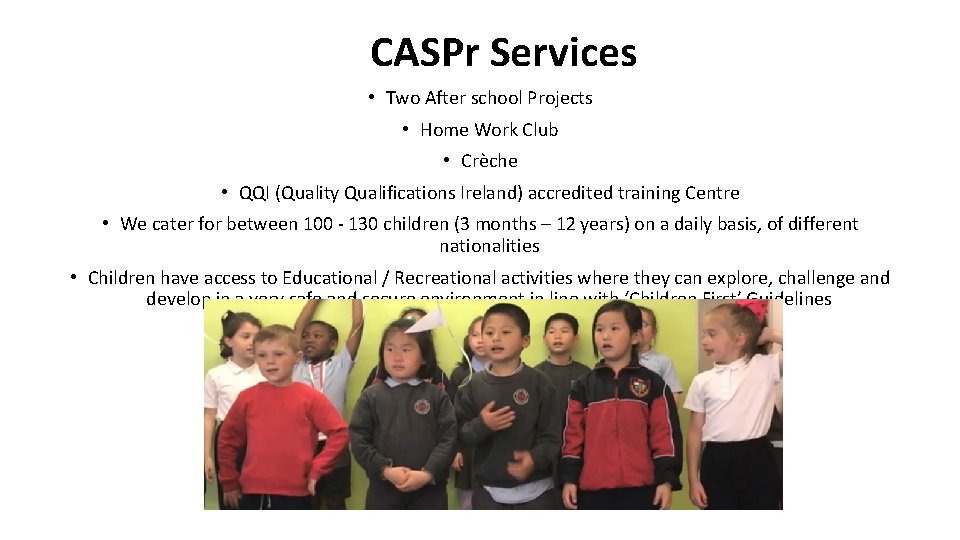
CASPr Services • Two After school Projects • Home Work Club • Crèche • QQI (Quality Qualifications Ireland) accredited training Centre • We cater for between 100 - 130 children (3 months – 12 years) on a daily basis, of different nationalities • Children have access to Educational / Recreational activities where they can explore, challenge and develop in a very safe and secure environment in line with ‘Children First’ Guidelines
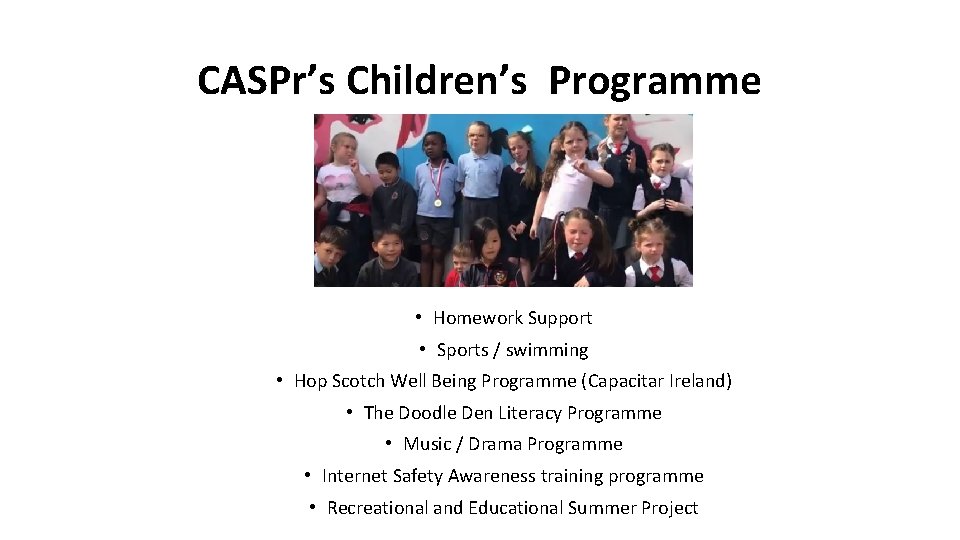
CASPr’s Children’s Programme • Homework Support • Sports / swimming • Hop Scotch Well Being Programme (Capacitar Ireland) • The Doodle Den Literacy Programme • Music / Drama Programme • Internet Safety Awareness training programme • Recreational and Educational Summer Project
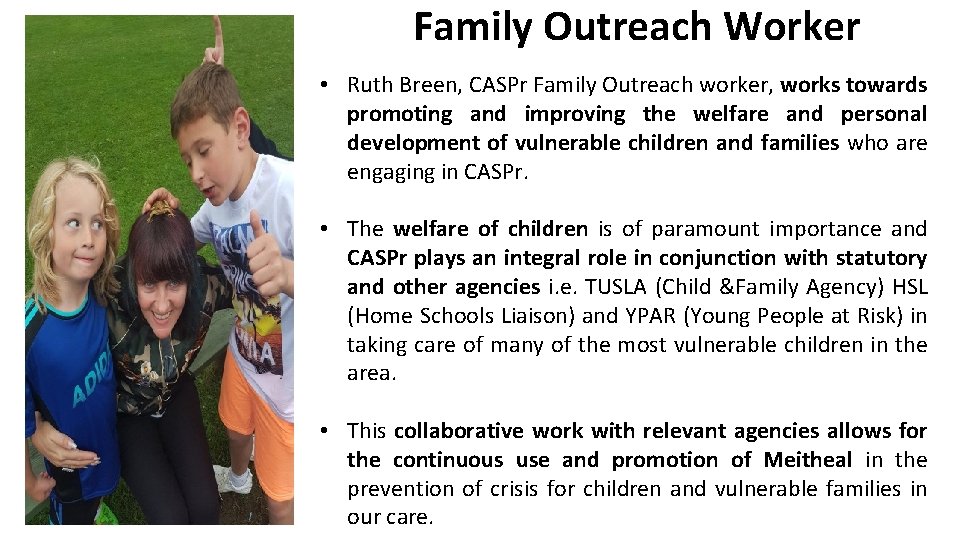
Family Outreach Worker • Ruth Breen, CASPr Family Outreach worker, works towards promoting and improving the welfare and personal development of vulnerable children and families who are engaging in CASPr. • The welfare of children is of paramount importance and CASPr plays an integral role in conjunction with statutory and other agencies i. e. TUSLA (Child &Family Agency) HSL (Home Schools Liaison) and YPAR (Young People at Risk) in taking care of many of the most vulnerable children in the area. • This collaborative work with relevant agencies allows for the continuous use and promotion of Meitheal in the prevention of crisis for children and vulnerable families in our care.
Case Study – Sequence of Interventions This case study runs from January 2016 up until October 2018 and reflects the non-linear nature of human development. FAMILY SITUATION The family consists of Mum & Dad (separated) with two adult children and three primary school age children. In January 2016 the youngest child was four years old, attending a local crèche and due to begin school the following September. The other two children were attending CASPr after schools projects. The adult children at the time were 19 years old and 17 years old. The 17 year old lived with Mum and 19 year old lived with Dad and Grandmother. CONCERNS • Mum suspected drug mis-use • Children's non attendance in school, missing at least two/three times weekly • Children showing signs of neglect • Constantly arriving late to school and to collect children from CASPr
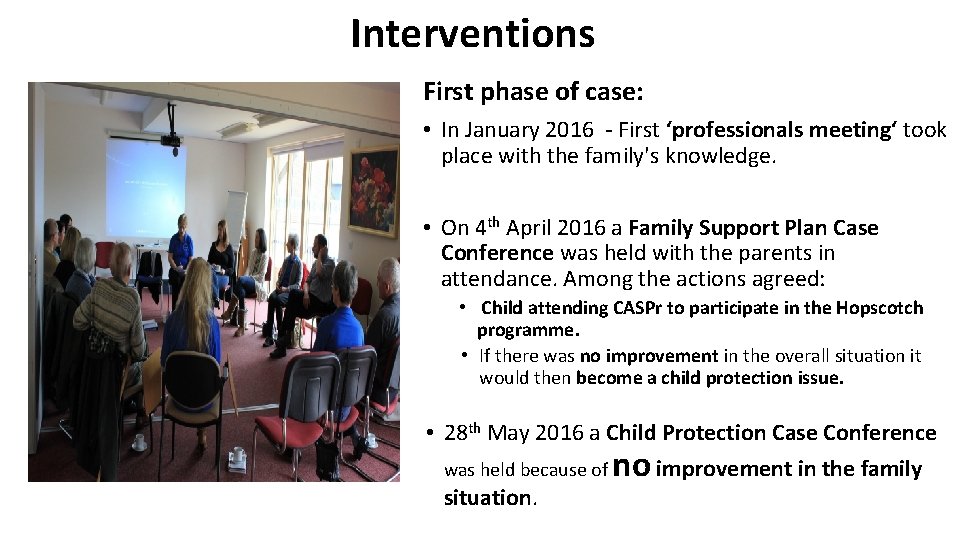
Interventions First phase of case: • In January 2016 - First ‘professionals meeting‘ took place with the family's knowledge. • On 4 th April 2016 a Family Support Plan Case Conference was held with the parents in attendance. Among the actions agreed: • Child attending CASPr to participate in the Hopscotch programme. • If there was no improvement in the overall situation it would then become a child protection issue. • 28 th May 2016 a Child Protection Case Conference was held because of no improvement in the family situation.
It was determined at this conference (28 th May 2016) that the children be placed on the CHILD PROTECTION NOTIFICATION SYSTEM REGISTER as being at risk of significant harm or neglect. The following actions were agreed by CASPr: 1. Mom to meet with CASPr family outreach worker once a week 2. Children to attend CASPr after schools project every day
Second phase of case : • 3 rd October 2016: A ‘professionals’ meeting’ was held because it was noted that the previous care & protection plans had not been adhered to by the parents. • 15 th October 2016 - Child Protection Case Conference - Among the social worker’s recommendations were: • CASPr project team to continue to link in with mum twice weekly for parenting skills and possible counselling. • Dad to be encouraged to take 3 children regularly at the same time. • Children not to be left alone with mum’s current partner because there was evidence of him buying and selling drugs. Mum was urged to manage this relationship and ensure that children’s needs were prioritised.
Third phase of case : • 18 th January 2017 - The Social worker was granted a ‘supervision order’ from the courts whereby: • The new arrangement was for dad to have three children from Monday to Thursday. • The Judge specified that if mum did not engage and fully comply with this arrangement, the children would have to be put in ‘Alternative care’. • 27 th March 2017 - Child Protection Review Case during which the following provisions were agreed: • • • Mum to engage with the Coop project team. Mum to engage immediately with this plan. It was emphasised that the social work department did not have to wait for next review case conference before proceeding with a care application should risks escalate in the interim. Children to remain on CPNS register until further notice.
Fourth phase of case : • 12 th September 2017 - A Review Case Conference took place, during which: • The social worker reported that there was significant improvement in relation to all the previous concerns. • Both parents were working together, and this was working very well. • The CASPr project team outlined the huge improvement in both children attending CASPr’s after school’s project. They never missed days and there had been a good improvement in their overall presentation. They were mixing with all the other children and had gained huge amounts of confidence. • The decision agreed at this meeting was: • The children’s names were to be deleted from the CPNS. It was stated by the social work department that the outstanding issues were not enough for the children’s names to remain on the CPNS register. Any remaining problems no longer met the threshold of ongoing risk of significant harm.
Final phase of case • In September 2017 the final case conference was held for the family and was the completion of a two-year period of case conferences and reviews. • Weekly communication continued between the Coop project team and the social work department throughout the remainder of 2017 and during 2018. • 28 th June 2018 - The Coop’s project team received a letter from the social work department to state that the case was now officially closed. • July 2018 - Both children attended CASPr’s summer project in July, including going on a weeklong residential trip to Cavan. • Autumn 2018 - non-linear nature of human beings!
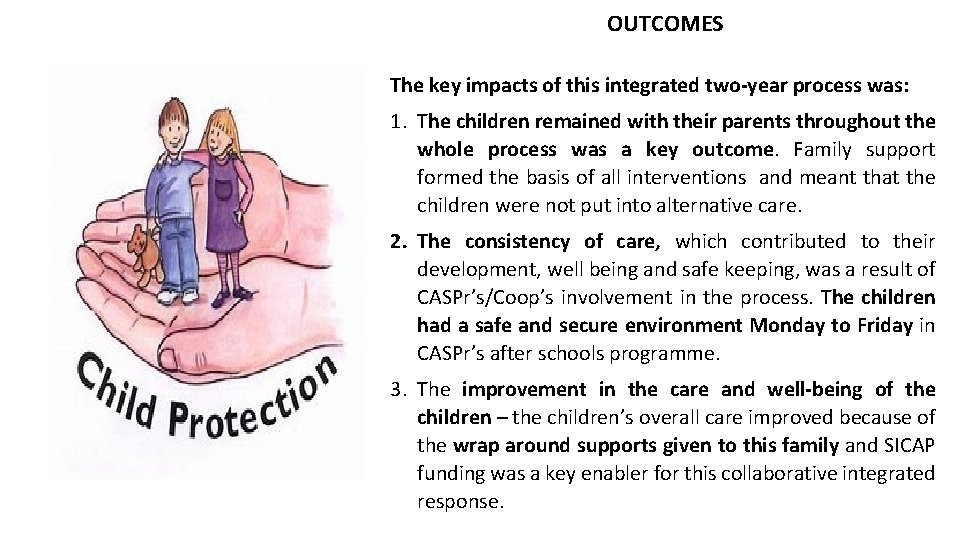
OUTCOMES The key impacts of this integrated two-year process was: 1. The children remained with their parents throughout the whole process was a key outcome. Family support formed the basis of all interventions and meant that the children were not put into alternative care. 2. The consistency of care, which contributed to their development, well being and safe keeping, was a result of CASPr’s/Coop’s involvement in the process. The children had a safe and secure environment Monday to Friday in CASPr’s after schools programme. 3. The improvement in the care and well-being of the children – the children’s overall care improved because of the wrap around supports given to this family and SICAP funding was a key enabler for this collaborative integrated response.
SICAP’s contribution was invaluable to this case • SICAP workers have a unique understanding of the target group and what issues the parents were dealing with and how this impacted on their children • SICAP workers had unique access to both parents and children • SICAP workers had a trusting and non-judgemental relationship with the mum and dad as well as with the children. • The SICAP project team was an important ‘constant’ in this case E. g. 3 social workers • SICAP worker co-ordinated, supervised and supported the Coop project team’s engagement in this process e. g. : • • Managing conflict and to assisting/training staff in doing so. Managing boundaries, a skill that is essential for the longevity, welfare and sustainability of staff working with such complex and emotionally charged cases. • SICAP workers had an understanding of, and strong relationships with the statutory agencies involved, all of which is necessary for good collaboration to happen. • The ability to listen to and effectively manage different perspectives, both with statutory agencies, within CASPr itself and with the clients themselves.
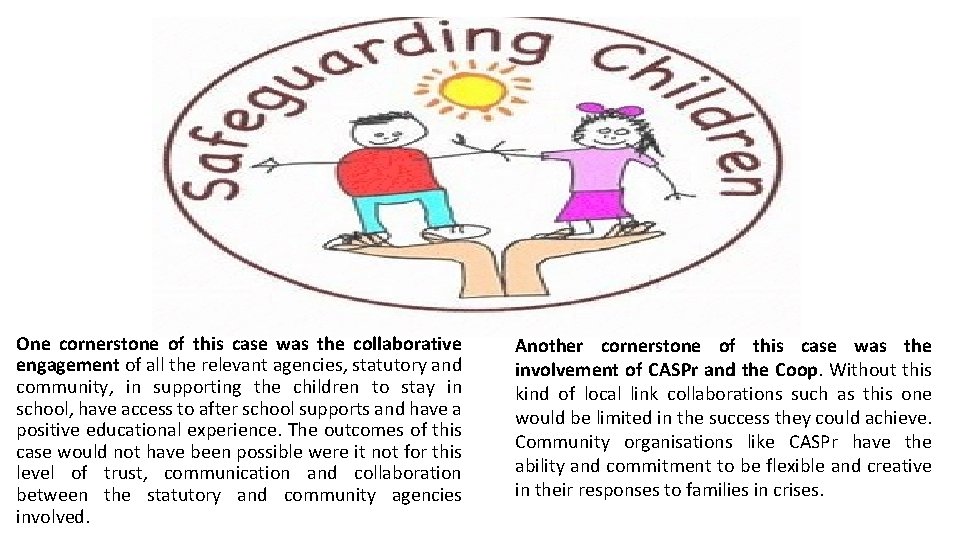
One cornerstone of this case was the collaborative engagement of all the relevant agencies, statutory and community, in supporting the children to stay in school, have access to after school supports and have a positive educational experience. The outcomes of this case would not have been possible were it not for this level of trust, communication and collaboration between the statutory and community agencies involved. Another cornerstone of this case was the involvement of CASPr and the Coop. Without this kind of local link collaborations such as this one would be limited in the success they could achieve. Community organisations like CASPr have the ability and commitment to be flexible and creative in their responses to families in crises.

SCAFFOLDING BY SEAMUS HEANEY Masons, when they start upon a building, Are careful to test out the scaffolding; Make sure that planks won’t slip at busy points, Secure all ladders, tighten bolted joints. And yet all this comes down when the job’s done Showing off walls of sure and solid stone. So if, my dear, there sometimes seem to be Old bridges breaking between you and me Never fear. We may let the scaffolds fall Confident that we have built our wall.
- Slides: 20