
Dualprocess model of older adults sedentary behavior An
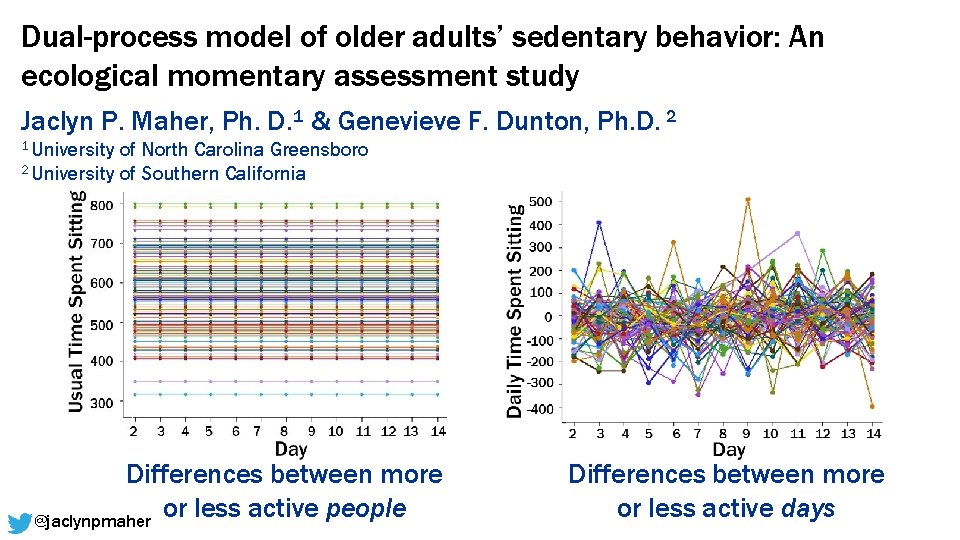
Dual-process model of older adults’ sedentary behavior: An ecological momentary assessment study Jaclyn P. Maher, Ph. D. 1 & Genevieve F. Dunton, Ph. D. 2 1 University of North Carolina Greensboro 2 University of Southern California Differences between more or less active people @jaclynpmaher Differences between more or less active days

A dual process model may be more effective in explaining older adults’ sedentary behavior compared to social cognitive frameworks. Conscious processes Behavior Non-conscious processes @jaclynpmaher (Bargh & Ferguson, 2000; Evans, 2008; Strack & Deutsch, 2004)

Non-conscious processes Conscious processes A dual process model may be more effective in explaining older adults’ sedentary behavior compared to social cognitive frameworks. @jaclynpmaher Intention Self-efficacy Habit Sedentary Behavior
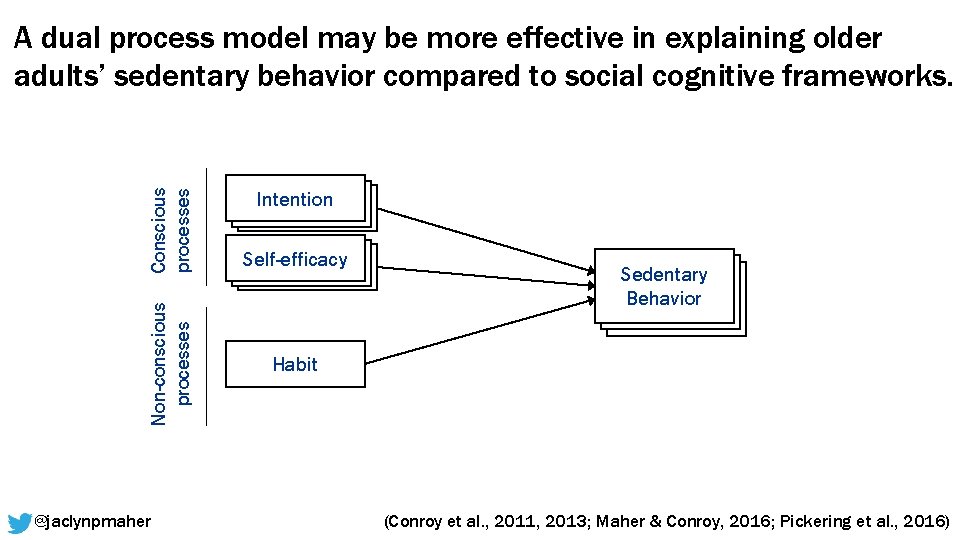
Non-conscious processes Conscious processes A dual process model may be more effective in explaining older adults’ sedentary behavior compared to social cognitive frameworks. @jaclynpmaher Intention Self-efficacy Intention Sedentary Behavior Habit (Conroy et al. , 2011, 2013; Maher & Conroy, 2016; Pickering et al. , 2016)
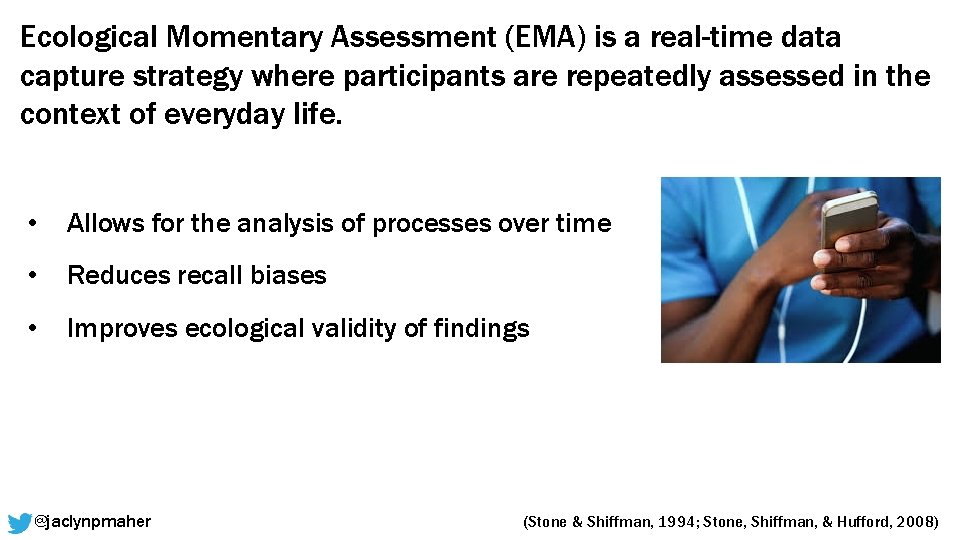
Ecological Momentary Assessment (EMA) is a real-time data capture strategy where participants are repeatedly assessed in the context of everyday life. • Allows for the analysis of processes over time • Reduces recall biases • Improves ecological validity of findings @jaclynpmaher (Stone & Shiffman, 1994; Stone, Shiffman, & Hufford, 2008)
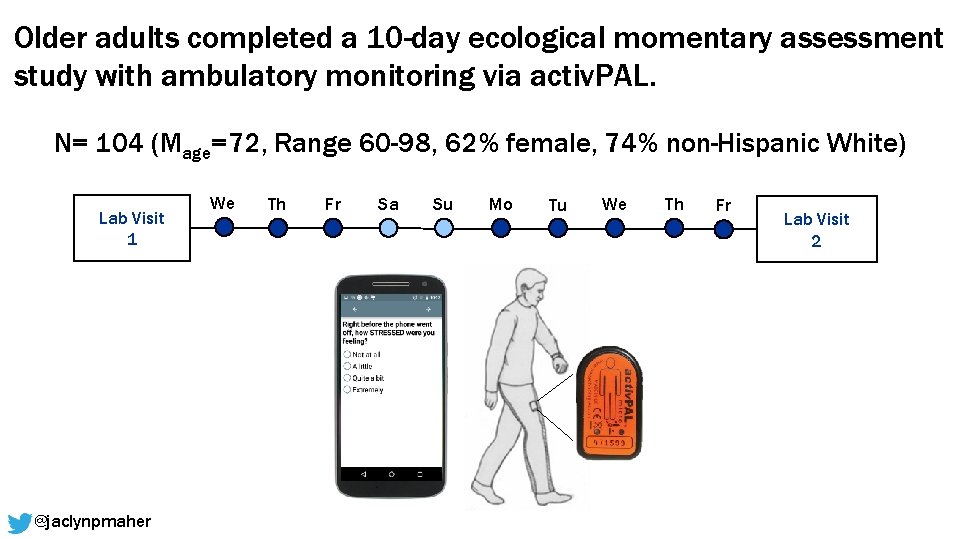
Older adults completed a 10 -day ecological momentary assessment study with ambulatory monitoring via activ. PAL. N= 104 (Mage=72, Range 60 -98, 62% female, 74% non-Hispanic White) Lab Visit 1 @jaclynpmaher We Th Fr Sa Su Mo Tu We Th Fr Lab Visit 2
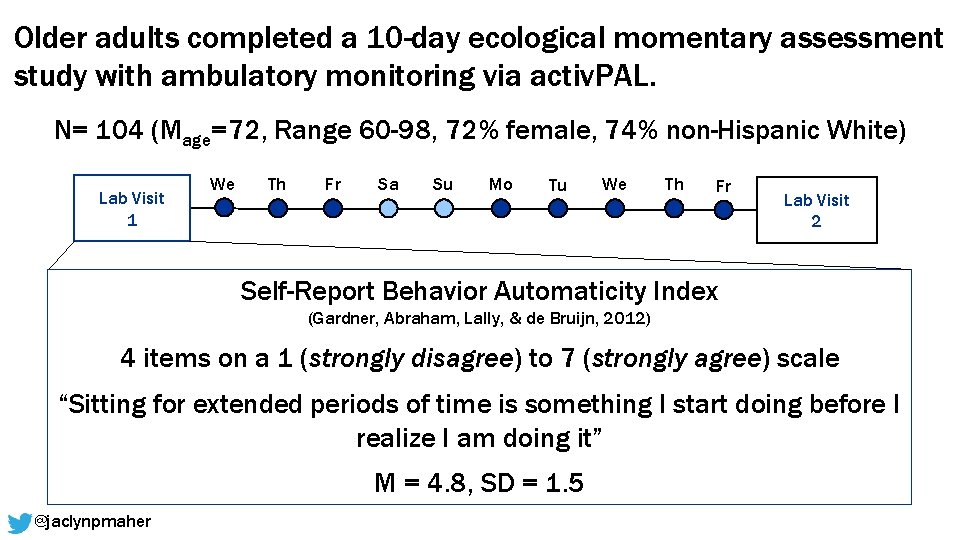
Older adults completed a 10 -day ecological momentary assessment study with ambulatory monitoring via activ. PAL. N= 104 (Mage=72, Range 60 -98, 72% female, 74% non-Hispanic White) Lab Visit 1 We Th Fr Sa Su Mo Tu We Th Fr Lab Visit 2 Self-Report Behavior Automaticity Index (Gardner, Abraham, Lally, & de Bruijn, 2012) 4 items on a 1 (strongly disagree) to 7 (strongly agree) scale “Sitting for extended periods of time is something I start doing before I realize I am doing it” M = 4. 8, SD = 1. 5 @jaclynpmaher
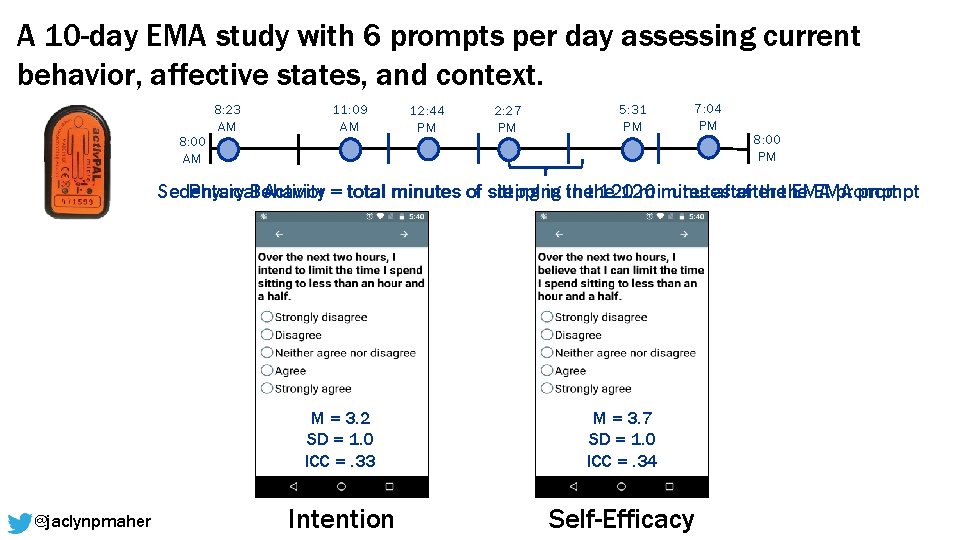
A 10 -day EMA study with 6 prompts per day assessing current behavior, affective states, and context. 8: 00 AM 8: 23 AM 11: 09 AM 12: 44 PM 2: 27 PM 5: 31 PM 7: 04 PM 8: 00 PM Sedentary in the 120 minutes after thethe EMA prompt Physical. Behavior Activity = total minutes of sitting stepping in the 120 minutes after EMA prompt @jaclynpmaher M = 3. 2 SD = 1. 0 ICC =. 33 M = 3. 7 SD = 1. 0 ICC =. 34 Intention Self-Efficacy
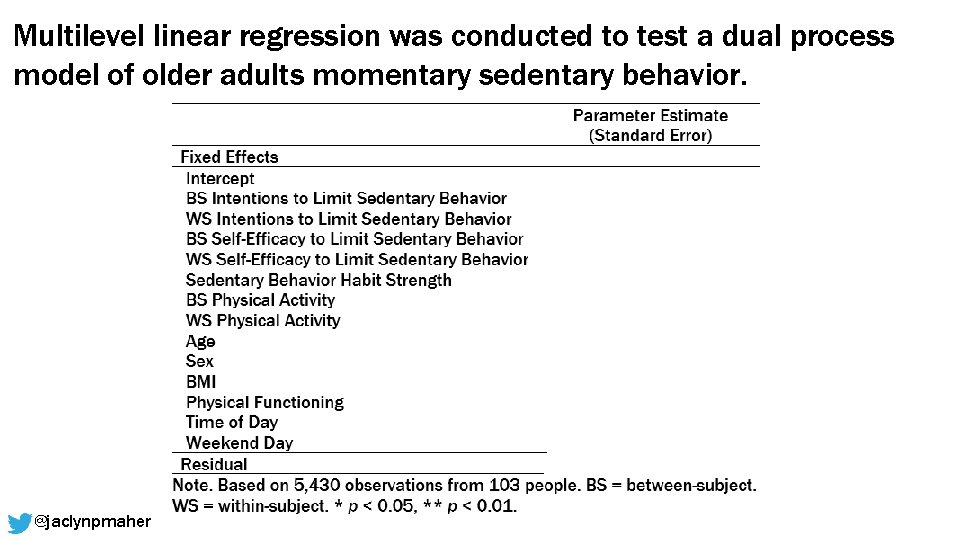
Multilevel linear regression was conducted to test a dual process model of older adults momentary sedentary behavior. @jaclynpmaher
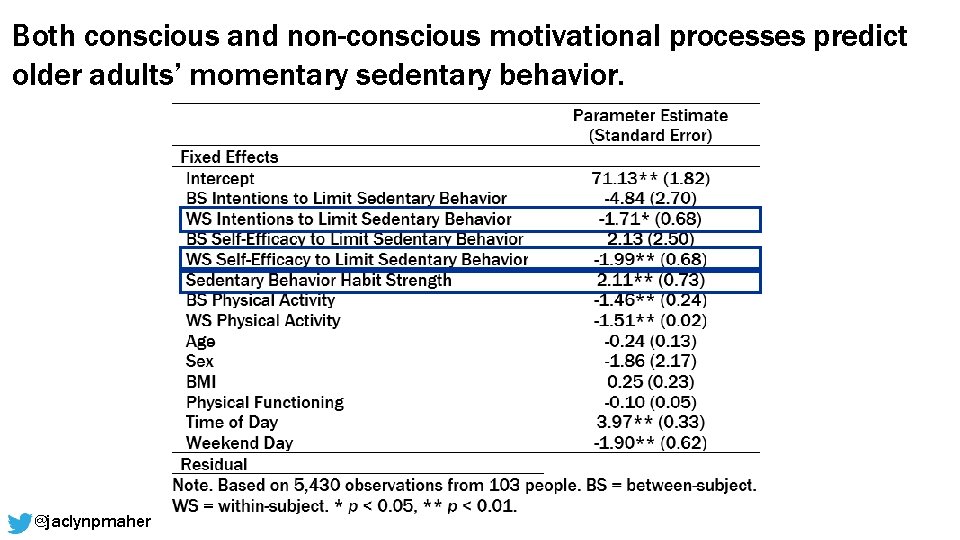
Both conscious and non-conscious motivational processes predict older adults’ momentary sedentary behavior. @jaclynpmaher
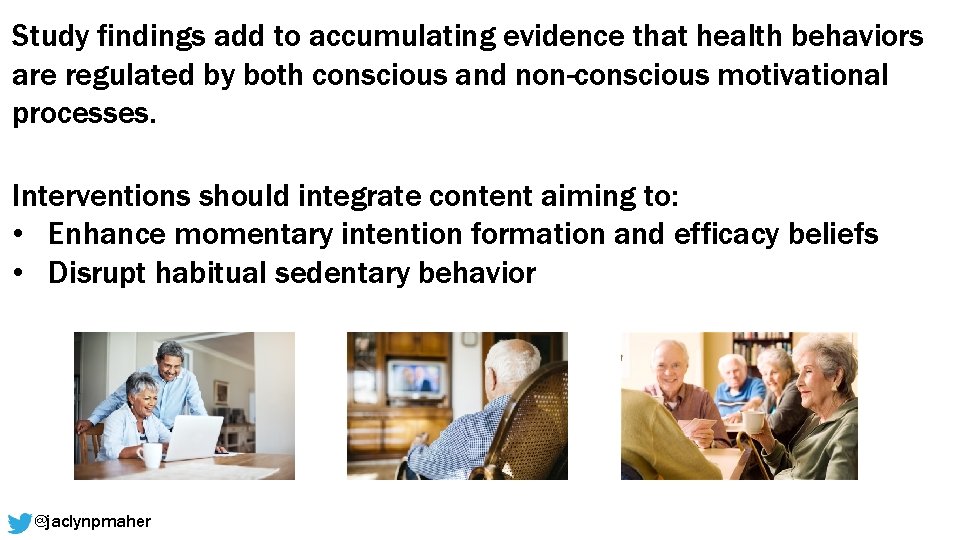
Study findings add to accumulating evidence that health behaviors are regulated by both conscious and non-conscious motivational processes. Interventions should integrate content aiming to: • Enhance momentary intention formation and efficacy beliefs • Disrupt habitual sedentary behavior @jaclynpmaher
Considerations for future research investigating dual-processes regulating sedentary behavior in older adults: • Additional conscious and non-conscious processes • Measurement of conscious and non-conscious processes • Event-contingent vs signal-contingent EMA protocols @jaclynpmaher
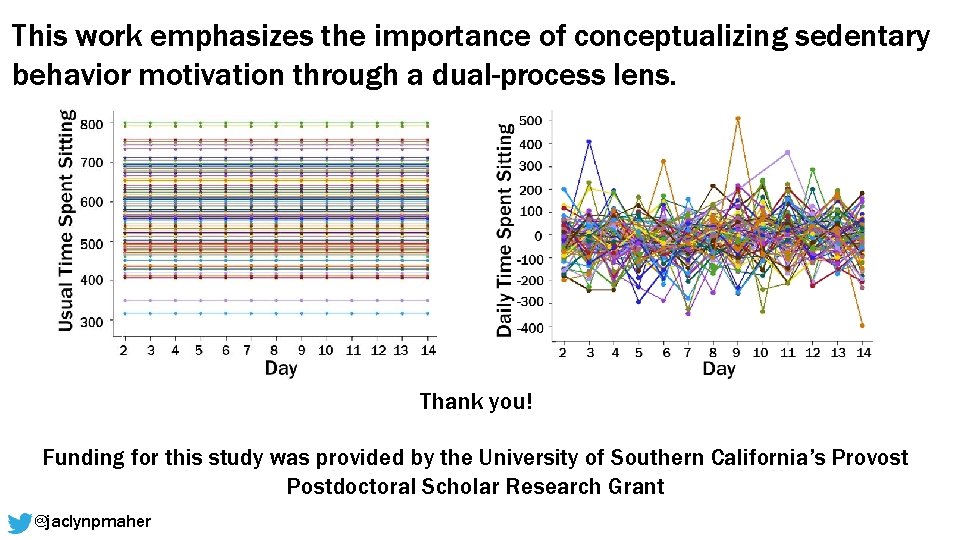
This work emphasizes the importance of conceptualizing sedentary behavior motivation through a dual-process lens. Thank you! Funding for this study was provided by the University of Southern California’s Provost Postdoctoral Scholar Research Grant @jaclynpmaher
- Slides: 13