
Duality Recent and Future Results Ioana Niculescu James
- Slides: 24
Duality: Recent and Future Results Ioana Niculescu James Madison University Hall C “Summer” Workshop
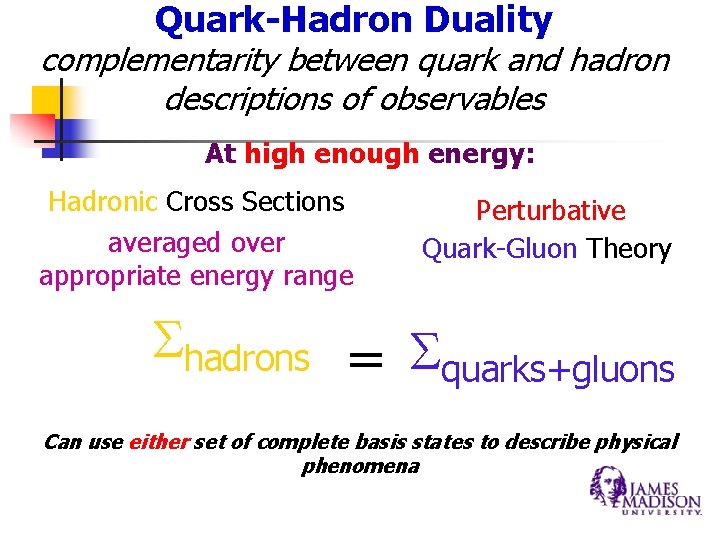
Quark-Hadron Duality complementarity between quark and hadron descriptions of observables At high enough energy: Hadronic Cross Sections averaged over appropriate energy range Perturbative Quark-Gluon Theory hadrons = quarks+gluons Can use either set of complete basis states to describe physical phenomena
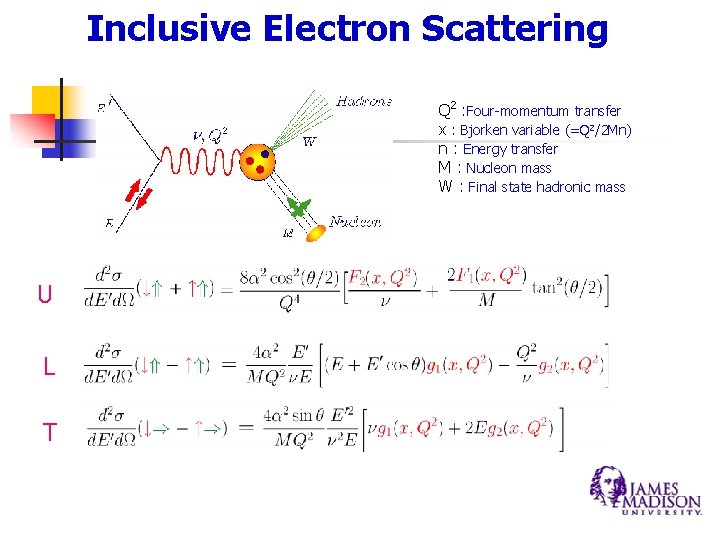
Inclusive Electron Scattering Q 2 : Four-momentum transfer x : Bjorken variable (=Q 2/2 Mn) n : Energy transfer M : Nucleon mass W : Final state hadronic mass U L T
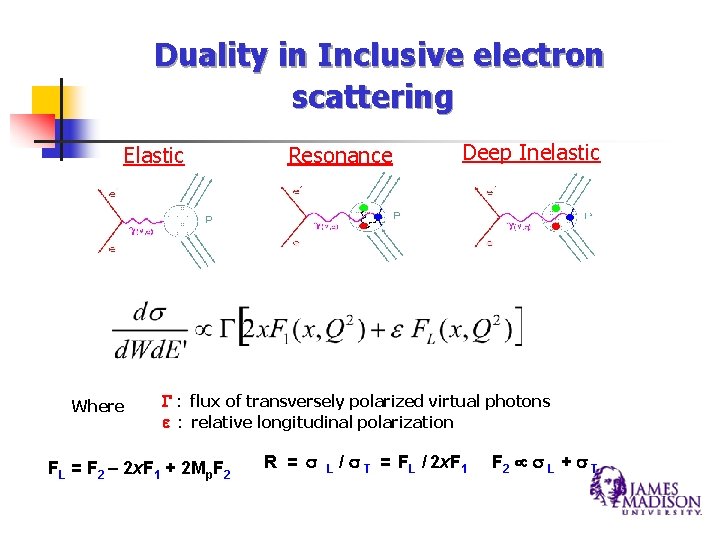
Duality in Inclusive electron scattering Elastic Where Resonance Deep Inelastic G : flux of transversely polarized virtual photons e : relative longitudinal polarization FL = F 2 – 2 x. F 1 + 2 Mp. F 2 R = s L / s T = FL / 2 x. F 1 F 2 s L + s T
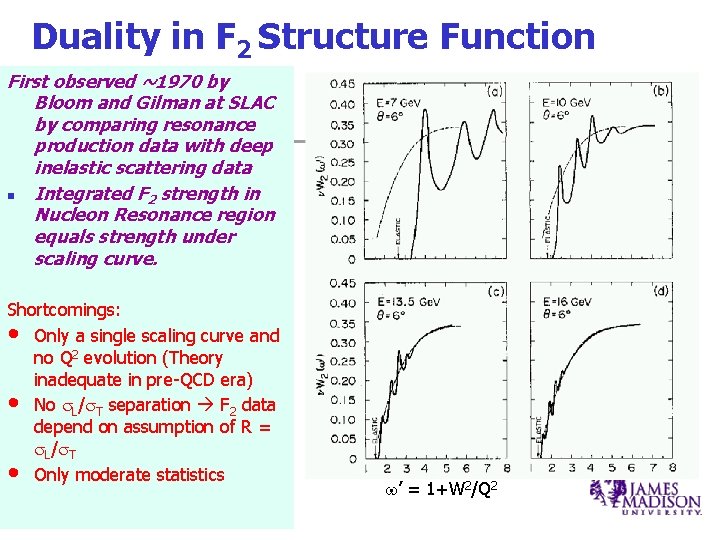
Duality in F 2 Structure Function First observed ~1970 by Bloom and Gilman at SLAC by comparing resonance production data with deep inelastic scattering data n Integrated F 2 strength in Nucleon Resonance region equals strength under scaling curve. Shortcomings: • Only a single scaling curve and no Q 2 evolution (Theory inadequate in pre-QCD era) • No s. L/s. T separation F 2 data depend on assumption of R = s. L/s. T • Only moderate statistics w’ = 1+W 2/Q 2
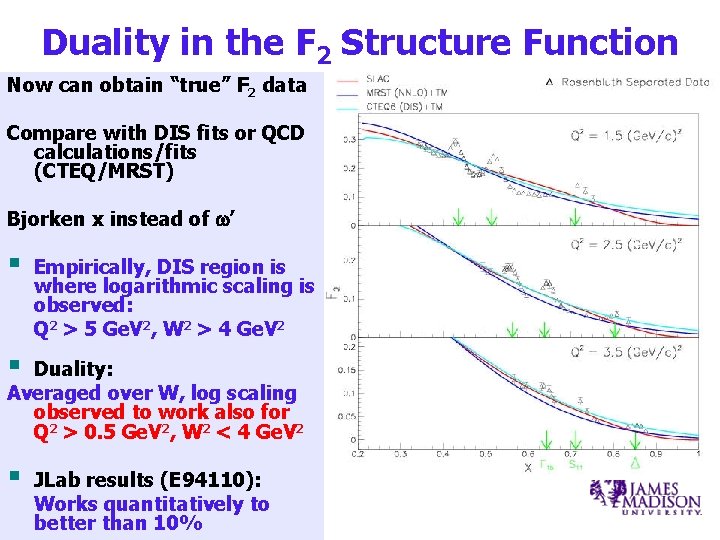
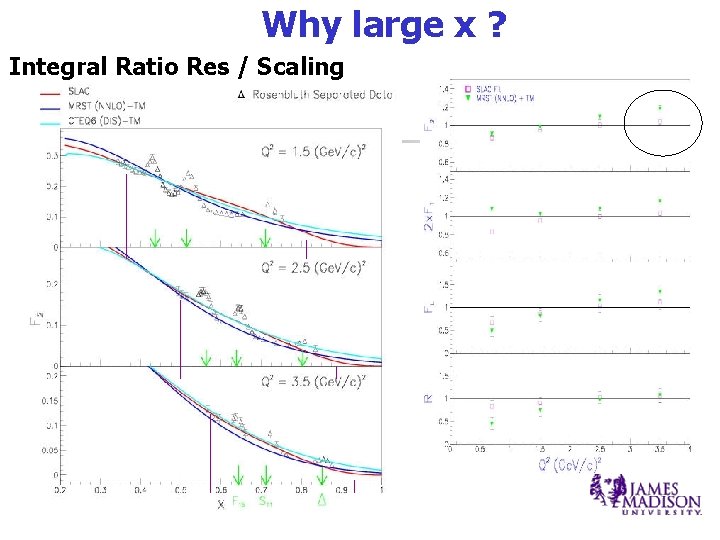
Duality in the F 2 Structure Function Now can obtain “true” F 2 data Compare with DIS fits or QCD calculations/fits (CTEQ/MRST) Bjorken x instead of w’ § Empirically, DIS region is where logarithmic scaling is observed: Q 2 > 5 Ge. V 2, W 2 > 4 Ge. V 2 § Duality: Averaged over W, log scaling observed to work also for Q 2 > 0. 5 Ge. V 2, W 2 < 4 Ge. V 2 § JLab results (E 94110): Works quantitatively to better than 10%
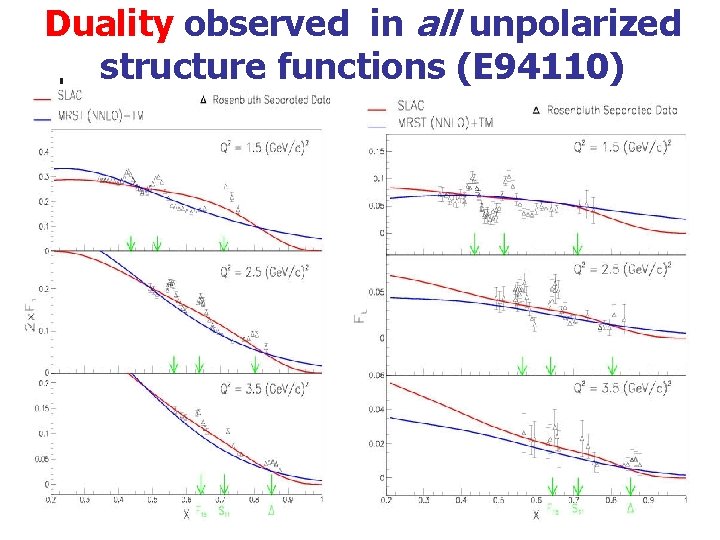
Duality observed in all unpolarized structure functions (E 94110)
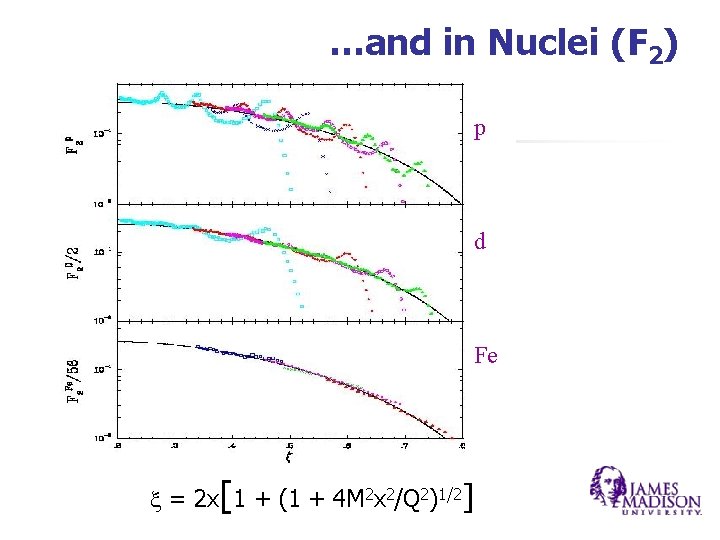
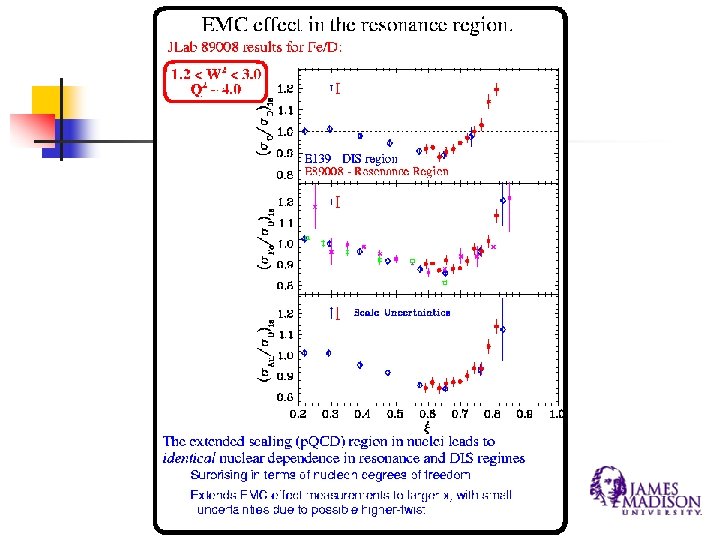
…and in Nuclei (F 2) p d Fe x = 2 x[1 + (1 + 4 M 2 x 2/Q 2)1/2]
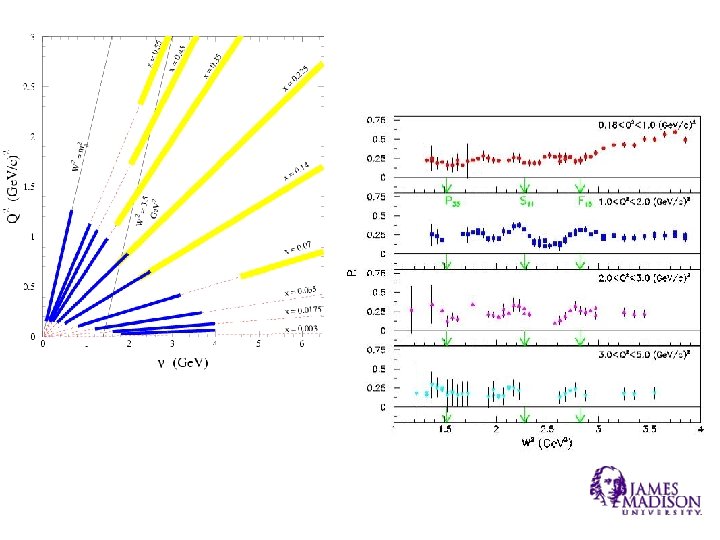
Where we are now… n Experimentally, duality holds in all unpolarized structure functions, in nuclei, and in tested spin structure functions down to surprisingly low Q 2 n Apparently a non-trivial property of nucleon structure
What is new… n E 00 -002: “F 2 N at Low Q 2” n E 00 -116: “Duality at Intermediate Q 2” n E 00 -108: “Duality in Meson Electroproduction”
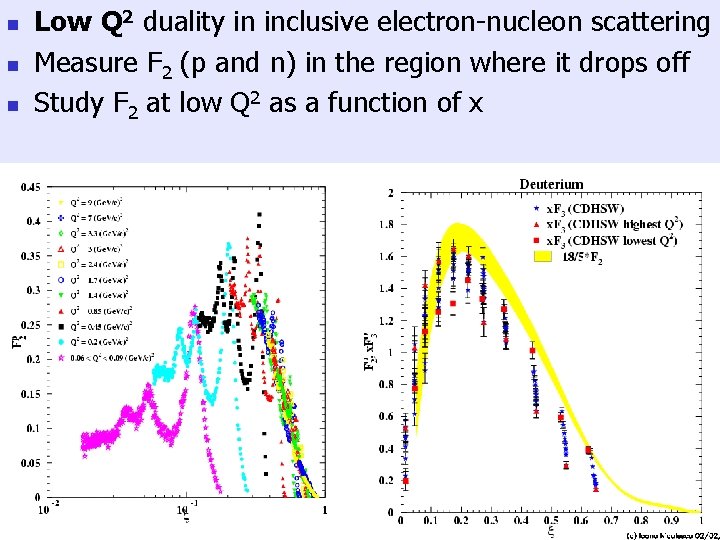
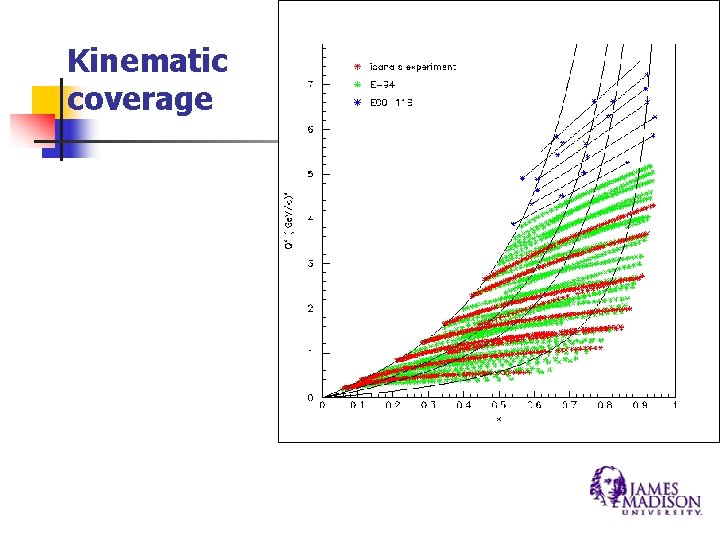
n n n Low Q 2 duality in inclusive electron-nucleon scattering Measure F 2 (p and n) in the region where it drops off Study F 2 at low Q 2 as a function of x
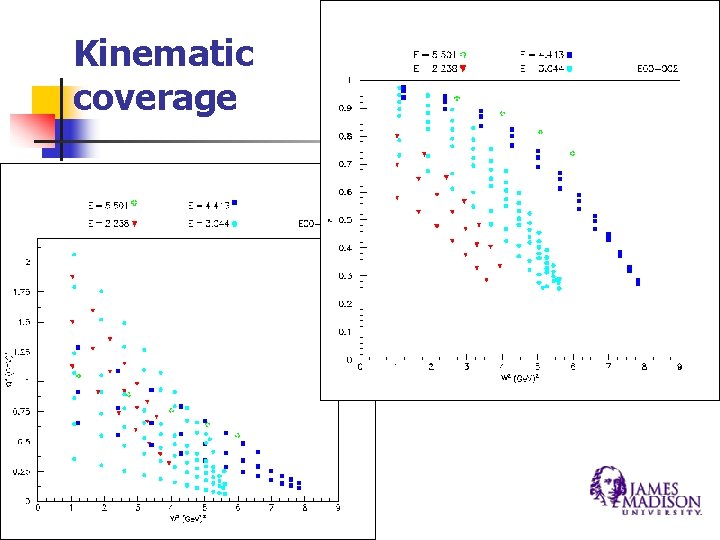
Kinematic coverage
Duality at Intermediate Q 2 n “proposed measurements will help answering the question of the nature of power corrections in hard processes as fundamental components in understanding the transition between p. QCD and non-p. QCD”
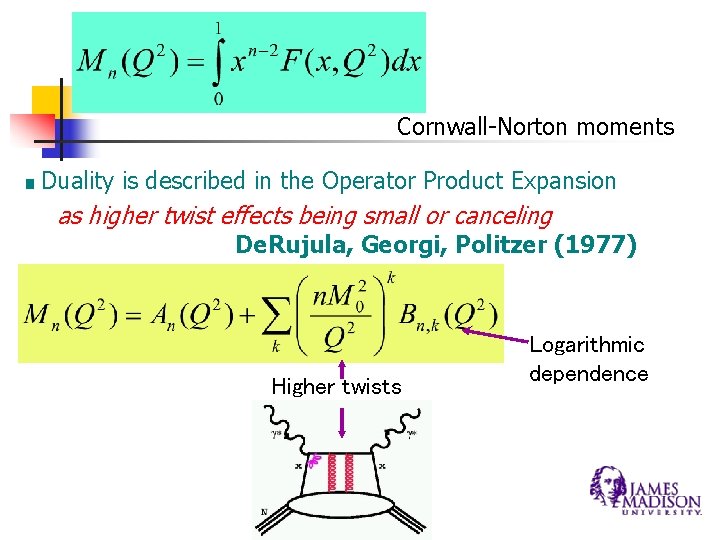
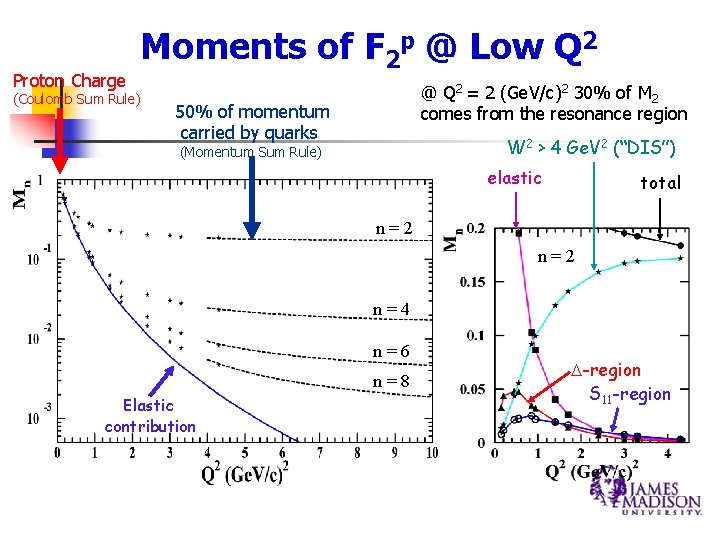
. Cornwall-Norton moments Duality is described in the Operator Product Expansion as higher twist effects being small or canceling De. Rujula, Georgi, Politzer (1977) Higher twists Logarithmic dependence
Proton Charge Moments of F 2 p @ Low Q 2 (Coulomb Sum Rule) @ Q 2 = 2 (Ge. V/c)2 30% of M 2 comes from the resonance region 50% of momentum carried by quarks W 2 > 4 Ge. V 2 (“DIS”) (Momentum Sum Rule) elastic total n=2 n=4 n=6 n=8 Elastic contribution D-region S 11 -region
Why large x ? Integral Ratio Res / Scaling
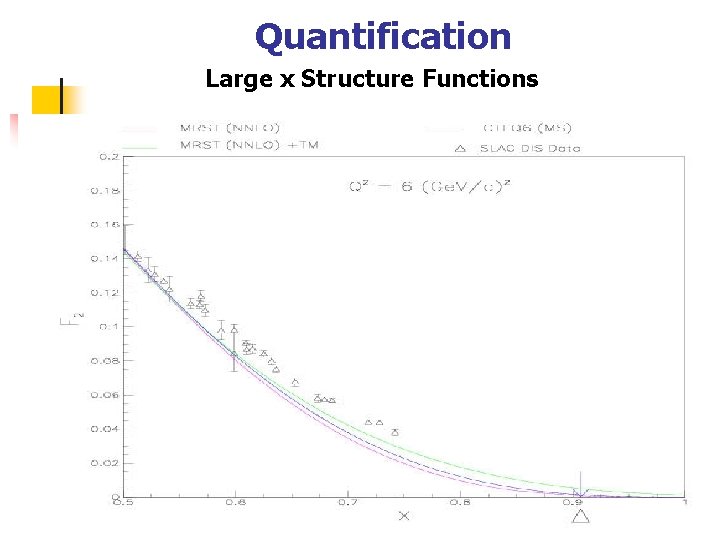
Quantification Large x Structure Functions
Kinematic coverage
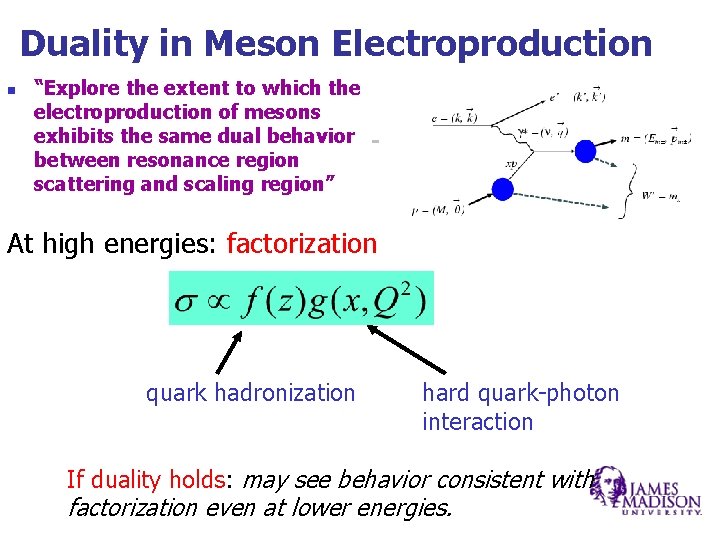
Duality in Meson Electroproduction n “Explore the extent to which the electroproduction of mesons exhibits the same dual behavior between resonance region scattering and scaling region” At high energies: factorization (p. QCD) quark hadronization hard quark-photon interaction If duality holds: may see behavior consistent with factorization even at lower energies.
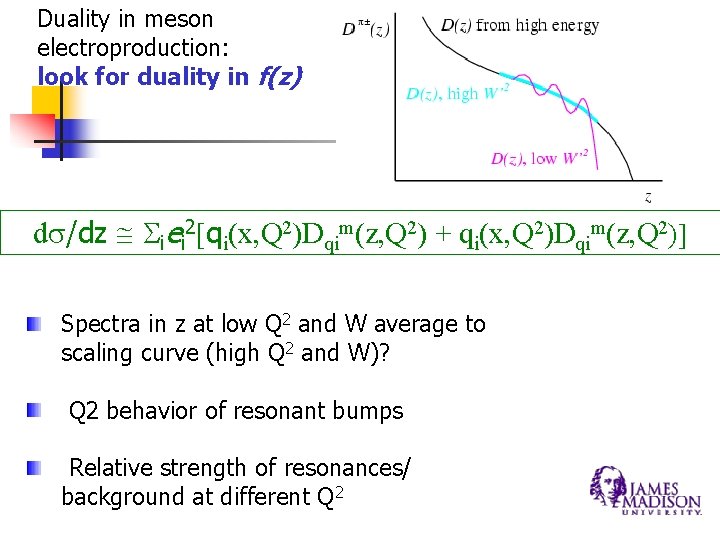
Duality in meson electroproduction: look for duality in f(z) ds/dz iei 2 qi(x, Q 2)Dqim(z, Q 2) + qi(x, Q 2)Dqim(z, Q 2) Spectra in z at low Q 2 and W average to scaling curve (high Q 2 and W)? Q 2 behavior of resonant bumps Relative strength of resonances/ background at different Q 2
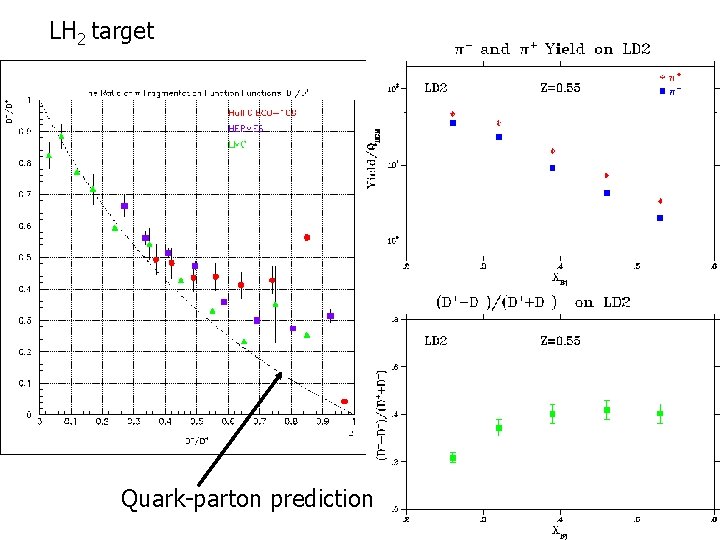
LH 2 target Quark-parton prediction
The future… CTEQ currently planning to use duality for large x parton distribution modeling Neutrino community planning to test duality Neutrino community using duality to predict low energy (~1 Ge. V) regime Duality provides extended access to large x regime Allows for direct comparison to QCD Moments calculated on the lattice More experiments are planned Neutron Polarized structure functions Neutrino scattering