
Duality of Methodology Using Focus Groups as both
Duality of Methodology Using Focus Groups as both an Educative Instrument and Measure of Exploring Student Perceptions of Evidence Based-Practice Rachel Forrester-Jones & Eleni Hatzidimitriadou University of Kent at Canterbury
Policy in learning Social Care policy - e. g. Modernising Social Services, The Best Value initiative, Do. H 1998, 1999 - prioritises the planning and commissioning of ‘an adequate supply of appropriate, cost-effective and safe social care provision for those eligible for local authority support’. HEFCE - ‘Widening Participation’ agenda, Df. EE 1999 calls for more inclusive education enabling people traditionally excluded from professional training and previously unable to access full or part-time education.
The Course Certificate in Community Care Practice: Funded by HEFCE and run by the Tizard Centre, University of Kent at Canterbury, began in 1999. Specifically designed to address Community Care Practice, to fill between trained staff and care providing a route towards an qualification. issues of the gap services, academic
‘Learner-Centred’ Approach Significant characteristics necessary to move from a ‘novice’ to an ‘expert’ learner: well organised study skills a context which enables students to gain control over their own learning Need for more relevant, non-hierarchical relationship between the activities of learning and scholarship than have been experienced by students in receipt of more traditional methods of teaching such as straight lecturing with little explorative discussion.
Focus Groups Approach Qualitative and popular method in modern media, market research, action research, medical research, and more recently, politics and health and social care research. Powell et al (1996: 499) A focus group is a group of individuals selected and assembled by researchers to discuss and comment on, from personal experience, the topic that is the subject of the research
Questions of the Study What is it that motivates care workers to embark on this academic course? How and in what ways do students utilise theory learnt in their own every day practice and what are the issues/tensions arising from this? Do students change their attitudes and motivations for their work environment and client group during the course? Does the course lead to the pursuit of further study or work goals?
Sample 32 mature students participated in the study, with 4 focus groups each made up of 8 students. Range of professional backgrounds including support staff working in residential and domiciliary services for people with learning disabilities, mental health difficulties or older people, as well as house managers and informal (unpaid) carers

Method 2 Teaching sessions on ‘Focus Groups’ Three stages: The teachers introduced the session, providing some historical background about research methods and an outline of ‘focus groups’ methodology. Students were informed about research aim to explore their perceptions of evidence based-practice and there was agreement of the utility of discussing their experiences. The next stage consisted of splitting the class into two groups of 8. The teachers each facilitated one group in separate rooms.
Ground Rules Discussion is anonymous All opinions are valued - no worries about what you say Everyone contributes Everyone respects each other for their contribution - one person speaks at a time
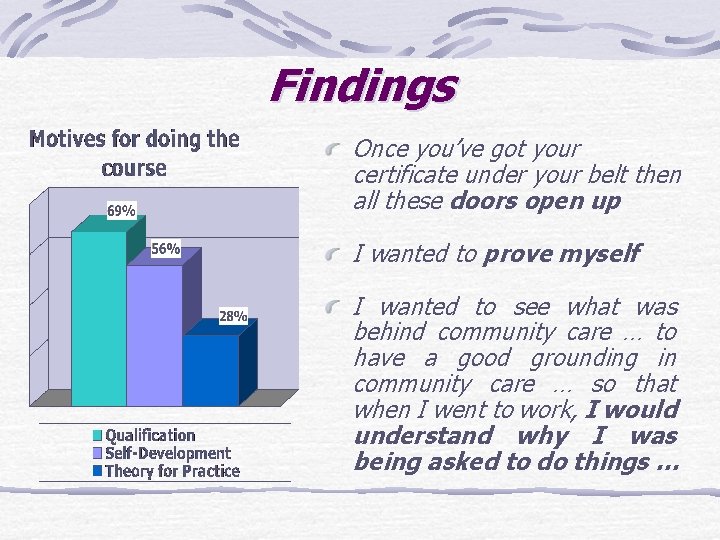
Findings Once you’ve got your certificate under your belt then all these doors open up I wanted to prove myself I wanted to see what was behind community care … to have a good grounding in community care … so that when I went to work, I would understand why I was being asked to do things …
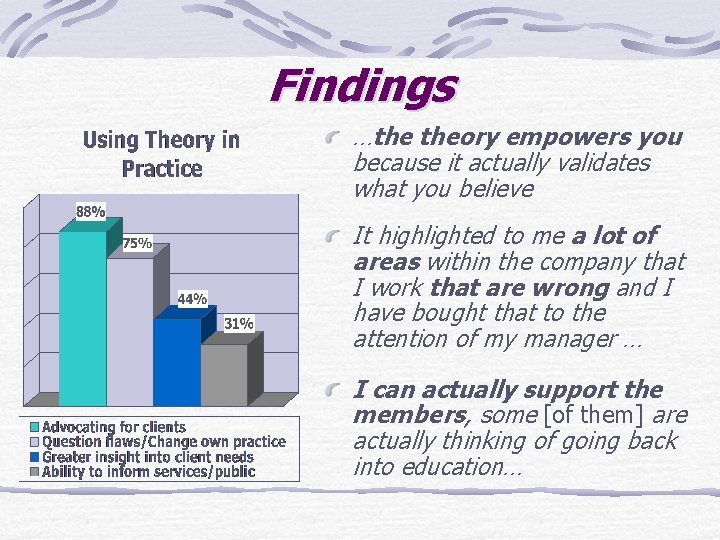
Findings …the theory empowers you because it actually validates what you believe It highlighted to me a lot of areas within the company that I work that are wrong and I have bought that to the attention of my manager … I can actually support the members, some [of them] are actually thinking of going back into education…
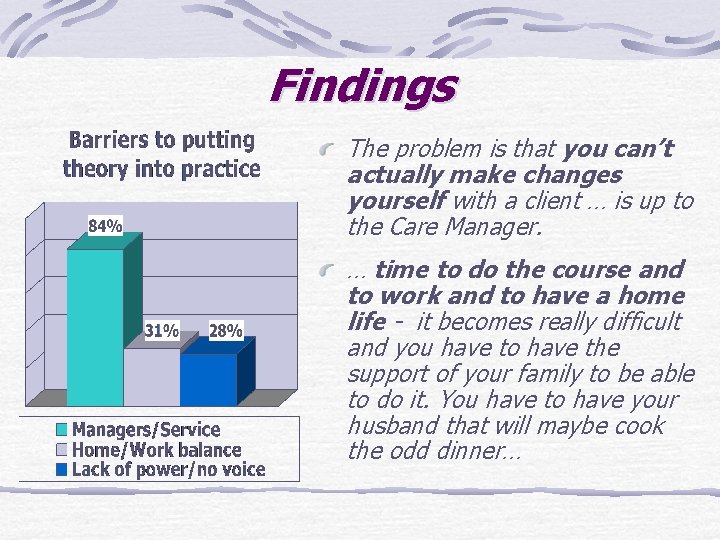
Findings The problem is that you can’t actually make changes yourself with a client … is up to the Care Manager. … time to do the course and to work and to have a home life - it becomes really difficult and you have to have the support of your family to be able to do it. You have to have your husband that will maybe cook the odd dinner…
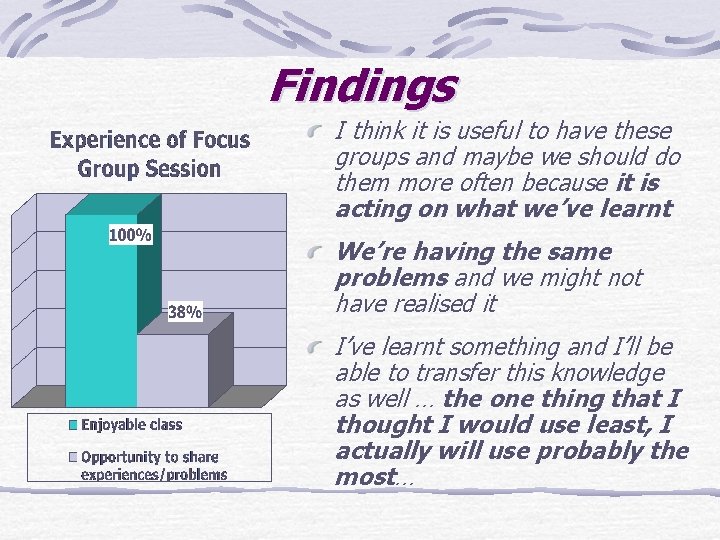
Findings I think it is useful to have these groups and maybe we should do them more often because it is acting on what we’ve learnt We’re having the same problems and we might not have realised it I’ve learnt something and I’ll be able to transfer this knowledge as well … the one thing that I thought I would use least, I actually will use probably the most…
Conclusions Technique proved successful both in terms of learning and research outcomes Students had the opportunity to explore a qualitative research method through participation Important data concerning student experiences derived from focus group data Utilisation of focus groups was a truly learner-centred approach to be implemented Practice implications: Such an approach might be useful to enable learning of other academic topics
- Slides: 14