
Duality Based Vector and Axial Form FactorsImproved Modeling
Duality Based Vector and Axial Form Factors-Improved Modeling of Quasielastic Neutrino Cross Sections at all Energies ARIE BODEK University of Rochester (in collaboration with S. Avvakumov, H. Budd, R. Bradford ) BBBA 2007 Vector and Axial Form Factors EPS Manchester Thursday July 19, 2007 16: 00 -16: 25 http: //agenda. hep. man. ac. uk/contribution. Display. py? contrib. Id=60&session. Id=16&conf. Id=70 Arie Bodek, Univ. of Rochester 1
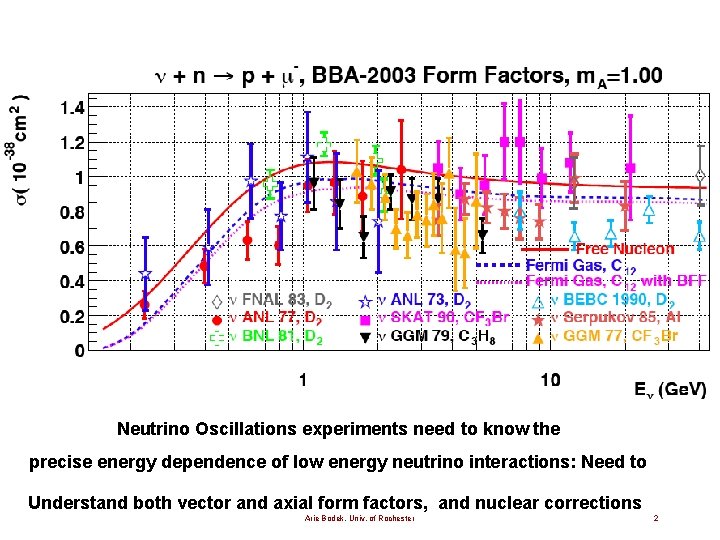
Neutrino Oscillations experiments need to know the precise energy dependence of low energy neutrino interactions: Need to Understand both vector and axial form factors, and nuclear corrections Arie Bodek, Univ. of Rochester 2
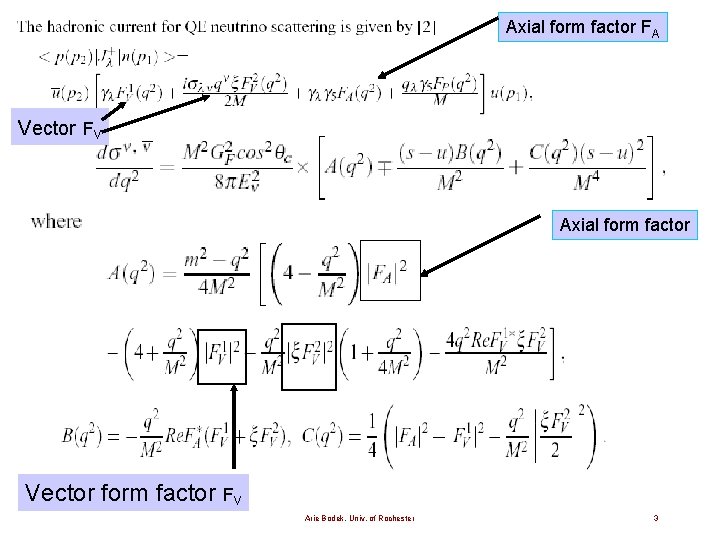
Axial form factor FA Vector FV Axial form factor Vector form factor FV Arie Bodek, Univ. of Rochester 3
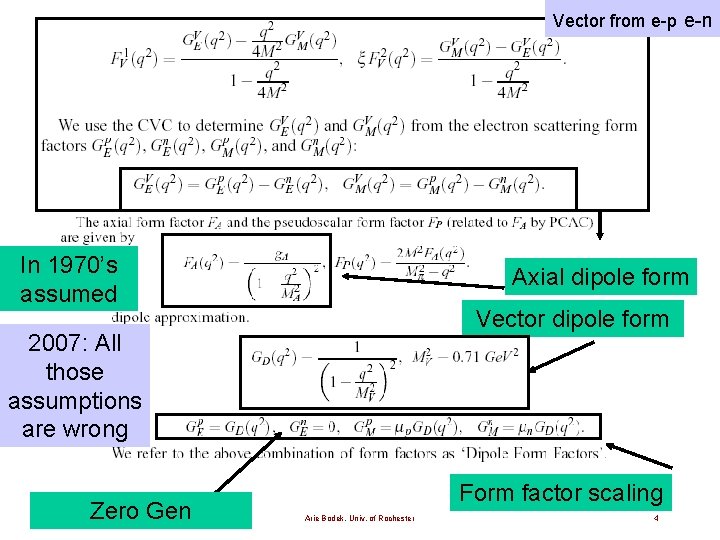
Vector from e-p e-n In 1970’s assumed Axial dipole form Vector dipole form 2007: All those assumptions are wrong Zero Gen Form factor scaling Arie Bodek, Univ. of Rochester 4
BBBA 2007: Start with vector form factors New Vector Form Factors new fit to (Gep, Gmp, Gen, Gmn) From Electron Scattering data 1. Incorporation of the recent BLAST results- Gep Gmp- C. B. Crawford et al, Phys. Rev. Lett 98, 052301 (2007). 2. Improved functional form that builds on the Kelly form [J. Kelly, Phys. Rev. C 70, 068202 (2004)] 3. Multiply by a modulating functions using the Nachtman scaling variable to relate elastic and inelastic (vector and axial nucleon form factors); 4. Excellent low Q 2 description of the spatial structure of the nucleon by constraining the fit to yield the same values as Arrington and Sick Q 2 < 0. 64 (Ge. V/c)2. J. Arrington I. Sick, nucl-th/0612079 (Submitted to Phys. Rev. C. ) 5. Extend to satisfy quark-hadron duality constraints on the ratio of form factors at high- Q 2 x = 1): (a) Gmn/Gmp; (b) (Gen/Gmn)/(Gep/Gmp) Arie Bodek, Univ. of Rochester 5
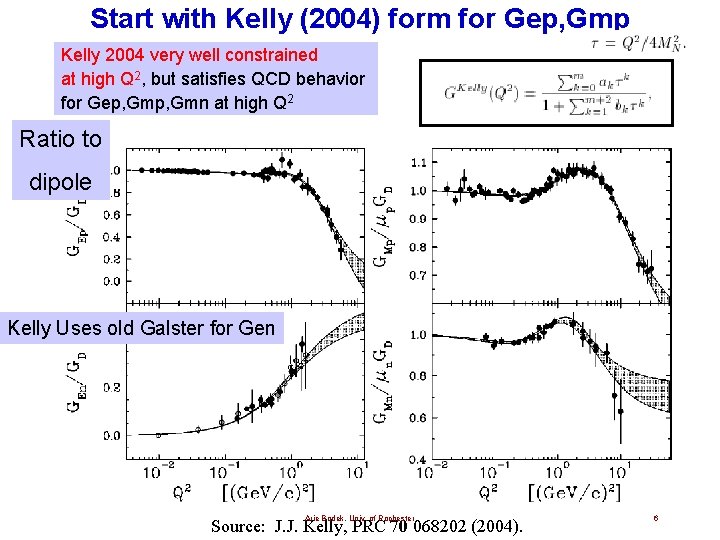
Start with Kelly (2004) form for Gep, Gmp Kelly 2004 very well constrained at high Q 2, but satisfies QCD behavior for Gep, Gmn at high Q 2 Ratio to dipole Kelly Uses old Galster for Gen Arie Bodek, Univ. of Rochester Source: J. J. Kelly, PRC 70 068202 (2004). 6
Constraint 0: Get excellent low Q 2 description of the spatial structure of the nucleon by constraining the fit to yield the same values as Arrington and Sick Q 2 < 0. 64 (Ge. V/c)2. “Precise determination of low-Q nucleon electromagnetic form factors and their impact on parity-violating e-p elastic scattering” John Arrington (Argonne, PHY) , Ingo Sick (Basel U. ). Dec 2006. Submitted to Phys. Rev. C e-Print: nucl-th/0612079 Arrington and Sick fit elastic differential cross sections and polarization data and include corrections for. 1. 2. Two photon exchange effects Nucleon coulomb field corrections on incoming and outgoing lepton Since we fit form factors instaed of differential cross section we include these corrections by requiring our fits to agree with Arrington and Sick exactly for Q 2 < 0. 64 (Ge. V/c)2 Arie Bodek, Univ. of Rochester 7
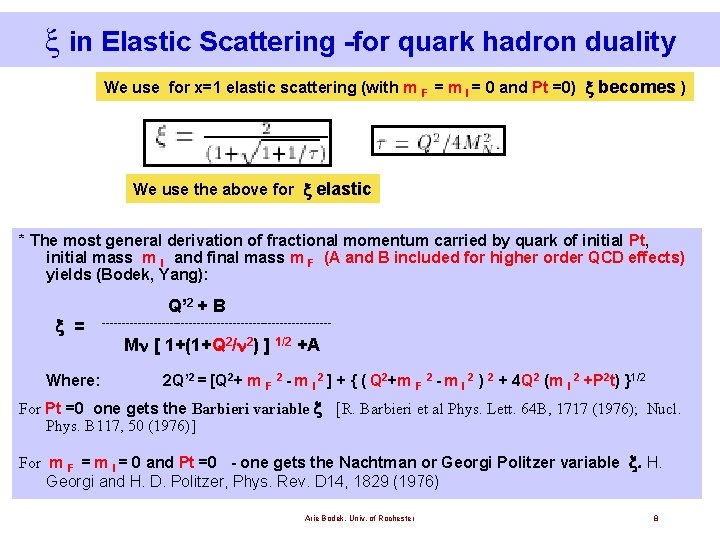
in Elastic Scattering -for quark hadron duality We use for x=1 elastic scattering (with m F = m I = 0 and Pt =0) x becomes ) We use the above for x elastic * The most general derivation of fractional momentum carried by quark of initial Pt, initial mass m I and final mass m F (A and B included for higher order QCD effects) yields (Bodek, Yang): x = Where: Q’ 2 + B ----------------------------- Mn [ 1+(1+Q 2/n 2) ] 1/2 +A 2 Q’ 2 = [Q 2+ m F 2 - m I 2 ] + { ( Q 2+m F 2 - m I 2 ) 2 + 4 Q 2 (m I 2 +P 2 t) }1/2 For Pt =0 one gets the Barbieri variable x R. Barbieri et al Phys. Lett. 64 B, 1717 (1976); Nucl. Phys. B 117, 50 (1976)] For m F = m I = 0 and Pt =0 - one gets the Nachtman or Georgi Politzer variable x H. Georgi and H. D. Politzer, Phys. Rev. D 14, 1829 (1976) Arie Bodek, Univ. of Rochester 8
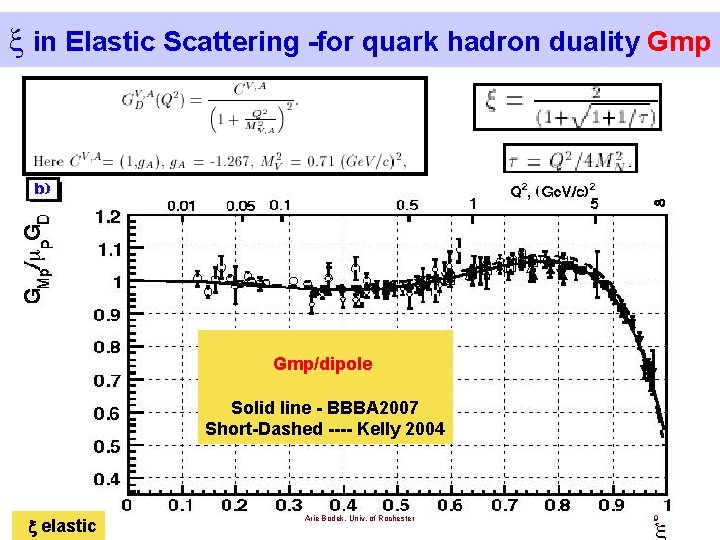
in Elastic Scattering -for quark hadron duality Gmp/dipole Solid line - BBBA 2007 Short-Dashed ---- Kelly 2004 x elastic Arie Bodek, Univ. of Rochester 9
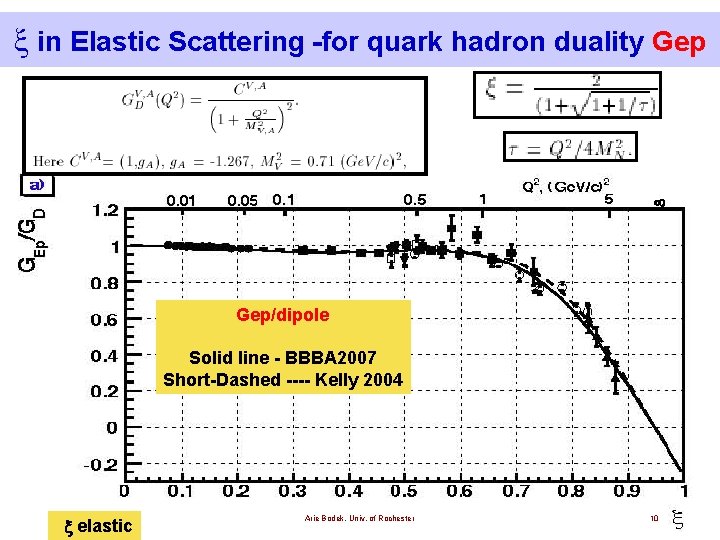
in Elastic Scattering -for quark hadron duality Gep/dipole Solid line - BBBA 2007 Short-Dashed ---- Kelly 2004 x elastic Arie Bodek, Univ. of Rochester 10

Constraint 1 Gmn: From local duality: F 2 n/F 2 p for Inelastic and Elastic scattering should be the same at high Q 2 • In the limit of →∞, Q 2→∞ : • In the elastic limit: (F 2 n/F 2 p)→(Gmn/Gmp)2 We do fits with d/u=0 (F 2 n/F 2 p) →(Gmn/Gmp)2 --> 0. 25 We do fits with d/u=0. 2 F 2 n/F 2 p) (F 2 n/F 2 p) →(Gmn/Gmp)2 --> 0. 43 Note, F 2 inelastic=F 2 respnance appears to be valid for the average of the resonance region (global duality). Local duality sates that it may be valid for the sum of elastic peak and first resonance, and possibly also in the limit of the elastic peak only. We only assume that any violations of local duality will cancel in this ratio Arie Bodek, Univ. of Rochester 11
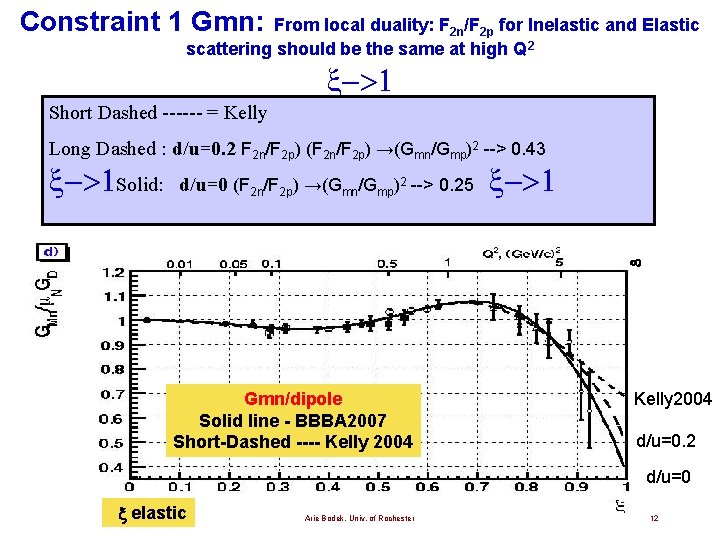
Constraint 1 Gmn: From local duality: F 2 n/F 2 p for Inelastic and Elastic scattering should be the same at high Q 2 Short Dashed ------ = Kelly Long Dashed : d/u=0. 2 F 2 n/F 2 p) (F 2 n/F 2 p) →(Gmn/Gmp)2 --> 0. 43 Solid: d/u=0 (F 2 n/F 2 p) →(Gmn/Gmp)2 --> 0. 25 Gmn/dipole Solid line - BBBA 2007 Short-Dashed ---- Kelly 2004 d/u=0. 2 d/u=0 x elastic Arie Bodek, Univ. of Rochester 12
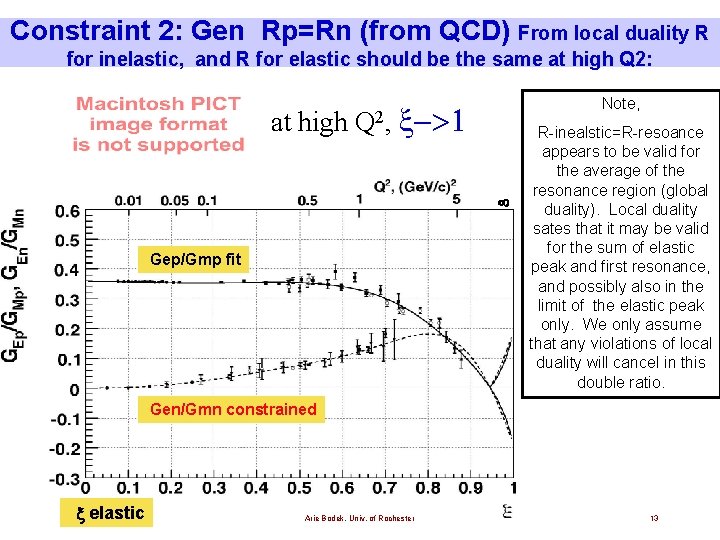
Constraint 2: Gen Rp=Rn (from QCD) From local duality R for inelastic, and R for elastic should be the same at high Q 2: at high Q 2, Note, Gep/Gmp fit R-inealstic=R-resoance appears to be valid for the average of the resonance region (global duality). Local duality sates that it may be valid for the sum of elastic peak and first resonance, and possibly also in the limit of the elastic peak only. We only assume that any violations of local duality will cancel in this double ratio. Gen/Gmn constrained x elastic Arie Bodek, Univ. of Rochester 13
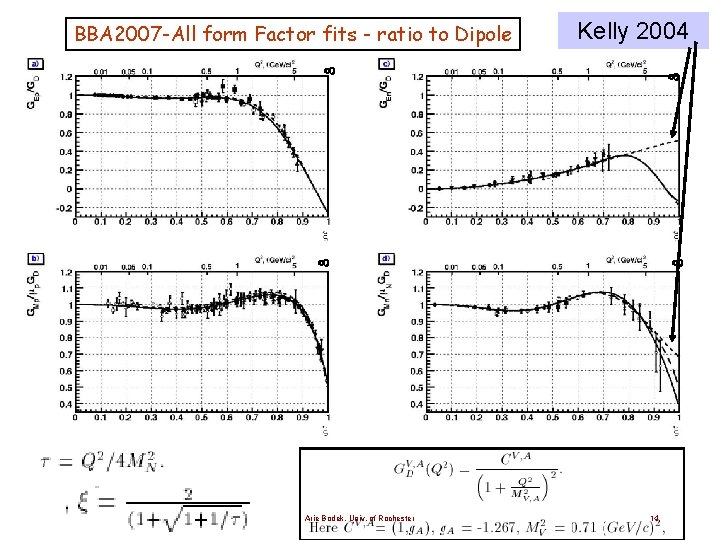
BBA 2007 -All form Factor fits - ratio to Dipole Kelly 2004 Arie Bodek, Univ. of Rochester 14
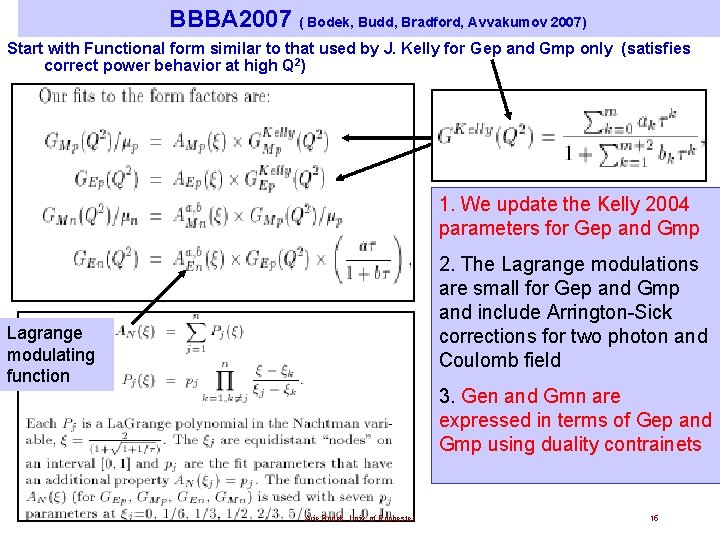
BBBA 2007 ( Bodek, Budd, Bradford, Avvakumov 2007) Start with Functional form similar to that used by J. Kelly for Gep and Gmp only (satisfies correct power behavior at high Q 2) 1. We update the Kelly 2004 parameters for Gep and Gmp 2. The Lagrange modulations are small for Gep and Gmp and include Arrington-Sick corrections for two photon and Coulomb field Lagrange modulating function 3. Gen and Gmn are expressed in terms of Gep and Gmp using duality contrainets Arie Bodek, Univ. of Rochester 15
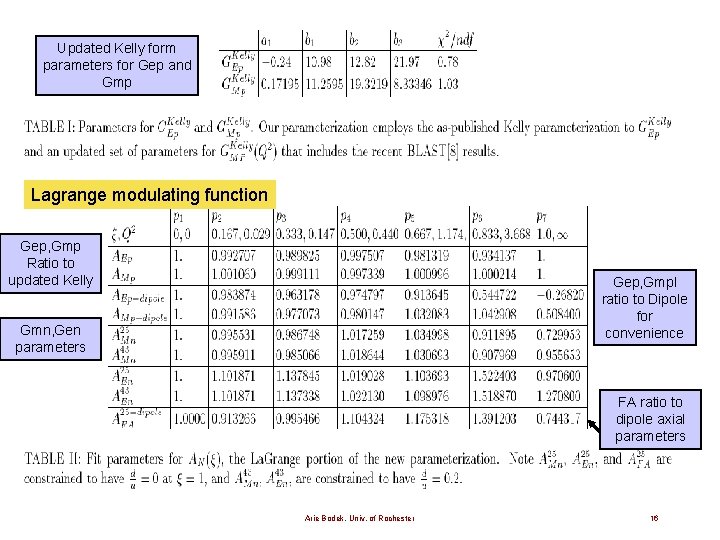
Updated Kelly form parameters for Gep and Gmp Lagrange modulating function Gep, Gmp Ratio to updated Kelly Gep, Gmpl ratio to Dipole for convenience Gmn, Gen parameters FA ratio to dipole axial parameters Arie Bodek, Univ. of Rochester 16

BBBA 2007…Axial New Axial Form Factor ( FA ) • We perform new extractions of. MA and FA from previous neutrino Deuterium data, using the updated vector form factors, and updated constants. We find new world average (Neutrino D 2 data And pion electro-production data) for MA Arie Bodek, Univ. of Rochester 17
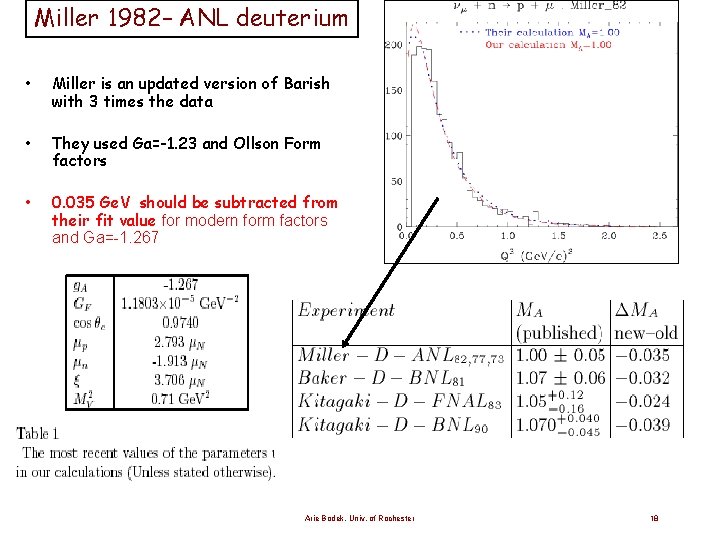
Miller 1982– ANL deuterium • Miller is an updated version of Barish with 3 times the data • They used Ga=-1. 23 and Ollson Form factors • 0. 035 Ge. V should be subtracted from their fit value for modern form factors and Ga=-1. 267 Arie Bodek, Univ. of Rochester 18
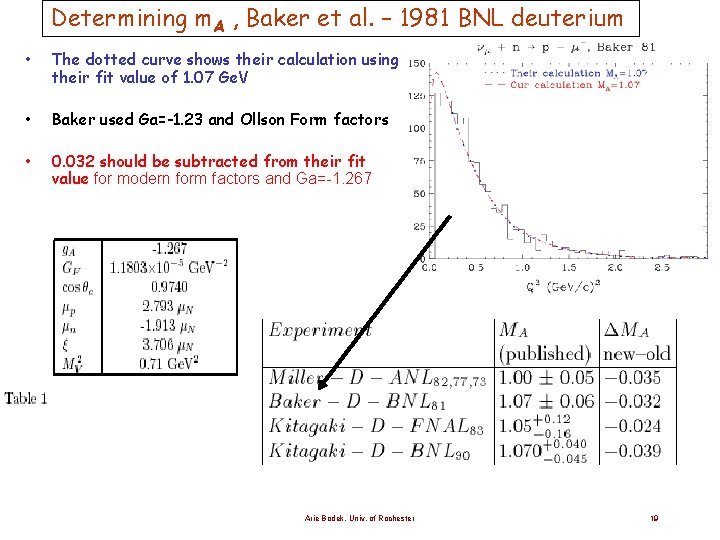
Determining m. A , Baker et al. – 1981 BNL deuterium • The dotted curve shows their calculation using their fit value of 1. 07 Ge. V • Baker used Ga=-1. 23 and Ollson Form factors • 0. 032 should be subtracted from their fit value for modern form factors and Ga=-1. 267 Arie Bodek, Univ. of Rochester 19
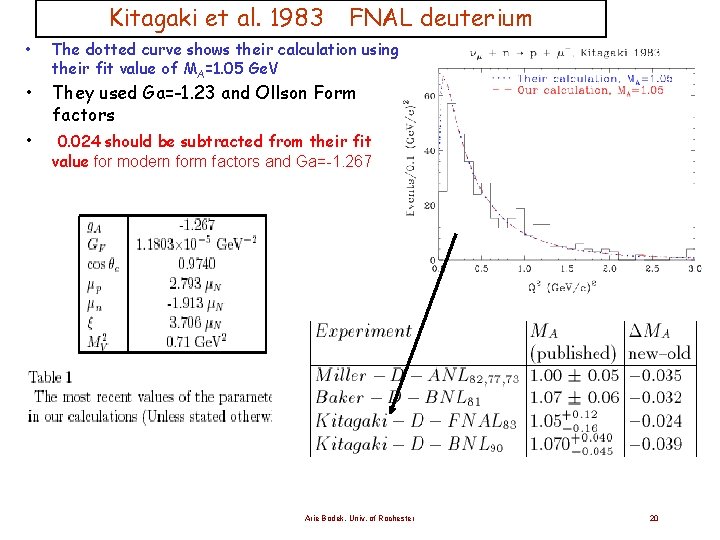
Kitagaki et al. 1983 • • • FNAL deuterium The dotted curve shows their calculation using their fit value of MA=1. 05 Ge. V They used Ga=-1. 23 and Ollson Form factors 0. 024 should be subtracted from their fit value for modern form factors and Ga=-1. 267 Arie Bodek, Univ. of Rochester 20
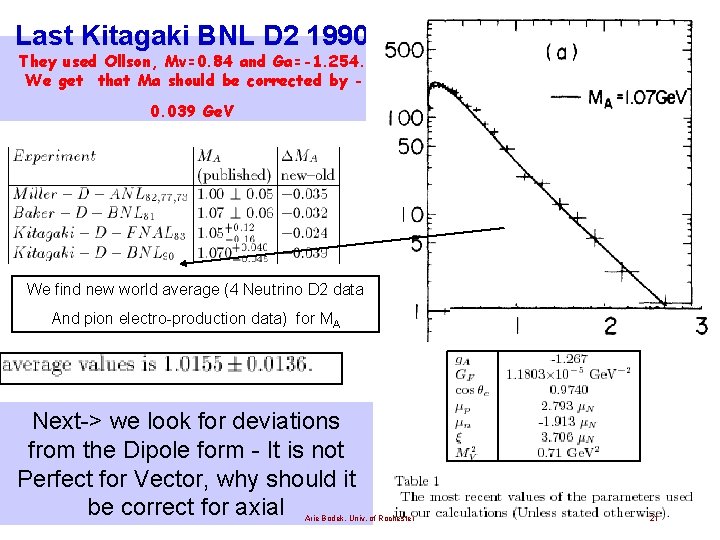
Last Kitagaki BNL D 2 1990 They used Ollson, Mv=0. 84 and Ga=-1. 254. We get that Ma should be corrected by 0. 039 Ge. V We find new world average (4 Neutrino D 2 data And pion electro-production data) for MA Next-> we look for deviations from the Dipole form - It is not Perfect for Vector, why should it be correct for axial Arie Bodek, Univ. of Rochester 21
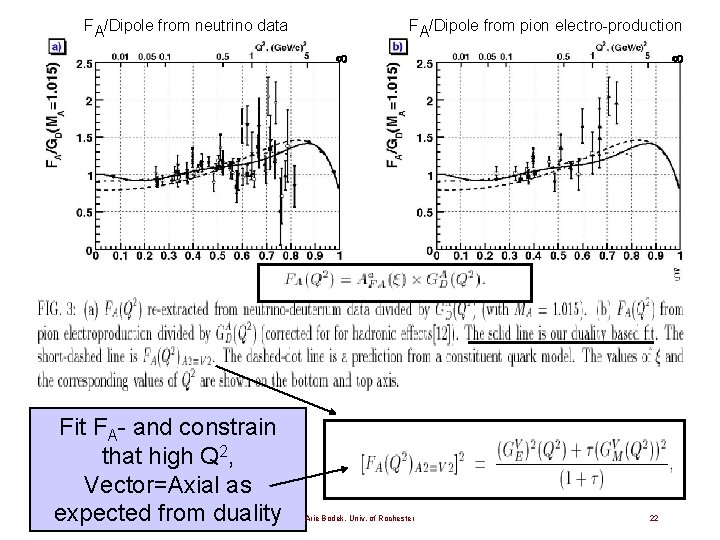
FA/Dipole from neutrino data FA/Dipole from pion electro-production Fit FA- and constrain that high Q 2, Vector=Axial as expected from duality Arie Bodek, Univ. of Rochester 22
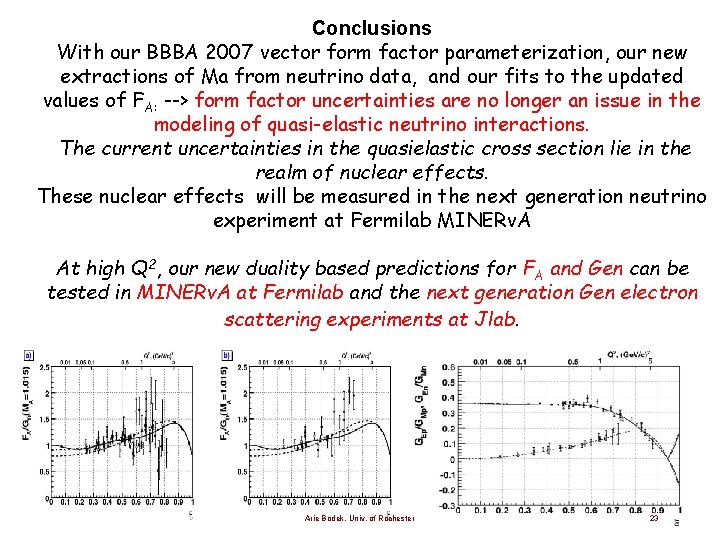
Conclusions With our BBBA 2007 vector form factor parameterization, our new extractions of Ma from neutrino data, and our fits to the updated values of FA: --> form factor uncertainties are no longer an issue in the modeling of quasi-elastic neutrino interactions. The current uncertainties in the quasielastic cross section lie in the realm of nuclear effects. These nuclear effects will be measured in the next generation neutrino experiment at Fermilab MINERv. A At high Q 2, our new duality based predictions for FA and Gen can be tested in MINERv. A at Fermilab and the next generation Gen electron scattering experiments at Jlab. Arie Bodek, Univ. of Rochester 23
- Slides: 23