
Duality 12222010 Concept Primal dual General form Conversion
- Slides: 15
Duality (12/22/2010) • • • Concept – Primal & dual General form Conversion rule: primal – dual & vice versa Matrix notation Some examples
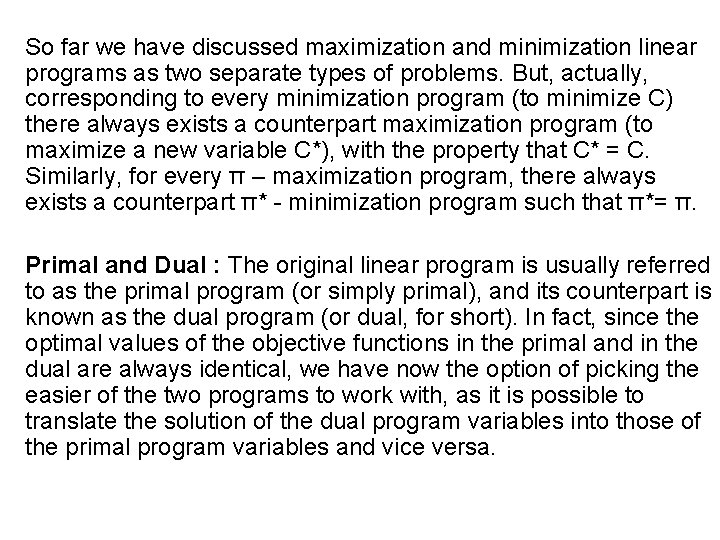
So far we have discussed maximization and minimization linear programs as two separate types of problems. But, actually, corresponding to every minimization program (to minimize C) there always exists a counterpart maximization program (to maximize a new variable C*), with the property that C* = C. Similarly, for every π – maximization program, there always exists a counterpart π* - minimization program such that π*= π. Primal and Dual : The original linear program is usually referred to as the primal program (or simply primal), and its counterpart is known as the dual program (or dual, for short). In fact, since the optimal values of the objective functions in the primal and in the dual are always identical, we have now the option of picking the easier of the two programs to work with, as it is possible to translate the solution of the dual program variables into those of the primal program variables and vice versa.
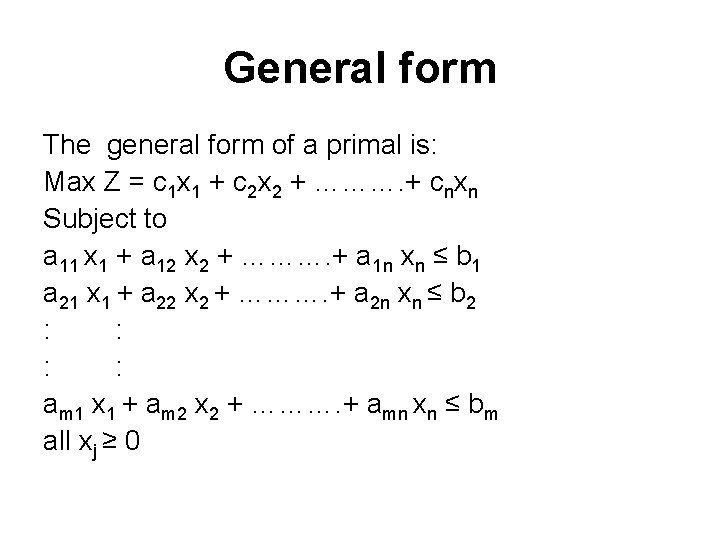
General form The general form of a primal is: Max Z = c 1 x 1 + c 2 x 2 + ………. + cnxn Subject to a 11 x 1 + a 12 x 2 + ………. + a 1 n xn ≤ b 1 a 21 x 1 + a 22 x 2 + ………. + a 2 n xn ≤ b 2 : : am 1 x 1 + am 2 x 2 + ………. + amn xn ≤ bm all xj ≥ 0
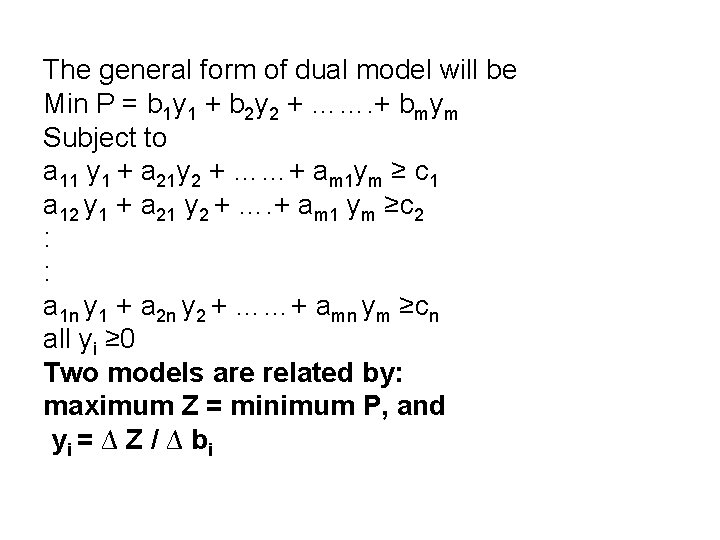
The general form of dual model will be Min P = b 1 y 1 + b 2 y 2 + ……. + bmym Subject to a 11 y 1 + a 21 y 2 + ……+ am 1 ym ≥ c 1 a 12 y 1 + a 21 y 2 + …. + am 1 ym ≥c 2 : : a 1 n y 1 + a 2 n y 2 + ……+ amn ym ≥cn all yi ≥ 0 Two models are related by: maximum Z = minimum P, and yi = ∆ Z / ∆ b i
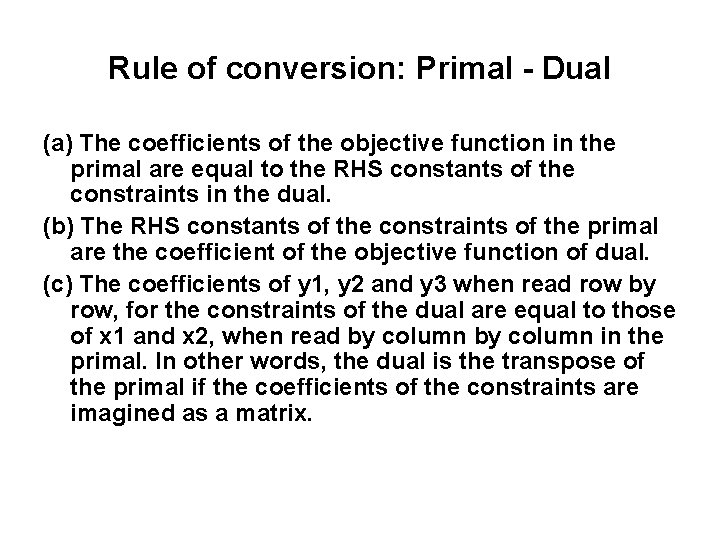
Rule of conversion: Primal - Dual (a) The coefficients of the objective function in the primal are equal to the RHS constants of the constraints in the dual. (b) The RHS constants of the constraints of the primal are the coefficient of the objective function of dual. (c) The coefficients of y 1, y 2 and y 3 when read row by row, for the constraints of the dual are equal to those of x 1 and x 2, when read by column in the primal. In other words, the dual is the transpose of the primal if the coefficients of the constraints are imagined as a matrix.
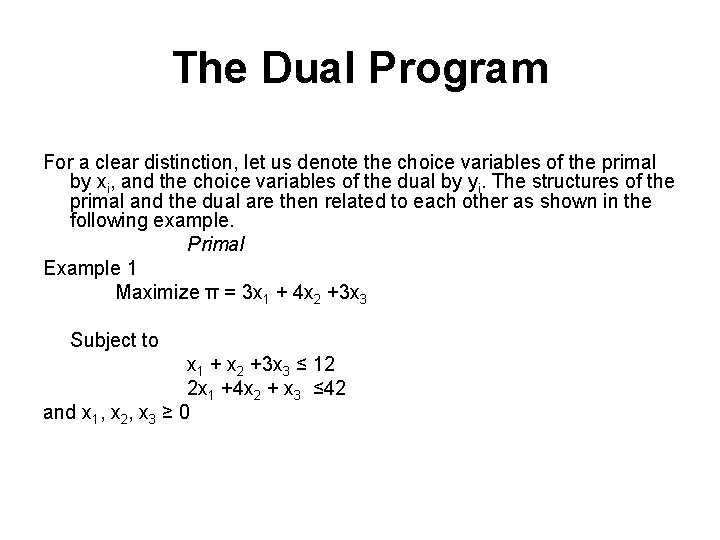
The Dual Program For a clear distinction, let us denote the choice variables of the primal by xi, and the choice variables of the dual by yi. The structures of the primal and the dual are then related to each other as shown in the following example. Primal Example 1 Maximize π = 3 x 1 + 4 x 2 +3 x 3 Subject to x 1 + x 2 +3 x 3 ≤ 12 2 x 1 +4 x 2 + x 3 ≤ 42 and x 1, x 2, x 3 ≥ 0
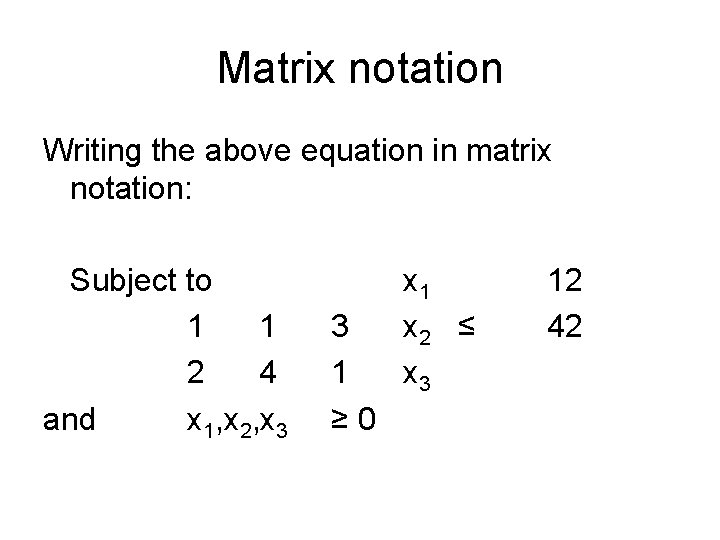
Matrix notation Writing the above equation in matrix notation: Subject to 1 1 2 4 and x 1, x 2, x 3 3 1 ≥ 0 x 1 x 2 ≤ x 3 12 42
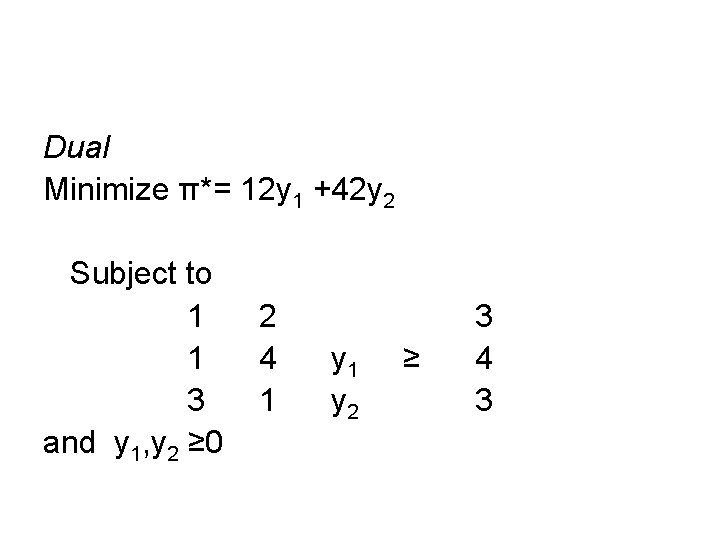
Dual Minimize π*= 12 y 1 +42 y 2 Subject to 1 1 3 and y 1, y 2 ≥ 0 2 4 1 y 2 ≥ 3 4 3
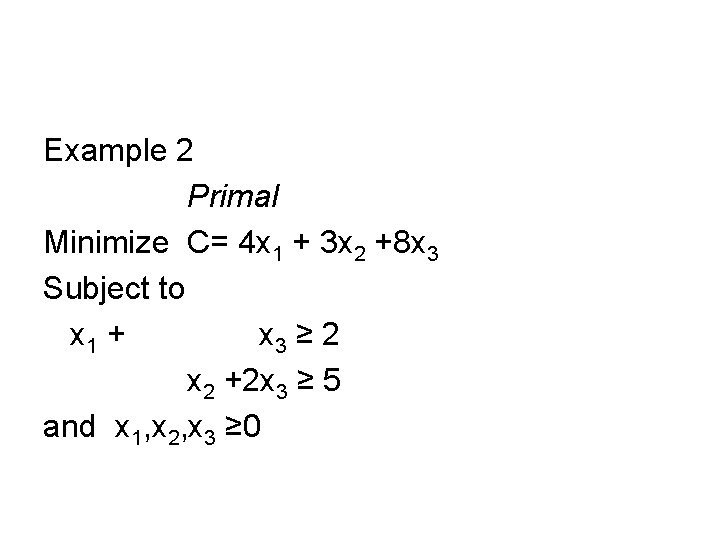
Example 2 Primal Minimize C= 4 x 1 + 3 x 2 +8 x 3 Subject to x 1 + x 3 ≥ 2 x 2 +2 x 3 ≥ 5 and x 1, x 2, x 3 ≥ 0
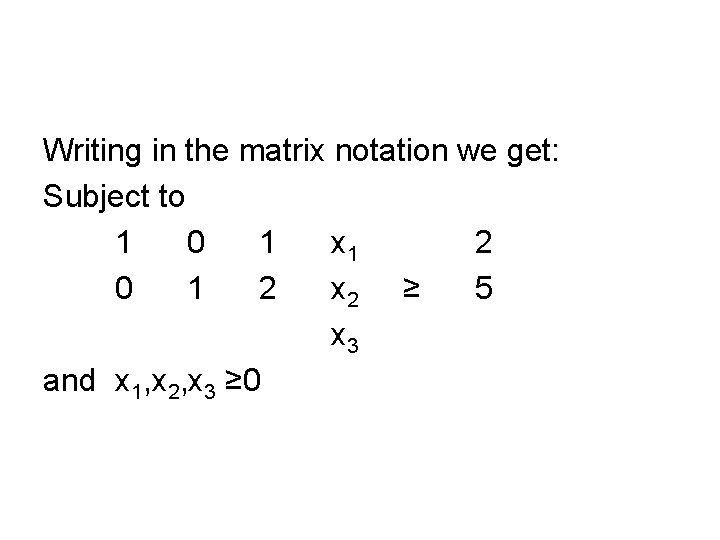
Writing in the matrix notation we get: Subject to 1 0 1 x 1 2 0 1 2 x 2 ≥ 5 x 3 and x 1, x 2, x 3 ≥ 0
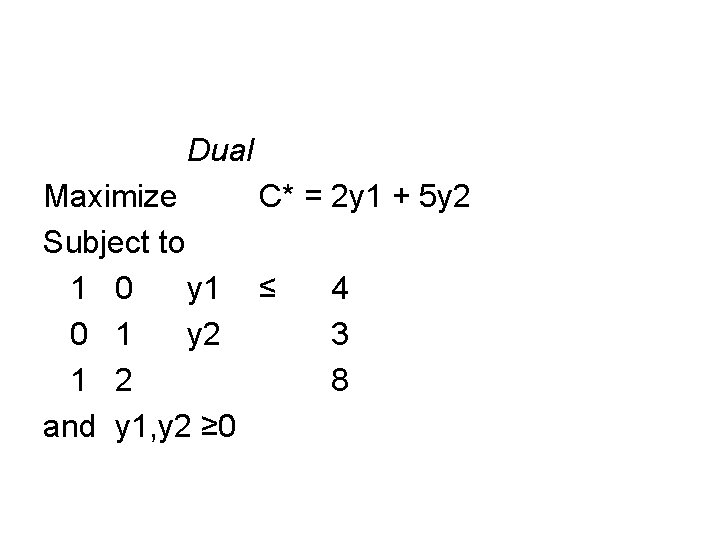
Dual Maximize C* = 2 y 1 + 5 y 2 Subject to 1 0 y 1 ≤ 4 0 1 y 2 3 1 2 8 and y 1, y 2 ≥ 0
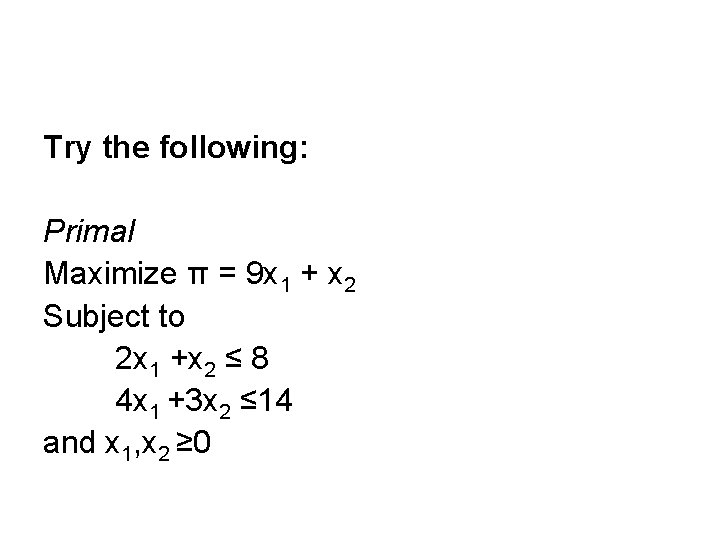
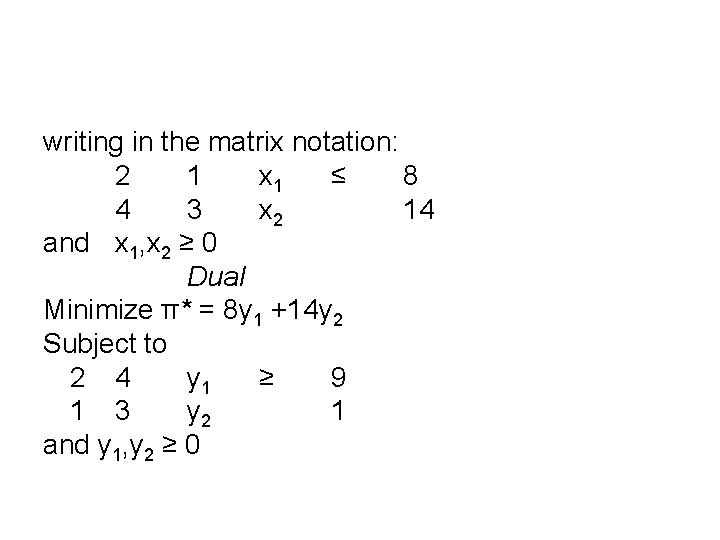
Try the following: Primal Maximize π = 9 x 1 + x 2 Subject to 2 x 1 +x 2 ≤ 8 4 x 1 +3 x 2 ≤ 14 and x 1, x 2 ≥ 0
writing in the matrix notation: 2 1 x 1 ≤ 8 4 3 x 2 14 and x 1, x 2 ≥ 0 Dual Minimize π* = 8 y 1 +14 y 2 Subject to 2 4 y 1 ≥ 9 1 3 y 2 1 and y 1, y 2 ≥ 0
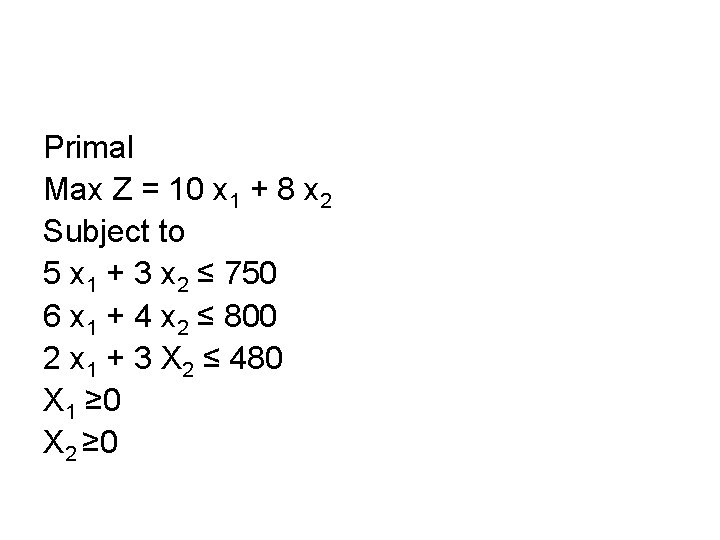
Primal Max Z = 10 x 1 + 8 x 2 Subject to 5 x 1 + 3 x 2 ≤ 750 6 x 1 + 4 x 2 ≤ 800 2 x 1 + 3 X 2 ≤ 480 X 1 ≥ 0 X 2 ≥ 0
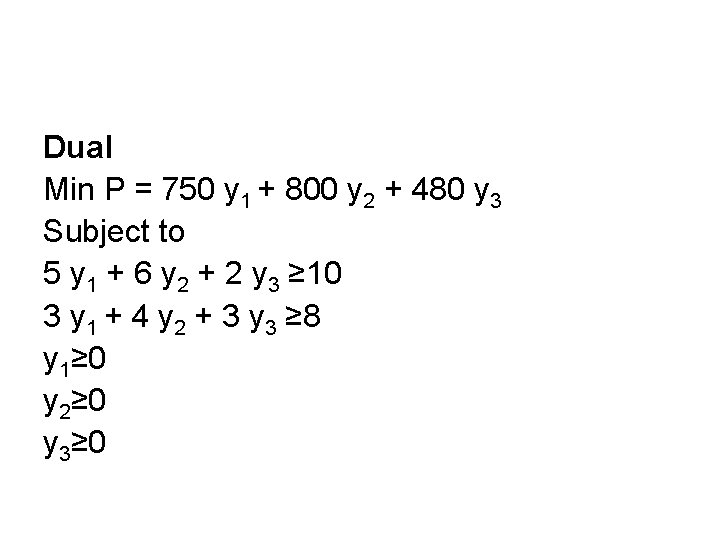
Dual Min P = 750 y 1 + 800 y 2 + 480 y 3 Subject to 5 y 1 + 6 y 2 + 2 y 3 ≥ 10 3 y 1 + 4 y 2 + 3 y 3 ≥ 8 y 1≥ 0 y 2≥ 0 y 3≥ 0