
DualBand Search Coil Magnetometer SCM for RPWI consortium
Dual-Band Search Coil Magnetometer (SCM) for RPWI consortium : concept & design report. (September 19, 2010) LPP (Laboratory of Plasma Physics) L 2 E (Laboratory of Electronic and Electromagnetism) & University of Kanazawa 1
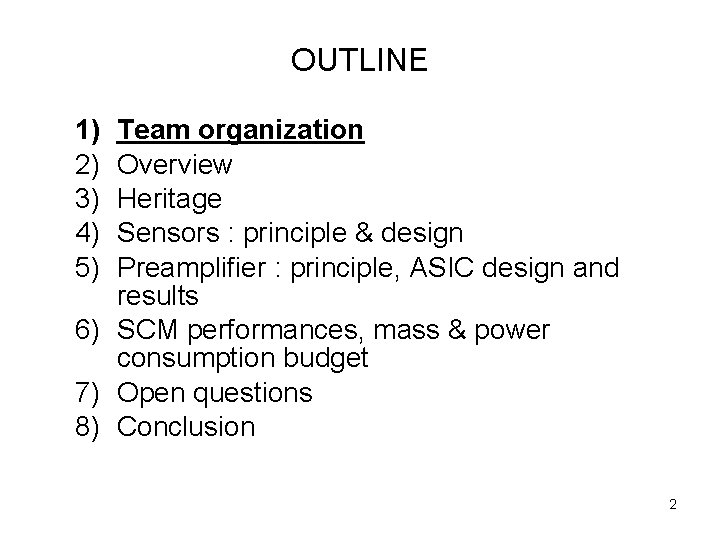
OUTLINE 1) 2) 3) 4) 5) Team organization Overview Heritage Sensors : principle & design Preamplifier : principle, ASIC design and results 6) SCM performances, mass & power consumption budget 7) Open questions 8) Conclusion 2
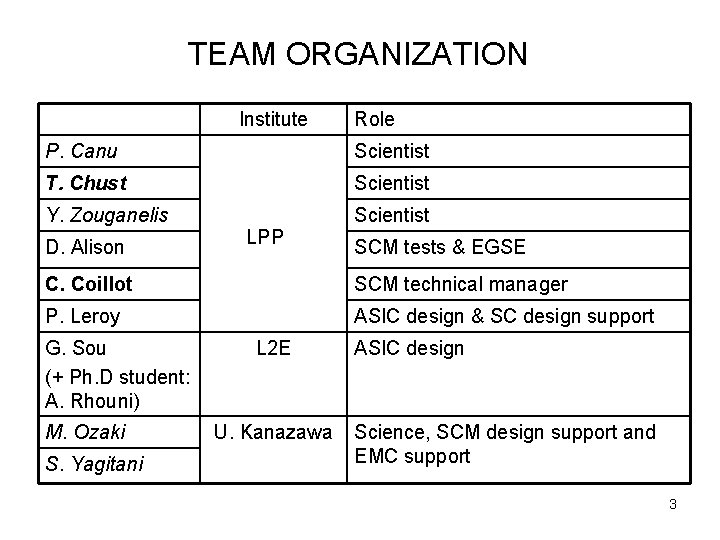
TEAM ORGANIZATION Institute Role P. Canu Scientist T. Chust Scientist Y. Zouganelis Scientist D. Alison LPP SCM tests & EGSE C. Coillot SCM technical manager P. Leroy ASIC design & SC design support G. Sou (+ Ph. D student: A. Rhouni) M. Ozaki S. Yagitani L 2 E U. Kanazawa ASIC design Science, SCM design support and EMC support 3
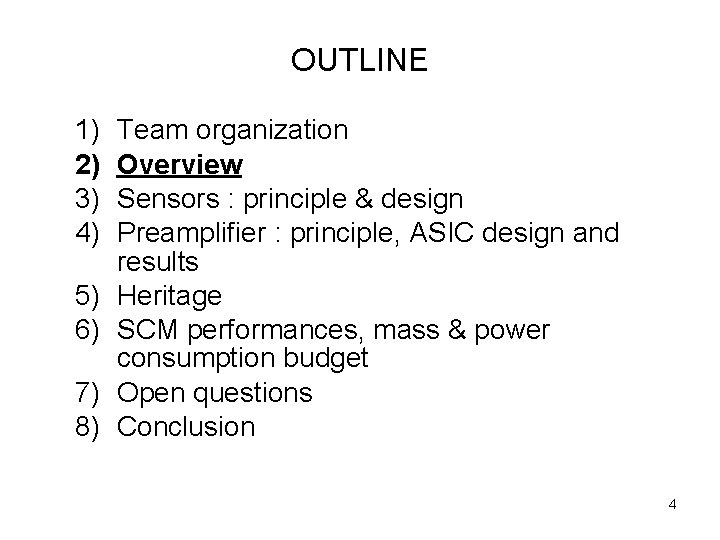
OUTLINE 1) 2) 3) 4) 5) 6) 7) 8) Team organization Overview Sensors : principle & design Preamplifier : principle, ASIC design and results Heritage SCM performances, mass & power consumption budget Open questions Conclusion 4
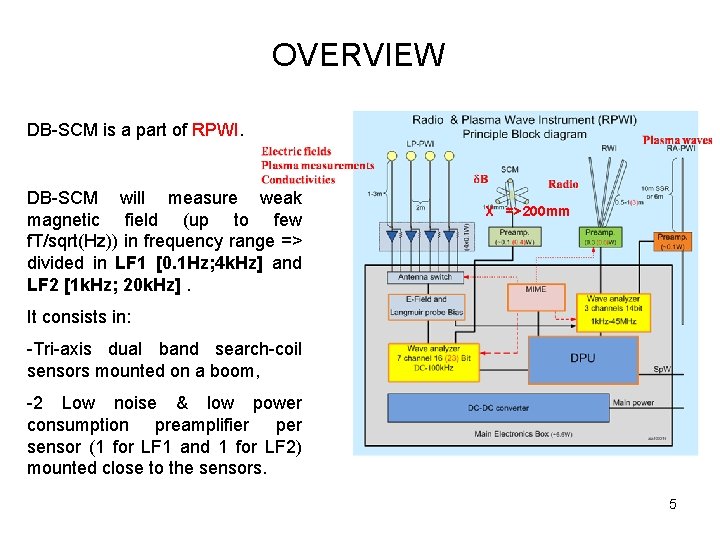
OVERVIEW DB-SCM is a part of RPWI. DB-SCM will measure weak magnetic field (up to few f. T/sqrt(Hz)) in frequency range => divided in LF 1 [0. 1 Hz; 4 k. Hz] and LF 2 [1 k. Hz; 20 k. Hz]. X =>200 mm It consists in: -Tri-axis dual band search-coil sensors mounted on a boom, -2 Low noise & low power consumption preamplifier per sensor (1 for LF 1 and 1 for LF 2) mounted close to the sensors. 5
OVERVIEW : SCIENTIFIC OBJECTIVES Study the electrodynamics of the Jovian system: • Determine the wave electric & magnetic fields (KAW, ICW, Whistler waves …) in the magnetosphere of Jupiter (“rotator” theme) • Characterize the interaction of the flowing Jovian magnetosphere with the Galilean moons (“binary system” theme) “High-frequency” electromagnetic wave processes: - Reconnection / large-scale instability (both Jupiter’s & Ganymede’s magnetospheres) - Particle acceleration and heating (both electrons & ions) - Energy transfer (wave-particle interaction, mode coupling, turbulence) - Mass loading (ion pick-up) Frequency bandwidth: 0. 1 Hz - 20 k. Hz. 6
OUTLINE 1) 2) 3) 4) 5) Team organization Overview Heritage Sensors : principle & design Preamplifier : principle, ASIC design and results 6) SCM performances, mass & power consumption budget 7) Open questions 8) Conclusion 7
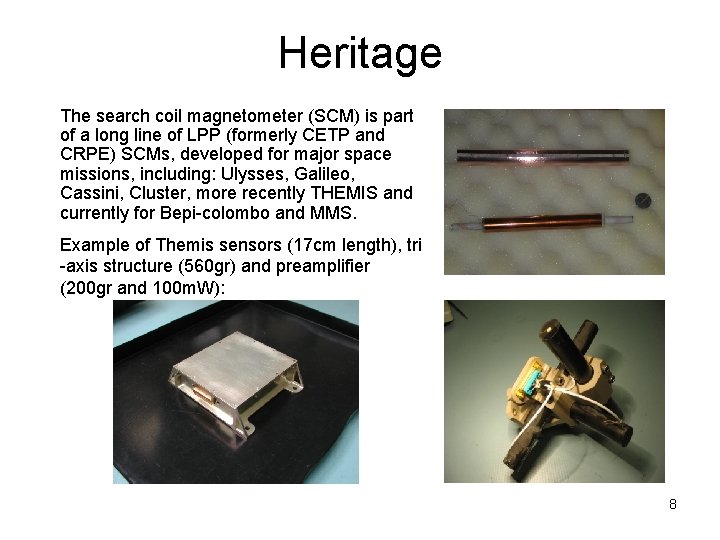
Heritage The search coil magnetometer (SCM) is part of a long line of LPP (formerly CETP and CRPE) SCMs, developed for major space missions, including: Ulysses, Galileo, Cassini, Cluster, more recently THEMIS and currently for Bepi-colombo and MMS. Example of Themis sensors (17 cm length), tri -axis structure (560 gr) and preamplifier (200 gr and 100 m. W): 8
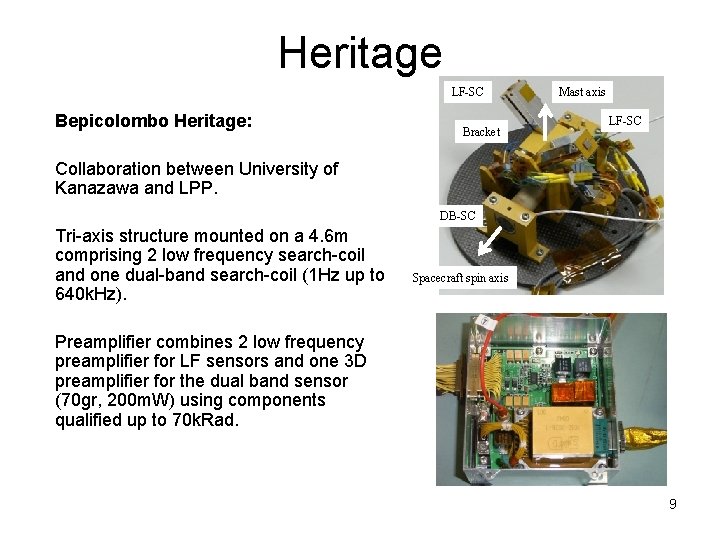
Heritage LF-SC Bepicolombo Heritage: Bracket Mast axis LF-SC Collaboration between University of Kanazawa and LPP. DB-SC Tri-axis structure mounted on a 4. 6 m comprising 2 low frequency search-coil and one dual-band search-coil (1 Hz up to 640 k. Hz). Spacecraft spin axis Preamplifier combines 2 low frequency preamplifier for LF sensors and one 3 D preamplifier for the dual band sensor (70 gr, 200 m. W) using components qualified up to 70 k. Rad. 9
OUTLINE 1) 2) 3) 4) 5) Team organization Overview Heritage Sensors : principle & design Preamplifier : principle, ASIC design and results 6) SCM performances, mass & power consumption budget 7) Open questions 8) Conclusion 10

Sensors : search-coil (SC) principle Search-coil: N turns wounded around a high permeability magnetic core. Magnetic core « amplifies » external magnetic field. Magnetic amplification µapp depends on µr and shape of the core. Winding : Flux variation (Bout*S) induces a voltage proportional to number of turns (N): 11

Sensors : search-coil (SC) principle Search-coil: N turns wounded around a high permeability magnetic core. Magnetic core « amplifies » external magnetic field. Magnetic amplification µapp depends on µr and shape of the core. Winding : Flux variation (Bout*S) induces a voltage proportional to number of turns (N): Electrokinetic's representation : Search-coil behaves like a source voltage “e” applied on a RLC circuit : e Vout Natural resonance of the sensor reduces dynamic and frequency range. 12
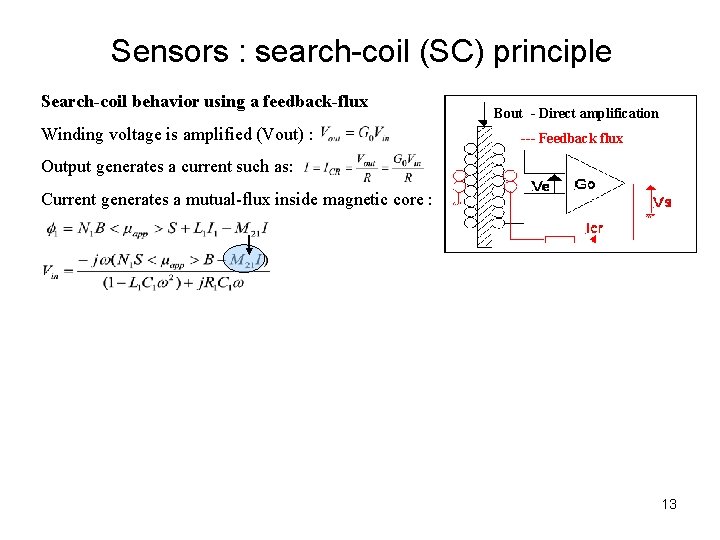
Sensors : search-coil (SC) principle Search-coil behavior using a feedback-flux Winding voltage is amplified (Vout) : Bout--- Direct amplification --- Feedback flux Output generates a current such as: Current generates a mutual-flux inside magnetic core : 13

Sensors : search-coil (SC) principle Search-coil behavior using a feedback-flux Bout--- Direct amplification Winding voltage is amplified (Vout) : --- Feedback flux Output generates a current such as: Current generates a mutual-flux inside magnetic core : By combining : we deduce : and Go= 100 ØResonance is flattened. ØOn flat part, gain is independent from temperature variation ØFrequency range remains limited by the resonance 14
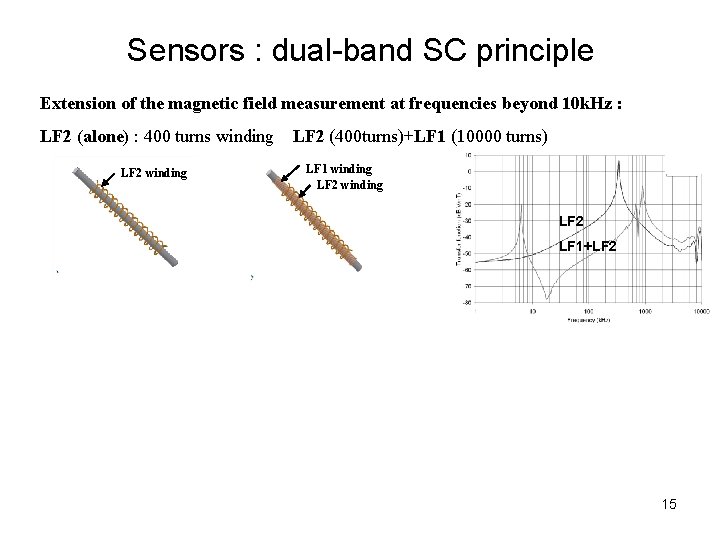
Sensors : dual-band SC principle Extension of the magnetic field measurement at frequencies beyond 10 k. Hz : LF 2 (alone) : 400 turns winding LF 2 (400 turns)+LF 1 (10000 turns) LF 1 winding LF 2 LF 1+LF 2 15
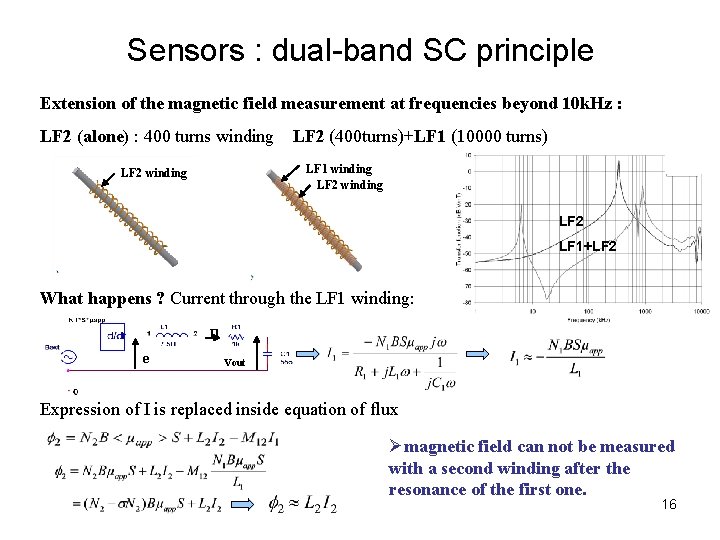
Sensors : dual-band SC principle Extension of the magnetic field measurement at frequencies beyond 10 k. Hz : LF 2 (alone) : 400 turns winding LF 2 (400 turns)+LF 1 (10000 turns) LF 1 winding LF 2 LF 1+LF 2 What happens ? Current through the LF 1 winding: I 1 e Vout Expression of I is replaced inside equation of flux Ømagnetic field can not be measured with a second winding after the resonance of the first one. 16
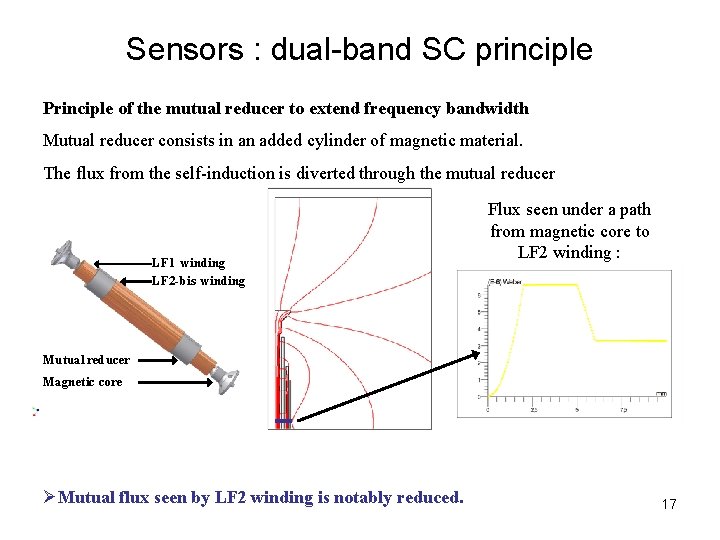
Sensors : dual-band SC principle Principle of the mutual reducer to extend frequency bandwidth Mutual reducer consists in an added cylinder of magnetic material. The flux from the self-induction is diverted through the mutual reducer LF LF 1 winding HF LF 2 -bis winding Flux seen under a path from magnetic core to LF 2 winding : Mutual reducer Magnetic core ØMutual flux seen by LF 2 winding is notably reduced. 17
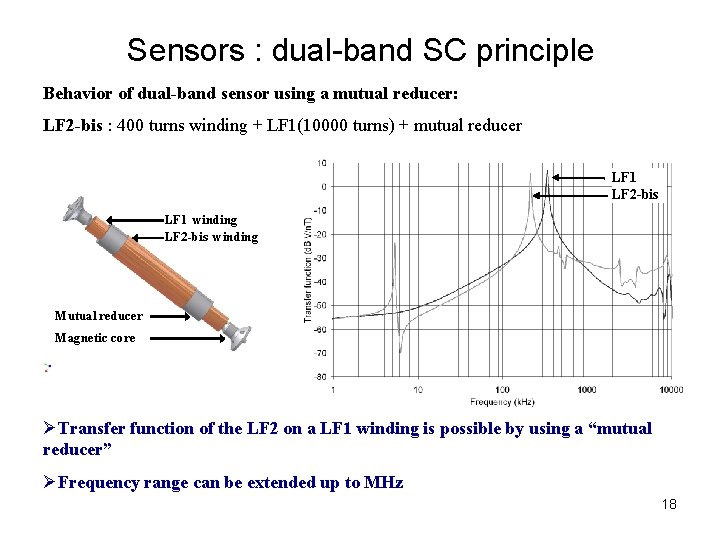
Sensors : dual-band SC principle Behavior of dual-band sensor using a mutual reducer: LF 2 -bis : 400 turns winding + LF 1(10000 turns) + mutual reducer LF 1 LF 2 -bis LF LF 1 winding HF LF 2 -bis winding Mutual reducer Magnetic core ØTransfer function of the LF 2 on a LF 1 winding is possible by using a “mutual reducer” ØFrequency range can be extended up to MHz 18
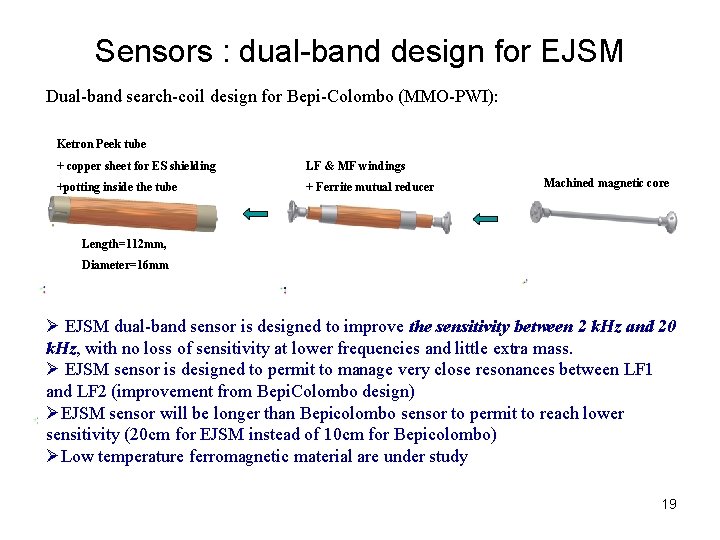
Sensors : dual-band design for EJSM Dual-band search-coil design for Bepi-Colombo (MMO-PWI): Ketron Peek tube + copper sheet for ES shielding LF & MF windings +potting inside the tube + Ferrite mutual reducer Machined magnetic core Length=112 mm, Diameter=16 mm Ketron Peek tube + copper sheet for ES shielding LF & MF windings +potting inside the tube + Ferrite mutual reducer Machined magnetic core Ø EJSM dual-band sensor is designed to improve the sensitivity between 2 k. Hz and 20 k. Hz, with no loss of sensitivity at lower frequencies and little extra mass. Ø EJSM sensor is designed to permit to manage very close resonances between LF 1 Length=112 mm, and Diameter=16 mm LF 2 (improvement from Bepi. Colombo design) ØEJSM sensor will be longer than Bepicolombo sensor to permit to reach lower sensitivity (20 cm for EJSM instead of 10 cm for Bepicolombo) ØLow temperature ferromagnetic material are under study 19
OUTLINE 1) 2) 3) 4) 5) Team organization Overview Heritage Sensors : principle & design Preamplifier : principle, ASIC design and results 6) SCM performances, mass & power consumption budget 7) Open questions 8) Conclusion 20
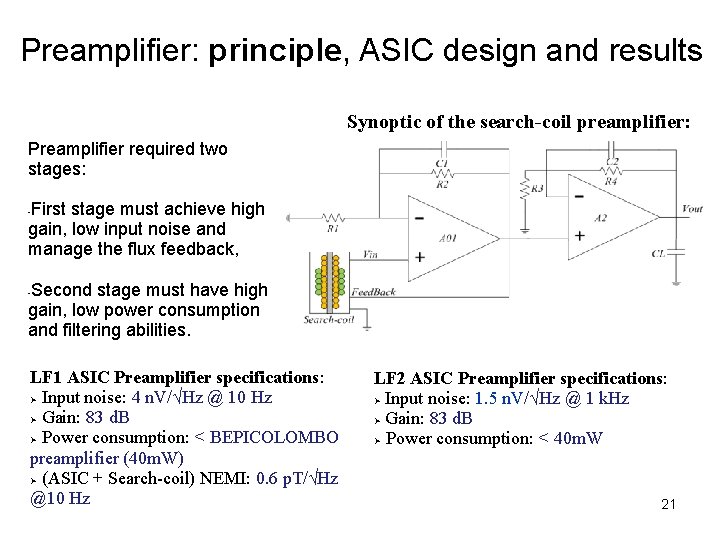
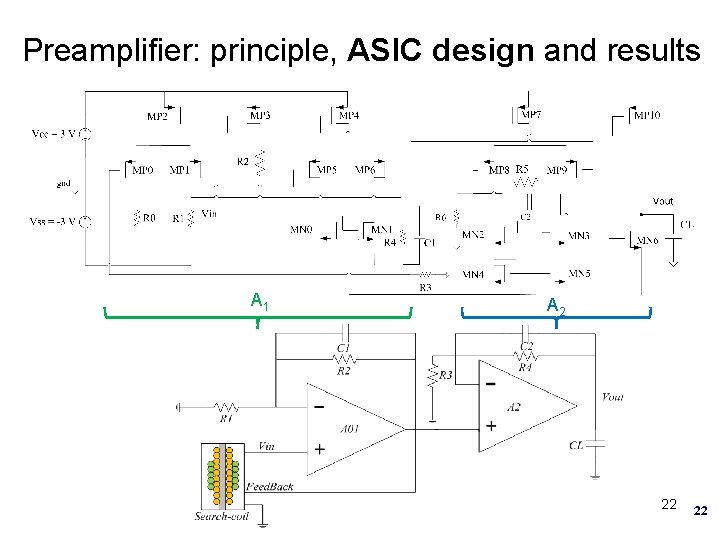
Preamplifier: principle, ASIC design and results Synoptic of the search-coil preamplifier: Preamplifier required two stages: First stage must achieve high gain, low input noise and manage the flux feedback, - Second stage must have high gain, low power consumption and filtering abilities. - LF 1 ASIC Preamplifier specifications: Ø Input noise: 4 n. V/√Hz @ 10 Hz Ø Gain: 83 d. B Ø Power consumption: < BEPICOLOMBO preamplifier (40 m. W) Ø (ASIC + Search-coil) NEMI: 0. 6 p. T/√Hz @10 Hz LF 2 ASIC Preamplifier specifications: Ø Input noise: 1. 5 n. V/√Hz @ 1 k. Hz Ø Gain: 83 d. B Ø Power consumption: < 40 m. W 21
Preamplifier: principle, ASIC design and results A 1 A 2 22 22
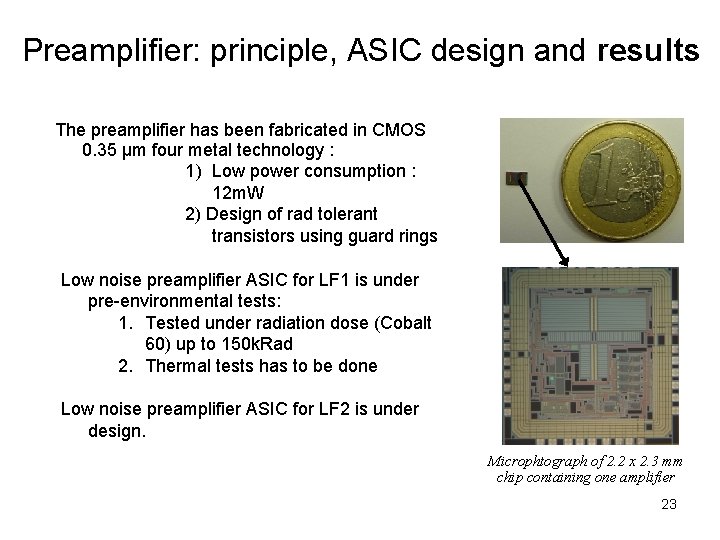
Preamplifier: principle, ASIC design and results The preamplifier has been fabricated in CMOS 0. 35 µm four metal technology : 1) Low power consumption : 12 m. W 2) Design of rad tolerant transistors using guard rings Low noise preamplifier ASIC for LF 1 is under pre-environmental tests: 1. Tested under radiation dose (Cobalt 60) up to 150 k. Rad 2. Thermal tests has to be done Low noise preamplifier ASIC for LF 2 is under design. Microphtograph of 2. 2 x 2. 3 mm chip containing one amplifier 23
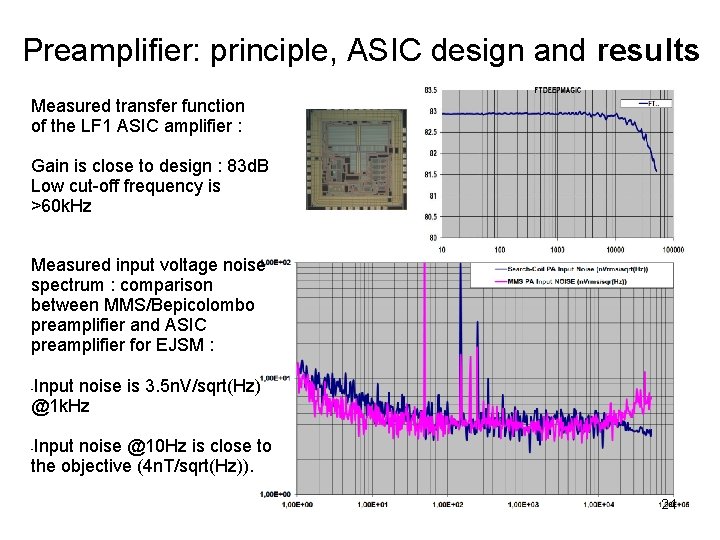
Preamplifier: principle, ASIC design and results Measured transfer function of the LF 1 ASIC amplifier : Gain is close to design : 83 d. B Low cut-off frequency is >60 k. Hz Measured input voltage noise spectrum : comparison between MMS/Bepicolombo preamplifier and ASIC preamplifier for EJSM : Input noise is 3. 5 n. V/sqrt(Hz) @1 k. Hz - Input noise @10 Hz is close to the objective (4 n. T/sqrt(Hz)). - 24
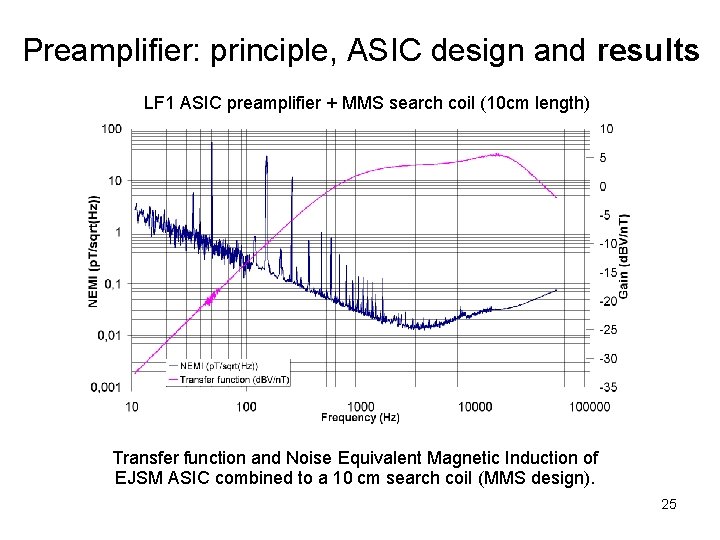
Preamplifier: principle, ASIC design and results LF 1 ASIC preamplifier + MMS search coil (10 cm length) Transfer function and Noise Equivalent Magnetic Induction of EJSM ASIC combined to a 10 cm search coil (MMS design). 25
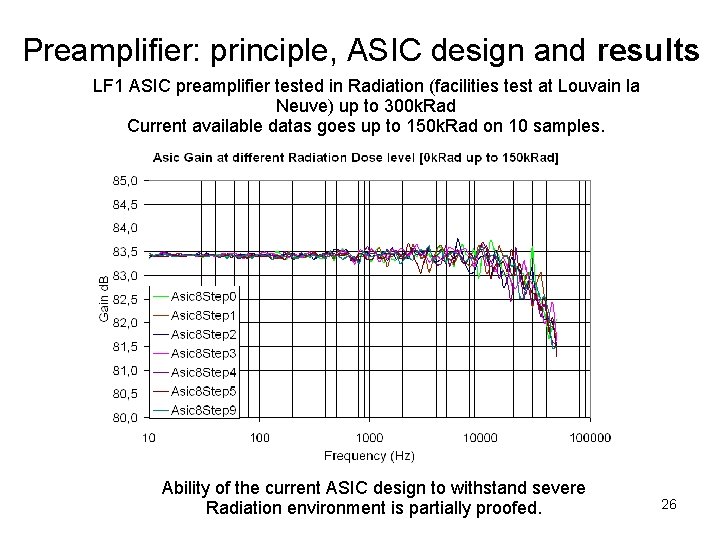
Preamplifier: principle, ASIC design and results LF 1 ASIC preamplifier tested in Radiation (facilities test at Louvain la Neuve) up to 300 k. Rad Current available datas goes up to 150 k. Rad on 10 samples. Ability of the current ASIC design to withstand severe Radiation environment is partially proofed. 26
OUTLINE 1) 2) 3) 4) 5) Team organization Overview Heritage Sensors : principle & design Preamplifier : principle, ASIC design and results 6) SCM performances, mass & power consumption budget 7) Open questions 8) Conclusion 27
SCM Performances: design goal for RPWI EJSM Dual-Band Search Coils (DB-SC) in red. Design hypotesis : preamplifier located close to the sensor… possibly inserted inside the hollow of the ferromagnetic core. 28
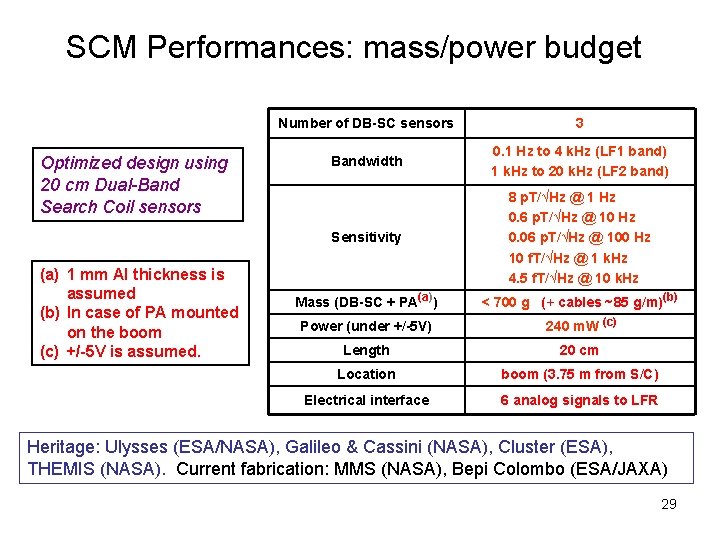
SCM Performances: mass/power budget Optimized design using 20 cm Dual-Band Search Coil sensors (a) 1 mm Al thickness is assumed (b) In case of PA mounted on the boom (c) +/-5 V is assumed. Number of DB-SC sensors 3 Bandwidth 0. 1 Hz to 4 k. Hz (LF 1 band) 1 k. Hz to 20 k. Hz (LF 2 band) Sensitivity 8 p. T/√Hz @ 1 Hz 0. 6 p. T/√Hz @ 10 Hz 0. 06 p. T/√Hz @ 100 Hz 10 f. T/√Hz @ 1 k. Hz 4. 5 f. T/√Hz @ 10 k. Hz Mass (DB-SC + PA(a)) < 700 g (+ cables ~85 g/m)(b) Power (under +/-5 V) 240 m. W (c) Length 20 cm Location boom (3. 75 m from S/C) Electrical interface 6 analog signals to LFR Heritage: Ulysses (ESA/NASA), Galileo & Cassini (NASA), Cluster (ESA), THEMIS (NASA). Current fabrication: MMS (NASA), Bepi Colombo (ESA/JAXA) 29
OUTLINE 1) 2) 3) 4) 5) Team organization Overview Heritage Sensors : principle & design Preamplifier : principle, ASIC design and results 6) SCM performances, mass & power consumption budget 7) Open questions 8) Conclusion 30
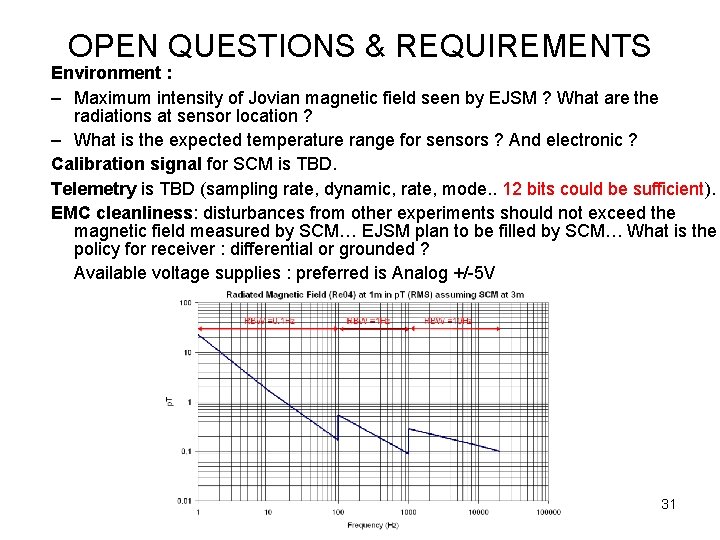
OPEN QUESTIONS & REQUIREMENTS Environment : – Maximum intensity of Jovian magnetic field seen by EJSM ? What are the radiations at sensor location ? – What is the expected temperature range for sensors ? And electronic ? Calibration signal for SCM is TBD. Telemetry is TBD (sampling rate, dynamic, rate, mode. . 12 bits could be sufficient). EMC cleanliness: disturbances from other experiments should not exceed the magnetic field measured by SCM… EJSM plan to be filled by SCM… What is the policy for receiver : differential or grounded ? Available voltage supplies : preferred is Analog +/-5 V 31
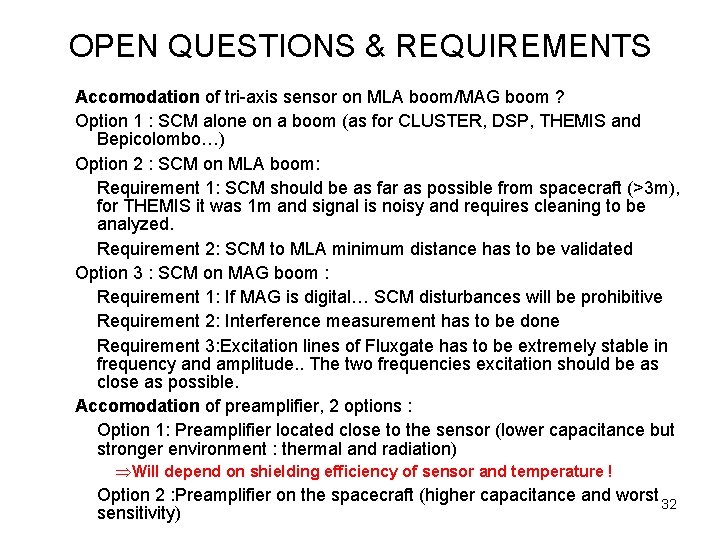
OPEN QUESTIONS & REQUIREMENTS Accomodation of tri-axis sensor on MLA boom/MAG boom ? Option 1 : SCM alone on a boom (as for CLUSTER, DSP, THEMIS and Bepicolombo…) Option 2 : SCM on MLA boom: Requirement 1: SCM should be as far as possible from spacecraft (>3 m), for THEMIS it was 1 m and signal is noisy and requires cleaning to be analyzed. Requirement 2: SCM to MLA minimum distance has to be validated Option 3 : SCM on MAG boom : Requirement 1: If MAG is digital… SCM disturbances will be prohibitive Requirement 2: Interference measurement has to be done Requirement 3: Excitation lines of Fluxgate has to be extremely stable in frequency and amplitude. . The two frequencies excitation should be as close as possible. Accomodation of preamplifier, 2 options : Option 1: Preamplifier located close to the sensor (lower capacitance but stronger environment : thermal and radiation) Þ Will depend on shielding efficiency of sensor and temperature ! Option 2 : Preamplifier on the spacecraft (higher capacitance and worst 32 sensitivity)
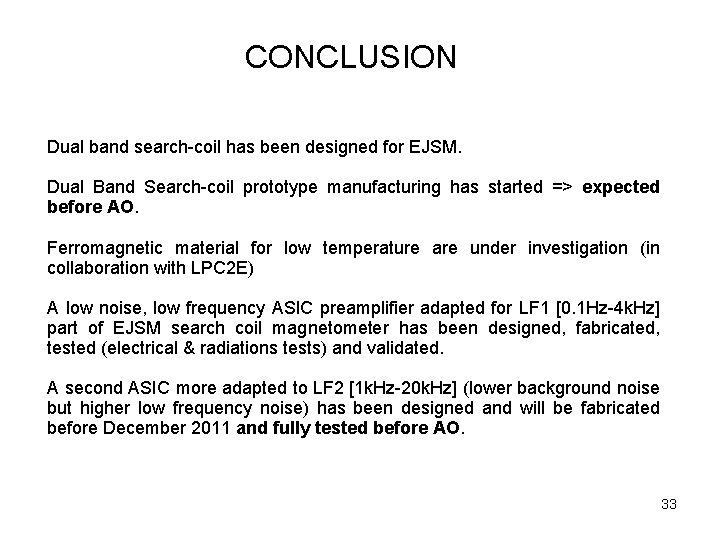
CONCLUSION Dual band search-coil has been designed for EJSM. Dual Band Search-coil prototype manufacturing has started => expected before AO. Ferromagnetic material for low temperature are under investigation (in collaboration with LPC 2 E) A low noise, low frequency ASIC preamplifier adapted for LF 1 [0. 1 Hz-4 k. Hz] part of EJSM search coil magnetometer has been designed, fabricated, tested (electrical & radiations tests) and validated. A second ASIC more adapted to LF 2 [1 k. Hz-20 k. Hz] (lower background noise but higher low frequency noise) has been designed and will be fabricated before December 2011 and fully tested before AO. 33

THANK YOU ! 34
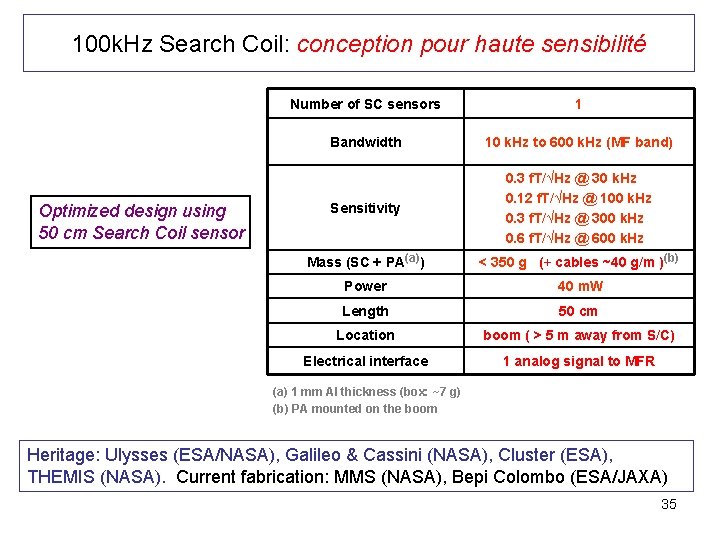
100 k. Hz Search Coil: conception pour haute sensibilité Optimized design using 50 cm Search Coil sensor Number of SC sensors 1 Bandwidth 10 k. Hz to 600 k. Hz (MF band) Sensitivity 0. 3 f. T/√Hz @ 30 k. Hz 0. 12 f. T/√Hz @ 100 k. Hz 0. 3 f. T/√Hz @ 300 k. Hz 0. 6 f. T/√Hz @ 600 k. Hz Mass (SC + PA(a)) < 350 g (+ cables ~40 g/m )(b) Power 40 m. W Length 50 cm Location boom ( > 5 m away from S/C) Electrical interface 1 analog signal to MFR (a) 1 mm Al thickness (box: ~7 g) (b) PA mounted on the boom Heritage: Ulysses (ESA/NASA), Galileo & Cassini (NASA), Cluster (ESA), THEMIS (NASA). Current fabrication: MMS (NASA), Bepi Colombo (ESA/JAXA) 35
- Slides: 35