
Dual Use Chemical Equipment Controlled by the CCL
Dual Use Chemical Equipment Controlled by the CCL Chemical and Biological Controls Division
Dual-Use Chemical Equipment · ECCN 2 B 350: Chemical Manufacturing Equipment a - Reaction vessels or reactors; b - Agitators; c - Storage tanks, containers, and receivers; d - Heat exchangers and condensers; e - Distillation or absorption columns; f - Remotely operated filling equipment; g - Valves; h - Piping; i - Pumps; j - Incinerators.
Dual-Use Chemical Equipment · ECCN 2 B 350. a - Reactors · – Combine mechanical stirring with temperature control; – Safely and economically perform chemical reactions; – Come in many different varieties; – Can be operated as batch reactors or continuously; – Only reactors which meet very specific size and materials of construction parameters are controlled. · Prescreening Key Words – 2 B 350. a - Reactor, reaction vessel, synthesizer, converter, compounder
Dual-Use Chemical Equipment · 2 B 350. b - Agitators – Mechanically mix reactants; – Insure an even distribution of reactants and products; – Only agitators which are made from very specific materials of construction are controlled. · Prescreening Key Words – 2 B 350. b - Agitator, stirrer, mixer, blender
Dual-Use Chemical Equipment · 2 B 350 c - Storage Tanks – Large tanks and storage containers used to store reactants, products, and waste materials onsite; – Smaller drums and tanker cars used to transport products and waste materials offsite; – Only tanks and storage containers with volumes greater than 100 liters (26 U. S. gallons) made from very specific materials of construction are controlled. · Prescreening Key Words – 2 B 350. c - Tank, container, receiver, storage, carrier, flask, dewar, vessel
Dual-Use Chemical Equipment · 2 B 350. d - Heat Exchangers – Used to increase, lower, or maintain reactor temperatures and to either increase or reduce the temperature of reactants and products. – Used to condense hot gases; – Come in a variety of shapes and styles; – Only heat exchangers with internal surface areas less than 20 m 2, but greater than 0. 15 m 2 and made from very specific materials of construction are controlled. · Prescreening Key Words – 2 B 350. d - Heat exchanger, condenser, cooler, collector
Dual-Use Chemical Equipment · 2 B 350. e - Columns – Used to increase reactant and product concentrations; – Remove impurities and waste products; – Perform reactions to form new products or remove impurities; – Only columns with internal diameters greater than 0. 1 m and made from very specific materials of construction are controlled. · Prescreening Key Words – 2 B 350. e - Distillation, absorption, column
Dual-Use Chemical Equipment · 2 B 350. f - Filling Equipment – Reduce human exposure to toxic or explosive materials; – Increase economic efficiency through automation; – Only filling equipment made from specific materials of construction are controlled. · Prescreening Key Words – 2 B 350. f - Filler, loader, remote
Dual-Use Chemical Equipment · 2 B 350. g - Valves – Used to control the flow of reactants, products, and waste materials; – Come in very many different forms and sizes; – Only a few types of valves made from very specific materials of construction are controlled. · Prescreening Key Words – 2 B 350. g - Valve, choke, diaphragm, check, relief
Dual-Use Chemical Equipment • 2 B 350. h - Multiple Walled Pipes Multiple walled pipes made from controlled corrosion resistant materials are generally not used in industry.
Dual-Use Chemical Equipment · 2 B 350. i - Pumps – Used to physically move reactants, products, and waste materials; – Come in very many different forms and sizes; – Only a few types of pumps with flow rates greater than 600 liters/hour and vacuum pumps with pumping rates greater than 5, 000 liters/hour made from specific materials of construction are controlled. · Prescreening Key Words – 2 B 350. i - Pump, diaphragm, magnetic drive, vacuum
Dual-Use Chemical Equipment · 2 B 350. j - Incinerators – Used to completely destroy chemical agents and other toxic materials; – Only incinerators made from very specific materials of construction are controlled. · Prescreening Key Words – 2 B 350. j - Incinerator, burner, combustor, destroyer, furnace
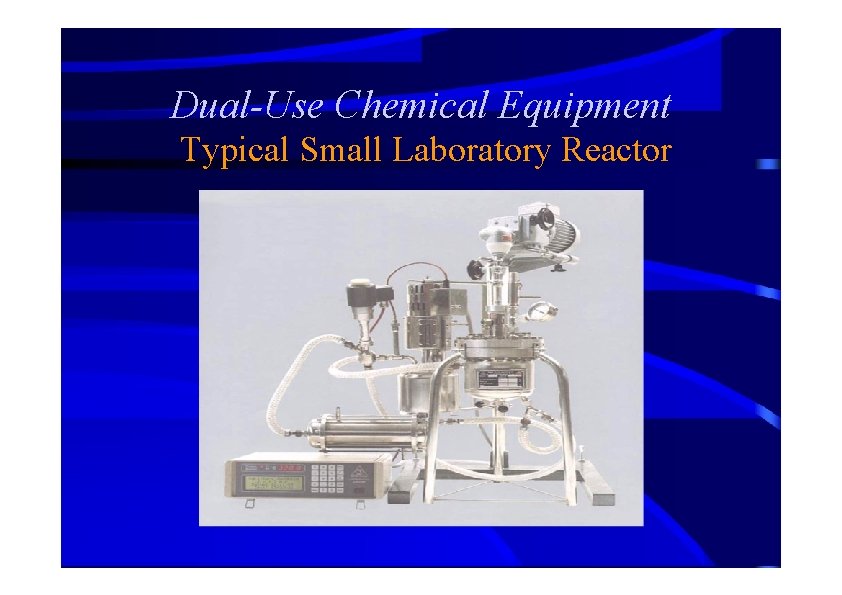
Dual-Use Chemical Equipment Typical Small Laboratory Reactor
Dual-Use Chemical Equipment · ECCN 2 B 351: Toxic Gas Monitors – Used to detect and monitor for chemical agents and other toxic chemicals; – Used to detect cholinesterase-inhibiting activity – Only toxic gas monitors which can continuously detect chemical agents, controlled precursors, and other compounds containing phosphorus, sulfuer, fluorine, or chlorine at concentrations less than 0. 3 mg/m 3 are controlled. · Prescreening Key Words – 2 B 351. a - Monitor, analyzer, spectrometer,
Conclusio n • Chemical Equipment Controlled by EAR – ECCN 2 B 350. a - Reaction vessels or reactors; – ECCB 2 B 350. b - Agitators; – ECCN 2 B 350. c - Storage tanks, containers, and receivers; – ECCN 2 B 350. d - Heat exchangers and condensers; – ECCN 2 B 350. e - Distillation or absorption columns; – ECCN 2 B 350. f - Remotely operated filling equipment; – ECCN 2 B 350. g - Valves; – ECCN 2 B 350. h - Piping; – ECCN 2 B 350. i - Pumps; – ECCN 2 B 350. j - Incinerators; – ECCN 2 B 351. a & b - Toxic gas monitors.
- Slides: 15