
Dual Simplex Method We use Simplex Method with
- Slides: 15
Dual Simplex Method We use Simplex Method with the condition that the right side constants must be non-negative. The Simplex method starts with a feasible solution but is non optimal solution. This improves the feasible solution to optimal solution. However, in Dual Simplex Method, it has no problem with negative right hand side constants and the Method starts with an optimal solution but with an infeasible solution and it improves the feasibility to optimality.
Dual Simplex Method: Iterative steps involved in the dual simplex method are: 1. All the constraints (except those with equality (=) sign) are modified to ‘less-than-equal-to’ sign. Constraints with greater-than-equal-to’ sign are multiplied by -1 through out so that inequality sign gets reversed. Finally, all these constraints are transformed to equality sign by introducing required slack variables
2. Modified problem, as in step one, is expressed in the form of a simplex tableau. If all the cost coefficients are positive (i. e. , optimality condition is satisfied) and one or more basic variables have negative values (i. e. , non-feasible solution), then dual simplex method is applicable.
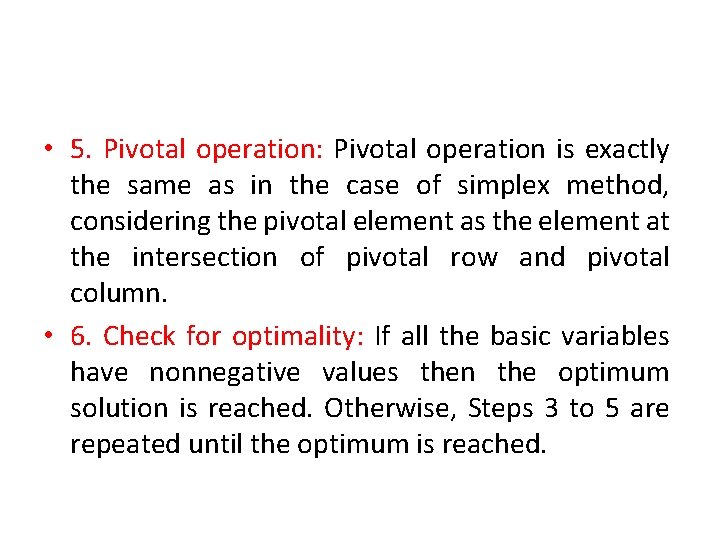
• 3. Selection of exiting variable: The basic variable with the highest negative value is the exiting variable. If there are two candidates for exiting variable, any one is selected. The row of the selected exiting variable is marked as pivotal row. • 4. Selection of entering variable: Cost coefficients, corresponding to all the negative elements of the pivotal row, are identified and their ratios are calculated using the coefficients of Z-equation as the denominators except zeroes of pivotal row, i. e. , The column corresponding to minimum ratio is identified as the pivotal column and associated decision variable is the entering variable.
• 5. Pivotal operation: Pivotal operation is exactly the same as in the case of simplex method, considering the pivotal element as the element at the intersection of pivotal row and pivotal column. • 6. Check for optimality: If all the basic variables have nonnegative values then the optimum solution is reached. Otherwise, Steps 3 to 5 are repeated until the optimum is reached.
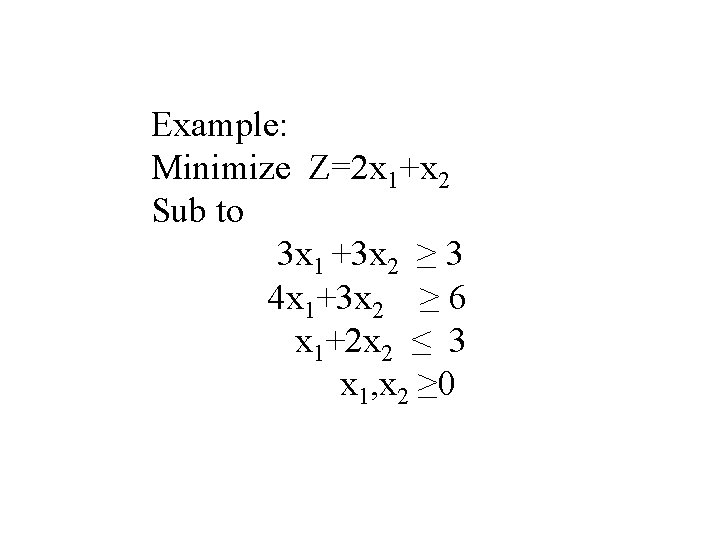
Example: Minimize Z=2 x 1+x 2 Sub to 3 x 1 +3 x 2 ≥ 3 4 x 1+3 x 2 ≥ 6 x 1+2 x 2 ≤ 3 x 1, x 2 ≥ 0
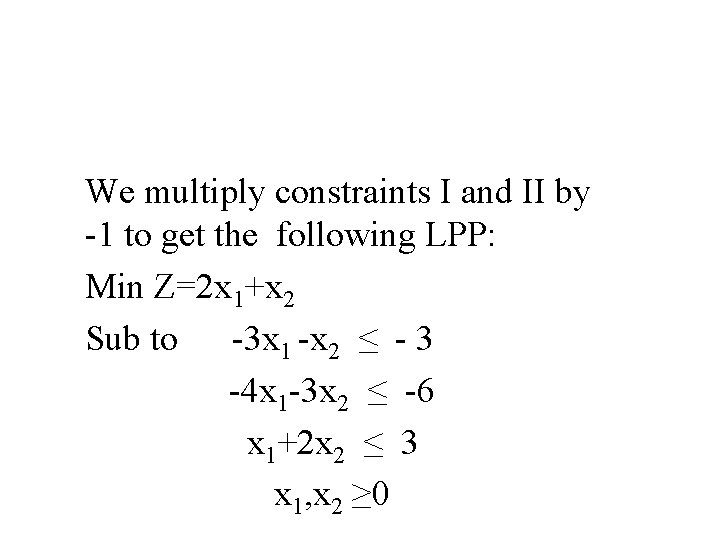
We multiply constraints I and II by -1 to get the following LPP: Min Z=2 x 1+x 2 Sub to -3 x 1 -x 2 ≤ - 3 -4 x 1 -3 x 2 ≤ -6 x 1+2 x 2 ≤ 3 x 1, x 2 ≥ 0
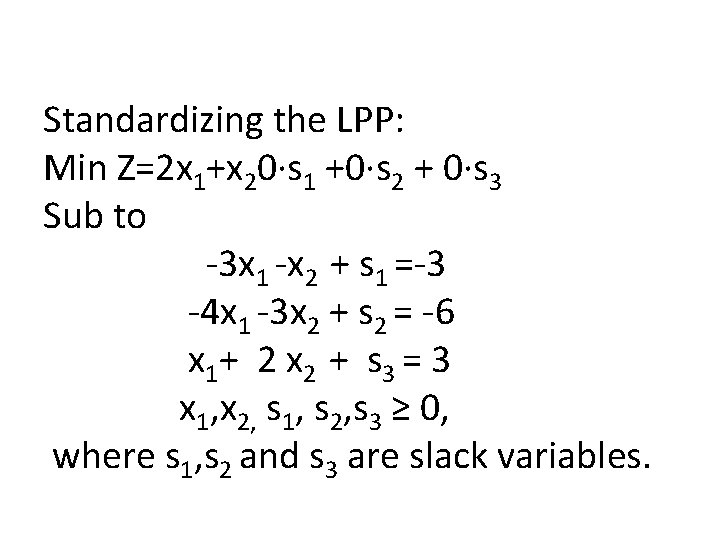
Standardizing the LPP: Min Z=2 x 1+x 20·s 1 +0·s 2 + 0·s 3 Sub to -3 x 1 -x 2 + s 1 =-3 -4 x 1 -3 x 2 + s 2 = -6 x 1 + 2 x 2 + s 3 = 3 x 1, x 2, s 1, s 2, s 3 ≥ 0, where s 1, s 2 and s 3 are slack variables.
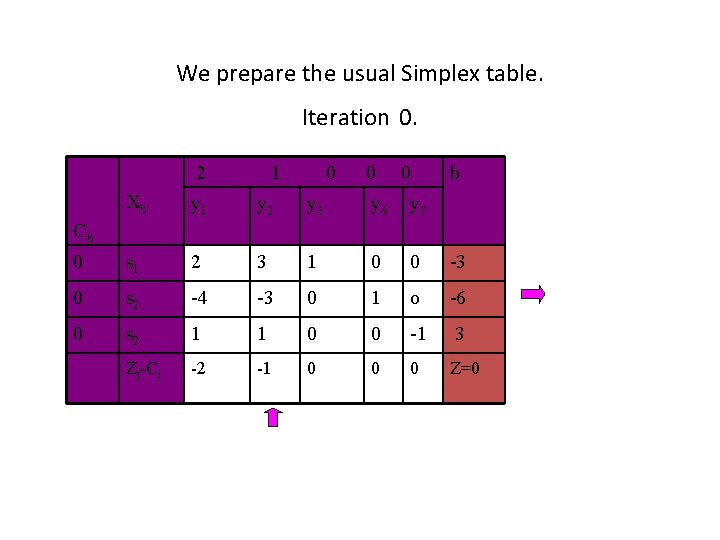
We prepare the usual Simplex table. Iteration 0. 2 1 0 0 0 b Xb y 1 y 2 y 3 y 4 y 5 0 s 1 2 3 1 0 0 -3 0 s 2 -4 -3 0 1 o -6 0 s 3 1 1 0 0 -1 3 Zj-Cj -2 -1 0 0 0 Z=0 Cb
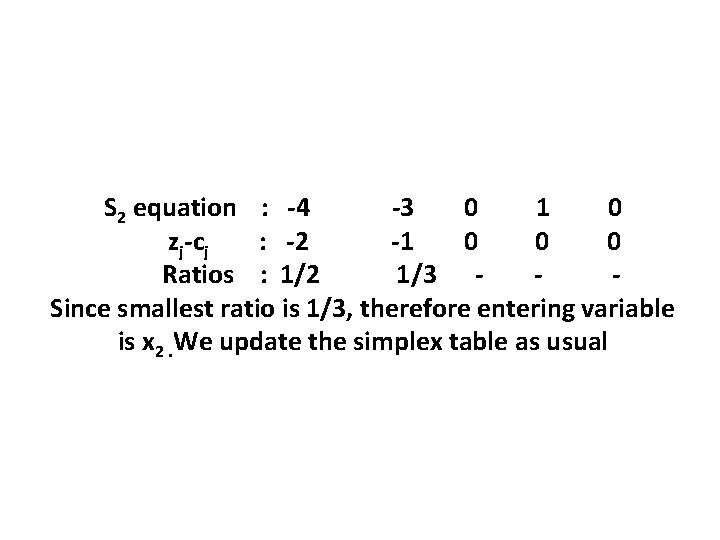
S 2 equation : -4 -3 0 1 0 zj-cj : -2 -1 0 0 0 Ratios : 1/2 1/3 Since smallest ratio is 1/3, therefore entering variable is x 2. We update the simplex table as usual
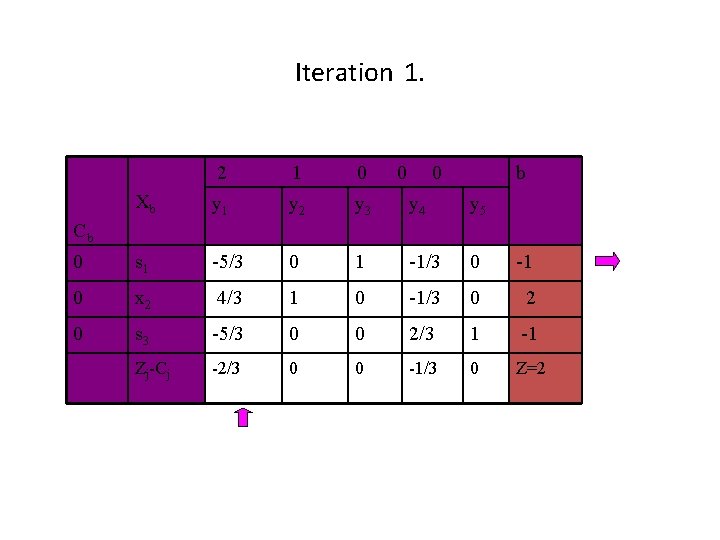
Iteration 1. 2 1 0 0 0 b Xb y 1 y 2 y 3 y 4 y 5 0 s 1 -5/3 0 1 -1/3 0 -1 0 x 2 4/3 1 0 -1/3 0 2 0 s 3 -5/3 0 0 2/3 1 -1 Zj-Cj -2/3 0 0 -1/3 0 Z=2 Cb
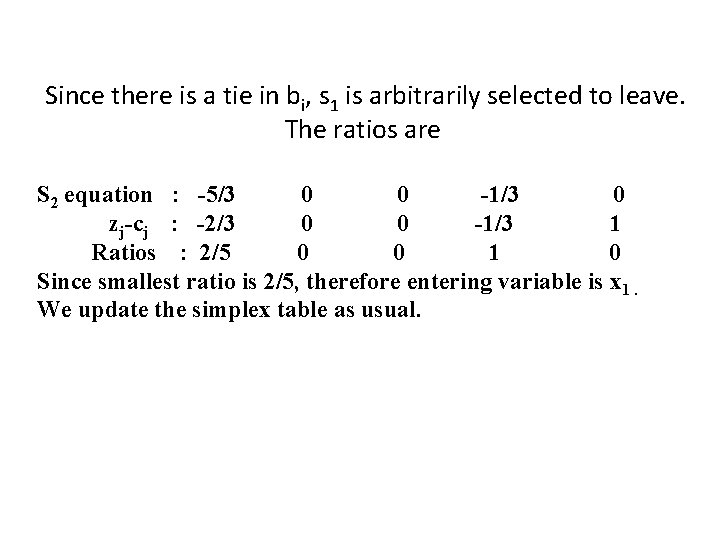
Since there is a tie in bi, s 1 is arbitrarily selected to leave. The ratios are S 2 equation : -5/3 0 0 -1/3 0 zj-cj : -2/3 0 0 -1/3 1 Ratios : 2/5 0 0 1 0 Since smallest ratio is 2/5, therefore entering variable is x 1. We update the simplex table as usual.
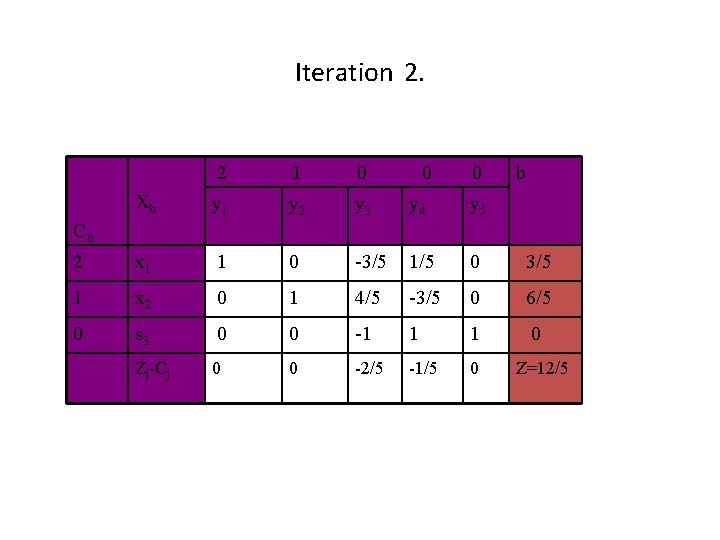
Iteration 2. 2 1 0 0 0 b Xb y 1 y 2 y 3 y 4 y 5 2 x 1 1 0 -3/5 1/5 0 3/5 1 x 2 0 1 4/5 -3/5 0 6/5 0 s 3 0 0 -1 1 1 0 Zj-Cj 0 0 -2/5 -1/5 0 Cb Z=12/5
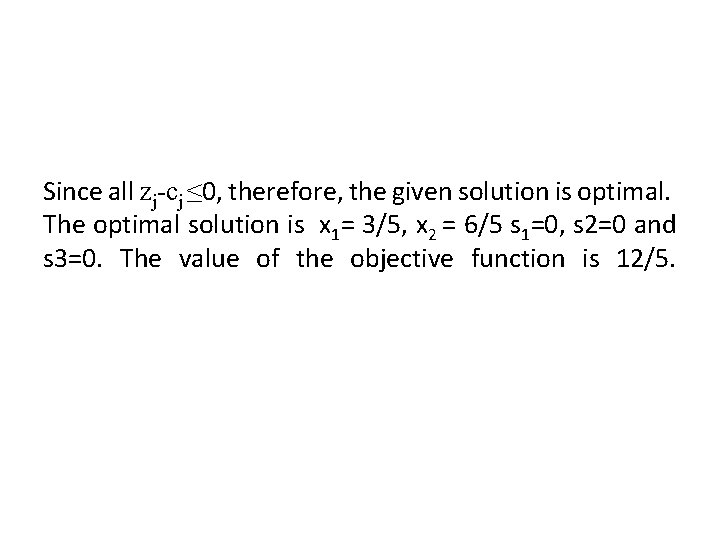
Since all zj-cj ≤ 0, therefore, the given solution is optimal. The optimal solution is x 1= 3/5, x 2 = 6/5 s 1=0, s 2=0 and s 3=0. The value of the objective function is 12/5.
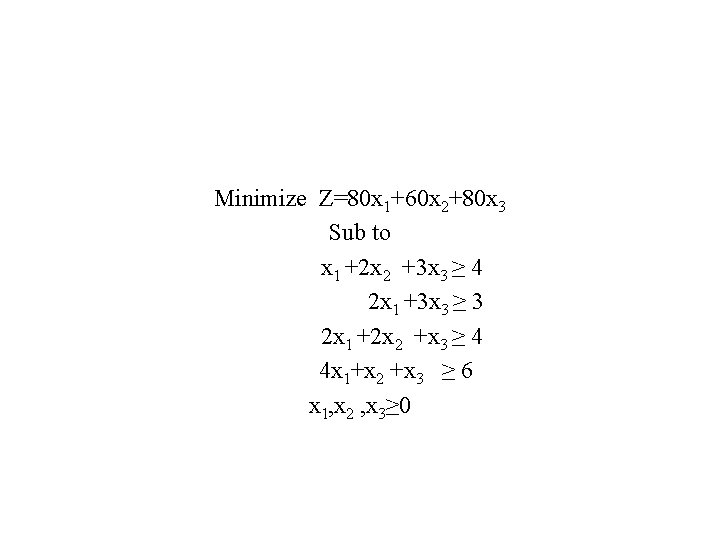
Minimize Z=80 x 1+60 x 2+80 x 3 Sub to x 1 +2 x 2 +3 x 3 ≥ 4 2 x 1 +3 x 3 ≥ 3 2 x 1 +2 x 2 +x 3 ≥ 4 4 x 1+x 2 +x 3 ≥ 6 x 1, x 2 , x 3≥ 0