
Dual Rods and Submuscular Rod Placement Reduce Complications
Dual Rods and Submuscular Rod Placement Reduce Complications and Unplanned Surgeries in the Growing Spine: Analysis of 910 Surgeries in 143 Patients Shay Bess, Behrooz Akbarnia, George Thompson, Paul Sponseller, David Skaggs, Suken Shah, Hazem Elsabaie, Oheneba Boachie-Adjei, Sarah Canale, Connie Poe-Kocher and the Growing Spine Study Group 2 nd International Congress Early Onset Scoliosis and Growing Spine Montreal November 2008
ICEOS 2 nd Annual Meeting Authors Disclosure Information Presenter Shay Bess Co-Authors Behrooz Akbarnia George Thompson Paul Sponseller David Skaggs Suken Shah Hazem Elsabaie Oheneba Boachie-Adjei Sarah Canale Connie Poe-Kocher Nuvasive (e), Pioneer (b), Alphatec (b), Stryker (d) De. Puy; A Johnson & Johnson Company (a, b, d, e), K 2 M (b, d, e), Nuvasive (a, b, c, d), Stryker (d), Ellipse Technologies, Inc (b), Allez Spine (c), Medtronic Sofamor Danek (a) De. Puy , A Johnson & Johnson Company (b, d), Synthes (b, d), Medtronic Sofamor Danek (a) , Zimmer (a) De. Puy , A Johnson & Johnson Company (a, b, d), Globus Medical (e) De. Puy Spine (d), Stryker (b, d), Medtronic (a, b, d) De. Puy Spine (a, b, e) No Relationships De. Puy Spine (a, d, e), Osteotech (a, b), K 2 M(a, b, e) Axial biotech (a) No Relationships (a) Grants/Research Support (b) Consultant (c) Stock/Shareholder (d) Speakers’ Bureau (e) Other Financial Support

Introduction • Treatment Scoliosis Growing Spine= Challenging • Observation – Curve progression – Arrest pulmonary development • Cast treatment – Skin breakdown – Inhibit chest wall development • Early Fusion – Inhibit trunk and thoracic development • Fusionless Technology – Allow thoracic and pulmonary development • Growing Rod Technique (GR) – Unacceptably high complication rates? Used with permission from Children's Hospital Los Angeles, Inc

Purpose: Materials and Methods • Evaluate Complications GR Treatment – Clinical – Radiographic • Minimum 2 yr F/U – Initial GR implant • Multi-center, Retrospective • Treatment Groups – Construct type • Single Rod (SI) • Dual rod (DU) – Implant placement • Subcutaneous (SQ) • Submuscular (MU) Used with permission from Children's Hospital Los Angeles, Inc
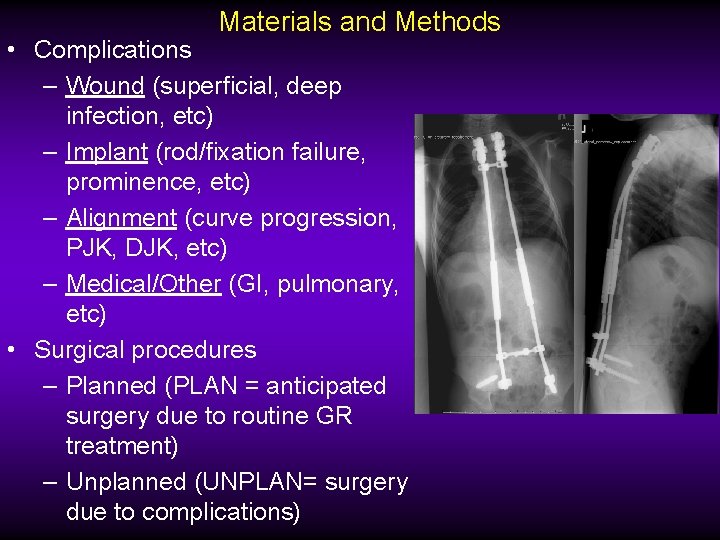
Materials and Methods • Complications – Wound (superficial, deep infection, etc) – Implant (rod/fixation failure, prominence, etc) – Alignment (curve progression, PJK, DJK, etc) – Medical/Other (GI, pulmonary, etc) • Surgical procedures – Planned (PLAN = anticipated surgery due to routine GR treatment) – Unplanned (UNPLAN= surgery due to complications)
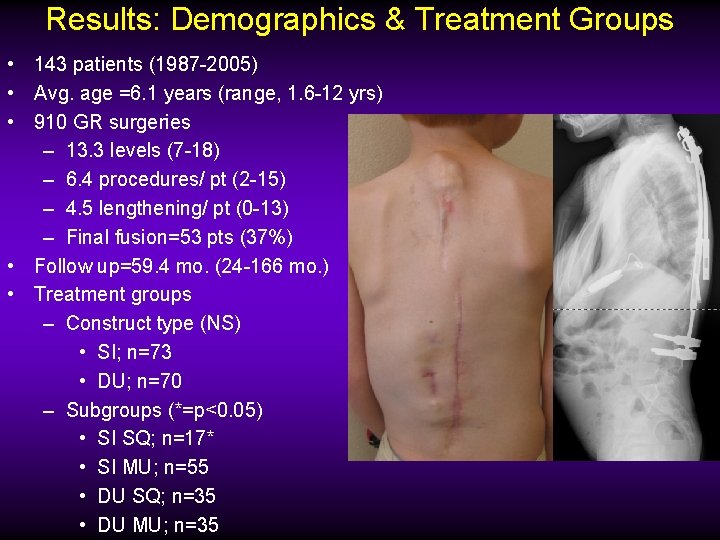
Results: Demographics & Treatment Groups • 143 patients (1987 -2005) • Avg. age =6. 1 years (range, 1. 6 -12 yrs) • 910 GR surgeries – 13. 3 levels (7 -18) – 6. 4 procedures/ pt (2 -15) – 4. 5 lengthening/ pt (0 -13) – Final fusion=53 pts (37%) • Follow up=59. 4 mo. (24 -166 mo. ) • Treatment groups – Construct type (NS) • SI; n=73 • DU; n=70 – Subgroups (*=p<0. 05) • SI SQ; n=17* • SI MU; n=55 • DU SQ; n=35 • DU MU; n=35

Results: Diagnosis

Results: Total Procedures and Complications Single vs. Dual Rod SI (n=73) DU (n=70) p value Total (n=143) 447; 6. 1 (3 -13) 463; 6. 6 (2 -15) NS 910; 6. 4 (2 -15) Total complications 94 83 NS 177 Total pts with complication 43 38 NS 81 59% 54% NS 57% Complications per patient (range) 1. 3 (0 -7) 1. 2 (0 -7) NS 1. 2 (0 -7) Complications per surgery 0. 21 0. 18 NS 0. 19 Total UNPLAN 42 32 NS 74 Total PLAN 405 431 NS 836 Ratio PLAN to UNPLAN 9. 6: 1 13. 5: 1 NS 11. 3: 1 Complications leading to UNPLAN 45% 38% NS 42% Total Surgeries; avg (range) Percent pts with complication
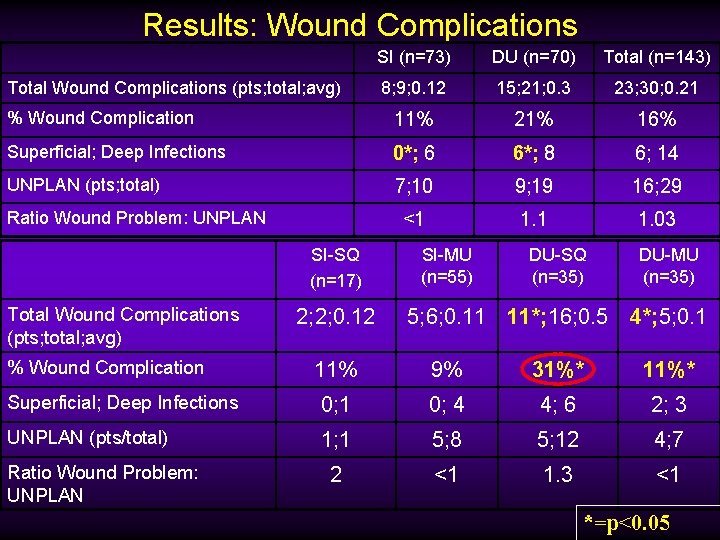
Results: Wound Complications SI (n=73) DU (n=70) Total (n=143) 8; 9; 0. 12 15; 21; 0. 3 23; 30; 0. 21 % Wound Complication 11% 21% 16% Superficial; Deep Infections 0*; 6 6*; 8 6; 14 UNPLAN (pts; total) 7; 10 9; 19 16; 29 <1 1. 03 Total Wound Complications (pts; total; avg) Ratio Wound Problem: UNPLAN SI-SQ (n=17) Total Wound Complications (pts; total; avg) % Wound Complication 2; 2; 0. 12 SI-MU (n=55) DU-SQ (n=35) DU-MU (n=35) 5; 6; 0. 11 11*; 16; 0. 5 4*; 5; 0. 1 11% 9% 31%* 11%* Superficial; Deep Infections 0; 1 0; 4 4; 6 2; 3 UNPLAN (pts/total) 1; 1 5; 8 5; 12 4; 7 2 <1 1. 3 <1 Ratio Wound Problem: UNPLAN *=p<0. 05
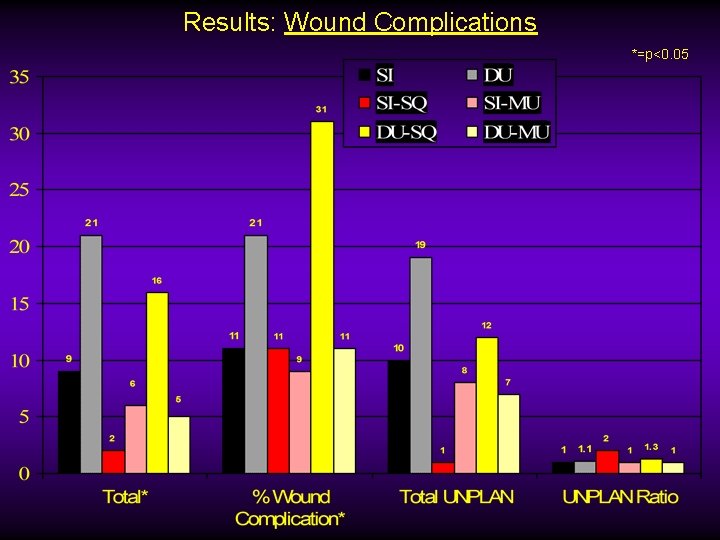
Results: Wound Complications *=p<0. 05
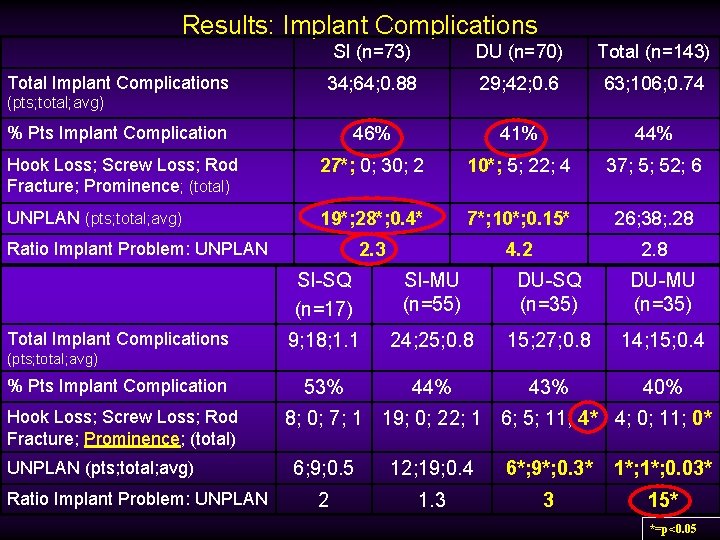
Results: Implant Complications SI (n=73) DU (n=70) Total (n=143) 34; 64; 0. 88 29; 42; 0. 6 63; 106; 0. 74 46% 41% 44% Hook Loss; Screw Loss; Rod Fracture; Prominence; (total) 27*; 0; 30; 2 10*; 5; 22; 4 37; 5; 52; 6 UNPLAN (pts; total; avg) 19*; 28*; 0. 4* 7*; 10*; 0. 15* 26; 38; . 28 2. 3 4. 2 2. 8 Total Implant Complications (pts; total; avg) % Pts Implant Complication Ratio Implant Problem: UNPLAN Total Implant Complications (pts; total; avg) % Pts Implant Complication Hook Loss; Screw Loss; Rod Fracture; Prominence; (total) UNPLAN (pts; total; avg) Ratio Implant Problem: UNPLAN SI-SQ (n=17) SI-MU (n=55) DU-SQ (n=35) DU-MU (n=35) 9; 18; 1. 1 24; 25; 0. 8 15; 27; 0. 8 14; 15; 0. 4 53% 44% 43% 40% 8; 0; 7; 1 19; 0; 22; 1 6; 5; 11; 4* 4; 0; 11; 0* 6; 9; 0. 5 12; 19; 0. 4 6*; 9*; 0. 3* 1*; 0. 03* 2 1. 3 3 15* *=p<0. 05
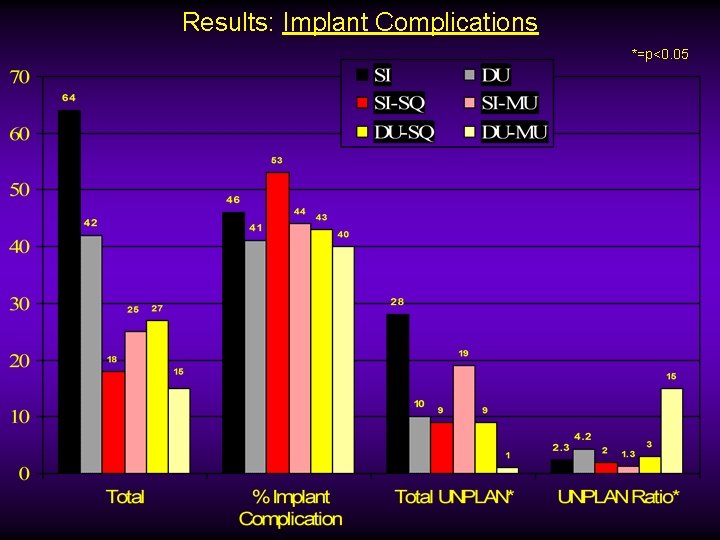
Results: Implant Complications *=p<0. 05
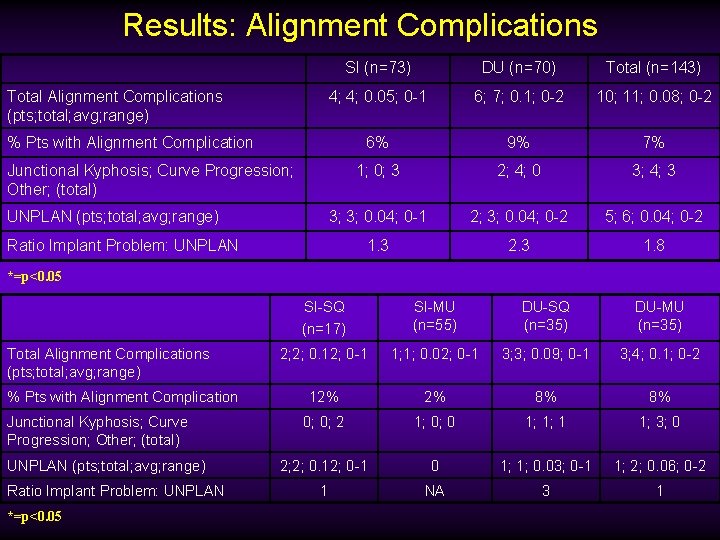
Results: Alignment Complications Total Alignment Complications (pts; total; avg; range) SI (n=73) DU (n=70) Total (n=143) 4; 4; 0. 05; 0 -1 6; 7; 0. 1; 0 -2 10; 11; 0. 08; 0 -2 6% 9% 7% 1; 0; 3 2; 4; 0 3; 4; 3 3; 3; 0. 04; 0 -1 2; 3; 0. 04; 0 -2 5; 6; 0. 04; 0 -2 1. 3 2. 3 1. 8 % Pts with Alignment Complication Junctional Kyphosis; Curve Progression; Other; (total) UNPLAN (pts; total; avg; range) Ratio Implant Problem: UNPLAN *=p<0. 05 Total Alignment Complications (pts; total; avg; range) % Pts with Alignment Complication Junctional Kyphosis; Curve Progression; Other; (total) UNPLAN (pts; total; avg; range) Ratio Implant Problem: UNPLAN *=p<0. 05 SI-SQ (n=17) SI-MU (n=55) DU-SQ (n=35) DU-MU (n=35) 2; 2; 0. 12; 0 -1 1; 1; 0. 02; 0 -1 3; 3; 0. 09; 0 -1 3; 4; 0. 1; 0 -2 12% 2% 8% 8% 0; 0; 2 1; 0; 0 1; 1; 1 1; 3; 0 2; 2; 0. 12; 0 -1 0 1; 1; 0. 03; 0 -1 1; 2; 0. 06; 0 -2 1 NA 3 1
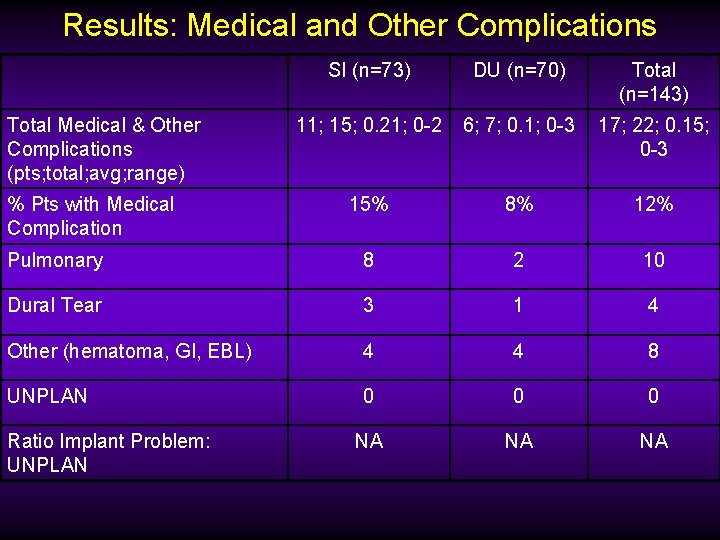
Results: Medical and Other Complications SI (n=73) DU (n=70) Total (n=143) 11; 15; 0. 21; 0 -2 6; 7; 0. 1; 0 -3 17; 22; 0. 15; 0 -3 15% 8% 12% Pulmonary 8 2 10 Dural Tear 3 1 4 Other (hematoma, GI, EBL) 4 4 8 UNPLAN 0 0 0 NA NA NA Total Medical & Other Complications (pts; total; avg; range) % Pts with Medical Complication Ratio Implant Problem: UNPLAN
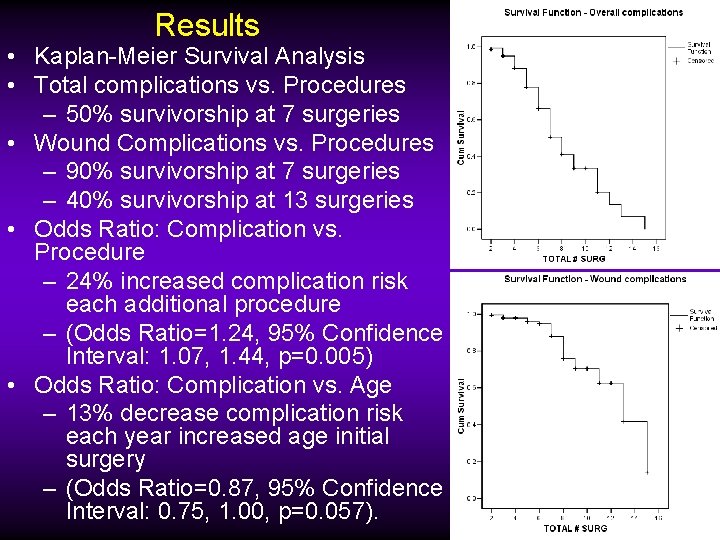
Results • Kaplan-Meier Survival Analysis • Total complications vs. Procedures – 50% survivorship at 7 surgeries • Wound Complications vs. Procedures – 90% survivorship at 7 surgeries – 40% survivorship at 13 surgeries • Odds Ratio: Complication vs. Procedure – 24% increased complication risk each additional procedure – (Odds Ratio=1. 24, 95% Confidence Interval: 1. 07, 1. 44, p=0. 005) • Odds Ratio: Complication vs. Age – 13% decrease complication risk each year increased age initial surgery – (Odds Ratio=0. 87, 95% Confidence Interval: 0. 75, 1. 00, p=0. 057).
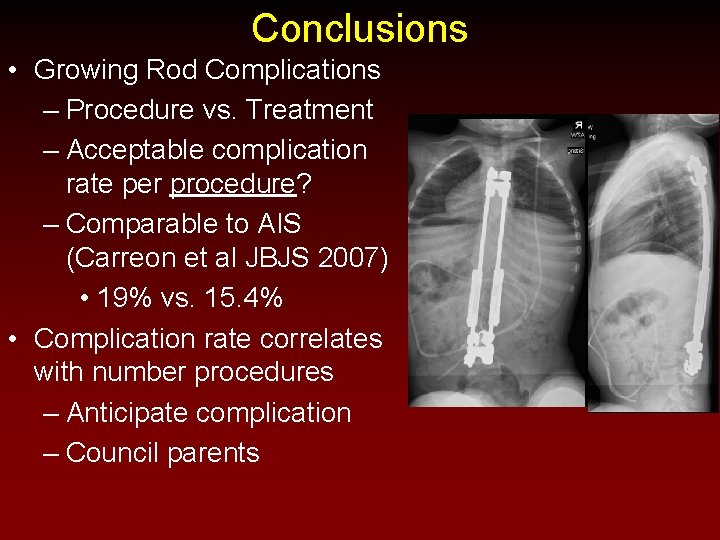
Conclusions • Growing Rod Complications – Procedure vs. Treatment – Acceptable complication rate per procedure? – Comparable to AIS (Carreon et al JBJS 2007) • 19% vs. 15. 4% • Complication rate correlates with number procedures – Anticipate complication – Council parents
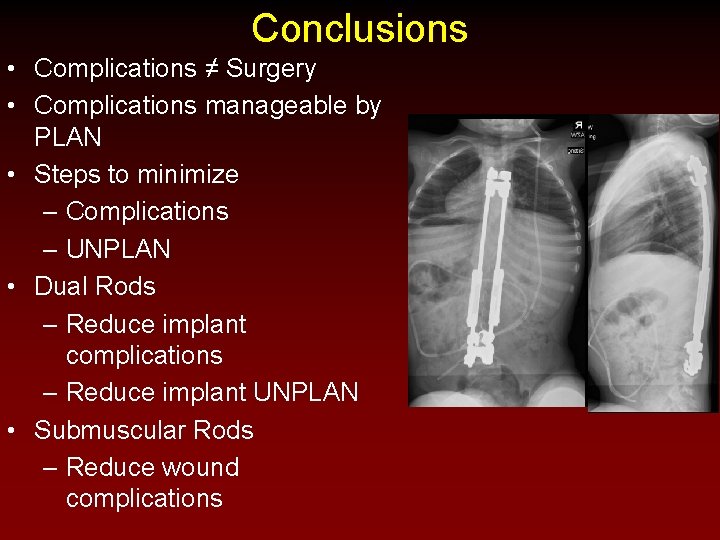
Conclusions • Complications ≠ Surgery • Complications manageable by PLAN • Steps to minimize – Complications – UNPLAN • Dual Rods – Reduce implant complications – Reduce implant UNPLAN • Submuscular Rods – Reduce wound complications
Thank You ICEOS 2 nd Annual Meeting Montreal November 2008
- Slides: 18