
Dual Readout Resolution v This time use samples
- Slides: 9
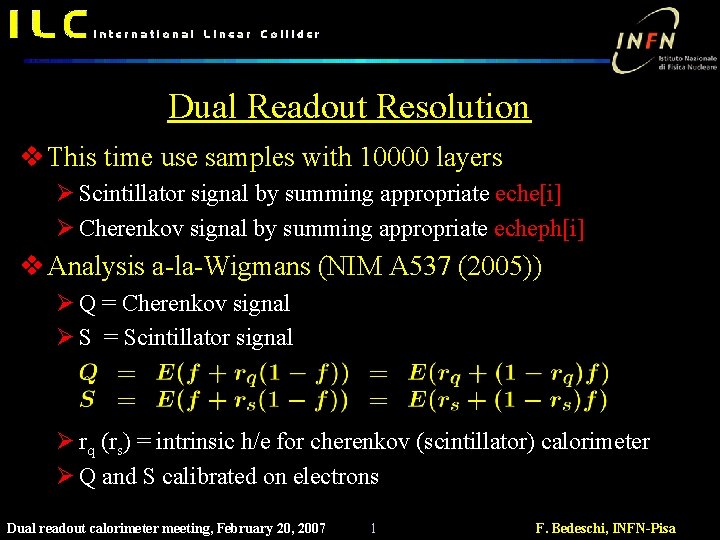
Dual Readout Resolution v This time use samples with 10000 layers Ø Scintillator signal by summing appropriate eche[i] Ø Cherenkov signal by summing appropriate echeph[i] v Analysis a-la-Wigmans (NIM A 537 (2005)) Ø Q = Cherenkov signal Ø S = Scintillator signal Ø rq (rs) = intrinsic h/e for cherenkov (scintillator) calorimeter Ø Q and S calibrated on electrons Dual readout calorimeter meeting, February 20, 2007 1 F. Bedeschi, INFN-Pisa
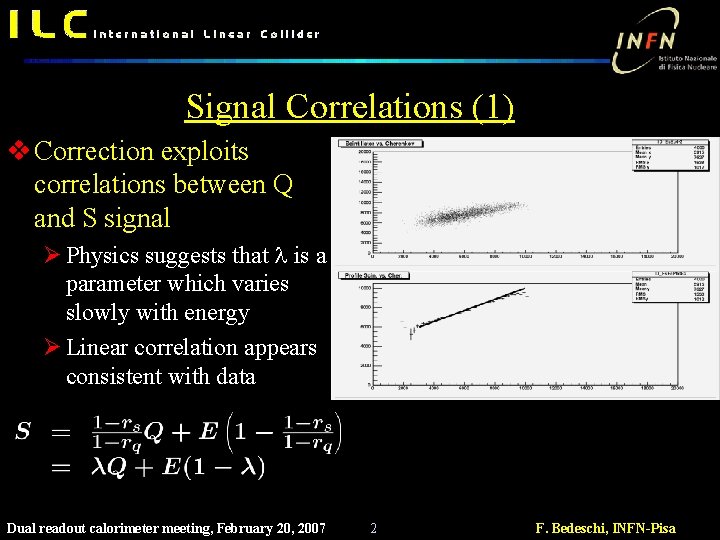
Signal Correlations (1) v Correction exploits correlations between Q and S signal Ø Physics suggests that is a parameter which varies slowly with energy Ø Linear correlation appears consistent with data Dual readout calorimeter meeting, February 20, 2007 2 F. Bedeschi, INFN-Pisa
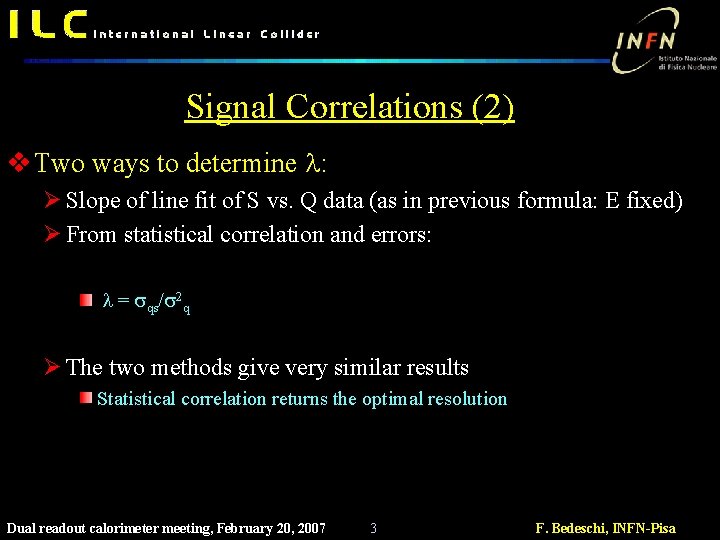
Signal Correlations (2) v Two ways to determine : Ø Slope of line fit of S vs. Q data (as in previous formula: E fixed) Ø From statistical correlation and errors: = qs/ 2 q Ø The two methods give very similar results Statistical correlation returns the optimal resolution Dual readout calorimeter meeting, February 20, 2007 3 F. Bedeschi, INFN-Pisa
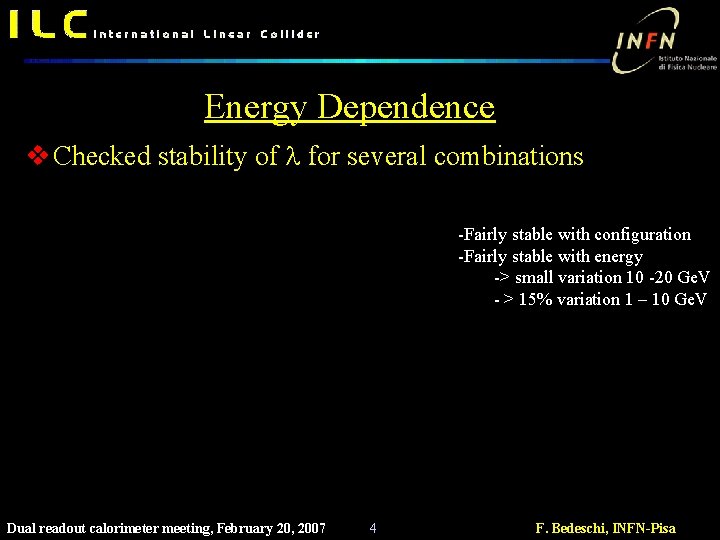
Energy Dependence v Checked stability of for several combinations -Fairly stable with configuration -Fairly stable with energy -> small variation 10 -20 Ge. V - > 15% variation 1 – 10 Ge. V Dual readout calorimeter meeting, February 20, 2007 4 F. Bedeschi, INFN-Pisa
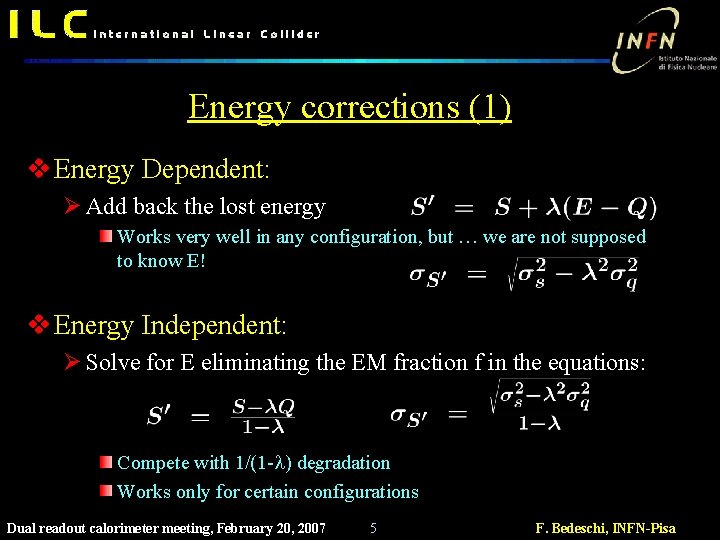
Energy corrections (1) v Energy Dependent: Ø Add back the lost energy Works very well in any configuration, but … we are not supposed to know E! v Energy Independent: Ø Solve for E eliminating the EM fraction f in the equations: Compete with 1/(1 - ) degradation Works only for certain configurations Dual readout calorimeter meeting, February 20, 2007 5 F. Bedeschi, INFN-Pisa
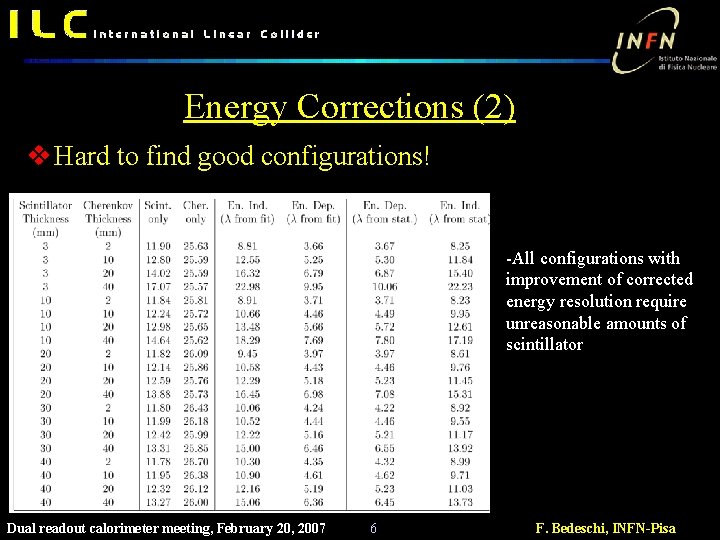
Energy Corrections (2) v Hard to find good configurations! -All configurations with improvement of corrected energy resolution require unreasonable amounts of scintillator Dual readout calorimeter meeting, February 20, 2007 6 F. Bedeschi, INFN-Pisa
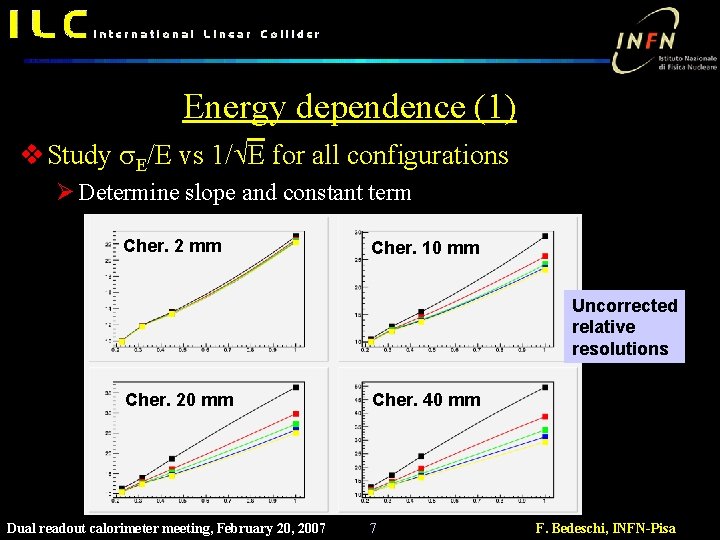
Energy dependence (1) v Study E/E vs 1/ E for all configurations Ø Determine slope and constant term Cher. 2 mm Cher. 10 mm Uncorrected relative resolutions Cher. 20 mm Dual readout calorimeter meeting, February 20, 2007 Cher. 40 mm 7 F. Bedeschi, INFN-Pisa
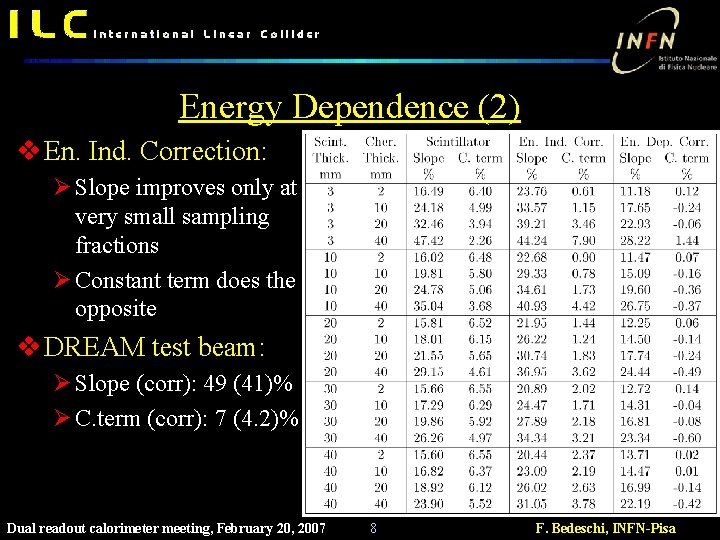
Energy Dependence (2) v En. Ind. Correction: Ø Slope improves only at very small sampling fractions Ø Constant term does the opposite v DREAM test beam: Ø Slope (corr): 49 (41)% Ø C. term (corr): 7 (4. 2)% Dual readout calorimeter meeting, February 20, 2007 8 F. Bedeschi, INFN-Pisa
Conclusions v Found two classes of energy corrections which compensate f. EM fluctuations v Only one is energy independent Ø Works only for some configurations, typically requiring large amounts of scintillator Ø Cannot find a configuration which performs as DREAM with only 2% scintillator sampling fraction v What is the magic of DREAMs? Dual readout calorimeter meeting, February 20, 2007 9 F. Bedeschi, INFN-Pisa