
Dual Evolution for Geometric Reconstruction Huaiping Yang FSP
![Implicit curve evolution l We use implicit T-spline curves [Sederberg 2003], and is the](https://slidetodoc.com/presentation_image_h2/c8e2654d42b93c26122b8ac006785910/image-9.jpg "Implicit curve evolution l We use implicit T-spline curves [Sederberg 2003], and is the")

- Slides: 24
Dual Evolution for Geometric Reconstruction Huaiping Yang (FSP Project S 09202) Johannes Kepler University of Linz 1 st FSP-Meeting in Graz, Nov. 23 -25, 2005
Overview l l l l Introduction Outline of our method Evolution equation Synchronization of dual representations Refine the evolution result Experimental Results Conclusions
Introduction l l Geometric reconstruction from discrete point data sets has various applications: Two types of representations: l l l Parametric curves/surfaces. Implicit curves/surfaces We use a combination of both representaions. l Improved handling of both topology changes and shape constraints
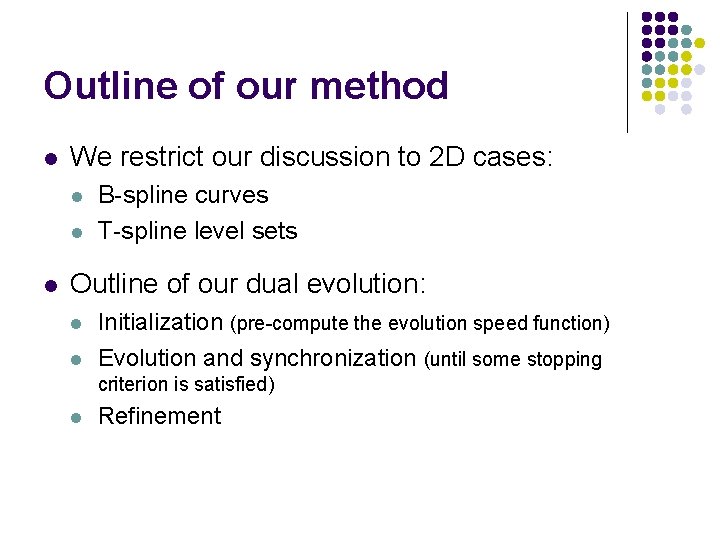
Outline of our method l We restrict our discussion to 2 D cases: l l l B-spline curves T-spline level sets Outline of our dual evolution: l l Initialization (pre-compute the evolution speed function) Evolution and synchronization (until some stopping criterion is satisfied) l Refinement
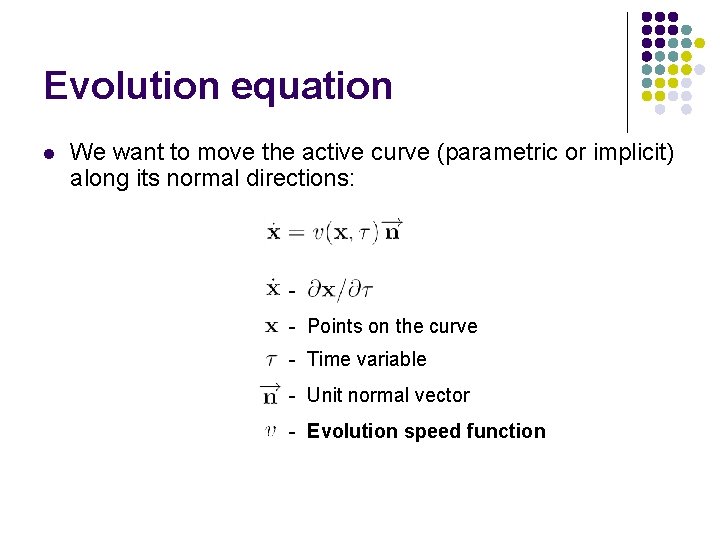
Evolution equation l We want to move the active curve (parametric or implicit) along its normal directions: - Points on the curve - Time variable - Unit normal vector - Evolution speed function
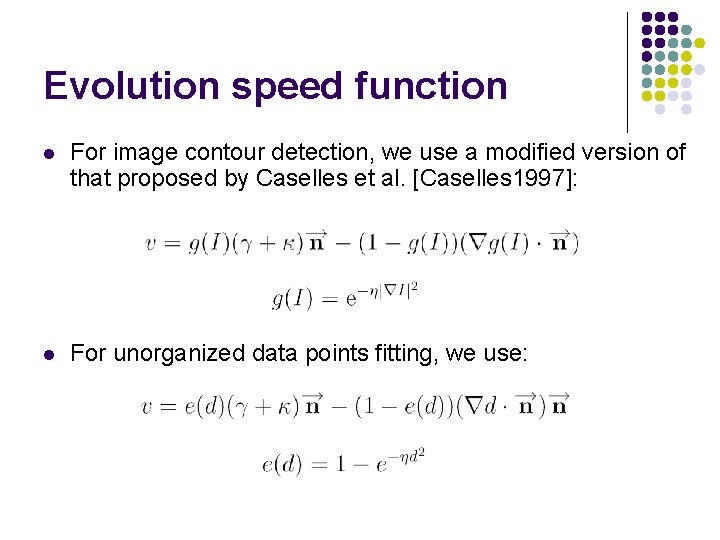
Evolution speed function l For image contour detection, we use a modified version of that proposed by Caselles et al. [Caselles 1997]: l For unorganized data points fitting, we use:
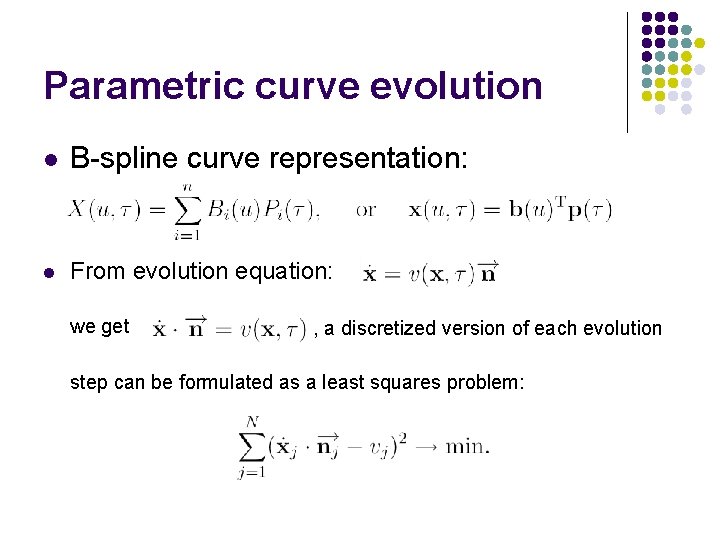
Parametric curve evolution l B-spline curve representation: l From evolution equation: we get , a discretized version of each evolution step can be formulated as a least squares problem:
Implicit curve evolution l We use implicit T-spline curves [Sederberg 2003], and is the T-spline function, where knot vectors , are cubic B-spline basis functions associated with ,
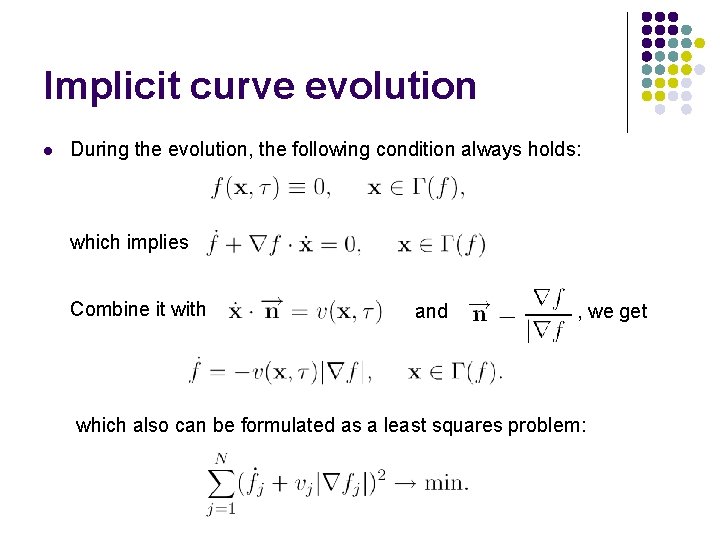
Implicit curve evolution l During the evolution, the following condition always holds: which implies Combine it with and , we get which also can be formulated as a least squares problem:
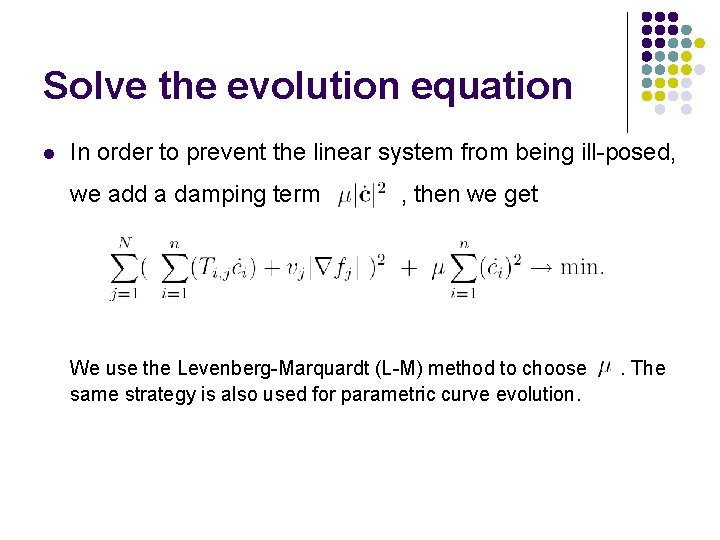
Solve the evolution equation l In order to prevent the linear system from being ill-posed, we add a damping term , then we get We use the Levenberg-Marquardt (L-M) method to choose same strategy is also used for parametric curve evolution. . The
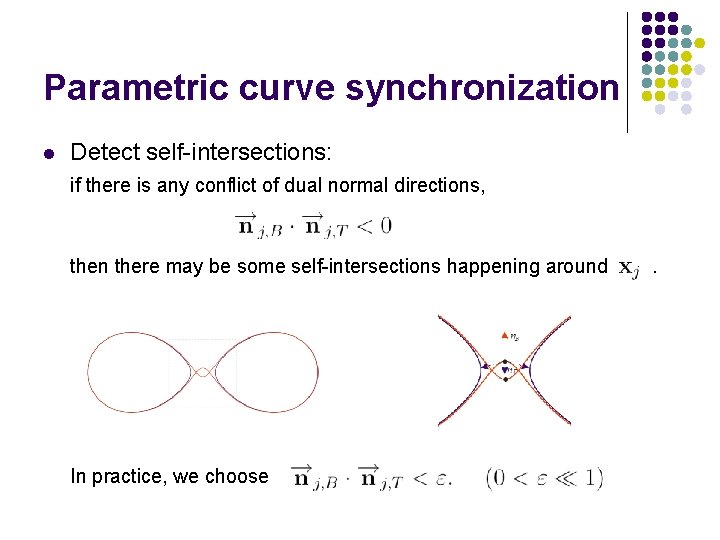
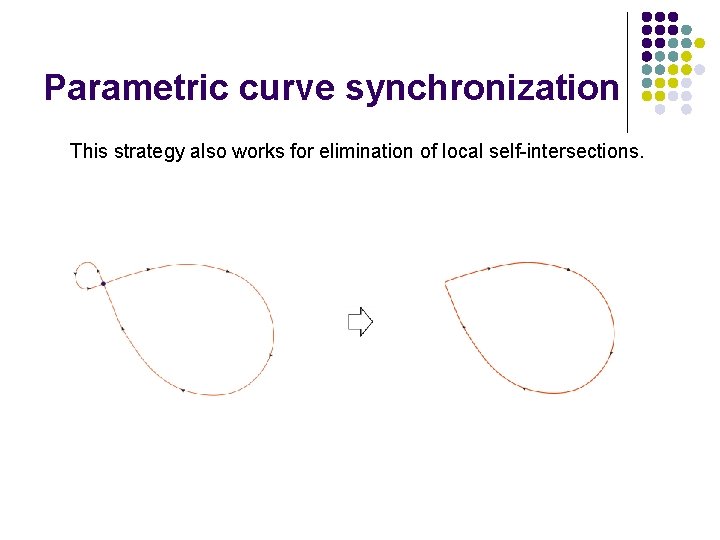
Parametric curve synchronization l Detect self-intersections: if there is any conflict of dual normal directions, then there may be some self-intersections happening around In practice, we choose .
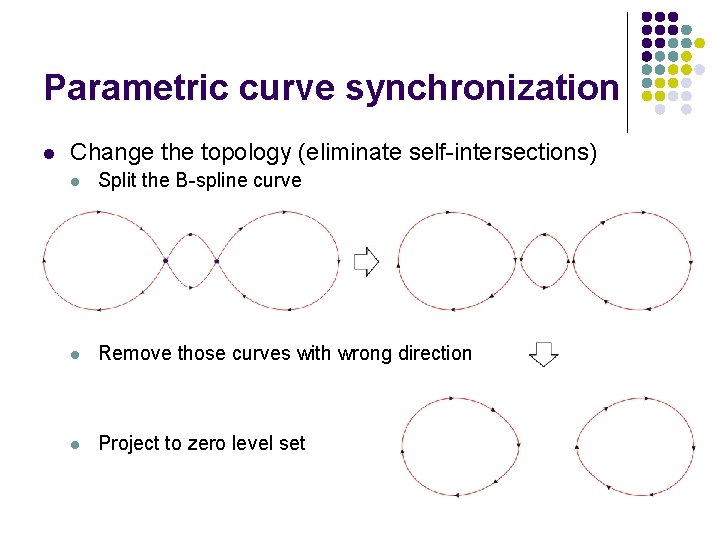
Parametric curve synchronization l Change the topology (eliminate self-intersections) l Split the B-spline curve l Remove those curves with wrong direction l Project to zero level set
Parametric curve synchronization This strategy also works for elimination of local self-intersections.
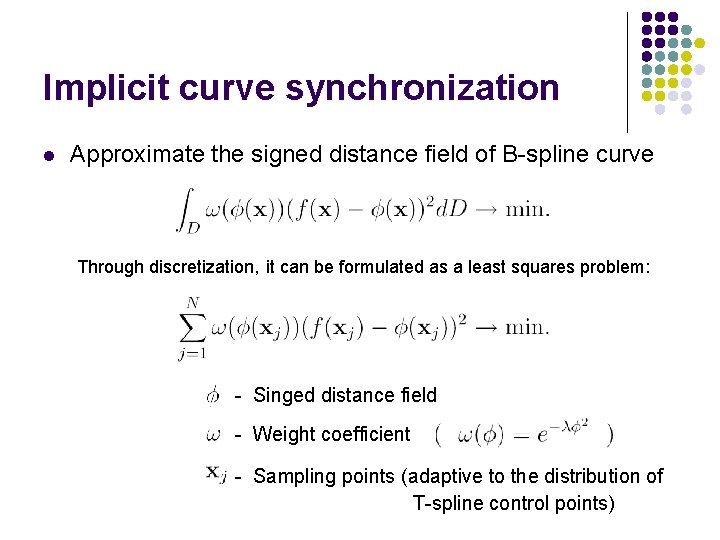
Implicit curve synchronization l Approximate the signed distance field of B-spline curve Through discretization, it can be formulated as a least squares problem: - Singed distance field - Weight coefficient - Sampling points (adaptive to the distribution of T-spline control points)
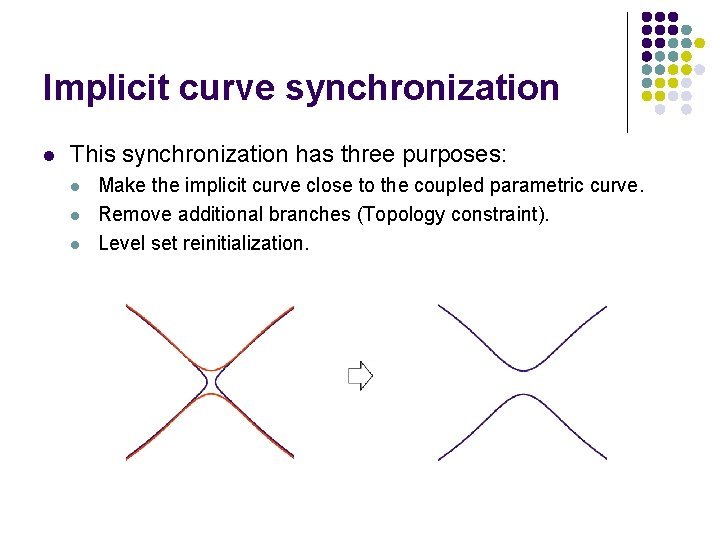
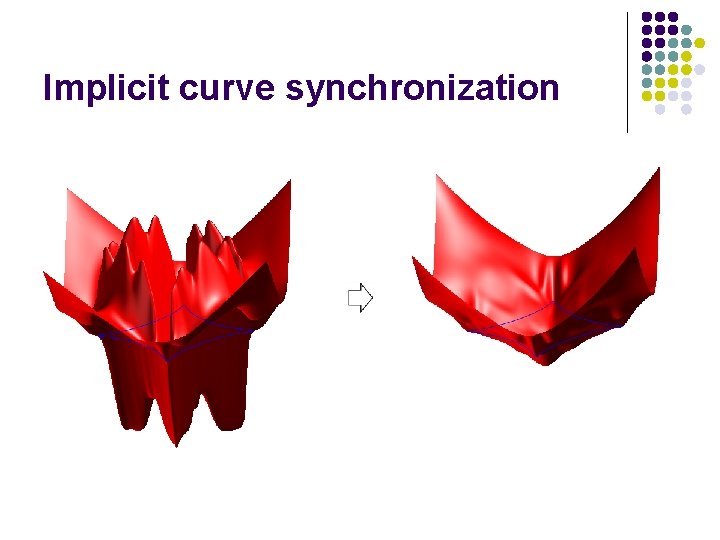
Implicit curve synchronization l This synchronization has three purposes: l l l Make the implicit curve close to the coupled parametric curve. Remove additional branches (Topology constraint). Level set reinitialization.
Implicit curve synchronization
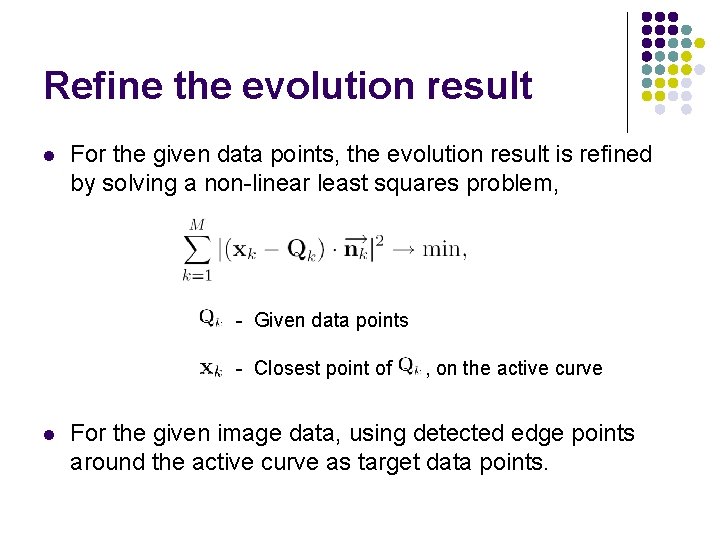
Refine the evolution result l For the given data points, the evolution result is refined by solving a non-linear least squares problem, - Given data points - Closest point of l , on the active curve For the given image data, using detected edge points around the active curve as target data points.
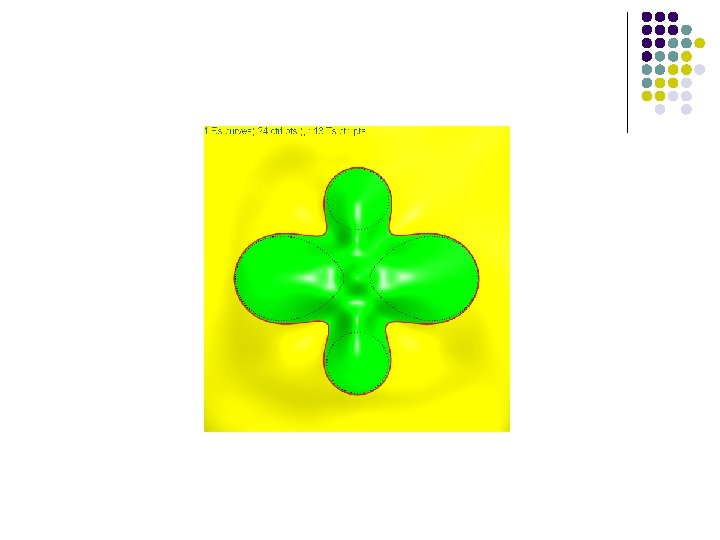
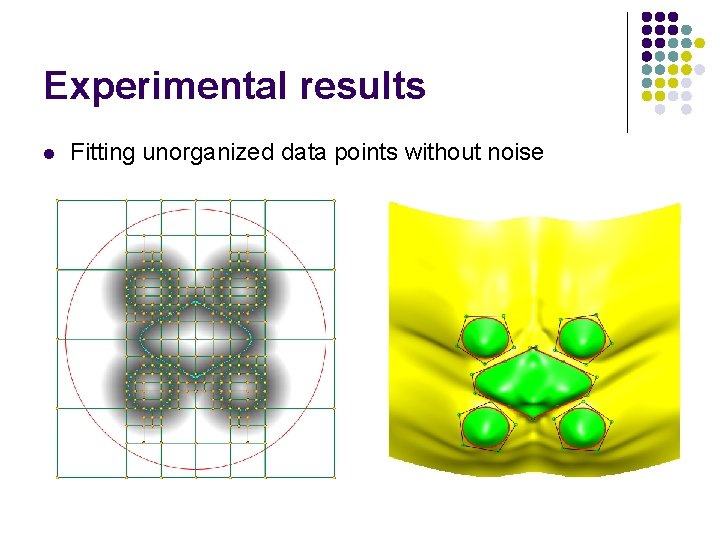
Experimental results l Fitting unorganized data points without noise
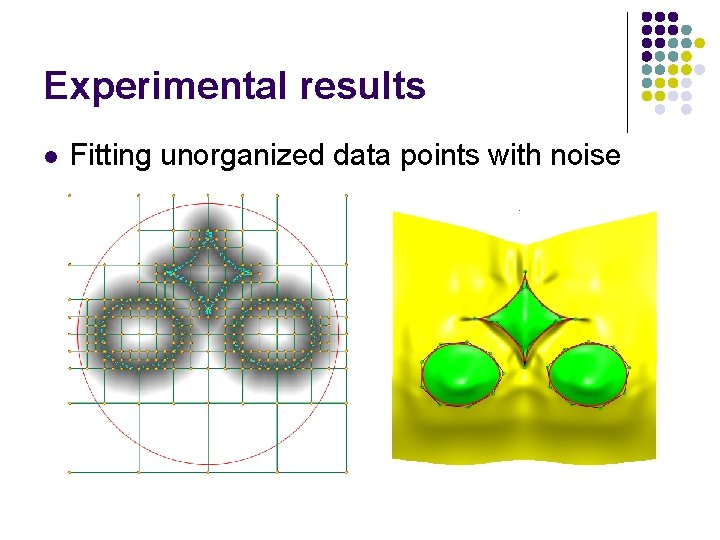
Experimental results l Fitting unorganized data points with noise
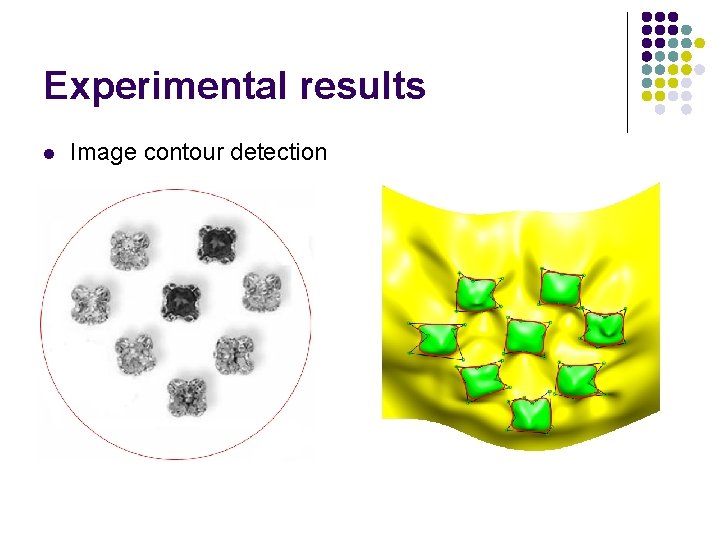
Experimental results l Image contour detection
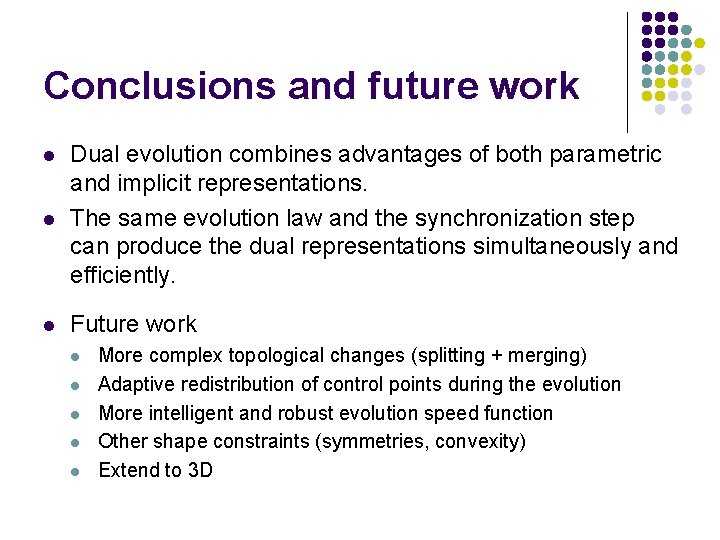
Conclusions and future work l Dual evolution combines advantages of both parametric and implicit representations. The same evolution law and the synchronization step can produce the dual representations simultaneously and efficiently. l Future work l l l More complex topological changes (splitting + merging) Adaptive redistribution of control points during the evolution More intelligent and robust evolution speed function Other shape constraints (symmetries, convexity) Extend to 3 D
References l V. Caselles, R. Kimmel, and G. Sapiro, “Geodesic active contours”, International Journal of Computer Vision, 22(1), 1997, pp. 61 -79 l H. Pottmann, S. Leopoldseder and M. Hofer, “Approximation with Active B-spline curves and surfaces”, Proc. Pacific Graphics, 2002, pp. 8 -25 l W. Wang, H. Pottmann and Y. Liu, “Fitting B-spline curves to point clouds by squared distance minimization”, ACM Transactions on Graphics, to appear, 2005 l T. W. Sederberg, J. Zheng, A. Bakenov and A. Nasri, “T-splines and T-NURCCS”, ACM Transactions on Graphics, 22(3), 2003, pp. 477484 l J. Nocedal and S. J. Wright, “Numerical optimization”, Springer Verlag, 1999
Thanks!