
Dual Enrollment Webinars High School Partners know their
Dual Enrollment Webinars
High School Partners know their students and their systems, Columbia knows our programs and classes… let’s help inform each other for the benefit of our shared dually-enrolled students
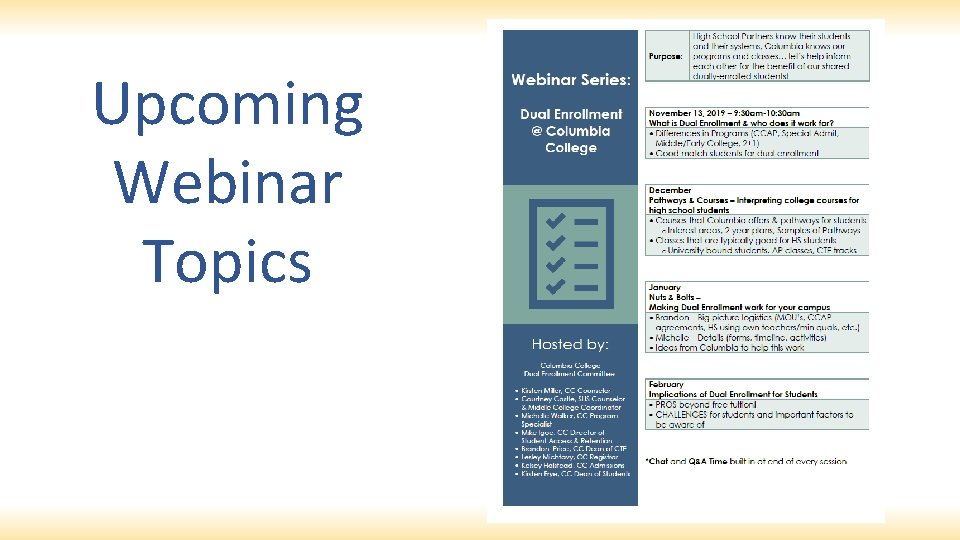
Upcoming Webinar Topics
We have resources available to support your dual enrollment efforts
Dual Enrollment Contacts: Michelle Walker, CC Program Specialist Dual Enrollment — walkerm@yosemite. edu, 209 -588 -5045 CCAP Questions, paperwork, coordination Kirsten Miller, CC Counselor millerk@yosemite. edu, 209 -588 -2155 Dual enrollment student advising, placement, educational planning. Courtney Castle, SHS Counselor, Middle College Coordinator, and CC Adjunct Counselor ccastle@sonorahs. k 12. ca. us, 209 -532 -5511 Ext 5119 Support for other high schools developing and implementing programs
Dual Enrollment Contacts: Kelsey Halstead, CC Admissions— halsteadke@yosemite. edu, 209 -588 -5231 Lesley Michtavy, CC Registrar michtavyl@yosemite. edu, 209 -588 -5232 Transcripts, admissions information, student holds, registration Mike Igoe, CC Director of Student Access & Retention— igoem@yosemite. edu, 209 -588 -5236 On boarding (applications, orientation, etc. )
Dual Enrollment Contacts: Kirsten Frye, CC Dean of Students— fryek@yosemite. edu, 209 -588 -5144 Special petitions, oversees CC Counseling and Outreach programs Brandon Price, CC Dean of CTE— priceb@yosemite. edu, 209 588 -5079 Dual Enrollment Program, faculty hiring, course scheduling
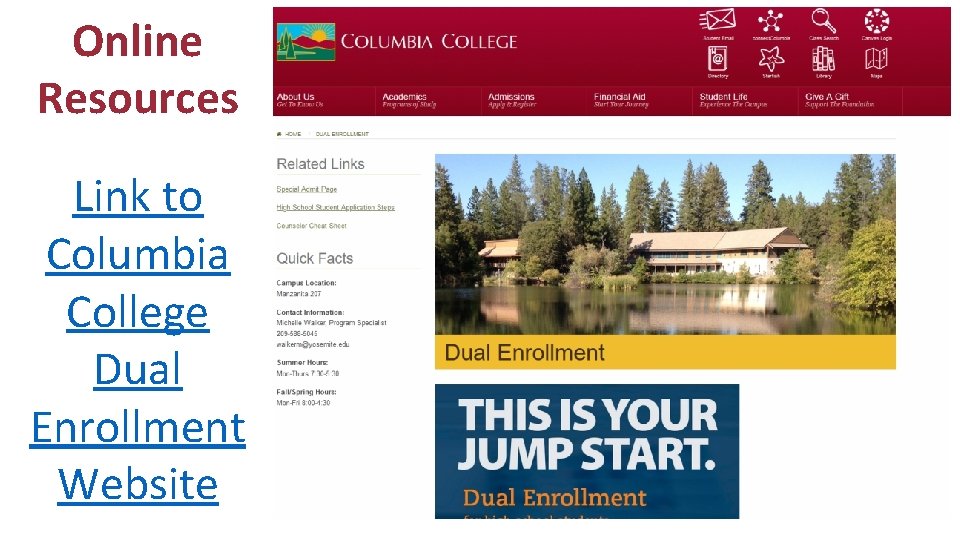
Online Resources Link to Columbia College Dual Enrollment Website
Online Resources Link to Dual Enrollment Tool Kit Dual Enrollment Toolkit The Dual Enrollment Toolkit is a resource for secondary and community college partners. This resource will highlight and describe promising practices related to providing historically underrepresented high school students with opportunities to earn college credits at California Community Colleges (CCC) while they complete the requirements for their high school diplomas. The intent is to provide specific, concrete guidance and evidence to interested college administrators, faculty and staff who are planning to build partnerships with K 12 districts to support dual enrollment efforts on their campuses and/or within their districts.
What is Dual Enrollment and Who Does it Work For?
What is Dual Enrollment? Dual enrollment offers students an opportunity to complete college-level coursework to earn college credits while they are pursuing their high school diploma.
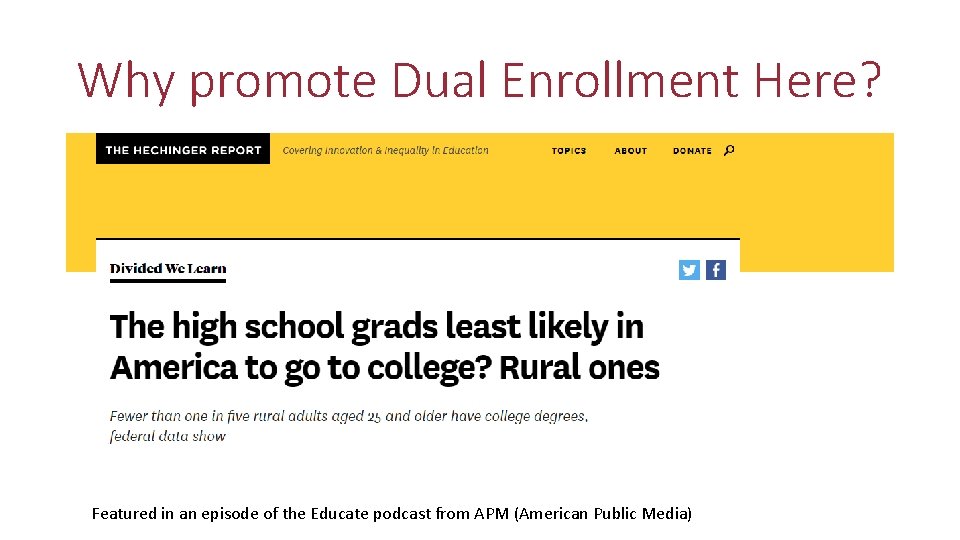
Why promote Dual Enrollment Here? Featured in an episode of the Educate podcast from APM (American Public Media)
Why Dual Enrollment? Dual enrollment programs may offer a range of advantages to students including: • A chance to complete high school and college credits at the same time; • An introduction to and preparation for college life, expectations, and requirements;
Why Dual Enrollment? • A smoother transition from high school to college; • The ability to explore various careers and majors before enrolling in college full-time; • An opportunity to address skill gaps and improve study skills and academic knowledge before becoming a full-time college student;
Why Dual Enrollment? • Confidence in one’s ability to do college-level work and successfully pursue a postsecondary credential; • An accelerated pathway through college that saves students time and money
Does Dual Enrollment Work? • In fall of 2019 Columbia College had approximately 400 students who were dual enrolled. Why? • Dual enrolled students are more likely to go to college, have higher persistence, and higher completion rates than their peers.
Dual Enrollment at Columbia College Middle 2+2 College and College Articulation Career Access Pathway (CCAP) Partnership Agreements
Special Admits Columbia College may admit students who are 14 years of age or older who would benefit from advanced scholastic or vocational work. To be eligible for admission, a student must be in good standing with the school in which he/she is enrolled and may not enroll in more than 11 units in any term. All applicants must submit a: • Columbia College Admissions Application • Fee Waiver Application • High School Petition for Advanced Admissions • Health Services Consent Form http: //www. gocolumbia. edu/admissions/highschoolstudents. php
Early and Middle College • ECHS are small, autonomous schools that blend high school and college into a coherent educational program. The legislation provides that a minimum school day for an ECHS student is 180 minutes • MCHS are secondary schools located on a college campus. These schools offer challenging academic programs designed to serve highpotential, high-risk students. The legislation provides that a minimum school day for a MCHS student is 180 minutes
Early College • California Education Code (EC)Section 11302 declares that Early College High Schools (ECHS) are innovative partnerships between charter or noncharter public secondary schools and a local community college, the California State University, or the University of California that allow pupils to earn a high school diploma and up to two years of college credit in four years or less. ECHS are small, autonomous schools that blend high school and college into a coherent educational program. • ECHS facilitate a greater participation of at-risk, low-income, and students of color in college level courses. ECHS potentially decrease high school drop-out rates while increasing students’ access to post-secondary education. Students are rewarded for hard work by the opportunity to accelerate at typically minor cost to the student.
Early College • ECHS operated by school districts must offer at least 180 days of instruction per year. All students in grades 9 -12 must be offered at least 64, 800 instructional minutes each year. In addition, students must be scheduled for at least the minimum school day in order for a day to count as a day of instruction. EC Section 46146. 5 exempts an ECHS operated by school districts from the 240 -minute minimum school day requirement for students that are concurrently enrolled. The legislation provides that a minimum school day for an ECHS student is 180 minutes if the student is a special part-time student enrolled in a community college under specified provisions, or the student is enrolled in grades 11 or 12 and is also enrolled part-time in classes at California State University or University of California campuses.
Middle College • California Education Code(EC), Section 11300 declares that Middle College High Schools (MCHS) have proven to be a highly effective collaborative effort between local school districts and community colleges. • MCHS are secondary schools located on a college campus. These schools offer challenging academic programs designed to serve highpotential, high-risk students. MCHS feature effective support services, small class size, and the opportunity for students to concurrently take some college classes at typically minor cost to the student.
Middle College MCHS operated by school districts must offer at least 180 days of instruction per year. All students in grades 9 -12 must be offered at least 64, 800 instructional minutes each year. In addition, students must be scheduled for at least the minimum school day in order for a day to count as a day of instruction. EC Section 46146. 5 exempts a MCHS operated by school districts from the 240 -minute minimum school day requirement for students that are concurrently enrolled. The legislation provides that a minimum school day for a MCHS student is 180 minutes if the student is a special part-time student enrolled in a community college under specified provisions, or the student is enrolled in grades 11 or 12 and is also enrolled part-time in classes at California State University or University of California campuses
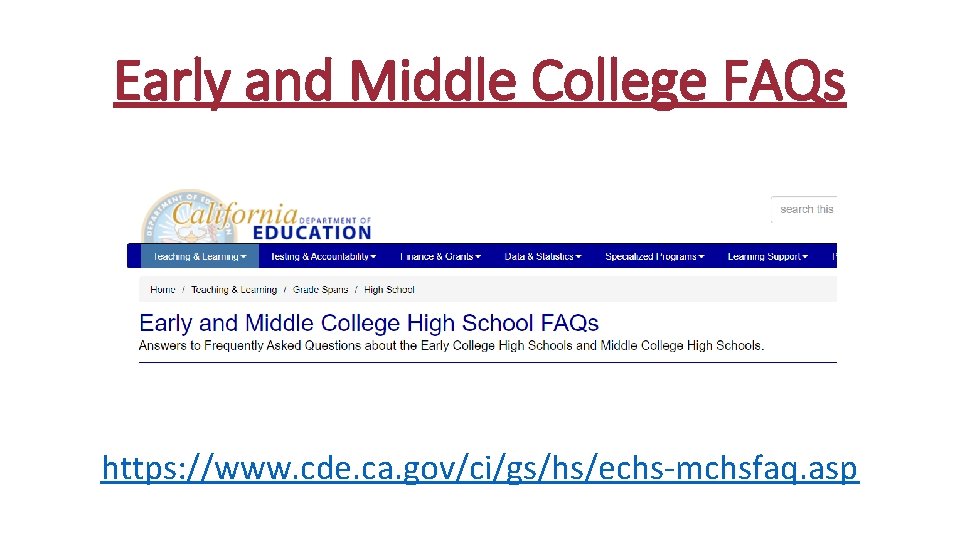
Early and Middle College FAQs https: //www. cde. ca. gov/ci/gs/hs/echs-mchsfaq. asp
CCAP agreements College and Career Access Pathways (CCAP) partnership agreements enable high school students to take college courses on the high school campus during the regular school day. (AB 288) “… can provide numerous benefits, such as reducing the number of high school dropouts, increasing the number of community college students who transfer and complete a degree, shortening the time to completion of educational goals, and improving the level of preparation of students to successfully complete for credit, college level courses. ”
2+2 Articulation 2+2 articulation is designed to help students make a smooth transition from high school to college without experiencing duplication in learning. Students successfully completing an articulated course while attending high school can, upon enrolling at Columbia College, be awarded college units for that course and are released from pre-requisite requirements in sequential courses.
Considerations CCAP programs were designed to encourage students who might not otherwise attend college to do so, selection processes need to be designed with this in mind. Which students are good candidates for dual enrollment? How do you promote success of dual enrolled students?
Thank You!
Dual Enrollment Resources Dual enrollment toolkit: http: //www. careerladdersproject. org/ccccode/
Dual Enrollment Resources Toolkit Includes: • Dual Enrollment and Assembly Bill 288 (CCAP) – Legal Opinion 16 -02 • AB 288 College and Career Access Pathways (CCAP) Partnership Agreement Apportionment Eligibility Checklist for Community College Districts • Frequently Asked Questions • Dual Enrollment: Considerations for AB 288 Agreements and Non-AB 288 Partnership • AB 288 Partnership Agreement Framework • Comparison of Non-AB 288 Agreements and AB 288 Partnership Agreements for Dual Enrollment • Legal Table – California Education Codes and State Active Legislation Influencing Dual Enrollment as of January 26, 2016
- Slides: 30