
Dual Eligibility Coordinating Medicare Medicaid Benefits Bill Mc
Dual Eligibility Coordinating Medicare & Medicaid Benefits Bill Mc. Kendree JD, MPA William. Mc. Kendree@phbsp. org 412 -266 -8322
This presentation includes: § Basic information about how Medicare works – its function, characteristics and vocabulary § The concept of dual eligibility - individuals who are eligible for both Medicare and Medicaid – and coordination of these benefits in accessing healthcare services § The impact of CHC on the utilization of Medicaid coverage by dual eligible beneficiaries 2

Medicare 3
Medicare is a federal government program that provides health care coverage for qualified individuals Administered by- Centers for Medicare & Medicaid Services Enrollment is through- Social Security Administration (SSA) or Railroad Retirement Board (RRB) railroad retirees 4
Medicare • Fee for Service payment system • Use Red, White & Blue Medicare Card as actual insurance card • May go to any provider that accepts Medicare • Deductibles & Coinsurances Apply • beneficiaries purchase additional insurance to cover these costs 5
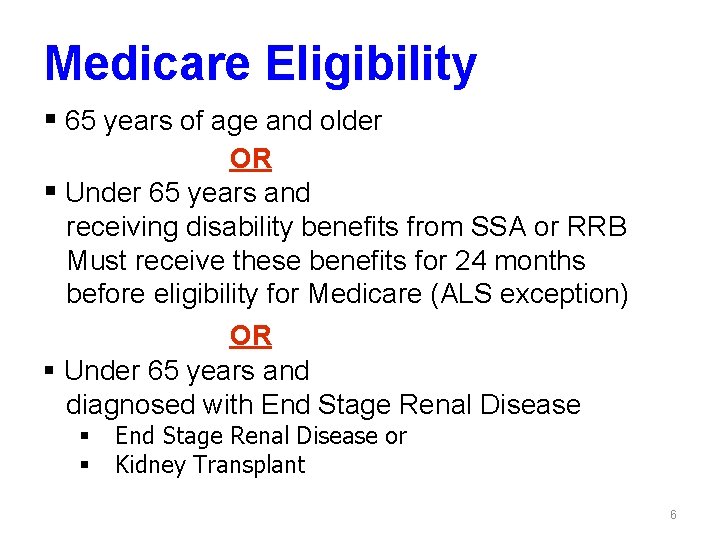
Medicare Eligibility § 65 years of age and older OR § Under 65 years and receiving disability benefits from SSA or RRB Must receive these benefits for 24 months before eligibility for Medicare (ALS exception) OR § Under 65 years and diagnosed with End Stage Renal Disease § § End Stage Renal Disease or Kidney Transplant 6
Medicare has multiple parts, each of which covers different parts of health care 7
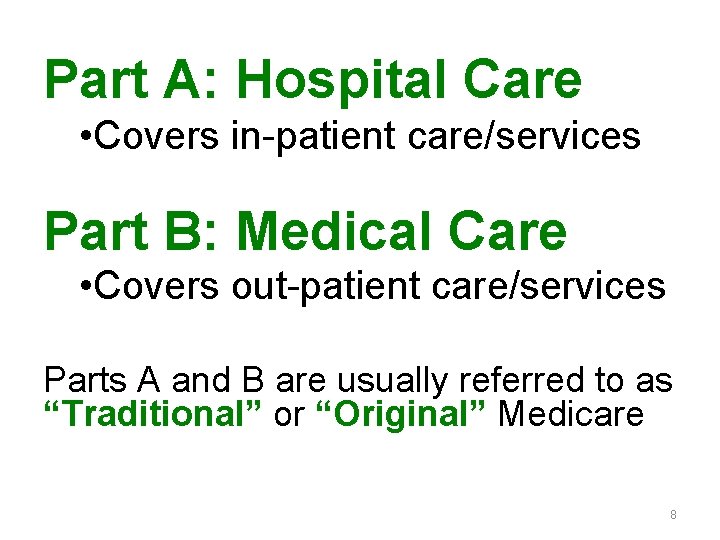
Part A: Hospital Care • Covers in-patient care/services Part B: Medical Care • Covers out-patient care/services Parts A and B are usually referred to as “Traditional” or “Original” Medicare 8
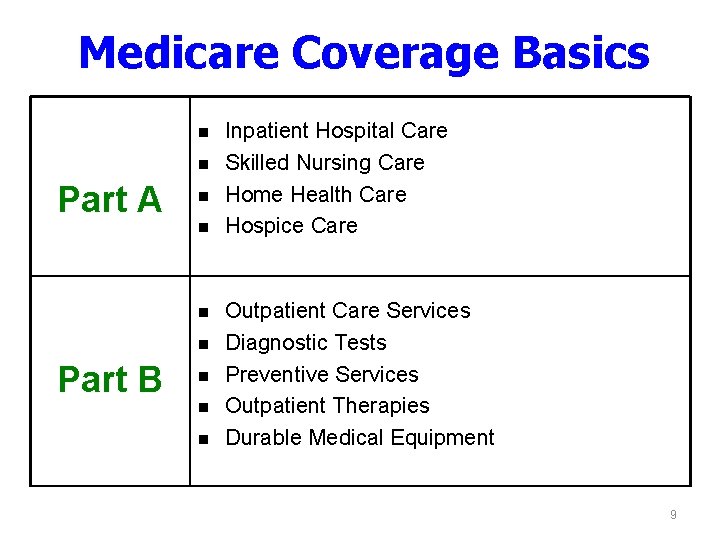
Medicare Coverage Basics n n Part A n n Part B n n n Inpatient Hospital Care Skilled Nursing Care Home Health Care Hospice Care Outpatient Care Services Diagnostic Tests Preventive Services Outpatient Therapies Durable Medical Equipment 9
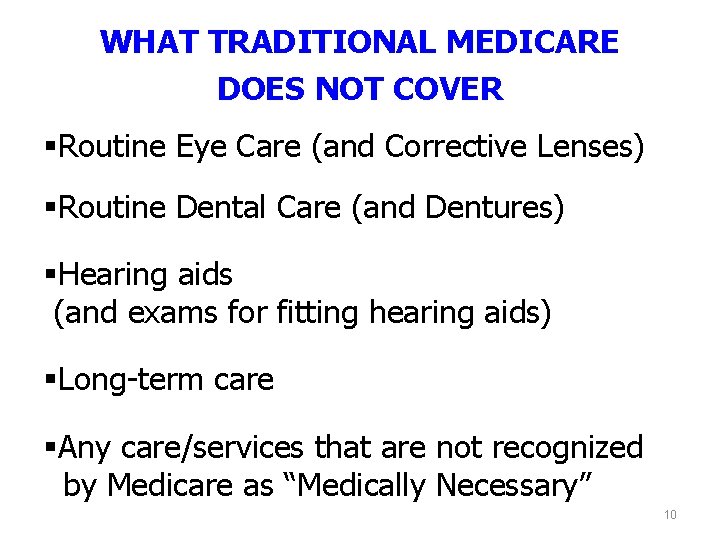
WHAT TRADITIONAL MEDICARE DOES NOT COVER §Routine Eye Care (and Corrective Lenses) §Routine Dental Care (and Dentures) §Hearing aids (and exams for fitting hearing aids) §Long-term care §Any care/services that are not recognized by Medicare as “Medically Necessary” 10
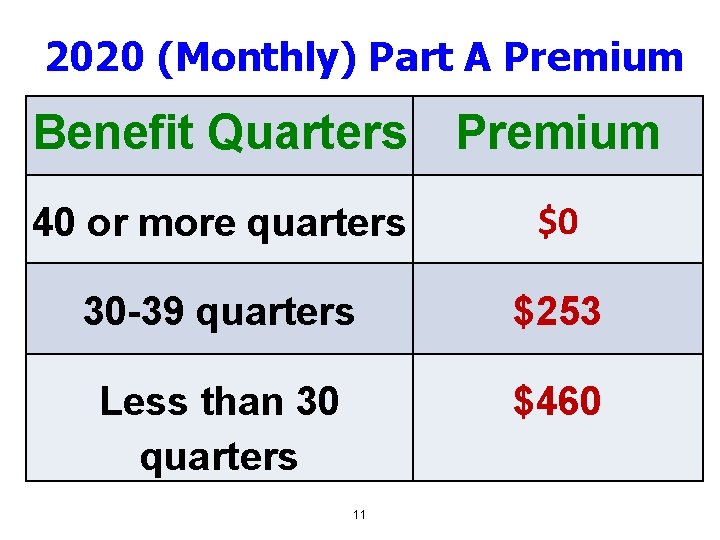
2020 (Monthly) Part A Premium Benefit Quarters Premium 40 or more quarters $0 30 -39 quarters $253 Less than 30 quarters $460 11
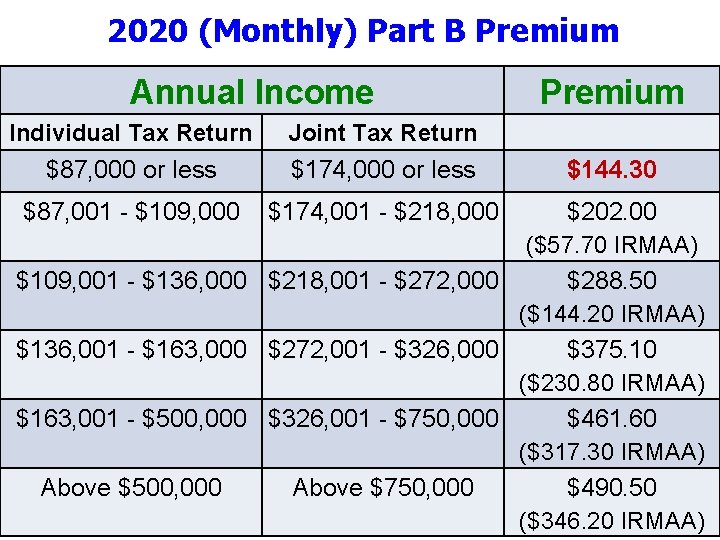
2020 (Monthly) Part B Premium Annual Income Individual Tax Return Joint Tax Return $87, 000 or less $174, 000 or less $87, 001 - $109, 000 $174, 001 - $218, 000 Premium $144. 30 $202. 00 ($57. 70 IRMAA) $109, 001 - $136, 000 $218, 001 - $272, 000 $288. 50 ($144. 20 IRMAA) $136, 001 - $163, 000 $272, 001 - $326, 000 $375. 10 ($230. 80 IRMAA) $163, 001 - $500, 000 $326, 001 - $750, 000 $461. 60 ($317. 30 IRMAA) Above $500, 000 Above $750, 000 $490. 50 ($346. 20 IRMAA)
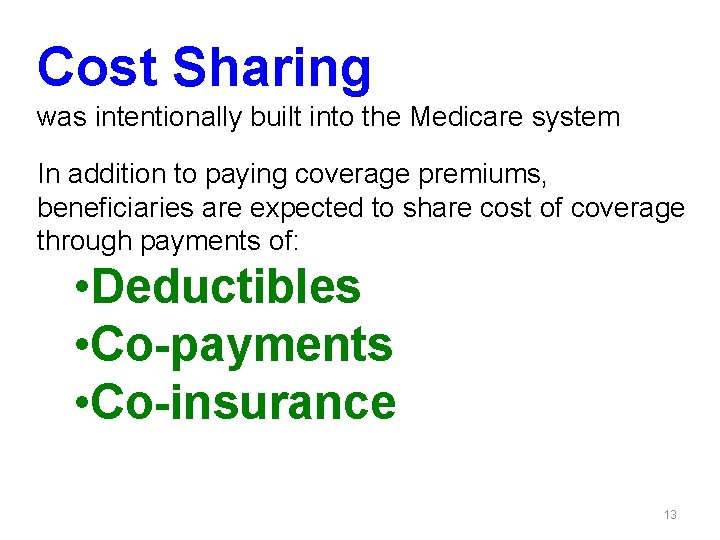
Cost Sharing was intentionally built into the Medicare system In addition to paying coverage premiums, beneficiaries are expected to share cost of coverage through payments of: • Deductibles • Co-payments • Co-insurance 13
As a Result: A key characteristic of the Medicare system is the utilization of private insurance to help with the costs “Traditional” Medicare does not cover 14
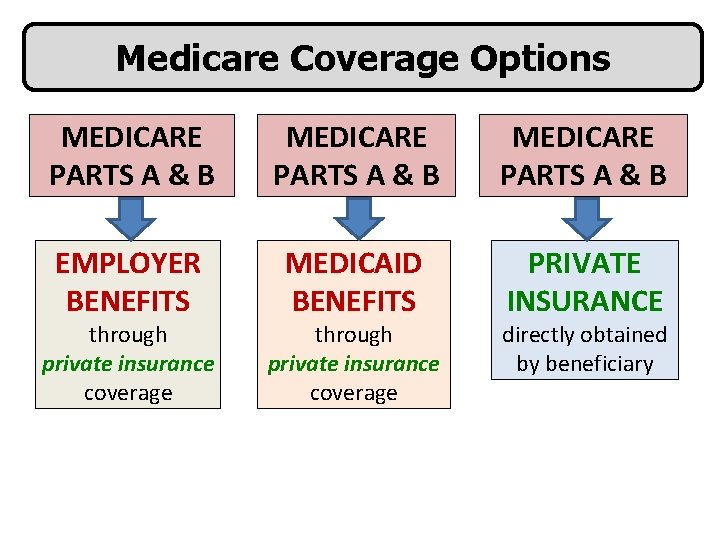
Medicare Coverage Options MEDICARE PARTS A & B EMPLOYER BENEFITS MEDICAID BENEFITS PRIVATE INSURANCE through private insurance coverage directly obtained by beneficiary
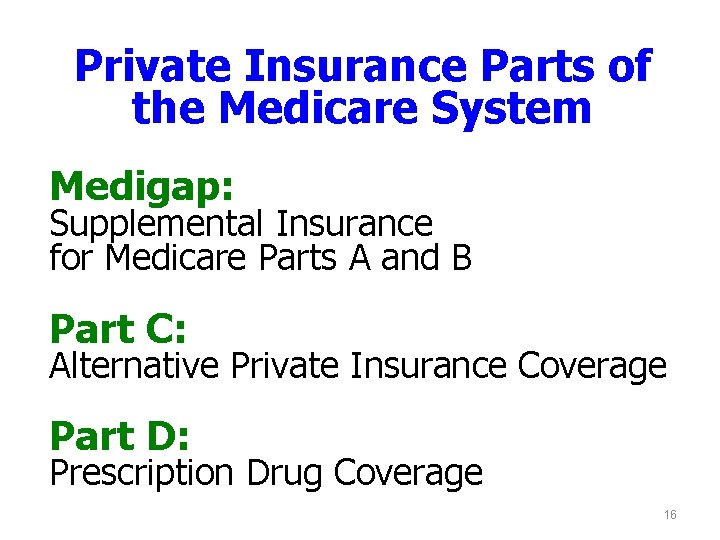
Private Insurance Parts of the Medicare System Medigap: Supplemental Insurance for Medicare Parts A and B Part C: Alternative Private Insurance Coverage Part D: Prescription Drug Coverage 16
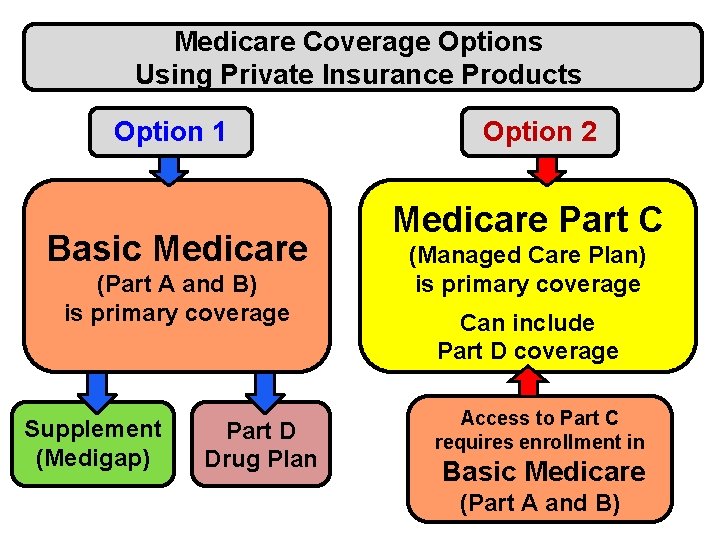
Medicare Coverage Options Using Private Insurance Products Option 1 Basic Medicare (Part A and B) is primary coverage Supplement (Medigap) Part D Drug Plan Option 2 Medicare Part C (Managed Care Plan) is primary coverage Can include Part D coverage Access to Part C requires enrollment in Basic Medicare (Part A and B)
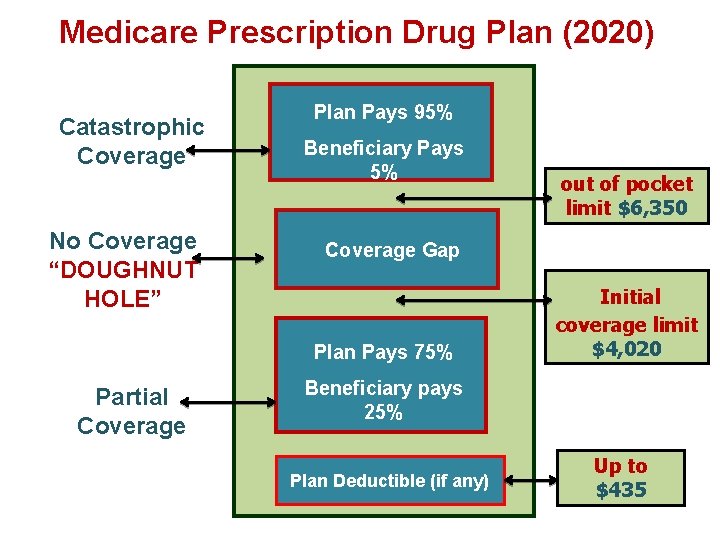
Medicare Prescription Drug Plan (2020) Catastrophic Coverage No Coverage “DOUGHNUT HOLE” Plan Pays 95% Beneficiary Pays 5% Coverage Gap Plan Pays 75% Partial Coverage out of pocket limit $6, 350 Initial coverage limit $4, 020 Beneficiary pays 25% Plan Deductible (if any) Up to $435

Medicaid
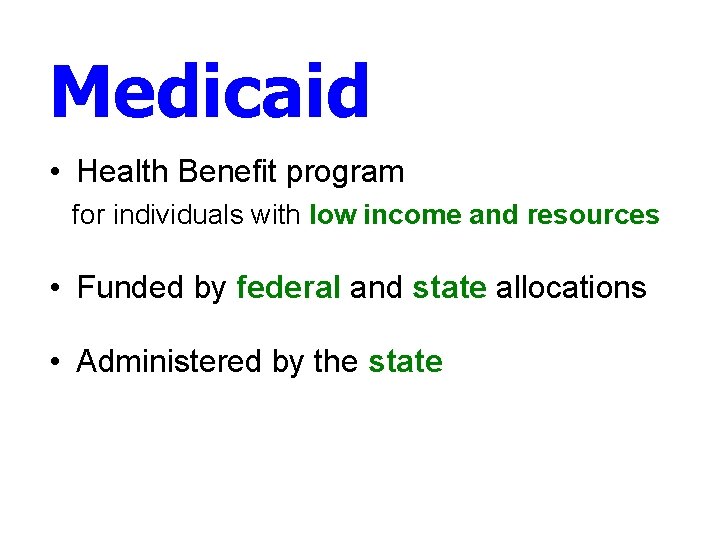
Medicaid • Health Benefit program for individuals with low income and resources • Funded by federal and state allocations • Administered by the state
Medicare and Medicaid Coordination of Benefits 21
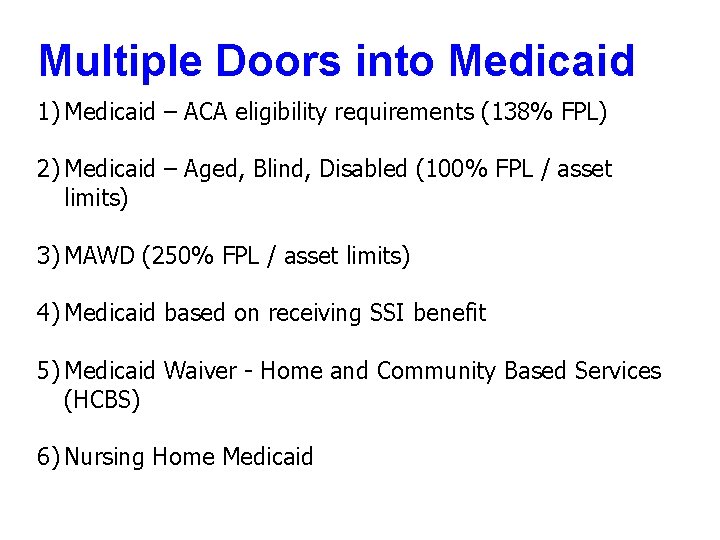
Multiple Doors into Medicaid 1) Medicaid – ACA eligibility requirements (138% FPL) 2) Medicaid – Aged, Blind, Disabled (100% FPL / asset limits) 3) MAWD (250% FPL / asset limits) 4) Medicaid based on receiving SSI benefit 5) Medicaid Waiver - Home and Community Based Services (HCBS) 6) Nursing Home Medicaid
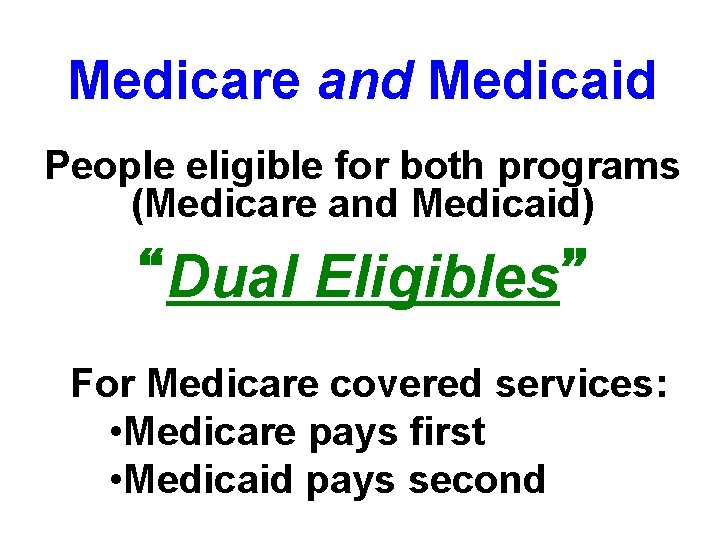
Medicare and Medicaid People eligible for both programs (Medicare and Medicaid) “Dual Eligibles” For Medicare covered services: • Medicare pays first • Medicaid pays second

Accessing Care: Dual Eligible • Basic Medicare (red, white & blue card) is Primary Coverage • Medicaid is secondary coverage to Medicare & will also cover things Medicare does not – i. e. dental and eye care • Medicare Part D PDP is drug coverage use Plan ID card at pharmacy • Can change Part D Plans at any time/multiple times • ACCESS card can cover drugs in classes that are excluded from Part D
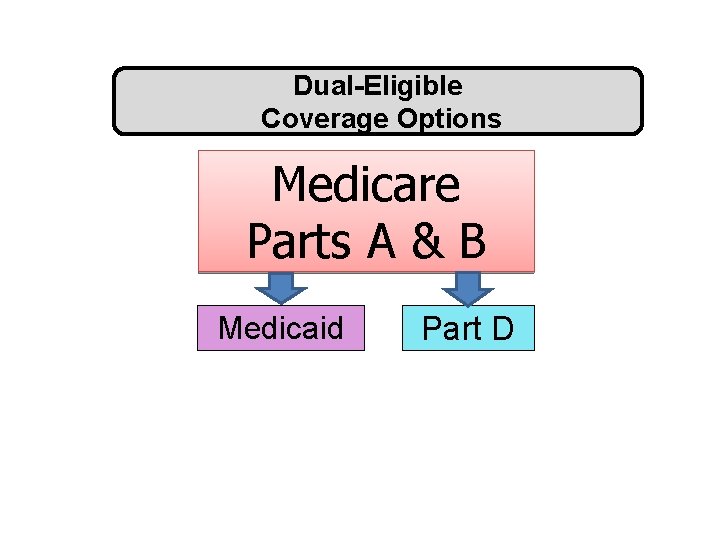
Dual-Eligible Coverage Options Medicare Parts A & B Medicaid Part D
Special Needs Plans (SNPs) • “Special” Medicare Part C Advantage Plans • SNP Plan is primary coverage • Must use in-network providers • Includes Part D drug coverage • Can change SNP Plans or disenroll and return to Original Medicare (Part A and B) as primary coverage any time of the year/multiple times • Medicaid still functions to cover things that Medicare/SNP Plan does not cover
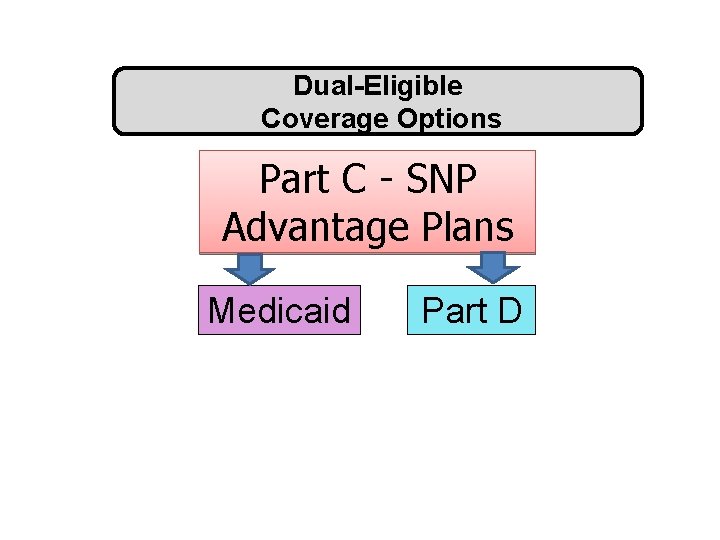
Dual-Eligible Coverage Options Part C - SNP Advantage Plans Medicaid Part D

LIS / Extra Help
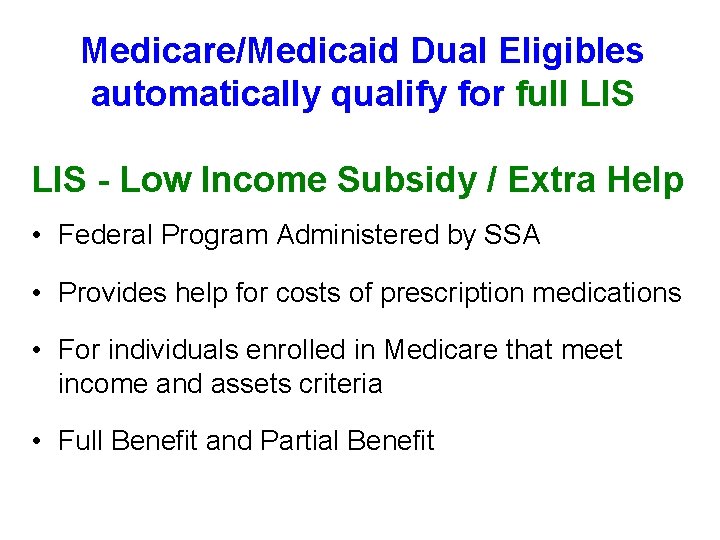
Medicare/Medicaid Dual Eligibles automatically qualify for full LIS - Low Income Subsidy / Extra Help • Federal Program Administered by SSA • Provides help for costs of prescription medications • For individuals enrolled in Medicare that meet income and assets criteria • Full Benefit and Partial Benefit
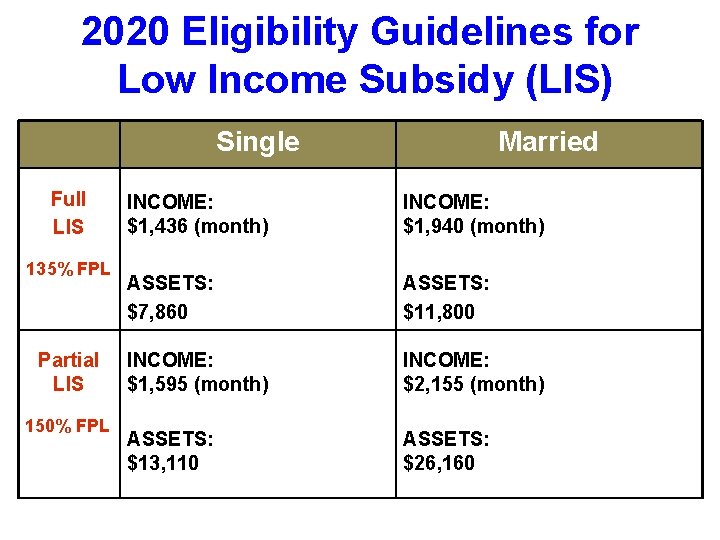
2020 Eligibility Guidelines for Low Income Subsidy (LIS) Single Full LIS 135% FPL Partial LIS 150% FPL Married INCOME: $1, 436 (month) INCOME: $1, 940 (month) ASSETS: $7, 860 ASSETS: $11, 800 INCOME: $1, 595 (month) INCOME: $2, 155 (month) ASSETS: $13, 110 ASSETS: $26, 160
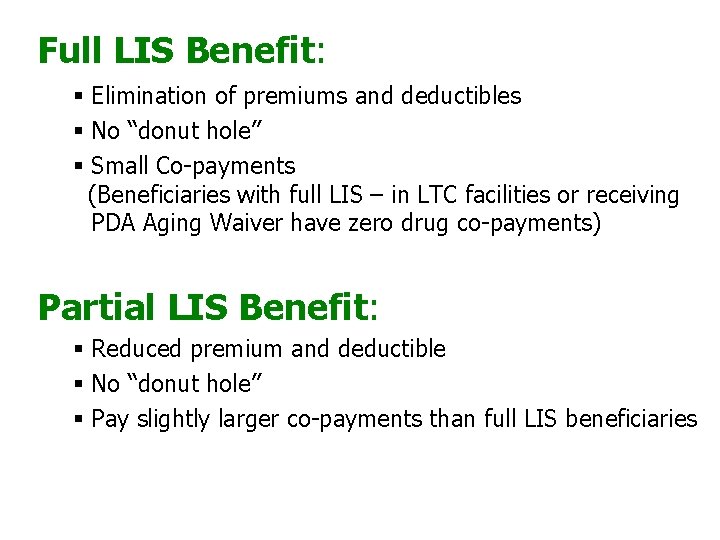
Full LIS Benefit: § Elimination of premiums and deductibles § No “donut hole” § Small Co-payments (Beneficiaries with full LIS – in LTC facilities or receiving PDA Aging Waiver have zero drug co-payments) Partial LIS Benefit: § Reduced premium and deductible § No “donut hole” § Pay slightly larger co-payments than full LIS beneficiaries
Community Health Choices (CHC)
Community Health Choices (CHC) Pennsylvania’s program for delivery of • Medicaid coverage • Long Term Care services • HCB waiver services Started January 1, 2018 in select counties in SW Western Pa 33
Under the New Program: Community Health Choices (CHC) The state pays Managed Care Organizations a capitated fee – to provide Medicaid coverage for dual eligibles (those on Medicare and Medicaid) – to provide LTSS for those eligible for Medicaid (now called Managed Long Term Services and Supports - MLTSS) • Enrollment is mandatory for those impacted • Began January 1, 2018 in 14 counties in SW PA • Began January 1, 2019 in SE PA • Begins January 1, 2020 in remainder of PA 34
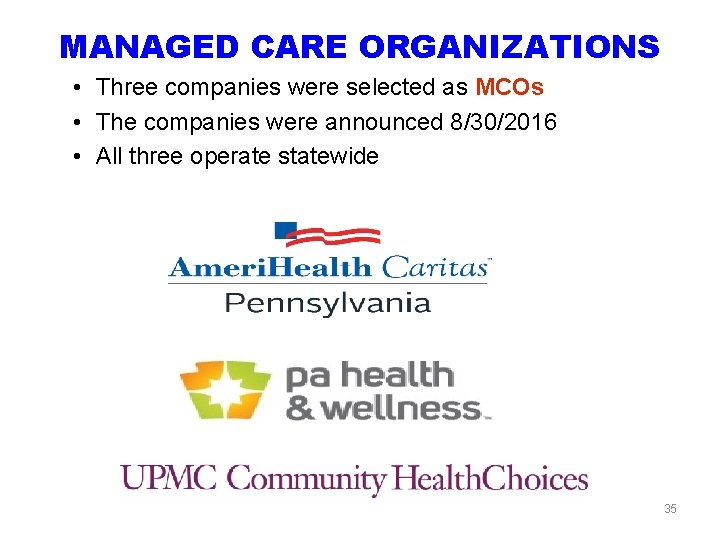
MANAGED CARE ORGANIZATIONS • Three companies were selected as MCOs • The companies were announced 8/30/2016 • All three operate statewide 35
Individuals Impacted: • Receiving LTSS through Attendant Care, Independence or Aging Waivers • Receiving nursing come care paid by Medicaid • Any Individuals that are dual-eligible (whether or not receiving LTSS or in nursing home) 36
Impact on Dual Eligibles: • The Access Card is no longer used • Instead, duals are enrolled in CHC managed care plan for medical assistance • Primary insurance for duals is still Medicare • Medicare Part A and B is still primary coverage • Or enrolled in Medicare SNP • CHC Plans have Companion Medicare SNPs enrollees are not be required to enroll in Companion SNP 37
Independent Enrollment Broker (IEB) • Provides counseling assistance – to help individuals choose an MCO • Provides enrollment assistance – to help individuals enroll in an MCO • Coordinates the MCO enrollment – with other programs providing services to enrollee (e. g. Medicare) 38
- Slides: 38