
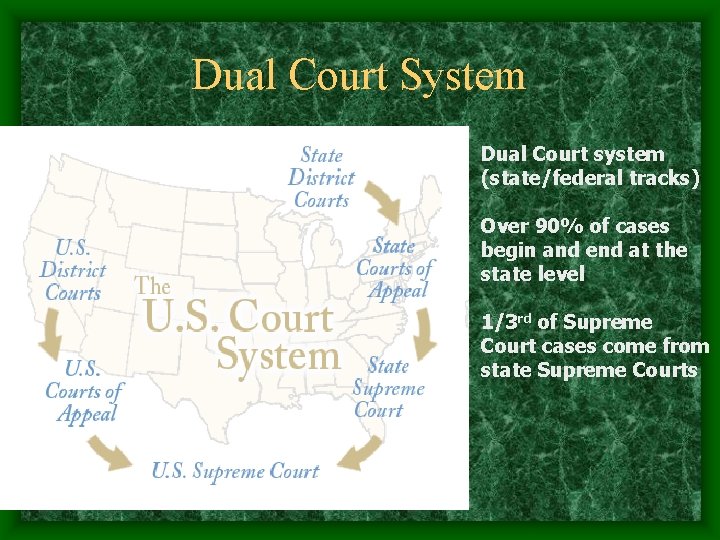
Dual Court System Dual Court system statefederal tracks
- Slides: 47
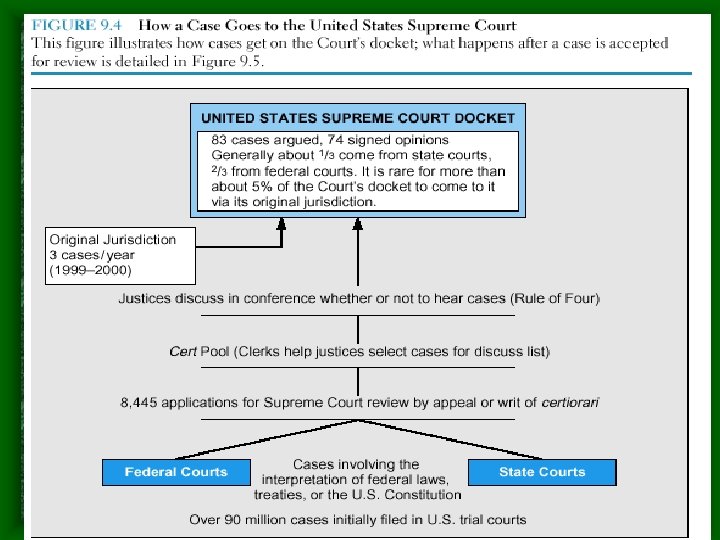
Dual Court System Dual Court system (state/federal tracks) Over 90% of cases begin and end at the state level 1/3 rd of Supreme Court cases come from state Supreme Courts
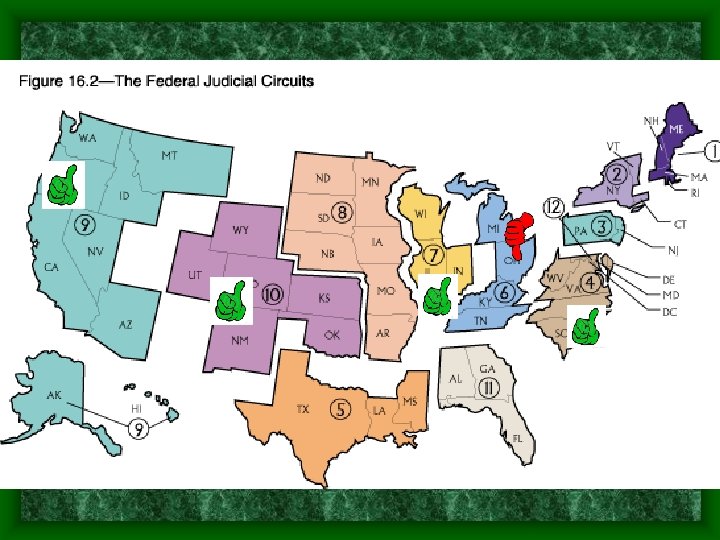
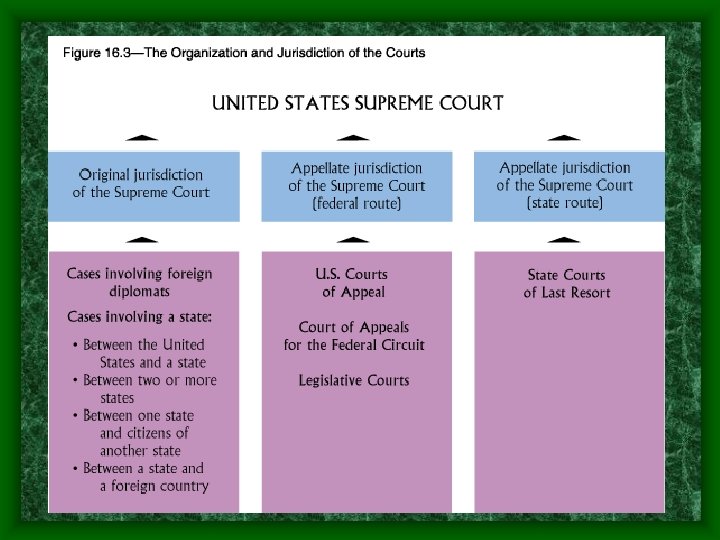
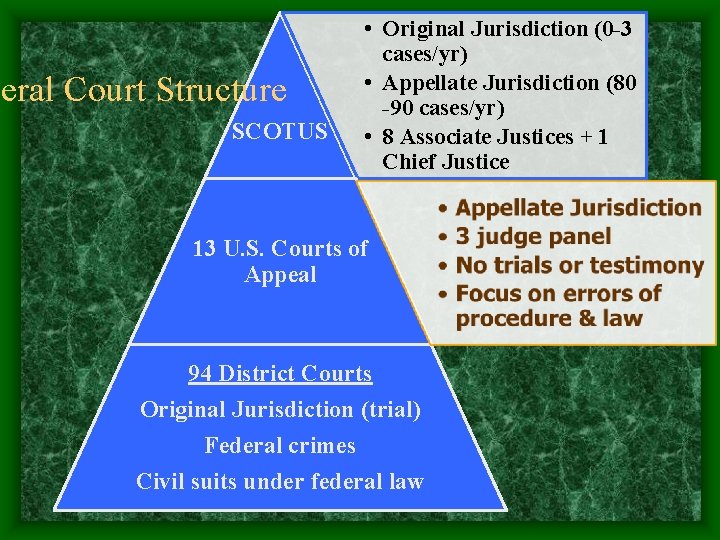
deral Court Structure SCOTUS • Original Jurisdiction (0 -3 cases/yr) • Appellate Jurisdiction (80 -90 cases/yr) • 8 Associate Justices + 1 Chief Justice 13 U. S. Courts of Appeal 94 District Courts Original Jurisdiction (trial) Federal crimes Civil suits under federal law
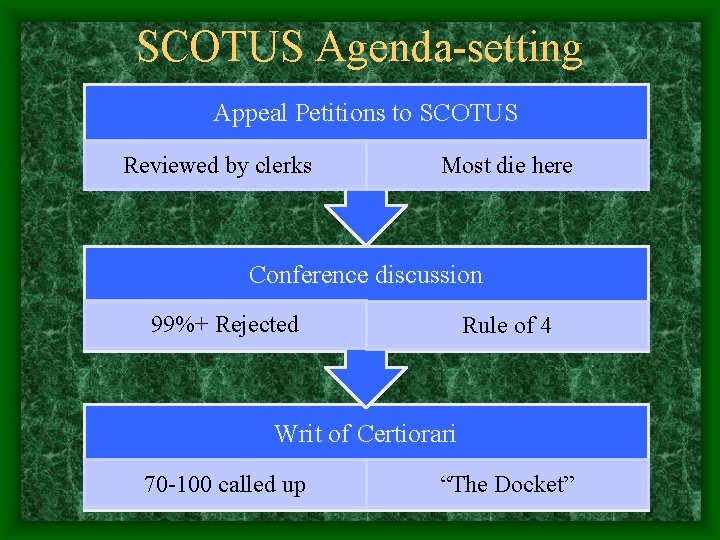
SCOTUS Agenda-setting Appeal Petitions to SCOTUS Reviewed by clerks Most die here Conference discussion 99%+ Rejected Rule of 4 Writ of Certiorari 70 -100 called up “The Docket”
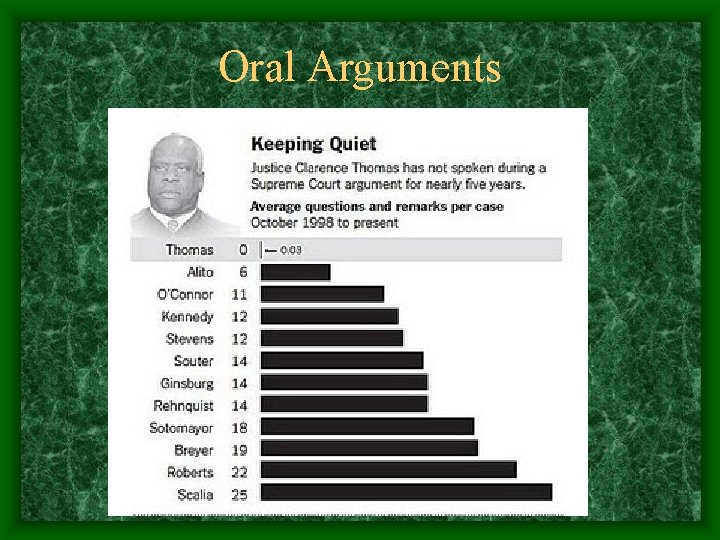
Oral Arguments
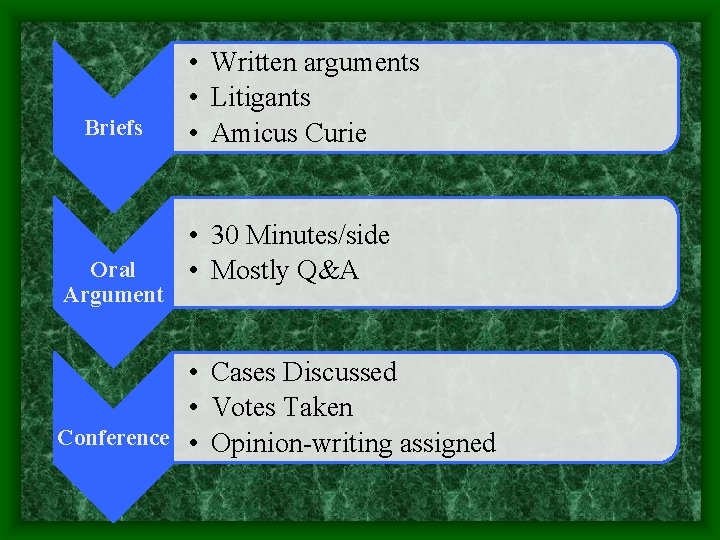
Briefs Oral Argument • Written arguments • Litigants • Amicus Curie • 30 Minutes/side • Mostly Q&A • Cases Discussed • Votes Taken Conference • Opinion-writing assigned
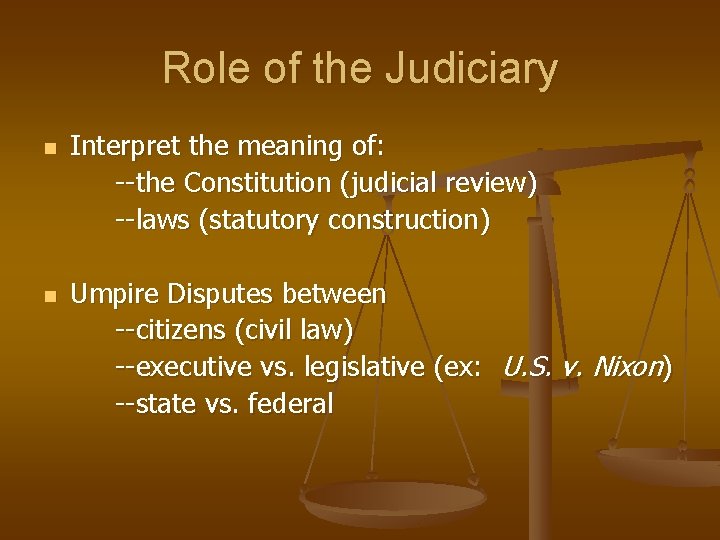
Role of the Judiciary n n Interpret the meaning of: --the Constitution (judicial review) --laws (statutory construction) Umpire Disputes between --citizens (civil law) --executive vs. legislative (ex: U. S. v. Nixon) --state vs. federal
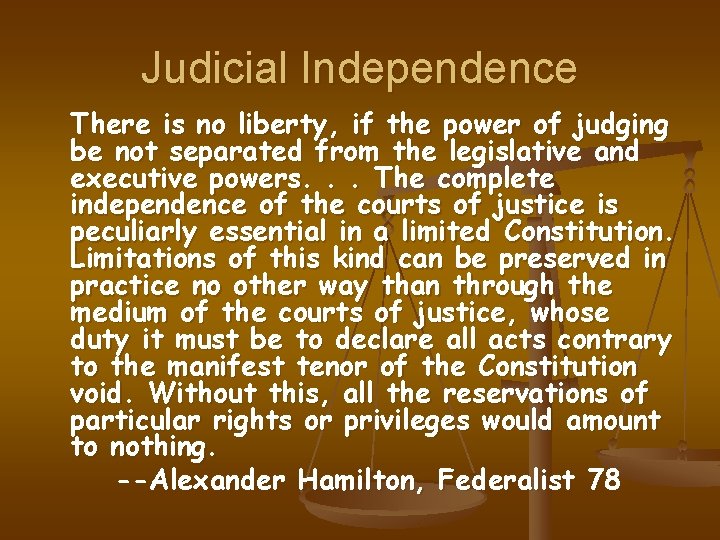
Judicial Independence There is no liberty, if the power of judging be not separated from the legislative and executive powers. . . The complete independence of the courts of justice is peculiarly essential in a limited Constitution. Limitations of this kind can be preserved in practice no other way than through the medium of the courts of justice, whose duty it must be to declare all acts contrary to the manifest tenor of the Constitution void. Without this, all the reservations of particular rights or privileges would amount to nothing. --Alexander Hamilton, Federalist 78
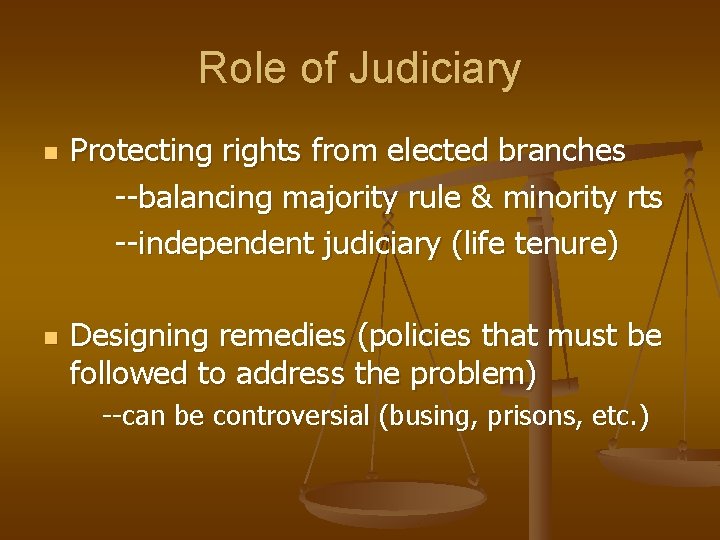
Role of Judiciary n n Protecting rights from elected branches --balancing majority rule & minority rts --independent judiciary (life tenure) Designing remedies (policies that must be followed to address the problem) --can be controversial (busing, prisons, etc. )
Checks on Judicial Power n n Presidents can shift the court via appointments Congress—can limit court jurisdiction, set court size, propose const. amendments
Limits on Judicial Power n Internal Checks --appeals process --stare decisis=look to past rulings --standing to sue: ct. must react to an actual plaintiff harmed by the policy
Least Dangerous Branch? n . . . the judiciary, from the nature of its functions, will always be the least dangerous to the political rights of the Constitution; because it will be least in a capacity to annoy or injure them. The Executive. . . holds the sword of the community. The legislature not only commands the purse, but prescribes the rules by which the duties and rights of every citizen are to be regulated. The judiciary. . . may truly be said to have neither FORCE nor WILL, but merely judgment; and must ultimately depend upon the aid of the executive arm even for the efficacy of its judgments. --Alexander Hamilton, Federalist 78
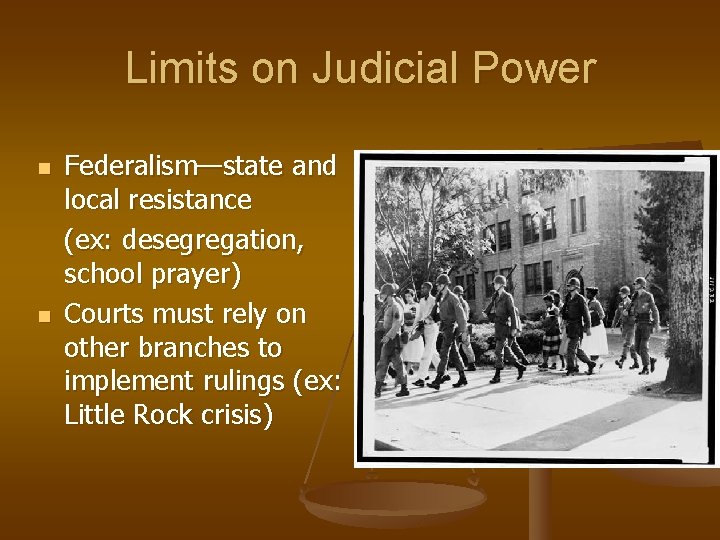
Limits on Judicial Power n n Federalism—state and local resistance (ex: desegregation, school prayer) Courts must rely on other branches to implement rulings (ex: Little Rock crisis)
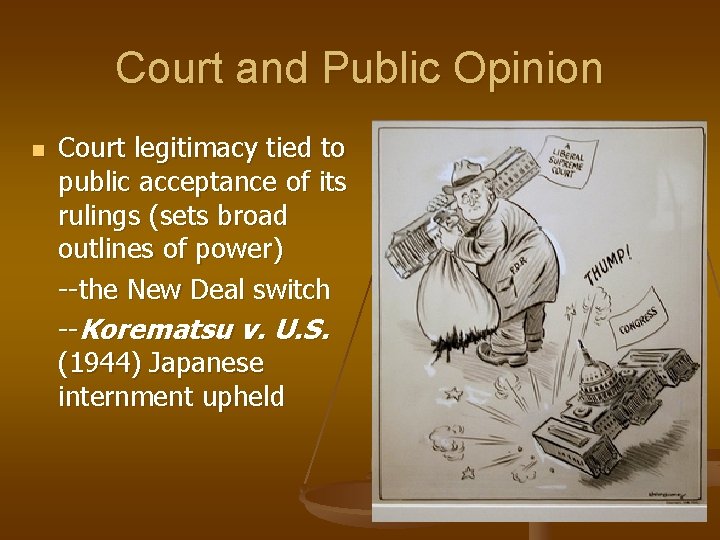
Court and Public Opinion n Court legitimacy tied to public acceptance of its rulings (sets broad outlines of power) --the New Deal switch --Korematsu v. U. S. (1944) Japanese internment upheld
Judicial Philosophies * More than just liberal or conservative * Judges are not technically Republican or Democratic but…. their philosophies do generally align with the parties/ideologies
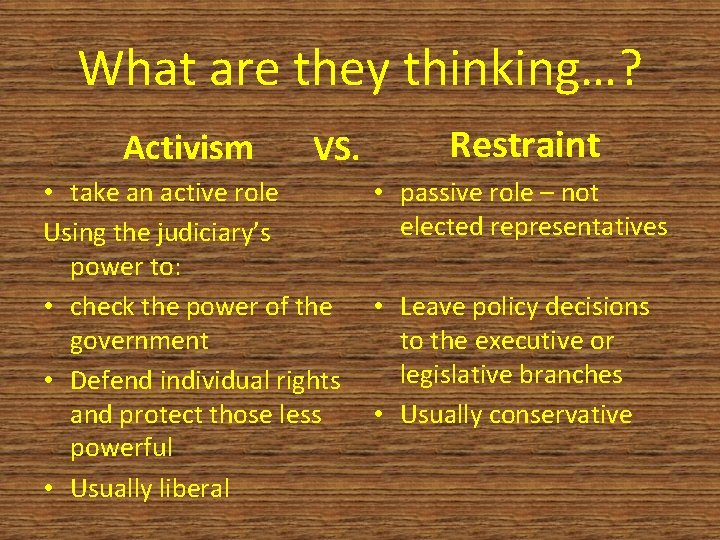
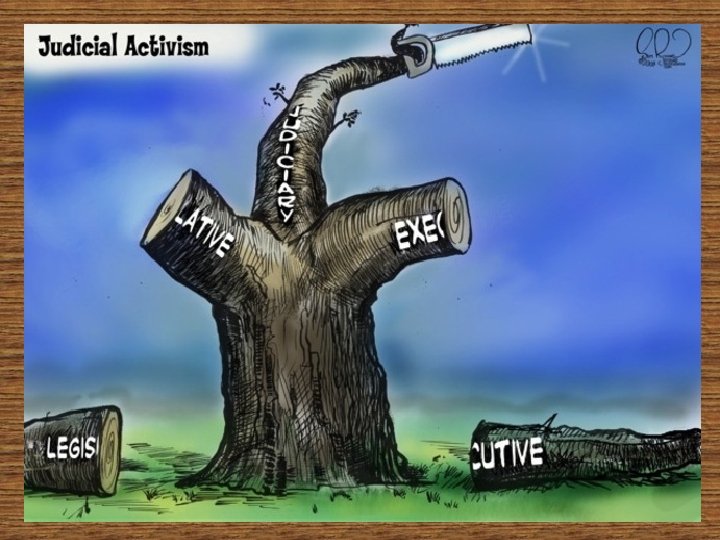
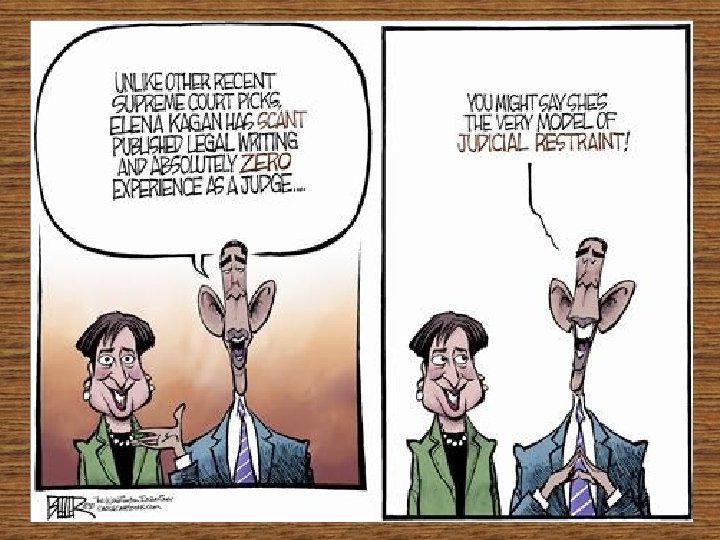
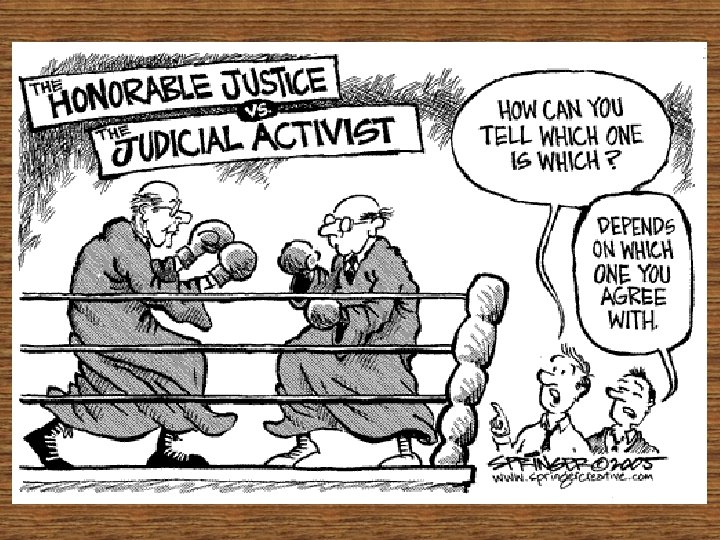
What are they thinking…? Activism VS. • take an active role Using the judiciary’s power to: • check the power of the government • Defend individual rights and protect those less powerful • Usually liberal Restraint • passive role – not elected representatives • Leave policy decisions to the executive or legislative branches • Usually conservative
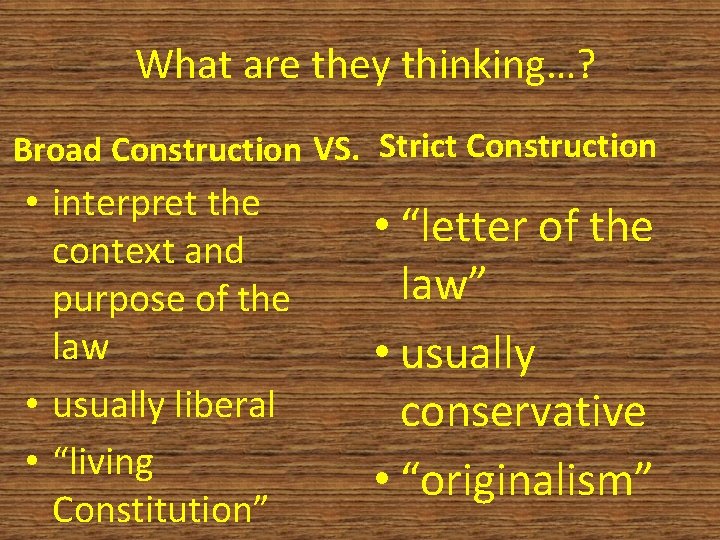
What are they thinking…? Broad Construction VS. Strict Construction • interpret the context and purpose of the law • usually liberal • “living Constitution” • “letter of the law” • usually conservative • “originalism”
Meet The Justices… Bachelor Number 1 Bachelor Number 2 Key Statements or rulings: Judicial Philosophy? * Remember…all judges have philosophies and can interpret federal law or the Constitution…. district, appellate, or supreme court (even state judges for that matter)
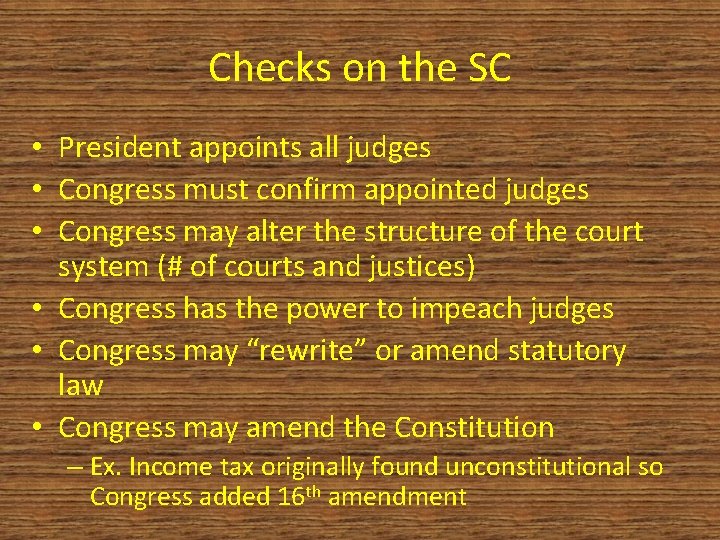
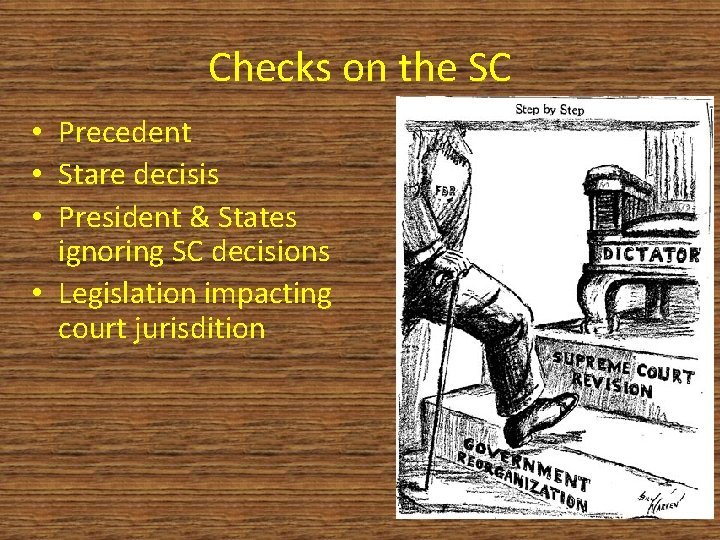
Checks on the SC • President appoints all judges • Congress must confirm appointed judges • Congress may alter the structure of the court system (# of courts and justices) • Congress has the power to impeach judges • Congress may “rewrite” or amend statutory law • Congress may amend the Constitution – Ex. Income tax originally found unconstitutional so Congress added 16 th amendment
Checks on the SC • Precedent • Stare decisis • President & States ignoring SC decisions • Legislation impacting court jurisdition
Constraints on the Power of Federal Courts 1. Adversarial system – decision must be made between 2 choices, and court can’t bring up an issue 2. Justiciable dispute – must judge actual situations, not hypothetical situations 3. Political question – absence of law to rule on a case and the court calls on the Congress to create law * Trump’s possible executive order to end birthright citizenship?
The Judicial Nomination and Confirmation Process Nomination=White House Confirmation=Senate
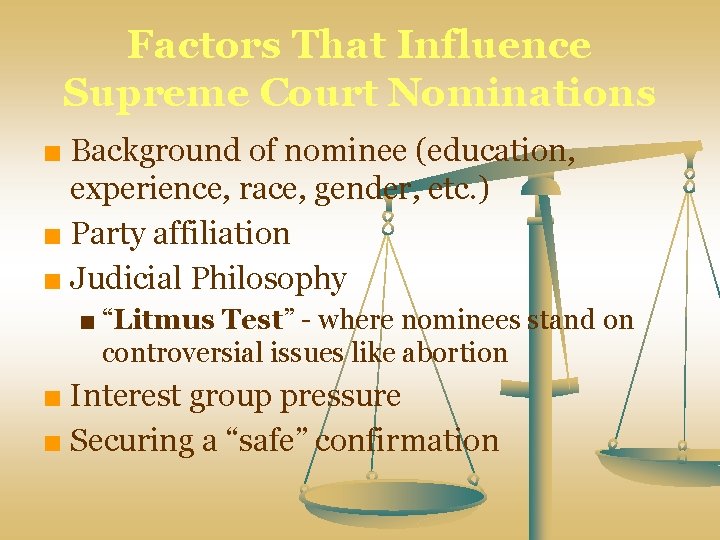
Factors That Influence Supreme Court Nominations ■ Background of nominee (education, experience, race, gender, etc. ) ■ Party affiliation ■ Judicial Philosophy ■ “Litmus Test” - where nominees stand on controversial issues like abortion ■ Interest group pressure ■ Securing a “safe” confirmation
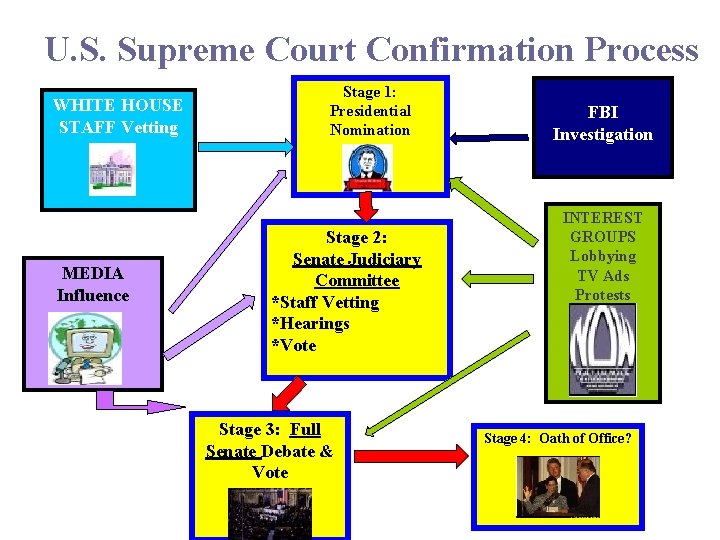
U. S. Supreme Court Confirmation Process WHITE HOUSE STAFF Vetting MEDIA Influence Stage 1: Presidential Nomination Stage 2: Senate Judiciary Committee *Staff Vetting *Hearings *Vote Stage 3: Full Senate Debate & Vote FBI Investigation INTEREST GROUPS Lobbying TV Ads Protests Stage 4: Oath of Office?
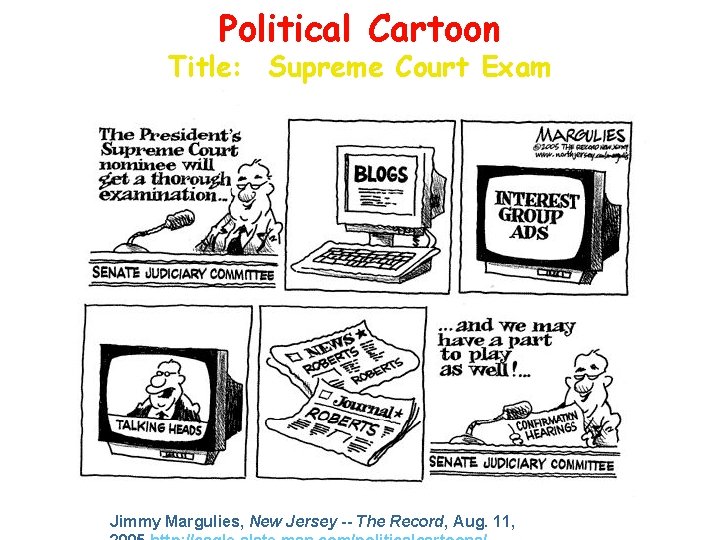
Political Cartoon Title: Supreme Court Exam Jimmy Margulies, New Jersey -- The Record, Aug. 11,
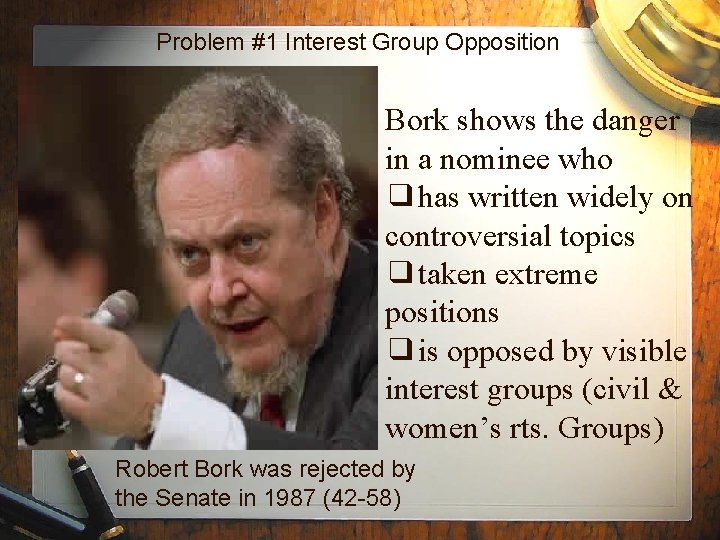
Problem #1 Interest Group Opposition Bork shows the danger in a nominee who ❑has written widely on controversial topics ❑taken extreme positions ❑is opposed by visible interest groups (civil & women’s rts. Groups) Robert Bork was rejected by the Senate in 1987 (42 -58)
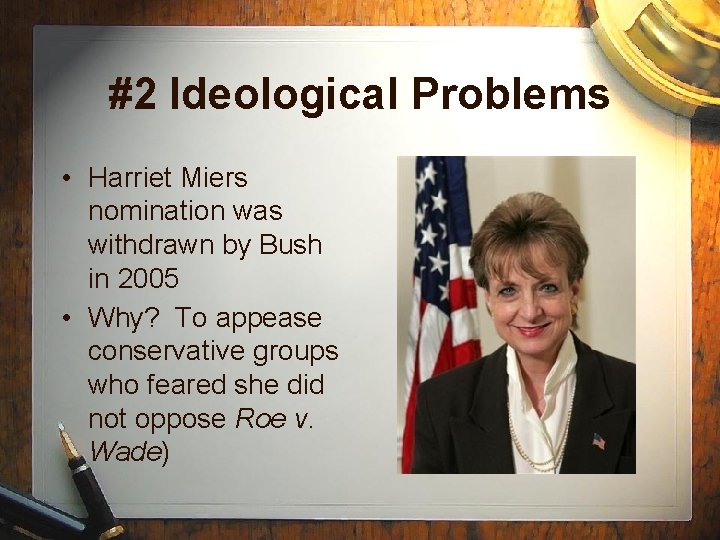
#2 Ideological Problems • Harriet Miers nomination was withdrawn by Bush in 2005 • Why? To appease conservative groups who feared she did not oppose Roe v. Wade)
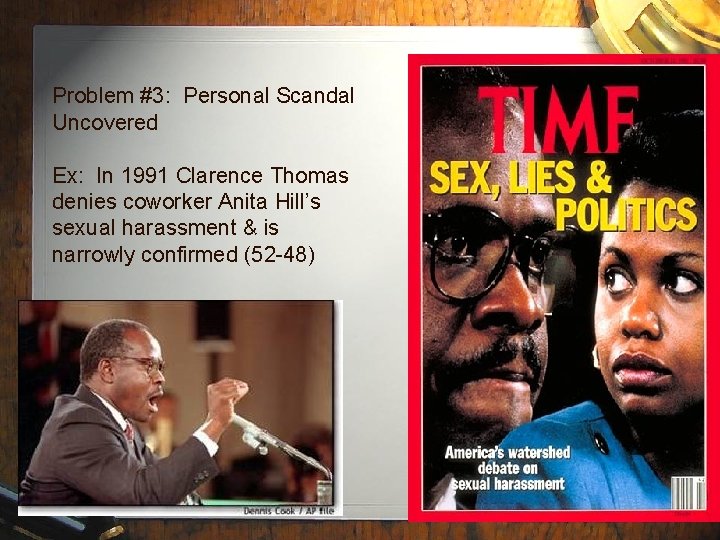
Problem #3: Personal Scandal Uncovered Ex: In 1991 Clarence Thomas denies coworker Anita Hill’s sexual harassment & is narrowly confirmed (52 -48)
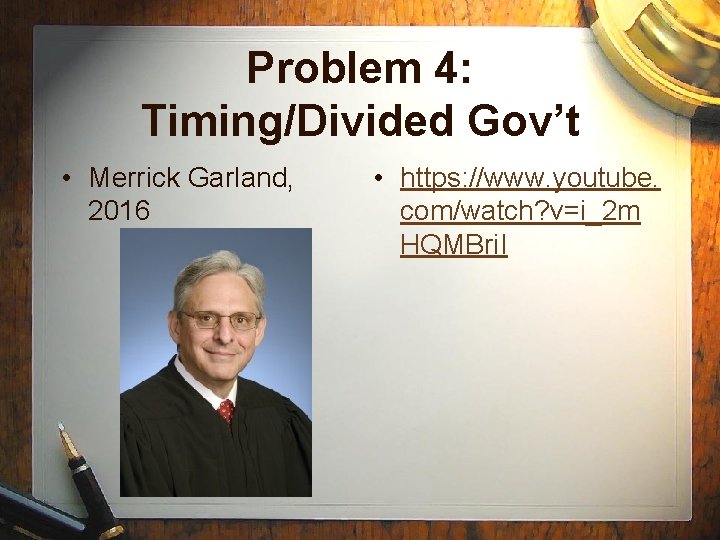
Problem 4: Timing/Divided Gov’t • Merrick Garland, 2016 • https: //www. youtube. com/watch? v=i_2 m HQMBri. I
Smooth Confirmation Tips ✓Intense vetting (research) of nominee ✓Consult with opposition party in Senate – Ex: Clinton & Sen. Hatch ✓Coach nominee to evade questions during confirmation hearings ✓Promote/market nominee in the media
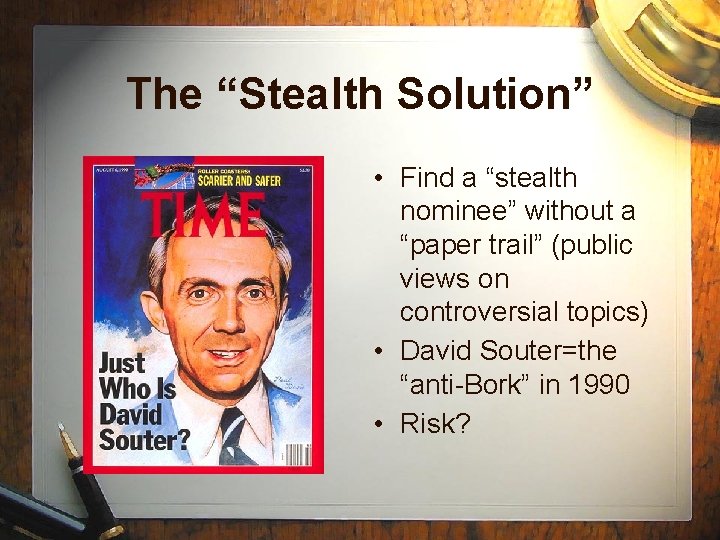
The “Stealth Solution” • Find a “stealth nominee” without a “paper trail” (public views on controversial topics) • David Souter=the “anti-Bork” in 1990 • Risk?
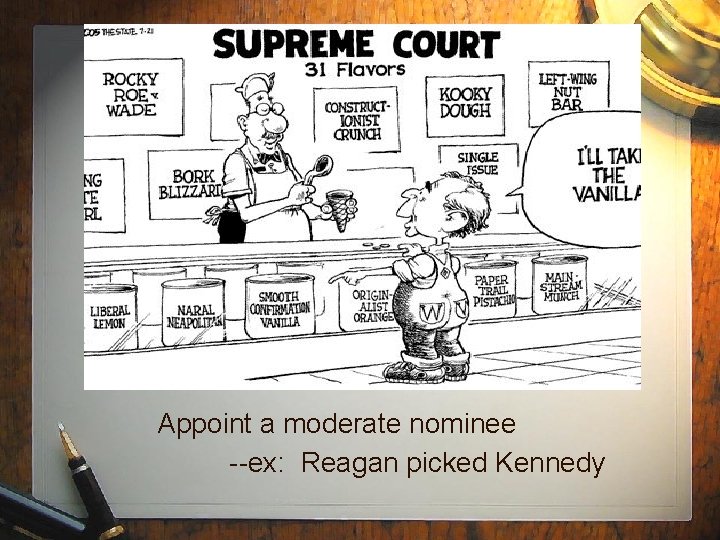
Appoint a moderate nominee --ex: Reagan picked Kennedy
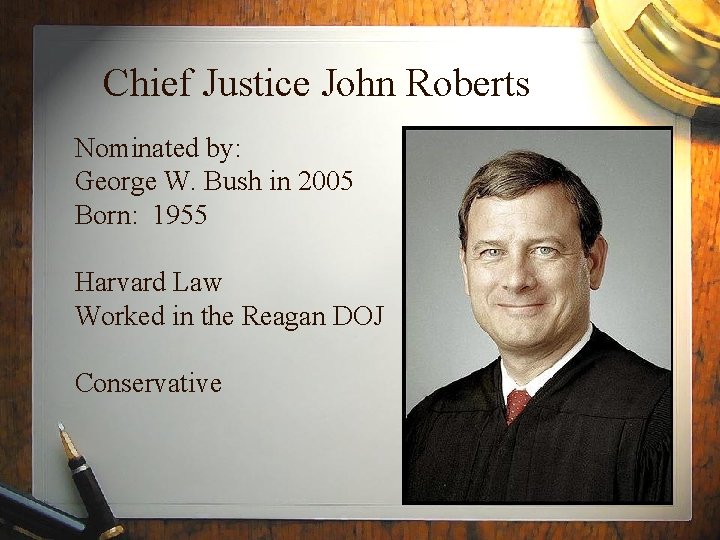
Chief Justice John Roberts Nominated by: George W. Bush in 2005 Born: 1955 Harvard Law Worked in the Reagan DOJ Conservative
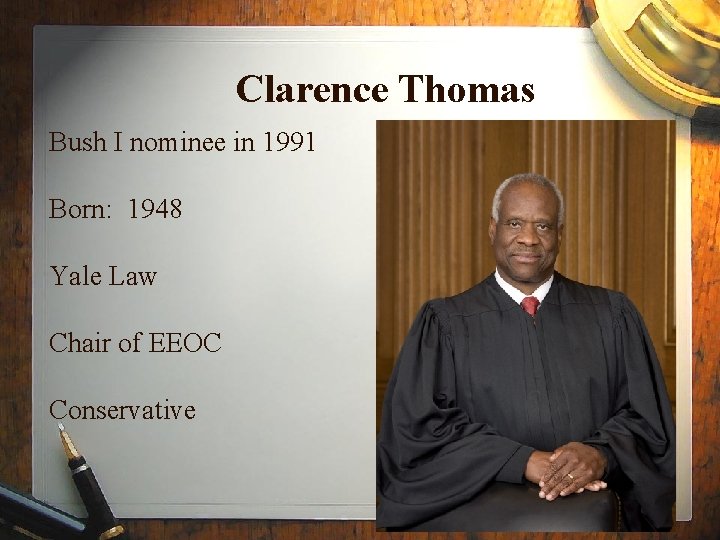
Clarence Thomas Bush I nominee in 1991 Born: 1948 Yale Law Chair of EEOC Conservative
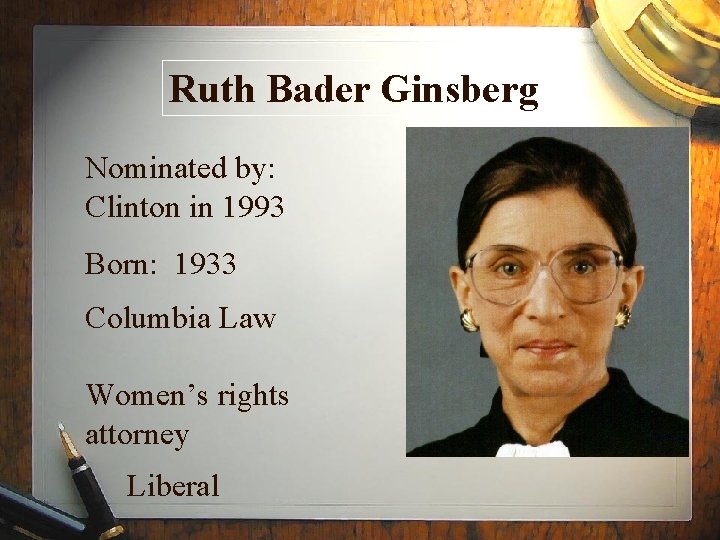
Ruth Bader Ginsberg Nominated by: Clinton in 1993 Born: 1933 Columbia Law Women’s rights attorney Liberal
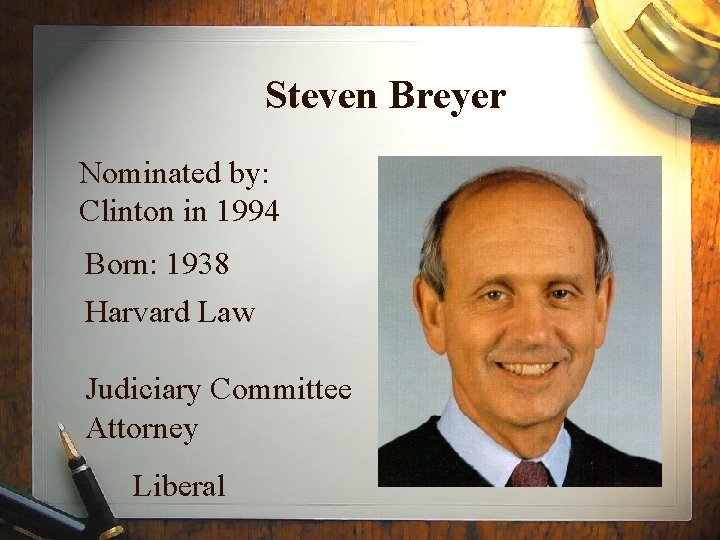
Steven Breyer Nominated by: Clinton in 1994 Born: 1938 Harvard Law Judiciary Committee Attorney Liberal
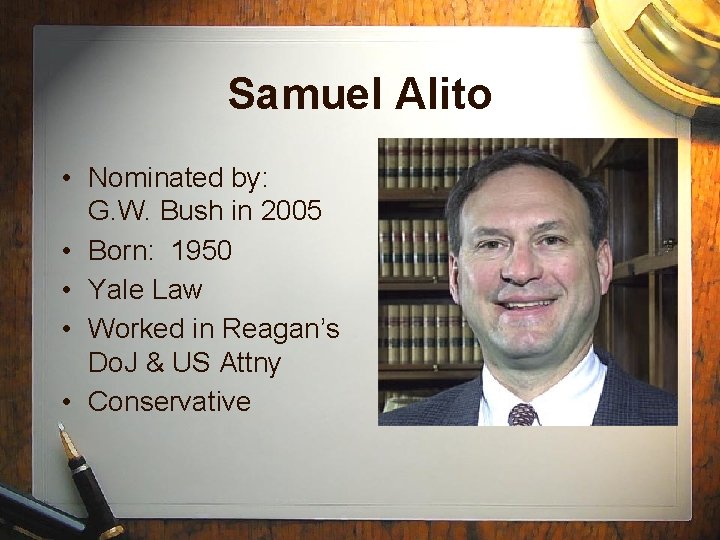
Samuel Alito • Nominated by: G. W. Bush in 2005 • Born: 1950 • Yale Law • Worked in Reagan’s Do. J & US Attny • Conservative
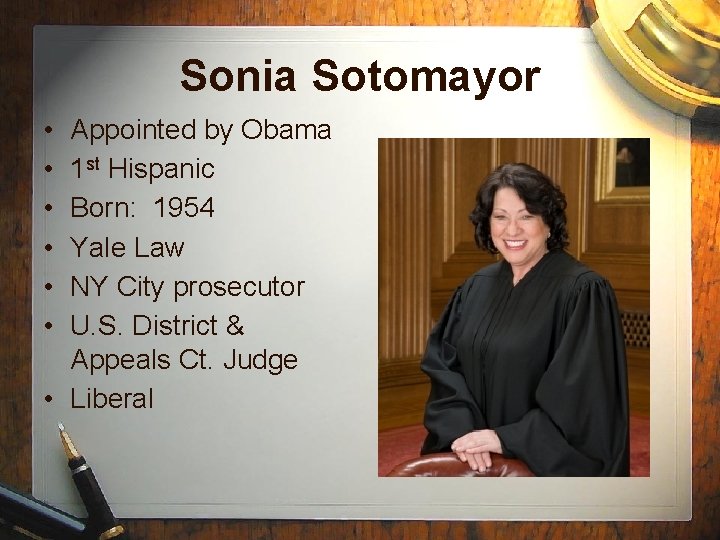
Sonia Sotomayor • • • Appointed by Obama 1 st Hispanic Born: 1954 Yale Law NY City prosecutor U. S. District & Appeals Ct. Judge • Liberal
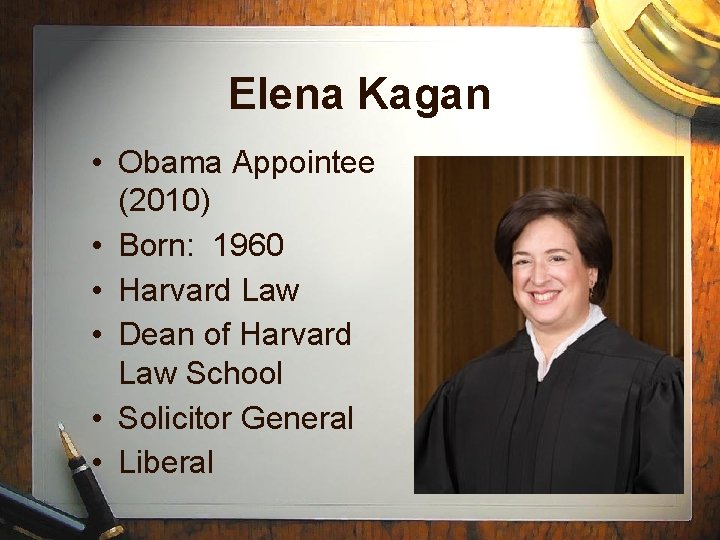
Elena Kagan • Obama Appointee (2010) • Born: 1960 • Harvard Law • Dean of Harvard Law School • Solicitor General • Liberal
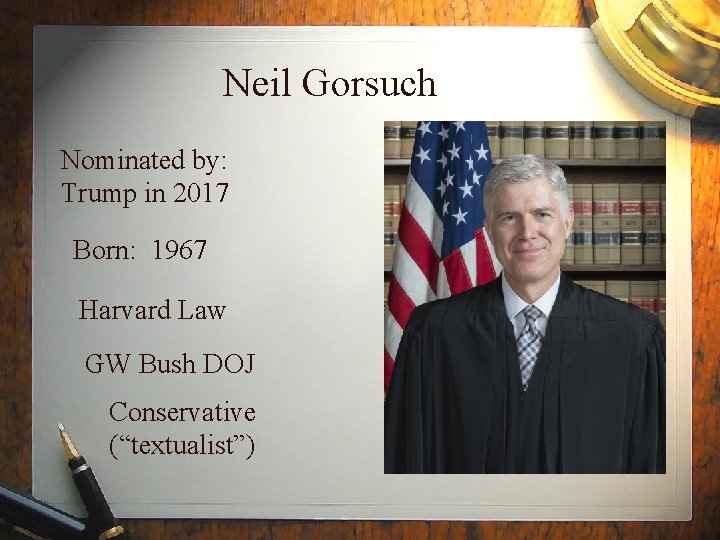
Neil Gorsuch Nominated by: Trump in 2017 Born: 1967 Harvard Law GW Bush DOJ Conservative (“textualist”)
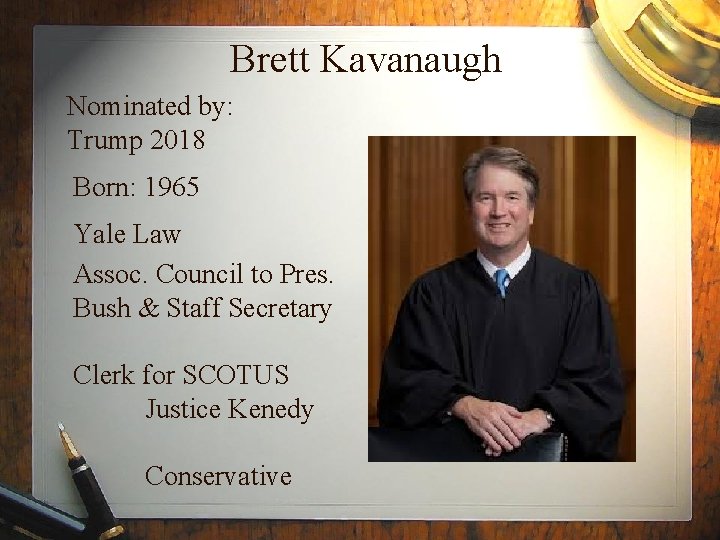
Brett Kavanaugh Nominated by: Trump 2018 Born: 1965 Yale Law Assoc. Council to Pres. Bush & Staff Secretary Clerk for SCOTUS Justice Kenedy Conservative