
DST Human Capital Development Initiatives Presentation by DST
DST Human Capital Development Initiatives Presentation by DST Select Committee: Comms and Public Enterprises 18 March 2015
Presentation outline • HCD Landscape: Institutional context • HCD Landscape: Policy framework • HCD systemic challenges • DST HCD programmes • Sector-specific HCD interventions • Science promotion and engagement • Conclusion 2
HCD Landscape (1/3): Institutional Context In 2013/14: • DBE: responsible for basic education (over R 205 billion including provinces; 25, 826 schools, 12 m learners) • DHET: responsible for Higher Education (over R 30 billion for universities; 25 universities; 972, 000 students); NSFAS >R 6 billion • DST: responsible for research development and support, and innovation across the national system of innovation (R 6. 5 billion; 720, 000 learners; 9, 771 students) 3
HCD landscape (2/3): National policy framework • National Development Plan (NDP). . . by 2030 – produce more than 100 doctoral graduates per million of the population (increase the number of Africans and women); – produce an additional 100, 000 Ph. Ds; – at least 75% of academics with doctoral degrees; – acknowledges the importance of hosting science expositions as a way of stimulating interest in science among young people. • Medium-Term Strategic Framework (MTSF) – will implement the first five-year of the three phases of the NDP – the DST contributes to Outcome (5): a skilled and capable workforce to support an inclusive growth path 4
HCD landscape (3/3): DST policy framework • National Research and Development Strategy (2002): – Human Capital Development, – investment in S&T infrastructure, – knowledge generation, – strategic management of the public S&T system, and – "centres and networks" of excellence • Ten Year Innovation Plan • HCD Strategy for Research Innovation and Scholarship 5
HCD systemic challenges (1/4) • Supervisory capacity to improve postgraduate completion rates (38. 6% of academic staff with Ph. Ds). • Low bursary values resulting in low progression ratios (from Bachelors to Honours to Masters to Ph. D) and high demographic drop-off. • Poor demographic representation at established researcher levels. • Small science system (currently producing 34 Ph. Ds per million population, GERD as percentage of GDP less than 0. 8%). 6
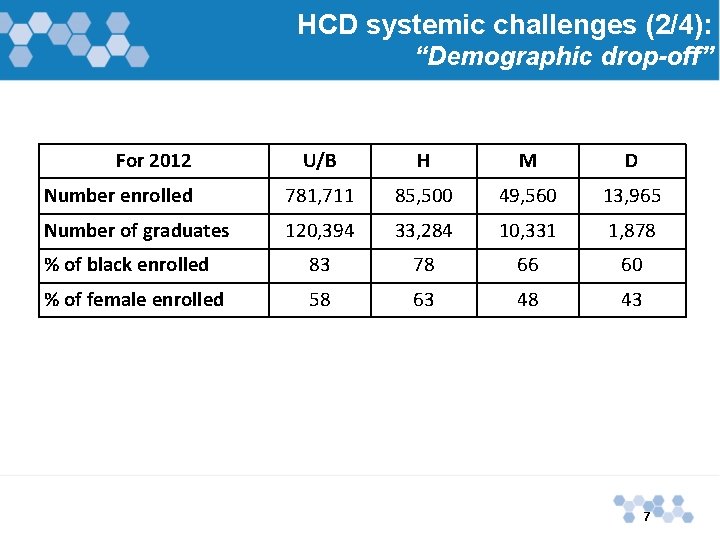
HCD systemic challenges (2/4): “Demographic drop-off” For 2012 U/B H M D Number enrolled 781, 711 85, 500 49, 560 13, 965 Number of graduates 120, 394 33, 284 10, 331 1, 878 % of black enrolled 83 78 66 60 % of female enrolled 58 63 48 43 7
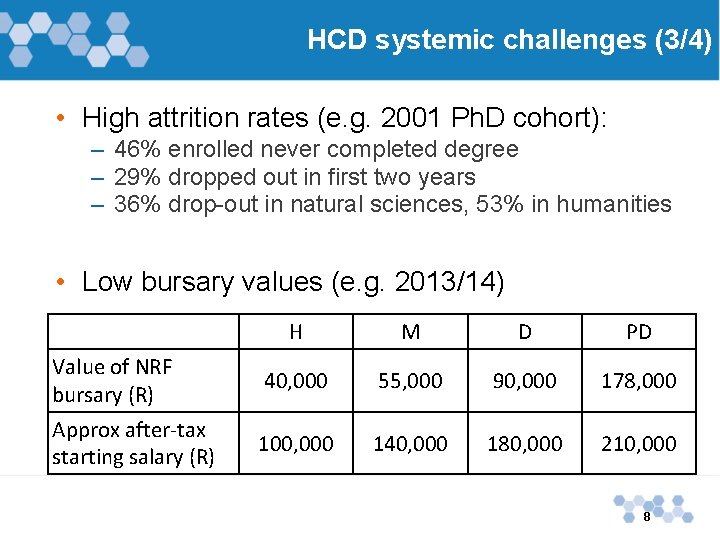
HCD systemic challenges (3/4) • High attrition rates (e. g. 2001 Ph. D cohort): – 46% enrolled never completed degree – 29% dropped out in first two years – 36% drop-out in natural sciences, 53% in humanities • Low bursary values (e. g. 2013/14) H M D PD Value of NRF bursary (R) 40, 000 55, 000 90, 000 178, 000 Approx after-tax starting salary (R) 100, 000 140, 000 180, 000 210, 000 8
HCD systemic challenges (4/4): “The Silent Majority” • About 12, 000 FT academic staff at lecturer and senior lecturer level – 6000 black; 2500 black women • DST/NRF support about 650 “emerging researchers” – 140 black women 9
Established researcher level Next-generation level HCD Programmes Emerging researcher level Science Promotion 10 10
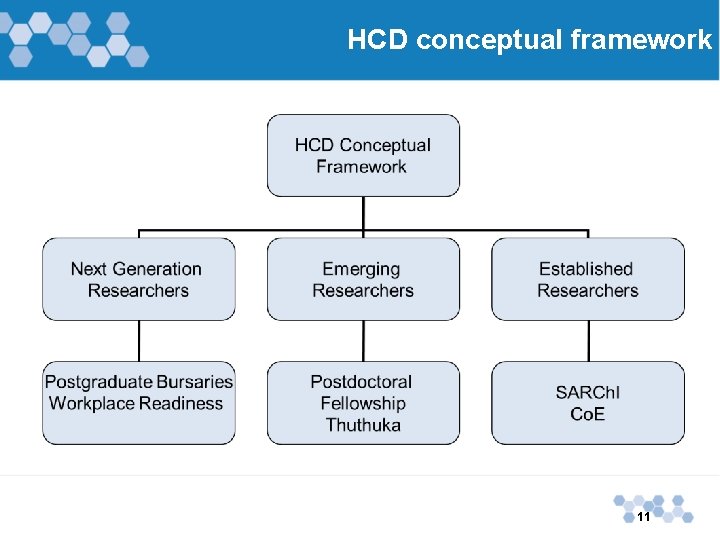
HCD conceptual framework 11
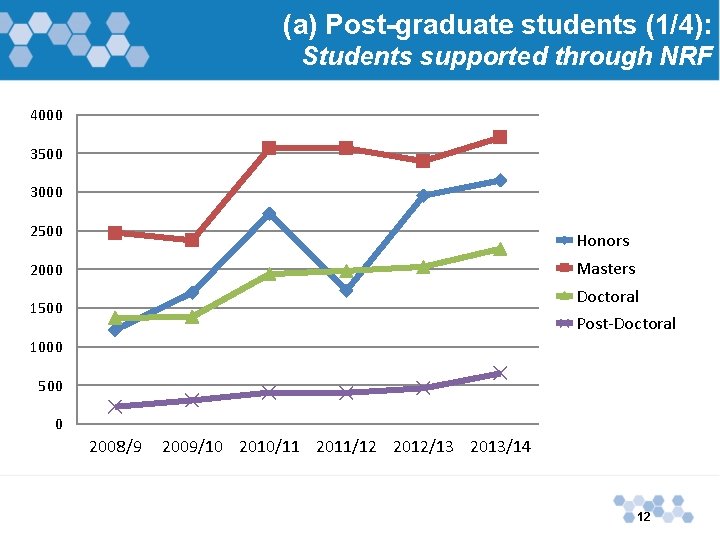
(a) Post-graduate students (1/4): Students supported through NRF 4000 3500 3000 2500 Honors Masters 2000 Doctoral 1500 Post-Doctoral 1000 500 0 2008/9 2009/10 2010/11 2011/12 2012/13 2013/14 12
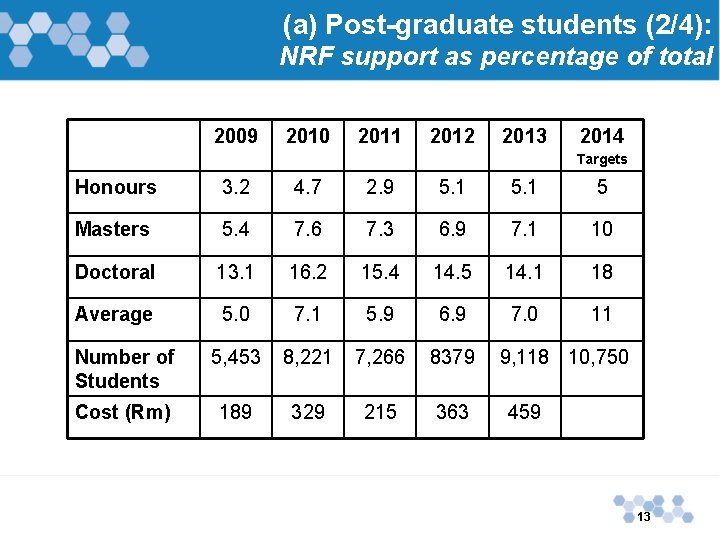
(a) Post-graduate students (2/4): NRF support as percentage of total 2009 2010 2011 2012 2013 2014 Targets Honours 3. 2 4. 7 2. 9 5. 1 5 Masters 5. 4 7. 6 7. 3 6. 9 7. 1 10 Doctoral 13. 1 16. 2 15. 4 14. 5 14. 1 18 Average 5. 0 7. 1 5. 9 6. 9 7. 0 11 Number of Students 5, 453 8, 221 7, 266 8379 Cost (Rm) 189 329 215 363 9, 118 10, 750 459 13
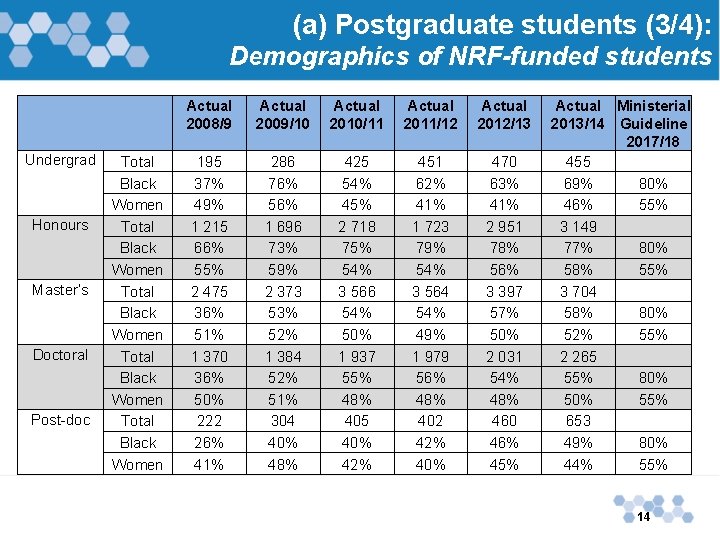
(a) Postgraduate students (3/4): Demographics of NRF-funded students Undergrad Honours Master’s Doctoral Post-doc Total Black Women Total Black Women Actual 2008/9 Actual 2009/10 Actual 2010/11 Actual 2011/12 Actual 2012/13 195 37% 49% 1 215 66% 55% 2 475 36% 51% 1 370 36% 50% 222 26% 41% 286 76% 56% 1 696 73% 59% 2 373 53% 52% 1 384 52% 51% 304 40% 48% 425 54% 45% 2 718 75% 54% 3 566 54% 50% 1 937 55% 48% 405 40% 42% 451 62% 41% 1 723 79% 54% 3 564 54% 49% 1 979 56% 48% 402 42% 40% 470 63% 41% 2 951 78% 56% 3 397 57% 50% 2 031 54% 48% 460 46% 45% Actual Ministerial 2013/14 Guideline 2017/18 455 69% 80% 46% 55% 3 149 77% 80% 58% 55% 3 704 58% 80% 52% 55% 2 265 55% 80% 55% 653 49% 80% 44% 55% 14
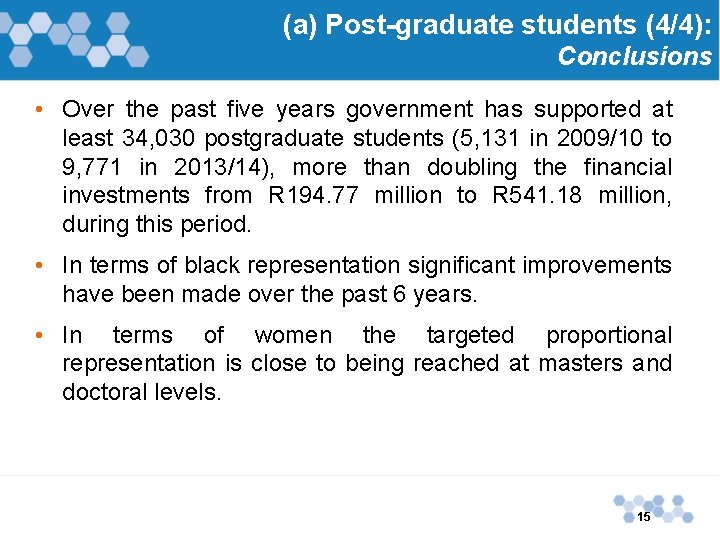
(a) Post-graduate students (4/4): Conclusions • Over the past five years government has supported at least 34, 030 postgraduate students (5, 131 in 2009/10 to 9, 771 in 2013/14), more than doubling the financial investments from R 194. 77 million to R 541. 18 million, during this period. • In terms of black representation significant improvements have been made over the past 6 years. • In terms of women the targeted proportional representation is close to being reached at masters and doctoral levels. 15
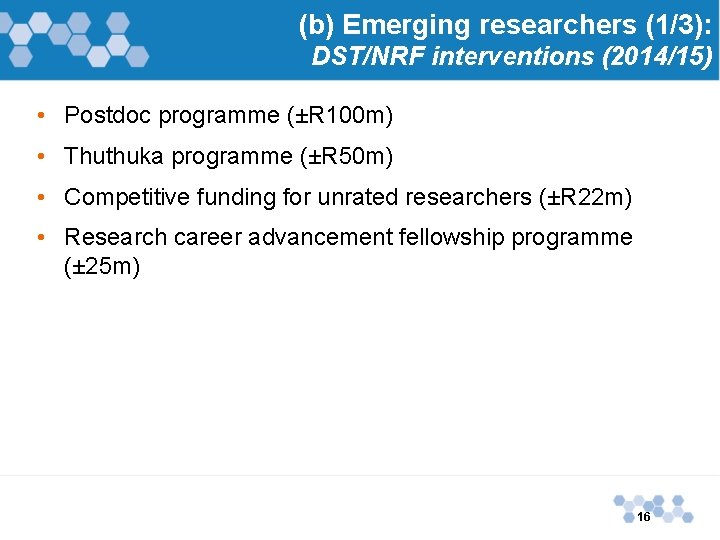
(b) Emerging researchers (1/3): DST/NRF interventions (2014/15) • Postdoc programme (±R 100 m) • Thuthuka programme (±R 50 m) • Competitive funding for unrated researchers (±R 22 m) • Research career advancement fellowship programme (± 25 m) 16
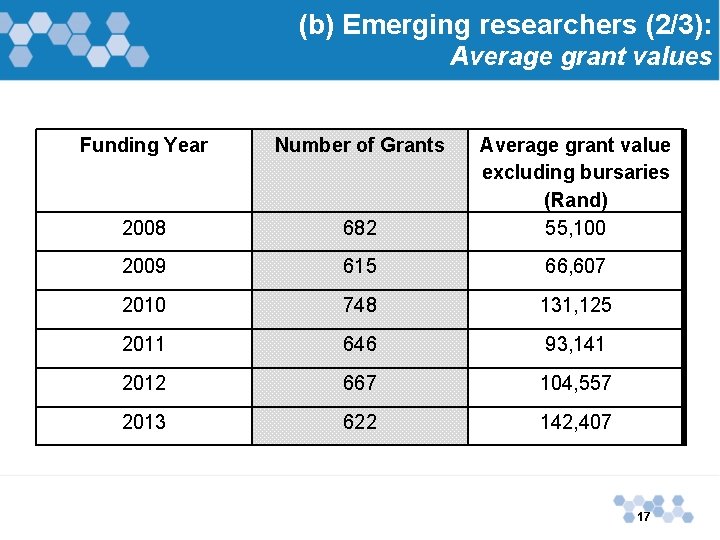
(b) Emerging researchers (2/3): Average grant values Funding Year Number of Grants 2008 682 Average grant value excluding bursaries (Rand) 55, 100 2009 615 66, 607 2010 748 131, 125 2011 646 93, 141 2012 667 104, 557 2013 622 142, 407 17
(b) Emerging researchers (3/3): Conclusions • While significant investments were made in this category by the DST, it has not led to significant growth in numbers of supported researchers, but in the growth of average grant. • A significant majority of early career academics remain dormant with respect to research. • In terms of equity, consistent growths have been in the proportion of white women, while proportional representation for blacks and black women fluctuates. • Careful implementation of these programmes is necessary to improve black (particularly black women) participation. 18
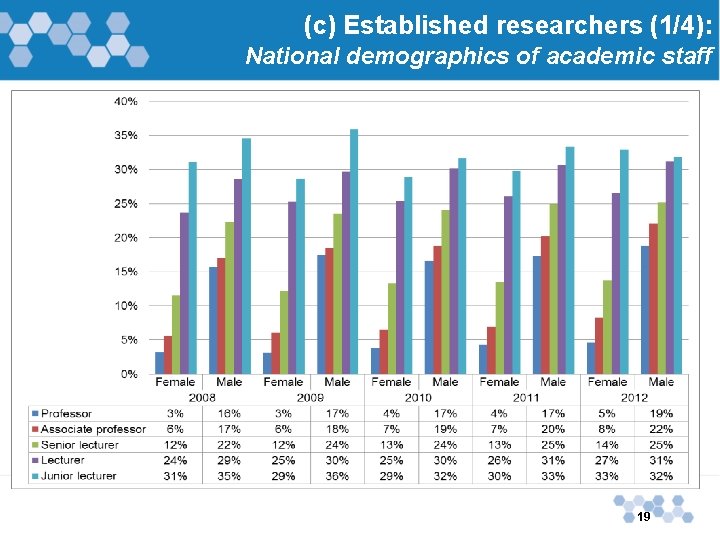
(c) Established researchers (1/4): National demographics of academic staff 19
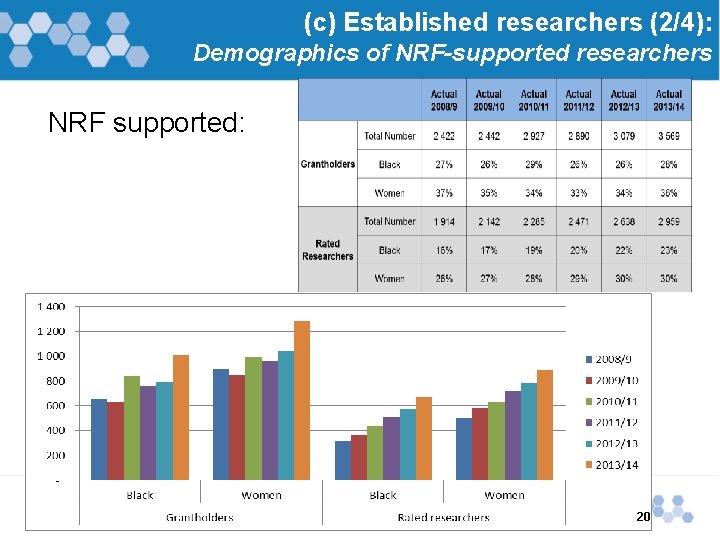
(c) Established researchers (2/4): Demographics of NRF-supported researchers ): NRF supported: 20
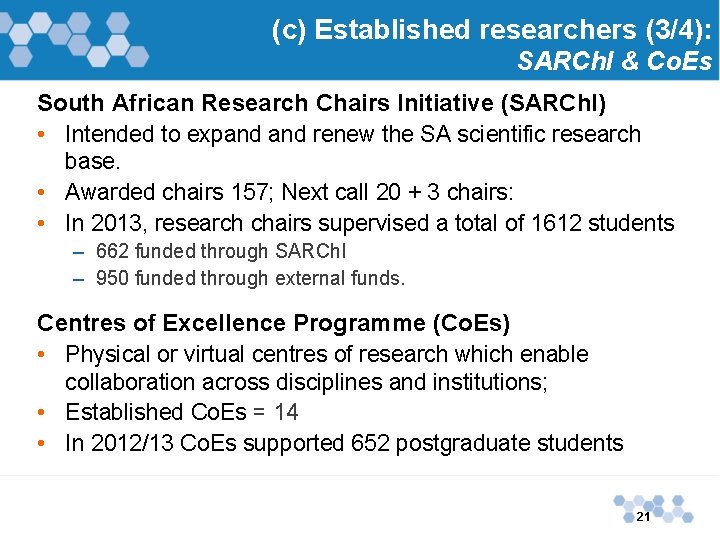
(c) Established researchers (3/4): SARCh. I & Co. Es South African Research Chairs Initiative (SARCh. I) • Intended to expand renew the SA scientific research base. • Awarded chairs 157; Next call 20 + 3 chairs: • In 2013, research chairs supervised a total of 1612 students – 662 funded through SARCh. I – 950 funded through external funds. Centres of Excellence Programme (Co. Es) • Physical or virtual centres of research which enable collaboration across disciplines and institutions; • Established Co. Es = 14 • In 2012/13 Co. Es supported 652 postgraduate students 21

(c) Established researchers (4/4): Conclusions • The DST interventions (Co. Es and SARCh. I) are yielding results in terms of the expansion of the supervisory capacity of the science system. • A number of organisations are sponsoring chairs outside the DST/NRF system and universities are adding full professors trying to emulate the SARCh. I example. • The initiatives are gradually succeeding in improving the race and gender inequity among the students supervised. • Additional investments in these initiatives would be essential to further expand the system while concomitantly improving student representation. 22
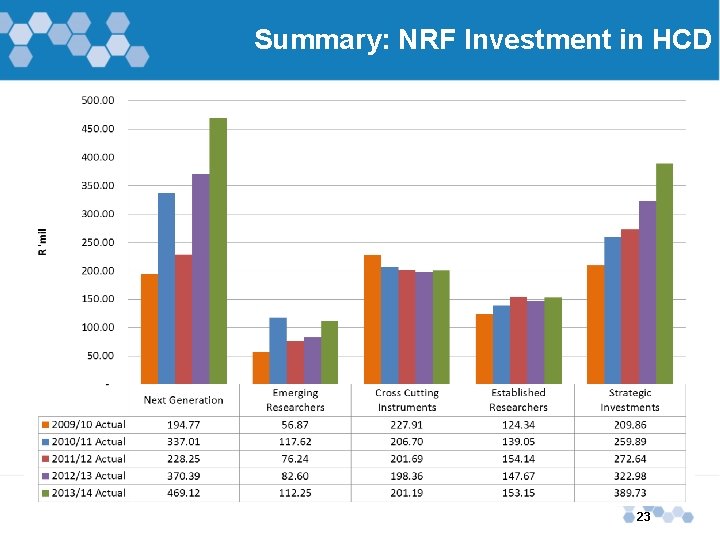
Summary: NRF Investment in HCD 23
Established researcher level Next-generation level Sector-specific HCD Interventions Emerging researcher level Science Promotion 24
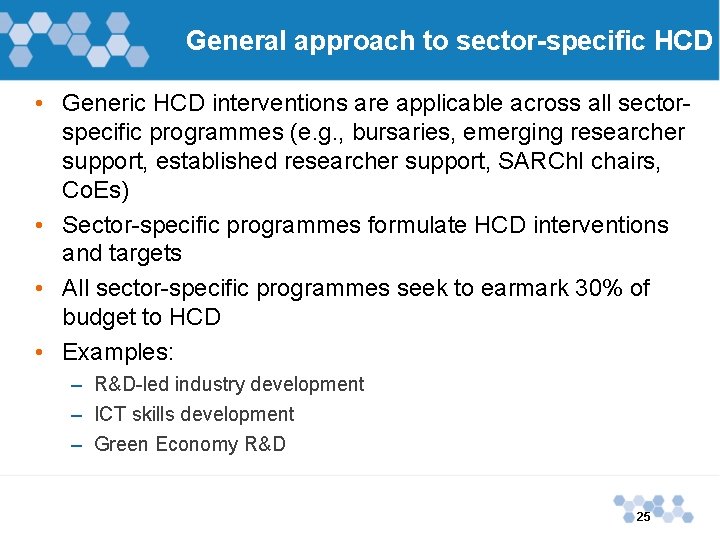
General approach to sector-specific HCD • Generic HCD interventions are applicable across all sectorspecific programmes (e. g. , bursaries, emerging researcher support, established researcher support, SARCh. I chairs, Co. Es) • Sector-specific programmes formulate HCD interventions and targets • All sector-specific programmes seek to earmark 30% of budget to HCD • Examples: – R&D-led industry development – ICT skills development – Green Economy R&D 25
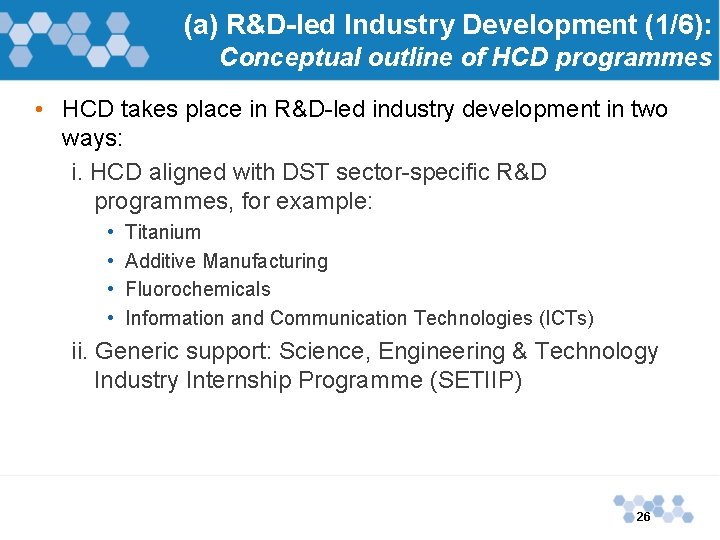
(a) R&D-led Industry Development (1/6): Conceptual outline of HCD programmes • HCD takes place in R&D-led industry development in two ways: i. HCD aligned with DST sector-specific R&D programmes, for example: • • Titanium Additive Manufacturing Fluorochemicals Information and Communication Technologies (ICTs) ii. Generic support: Science, Engineering & Technology Industry Internship Programme (SETIIP) 26
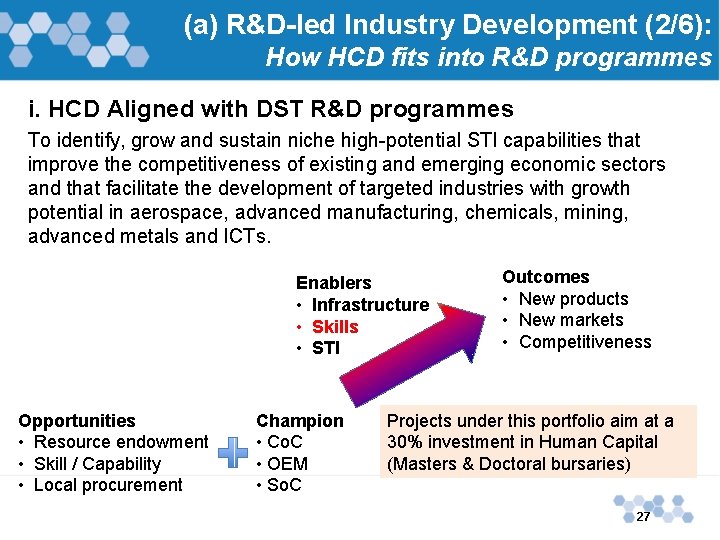
(a) R&D-led Industry Development (2/6): How HCD fits into R&D programmes i. HCD Aligned with DST R&D programmes To identify, grow and sustain niche high-potential STI capabilities that improve the competitiveness of existing and emerging economic sectors and that facilitate the development of targeted industries with growth potential in aerospace, advanced manufacturing, chemicals, mining, advanced metals and ICTs. Enablers • Infrastructure • Skills • STI Opportunities • Resource endowment • Skill / Capability • Local procurement Champion • Co. C • OEM • So. C Outcomes • New products • New markets • Competitiveness Projects under this portfolio aim at a 30% investment in Human Capital (Masters & Doctoral bursaries) 27
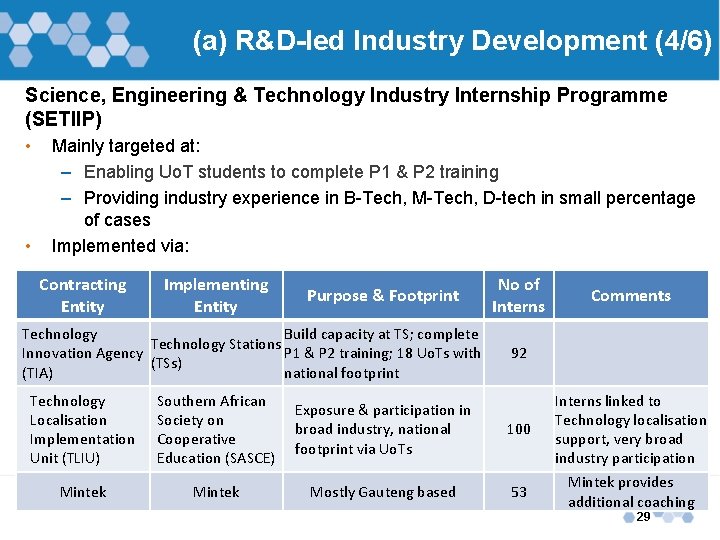
(a) R&D-led Industry Development (4/6) Science, Engineering & Technology Industry Internship Programme (SETIIP) • • Mainly targeted at: – Enabling Uo. T students to complete P 1 & P 2 training – Providing industry experience in B-Tech, M-Tech, D-tech in small percentage of cases Implemented via: Contracting Entity Implementing Entity Purpose & Footprint Technology Build capacity at TS; complete Technology Stations Innovation Agency P 1 & P 2 training; 18 Uo. Ts with (TSs) (TIA) national footprint No of Interns Comments 92 Technology Localisation Implementation Unit (TLIU) Southern African Society on Cooperative Education (SASCE) Exposure & participation in broad industry, national footprint via Uo. Ts 100 Interns linked to Technology localisation support, very broad industry participation Mintek Mostly Gauteng based 53 Mintek provides additional coaching 29
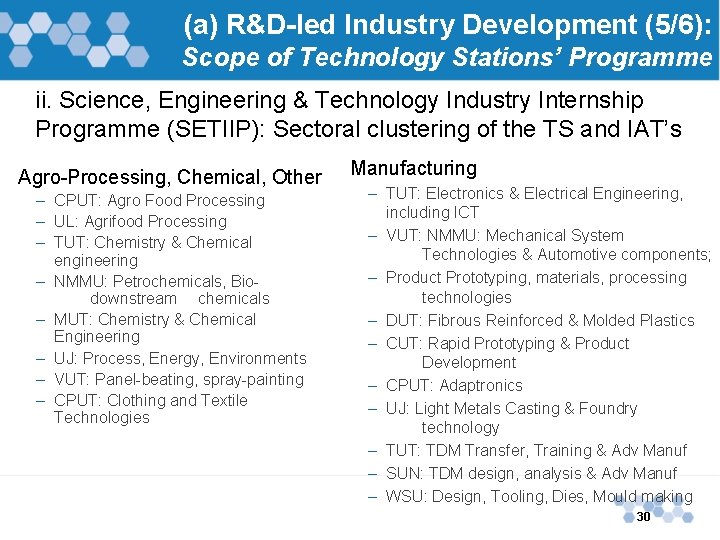
(a) R&D-led Industry Development (5/6): Scope of Technology Stations’ Programme ii. Science, Engineering & Technology Industry Internship Programme (SETIIP): Sectoral clustering of the TS and IAT’s Agro-Processing, Chemical, Other – CPUT: Agro Food Processing – UL: Agrifood Processing – TUT: Chemistry & Chemical engineering – NMMU: Petrochemicals, Biodownstream chemicals – MUT: Chemistry & Chemical Engineering – UJ: Process, Energy, Environments – VUT: Panel-beating, spray-painting – CPUT: Clothing and Textile Technologies Manufacturing – TUT: Electronics & Electrical Engineering, including ICT – VUT: NMMU: Mechanical System Technologies & Automotive components; – Product Prototyping, materials, processing technologies – DUT: Fibrous Reinforced & Molded Plastics – CUT: Rapid Prototyping & Product Development – CPUT: Adaptronics – UJ: Light Metals Casting & Foundry technology – TUT: TDM Transfer, Training & Adv Manuf – SUN: TDM design, analysis & Adv Manuf – WSU: Design, Tooling, Dies, Mould making 30
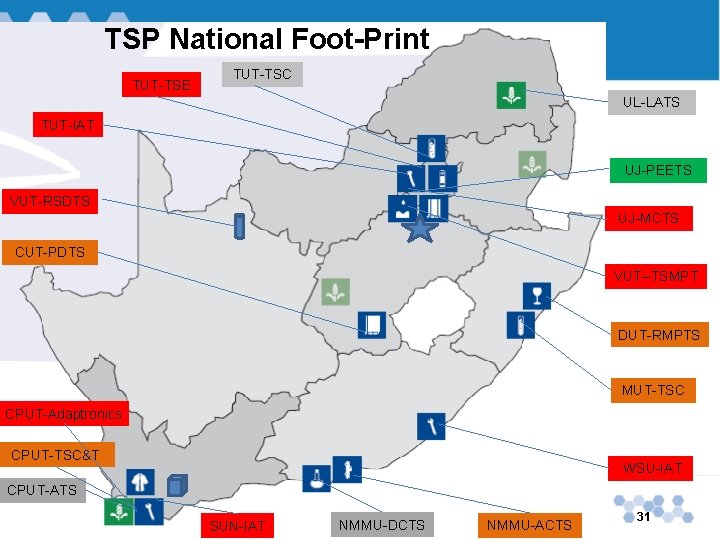
TSP National Foot-Print TUT-TSE TUT-TSC UL-LATS TUT-IAT UJ-PEETS VUT-RSDTS UJ-MCTS CUT-PDTS VUT--TSMPT DUT-RMPTS MUT-TSC CPUT-Adaptronics CPUT-TSC&T WSU-IAT CPUT-ATS SUN-IAT NMMU-DCTS NMMU-ACTS 31
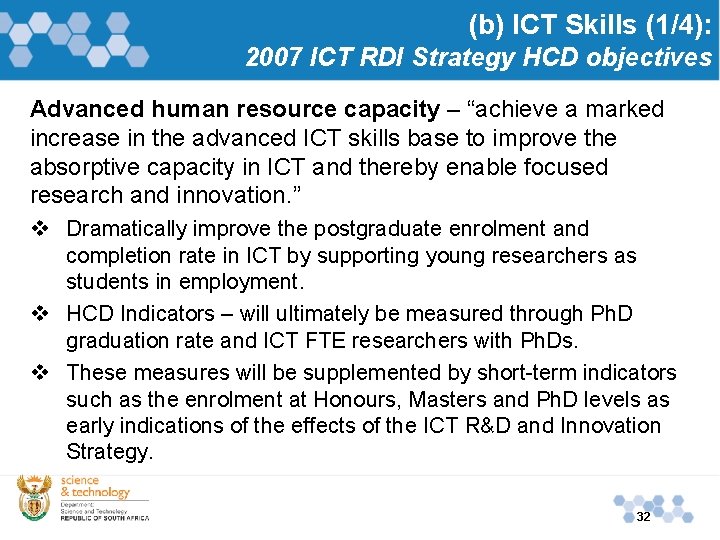
(b) ICT Skills (1/4): 2007 ICT RDI Strategy HCD objectives Advanced human resource capacity – “achieve a marked increase in the advanced ICT skills base to improve the absorptive capacity in ICT and thereby enable focused research and innovation. ” v Dramatically improve the postgraduate enrolment and completion rate in ICT by supporting young researchers as students in employment. v HCD Indicators – will ultimately be measured through Ph. D graduation rate and ICT FTE researchers with Ph. Ds. v These measures will be supplemented by short-term indicators such as the enrolment at Honours, Masters and Ph. D levels as early indications of the effects of the ICT R&D and Innovation Strategy. Presentation 32
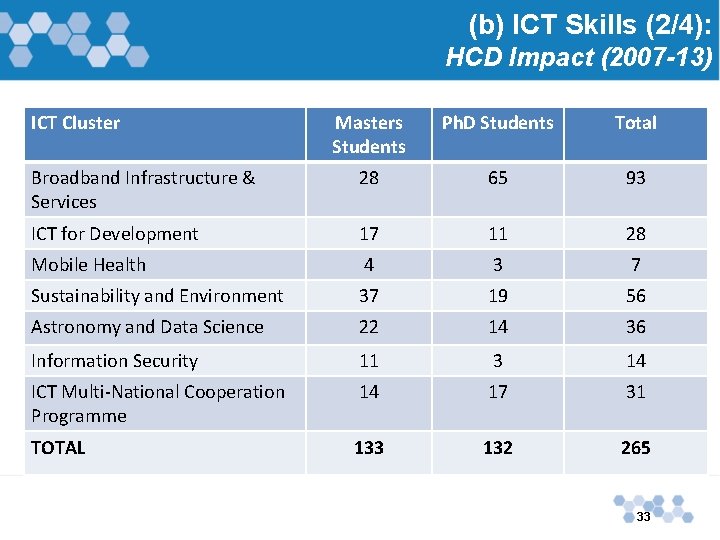
(b) ICT Skills (2/4): HCD Impact (2007 -13) ICT Cluster Masters Students Ph. D Students Total Broadband Infrastructure & Services 28 65 93 ICT for Development 17 11 28 Mobile Health 4 3 7 Sustainability and Environment 37 19 56 Astronomy and Data Science 22 14 36 Information Security 11 3 14 ICT Multi-National Cooperation Programme 14 17 31 TOTAL 133 132 265 33
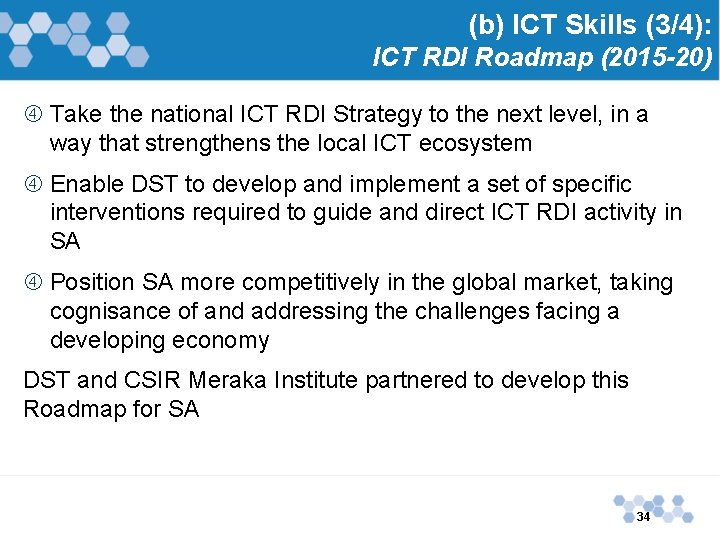
(b) ICT Skills (3/4): ICT RDI Roadmap (2015 -20) Take the national ICT RDI Strategy to the next level, in a way that strengthens the local ICT ecosystem Enable DST to develop and implement a set of specific interventions required to guide and direct ICT RDI activity in SA Position SA more competitively in the global market, taking cognisance of and addressing the challenges facing a developing economy DST and CSIR Meraka Institute partnered to develop this Roadmap for SA 34
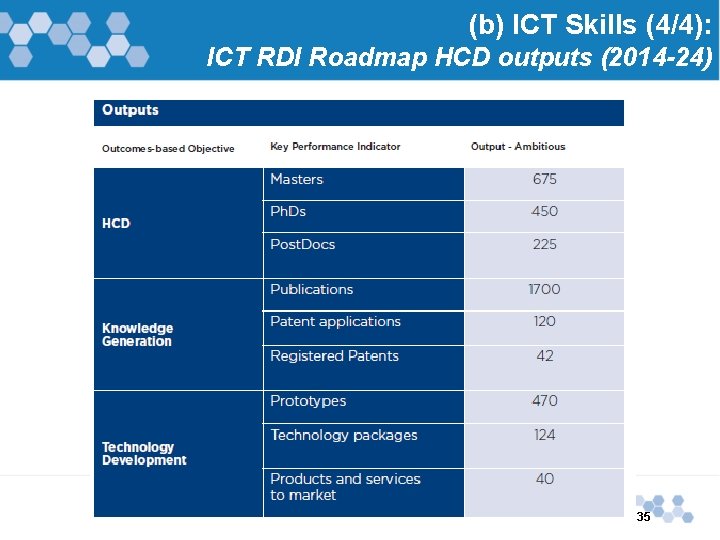
(b) ICT Skills (4/4): ICT RDI Roadmap HCD outputs (2014 -24) 35
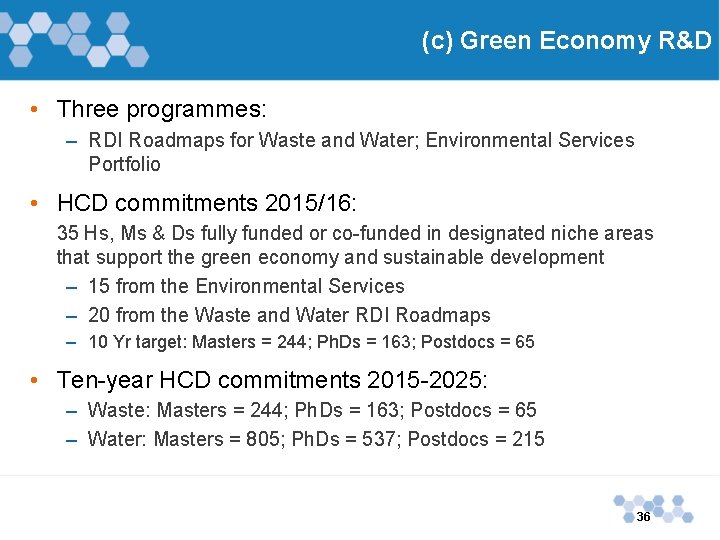
(c) Green Economy R&D • Three programmes: – RDI Roadmaps for Waste and Water; Environmental Services Portfolio • HCD commitments 2015/16: 35 Hs, Ms & Ds fully funded or co-funded in designated niche areas that support the green economy and sustainable development – 15 from the Environmental Services – 20 from the Waste and Water RDI Roadmaps – 10 Yr target: Masters = 244; Ph. Ds = 163; Postdocs = 65 • Ten-year HCD commitments 2015 -2025: – Waste: Masters = 244; Ph. Ds = 163; Postdocs = 65 – Water: Masters = 805; Ph. Ds = 537; Postdocs = 215 36
Science promotion & engagement (1/6): School-level interventions (2014 -19) • In February 2014, the DST adopted the “Framework for the DST’s activities in support of basic education” (2014 -2019). • The Framework supports basic education through: – Promotion of public engagement with science – Enhancing effective teaching and learning environment through technology and educational research • The science engagement programme comprises established portfolio of activities, which in many ways: an – complement the objective of the National Strategy for Mathematics, Science and Technology Education; and – generally contribute to teaching and learning of mathematics and science. 37
Science promotion & engagement (2/6): National Science Week (NSW) • Contributing to increased learners’ participation in mathematics and science – Activities like the annual NSW, science festivals and science centre-based science awareness exhibits stimulate learners’ interest in mathematics and science, which enhances the DBE’s intentions to increase learners’ participation in these learning areas. – Up to 70% of about 700, 000 participants in the NSW and festivals were learners, mainly in the FET band. – Up to 65% of the 1. 6 million visitors to science centres in 2013 were learners (GET and FET combined). 38
Science promotion & engagement (3/6): Science Centres • Science centre-based support – In addition to pure science awareness exhibits, science centres have hands-on exhibits that are linked to curriculum concepts across grades. – Of the 33 science centres supported by the DST: • 27% have fully equipped science laboratories, assisting learners from under-resourced schools with experiments. • 42% have mobile laboratories, conducting scheduled school visits to assist with experiments. • 12% collaborated with their provincial departments of Education in the delivery of teacher in-service training in the 2013 academic year. • Up to 90% annually conduct supplementary tuition and/or exam preparatory sessions in Mathematics and Physical Science. 39
Science promotion & engagement (4/6) STEMI Olympiads and competitions – STEMI Olympiads and related competitions create an opportunity for learners to apply and refine knowledge gained from formal classroom learning and teaching. – The DST supports 8 STEMI Olympiads and related competitions, which collectively contributed to 28% of the just above 1 million people who participated in the DST-supported science engagement programme in the 2013/14 financial year. SET career awareness – DST campaign on SET careers include profiling mathematics and science teaching. • 10, 000 copies of SET career booklet to be distributed in the 2014/15 financial year. • First SET career workshop on the SET career booklet involving about 60 subject advisers of Limpopo happening during the NSW 2014 in Limpopo. 40
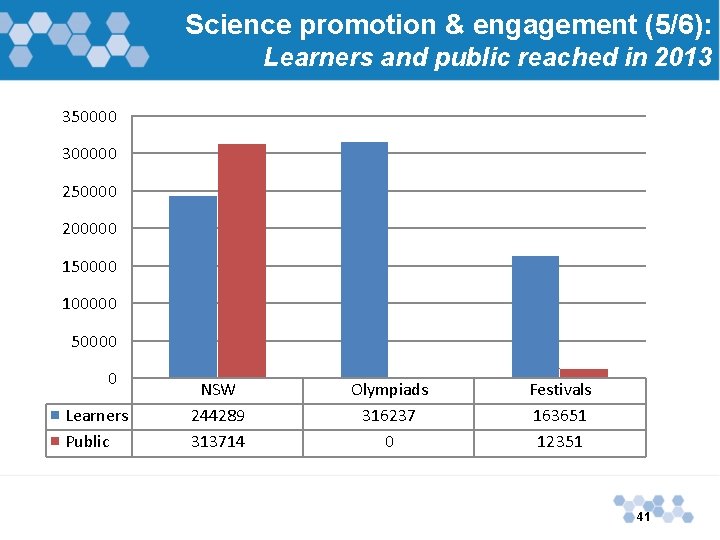
Science promotion & engagement (5/6): Learners and public reached in 2013 350000 300000 250000 200000 150000 100000 50000 0 Learners Public NSW 244289 313714 Olympiads 316237 0 Festivals 163651 12351 41
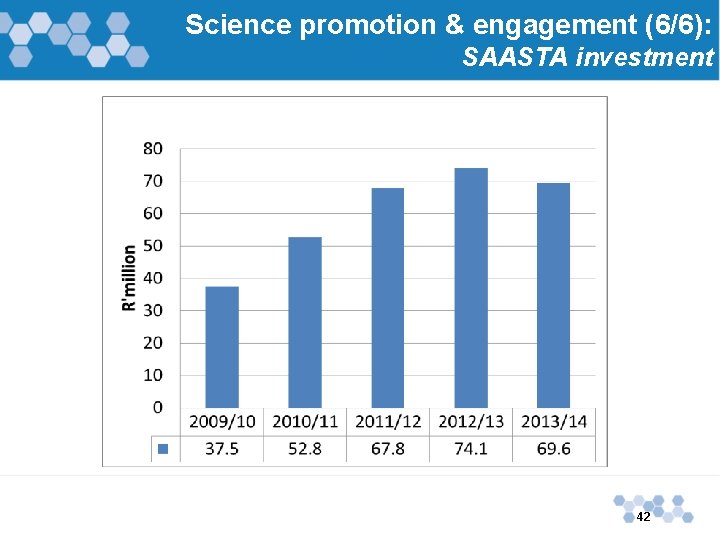
Science promotion & engagement (6/6): SAASTA investment 42
Conclusions • The system is growing and transforming in terms of human capital. However, . . . • More funds will be invested in the post-graduate category, but tighter monitoring of demographics and completion rates will be essential (the demographic drop-off) • Graduated Ph. Ds need to be tracked to establish level of retention in system. • Academics must become more research-active as emerging researchers (the silent majority). • More resources are required to grow the established researcher initiatives and increase the values of average grants. • NDP targets require significant ramping up in level of investment. 43
Dankie Enkosi Ha khensa Re a leboga Ro livhuwa Siyabonga Siyathokoza Thank you 44
- Slides: 43